
Section 121 Exclusion Rules and Documentation
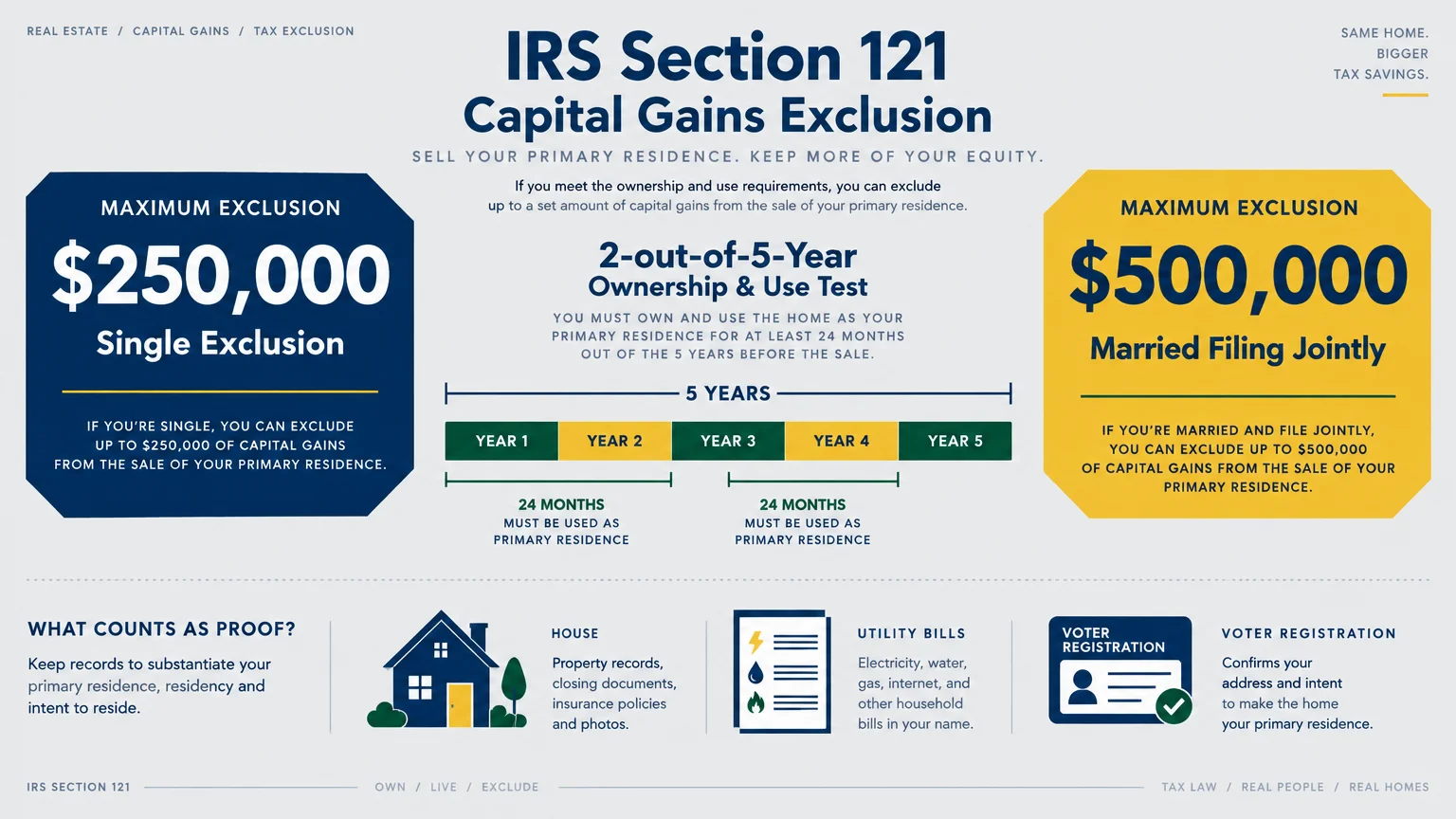
The Section 121 exclusion offers substantial relief from capital gains taxes when you sell a principal residence. Single filers can exclude up to $250,000 in capital gain, while married couples filing jointly can exclude $500,000.
To qualify, you must pass the two-out-of-five-year ownership and use tests under Internal Revenue Code Section 121. Educational guides on Kiplinger provide detailed breakdowns of these residency rules.
Never assume the exclusion eliminates your need to retain home ownership tax records. Long-term property appreciation across two or three decades frequently pushes net profits well beyond the statutory exclusion amounts.
If a married couple sells a home for an $800,000 gross gain, they must prove at least $300,000 in capital improvements to avoid paying taxes on the excess gain.
Special provisions protect surviving spouses under Internal Revenue Code Section 121(b)(4). A surviving spouse who has not remarried can claim the full $500,000 exclusion if selling within two years of their spouse’s death.
Surviving spouses must retain death certificates and historical deeds proving both spouses satisfied ownership and residency tests before the death occurred. These files guarantee your claim to the higher exclusion limit.








To many pop ups this website is tooooo difficult to read!
How long do you have to keep tax returns and accompanying documents if you DON’T own a home?