
Retired in America

Your Guide to a Confident Retirement

  • Home
  • Personal finance
  • Retirement Life
  • Saving & Spending

Update: Social Security Is Changing How Millions Get Paid – Here’s What to Know

June 10, 2026 · Retirement Life

Your Social Security payment schedule dictates your monthly household budget, and missing a deposit date can create unnecessary financial stress. The Social Security Administration relies on a strict calendar to disburse benefits to more than 70 million Americans, but weekend shifts, federal holidays, and specific benefit types frequently alter when your money actually arrives. Understanding how these timing rules work—especially when holiday shifts create double-payment months or push deposits forward—protects you from bounced checks and delayed bill payments. This guide breaks down the precise rules governing your deposit dates, how to navigate recent security updates to your online portal, and the exact steps you need to take if a payment fails to arrive on time.
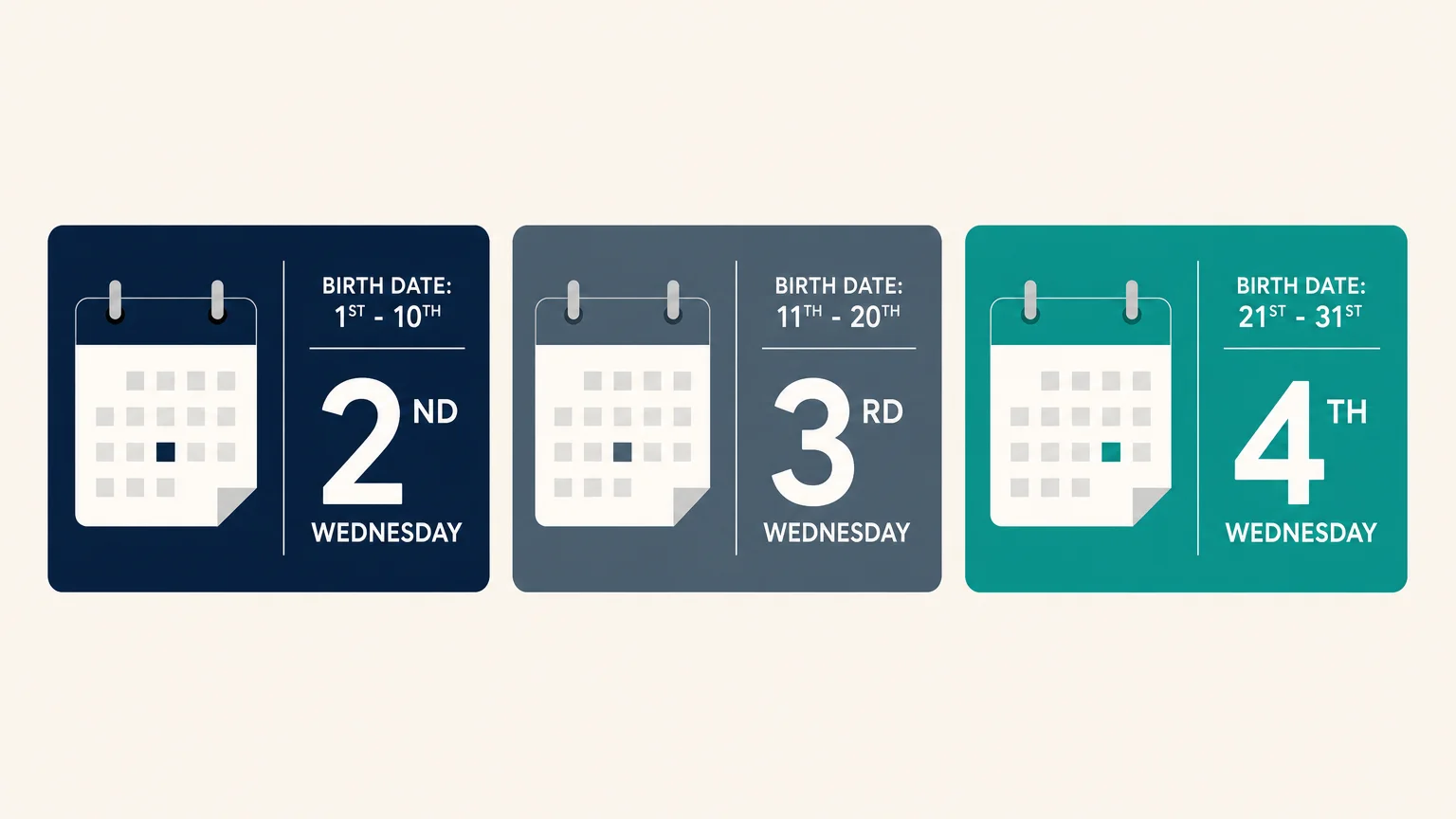
Table of Contents

  • How the Social Security Administration Sets Your Payment Date
  • The Exceptions: Who Gets Paid on the 1st and 3rd?
  • Holiday and Weekend Shifts: Navigating Early Deposits
  • The Digital Security Update: Protecting Your Payment Portal
  • Understanding Direct Deposit and Bank Processing Times
  • How Medicare Premiums Affect Your Net Deposit
  • Tax Withholding: Taking Control of Your Final Payout
  • What Can Go Wrong
  • When to Consult a Professional
  • Frequently Asked Questions
Infographic showing Social Security payment dates based on birth date ranges: 1st-10th, 11th-20th, and 21st-31st.
Three calendar icons show how your birth date determines which Wednesday you receive your monthly payment.

How the Social Security Administration Sets Your Payment Date

For decades, the federal government attempted to issue every single benefit check on the third day of the month. As the population of retirees and disabled workers surged, this single-day distribution model created severe administrative bottlenecks; processing tens of millions of financial transactions in a 24-hour window strained the Federal Reserve banking system and routinely overwhelmed government customer service call centers.

To resolve this logistical nightmare, the government completely overhauled the distribution system in May 1997. If you began claiming benefits after this date, your monthly deposit is strategically staggered across the month based on the day you were born. Rather than dumping all funds simultaneously, the Social Security Administration disperses the massive banking load across three distinct Wednesdays.

Your specific processing day is permanently tethered to the date of your birth. This system applies uniformly to standard retirement benefits, Social Security Disability Insurance (SSDI), and survivor benefits. Here is exactly how the modern payment calendar divides beneficiaries:

Your Birth Date Your Payment Day
1st through the 10th of the month Second Wednesday of every month
11th through the 20th of the month Third Wednesday of every month
21st through the 31st of the month Fourth Wednesday of every month

Consider a practical example to understand how rigidly this system operates. If you were born on August 15th, your payment will always arrive on the third Wednesday of the month. If you were born on March 2nd, you are permanently assigned to the second Wednesday. It does not matter what month of the year it currently is; your assigned Wednesday remains your designated payday.

There is one crucial nuance regarding family benefits: if you receive benefits based on someone else’s work record—such as spousal benefits or survivor benefits—your payout date is entirely dictated by the primary earner’s birth date. If your spouse was born on the 5th, but you were born on the 25th, your spousal benefit will arrive on the second Wednesday of the month to align with your spouse’s record, completely ignoring your own birthday.


Close-up of a person's hands checking a mobile bank deposit notification on a smartphone.
An older man checks his smartphone for a direct deposit notification while sitting at a kitchen counter.

The Exceptions: Who Gets Paid on the 1st and 3rd?

While the Wednesday rotation system handles the vast majority of modern beneficiaries, millions of Americans fall under specialized categories that exempt them from the standard calendar. If you fall into one of these specific groups, your money is disbursed at the very beginning of the month.

Supplemental Security Income (SSI) Recipients: The SSI program provides critical financial assistance to disabled adults, children, and older adults who possess extremely limited income and financial resources. Because this program acts as a fundamental safety net for basic survival needs, the government expedites these payments. SSI benefits are uniformly scheduled for the 1st of every month, regardless of your birth date.

Pre-1997 Beneficiaries: When the government transitioned to the staggered Wednesday system in May 1997, they chose not to disrupt the financial routines of millions of older Americans who had already spent years budgeting around a single date. If you began receiving Social Security benefits prior to May 1997, you are permanently grandfathered into the legacy system; your benefits arrive on the 3rd of the month.

Concurrent Beneficiaries: Many Americans qualify for both standard Social Security (such as SSDI or retirement) and Supplemental Security Income simultaneously. If you receive dual benefits, your payment schedule is split to prevent system errors. Your SSI payment arrives on the 1st of the month, and your standard Social Security payment arrives on the 3rd of the month.

International Residents: If you reside outside of the United States, managing international wire transfers and foreign banking systems introduces significant complexity. To streamline international distribution, the government exempts overseas beneficiaries from the Wednesday system and issues their payments on the 3rd of the month.

Diagram showing a payment moving from a holiday Wednesday to the preceding Tuesday.
This payment timeline illustrates how federal holidays shift your deposit to an earlier date on the calendar.

Holiday and Weekend Shifts: Navigating Early Deposits

The Treasury Department, which physically issues the electronic transfers on behalf of the Social Security Administration, does not process payments on weekends or federal holidays. This banking reality creates a rolling series of calendar shifts that frequently catch beneficiaries off guard.

The cardinal rule of federal benefit distribution is simple: if your scheduled payment date falls on a Saturday, Sunday, or federal holiday, your money is advanced to the closest preceding business day. The government will never penalize you by making you wait until after a weekend to receive your funds.

This rule profoundly impacts Supplemental Security Income recipients. Because SSI is rigidly tied to the 1st of the month, the calendar frequently forces early payments. When the 1st lands on a Saturday or Sunday, the deposit is pushed backward into the previous month. This creates a highly confusing calendar phenomenon where beneficiaries receive two distinct payments in a single calendar month, followed by a “ghost month” where no payments are scheduled.

For example, if August 1st lands on a Saturday, your August payment is disbursed on Friday, July 31st. Because you already received your standard July payment on July 1st, your bank statement will show two deposits in July. Consequently, August will pass without a scheduled payment. This is not a stimulus check, a bonus, or an administrative error—it is simply a calendar adjustment.

Budgeting through these shifts requires immense discipline. When a payment arrives early, you must actively preserve those funds to cover the upcoming month’s expenses. The gap between an early payment and the subsequent month’s payment can sometimes stretch to 33 or 34 days, making tight household budgeting essential.

“A successful retirement isn’t just about accumulating assets; it’s about managing a predictable cash flow that supports your life’s purpose.” — Mitch Anthony, Retirement Expert

Conceptual illustration of a padlock shaped like a computer mouse on a blue background.
A gold padlock computer mouse with a cord spelling secure illustrates the need for digital payment protection.

The Digital Security Update: Protecting Your Payment Portal

Monitoring your payment schedule, updating your bank account information, and viewing your annual tax documents all require access to the government’s official online portal. In a sweeping move to combat rampant identity theft and sophisticated financial fraud, the Social Security Administration recently overhauled how Americans access their online accounts.

Historically, beneficiaries logged in using proprietary usernames and passwords created directly on the SSA website. However, these legacy accounts lacked modern security protocols, making them vulnerable to cybercriminals who sought to hijack accounts and maliciously reroute direct deposits to fraudulent bank accounts.

To eliminate these vulnerabilities, the government mandated a complete transition away from legacy credentials. Today, you must access your portal through one of two federally approved, third-party authentication services: Login.gov or ID.me. These platforms enforce rigorous identity verification standards and require multi-factor authentication (MFA)—meaning you must verify your identity using a secondary method, such as a text message code or an authenticator app, every single time you log in.

If you have not yet updated your account, you must complete this transition to maintain access to your payment controls. The process is straightforward but requires specific documentation:

  1. Navigate directly to the Social Security Administration official website. Never click on links sent via unexpected emails or text messages, as these are common phishing tactics.
  2. Select the “Sign In” option. You will be prompted to create a new Login.gov or ID.me account.
  3. Provide a valid email address and establish a secure, unique password.
  4. Verify your identity by providing your state-issued driver’s license, your Social Security number, and in some cases, a live facial scan if using ID.me.
  5. Set up multi-factor authentication by linking your mobile phone number.

Once authenticated, your previous portal history will automatically link to your new secure login, ensuring uninterrupted access to your payment schedule and direct deposit settings.

Flowchart showing the path of a Social Security payment from the SSA through the Federal Reserve to a personal bank.
Follow the path of Social Security payments from distribution through the Federal Reserve to your bank account.

Understanding Direct Deposit and Bank Processing Times

The era of waiting by the mailbox for a paper check has officially ended. In 2013, the Treasury Department enacted a strict mandate requiring all federal benefit payments to be distributed electronically. Unless you qualify for an exceedingly rare waiver due to severe geographic isolation or a documented mental impairment, your money must be delivered digitally.

Electronic distribution relies on the Automated Clearing House (ACH) network. The Treasury submits the payment files to the Federal Reserve days in advance of your official payday. The Federal Reserve then routes these instructions to your specific financial institution. How quickly those funds become available to spend depends entirely on your bank’s internal policies.

Many modern banks and credit unions now offer “early direct deposit” features. Because the government transmits the pending deposit notification several days before the official Wednesday payday, institutions with this feature will release the funds into your account the moment they receive the notification. If you utilize a bank with early direct deposit, you might consistently see your money arrive on a Monday or Tuesday rather than your scheduled Wednesday.

For Americans who do not utilize traditional banking institutions, the government provides the Direct Express debit card program. Managed by Comerica Bank, this prepaid Mastercard automatically receives your monthly benefit balance. While convenient for unbanked individuals, the Direct Express card carries specific limitations. You must carefully monitor your balance, and while standard domestic purchases are fee-free, you may incur charges for out-of-network ATM withdrawals, international transactions, or replacing lost cards.

Bar chart showing a Medicare premium being deducted from a gross Social Security benefit to leave the net deposit.
This chart shows how Medicare Part B premiums are deducted from your gross monthly benefit amount.

How Medicare Premiums Affect Your Net Deposit

One of the most common sources of confusion for new retirees is the discrepancy between their official award letter and the actual amount deposited into their bank account. Your official benefit amount—often referred to as your gross benefit—is rarely the exact dollar figure that you receive. For the vast majority of beneficiaries, healthcare premiums are siphoned off before the money ever leaves the Treasury.

If you are enrolled in Medicare, your Part B premium (which covers outpatient services, doctor visits, and durable medical equipment) is automatically deducted from your monthly Social Security payment. You do not write a separate check to Medicare.gov; the coordination is handled seamlessly between the two agencies.

Your exact deduction depends entirely on your lifetime earnings and your current income bracket. Most Americans pay the standard Part B premium. However, if your modified adjusted gross income from two years prior exceeds specific IRS thresholds, you will be subject to the Income-Related Monthly Adjustment Amount (IRMAA). This surcharge can significantly reduce your net monthly deposit, and it recalculates annually based on your latest tax returns.

Fortunately, the government enforces a consumer protection mechanism known as the “Hold Harmless” provision. This law dictates that an increase in your Medicare Part B premium cannot reduce your net Social Security benefit below what it was the previous year. If the annual cost-of-living adjustment (COLA) applied to your Social Security benefit is extremely low, and the Medicare premium increase is exceptionally high, the government will cap your Medicare premium increase to ensure your actual take-home pay does not shrink.

“Social Security is the defining foundation of your retirement plan. You must treat it with absolute respect and protect your accounts fiercely.” — Suze Orman, Personal Finance Expert

Close-up of a Social Security tax withholding form with a pen and glasses on a wooden desk.
A pair of glasses and a fountain pen rest on a voluntary tax withholding form for retirees.

Tax Withholding: Taking Control of Your Final Payout

A shocking revelation for many retirees is discovering that their Social Security benefits may be subject to federal income taxation. Unlike standard employment income, taxes are not automatically withheld from your monthly benefit. If you do not proactively manage this liability, you may face substantial tax bills and underpayment penalties when you file your annual returns.

The Internal Revenue Service (IRS) utilizes a specific formula known as “Provisional Income” to determine how much of your benefit is taxable. Provisional income is calculated by adding your Adjusted Gross Income (AGI), any nontaxable interest (such as municipal bond yields), and exactly 50% of your total Social Security benefits.

Understanding how this formula applies requires looking at distinct taxpayer scenarios:

  • The Sole-Income Retiree: If you are a single filer whose only source of income is a $20,000 annual Social Security benefit, your provisional income is just $10,000 (half of the benefit). Because this falls well below the IRS threshold of $25,000, absolutely none of your Social Security benefit is taxed.
  • The Middle-Income Filer: If you are a single filer drawing $18,000 from Social Security and pulling $20,000 from a traditional IRA, your provisional income is $29,000. Because this falls between $25,000 and $34,000, up to 50% of your Social Security benefits may be subject to federal income tax.
  • The High-Income Couple: If you are married filing jointly with $40,000 in combined Social Security benefits, a $30,000 pension, and $20,000 in part-time wages, your provisional income is $70,000. Because this far exceeds the $44,000 threshold for married couples, up to 85% of your Social Security benefits will be taxed at your standard income tax rate.

To avoid a massive tax bill in April, you have the right to request voluntary tax withholding directly from your monthly payment. You accomplish this by completing IRS Form W-4V (Voluntary Withholding Request) and mailing it to your local Social Security office. You cannot choose arbitrary dollar amounts; the law requires you to select a flat withholding rate of 7%, 10%, 12%, or 22%. By strategically matching this percentage to your estimated tax liability, you effectively smooth out your tax burden across the entire calendar year.

Watercolor illustration of a man looking into an empty mailbox with a confused expression.
A concerned man stares at an empty mailbox while checking his phone for a missing payment.

What Can Go Wrong

Even a highly automated system processing 70 million payments monthly encounters friction. Knowing how to react when the system fails protects your household liquidity and prevents cascading financial consequences.

The “Dead Zone” of Switching Bank Accounts

The most common cause of a missing payment is an improperly executed bank account transition. When you update your direct deposit information online, the change takes significant time to propagate through the Treasury’s systems. If you close your old bank account before the first payment successfully lands in your new account, the Treasury will attempt to deposit funds into a closed account. The bank will immediately reject the transfer, bouncing the money back to the government. This automatically triggers a fraud-prevention freeze on your Social Security record, suspending all future payments until you verify your identity and submit valid routing information. Always leave your old checking account open until you visually confirm the first Social Security deposit has cleared in your new account.

Resolving a Missing or Delayed Payment

If your assigned Wednesday arrives and your account balance remains unchanged, do not immediately panic. The Social Security Administration enforces a strict “three-day mailing rule.” You must wait exactly three full business days after your scheduled payment date before initiating an inquiry. Brief delays frequently occur due to localized banking outages or Federal Reserve routing issues. If the money has not appeared after three business days, call the national SSA hotline or visit your local field office. Representatives can trace the ACH tracking number to determine exactly where the funds stalled.

Navigating Overpayment Notices

Occasionally, the government will calculate your benefit incorrectly and pay you more than you are legally entitled to receive. When the system eventually audits the discrepancy—sometimes years later—they will issue an overpayment notice demanding immediate restitution. Historically, the SSA would forcefully withhold 100% of your monthly benefit until the debt was satisfied, plunging seniors into immediate poverty. Recent administrative reforms have curtailed this aggressive tactic; the agency now caps automatic clawbacks at a much smaller percentage of your monthly check, ensuring you retain enough income to survive while the debt is resolved. You also maintain the explicit right to file an appeal or request a waiver if repaying the money would defeat the purpose of the benefit program.

The Final Payment After a Beneficiary Dies

Social Security benefits do not prorate, and this rule creates immense confusion for grieving families. A beneficiary must survive for the entire calendar month to be entitled to that month’s benefit. For example, if your spouse dies on September 28th, they are not entitled to the September benefit (which is typically paid in October). If the Treasury processes the payment before the death is recorded, those funds must be returned. Joint account holders must never spend a deposit received after a beneficiary’s death, as the government will forcefully initiate an automatic clawback directly from the bank account once the death certificate processes. Survivors must instead contact the SSA directly to establish appropriate survivor benefits moving forward.

An older couple talking with a financial advisor in a sunlit room at home.
A professional advisor explains Social Security updates to a senior couple using a tablet at home.

When to Consult a Professional

While the standard payment schedule operates automatically, certain financial scenarios require specialized intervention. You should strongly consider engaging a professional in the following situations:

  • Tax Strategy and Provisional Income Management: A Certified Public Accountant (CPA) can help you strategically time your IRA withdrawals and capital gains harvesting to keep your provisional income below the critical taxation thresholds, preserving more of your monthly Social Security check.
  • Coordinating Spousal and Survivor Claims: A Certified Financial Planner (CFP) possesses the software and expertise to mathematically model the optimal age for both you and your spouse to claim benefits, ensuring your household payment schedule maximizes lifetime yields.
  • Establishing a Representative Payee: If a family member develops severe cognitive decline and can no longer manage their monthly deposits, an Elder Law attorney can help you formally apply to become a Representative Payee. The Consumer Financial Protection Bureau (CFPB) requires Payees to maintain strict accounting records of how the funds are spent to protect the beneficiary from financial exploitation.

Frequently Asked Questions

Why did I receive two SSI payments in one month?

When the first day of the month falls on a weekend or a federal holiday, the Treasury Department issues Supplemental Security Income (SSI) payments on the preceding business day. This calendar shift can result in receiving two payments in a single calendar month, followed by a month with no scheduled payments. Your total annual benefit remains unchanged; the schedule is simply compensating for banking closures.

Will my payment date change if I move to a different state?

No. Your payment date is intrinsically tied to your birth date, not your geographic location. Whether you move across town or across the country, your designated Wednesday remains completely unchanged. However, you must promptly update your address in the official portal to ensure you receive vital tax documents and legal notices regarding your ongoing eligibility.

How do I report a missing Social Security payment?

You must wait three full business days after your officially scheduled payment date before taking action. If the funds have still not appeared in your bank account, you must contact the Social Security Administration directly at 1-800-772-1213. Do not contact the IRS or Medicare, as they do not control the physical distribution of your monthly funds.

What happens to my schedule if I claim spousal benefits?

If you receive benefits based entirely on your spouse’s earning record, your personal birth date is irrelevant for scheduling purposes. The government will align your payment date with the primary earner’s birth date. If your spouse was born on the 8th of the month, your spousal deposit will arrive on the second Wednesday, perfectly mirroring their schedule.

Does claiming early retirement change what day of the month I am paid?

The age at which you choose to claim your retirement benefits heavily impacts the total dollar amount of your monthly check, but it has absolutely no effect on your payment schedule. Claiming at age 62, your Full Retirement Age, or delaying until age 70 will still result in your payment landing on your birth-date-assigned Wednesday.

Taking Control of Your Financial Timeline

Understanding the intricate mechanics of the Social Security payment schedule eliminates financial anxiety and empowers you to manage your retirement budget with absolute precision. By anticipating holiday shifts, proactively managing your tax withholding, and securing your digital portal access, you ensure that your hard-earned benefits serve their intended purpose. Protect your electronic deposit information vigilantly, verify your payment dates at the start of each year, and always maintain a cash buffer to bridge the gap during months with unusual calendar shifts. This is educational content based on general retirement and financial principles. Individual results vary based on your situation. Always verify current benefit rules, tax laws, and eligibility requirements with official sources like SSA, Medicare.gov, or the IRS.


Last updated: June 2026. Retirement benefits, tax rules, and healthcare regulations change frequently—verify current details with official sources.

Share this article

Facebook Twitter Pinterest LinkedIn Email

Leave a Reply Cancel reply

Your email address will not be published. Required fields are marked *

Search

Latest Posts

  • A senior woman at a kitchen table checking a circled date on her calendar next to a laptop. Update: Social Security Is Changing How Millions Get Paid - Here’s What to Know
  • Is Your 401(k) Keeping Pace? See the Average Balance by Age in 2026
  • A watercolor illustration of a garden path with signs for retirement ages 62, 67, and 70 under a bright, sunny sky. 6 Easy Steps to Estimate Your Social Security Benefits
  • A panoramic view of the twin crater lakes of Sete Cidades in the Azores, featuring one blue and one green lake surrounded by lush green hill 9 Scenic (and Cheap) Destinations That Rarely Disappoint
  • A retired couple stands amidst moving boxes in their living room, bathed in warm afternoon sunlight during their relocation process. 8 Common Relocation Mistakes Retirees Tend to Make
  • 7 Costco Items Worth Buying in Retirement Because They Actually Lower What You Spend Each Month
  • A retired couple at a kitchen table looking at a map and tablet, planning their next move to a surprise retirement destination. 8 Places That Surprise Retirees in the Best Possible Way
  • A panoramic watercolor illustration showing a transition from green mountains to red deserts and blue lakes. 11 Nature-Filled Destinations Perfect After 60
  • A retired couple sits on a coastal bench in Maine at twilight, looking out at a harbor with lobster boats. 9 Charming Northern Spots for Retirement
  • A stylized gouache illustration of a western landscape featuring mountains, red rock mesas, and pine forests under a warm afternoon sun. 10 Western Retirement Spots with Incredible Lifestyle Appeal

Newsletter

Get retirement planning tips, savings strategies, and lifestyle insights delivered to your inbox.

Related Articles

Should You Ever Stop Saving for Your Retirement? 8 Financial Considerations!

Financial advisors will give you differing advice when it comes to your retirement contributions. Is…

Read More →

Will Taxing the Rich Save Social Security? Experts Weigh in

If no measures are taken in the near future, Social Security may run out of…

Read More →

22 Ways to Live a Comfortable Retirement on Social Security Alone

A smiling senior woman manages her retirement budget on a tablet in her bright, modern…

Read More →

28 Ways to Make Early Retirement Work for You

Early retirement is on the mild of many retirees- and why wouldn’t it be? Who…

Read More →

10 Do’s and Don’ts You Have to Consider Before Moving During Retirement

If when you think about moving during retirement all sorts of financial alarm bells start…

Read More →
A panoramic view of the twin crater lakes of Sete Cidades in the Azores, featuring one blue and one green lake surrounded by lush green hill

9 Scenic (and Cheap) Destinations That Rarely Disappoint

Discover nine scenic and affordable travel destinations perfect for retirees, featuring hidden gems that maximize…

Read More →
A man in his 60s working in his sunlit woodshop, representing the active and purposeful nature of unretiring.

8 Honest Reasons Why Some Retirees Are Going Back to Work in 2026

Discover the real motivations driving the unretiring trend in the USA, from outpacing inflation and…

Read More →

10 Retirement Myths You Need to Stop Believing Right Now

A senior woman gazes across her sunlit garden, contemplating the gap between retirement myths and…

Read More →

Find Out if You Can Still Work Through Retirement in the USA

Every single senior’s retirement journey is different. Some work past their retirement age because they…

Read More →
Retired in America

Your Guide to a Confident Retirement

Inedit Agency S.R.L.
Bucharest, Romania

contact@retiredinamerica.com

Trust & Legal

About Us

Editorial Policy

Advertiser Disclosure

Frequently Asked Questions

Contact Us

Disclaimer

Terms and Conditions

Privacy Policy

Subscribe

Unsubscribe

Categories

  • Personal finance
  • Retirement Life
  • Saving & Spending

© 2026 Retired in America. All rights reserved.