
Securing Medicare coverage for essential medical gear can save you thousands of dollars, but a single paperwork misstep can leave you footing the entire bill. Medicare Part B covers durable medical equipment like wheelchairs, CPAP devices, hospital beds, and oxygen concentrators, yet navigating the qualification criteria requires precision. To get your equipment fully approved and paid at the standard eighty percent rate, you must satisfy strict federal guidelines regarding medical necessity, supplier enrollment, and equipment longevity. Understanding these seven core Medicare coverage rules ensures you receive the vital home medical equipment you need without facing costly claim denials or unexpected out-of-pocket expenses.
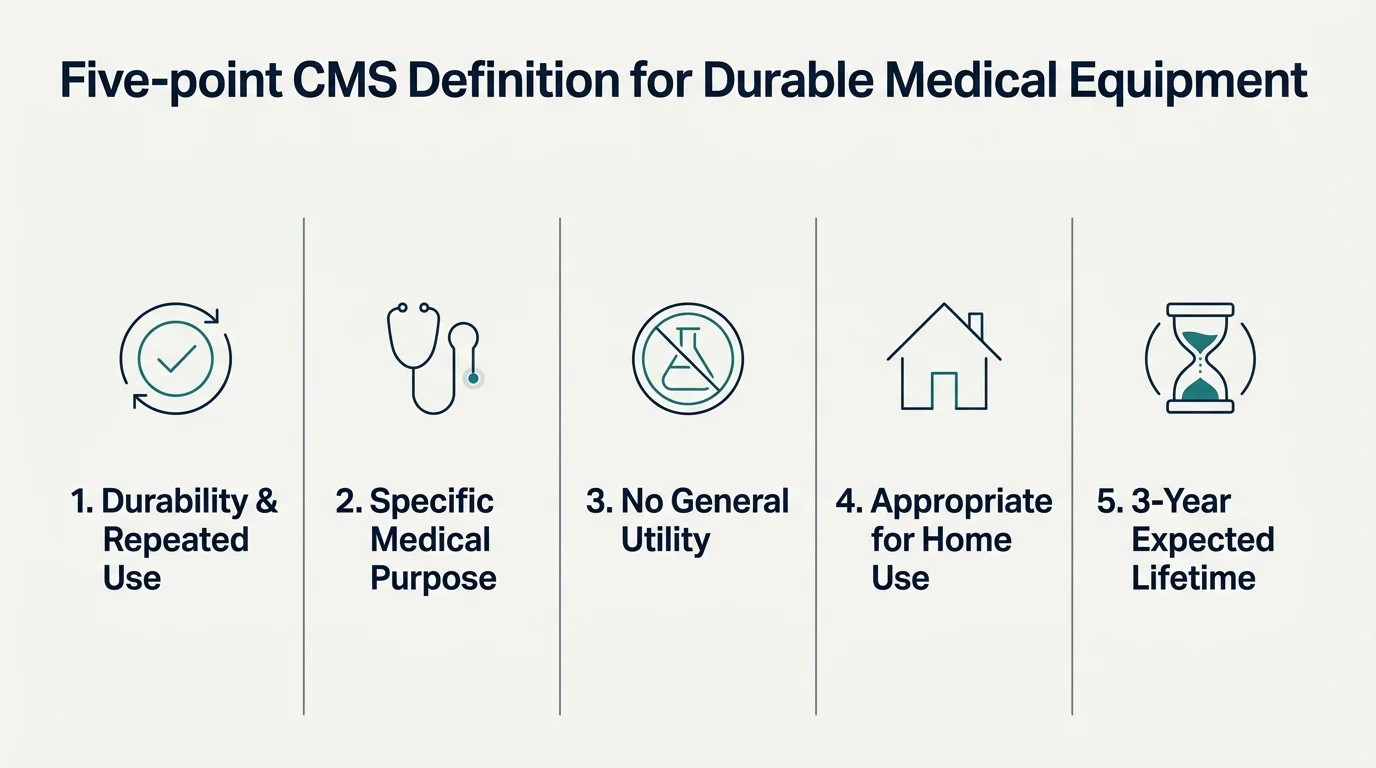
1. The Equipment Must Meet the Strict 5-Point CMS Definition
Medicare does not reimburse every health-related tool you purchase at a pharmacy or order online. The Centers for Medicare & Medicaid Services (CMS) enforces a strict, five-part statutory definition under Medicare Part B to determine whether an item qualifies as durable medical equipment (DME). If an item fails even one of these five benchmarks, Medicare automatically denies coverage, leaving you entirely responsible for the cost.
To qualify for Medicare durable medical equipment coverage, an item must satisfy all of the following criteria:
- Durability and repeated use: The equipment must withstand repeated, long-term operation. Disposable items—such as adhesive bandages, surgical gloves, and incontinence pads—do not qualify as DME, though Medicare covers certain disposable supplies separately under specific prosthetic and ostomy benefit categories.
- Specific medical purpose: The equipment must serve a therapeutic medical objective. Medicare approves items designed to treat an active illness, heal an injury, or restore essential bodily function, rather than general wellness tools.
- No general utility for healthy individuals: The item cannot be generally useful to someone without a qualifying medical condition. While standard air conditioners, dehumidifiers, and exercise treadmills improve physical comfort and health, Medicare classifies them as personal comfort items because healthy individuals use them regularly.
- Appropriate for home use: The equipment must be suitable, safe, and practical for use within a residential setting. Special clinical machinery designed exclusively for hospitals or outpatient clinics does not qualify under the Part B home benefit.
- Expected lifetime of at least three years: The item must have an engineered, reasonable useful lifetime of at least 36 months of continuous operation under normal use.
Understanding what Medicare covers for medical equipment begins with recognizing this threshold. Items like standard canes, patient lifts, continuous passive motion (CPM) machines, blood sugar monitors, and commode chairs meet these criteria when your physician certifies that your clinical diagnosis warrants their use at home.
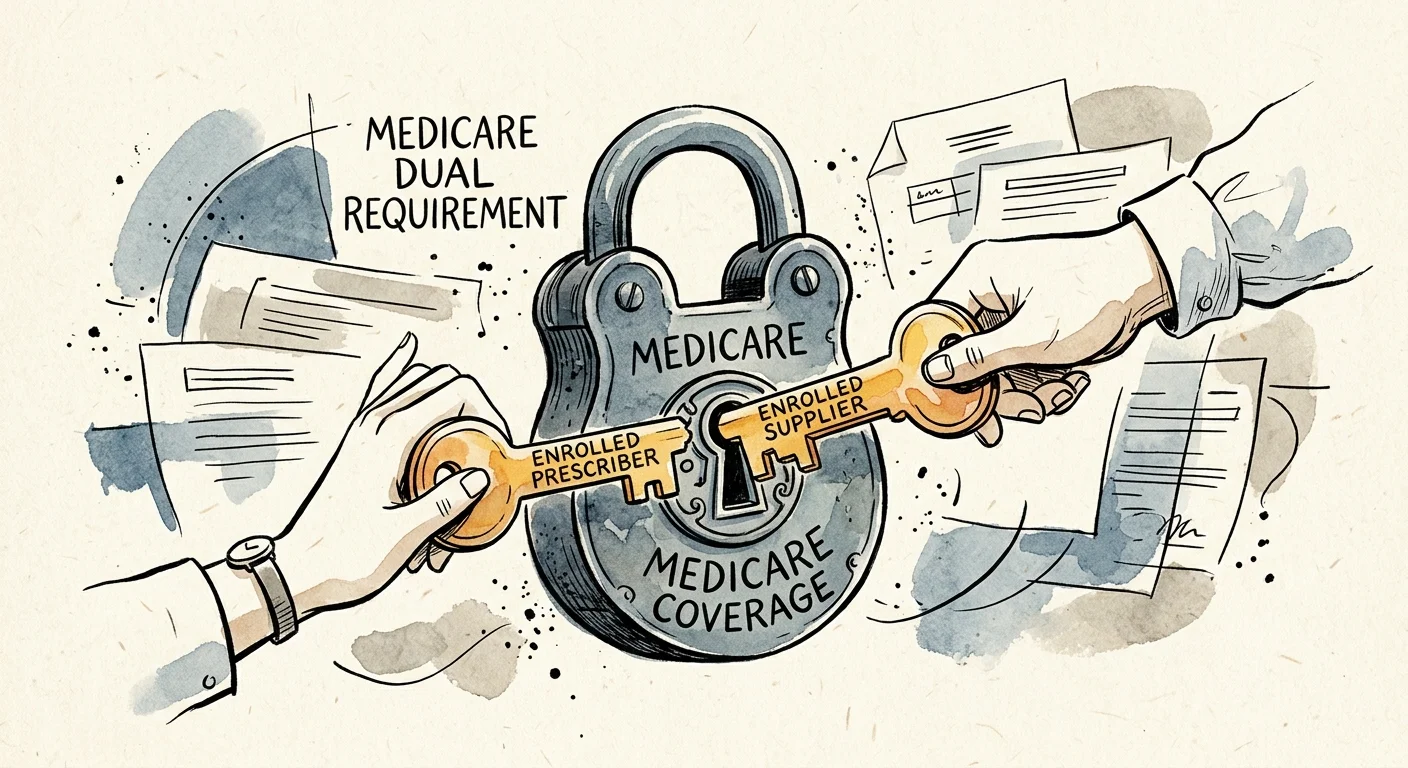
2. Prescribers and Suppliers Must Be Enrolled in Medicare and Accept Assignment
Having a genuine medical need and a valid prescription is not enough to guarantee your claim gets paid. One of the most rigid Medicare rules for DME dictates that both the prescribing healthcare provider and the medical supply company must be actively enrolled in the Medicare program. If either party falls outside the Medicare network, your claim faces immediate rejection.
When selecting a medical equipment supplier, you must confirm whether the vendor is an “enrolled participating supplier” or an “enrolled non-participating supplier.” This distinction carries massive financial consequences for your personal finances:
- Participating suppliers: These suppliers sign an agreement with Medicare to “accept assignment.” By accepting assignment, the supplier agrees to accept the Medicare-approved amount as payment in full. You are legally responsible only for your 20% Part B coinsurance after meeting your annual Part B deductible.
- Non-participating suppliers: These vendors enroll in Medicare but reserve the right not to accept assignment on a claim-by-claim basis. If a supplier does not accept assignment, they can charge you more than the Medicare-approved rate—a practice known as balance billing. While federal limiting charges restrict how much extra physicians can bill, DME suppliers face fewer restrictions, meaning you could absorb hundreds or thousands of dollars in excess fees.
- Opt-out suppliers: If a supplier or practitioner opts out of Medicare entirely, Medicare will not pay a single dollar toward the equipment. You must pay the total retail cost upfront with zero chance of reimbursement.
Always check the supplier directory on Medicare.gov or contact 1-800-MEDICARE before placing an order. Ask the supplier directly: “Are you an enrolled Medicare supplier, and will you accept assignment on this specific item?” Securing that confirmation in writing protects your retirement budget from surprise medical bills.
“Healthcare is often the wildcard in retirement planning. Knowing the exact rules of your coverage before you need care prevents sudden drains on your nest egg.” — Jean Chatzky, Financial Educator and Author

3. The Equipment Must Be Medically Necessary for Use Inside the Home
Medicare Part B covers medical equipment exclusively for use within your private residence. Under federal rules, your “home” includes a private house, an apartment, a condominium, a congregate living facility, or an assisted living facility. However, a hospital or a Skilled Nursing Facility (SNF) providing Medicare Part A-covered skilled rehabilitation does not qualify as your home for Part B DME purposes. In those institutional settings, the facility must supply all necessary equipment under its Part A per-diem payment rate.
This “in-home” rule creates specific hurdles for beneficiaries seeking mobility aids. Under Medicare wheelchair walker coverage rules, Medicare evaluates your mobility limitations strictly based on your ability to complete Mobility-Related Activities of Daily Living (MRADLs) inside your home. MRADLs include essential daily tasks such as:
- Toileting and personal hygiene routines
- Feeding yourself in the kitchen or dining area
- Dressing and grooming in the bedroom
- Transferring safely in and out of a bed, chair, or wheelchair
If you can walk safely inside your home without assistance, but you experience severe fatigue or joint pain when walking around your neighborhood, grocery shopping, or visiting community centers, Medicare will generally deny coverage for a power scooter or motorized wheelchair. The clinical documentation submitted by your doctor must prove that without the mobility device, you cannot resolve your mobility deficit within your immediate living space.
Furthermore, your home environment must physically accommodate the requested equipment. For power wheelchairs and specialized hospital beds, your supplier will conduct a home assessment. The supplier must verify that your doorways are wide enough, floor surfaces are safe, turning radiuses exist, and electrical outlets are grounded to support the equipment safely.

4. Standard Items Follow the 13-Month Capped Rental Ownership Rule
Medicare rarely purchases expensive medical equipment outright on the first day of your prescription. Instead, CMS operates a “capped rental” payment methodology for items such as standard manual wheelchairs, hospital beds, CPAP machines, and patient lifts. This system protects Medicare from paying full price for equipment that a patient might only require for a few weeks of post-surgical recovery.
Under the 13-month capped rental rule, Medicare pays a monthly rental fee to the supplier for up to 13 continuous months of documented medical use:
- Months 1 through 3: Medicare pays the supplier a rental fee equal to 10% of the equipment’s established purchase price per month. You pay your 20% coinsurance share of this monthly rental rate.
- Months 4 through 13: The monthly rental rate drops to 7.5% of the total purchase price for the remaining 10 months. You continue paying your 20% coinsurance on these lower monthly figures.
- Month 14 and beyond: After 13 continuous months of rental payments, the supplier must legally transfer title and ownership of the equipment directly to you. The monthly rental fees stop completely.
Once you own the equipment after the 13th month, Medicare transitions from paying rental charges to covering necessary ongoing maintenance, replacement parts, and repair labor under Part B. However, you must maintain active medical documentation in your clinical chart showing that you still require the equipment. If your health improves and you no longer need the device during the initial 13-month rental period, your doctor will discontinue the order, and the supplier will retrieve the equipment, ending your monthly coinsurance payments.
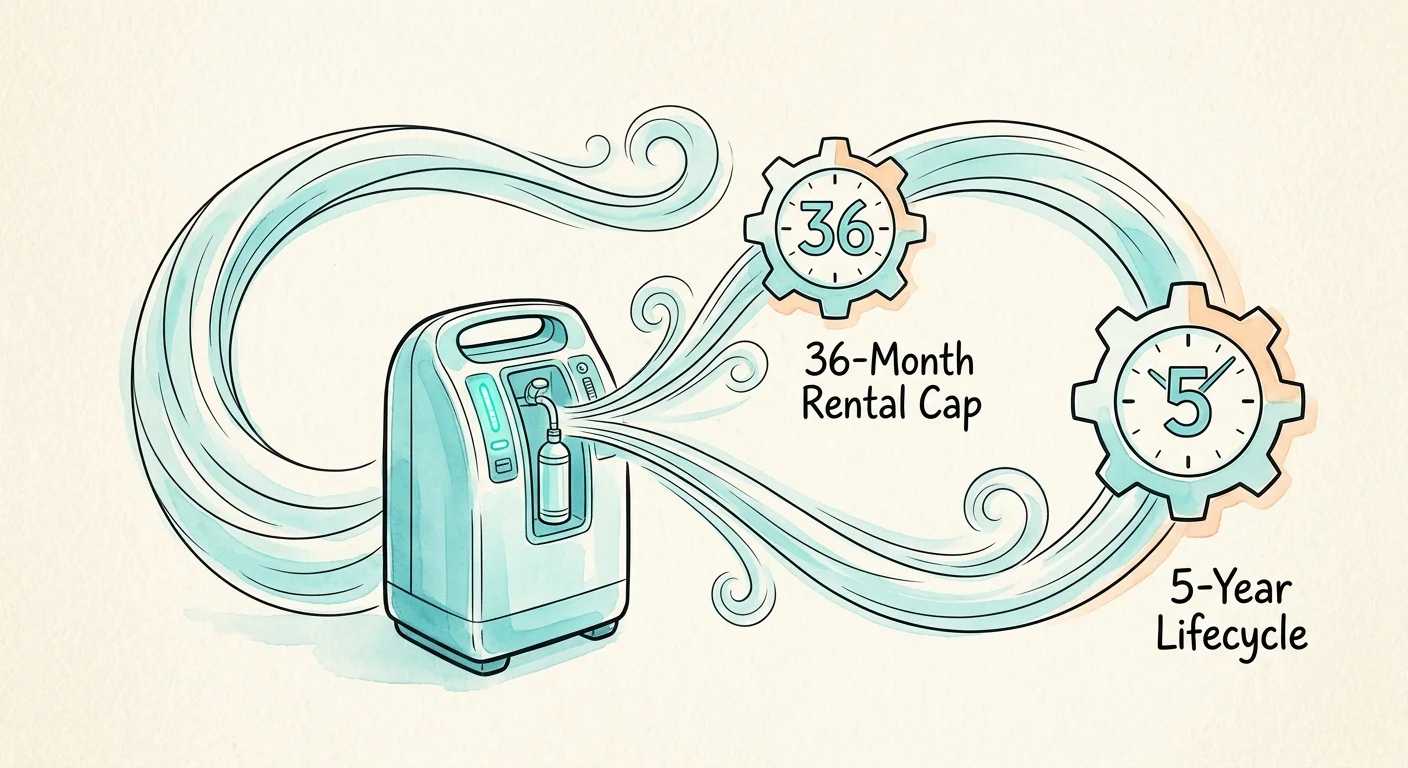
5. Oxygen Therapy Operates Under a Unique 36-Month and 5-Year Lifecycle
Stationary and portable oxygen equipment follows an entirely different statutory model than standard capped rental items. Under Section 5101(b) of the Deficit Reduction Act, Medicare beneficiaries cannot purchase oxygen equipment outright. Instead, Medicare pays a monthly bundled rental rate for oxygen concentrators, liquid oxygen systems, and compressed gas tanks for exactly 36 continuous months.
The oxygen coverage lifecycle spans a full five-year (60-month) service contract divided into two distinct phases:
- The 36-Month Rental Phase: Medicare pays monthly rental fees for 36 consecutive months of medically verified oxygen therapy. During this time, you pay your 20% Part B coinsurance each month. The bundled payment covers the equipment rental, monthly delivery of oxygen contents (tanks), maintenance, tubing, masks, and cannula replacements.
- The 24-Month Maintenance Phase: Once the 36th monthly payment is completed, the monthly rental payments terminate. However, ownership does not transfer to you. The supplier remains the owner of the equipment and is legally mandated to maintain, service, repair, and replace the oxygen equipment at zero rental cost to you for an additional 24 months, completing the five-year Reasonable Useful Lifetime (RUL).
During the final 24 months, the supplier may bill Medicare only for actual gaseous or liquid oxygen refills and periodic general maintenance visits authorized by CMS rules. If your oxygen machine malfunctions or breaks down during years four or five, the supplier must repair or replace it immediately without charging you for the replacement hardware. After the full five-year cycle concludes, you and your physician can choose to establish a new 36-month rental cycle with updated hardware or continue with your current supplier.

6. Power Mobility Devices Require Face-to-Face Exams and Prior Authorization
Because power wheelchairs, motorized scooters (power-operated vehicles), and specialized bariatric support surfaces represent significant financial outlays, CMS subjects these items to the strictest DME coverage requirements Medicare enforces. You cannot simply obtain a prescription during a routine phone call or virtual appointment; the process requires rigorous clinical validation before the supplier can deliver the device.
To qualify for complex power mobility devices, you must complete three mandatory administrative milestones:
- The In-Person Face-to-Face Examination: You must complete an in-person clinical evaluation with your treating physician, physician assistant, or nurse practitioner. The provider must document a thorough physical and functional mobility evaluation in your medical record, explaining precisely why lower-level mobility aids—such as a cane, rolling walker, or manual wheelchair—are clinically insufficient to handle your daily in-home needs.
- The Written Order Prior to Delivery (WOPD): Your physician must write and sign a formal prescription containing detailed clinical specifications before the supplier provides the equipment. Verbal orders or retroactively signed prescriptions result in automatic claim rejections.
- Medicare Prior Authorization: The DME supplier must compile your clinical notes, physical therapy evaluations, home access assessment, and the WOPD, then submit the complete packet to Medicare’s DME Medicare Administrative Contractor (DME MAC) for prior authorization. Medicare must issue an affirmative approval decision before the supplier dispenses the equipment.
If a supplier delivers a power mobility device before securing official prior authorization approval from Medicare, they do so at their own financial risk. If Medicare subsequently denies the claim, the supplier cannot legally force you to pay for the unapproved hardware, provided you signed the standard advance beneficiary notifications appropriately.
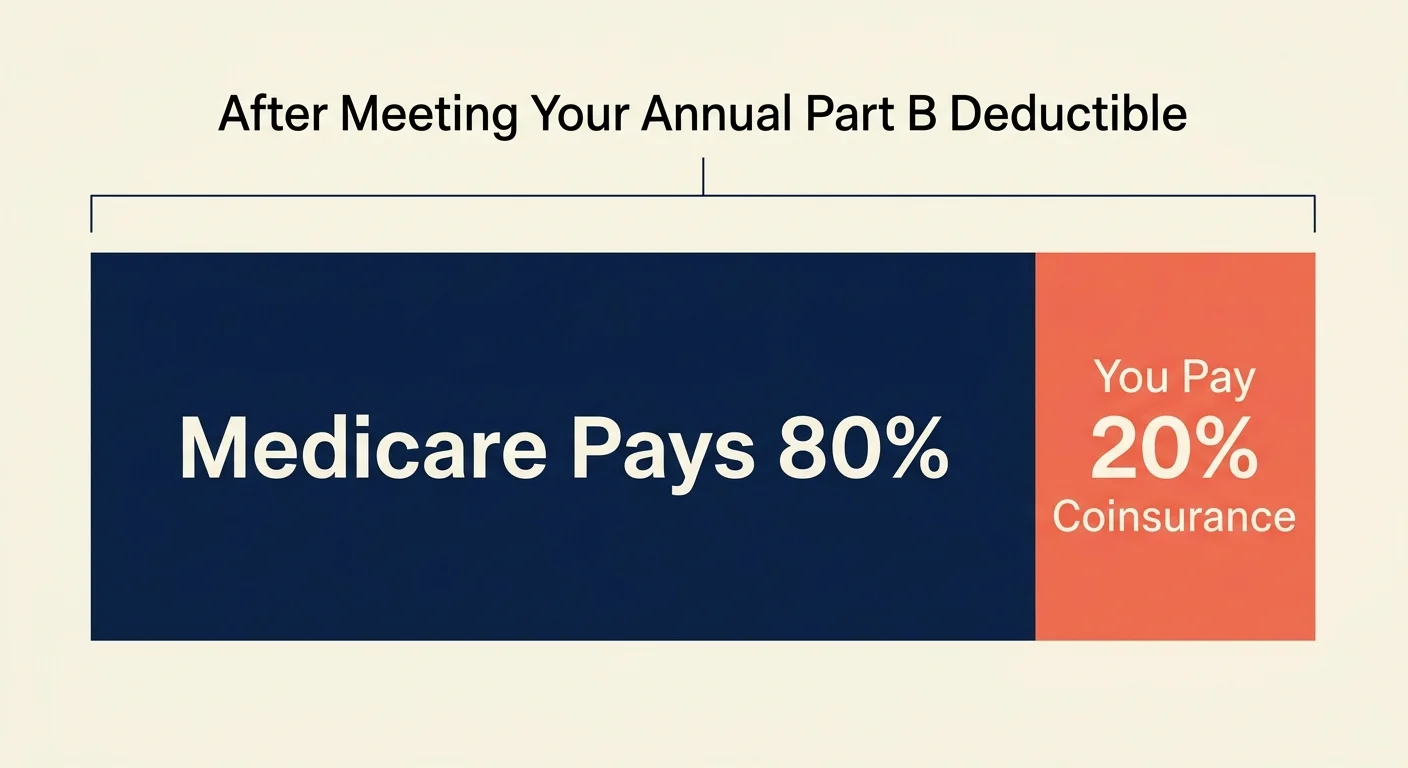
7. You Must Pay the 2026 Part B Deductible and 20% Coinsurance
Medicare durable medical equipment is covered under Part B (medical insurance), not Part A (hospital insurance) or Part D (prescription drugs). Consequently, standard Medicare cost-sharing applies to every piece of equipment, rental fee, and replacement accessory you receive.
For 2026, the baseline financial framework for Medicare DME coverage operates as follows:
- The 2026 Part B Annual Deductible: You must first pay the 2026 Part B deductible of $283 out-of-pocket before Medicare pays its share of medical equipment claims. If you have already satisfied your $283 deductible through doctor visits or lab work earlier in the calendar year, your DME coverage begins immediately.
- The 80/20 Coinsurance Split: Once your deductible is met, Medicare pays 80% of the Medicare-approved amount for the equipment rental or purchase. You are responsible for the remaining 20% coinsurance.
- Medicare Supplement Insurance (Medigap): If you carry a standard Medigap policy (such as Plan G, Plan N, or older Plan F), your supplemental plan pays your 20% coinsurance obligation. Plan F and older Plan C policies also cover the annual Part B deductible, while Plan G and Plan N require you to pay the 2026 $283 deductible before picking up 100% of remaining DME coinsurance charges.
- Medicare Advantage (Part C) Cost Structures: If you enroll in a private Medicare Advantage plan, the plan must cover all DME items that Original Medicare covers. However, your cost-sharing may differ from the standard 80/20 split. Medicare Advantage plans frequently charge copayments, require you to use specific in-network DME supply vendors, and enforce their own internal prior authorization processes for equipment approval.
For independent guidance on coordinating your supplemental benefits with Part B coverage, the National Council on Aging (NCOA) provides localized resources to help seniors navigate out-of-pocket medical expenses.
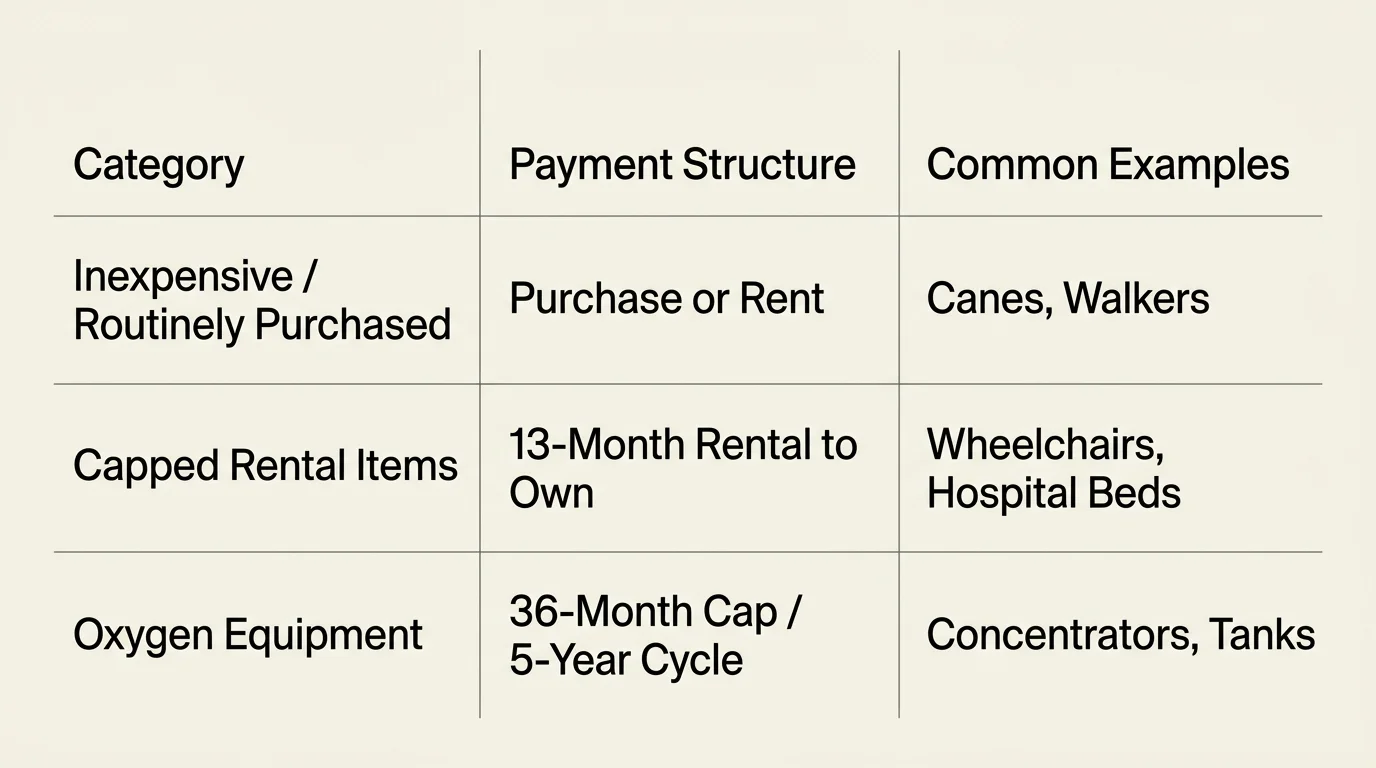
Comparing Medicare DME Categories and Payment Structures
Different types of medical equipment operate under distinct payment models, rental timelines, and ownership rules. The table below outlines how Medicare classifies and reimburses the most common durable medical equipment categories.
| Equipment Category | Common Examples | Payment Structure | Ownership Rules | Key Coverage Requirement |
|---|---|---|---|---|
| Inexpensive or Routinely Purchased | Standard canes, crutches, walkers, commode chairs, blood glucose monitors | Lump-sum purchase or initial short-term rental | Purchased immediately or rented briefly before purchase | Physician prescription proving home medical necessity |
| Capped Rental Items | Manual wheelchairs, hospital beds, CPAP machines, patient lifts | Monthly rental payments for up to 13 continuous months | Ownership transfers to beneficiary on the 14th month | Documented ongoing medical use and provider chart notes |
| Oxygen Equipment | Stationary oxygen concentrators, portable tanks, liquid oxygen units | 36-month rental bundle followed by 24-month maintenance | Supplier retains ownership; maintains equipment for 5 full years | Qualifying arterial blood gas or pulse oximetry lab test results |
| Complex Power Mobility | Power wheelchairs, motorized scooters, custom seating systems | Prior-authorized purchase or specialized capped rental | Beneficiary ownership upon claim approval and fulfillment | In-person face-to-face exam, PT/OT evaluation, prior authorization |
| Service & Maintenance | Replacement wheelchair batteries, CPAP masks, oxygen tubing, filters | Purchased as needed according to CMS replacement schedules | Owned by beneficiary upon delivery | Must be for patient-owned equipment still within useful lifespan |
Pitfalls to Watch For
Navigating the administrative rules surrounding medical equipment requires vigilance. Many retirees run into unexpected financial liabilities by making simple procedural errors during the ordering process. Avoid these common mistakes when securing your equipment:
- Responding to unsolicited phone calls or television ads: Telemarketing scams targeting Medicare beneficiaries are widespread. Scammers call offering “free back braces” or “no-cost knee supports.” If an unverified company bills Medicare using your Medicare Beneficiary Identifier (MBI) without your treating physician’s involvement, Medicare will deny the claim, and you may find yourself liable for hundreds of dollars in unauthorized equipment.
- Overlooking equipment replacement schedules: Medicare establishes a five-year Reasonable Useful Lifetime (RUL) for most durable equipment. If you request a new wheelchair or hospital bed before your existing equipment reaches its five-year mark, Medicare will deny the request unless your clinical condition has drastically changed or the existing equipment was damaged beyond repair in an unavoidable accident.
- Failing to meet CPAP compliance thresholds: If Medicare approves a CPAP machine for sleep apnea, you enter a mandatory 90-day trial period. Between day 31 and day 90, your CPAP data card must prove that you used the device for at least four hours per night on 70% of consecutive nights (21 out of 30 days). If you fail this compliance check, Medicare terminates rental payments, and the supplier will demand the return of the machine.
- Ignoring Medicare Advantage network restrictions: If you are enrolled in a Medicare Advantage plan, ordering equipment from a supplier outside the plan’s contracted network can result in complete claim denial. Always verify network status directly with your insurer before allowing any supplier to deliver equipment to your doorstep.

Getting Expert Help
When DME coverage determinations become complicated, navigating the appeals process or coordinating multiple coverage layers requires specialized guidance. You can turn to trained advocates and administrative resources in several specific scenarios:
- Scenario 1: Appealing an unfair DME claim denial. If Medicare denies coverage for an essential piece of equipment, you have the legal right to file a redetermination appeal within 120 days of receiving your Medicare Summary Notice (MSN). Contact your local State Health Insurance Assistance Program (SHIP) through the national network supported by AARP and CMS. SHIP counselors provide free, unbiased assistance in gathering physician letters and lodging formal Medicare appeals.
- Scenario 2: Transitioning from a skilled nursing facility to home. When you prepare for discharge from a hospital or SNF, work directly with the facility’s licensed medical social worker or discharge planner. They must coordinate with Medicare-enrolled DME suppliers to ensure that required hospital beds, patient lifts, or mobility devices are delivered to your residence on the exact day of your discharge.
- Scenario 3: Coordinating dual eligibility with Medicaid. If you qualify for both Medicare and Medicaid, Medicare pays first as the primary insurer, and Medicaid acts as the secondary payer. Medicaid often covers DME items that Medicare excludes, such as permanent home bathroom modifications, grab bars, and wheelchair ramps. A Medicaid case manager can help submit crossover claims to eliminate out-of-pocket copayments.
- Scenario 4: Resolving equipment disputes with uncooperative suppliers. If your oxygen supplier refuses to perform mandatory repairs during years four or five of your 5-year cycle, or if a supplier fails to transfer title after month 13, contact the Medicare Beneficiary Ombudsman or file an official complaint via 1-800-MEDICARE to enforce federal supplier compliance rules.
Frequently Asked Questions About Medicare DME Coverage
Does Medicare cover bathroom modifications like grab bars or walk-in tubs?
No. Original Medicare classifies walk-in bathtubs, stair lifts, and standard bathroom grab bars as home modifications or convenience items rather than durable medical equipment. Because healthy individuals can use these items and they modify the home structure, Medicare Part B does not pay for them. However, Medicare does cover bedside commodes when you are physically confined to a room or cannot reach a standard bathroom safely.
Can I travel out of state with my Medicare-supplied oxygen equipment?
Yes. If you travel within the United States, your current oxygen supplier is legally required under their 36-month or 5-year contract to help arrange oxygen supplies at your destination. You must notify your supplier at least four to six weeks before your trip so they can coordinate with an affiliated branch or regional partner to provide oxygen tanks or concentrators while you are away from home.
How often does Medicare pay to replace standard mobility equipment?
Medicare adheres to a five-year Reasonable Useful Lifetime rule for standard mobility equipment like walkers, manual wheelchairs, and power chairs. Medicare will not pay for a replacement device within five years unless your prescribing doctor documents a significant change in your physical condition—such as a progressive neurological decline—that renders your current equipment clinically unusable, or unless the equipment suffered catastrophic, unrepairable damage from an external event.
What should I do if my doctor prescribes equipment that Medicare denies?
If Medicare denies your equipment claim, review the Medicare Summary Notice to identify the specific denial code. Most initial denials occur due to missing medical records, incomplete functional evaluations, or improper supplier enrollment forms. Have your physician provide detailed clinical chart notes addressing the specific deficiency, and submit a Level 1 Appeal (Redetermination) to your regional DME MAC within 120 days of the denial notice.
Next Steps for Securing Your Medical Equipment
Navigating Medicare durable medical equipment coverage successfully comes down to preparation, clear communication, and precise paperwork. Before scheduling an equipment consultation, schedule an in-person appointment with your physician to discuss your specific home mobility and therapeutic requirements. Ensure that your doctor thoroughly documents your limitations in your clinical records rather than merely writing a quick prescription note.
Once you have a comprehensive clinical evaluation, select an enrolled Medicare supplier that explicitly accepts assignment. Verify all deductible and coinsurance obligations upfront with your supplemental insurance plan or Medicare Advantage carrier. Taking these structured steps guarantees you receive the medical equipment necessary to maintain your health, mobility, and independence throughout your retirement years.
This is educational content based on general retirement and financial principles. Individual results vary based on your situation. Always verify current benefit rules, tax laws, and eligibility requirements with official sources like SSA, Medicare.gov, or the IRS.
Last updated: March 2026. Retirement benefits, tax rules, and healthcare regulations change frequently—verify current details with official sources.









Leave a Reply