
Paying $202.90 every month for Medicare Part B—plus a $283 annual deductible—makes it feel like nothing in healthcare is truly free. Yet you can access a wide array of life-saving Medicare preventive services without paying a single dime out of pocket.
When you use these free Medicare services correctly, Medicare waives both your yearly deductible and your standard 20% coinsurance. Knowing which screenings and vaccines qualify helps you protect both your long-term health and your retirement savings.
Here is how to claim twelve of the most valuable zero-cost benefits available to you right now—and how to avoid the sneaky billing traps that turn a free visit into an expensive invoice.
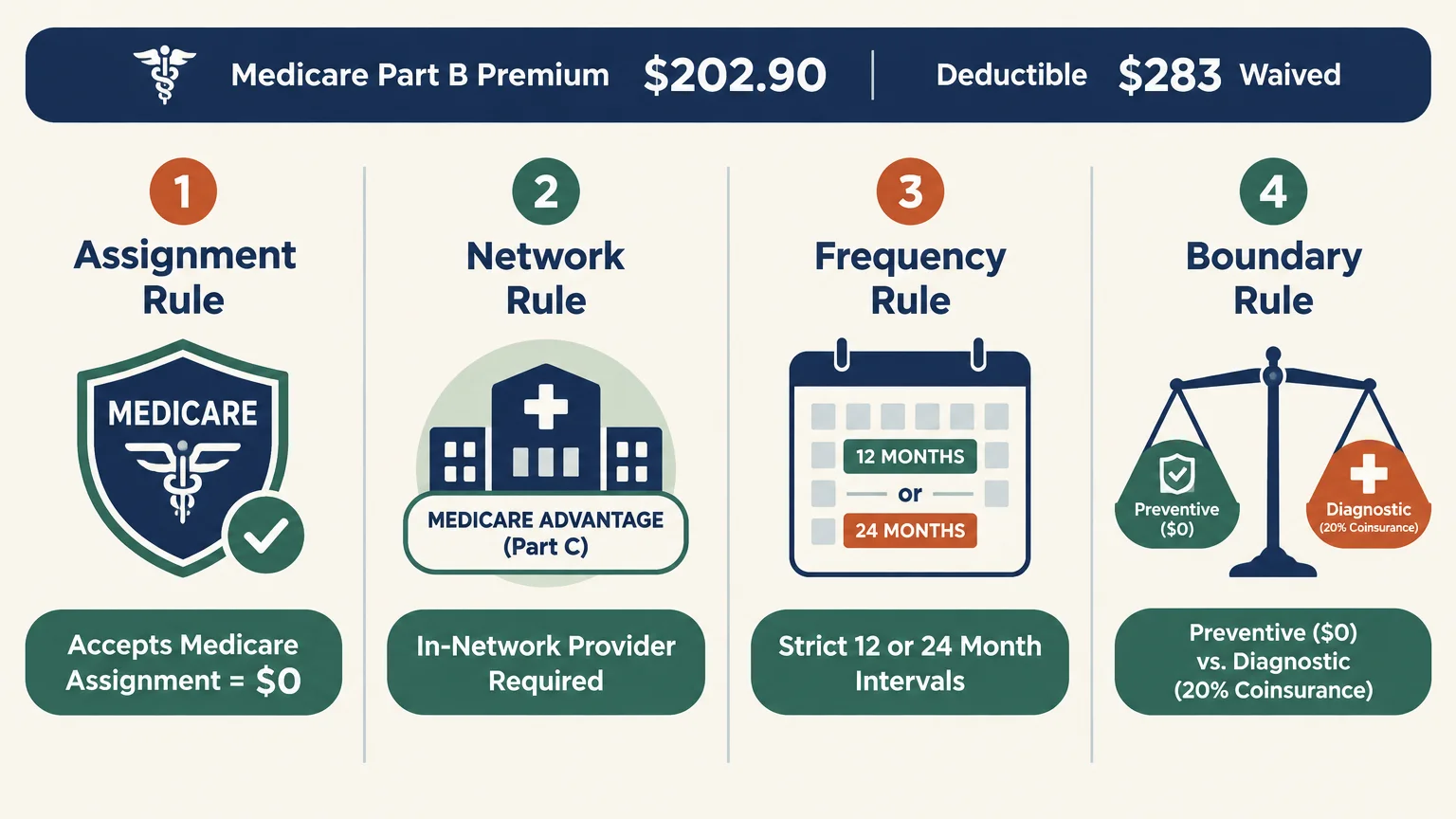
At a Glance: Key Rules for Zero-Dollar Medicare Benefits
Before you book your next doctor’s appointment, you need to understand what “free” actually means in the Medicare system. While you still pay your monthly Part B premium of $202.90 (up from $185.00 in 2025), qualifying preventive care carries zero out-of-pocket cost at the point of service.
Normally, Medicare Part B requires you to pay a $283 annual deductible (up from $257 in 2025) before coverage kicks in, followed by a 20% coinsurance on most doctor visits and outpatient tests. For approved preventive benefits, Medicare waives both that $283 deductible and the 20% copay entirely.
- The Assignment Rule for Original Medicare: Your screening or visit is only $0 out of pocket if your doctor or lab accepts “Medicare assignment,” meaning they agree to accept the Medicare-approved amount as full payment.
- The Network Rule for Medicare Advantage (Part C): Private Medicare Advantage plans must cover all Original Medicare preventive services at $0 cost-sharing, provided you use an in-network healthcare provider.
- The Frequency Rule: Medicare enforces strict calendar intervals—such as once every 12 months or once every 24 months—and scheduling a test even one week too early can leave you responsible for the full bill.
- The Preventive vs. Diagnostic Boundary: A screening is only free when you have no symptoms of the condition being tested; once you report a specific pain or problem, the test often becomes a diagnostic service subject to deductibles and coinsurance.
“An ounce of prevention is worth a pound of cure.” — Benjamin Franklin, Founding Father and Polymath
Benjamin Franklin’s timeless observation carries huge financial weight in retirement. Catching high blood pressure, prediabetes, or early-stage cellular changes during a free screening spares you from thousands of dollars in downstream hospital bills and prescription costs.

The 12 Most Valuable Free Medicare Services You Should Claim
The Centers for Medicare & Medicaid Services (CMS) has expanded its roster of zero-cost preventive care over the past several years. Reviewing the official Medicare.gov preventive checklist before your annual checkup ensures you never leave valuable benefits on the table.
Below are the twelve most impactful Medicare covered services that cost you nothing out of pocket when you meet the eligibility rules.
1. The “Welcome to Medicare” Preventive Visit
Your first year on Medicare comes with a special, one-time introductory benefit known formally as the Initial Preventive Physical Examination (IPPE). You must complete this appointment within the first 12 months of your Medicare Part B effective date, or you lose the benefit forever.
During this baseline visit, your primary care provider reviews your medical and social history, checks your height, weight, and blood pressure, and performs a simple vision test. They also check your body mass index (BMI) and screen you for depression and daily functional safety.
Most importantly, your doctor will hand you a written checklist of the other free health screenings Medicare covers for your specific age and risk profile. Bring your complete vaccination records, a list of your current prescription medications, and your family health history to get the most out of this session.
2. Your Medicare Annual Wellness Visit
Once you have held Medicare Part B for more than 12 months—and at least 11 full months have passed since your “Welcome to Medicare” visit—you unlock a free Medicare annual wellness visit every 12 months. This appointment is one of the most misunderstood benefits in the entire healthcare system.
Crucially, an Annual Wellness Visit (AWV) is not a routine head-to-toe physical exam. Original Medicare actually does not cover traditional routine physicals where a doctor listens to your lungs, taps your knees, and orders a random battery of blood work.
Instead, the Annual Wellness Visit is a forward-looking planning session focused on keeping you independent and healthy. You will fill out a Health Risk Assessment questionnaire before or during the appointment, and your care team will update your personalized 5-to-10-year prevention plan.
Your provider will also perform a routine cognitive impairment assessment to look for early signs of Alzheimer’s disease or dementia. In addition, you can use this visit to discuss advance care planning—such as living wills and healthcare proxies—at zero out-of-pocket cost.
3. Essential Adult Vaccines Under Part B and Part D
Until recently, getting vaccinated under Medicare was a frustrating guessing game where some shots were free and others carried steep copays. Thanks to federal legislative updates, including the Inflation Reduction Act, virtually all recommended adult vaccines now cost you $0.
However, you still need to know whether a vaccine falls under Part B (medical insurance) or Part D (prescription drug coverage) so you get the shot at the right location. Part B vaccines can be administered at your doctor’s office or a pharmacy, whereas Part D vaccines are almost always easiest to claim at an in-network retail pharmacy.
- Annual Flu Shots (Part B): You get one free influenza vaccine every flu season, and Medicare will even cover a second shot in the same calendar year if seasonal timing requires it.
- Pneumococcal Shots (Part B): Medicare pays 100% for pneumonia vaccines, which protect older adults from severe respiratory and bloodstream infections.
- COVID-19 Vaccines and Boosters (Part B): All updated FDA-authorized COVID-19 vaccines remain completely free with no deductible or copay.
- Hepatitis B Shots (Part B): Coverage was recently expanded so that all adults with an unknown vaccination history or an incomplete series qualify for $0 shots, not just high-risk patients.
- Shingles Vaccine / Shingrix (Part D): Previously costing retirees up to $200 out of pocket, the two-dose Shingrix series is now 100% free under Part D with no deductible or coinsurance.
- RSV Vaccine (Part D): The Respiratory Syncytial Virus vaccine is covered at $0 out of pocket for older adults when recommended by the Advisory Committee on Immunization Practices (ACIP).
- Tdap Booster (Part D): Your tetanus, diphtheria, and pertussis booster shot is now completely free at your Part D pharmacy counter.
If your family doctor administers a Part D vaccine like Shingrix in their medical office, their billing system might not connect directly to your Part D drug plan. To avoid paying up front and filing paper reimbursement claims, always get Part D vaccines at an in-network pharmacy.
4. Colorectal Cancer Screenings
Colorectal cancer is highly preventable when caught early, which is why Medicare offers multiple zero-cost screening pathways starting at age 45. If you are at average risk and prefer a non-invasive option at home, Medicare covers a multi-target stool DNA test—such as Cologuard—once every 3 years for beneficiaries aged 45 to 85.
You can also receive a free fecal occult blood test once every 12 months, or a flexible sigmoidoscopy once every 4 years. For the gold-standard screening colonoscopy, Medicare covers the procedure at $0 once every 10 years for average-risk individuals, or once every 24 months if you have a high-risk personal or family history.
For decades, retirees faced an unfair surprise bill whenever a doctor found and snared a polyp during a free screening colonoscopy, or when a colonoscopy was ordered as a follow-up to a positive stool test. Today, Medicare waives the $283 Part B deductible in both scenarios.
Better yet, the coinsurance for polyp removal during a screening colonoscopy is actively phasing out by law. In 2026, your maximum coinsurance for polyp removal during a preventive colonoscopy is capped at 15%, and it is scheduled to drop all the way to 0% between 2027 and 2030.
5. Annual Screening Mammograms
Every woman enrolled in Medicare aged 40 and older qualifies for one free screening mammogram every 12 months. Women on Medicare through disability between ages 35 and 39 also qualify for one free baseline mammogram during that five-year window.
This zero-cost benefit includes both traditional two-dimensional mammography and three-dimensional digital breast tomosynthesis, which provides clearer imaging for dense breast tissue. You do not need a doctor’s referral or prescription to book a routine screening mammogram under Medicare.
Keep in mind that a “screening” mammogram is for women with no breast symptoms. If you feel a lump, experience pain, or return for a second imaging appointment to investigate a suspicious shadow, the follow-up test is coded as a diagnostic mammogram and triggers the Part B deductible and 20% coinsurance.
6. Cardiovascular Disease Screenings and Behavioral Therapy
Heart disease remains the leading health threat for older Americans, making Medicare’s two-pronged cardiovascular benefit essential for every retiree. First, Medicare covers a complete cardiovascular screening blood test panel—checking your total cholesterol, high-density lipoproteins (HDL), and triglycerides—once every 5 years at $0 out of pocket.
Second, you do not have to wait five years to get free heart-health support from your primary care provider. Medicare also covers one face-to-face cardiovascular behavioral therapy visit every year at no cost to you.
During this dedicated annual session, your primary care doctor checks your blood pressure, evaluates your dietary sodium and saturated fat intake, and determines whether daily low-dose aspirin therapy is appropriate for your risk profile. Pairing this visit with your annual checkup gives you a focused action plan to keep your arteries healthy.
7. Bone Mass Measurements (DEXA Scans)
A hip or wrist fracture in your seventies can permanently derail your mobility and retirement lifestyle. To help you catch bone loss before a fracture occurs, Medicare covers a bone density test—commonly known as a DEXA scan—once every 24 months at $0 cost to qualified beneficiaries.
Your doctor can even order the scan more frequently than every two years if it is medically necessary, such as when monitoring your response to a new osteoporosis medication. You qualify for this free screening if you meet at least one of five clinical criteria:
- You are a woman whose healthcare provider determines you are estrogen-deficient and at clinical risk for osteoporosis.
- Your X-rays show possible osteopenia, bone loss, or spinal vertebral fractures.
- You are currently taking—or planning to begin—long-term steroid medication such as prednisone.
- You have been diagnosed with primary hyperparathyroidism.
- You are currently taking an FDA-approved osteoporosis drug and your doctor needs to monitor how well the treatment is working.
8. Diabetes Screenings and the Medicare Diabetes Prevention Program
Millions of older adults live with elevated blood sugar without realizing it. If your doctor determines you are at risk for diabetes due to high blood pressure, abnormal cholesterol, obesity, a history of high blood sugar, or a family history of diabetes, Medicare covers up to two free blood glucose laboratory screenings per year.
These free lab tests include fasting blood glucose tests and post-glucose challenge tests. If your results reveal that you have prediabetes—meaning your blood sugar is elevated but not yet high enough for a Type 2 diabetes diagnosis—you unlock one of Medicare’s best-kept secrets.
The Medicare Diabetes Prevention Program (MDPP) is a completely free, once-per-lifetime, two-year health behavior change program. Taught by trained lifestyle coaches in a supportive group setting, the program gives you 16 core weekly sessions over the first six months, followed by monthly maintenance sessions to help you lose 5% to 7% of your body weight through practical nutrition and movement habits.
9. Annual Depression Screenings
Retirement brings major transitions, from leaving a lifelong career to coping with the loss of loved ones or managing chronic physical changes. Medicare recognizes that mental health is foundational to physical health, offering one free depression screening every 12 months.
This screening takes up to 15 minutes and is completely free of deductibles and copays. To qualify for $0 cost-sharing, the screening must take place in a primary care setting—such as your family doctor’s office—that has staff-assisted depression care supports in place to provide accurate diagnosis, follow-up treatment, or specialist referrals.
If your screening indicates that you would benefit from therapy or medication management, those subsequent counseling sessions are covered under Medicare Part B mental health benefits (where the standard deductible and 20% coinsurance apply unless you carry a Medigap policy).
10. Lung Cancer Screenings With Low-Dose CT Scans
Standard chest X-rays often miss early lung tumors, whereas a Low-Dose Computed Tomography (LDCT) scan can detect tiny nodules when they are easiest to treat. Medicare covers one Low-Dose CT lung cancer screening every 12 months at $0 out of pocket for eligible current and former smokers.
You qualify for this free annual scan if you meet all of the following conditions:
- You are between 50 and 77 years old.
- You have no current signs or symptoms of lung cancer (such as coughing up blood or unexplained weight loss).
- You currently smoke tobacco, or you quit smoking within the past 15 years.
- You have a tobacco smoking history of at least 20 “pack-years” (calculated by multiplying the average number of packs smoked per day by the number of years you smoked—for example, one pack a day for 20 years, or two packs a day for 10 years).
- You receive a written order for the scan from your healthcare provider.
Before your very first LDCT scan, your doctor will conduct a shared decision-making counseling visit to discuss the pros and cons of screening and offer tobacco cessation support if you still smoke.
11. Intensive Behavioral Therapy for Obesity
Carrying excess weight in retirement places extra strain on your knees, hips, heart, and metabolic system. If your Body Mass Index (BMI) is 30 or higher, Medicare covers intensive behavioral therapy for obesity at $0 out of pocket.
This structured benefit is much more substantial than a quick two-minute pep talk from your doctor. When delivered by your primary care physician, nurse practitioner, or physician assistant in a primary care office, the program provides a high-contact schedule of face-to-face nutrition and exercise counseling:
- Month 1: One face-to-face counseling visit every week.
- Months 2 through 6: One face-to-face counseling visit every other week.
- Months 7 through 12: One face-to-face visit every month, provided you have achieved a weight reduction of at least 6.6 pounds (3 kilograms) during the first six months of the program.
If you do not lose the required 6.6 pounds during your first six months, Medicare allows you to wait six months and have your doctor re-evaluate your readiness to start a fresh cycle at no cost.
12. Alcohol Misuse and Tobacco Cessation Counseling
Whether you want to cut back on evening drinks to improve your sleep and blood pressure or finally quit smoking for good, Medicare covers professional behavioral support without charging you a cent. All Medicare beneficiaries qualify for one free alcohol misuse screening every year with their primary care provider.
If your doctor determines during that screening that you are misusing alcohol—without necessarily meeting the clinical threshold for severe alcohol dependency—you can receive up to four brief face-to-face counseling sessions per year in a primary care setting at $0 out of pocket.
For tobacco users, the benefit is even more generous. Medicare covers up to eight face-to-face smoking and tobacco cessation counseling sessions during any 12-month period (structured as two separate cessation attempts of up to four sessions each) at zero cost, provided you have no current symptoms of tobacco-related illness and use a qualified Medicare provider.

Bonus Free Screenings for Specific Risk Profiles
Beyond the twelve universal and lifestyle-focused services above, Medicare provides two additional zero-cost screenings targeted at specific anatomical risks. Checking whether you fit these criteria can save your life.
Abdominal Aortic Aneurysm (AAA) One-Time Ultrasound
An abdominal aortic aneurysm is a dangerous ballooning of the main blood vessel supplying your lower body, which often grows silently without warning signs. Medicare covers a one-time screening ultrasound at $0 out of pocket if you get a referral from your healthcare provider and meet one of two risk profiles.
You qualify if you are a man aged 65 to 75 who has smoked at least 100 cigarettes in your entire lifetime, even if you quit decades ago. In addition, both men and women qualify for this free one-time ultrasound if they have a family history of abdominal aortic aneurysms.
Cervical and Vaginal Cancer Screenings
Women do not age out of gynecological preventive care the day they turn 65. Medicare covers a complete Pap test and pelvic exam—including a clinical breast exam—once every 24 months at $0 out of pocket for all female beneficiaries.
If you are at high risk for cervical or vaginal cancer, or if you are of childbearing age and had an abnormal Pap test within the past 36 months, Medicare covers these exams once every 12 months. For women aged 30 to 65 who are on Medicare, the benefit also includes a free Human Papillomavirus (HPV) co-test once every 5 years.
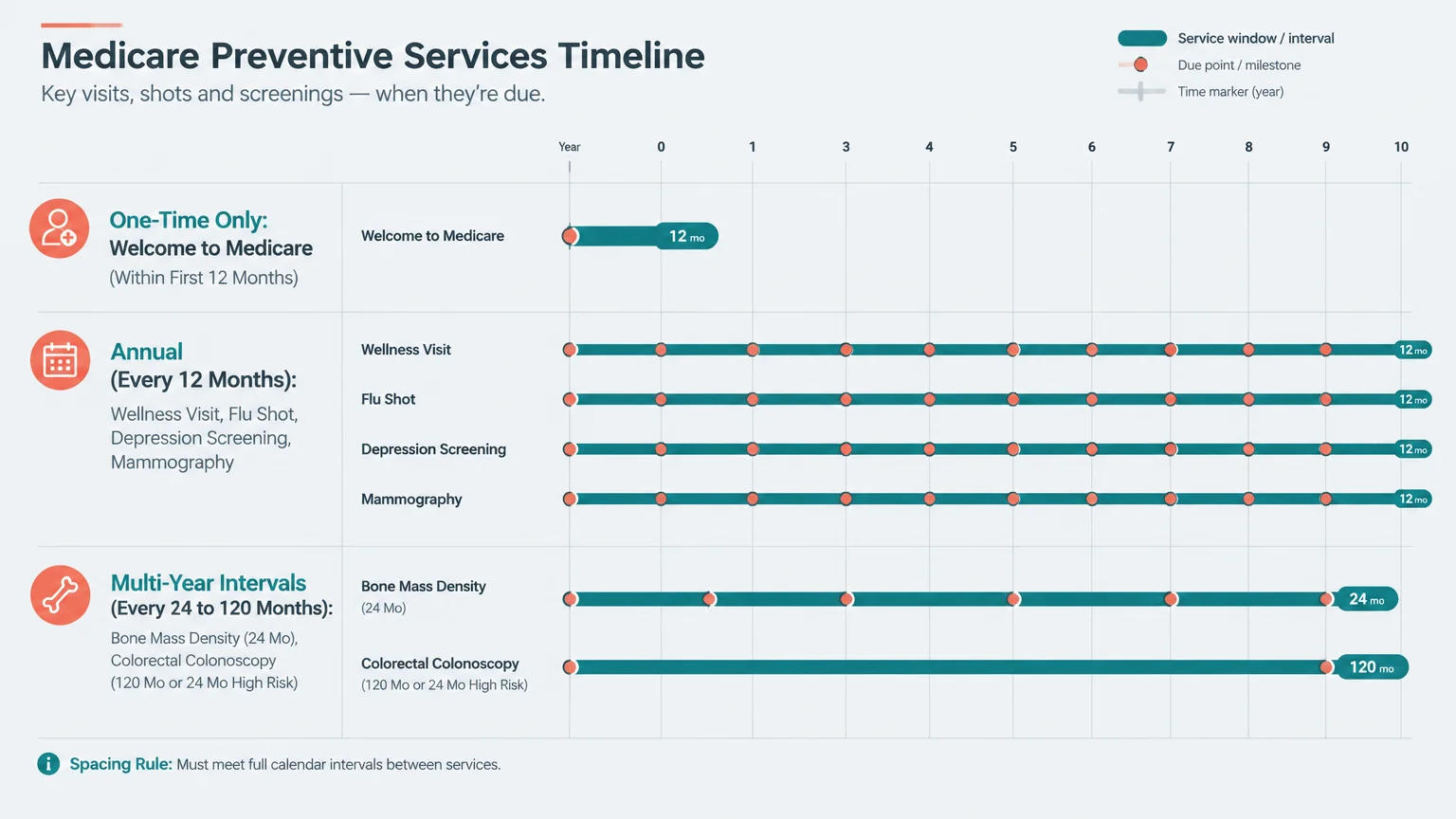
Quick-Reference Schedule: Your Free Health Screenings Under Medicare
Keeping track of eligibility windows and calendar frequencies is the easiest way to avoid accidental claim denials. Use this reference table to plan your preventive calendar for the year ahead.
| Preventive Service | Medicare Part | Covered Frequency | Who Qualifies | Out-of-Pocket Cost |
|---|---|---|---|---|
| “Welcome to Medicare” Visit | Part B | Once in a lifetime | All new enrollees within first 12 months of Part B | $0 (Deductible & 20% waived) |
| Annual Wellness Visit (AWV) | Part B | Once every 12 months | All beneficiaries after 12 months on Part B | $0 (Deductible & 20% waived) |
| Flu, Pneumonia, COVID-19, Hep B Shots | Part B | Seasonal / per CDC schedule | All Part B enrollees | $0 (Deductible & 20% waived) |
| Shingles, RSV, and Tdap Vaccines | Part D | Per ACIP adult schedule | All Part D (or Advantage drug plan) enrollees | $0 under Inflation Reduction Act |
| Colorectal Cancer Screening | Part B | Cologuard: 3 yrs; Colonoscopy: 10 yrs (2 yrs high risk) | Ages 45+ (Cologuard 45–85 at average risk) | $0 screening (15% polyp removal in 2026, deductible waived) |
| Screening Mammogram | Part B | Once every 12 months | All women aged 40+ (1 baseline ages 35–39) | $0 (Deductible & 20% waived) |
| Cardiovascular Blood Test & Therapy | Part B | Labs: every 5 yrs; Therapy: once a year | All Part B enrollees | $0 (Deductible & 20% waived) |
| Bone Mass Measurement (DEXA) | Part B | Once every 24 months | Beneficiaries at clinical risk for osteoporosis | $0 (Deductible & 20% waived) |
| Diabetes Lab Screenings & MDPP | Part B | Labs: up to 2/yr; MDPP: once per lifetime | At-risk enrollees (Labs); Prediabetes criteria (MDPP) | $0 (Deductible & 20% waived) |
| Depression Screening | Part B | Once every 12 months | All enrollees in a qualified primary care setting | $0 (Deductible & 20% waived) |
| Lung Cancer Low-Dose CT Scan | Part B | Once every 12 months | Ages 50–77, asymptomatic, 20+ pack-year history | $0 (Deductible & 20% waived) |
| Obesity Behavioral Therapy | Part B | Weekly to monthly visits | Enrollees with a BMI of 30 or higher | $0 in primary care setting |
| Alcohol & Tobacco Counseling | Part B | 4 alcohol visits/yr; 8 tobacco visits/yr | Enrollees identified via screening or using tobacco | $0 (Deductible & 20% waived) |

Avoiding Common Errors: The Diagnostic Billing Trap
Every week, retirees open their mail expecting a $0 statement for their Medicare annual wellness visit or routine screening, only to find a bill for $150 or more. Understanding why this happens gives you the power to prevent it before you ever step into the exam room.
“You have to be the CEO of your own life and your own financial future—and that includes reading the fine print on your healthcare.” — Jean Chatzky, Financial Journalist and Author
Jean Chatzky’s advice is spot-on when dealing with medical billing codes. Here are the four most common traps that turn free Medicare preventive services into out-of-pocket expenses—and how you can sidestep them.
Trap 1: Bringing Up New Symptoms During Your Annual Wellness Visit
This is the number-one billing complaint among Medicare beneficiaries. Suppose you go in for your free Annual Wellness Visit and ask your doctor to examine a painful shoulder, adjust your blood pressure medication, or write a referral for a new skin rash.
The moment your doctor evaluates, diagnoses, or treats a new or existing medical problem, Medicare rules allow the clinic to “split-bill” your appointment. The clinic bills your Annual Wellness Visit at $0, and simultaneously bills a separate diagnostic office visit code on the exact same day.
That second diagnostic code immediately triggers your $283 Part B annual deductible and your 20% coinsurance. Before bringing up non-preventive health complaints during a wellness check, ask your doctor whether discussing that issue will generate a separate office visit charge—or clarify whether your Medigap policy will cover the coinsurance if you have already met your deductible.
Trap 2: Confusing a “Routine Physical” With an “Annual Wellness Visit”
Words matter immensely when you call your doctor’s receptionist to book an appointment. If you call the front desk and say, “I would like to schedule my annual physical,” the clinic may book you for a comprehensive physical exam that Original Medicare does not cover at all.
In fact, your clinic may ask you to sign an Advance Beneficiary Notice of Noncoverage (ABN), making you 100% financially responsible for the entire visit. Always use the exact phrase “Medicare Annual Wellness Visit” when booking your appointment, and confirm with the intake nurse that your chart is coded specifically for the Medicare wellness benefit.
Trap 3: Ordering Extra “Routine” Blood Work
Many retirees are accustomed to employer health plans where a doctor orders a big annual metabolic panel, thyroid test, vitamin D check, and complete blood count during every yearly checkup. Under Original Medicare, general screening blood tests are not covered unless they fall under a specific statutory benefit like the five-year cardiovascular lipid panel or the semiannual diabetes glucose test.
For Medicare to pay for a thyroid, iron, or vitamin D blood test, your doctor must document a specific medical symptom or chronic diagnosis—such as fatigue, anemia, or hypothyroidism—that makes the test medically necessary. Even when medically necessary, diagnostic lab work or associated doctor visits can interact with your Part B deductible depending on how the facility bills, so always ask your doctor which tests are preventive versus diagnostic.
Trap 4: Scheduling Screenings Before the Calendar Window Resets
Medicare’s automated claims system counts months strictly by the calendar offered in the statute, which you can verify directly through the Centers for Medicare & Medicaid Services (CMS) guidelines. When a benefit is covered “once every 12 months,” at least 11 full calendar months must pass after the month of your last service before you are eligible again.
For example, if you had your Annual Wellness Visit or screening mammogram on May 20, 2025, you can schedule your next one anytime starting May 1, 2026. However, for certain screenings like a bone density DEXA scan covered “once every 24 months,” Medicare counts 23 full calendar months—so confirming your last service date on your Medicare Summary Notice (MSN) before booking will save you from a costly timing denial.
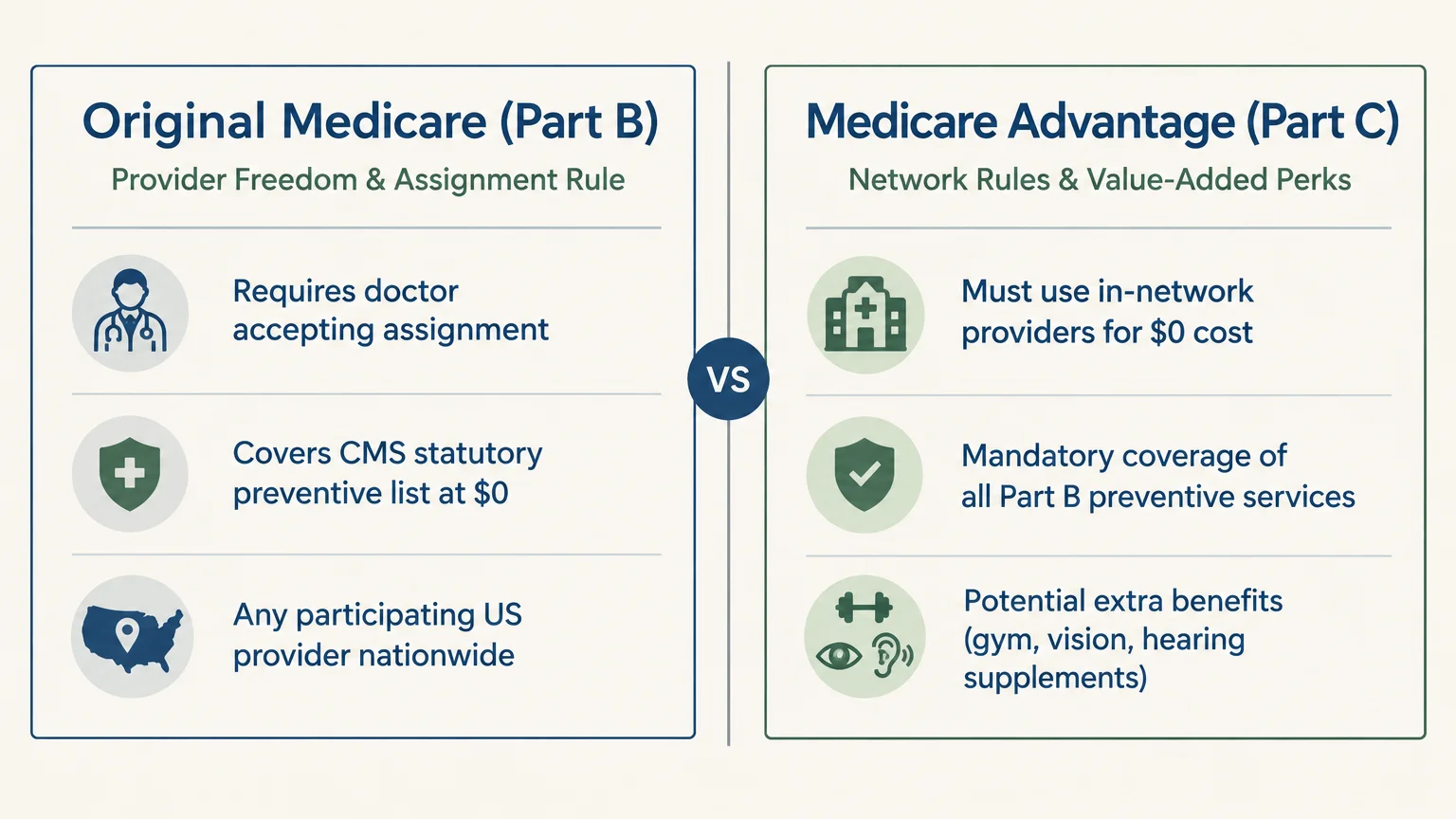
How Original Medicare vs. Medicare Advantage Handle Preventive Care
How you experience free health screenings Medicare provides depends heavily on whether you chose Original Medicare (Parts A and B, often paired with a Medigap supplement) or a private Medicare Advantage plan (Part C). Both pathways must offer the exact same baseline menu of zero-dollar preventive services by federal law.
If you have Original Medicare, your golden rule is verifying that every provider accepts Medicare assignment. There are three legal tiers of providers: participating providers (who always accept assignment), non-participating providers (who can decline assignment on a claim-by-claim basis and charge up to 15% over the Medicare-approved rate), and opt-out providers (who do not bill Medicare at all).
Even if a screening is on the official $0 preventive list, visiting a non-participating doctor who does not accept assignment on your claim allows them to bill you both the 20% coinsurance and the 15% “limiting charge.” Always confirm ahead of time that your doctor, imaging center, anesthesiologist, and pathology lab are participating Medicare providers.
If you are enrolled in a Medicare Advantage plan, your golden rule is staying strictly inside your plan’s provider network. While Medicare Advantage plans frequently offer extra perks—such as a true head-to-toe routine physical exam, dental cleanings, and fitness memberships—going to an out-of-network radiology center for a mammogram or DEXA scan can result in steep out-of-network copays or a complete denial of coverage.

When DIY Isn’t Enough: Getting Help With Medicare Billing Disputes
Most of the time, requesting preventive care using the right terminology and checking your provider’s network status keeps your bills at $0. However, medical coding is notoriously complex, and even conscientious retirees occasionally get hit with erroneous bills.
Here are four specific situations where you should stop fighting the bureaucracy alone and bring in experienced advocates:
- A Preventive Screening Was Miscoded as Diagnostic: If you had zero symptoms and went in strictly for a routine mammogram, bone density scan, or Annual Wellness Visit, yet received a bill for the $283 deductible, first call your doctor’s billing department to request a coding review. If the clinic refuses to update the Current Procedural Terminology (CPT) or diagnosis code, contact your local State Health Insurance Assistance Program (SHIP) for free, one-on-one counseling on filing an official Medicare appeal.
- You Suspect Upcoding or Medicare Billing Fraud: If your Medicare Summary Notice or Explanation of Benefits shows charges for counseling sessions, tests, or medical equipment you never actually received during your wellness visit, reach out to the Senior Medicare Patrol (SMP) through the Administration for Community Living (ACL). Their trained specialists help retirees investigate and report improper Medicare billing practices.
- You Cannot Afford Your $202.90 Monthly Part B Premium: While preventive services are free once you have Part B, paying $202.90 every month out of a modest Social Security check can strain your budget. Contact your state Medicaid agency or use the benefits screening tools from the National Council on Aging (NCOA) to see if you qualify for a Medicare Savings Program (MSP), which can pay your monthly Part B premium and waive your deductibles entirely.
- Healthcare Costs Are Squeezing Your Overall Retirement Withdrawal Plan: When rising Part B premiums, IRMAA high-income surcharges, and diagnostic copays start complicating your tax and retirement account withdrawals, sit down with a Certified Financial Planner (CFP). A qualified planner can help you manage your Modified Adjusted Gross Income (MAGI) to keep your Medicare premiums as low as possible over your lifetime.
Frequently Asked Questions About Medicare Covered Services
Do I have to meet my $283 Part B deductible before getting free Medicare preventive services?
No, you do not have to meet your $283 annual Part B deductible to get qualifying preventive services at $0. Medicare waives both the annual deductible and the 20% coinsurance from day one of the calendar year for approved preventive visits, screenings, and vaccines, provided your doctor accepts Medicare assignment (or is in-network for Medicare Advantage).
Why isn’t an annual head-to-toe physical exam covered by Original Medicare?
By federal statute, Original Medicare is legally prohibited from paying for routine, generalized physical examinations that are not tied to a specific symptom or statutory preventive benefit. Instead, Congress created the Medicare Annual Wellness Visit to focus on evidence-based health risk assessments, cognitive screenings, and personalized schedule planning for targeted screenings like mammograms, colonoscopies, and cardiovascular blood tests.
Are Shingles and RSV vaccines really 100% free under Medicare now?
Yes, as long as you have Medicare Part D prescription drug coverage—either through a standalone Part D plan or a Medicare Advantage plan that includes drug coverage—all adult vaccines recommended by the Advisory Committee on Immunization Practices (ACIP), including Shingrix (shingles), RSV, and Tdap, cost $0 out of pocket. Make sure you receive these Part D vaccines at an in-network pharmacy so the claim processes automatically with zero copay.
What happens if the doctor finds and removes a polyp during my free screening colonoscopy?
When a polyp or tissue is removed during a preventive screening colonoscopy—or when a colonoscopy is performed as a follow-up to a positive stool-based test like Cologuard—Medicare waives the $283 Part B deductible. However, under federal phase-out legislation, a temporary 15% coinsurance still applies in 2026 (unless your Medigap supplement pays it), and that coinsurance will gradually step down until it reaches 0% by 2030.
Does Medicare cover free dental, vision, or hearing exams as preventive services?
Original Medicare does not cover routine dental cleanings, routine eye exams for glasses, or hearing exams and hearing aids. The only exceptions under Original Medicare are limited preventive checks—such as the simple vision screening included during your one-time “Welcome to Medicare” visit or annual glaucoma screenings for high-risk individuals—though many private Medicare Advantage plans offer routine dental, vision, and hearing coverage as extra benefits.
Your Next Steps for a Healthier, Wealthier Retirement
Taking full advantage of the free Medicare services you have already earned is one of the smartest financial moves you can make this year. Pull out your calendar today, log in to your secure Medicare account to check the dates of your last screenings, and schedule your Medicare annual wellness visit along with any overdue vaccines or cancer checks.
This article provides general retirement education and information only. Every retiree’s situation is unique—what works for others may not work for you. For personalized advice, consider consulting a qualified financial professional such as a CFP or CPA.
Last updated: March 2026. Retirement benefits, tax rules, and healthcare regulations change frequently—verify current details with official sources.









Leave a Reply