
If you plan to retire before age 65, your healthcare budget faces a major financial hurdle. Average benchmark silver plan premiums across the Affordable Care Act marketplaces are climbing by 13% for 2027.
This increase marks the second consecutive year of double-digit rate hikes for individual coverage. Without careful planning, rising unsubsidized premiums can disrupt your early retirement cash flow.
Understanding the latest subsidy thresholds and policy changes allows you to protect your savings. Here is what you need to navigate these cost increases effectively.
Understanding the 2027 ACA Premium Surge
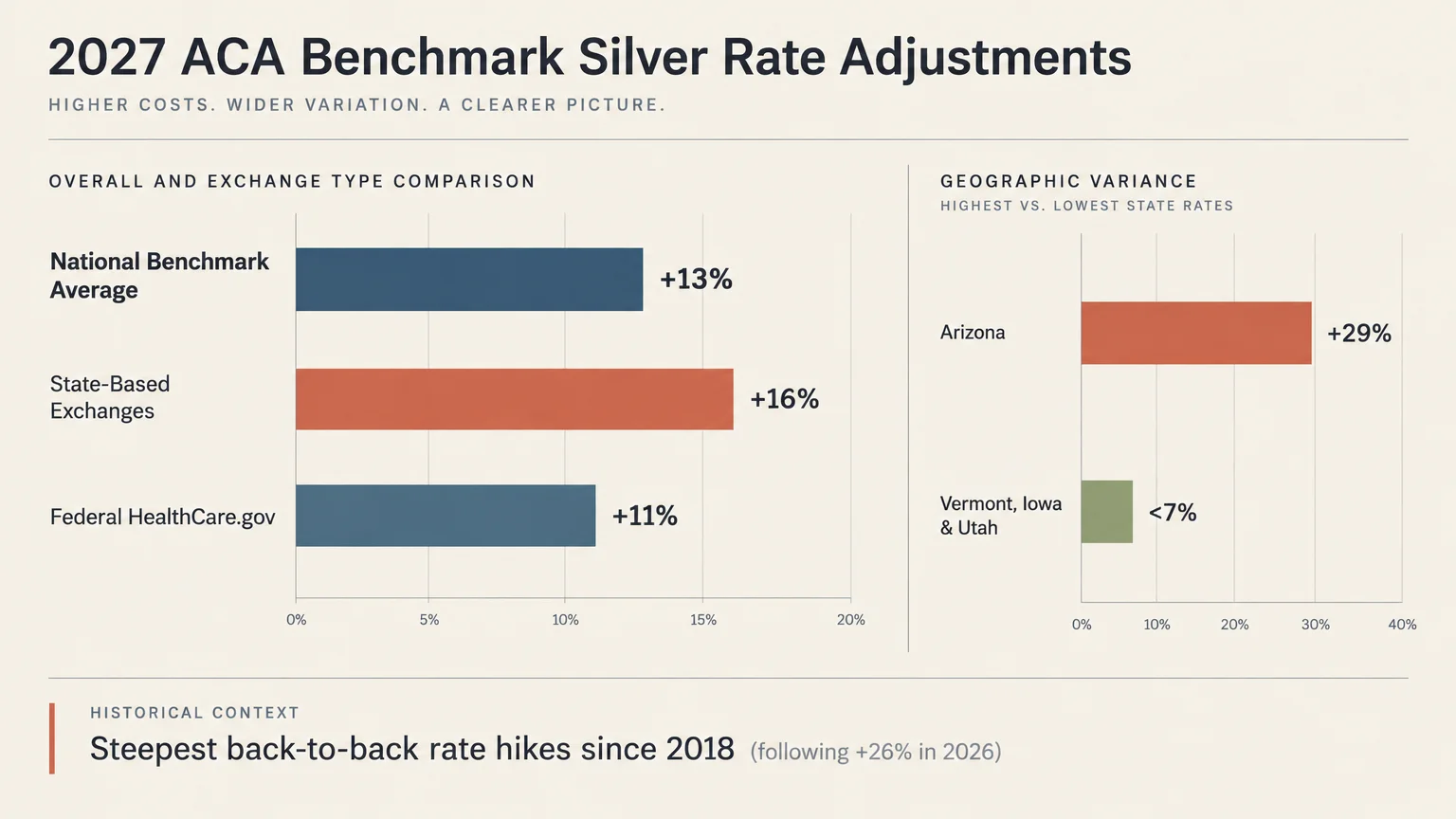
Healthcare expenses remain one of the most unpredictable lines in an early retirement budget. For 2027, average finalized benchmark silver plan premiums are rising by 13% nationwide.
This double-digit surge significantly outpaces employer-sponsored and federal worker health plans, which face an estimated 10% increase. Pre-Medicare retirees who purchase individual coverage must absorb these higher expenses directly.
Federal data analyzed by health policy researchers reveals significant regional variation across platforms. States using the federal HealthCare.gov exchange average an 11% premium increase, while state-based marketplaces average a 16% hike.
Insurers proposed steep adjustments across the country during state rate reviews. Across 276 individual marketplace carriers, the median proposed rate increase was 15%, leading to a weighted average approved increase of roughly 14%.
Geographic location plays a decisive role in your annual rate adjustment. Average proposed state rate changes ranged from under 7% in Vermont, Iowa, and Utah to a striking 29% in Arizona.
This latest adjustment marks the second consecutive year of double-digit rate growth. Following a 26% benchmark increase from 2025 to 2026, this period represents the steepest back-to-back rate hikes since 2018.
Back in 2018, federal policy shifts created widespread volatility throughout the individual health market. Today, early retirees face similar pricing pressures as insurers adjust their risk pools to account for shifting federal regulations.
Key Drivers Behind Rising Marketplace Rates
Insurance carriers file detailed actuarial justifications with state regulators before finalizing annual rates. Several persistent financial pressures drove the 2027 premium increases across individual marketplaces.
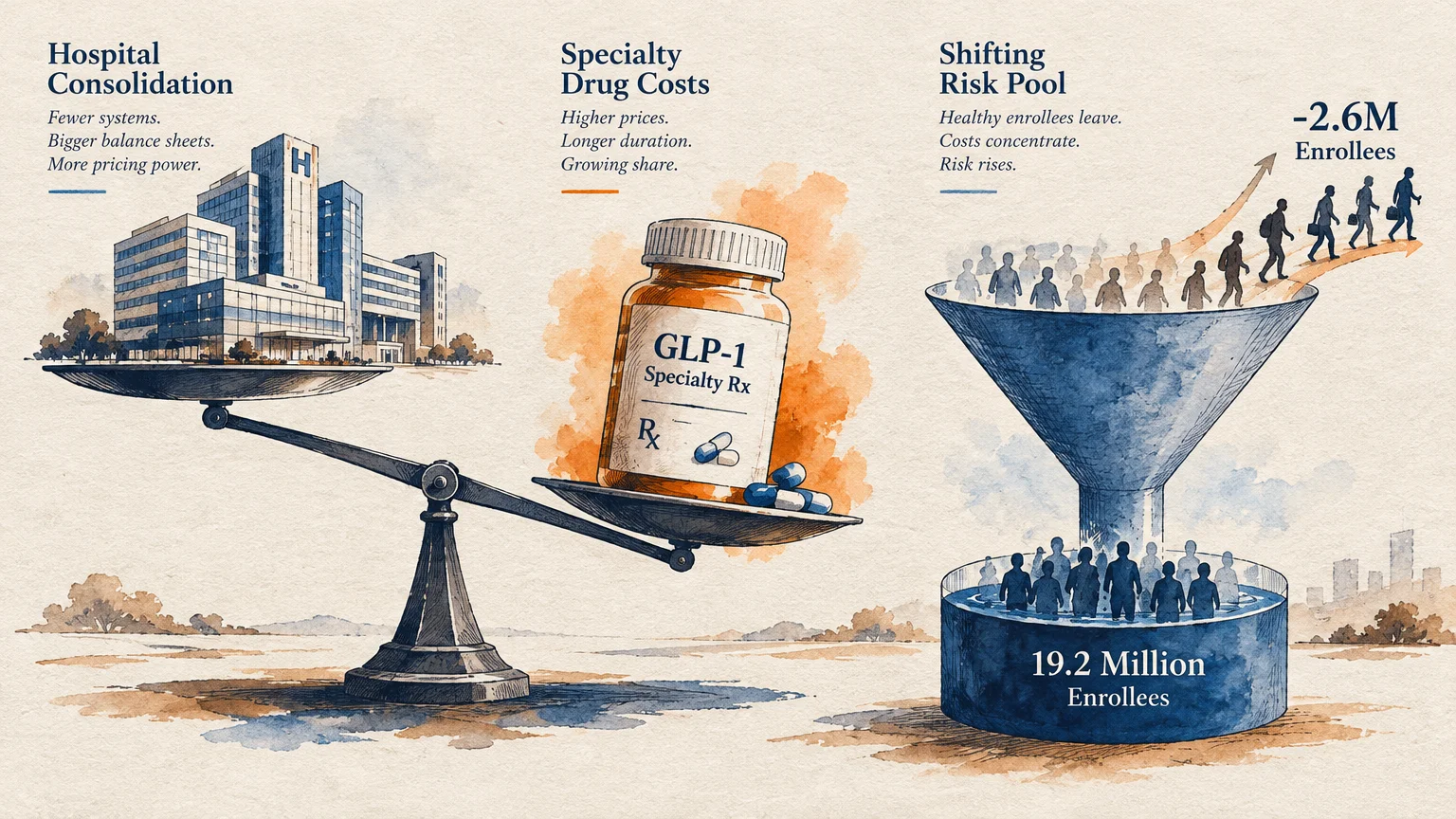
Rising hospital and medical service prices continue to push underlying claims costs higher. Hospital market concentration allows dominant regional health systems to negotiate substantially higher reimbursement contracts with commercial payers.
According to data from the Centers for Medicare & Medicaid Services, broader healthcare price inflation continues to affect the private insurance sector. Medical trend rates have steadily expanded across inpatient and outpatient care.
Skyrocketing prescription drug expenses also play a central role in driving up claims costs. High-cost specialty medications, particularly GLP-1 treatments for diabetes and weight management, have significantly increased insurer liabilities.
Demand for these specialty drugs surged dramatically over the past three years. Because these medications require continuous long-term usage, carriers must set aside substantial capital reserves to cover ongoing monthly pharmacy claims.
The composition of the marketplace risk pool has also deteriorated over the past year. Total ACA marketplace enrollment fell by 2.6 million people to 19.2 million following the expiration of enhanced federal subsidies.
When younger and healthier policyholders drop coverage due to escalating sticker prices, the remaining insured population skews older and sicker. Insurers must raise premiums across the board to cover higher per-enrollee medical claims.
The Subsidy Cliff: What Pre-Medicare Retirees Must Know
Premium tax credits serve as the primary buffer between retirees and escalating healthcare costs. However, the expiration of temporary federal expansions has reintroduced rigid income boundaries.
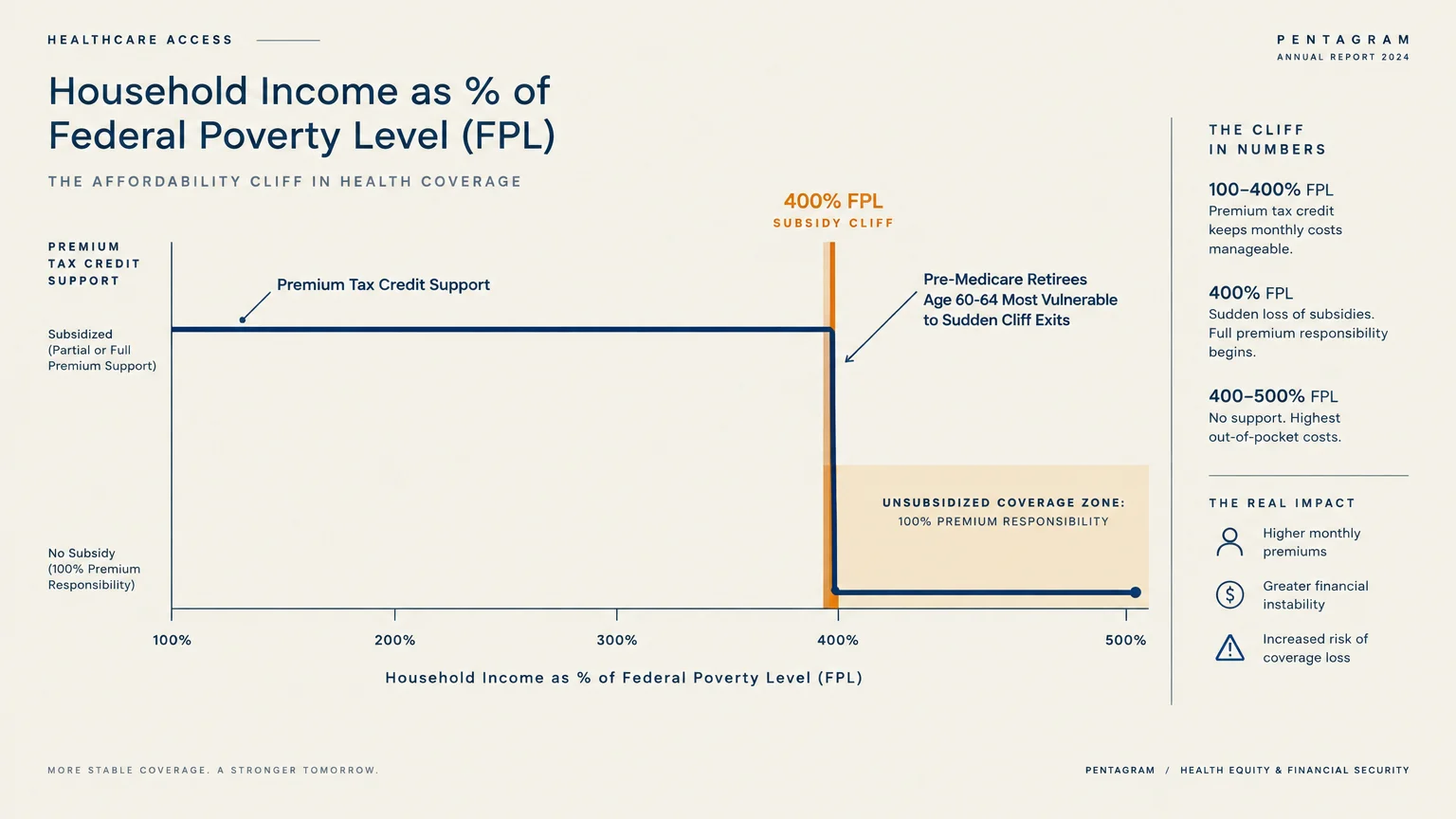
Enhanced premium subsidies established under the American Rescue Plan and extended by the Inflation Reduction Act expired at the end of 2025. This expiration fully reinstated the statutory subsidy cliff for the 2027 plan year.
Under current law, households with incomes above 400% of the Federal Poverty Level (FPL) receive zero premium tax credits. Crossing that threshold by a single dollar eliminates all federal premium assistance immediately.
To calculate 2027 subsidy eligibility, the marketplace relies on the 2026 federal poverty guidelines. Qualifying for premium tax credits requires a household income between 100% and 400% of the poverty level.
For a single individual, the 2027 qualifying income range spans from $15,960 to $63,840. An individual earning $63,850 must pay the full unsubsidized premium regardless of age or medical need.
For a married couple retiring together, the qualifying income range is $21,640 to $86,560. For a four-person household, the eligibility window spans from $33,000 to $132,000.
Enrollees within the eligible income brackets must contribute between 2.15% and 10.22% of their household income toward the benchmark silver plan. The premium tax credit pays the difference between your required contribution and the benchmark plan cost.
Retirees near the lower end of the income spectrum pay a much smaller share of their income. As your income rises toward the 400% FPL ceiling, your required percentage climbs steadily toward the 10.22% maximum.
Financial educator Suze Orman frequently emphasizes the acute financial vulnerability that healthcare creates before age 65.
“Healthcare is the single biggest wild card in retirement planning. If you do not have a concrete plan to pay for medical coverage before Medicare, you risk draining your nest egg prematurely.” — Suze Orman, Financial Author and Educator
Another critical consequence of the expired subsidy rules involves year-end tax reconciliation. There is no longer a cap on repaying excess advance premium tax credits when you file your tax return.
If your actual 2027 Modified Adjusted Gross Income exceeds 400% FPL due to unexpected capital gains or retirement withdrawals, you must repay every dollar of advance subsidy received.
Under earlier temporary relief measures, repayment caps protected middle-income households from catastrophic tax repayments. Now, an oversight can trigger an unexpected tax bill amounting to tens of thousands of dollars.

Comparing 2027 Plan Tiers and Out-of-Pocket Costs
When premium prices climb, enrollees often consider switching coverage tiers to reduce monthly premiums. However, lowering your premium usually forces you to accept higher deductibles and out-of-pocket limits.
In 2026, net after-subsidy premiums jumped by an average of 58% nationwide after enhanced credits ended. In response, millions of policyholders downgraded to cheaper Bronze plans to keep their monthly cash outflows manageable.
This migration caused the average marketplace deductible to surge by over $1,000, reaching $3,786. Enrollees saved on monthly premiums but took on substantial exposure to front-end medical bills.
Before selecting a plan tier, compare the fundamental trade-offs between coverage levels for the 2027 coverage year.
| Plan Tier | Actuarial Value | Average Premium Level | Deductible & Cost Sharing | Best Suited For |
|---|---|---|---|---|
| Bronze | 60% | Lowest monthly premium | High deductibles (often $6,000+); high out-of-pocket maximums | Healthy retirees wanting catastrophic protection and lower premiums |
| Silver | 70% (up to 94% with CSRs) | Moderate monthly premium; benchmark for tax credits | Moderate deductibles; eligible for Cost-Sharing Reductions below 250% FPL | Retirees with qualifying incomes below 250% FPL or regular medical needs |
| Gold | 80% | Higher monthly premium | Low deductibles; predictable copays for doctor visits and prescriptions | Individuals managing ongoing chronic conditions or scheduled surgeries |
| Catastrophic | Under 60% | Minimal premium | Maximum statutory deductible ($8,700 individual in 2027) | Individuals under 30 or those with an approved hardship exemption |
Silver plans remain the pivot point of the marketplace because subsidies benchmark directly against the second-lowest-cost silver plan. If your income falls below 250% FPL, Silver plans unlock Cost-Sharing Reductions that slash deductibles drastically.
These Cost-Sharing Reductions effectively transform a Silver plan into the equivalent of a Gold or Platinum policy. Enrollees qualifying for maximum reductions often pay negligible deductibles and minimal prescription copayments.
Reviewing annual out-of-pocket maximums is essential before downgrading to a Bronze plan. One major hospitalization can quickly wipe out several years of premium savings.

New HSA Rules Under the One Big Beautiful Bill Act
Recent federal legislation significantly changed how Health Savings Accounts pair with individual health insurance. Signed into law on July 4, 2025, the One Big Beautiful Bill Act (Public Law 119-21) introduced key flexibilities.
Referred to by federal agencies as the Working Families Tax Cuts legislation, this law reshaped marketplace rules. Under provisions active for 2026 and 2027, all ACA-compliant Bronze and Catastrophic plans can pair with an HSA.
Individual policies no longer need to satisfy traditional high-deductible health plan benefit design structures to qualify. This reform allows pre-retirees to build tax-sheltered medical savings while choosing lower-premium bronze policies.
For standard high-deductible health plans in 2027, the Internal Revenue Service sets specific statutory limits. The minimum annual deductible is $1,750 for self-only coverage and $3,500 for family coverage.
The statutory maximum out-of-pocket limit for qualified plans in 2027 is $8,700 for individual policies and $17,400 for families. These caps protect policyholders against catastrophic medical bills resulting from severe illness.
Contributing to an HSA directly reduces your Modified Adjusted Gross Income through an above-the-line deduction. This deduction can prevent you from crossing the 400% FPL threshold, safeguarding your premium tax credits.
Retirees aged 55 and older can also make an additional $1,000 annual catch-up contribution. This extra deduction provides valuable financial flexibility when fine-tuning your taxable income near year-end.

Crucial Marketplace Rule Changes for the 2027 Plan Year
Beyond premium price increases, significant regulatory updates alter how consumers select and maintain their coverage. The 2027 Notice of Benefit and Payment Parameters final rule introduced several operational mandates.
HealthCare.gov and state exchanges now enforce stricter pre-enrollment income and eligibility verification procedures. These measures limit automatic re-enrollment for certain subsidized enrollees whose reported financial records show data discrepancies.
Legal challenges have created short-term exceptions to some planned administrative rules. On July 16, 2026, a federal court issued a preliminary injunction pausing eight specific provisions, including automatic tax credit denials for failure to reconcile.
Despite that temporary legal injunction, early retirees should still document their income sources meticulously. Clear tax records prevent administrative delays during exchange verification reviews.
The 2027 regulations permanently eliminate standardized plan options on HealthCare.gov. Without standardized deductibles and copayment structures, consumers must examine plan formularies and cost structures more carefully.
Comparing policies now requires auditing individual summary of benefits documents line by line. Insurers have greater latitude to restructure cost-sharing tiers, making careful plan analysis essential.
Regulators also ended the year-round Special Enrollment Period for low-income individuals. You can no longer enroll mid-year simply because your income is below 150% of the poverty level.
New non-citizen eligibility rules restrict marketplace subsidies strictly to green card holders, COFA migrants, and Cuban-Haitian entrants. Other lawfully present immigrants can no longer access premium tax credits.
Early retirees relying on expanded Medicaid must prepare for new administrative requirements. Under OBBBA mandates, able-bodied expansion adults up to age 64 must document 80 hours per month of work, volunteering, or community service.

Strategic Moves to Lower Your Health Insurance Costs
Managing health insurance expenses requires proactive planning well before open enrollment ends. Pre-Medicare retirees possess several financial levers to control their annual premiums.
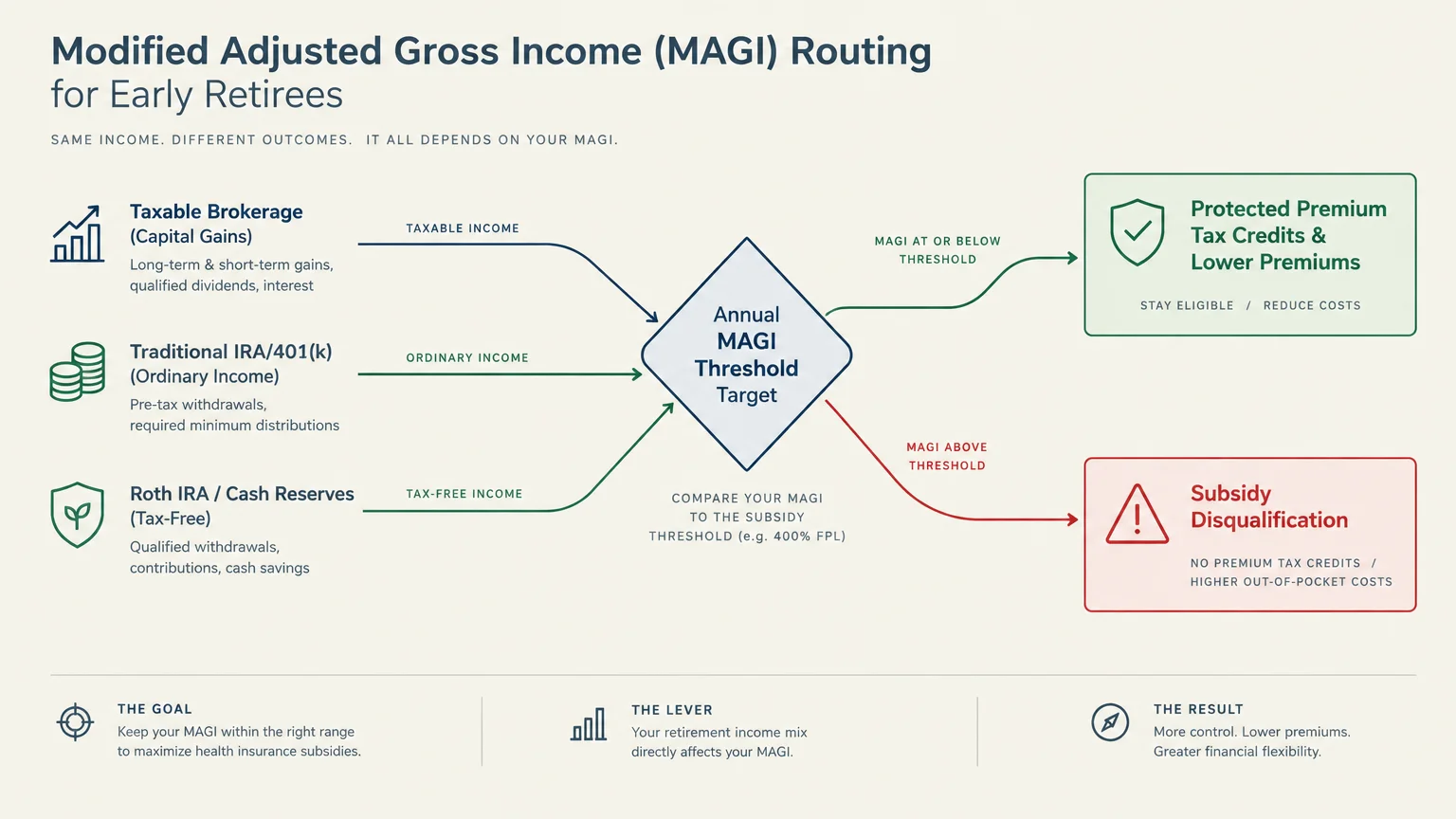
Because ACA subsidies depend directly on your Modified Adjusted Gross Income, controlling recognized taxable income is paramount. Strategic withdrawals from different asset classes allow you to access living cash while keeping your reported MAGI low.
Retirement guidance from organizations like AARP emphasizes planning pre-Medicare healthcare costs years in advance. Coordinated income planning prevents unexpected premium spikes during your early retirement years.
Consider these practical financial strategies to minimize your 2027 marketplace expenses:
- Draw from cash reserves: Spend down non-taxable cash savings or checking accounts to cover living expenses without increasing your taxable income.
- Utilize Roth distributions: Withdraw tax-free principal and earnings from Roth IRAs, which do not count toward your marketplace MAGI calculations.
- Max out Health Savings Accounts: Contribute deductible dollars to an HSA if you enroll in an eligible Bronze plan to reduce your adjusted gross income.
- Time your capital gains carefully: Avoid selling appreciated taxable assets in years where your baseline income already approaches the 400% FPL ceiling.
- Delay taxable Roth conversions: Postpone large traditional IRA conversions until age 65 when you transition to Medicare and exit the ACA exchange.
Carefully balancing these distribution sources can keep your income comfortably below the 400% FPL threshold. A modest reduction in taxable income can save thousands of dollars in annual premiums.
For retirees interested in consumer protection and healthcare costs, broader market dynamics remain important. As Senator Elizabeth Warren has noted regarding financial security, healthcare costs can quickly destabilize household budgets.
“Families cannot achieve true financial security when a single illness or an unexpected spike in health insurance premiums can wipe out years of disciplined savings.” — Elizabeth Warren, U.S. Senator and Consumer Advocate
Maintaining a dedicated medical buffer fund inside an accessible savings account protects your long-term portfolio. Having cash on hand ensures you never need to make sudden taxable withdrawals to cover unexpected deductibles.
Managing Early Retirement Withdrawals to Protect Subsidies
Your withdrawal strategy determines your eligibility for premium assistance on the exchange. Understanding how various retirement income streams impact your MAGI calculation is crucial.
Marketplace MAGI includes taxable wages, taxable Social Security benefits, pension payouts, and traditional IRA distributions. It also adds back tax-exempt municipal bond interest, which catches many conservative retirees by surprise.
If you need $80,000 to cover annual living costs, pulling the entire sum from a traditional 401(k) creates $80,000 of MAGI. For a single retiree, that pushes income far past the $63,840 subsidy cliff.
Instead, you might withdraw $45,000 from your traditional IRA and fund the remaining $35,000 from cash savings or a Roth account. This approach generates substantial living liquidity while keeping your official MAGI at $45,000.
At an income of $45,000, a single retiree stays well below the 400% FPL limit and qualifies for premium tax credits. The resulting monthly subsidy can save you hundreds of dollars on benchmark coverage.
Retirees can consult educational resources on Investopedia to study tax-efficient withdrawal sequences. Preserving your capital requires coordinating your healthcare subsidies with your broader investment plan.
Similarly, married couples with an $86,560 cliff can split withdrawals between taxable accounts, cost basis recovery, and pretax funds. Blending these accounts keeps household income within subsidized territory.
Important Deadlines for 2027 Open Enrollment
Navigating marketplace rate changes requires strict adherence to statutory enrollment deadlines. Missing these dates can leave you uninsured or trapped in an uncompetitive plan for the entire year.
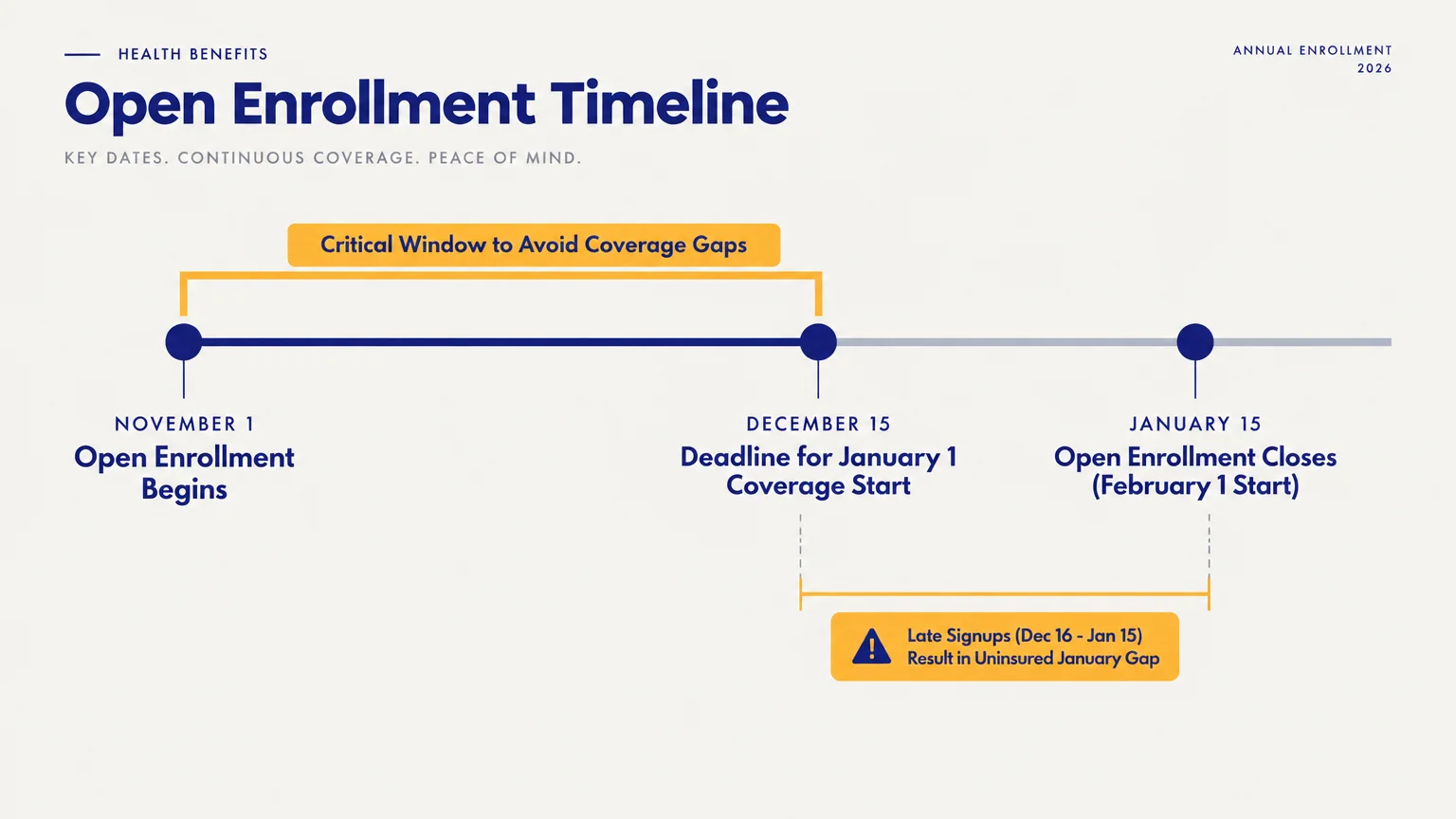
Open enrollment for 2027 coverage began nationwide on November 1, 2026. The standard enrollment window runs through January 15, 2027, on HealthCare.gov and across most state-based exchanges.
If you want your new health policy to take effect on January 1, 2027, you must complete enrollment by December 15, 2026. Enrolling between December 16 and January 15 pushes your coverage start date to February 1.
Because automatic re-enrollment rules face tighter scrutiny this year, never rely on passive plan rollover. Log into your exchange account before December 15 to update your income estimates and review provider networks.
A few state-based exchanges maintain slightly extended deadlines past January 15. Check your specific state marketplace platform to verify whether your local exchange offers additional days to finalize selections.
What Can Go Wrong: Critical Marketplace Mistakes
Navigating individual health insurance during early retirement involves several financial traps. Avoiding these common missteps protects your household cash flow from costly surprises.
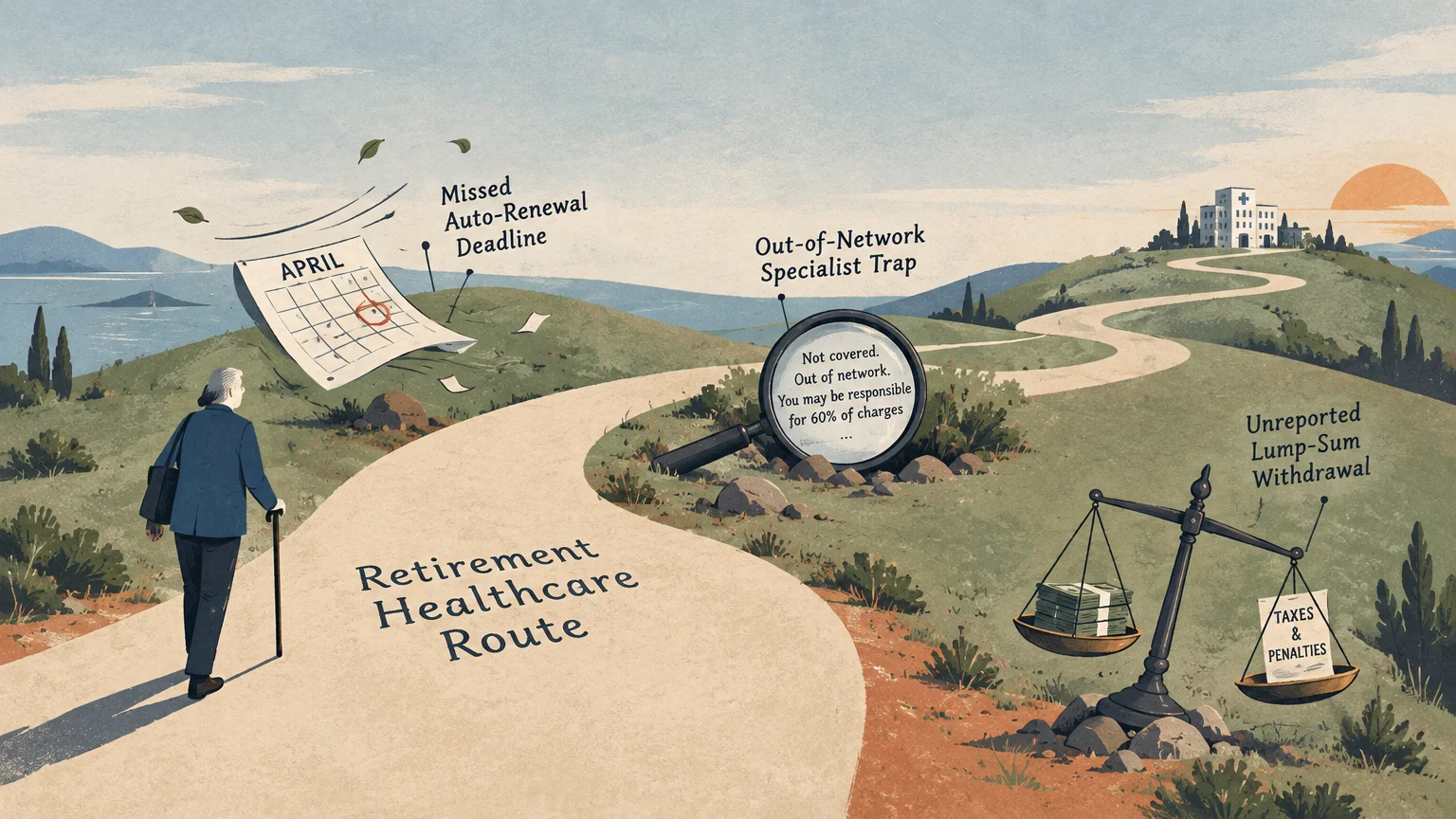
The most dangerous mistake is accidentally crossing the 400% FPL subsidy cliff. Realizing an unexpected capital gain or taking an unbudgeted IRA distribution can push your income over the limit by a few dollars.
Because the repayment limitation cap has expired, exceeding the cliff triggers a mandatory 100% clawback of all advance tax credits. That error can generate an unexpected five-figure tax bill on your federal return.
Another frequent trap involves unexpected capital gain distributions from mutual funds held in taxable brokerage accounts. Mutual funds often declare capital gains in December, creating phantom income that pushes retirees over the subsidy cutoff.
Another major error is failing to re-verify provider networks before auto-renewing. Insurers frequently adjust physician networks, prescription drug formularies, and hospital contracts between plan years.
Finally, early retirees receiving Medicaid coverage under the expansion must avoid missing the new 80-hour monthly work or community service verification. Failing to document qualifying activities can lead to rapid coverage termination.

When to Consult a Professional
While many retirees navigate marketplace enrollment independently, certain complex situations warrant expert guidance. Professional assistance can help prevent costly tax penalties and coverage disruptions.
You should consider consulting a qualified professional in the following specific scenarios:
First, consult a Certified Financial Planner or CPA if your projected retirement income falls within 10% of the 400% FPL threshold. A financial planner can structure distributions to ensure you do not inadvertently trigger the subsidy cliff.
Second, seek guidance if you retire mid-year and must choose between COBRA continuation and marketplace coverage. A benefits specialist can evaluate whether subsidized exchange plans offer better financial protection than maintaining your employer plan.
Third, consult a tax advisor if your income includes complex assets such as commercial real estate, business partnerships, or variable royalties. Properly timing depreciation and deductions is essential for accurately forecasting marketplace MAGI.
Fourth, reach out to a professional if you receive an employer severance package or deferred compensation payout. Structuring the timing of severance payments can keep your taxable income eligible for marketplace tax credits.
Frequently Asked Questions
How much are Obamacare premiums increasing for 2027?
Nationwide, average benchmark silver plan premiums are increasing by 13% for 2027. Rate changes vary by state, ranging from under 7% in Vermont and Utah to 29% in Arizona.
What is the income cutoff for ACA subsidies in 2027?
Subsidies cut off at 400% of the Federal Poverty Level. For 2027, the income threshold is $63,840 for a single individual and $86,560 for a two-person household.
What happens if my income exceeds the 400% FPL limit?
Because enhanced subsidies expired at the end of 2025, the subsidy cliff has returned. If your income exceeds 400% FPL, you must repay 100% of the advance tax credits received.
Can I pair a Health Savings Account with a Bronze plan in 2027?
Yes. Under the One Big Beautiful Bill Act, all ACA-compliant Bronze and Catastrophic plans can pair with an HSA, even if they do not meet traditional HDHP design rules.
When is the deadline to enroll in 2027 ACA health coverage?
Open enrollment runs from November 1, 2026, through January 15, 2027. You must enroll by December 15, 2026, for coverage starting January 1, 2027.
Practical Next Steps for Your 2027 Health Coverage
Take action immediately by reviewing your current health policy on HealthCare.gov or your state marketplace before the December 15 deadline. Compare available plan tiers, verify your prescription drug coverage, and recalculate your projected 2027 income.
Careful income planning and proactive plan selection remain your most effective tools to combat rising healthcare premiums. By optimizing your withdrawals and leveraging tax-advantaged accounts, you can protect your savings until Medicare takes over.
This article provides general retirement education and information only. Every retiree’s situation is unique—what works for others may not work for you. For personalized advice, consider consulting a qualified financial professional such as a CFP or CPA.
Last updated: November 2026. Retirement benefits, tax rules, and healthcare regulations change frequently—verify current details with official sources.









Leave a Reply