
Most retirement spreadsheets track groceries, utilities, and travel—yet leave out the everyday services that become essential as you age. When your physical stamina shifts or tax rules tighten, paying professionals stops being optional.
According to the 2026 Retirement Confidence Survey from the Employee Benefit Research Institute and Greenwald Research, 2 in 5 retirees report higher-than-expected expenses. Knowing which services trigger those budget surprises lets you plan ahead.
Four overlooked service categories—in-home caregiving, uncovered dental and vision care, home upkeep and modifications, and specialized tax or legal advice—can reshape your retirement budget. Here is what they actually cost and how to prepare.
Why Your Retirement Budget Often Misses Service Costs
Working years train you to think in terms of monthly bills, not shifting service needs. When you retire, the balance between what you do yourself and what you hire out gradually flips.
That shift catches many households off guard and erodes financial peace of mind. In the 2026 Retirement Confidence Survey, overall confidence in having enough money to live comfortably fell to 64%—including 73% of retirees, down from 78% in 2025.
Worker confidence dropped to 61%, down from 67% in 2025, hitting its lowest level since 2017. Half of retirees also worry that rising housing costs will squeeze their retirement plans.
Surveys consistently show that spending surprises stem from underestimating non-discretionary services. In Schroders’ May 2026 U.S. Retirement Survey, 49% of retirees reported higher-than-expected expenses, 58% did not know how long their savings would last, and 64% wished they had planned more beforehand.
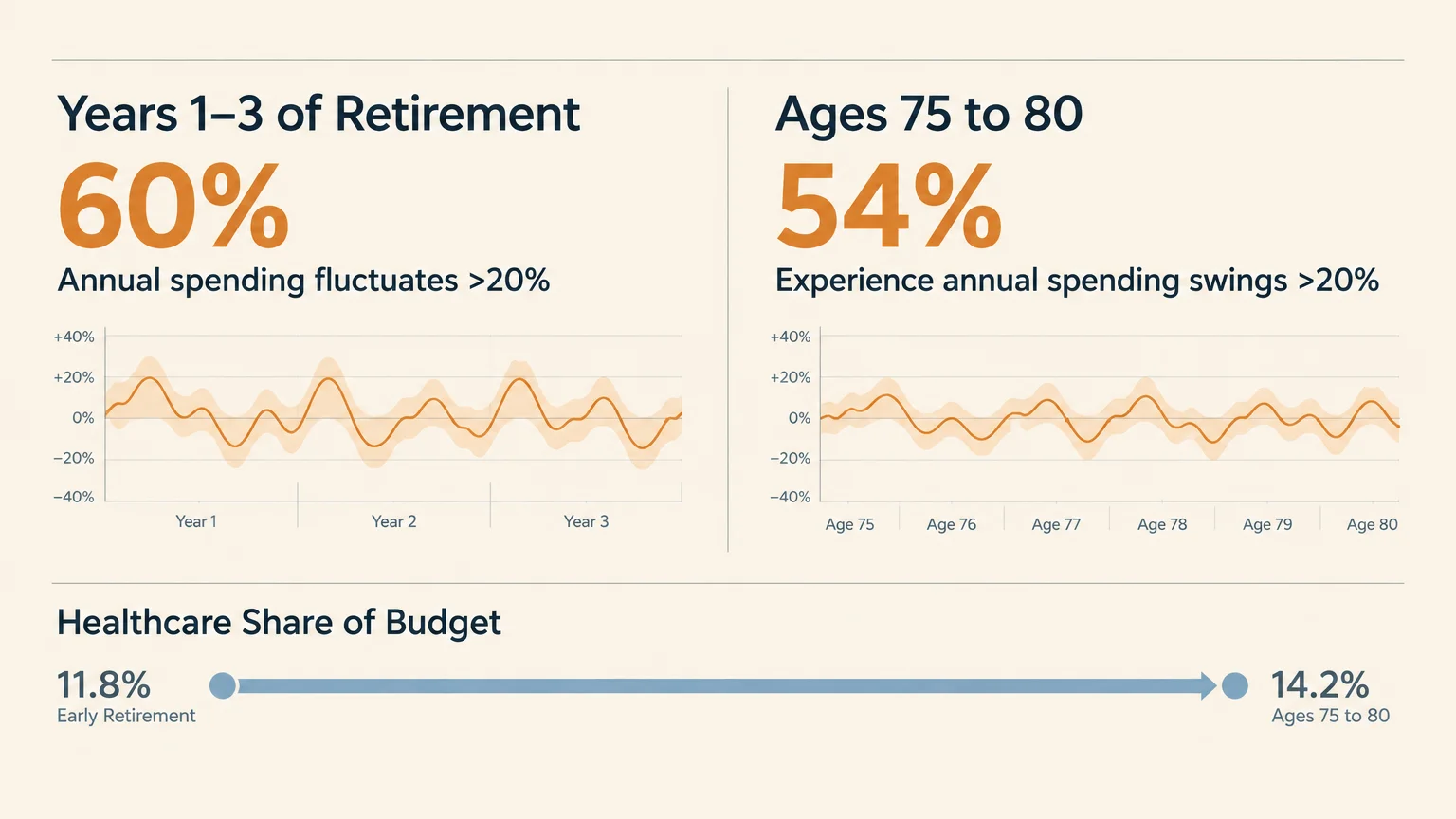
Your spending rarely moves in a neat, inflation-adjusted line from year to year. According to J.P. Morgan Asset Management’s December 2025 Retirement by the Numbers report, 60% of new retirees see annual spending fluctuate by more than 20% in their first three years.
Even later in retirement, big swings remain common rather than rare. J.P. Morgan Asset Management found that 54% of retirees aged 75 to 80 still experience annual spending swings exceeding 20% up or down.
Federal spending data confirms how age reshapes where your dollars go. The U.S. Bureau of Labor Statistics Consumer Expenditure Survey reported average spending across all U.S. consumer units of $81,905 in 2025, up 4.3% from 2024.
In the 2024 age breakdown, households headed by someone 65 or older averaged $61,432 per year—specifically $65,354 for ages 65 to 74 and $55,834 for ages 75 and older. While total spending dipped with age, healthcare’s share climbed from roughly 11.8% to 14.2%.
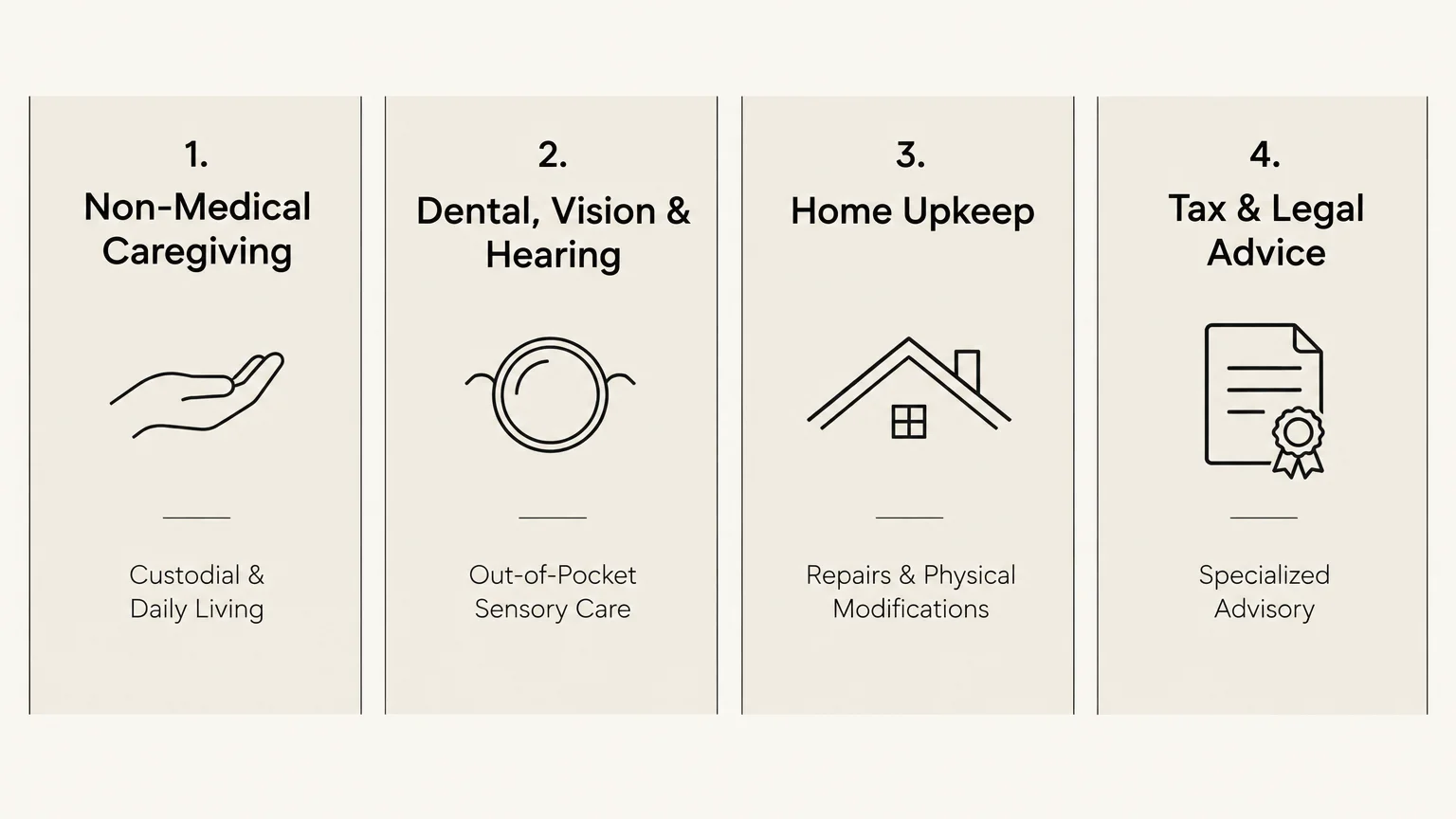
As energy declines or health becomes more complex, hidden retirement costs appear across four core services. Building line items for these services retirees pay for protects your long-term savings from sudden shocks.
01 Non-Medical In-Home Caregiving and Long-Term Support
Most people picture retirement as active travel and hobbies, not help with daily routines. Yet according to the U.S. Administration for Community Living (ACL) and CareScout, 7 out of 10 people turning 65 will require long-term care at some point.
The biggest shock for families is how little Original Medicare actually pays for this assistance. Official guidance on Medicare.gov specifies that Original Medicare does not pay for long-term custodial care when that is the only care you need.
Custodial care includes non-medical help with bathing, dressing, cooking, cleaning, and errands. Medicare covers only limited, short-term skilled nursing or home health rehabilitation, typically following a qualifying hospital stay.
When you hire help privately, hourly charges add up faster than most savers anticipate. The CareScout and Genworth 2025 Cost of Care Survey, released in March 2026, puts the national median rate for a non-medical caregiver at $35 per hour.
That hourly rate rose 3% from $34 in 2024, reflecting converged pricing between homemaker services and home health aides. At 44 hours per week for 52 weeks, non-medical in-home help reaches $80,080 per year.
Comparing care formats shows how quickly expenses cross major thresholds. Here are the national median figures from the CareScout and Genworth 2025 Cost of Care Survey:
- Non-medical in-home caregiver: $35 per hour, or $80,080 per year for 44 weekly hours.
- Skilled nursing in the home: $90 per hour for licensed clinical visits.
- Adult day health care: $95 per day, or $24,700 per year for five days a week.
- Assisted living community (private room): $6,200 per month, or $74,400 per year, up 5% from $70,800 in 2024.
- Nursing home care: $114,975 per year for a semi-private room and $129,575 per year ($10,798 per month) for a private room.
Notice the financial tipping point between staying home and moving to senior housing. At $35 per hour, in-home caregiving surpasses the median cost of assisted living once you need roughly 41 hours of help per week.
Relying entirely on unpaid relatives carries steep hidden costs too. AARP estimated in 2025 that unpaid family caregivers spend an average of $7,200 per year out of their own pockets.
Caregiving pressures often spill directly into the next generation’s finances. In the 2026 EBRI survey, 34% of caregiving workers gave financial support to their care recipient, and 20% took on new or additional debt because of caregiving.
Practical Steps to Prepare for Care Costs
Start by modeling a modest weekly care allowance—such as 10 to 15 hours of in-home support—into your later-life retirement planning projections. Testing those numbers now reveals whether your cash flow or home equity can handle gradual increases.
Explore adult day health care early if a spouse develops cognitive or mobility challenges. At $95 per day, structured daytime programs offer social engagement and relief for family caregivers at a fraction of round-the-clock private care.
If you are in your 50s or early 60s, compare dedicated long-term care insurance, hybrid life-care policies, or earmarked brokerage reserves. Keeping a dedicated care bucket separate from daily spending prevents panic-selling during market downturns.

02 Dental, Vision, Hearing, and Out-of-Pocket Healthcare
Turning 65 and enrolling in Medicare feels like crossing a financial finish line. Yet Fidelity Investments’ July 2026 Retiree Health Care Cost Estimate warns that 54% of pre-retirees wrongly think Medicare covers all health costs.
Fidelity projects a 65-year-old retiring in 2026 will spend $185,500 on medical expenses throughout retirement, up 7.5% from $172,500 in 2025. For a couple retiring together, that estimate climbs to roughly $371,000.
Even those large projections leave out several major service categories. Fidelity’s figure excludes most dental care, over-the-counter medications, and long-term care.
Other independent models put lifetime healthcare obligations even higher when supplemental insurance is included. Milliman’s 2026 Retiree Health Cost Index, cited by AARP in August 2026, estimates $297,000 for a healthy 65-year-old man and $340,000 for a healthy 65-year-old woman using Original Medicare and Medigap.
Everyday Medicare exclusions catch many retirees off guard at the dentist or optometrist. Original Medicare Parts A and B generally do not cover routine dental cleanings, fillings, crowns, or dentures.
Original Medicare also excludes routine eye exams for glasses or contact lenses, as well as routine hearing exams and hearing aids. Only narrow medical exceptions—such as cataract-related eyewear or diabetic eye exams—receive coverage.
On top of uncovered services, monthly premiums and deductibles consume a steady slice of retirement income. KFF reported in May 2026 that Medicare beneficiaries spent an average of $6,459 out of pocket on healthcare, including supplemental premiums, in 2023.
Schroders’ 2026 survey found retirees spend an average of 16% of their monthly income on healthcare. Meanwhile, 58% of respondents expected Medicare to cover more of their bills than it actually does.
Staying current on annual Medicare adjustments helps you avoid budget shortfalls:
- Medicare Part B costs: The standard monthly premium is $202.90 in 2026 with a $283 annual deductible, while the 2026 Medicare Trustees Report projects $209.50 per month and a $292 deductible for 2027.
- Temporary Part B rebate: In October 2026, federal officials announced a one-time $90 rebate for roughly 20.8 million Original Medicare enrollees.
- Medicare Part D drug caps: The annual out-of-pocket prescription drug cap increases from $2,100 in 2026 to $2,400 in 2027, and the maximum standard deductible rises from $615 to $700.
- Part D monthly premiums: Federal projections put average stand-alone Part D premiums moving from $35.09 per month in 2026 to $36 per month in 2027 as a temporary subsidy demonstration ends.
When you pay out of pocket for sensory and dental services, unit prices vary widely by product tier. Over-the-counter hearing aids for mild-to-moderate loss typically run $200 to $1,500 per pair, while full-service prescription hearing aids commonly cost $1,500 to $2,500 or more per pair.
Standalone senior dental plans generally cost $20 to $60 per month, though annual benefits are often capped at $1,000 to $2,000. Standalone vision insurance typically runs $10 to $25 per month.
How to Handle Uncovered Care Without Overpaying
Run the math before buying standalone dental or vision policies, because annual benefit caps can make premiums a poor value. If you only need routine cleanings and occasional exams, paying cash or using a dentist’s in-house discount plan may cost less.
If you wear hearing aids or anticipate major dental work like crowns, build a dedicated medical reserve of a few thousand dollars per year. Contributing to a Health Savings Account while still working and enrolled in a qualifying high-deductible plan creates tax-free dollars for these expenses later.
During Medicare Open Enrollment each fall, compare whether a Medigap policy paired with Part D or a Medicare Advantage plan fits your doctors and prescriptions best. Advantage plans often bundle dental, vision, and hearing allowances, though network rules and prior authorizations require careful review.
03 Home Maintenance, Yard Work, and Aging-in-Place Modifications
Paying off your mortgage does not make living at home free. As climbing ladders, shoveling snow, or mowing steep lawns becomes risky, household chores quickly turn into recurring service contracts.
Most older Americans want to remain right where they live. AARP’s Home and Community Preferences Survey found that 75% of adults age 50 and older want to stay in their current home as long as possible.
However, wanting to stay and living in a safe, accessible house are two very different things. In that same AARP survey, 43% of older adults expect their home will need modifications to support aging in place safely.
Housing affordability also drives tough decisions for people who decide staying put costs too much. Among older adults planning to relocate, 60% cite lowering housing and maintenance costs as a primary reason.
America’s housing stock was largely built without aging bodies in mind. Fewer than 10% of U.S. homes currently feature basic accessibility elements like a zero-step entry, single-floor living, wide doorways, and accessible bathrooms.
Demand for contractors who specialize in accessibility upgrades has surged in recent years. A National Association of Home Builders survey showed 73% of remodelers reported rising requests for aging-in-place features over the past five years.
Skilled trade shortages and persistent inflation in building materials keep those renovation quotes elevated, according to the Harvard Joint Center for Housing Studies’ Improving America’s Housing 2025 report. Understanding typical 2026 modification prices helps you budget realistically:
- Targeted safety upgrades: Grab bars run $100 to $350 each installed, lever door handles cost $100 to $250 per door, comfort-height toilets run $400 to $1,000, and wheelchair ramps average roughly $1,110.
- Bathroom and whole-home retrofits: A curbless walk-in shower runs $6,000 to $10,000, a full accessible bathroom remodel costs $8,000 to $25,000, and a whole-home retrofit spans $18,000 to $75,000.
- Mobility equipment: Straight stair lifts run $2,200 to $8,500, curved stair lifts cost $7,500 to $15,000 or more, walk-in tubs range from $4,000 to $18,000, and residential elevators run $30,000 to $60,000 or more.
Beyond one-time remodeling projects, outsourcing routine outdoor maintenance creates a steady monthly bill. According to September 2026 Angie’s List data, routine residential lawn care maintenance runs $100 to $500 per month, with a $300 national average per project.
Single mowing visits average $50 to $205 on Angie’s List, while LawnStarter’s October 2026 estimates put basic mowing at $42 to $68 per visit. Seasonal tasks add extra spikes, with leaf removal averaging $107 to $435 and tree trimming running $430 to $640 per tree.
Some home accessibility work may offer partial tax relief if it is driven by a medical condition. IRS Publication 502 explains when medically necessary accessibility modifications qualify as itemized medical deductions, provided they do not simply increase general property value.
Budgeting Strategies for Your Home
Set aside a separate annual home-service fund alongside your regular property tax and insurance escrow. Treating yard care, gutter cleaning, and minor handyman repairs as fixed monthly bills prevents you from dipping into principal unexpectedly.
If you plan a kitchen or bathroom refresh in your late 60s, integrate universal design features while contractors are already on site. Adding blocking behind shower walls for future grab bars costs very little during framing and saves thousands later.
04 Tax Preparation, Financial Advice, and Estate Legal Services
Filing taxes during your working years often takes one W-2 and a standard deduction. Retirement replaces that simplicity with multiple income streams, strict withdrawal deadlines, and costly penalties if you miss a rule.
Despite that added complexity, most retirees still try to manage withdrawals alone. Schroders’ 2026 survey found that only 32% of retirees work with a financial advisor, even though 69% worry about not knowing how best to draw down assets.
Several federal rules collide in your 70s, turning small filing errors into thousands of dollars in avoidable taxes. Required Minimum Distributions under the SECURE 2.0 Act begin at age 73 for people born between 1951 and 1959, and age 75 for those born in 1960 or later.
Charitably minded retirees age 70 and a half or older can use Qualified Charitable Distributions to satisfy RMDs tax-free. For 2026, the IRS Qualified Charitable Distribution limit is $111,000 per person.
Your withdrawal order also controls how much of your Social Security check gets taxed and what you pay for Medicare. Up to 85% of Social Security benefits can face federal income tax depending on your combined income.
Meanwhile, Medicare Income-Related Monthly Adjustment Amount surcharges raise Part B and Part D premiums based on Modified Adjusted Gross Income from two years earlier. In 2026, IRMAA surcharges begin above $218,000 for married couples filing jointly based on 2024 MAGI.
Smart bracket management can keep investment gains completely tax-free for many middle-income couples. Under IRS Revenue Procedure 2025-32, the 2026 0% long-term capital gains bracket extends up to $49,450 of taxable income for single filers and $98,900 for married couples filing jointly, alongside a $32,200 baseline joint standard deduction before age-65 add-ons.
Recent legislative and agency shifts make professional tax guidance even more valuable in 2026. The One Big Beautiful Bill Act introduced new 2026 provisions, including an enhanced senior deduction for taxpayers 65 and older and an updated $15 million estate tax exemption.
At the same time, 27% IRS workforce reductions have reduced live taxpayer assistance when questions arise. Hiring qualified tax, financial, and estate professionals comes with clear market price ranges in 2026:
- Comprehensive tax planning: One-time tax plans typically cost $1,500 to $5,000 for individuals, while ongoing tax-planning subscriptions run $2,000 to $10,000 or more per year.
- Hourly CPA guidance: Experienced CPAs and tax advisors in major markets commonly bill $150 to $500 per hour.
- Individual estate packages: An attorney-drafted will package carries a median cost around $1,000, while an individual living trust package averages roughly $2,700.
- Couples estate planning: Flat-fee online attorney-led plans covering revocable living trusts, pour-over wills, healthcare directives, and durable powers of attorney generally run $2,500 to $4,000, while traditional law firms billing hourly cost $4,000 to $12,000 or more.
In high-cost states such as New York and California, senior estate attorneys often charge $400 to $800 per hour. Budgeting for periodic legal updates every several years keeps powers of attorney and beneficiary designations aligned with current law.
Smart retirement budgeting is not about fearing expenses—it is about pricing real-world services before you need them, so you stay in control of where and how you live.
Comparing the Four Overlooked Retirement Services
Seeing these four hidden retirement costs side by side makes it easier to spot where your current savings plan has blind spots. Use the table below as a starting checklist when updating your annual spending assumptions.
| Service Category | Typical 2026 Cost Range | Does Original Medicare Cover It? | Primary Budgeting Action |
|---|---|---|---|
| Non-medical caregiving and long-term care | $35/hr in-home ($80,080/yr at 44 hrs/wk); $6,200/mo assisted living | No custodial care; short-term skilled rehab only | Test weekly care hours in your budget and ring-fence a care reserve |
| Dental, vision, hearing, and medical out-of-pocket | $6,459/yr average out-of-pocket; $1,500–$2,500+ prescription hearing aids | Excludes routine dental, eyeglasses, and hearing aids | Maintain a dedicated health fund and review Advantage vs. Medigap |
| Home upkeep and aging-in-place modifications | $100–$500/mo lawn care; $6,000–$10,000 curbless shower | No home remodeling or exterior chores covered | Create an annual maintenance escrow and plan accessibility early |
| Tax strategy, financial advice, and estate law | $1,500–$5,000 tax plan; $2,500–$4,000+ couples estate plan | Not applicable | Schedule proactive Roth, RMD, and estate reviews before age 73 |
Professional vs. Self-Guided: When Paid Help Makes Sense
You do not need to outsource every task in retirement, because doing what you safely enjoy saves money and keeps you active. Knowing when to handle jobs yourself versus when to hire a specialist protects both your wallet and your health.
- Tax and withdrawal coordination: Handle basic filing yourself if your only income is Social Security and a single pension, but hire a CPA or fee-only planner when coordinating Roth conversions, IRMAA thresholds, and Qualified Charitable Distributions.
- Estate and incapacity documents: Simple beneficiary updates on bank and IRA accounts are easy to manage online, whereas drafting revocable living trusts, durable powers of attorney, and healthcare directives warrants a qualified estate attorney.
- Home maintenance and safety upgrades: Keep light gardening or interior painting if you enjoy it, yet hire licensed pros immediately for ladder work, electrical jobs, tree trimming, and load-bearing bathroom remodels.
- Caregiving support: Family members can coordinate rides, groceries, and bill pay early on, while paid home aides or adult day programs become essential once physical transfers, bathing, or memory supervision strain family health.

Common Mistakes to Avoid
Even disciplined savers stumble when moving from accumulating assets to paying for real-world retirement services. Avoiding these common errors keeps small oversights from snowballing into major financial setbacks.
- Assuming Medicare covers everything: Counting on Original Medicare for custodial home care, routine dental work, or hearing aids leaves massive gaps in your retirement budget.
- Projecting flat spending forever: Treating your age-65 travel and living budget as static ignores the 20% annual spending swings common early in retirement and rising healthcare shares after 75.
- Waiting until a health crisis to modify your home: Rushing bathroom retrofits or ramp installations after a hospital discharge limits contractor choices and leaves little time to compare quotes.
- Skipping tax planning until RMDs start: Waiting until age 73 or 75 to address tax-deferred IRA balances can trigger higher Social Security taxation and costly two-year Medicare IRMAA surcharges.
- Letting family caregivers absorb hidden bills silently: Failing to track or reimburse out-of-pocket caregiving costs can quietly push adult children into debt while delaying professional support.
Frequently Asked Questions
Does Medicare pay for a caregiver to help with cooking and bathing at home?
No, Original Medicare does not cover non-medical custodial care when help with bathing, dressing, cooking, or housekeeping is the only care you need. Medicare pays only for short-term, medically necessary skilled nursing or home health therapy ordered by a doctor.
How much should I budget each year for dental, vision, and hearing expenses?
Plan on at least $1,000 to $3,000 per person annually once you factor in routine exams, dental repairs, glasses, and periodic hearing aid replacements. Prescription hearing aids alone often cost $1,500 to $2,500 or more per pair, and most dental plans cap annual payouts around $1,000 to $2,000.
Are aging-in-place home modifications ever tax-deductible?
Yes, certain accessibility upgrades can qualify as itemized medical deductions if they are medically necessary and exceed standard property improvements. IRS Publication 502 details which features, such as ramps, widened doorways, or bathroom safety modifications, qualify and how home-value increases reduce the deductible amount.
When does paying for professional tax planning save more than it costs?
Professional tax planning typically pays for itself when you hold sizable pre-tax retirement accounts, charitable goals, or taxable investment gains near Medicare IRMAA cutoffs. Coordinating 0% capital gains brackets, Qualified Charitable Distributions, and Roth conversions can save far more than a $1,500 to $5,000 planning fee.
Putting These Costs Into Your Plan
Review your current retirement budget this week and add a dedicated line item for each of these four unexpected retirement expenses. Even modest monthly reserves for future caregiving, dental and hearing care, home upkeep, and tax or legal help build real resilience.
Start with one concrete step—request an estimate for a home safety check, price a Medicare supplement review, or schedule a baseline estate document audit. The information in this guide is meant for educational purposes. Your specific circumstances—including income, health needs, tax situation, and goals—may require different approaches. When in doubt, consult a licensed professional.
Last updated: November 2026. Retirement benefits, tax rules, and healthcare regulations change frequently—verify current details with official sources.