
Retirees in their 80s offer the clearest perspective on long-term wealth management. Their hindsight reveals critical structural errors that drain nest eggs decades into retirement.
Many octogenarians discover that early withdrawal strategies and outdated tax assumptions create unexpected financial pressure late in life. You can safeguard your lifestyle by learning from their firsthand experiences today.
Listening to their regrets helps you avoid costly traps before compounding locks them in. Here are the core 401(k) mistakes retirees in their 80s urge you to avoid.

1. Treating Your 401(k) Like an Endless Windfall in Early Retirement
Fresh retirees often celebrate their newfound freedom with aggressive spending. Octogenarians frequently describe their early 60s as a period of financial overconfidence that cost them dearly later.
When you leave the workforce, an account balance of several hundred thousand dollars feels virtually unlimited. However, elevated withdrawals during your first five years permanently deplete the principal balance you need for later decades.
Octogenarians note that early splurges on second homes, luxury cruises, and extensive renovations compromised their financial independence in their 80s. They pulled money out without factoring in the compounding growth lost forever.
Sequence of returns risk magnifies this spending mistake. If the stock market drops during your early retirement while you make heavy distributions, you lock in capital losses.
You cannot easily replenish those accounts once wage income stops. Every dollar you take out during a market correction removes the shares required to fuel recovery.
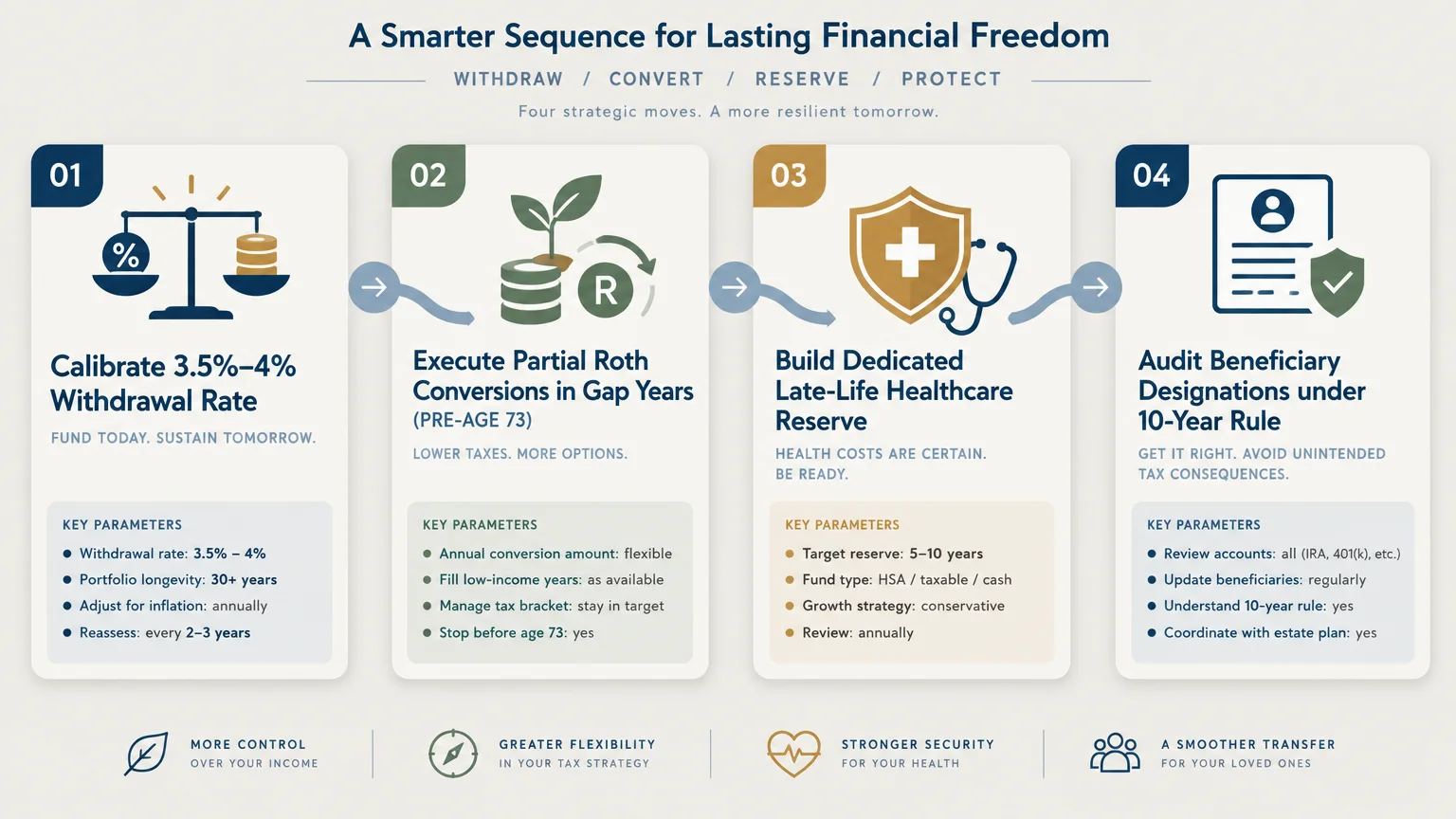
Establish a disciplined withdrawal rate between 3.5% and 4% during your first decade of retirement. This modest pace protects your purchasing power against decades of future inflation.
You must adjust your budget annually based on market performance rather than maintaining rigid spending targets. Flexibility in your 60s ensures liquidity in your 80s.
2. Ignoring the Looming Tax Bomb of Required Minimum Distributions
Most workers spend four decades focusing entirely on pre-tax 401(k) contributions. Retirees in their 80s warn that deferring taxes indefinitely creates a painful tax shock later in life.
Pre-tax accounts represent an unliquidated tax partnership with the Internal Revenue Service. When government withdrawal mandates kick in, the IRS claims its share at ordinary income rates.
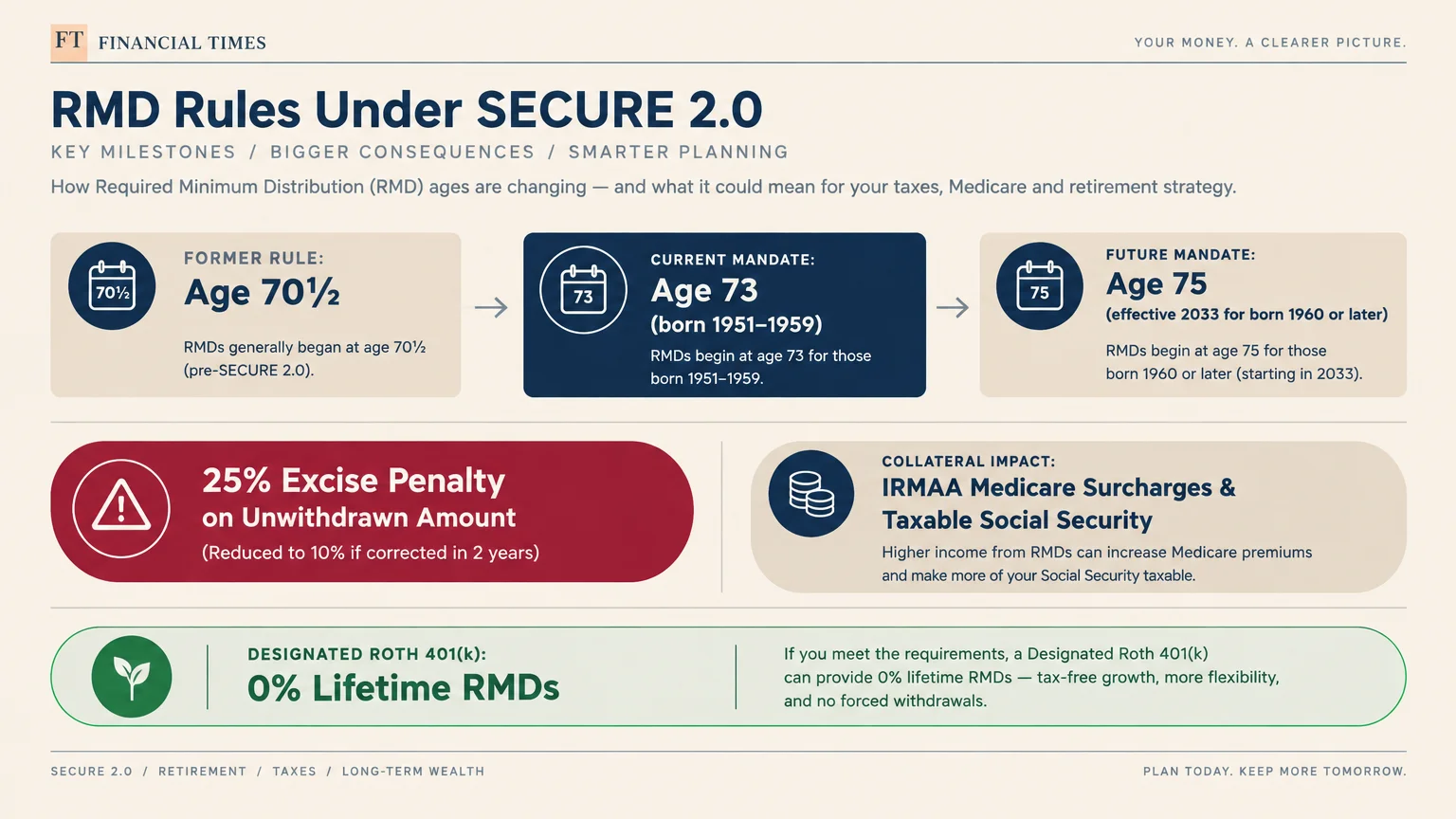
Under the SECURE 2.0 Act, you must begin taking Required Minimum Distributions (RMDs) at age 73 if born between 1951 and 1959. That starting age increases to 75 in 2033 for those born in 1960 or later.
Retirees in their 80s remember starting under older rules at age 70½. Many report that substantial RMDs catapulted them into higher federal tax brackets against their will.
These forced withdrawals trigger widespread collateral financial damage. For instance, increased taxable income pushes more of your Social Security benefits into taxable territory.
Furthermore, elevated income triggers Income-Related Monthly Adjustment Amounts (IRMAA) surcharges on your Medicare Part B and Part D premiums. That surprise surcharge diminishes your monthly net income.
Failing to take an RMD brings an excise tax penalty of 25% on the amount not withdrawn. You can reduce this penalty to 10% only if you correct the error in a timely manner within two years.
Designated Roth 401(k) accounts offer tremendous relief because SECURE 2.0 eliminated lifetime RMDs for them. You should evaluate strategic partial Roth conversions during lower-income gap years between retirement and age 73.
“Do not save what is left after spending, but spend what is left after saving.” — Warren Buffett, Chairman and CEO of Berkshire Hathaway

3. Underestimating Late-Life Healthcare and Long-Term Care Costs
A widespread regret among older retirees is assuming standard health insurance shields personal savings. Many individuals enter their 80s shocked by out-of-pocket medical expenses.
According to Fidelity Investments, an average 65-year-old individual retiring needs approximately $185,500 in after-tax savings for medical expenses throughout retirement. A married couple requires roughly $371,000, assuming enrollment in Original Medicare Parts A, B, and D.
These estimates cover standard deductibles, co-pays, and prescriptions. Crucially, they exclude the astronomical costs of custodial long-term care.
Medicare.gov clearly states that traditional Medicare does not cover custodial assistance with daily living activities. Older retirees who failed to earmark funds for care facilities faced devastating out-of-pocket bills.
Current national median costs illustrate the immense financial drain of late-life assistance. An assisted living community costs approximately $74,400 per year, which equates to $6,200 each month.
Hiring an in-home, non-medical caregiver costs an average of $80,080 annually for 44 hours of weekly care at $35 per hour. These figures climb rapidly when medical needs intensify.
A semi-private room in a nursing home costs an average of $114,975 per year. A private nursing room reaches $129,575 annually, or roughly $355 per day.
Retirees in their 80s who relied solely on their 401(k) balances for care quickly liquidated assets at high ordinary income tax rates. Planning early for dedicated long-term care insurance or hybrid life annuities protects your nest egg.

4. Shifting Assets Entirely into Cash and Low-Yield Bonds
Generations of financial conventional wisdom urged retirees to eliminate stock exposure entirely at age 65. Octogenarians who dumped all their equities found their portfolios decimated by inflation over twenty years.
Retirement is no longer a ten-year sprint; it is often a thirty-year marathon. A portfolio loaded solely with cash and low-yielding debt cannot keep pace with rising grocery, utility, and healthcare prices.
Older retirees report that extreme conservatism restricted their standard of living during their golden years. Cash balances sitting in standard accounts lost immense purchasing power over two decades.
You need enduring capital appreciation to support your spending across multiple decades. Equities provide dividend growth and capital expansion that outrun persistent inflationary pressures.
You can study diversified portfolio options through educational portals like Investor.gov. Maintaining an allocation of 40% to 60% in quality dividend-paying stocks and broad market index funds preserves real capital.
A rising equity glide path or bucket strategy protects immediate spending without sacrificing long-term growth. Never let short-term market anxiety trick you into abandoning productive corporate assets.
“The goal is not to retire from something; it is to retire to something.” — Mitch Anthony, Financial Author and Retirement Coach
5. Flawed Assumptions vs. Octogenarian Reality
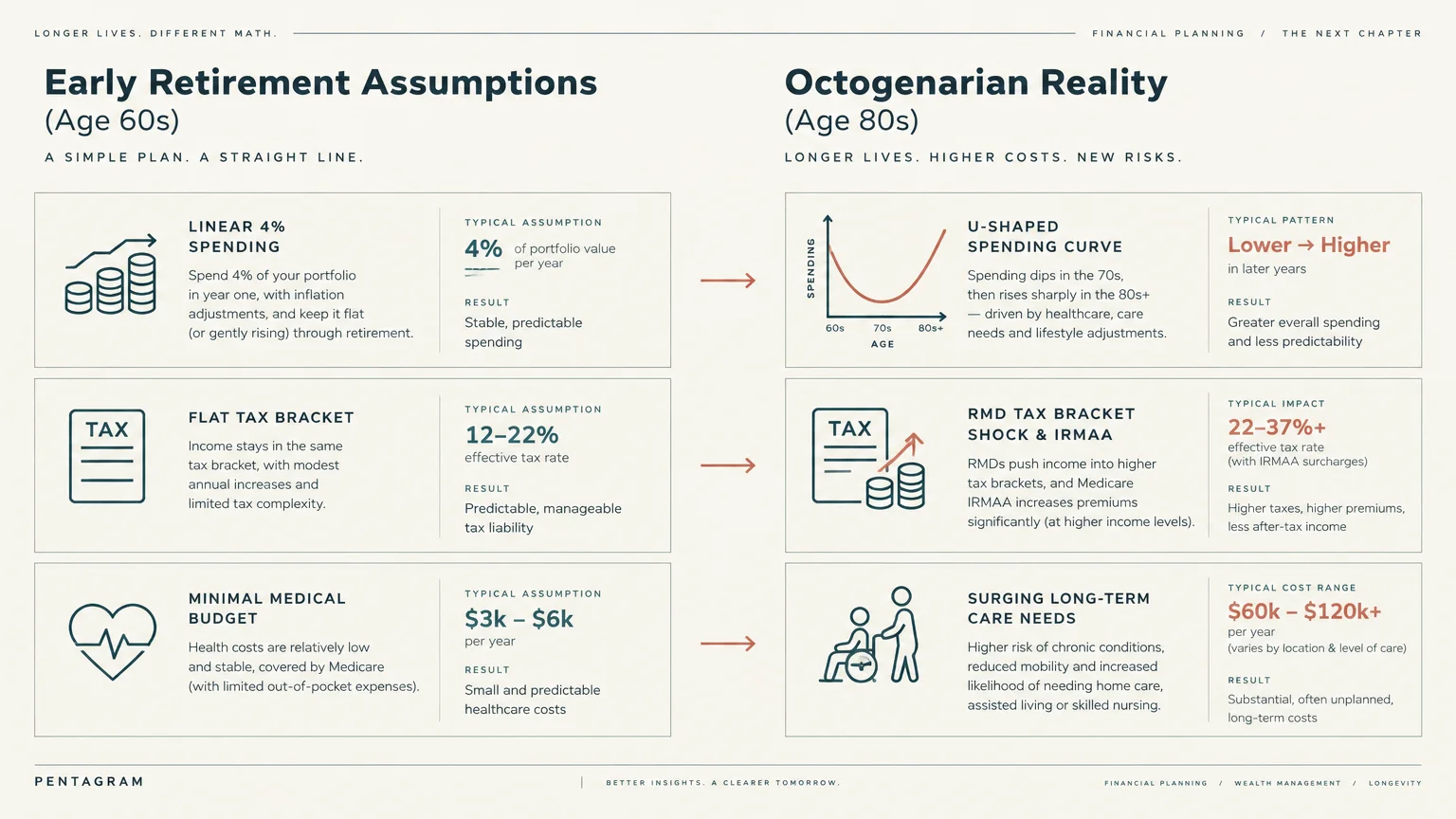
Retirees often build financial plans around overly optimistic assumptions that fail to survive decades of real-world exposure. The following comparison highlights where planning expectations diverge from late-life reality.
| Planning Assumption | Real-World Reality in Your 80s | Corrective Action |
|---|---|---|
| Retirement spending drops steadily every year. | Spending forms a U-curve; healthcare surges in your 80s offset early reductions in travel. | Model a late-stage healthcare reserve alongside your basic retirement living budget. |
| Taxes drop significantly once you stop working. | RMDs and single-filer tax brackets frequently push octogenarians into higher tax brackets. | Execute gradual Roth conversions between your retirement date and age 73. |
| Medicare covers all essential health and care needs. | Medicare excludes long-term custodial care, assisted living, and home aides. | Secure hybrid long-term care policies or reserve designated health savings accounts. |
| Bonds and cash eliminate portfolio risk completely. | Fixed-income allocations produce severe purchasing-power erosion over 20-30 years. | Retain 40% to 50% equity exposure to generate long-term capital growth. |
| Children inherit traditional 401(k) accounts tax-free. | Non-spouse heirs must fully drain accounts within 10 years, creating huge tax bills. | Distribute pre-tax funds gradually or leave heirs tax-free Roth assets instead. |

6. Overlooking the 10-Year Inherited Account Rule
Many retirees view their 401(k) as the primary wealth vehicle they will pass along to children. However, retirees in their 80s often realize too late that leaving pre-tax accounts creates an inheritance nightmare.
For account owners who died in 2020 or later, non-spouse beneficiaries can no longer stretch distributions over their lifetimes. The SECURE Act mandates that adult children must liquidate the entire inherited account within 10 years.
Adult children usually inherit these accounts during their own peak earning years in their 40s or 50s. Large mandatory distributions pile directly on top of their salaries, pushing them into top tax brackets.
Octogenarians regret not drawing down their accounts earlier at moderate tax rates to spare their adult children this burden. Passing down a traditional 401(k) often surrenders a huge portion of family wealth to the government.
Converting pre-tax balances into Roth accounts during your early retirement shields your heirs from sudden tax liability. Beneficiaries still face the 10-year rule with inherited Roths, but their distributions are entirely income-tax-free.
7. Missing Prime Catch-Up Contribution Windows Before Retirement
Retirees in their 80s reflect on how much harder saving was early in their careers. Their greatest financial regret before retirement was failing to exploit late-career catch-up windows when their earnings peaked.
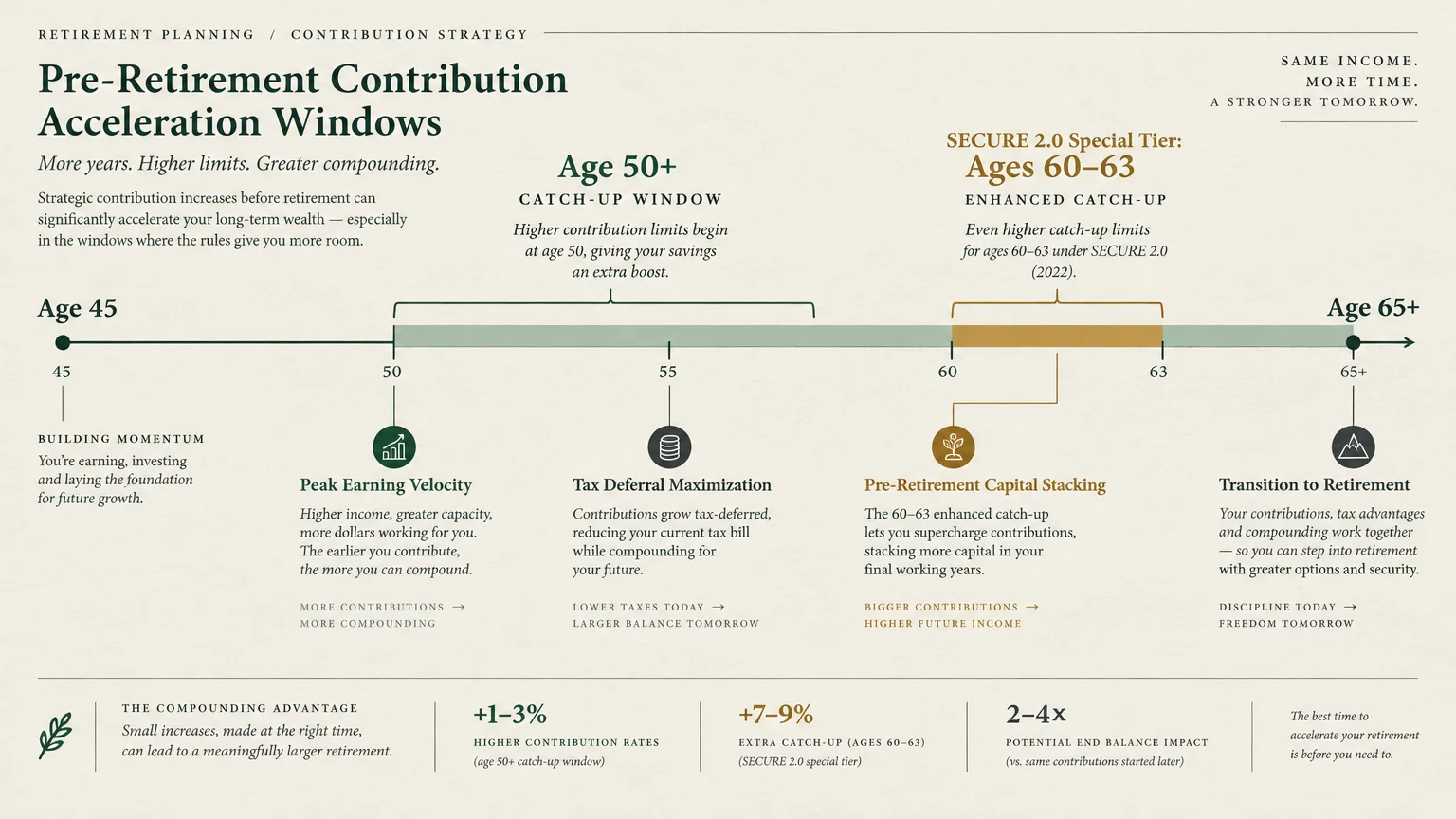
The IRS elective deferral limit allows workers to contribute up to $24,500 into an employer 401(k), 403(b), or 457(b) plan. The combined employee and employer contribution ceiling reaches $72,000.
If you are age 50 or older, you can deploy an additional standard catch-up contribution of $8,000. That raises your total annual employee savings threshold to $32,500.
Under SECURE 2.0, workers aged 60, 61, 62, or 63 can utilize a super catch-up contribution limit of $11,250 instead of $8,000. This special rule enables you to contribute up to $35,750 in elective salary deferrals annually.
You must also monitor the mandatory Roth catch-up rule. Workers aged 50 and older earning over $150,000 in prior-year FICA wages must allocate all catch-up contributions into after-tax Roth accounts.
Octogenarians emphasize that utilizing every available catch-up tier during your final working years provides essential stability. Those additional contributions build the liquidity required to weather unpredictable late-life costs.

8. What Can Go Wrong
Failing to manage your 401(k) properly across a multi-decade retirement exposes you to severe cascading financial penalties. Recognizing these common traps allows you to erect safeguards before damage occurs.
- Premature Account Depletion: High withdrawal rates combined with early market downturns permanently impair portfolio principal, causing funds to run out before age 85.
- Brutal RMD Penalties: Missing your distribution deadlines triggers an immediate 25% IRS penalty on the required balance, reducing your usable retirement income.
- The Widow’s Tax Penalty: When one spouse passes away, the surviving spouse must file income taxes as a single individual, facing higher tax rates on identical RMD amounts.
- Accelerated Medicaid Spend-Downs: Lacking dedicated long-term care assets forces seniors to spend down personal savings to poverty thresholds to qualify for state healthcare aid.
- Erosion of Real Purchasing Power: Allocating excessively to low-yielding cash allows persistent inflation to diminish your baseline living standards over a thirty-year retirement.

9. When to Consult a Professional
Self-managing a 401(k) becomes increasingly risky as tax codes and healthcare rules grow more complex with age. Knowing when to engage outside expertise protects your family from irreversible financial errors.
You can verify professional credentials through the Certified Financial Planner Board. Seek qualified fee-only advice during the following specific scenarios:
- Approaching Age 70 Without a Tax Strategy: If your pre-tax assets exceed $500,000, consult a fiduciary advisor to evaluate multi-year Roth conversion strategies before mandatory age-73 distributions trigger.
- Navigating the Loss of a Spouse: Work with an advisor immediately to adjust asset locations and income drawdowns before single-filer tax brackets impact your RMD tax liability.
- Structuring Late-Life Long-Term Care Funding: When you or your spouse receive a chronic health diagnosis, engage an elder law attorney to protect non-qualified savings and establish appropriate trusts.
- Planning Inherited Account Distributions: Consult a CPA when designating non-spouse beneficiaries to balance estate tax efficiency against the strict 10-year inherited IRA liquidation rules.
10. Proactive Steps You Can Take Today
You can easily correct course today regardless of your current age. Implementing proactive adjustments shields your nest egg from the pitfalls identified by retirees in their 80s.
- Audit Your Asset Allocation: Review your stock-to-bond ratio to ensure you hold sufficient equity exposure for long-term growth alongside your cash reserve.
- Calculate Future RMD Projections: Estimate your account balances at ages 73 and 75 to calculate mandatory withdrawals and project future Medicare IRMAA surcharge brackets.
- Maximize Earning-Year Contributions: Take full advantage of the $8,000 catch-up limit if you are 50 or older, or the $11,250 super catch-up tier if you are between ages 60 and 63.
- Build a Dedicated Health Reserve: Establish a dedicated medical fund outside your primary retirement spending pool to handle the projected $185,500 individual healthcare cost baseline.
- Update Beneficiary Designations: Audit your primary and contingent beneficiary designations on all 401(k) accounts to align with updated 10-year distribution regulations.
Frequently Asked Questions About 401(k) Planning
Can I avoid RMDs if I continue working into my 80s?
If you do not own 5% or more of the company employing you, you can delay RMDs from your current employer’s 401(k) until you actually retire. However, this exception does not apply to traditional IRAs or past 401(k) plans from prior employers.
Are Roth 401(k) accounts subject to mandatory withdrawals?
Under the SECURE 2.0 Act, designated Roth 401(k) accounts are no longer subject to lifetime Required Minimum Distributions. This change permanently aligns Roth 401(k) regulations with traditional Roth IRA rules.
What is the penalty for failing to take an RMD on time?
The IRS imposes an excise tax penalty equal to 25% of the amount not withdrawn. You can reduce this penalty to 10% if you correct the shortfall and submit payment within two years.
How does Medicare treat 401(k) distributions?
Withdrawals from traditional pre-tax 401(k) accounts count as ordinary income, raising your modified adjusted gross income. If your income exceeds specific statutory thresholds, Medicare assesses monthly IRMAA surcharges on Parts B and D.
Take time today to evaluate your retirement distribution plan, tax brackets, and healthcare preparations. Implementing the hard-won wisdom of octogenarians ensures that your nest egg endures as long as you do.
The information in this guide is meant for educational purposes. Your specific circumstances—including income, health needs, tax situation, and goals—may require different approaches. When in doubt, consult a licensed professional.
Last updated: October 2026. Retirement benefits, tax rules, and healthcare regulations change frequently—verify current details with official sources.









Leave a Reply