
If you celebrate your 73rd birthday in 2027, your tax return is about to experience a profound structural shift. A sudden surge in taxable income can unexpectedly trigger heavy taxes on your Social Security benefits.
Under federal law, reaching age 73 forces you to begin taking required minimum distributions from your pre-tax retirement accounts. These forced withdrawals routinely push unsuspecting retirees over long-standing federal tax thresholds.
By learning how required withdrawals interact with your benefits, you can execute proactive moves before 2027 arrives. Smart planning protects your income and keeps more money in your pocket.
The Turning 73 Milestone: Why 2027 Changes Everything
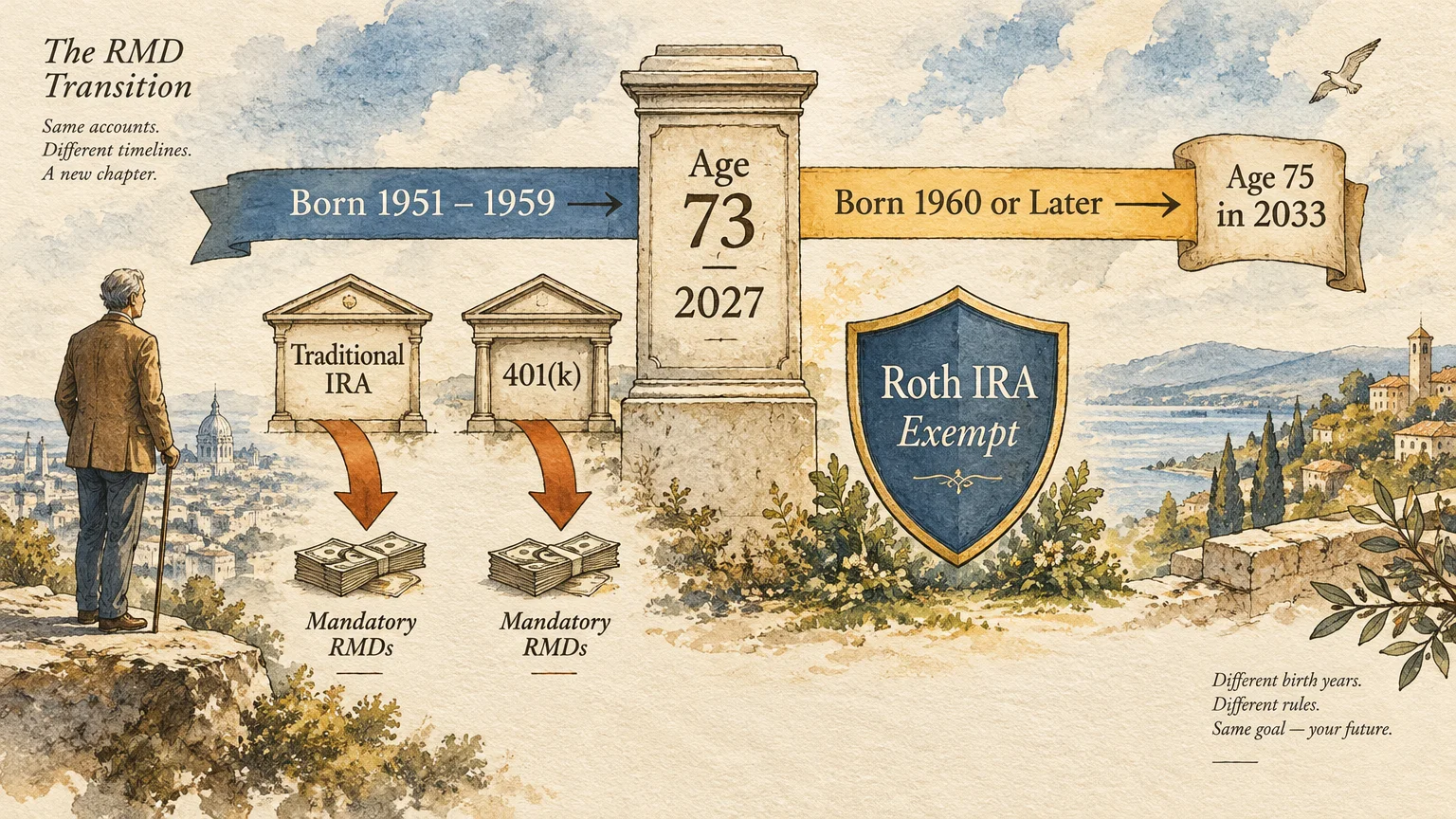
If you were born in 1954, you reach a pivotal financial milestone when you turn 73 in 2027. Under the SECURE 2.0 Act, age 73 serves as the official starting point for required minimum distributions, commonly known as RMDs.
For individuals born between 1951 and 1959, the law set the required distribution age firmly at 73. Younger retirees born in 1960 or later will not face required distributions until they reach age 75 in 2033.
Until now, you enjoyed full control over the timing and size of withdrawals from your retirement accounts. You withdrew funds only when your household budget demanded extra cash.
That personal control vanishes once you cross the age 73 threshold. The federal government mandates that you withdraw a specific minimum balance every single year, whether you need the money or not.
These mandatory distributions apply to traditional individual retirement accounts (IRAs), SEP IRAs, and SIMPLE IRAs. They also apply to employer-sponsored plans, including traditional 401(k), 403(b), and 457(b) accounts.
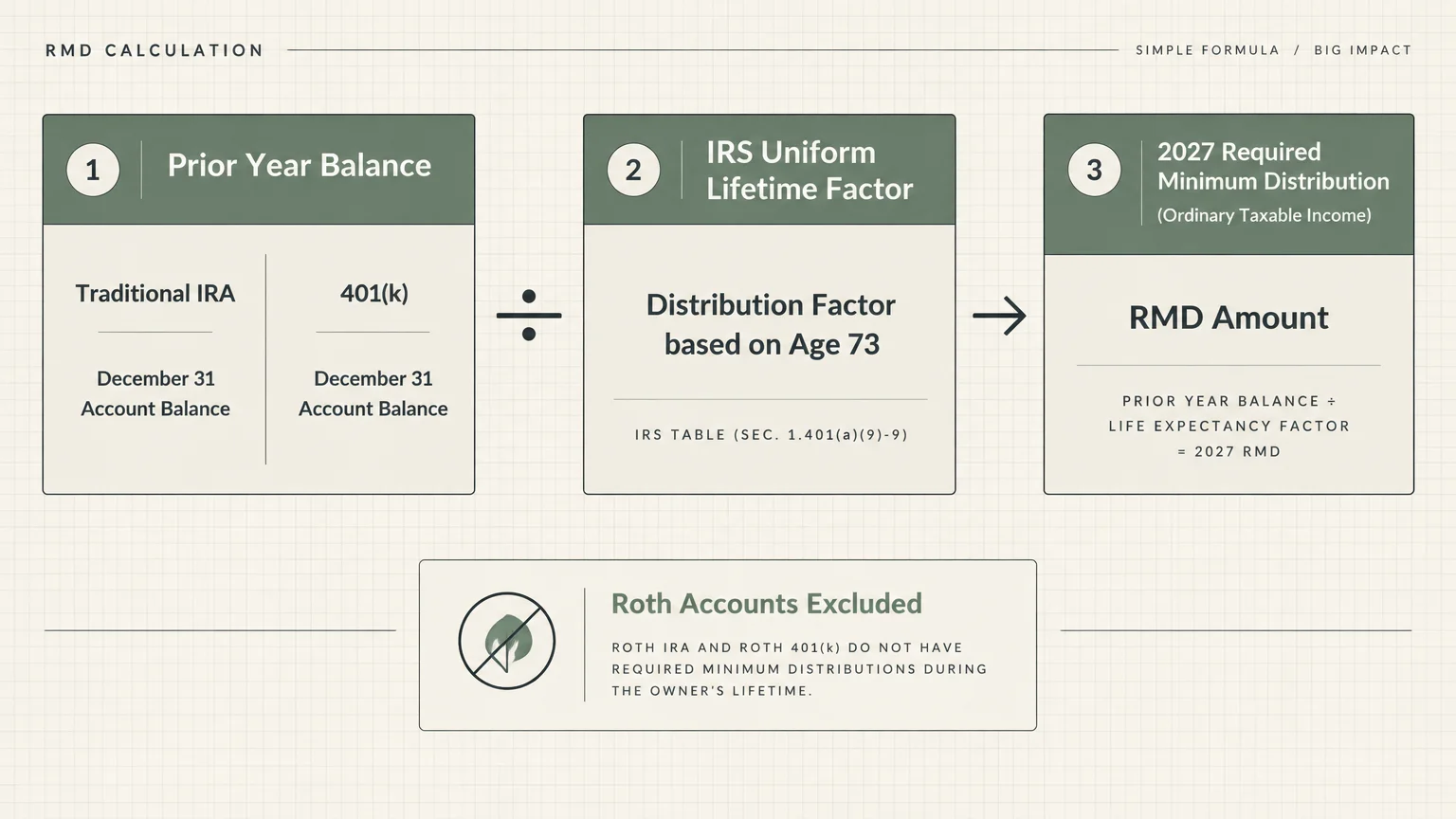
Fortunately, Roth IRAs remain completely exempt from lifetime distribution requirements. Thanks to recent legislative updates, designated Roth balances inside workplace 401(k) and 403(b) accounts are also exempt from lifetime RMDs.
Every dollar you pull from a pre-tax retirement account counts as ordinary taxable income on your federal return. This extra income does not exist in a vacuum; it directly impacts your other retirement revenue streams.
Understanding the Social Security Tax Formula
Many retirees mistakenly assume their Social Security benefits will arrive completely tax-free throughout retirement. In reality, the Internal Revenue Service (IRS) taxes a substantial portion of monthly benefits for millions of older Americans.
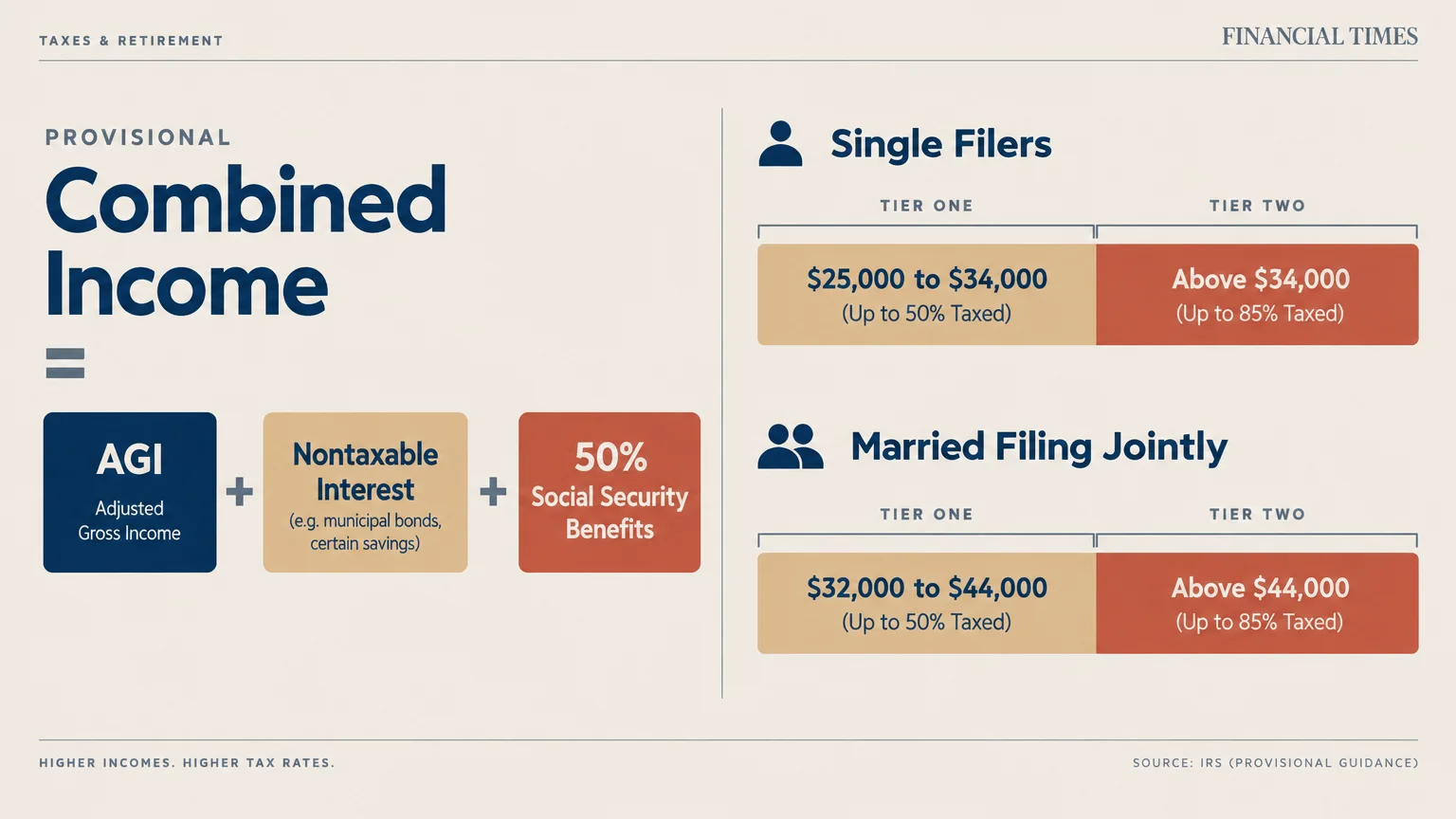
The federal government determines benefit taxation using a specific metric known as combined income, often called provisional income. This metric links your benefits directly to your other income sources.
The formula for combined income remains straightforward: your Adjusted Gross Income (AGI), plus any nontaxable interest, plus exactly 50 percent of your annual Social Security benefits.
Congress established the statutory taxation thresholds back in 1983 and added a second tier in 1993. Lawmakers never indexed these dollar thresholds to adjust for annual inflation.
Because these dollar amounts remain permanently frozen in time, normal cost-of-living adjustments steadily pull more retirees into taxable territory every year.
If you file your federal tax return as an individual, the taxation thresholds apply as follows:
- Combined income between $25,000 and $34,000: You may owe income taxes on up to 50 percent of your total Social Security benefits.
- Combined income above $34,000: You may owe income taxes on up to 85 percent of your total Social Security benefits.
If you are married and file a joint tax return with your spouse, the thresholds shift slightly:
- Combined income between $32,000 and $44,000: You may owe income taxes on up to 50 percent of your total Social Security benefits.
- Combined income above $44,000: You may owe income taxes on up to 85 percent of your total Social Security benefits.
Beginning in January 2027, Social Security beneficiaries will receive an estimated 3.6 percent cost-of-living adjustment (COLA). This adjustment boosts the average retirement benefit by approximately $75 each month.
While that monthly increase provides welcome relief against grocery and utility bills, it also inflates the Social Security half of your provisional income calculation. The higher baseline leaves you with even less financial headroom before you cross into taxable tiers.
You can verify your current benefit projections directly through the Social Security Administration (SSA) portal before your 73rd year begins.
The Mechanics of the 2027 RMD Calculation
To anticipate the tax impact on your benefits, you must calculate your exact mandatory withdrawal amount for 2027. The IRS determines this withdrawal through a standardized mathematical formula.
Your required withdrawal equals your total pre-tax account balance as of December 31, 2026, divided by an IRS life expectancy factor. The IRS publishes these distribution factors in its Uniform Lifetime Table.
For an individual turning 73, the IRS assigns a life expectancy factor of 26.5. This factor translates to an initial withdrawal rate of approximately 3.77 percent of your pre-tax assets.
Consider an unmarried retiree who holds $500,000 across traditional IRAs on December 31, 2026. Dividing $500,000 by 26.5 results in a mandatory 2027 distribution of $18,868.
Now consider a married couple with $1,000,000 saved across their traditional accounts. If the primary account holder turns 73 in 2027, their mandatory distribution equals roughly $37,736.
Every penny of that required distribution flows straight into your Adjusted Gross Income on Line 11 of IRS Form 1040. Because your AGI rises, your combined income rises dollar for dollar.
If your combined income previously hovered just below the statutory thresholds, that single withdrawal instantly pushes your Social Security benefits into the 85 percent taxable bracket.
The Tax Torpedo: How RMDs Trigger Higher Benefit Taxes
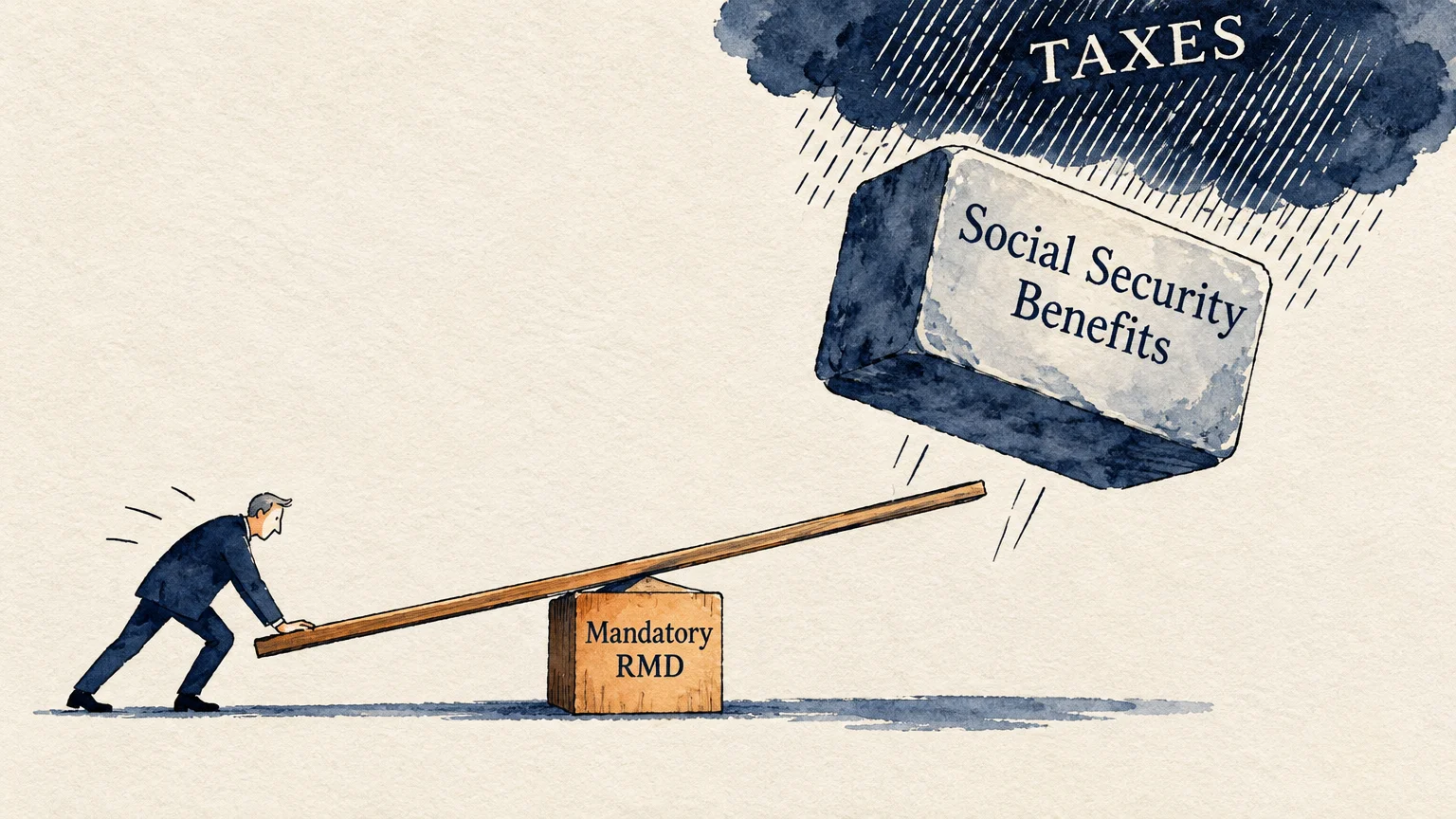
Financial planners frequently refer to this sudden compounding tax effect as the “tax torpedo.” The phenomenon occurs because an increase in retirement account income triggers a secondary wave of taxation on your federal benefits.
Under normal circumstances, earning one additional dollar of income results in paying tax on that single dollar. When the tax torpedo strikes, earning one additional dollar forces up to 85 cents of previously exempt Social Security benefits into taxable income.
Consequently, you find yourself paying taxes on $1.85 of total income for every single dollar you withdraw from your IRA. This compounding effect causes your actual marginal tax bracket to surge far above your statutory federal bracket.
“Taxes can devour your retirement nest egg faster than market drops if you fail to plan ahead.” — Suze Orman, Personal Finance Expert
A retiree in the 12 percent statutory tax bracket can suddenly face an effective marginal tax rate of 22.2 percent. A retiree in the 22 percent bracket can see their effective marginal rate jump toward 40.7 percent on those overlapping dollars.
The following table illustrates how a mandatory distribution at age 73 can dramatically alter benefit taxation for hypothetical retirees in 2027:
| Filing Status | Baseline AGI (Excl. RMD) | Age 73 RMD | 50% of Annual Social Security | Total Combined Income | Social Security Subject to Tax |
|---|---|---|---|---|---|
| Single (No RMD) | $16,000 | $0 | $14,000 | $30,000 | Up to 50% |
| Single (With RMD) | $16,000 | $18,868 | $14,000 | $48,868 | Up to 85% |
| Married Joint (No RMD) | $24,000 | $0 | $22,000 | $46,000 | Up to 85% (Partial) |
| Married Joint (With RMD) | $24,000 | $37,736 | $22,000 | $83,736 | Up to 85% (Full Max) |
In both scenarios, the required withdrawal fundamentally alters the retiree’s tax picture. Benefits that were once partially shielded or completely exempt become exposed to federal income tax.

Standard Deductions and the Extra Senior Tax Breaks for 2027
When reviewing these figures, many retirees assume standard deductions will protect their benefits from taxation. However, understanding the difference between above-the-line income calculations and below-the-line deductions is critical.
The IRS calculates your combined income using Adjusted Gross Income, which sits above the line. Deductions occur below the line, meaning they reduce your final taxable income but cannot prevent your benefits from being classified as taxable.
Nevertheless, robust tax deductions remain essential because they soften the final tax blow. Under IRS Revenue Procedure 2026-35, standard deductions receive significant increases for the 2027 tax year.
The baseline standard deduction rises to $16,600 for single filers, representing a $500 increase over 2026 levels. Married couples filing jointly receive a baseline deduction of $33,200, an increase of $1,000.
Taxpayers aged 65 and older qualify for an additional senior standard deduction. For 2027, this senior addition increases to $2,100 for single filers, bringing their full standard deduction to $18,700.
For married couples where both spouses are 65 or older, the additional deduction rises to $1,700 per person. This brings the total joint standard deduction to $36,600 in 2027.
Retirees also benefit from the temporary senior deduction established under the One Big Beautiful Bill Act (OBBBA). This provision grants an extra $6,000 deduction per qualifying individual aged 65 and older through 2028.
A qualifying single senior can claim up to $24,700 in combined deductions in 2027. A married couple who both qualify can claim an impressive $48,600 in aggregate tax deductions.
However, you must monitor the strict income phaseouts attached to the OBBBA senior deduction. The deduction phases out at a rate of 6 percent for incomes exceeding $75,000 for single filers and $150,000 for married couples filing jointly.
A large required distribution can unexpectedly push your total income past these phaseout limits. When that happens, you lose valuable senior tax deductions at the exact moment your taxable benefit percentage increases.
The Double RMD Trap in 2028
The IRS grants special flexibility for your very first required distribution, but using that flexibility can lead to a severe tax trap. Understanding the calendar rules prevents an expensive mistake.
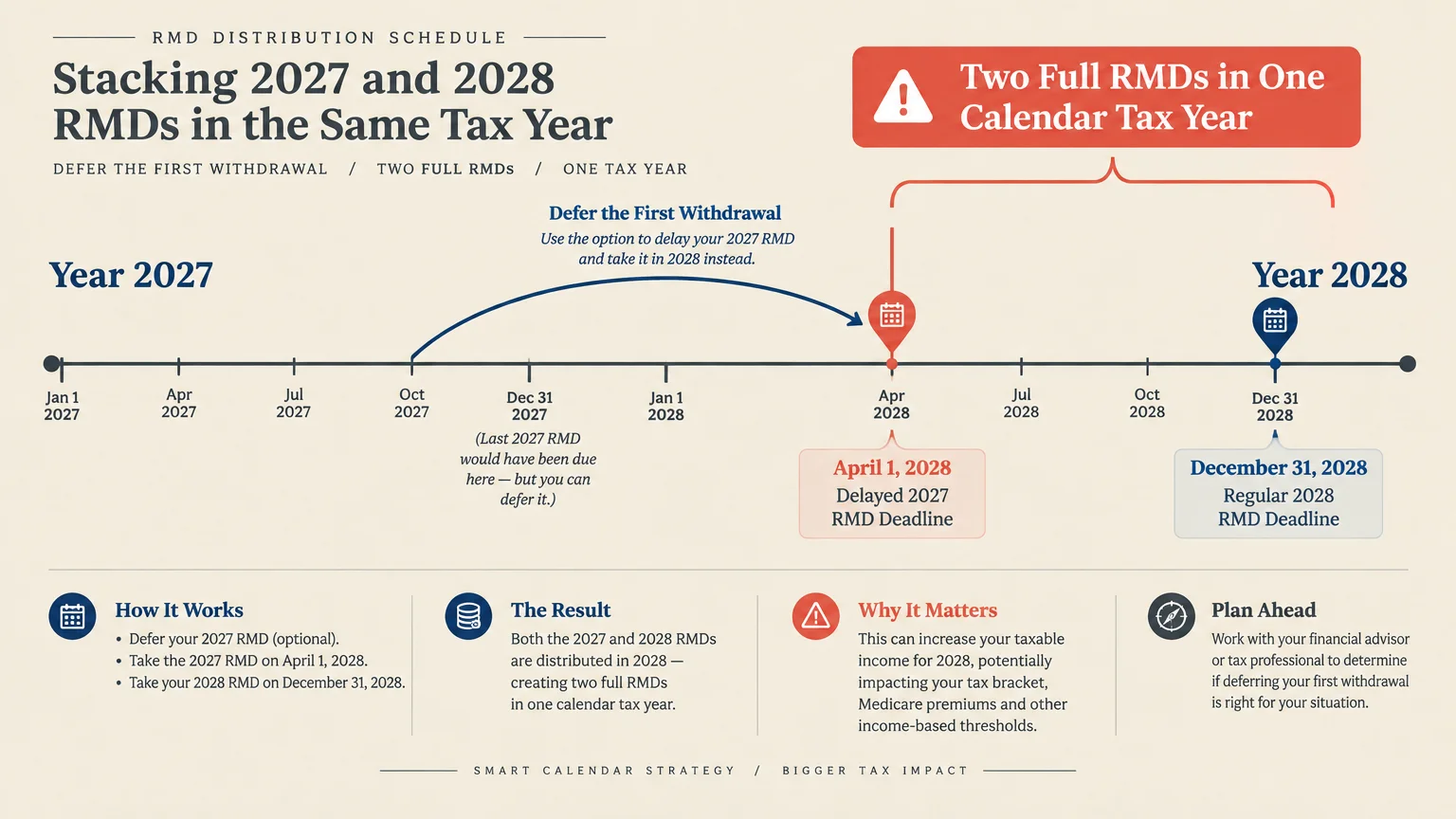
Normally, calendar-year distributions must leave your accounts by December 31. For your first year only, the law allows you to delay taking your distribution until April 1 of the following year.
Because you turn 73 in 2027, your official Required Beginning Date is April 1, 2028. This temporary extension tempts many retirees to postpone their initial withdrawal to keep funds growing tax-deferred.
Delaying that first withdrawal until early 2028 creates a catastrophic “double RMD” year. While your 2027 withdrawal is delayed to April 1, 2028, your regular 2028 distribution remains due by December 31, 2028.
Taking two full required distributions within a single twelve-month calendar year doubles your withdrawal income. That concentrated income spike can dramatically disrupt your tax bracket and your Social Security withholding.
The combined income from two distributions almost guarantees that the maximum 85 percent of your Social Security benefits will become taxable. It can also push you into significantly higher federal tax brackets.
Furthermore, an inflated AGI in 2028 can trigger Income-Related Monthly Adjustment Amount (IRMAA) surcharges on your Medicare Part B and Part D premiums two years later. You can monitor premium rules directly at Medicare.gov.
For the vast majority of retirees, taking the initial 2027 distribution on or before December 31, 2027, proves far more economical than bunching two distributions into 2028.

Actionable Strategies to Shield Your Retirement Income
You do not have to sit passively while mandatory distributions erode your Social Security checks. Several practical strategies allow you to mitigate or completely sidestep this tax escalation before 2027 arrives.
First, explore Qualified Charitable Distributions (QCDs) if you regularly support non-profit organizations, houses of worship, or community causes. A QCD allows individuals aged 70½ and older to transfer funds directly from a traditional IRA to an eligible 501(c)(3) charity.
Money sent via a QCD satisfies your annual required distribution requirement dollar for dollar. More importantly, the distributed funds bypass your Adjusted Gross Income entirely.
Because a QCD never enters your AGI, it never appears in your combined income calculation. This exclusion keeps your provisional income low and shields your Social Security benefits from entering the taxable bracket.
The annual QCD limit stands at $111,000 per person for 2026 and increases to $114,000 per person in 2027. Starting in 2027, custodians must use the mandatory “Code Y” designation on Form 1099-R to streamline IRS reporting.
Second, evaluate strategic Roth conversions during the 2025 and 2026 tax years. Converting portions of your traditional IRA into a Roth IRA requires paying income taxes upfront in the conversion year.
However, money inside a Roth IRA grows tax-free and incurs zero lifetime distribution requirements. Executing conversions before December 31, 2026, reduces the year-end balance used to calculate your mandatory 2027 distribution.
A smaller December 31 account balance directly shrinks your required withdrawal factor. By lowering your future mandatory distributions, you permanently suppress your combined income throughout your mid-70s and beyond.
Third, adjust your cash-flow sequencing to spend down taxable accounts before tapping tax-deferred funds. Using cash savings or non-dividend-generating taxable brokerage assets allows you to leave traditional accounts smaller without creating taxable ordinary income.
You can research comprehensive guidance on asset distribution strategies through Investor.gov (SEC) to determine how account types interact over time.
What Can Go Wrong
Navigating required distributions involves navigating strict federal compliance rules where minor oversights generate painful financial penalties. Awareness of common pitfalls helps safeguard your retirement savings.
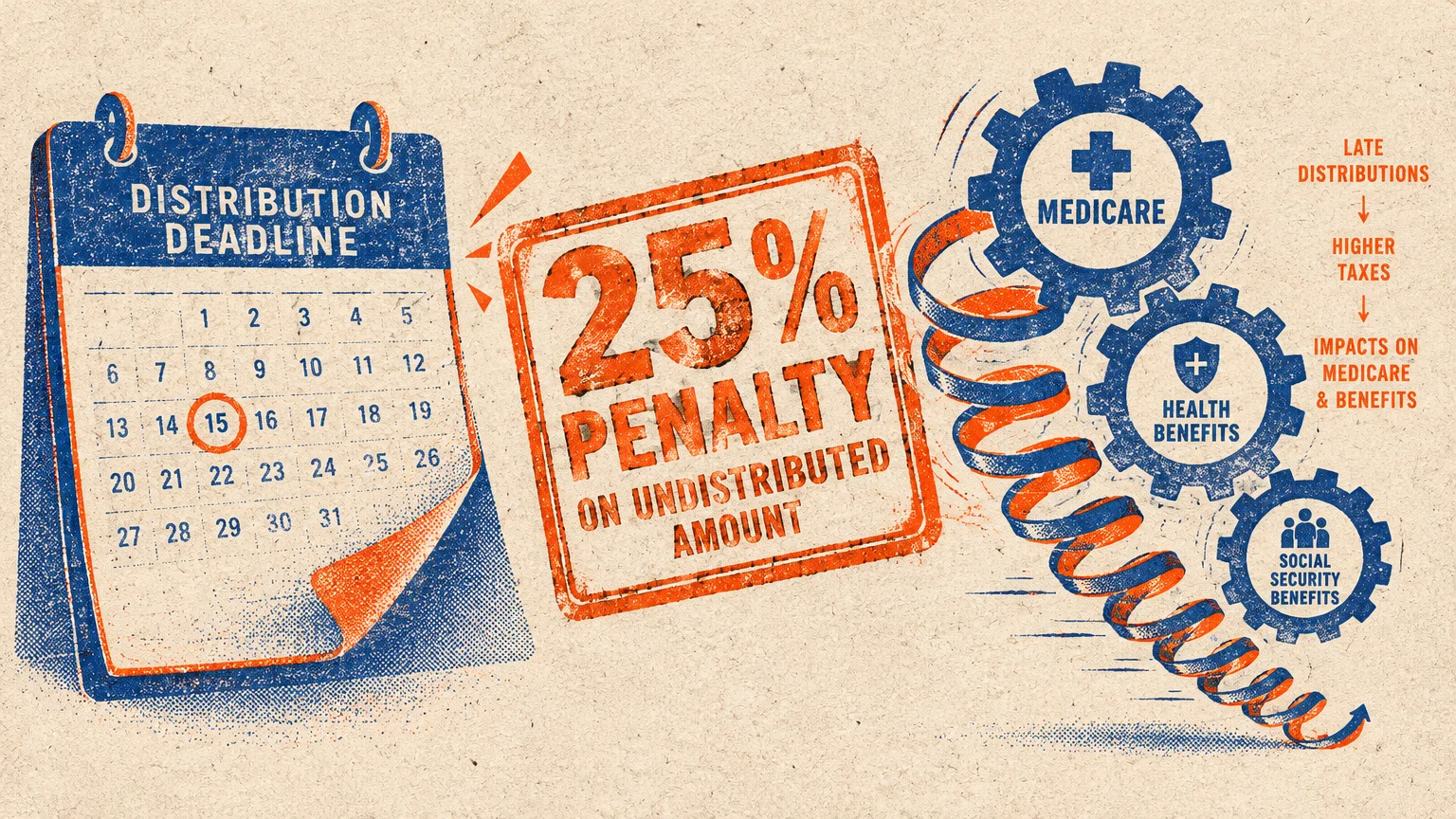
The most expensive error is missing the statutory distribution deadline entirely. If you fail to withdraw your full required amount, the IRS imposes a 25 percent excise tax penalty on every unwithdrawn dollar.
For example, if your required distribution equals $20,000 and you withdraw nothing, you face an immediate excise tax penalty of $5,000. That penalty sits entirely on top of the ordinary income tax you still owe on the funds.
The SECURE 2.0 Act provides modest relief by reducing this penalty to 10 percent if you correct the failure quickly. You must submit a timely correction, file Form 5329, and withdraw the missing funds within a two-year correction window.
Another frequent misstep involves confusing account aggregation rules across different retirement vehicle types. You can calculate the total RMDs for all your traditional IRAs and withdraw the aggregate sum from a single IRA account.
However, you cannot satisfy a 401(k) or 403(b) distribution requirement by withdrawing funds from an IRA. Workplace retirement plans must satisfy their mandatory distributions independently from their respective plan accounts.
Retirees also make critical errors when executing charitable distributions. If you withdraw funds into your personal checking account first and subsequently write a check to a charity, the transaction fails to qualify as a QCD.
The money will count fully as taxable income on your Form 1040, driving up your provisional income and triggering Social Security taxes. The transfer must proceed directly from your IRA custodian to the qualified charity.

When to Consult a Professional
Managing the intersection of required distributions, provisional income, and Medicare thresholds requires careful mathematical forecasting. Certain financial scenarios warrant direct collaboration with a fee-only fiduciary advisor or certified public accountant.
You should seek specialized professional advice if you encounter any of the following circumstances:
- Large Traditional Balances: You hold more than $750,000 across pre-tax accounts, which will push you past the OBBBA senior deduction phaseout limits once distributions commence.
- Multi-Year Roth Planning: You want to model multi-year partial Roth conversions across 2025 and 2026 to systematically minimize your future lifetime marginal tax brackets.
- Complex Account Holdings: You manage a patchwork of traditional IRAs, inherited IRAs, active workplace plans, and SEP IRAs subject to divergent distribution rules.
- Medicare IRMAA Exposure: Your projected required distribution brings your household modified AGI near the two-year lookback thresholds for Medicare Part B and Part D premium surcharges.
A qualified professional can model multi-year tax projections to identify the exact withdrawal levels that optimize your take-home cash. You can verify professional credentials through the Certified Financial Planner Board.
Frequently Asked Questions
Does my Roth IRA require an RMD when I turn 73 in 2027?
No, Roth IRAs do not require minimum distributions during the original account owner’s lifetime. Additionally, the SECURE 2.0 Act eliminated pre-death distribution requirements for workplace Roth 401(k) and Roth 403(b) accounts.
Can the standard deduction prevent my Social Security benefits from being taxed?
No, the standard deduction cannot prevent your benefits from being categorized as taxable. The IRS calculates Social Security taxability using Adjusted Gross Income, which is computed before applying the standard deduction or itemized deductions.
What happens if I take my first RMD in early 2028 instead of 2027?
Delaying your first withdrawal until the April 1, 2028 deadline forces you to take two required distributions in the 2028 tax year. This double distribution can push your income into higher tax brackets and maximize taxes on your benefits.
How does the 2027 Social Security COLA affect my provisional income?
The projected 3.6 percent COLA increases your gross monthly Social Security check, which increases the 50 percent benefit portion used in your provisional income calculation. This higher base narrows your margin before reaching taxable thresholds.
Next Steps for Your 2027 Tax Plan
Reaching age 73 marks an important retirement milestone, but it does not have to result in an unwelcome tax shock. Take proactive steps right now while you still have time to shape your financial trajectory.
Review your total pre-tax retirement balances across all institutions and calculate your projected 2027 required distribution. Evaluate whether executing charitable distributions or completing strategic Roth conversions before 2027 makes sense for your household.
This article provides general retirement education and information only. Every retiree’s situation is unique—what works for others may not work for you. For personalized advice, consider consulting a qualified financial professional such as a CFP or CPA.
Last updated: November 2026. Retirement benefits, tax rules, and healthcare regulations change frequently—verify current details with official sources.









Leave a Reply