
You could lose over $16,000 every single year if Congress allows Social Security reserves to run dry. For an average middle-class couple, that reduction represents an immediate 22 percent drop in retirement cash flow.
The Old-Age and Survivors Insurance trust fund faces depletion by late 2032. Without legislative intervention, automatic benefit reductions will impact both current retirees and workers preparing to leave the workforce.
Protecting your household finances requires examining these projections today. Understanding how these cuts are calculated empowers you to adapt your savings strategy and secure your long-term independence.
The 2032 Depletion Cliff: Why the Social Security Shortfall Is Accelerating
Social Security faces a looming financial crossroads that directly affects your retirement planning. The latest annual Social Security Trustees Report outlines an urgent timeline for the program’s primary reserve fund.
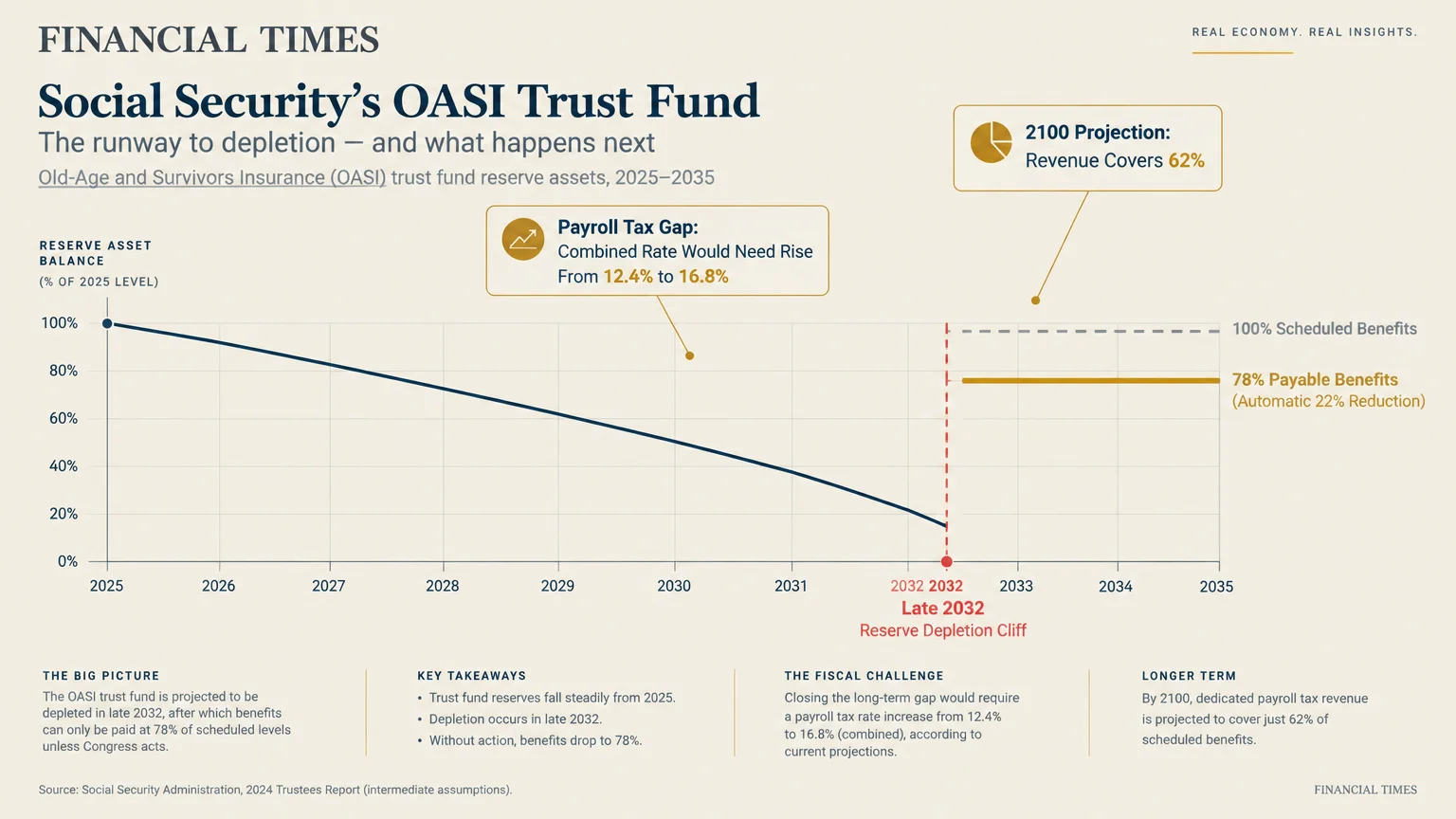
The Old-Age and Survivors Insurance trust fund will exhaust its asset reserves during the fourth quarter of 2032. That projected date moved up from earlier forecasts, leaving less time for lawmakers to craft meaningful reforms.
Once the trust fund depletes its reserves, incoming payroll taxes will cover only 78 percent of scheduled benefits. This gap triggers an automatic across-the-board reduction of 22 percent starting in late 2032.
By the year 2100, incoming revenues will only support 62 percent of scheduled payments if structural fixes remain absent. This downward trajectory makes long-term income planning critical for anyone entering retirement today.
Recent legislation contributed to this shortened solvency runway. The 2025 One Big Beautiful Bill Act lowered tax liabilities for beneficiaries, inadvertently shrinking income tax revenue flowing back into the trust funds.
Demographic headwinds compound these legislative pressures. The Social Security Administration recently lowered projected fertility rates from 1.90 to 1.75 children per woman while adjusting net immigration expectations.
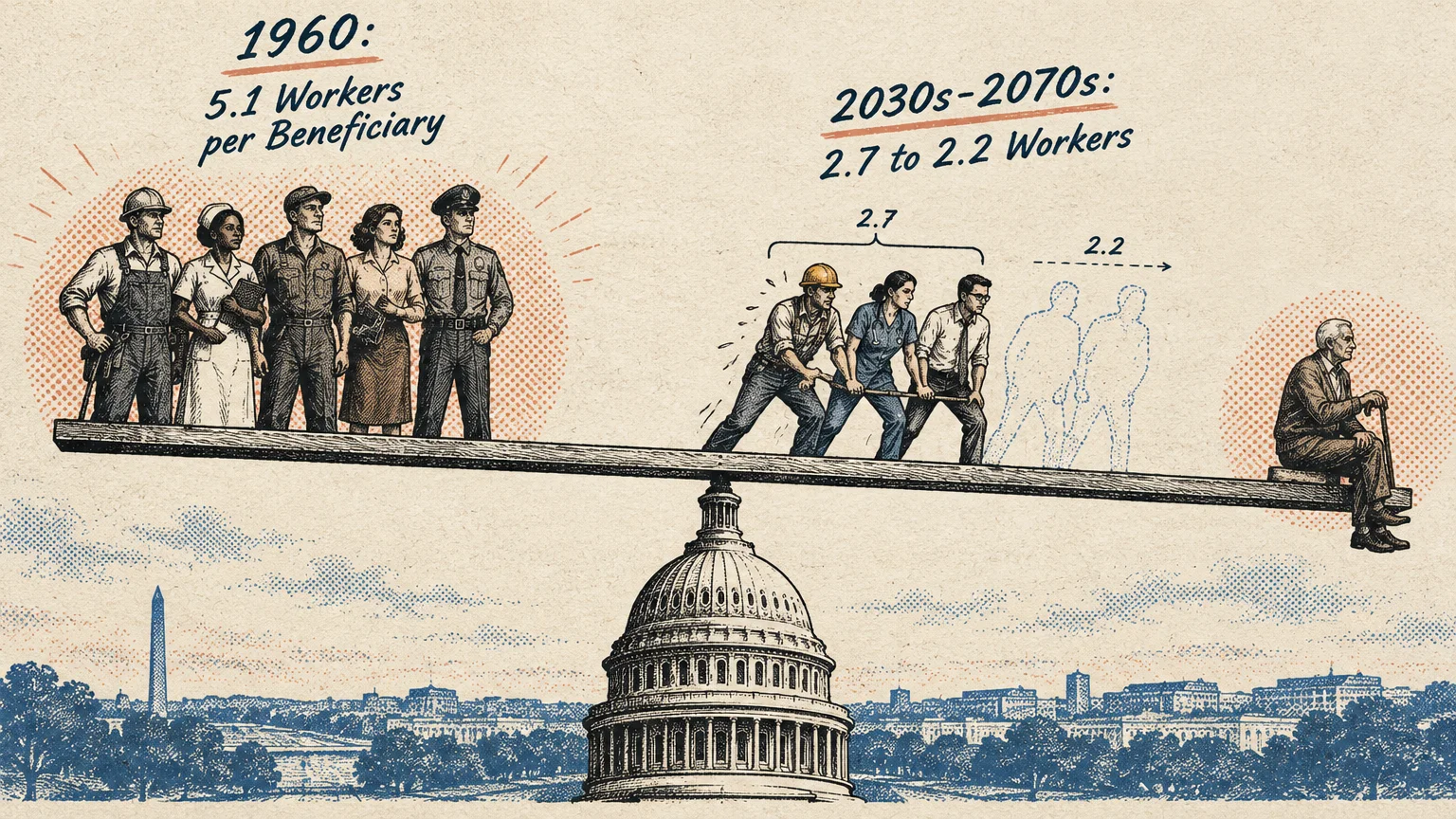
These shifts drastically alter the worker-to-beneficiary ratio across the country. In 1960, more than five covered workers supported each Social Security recipient.
Today, that balance has collapsed to roughly 2.7 to 2.9 workers per beneficiary. Actuaries project this ratio will fall to just 2.2 workers per retiree by the 2070s.
Official data published by the Social Security Administration highlights the immense scale of this shortfall. The program’s estimated 75-year unfunded obligation now stands between $29.3 trillion and $30.3 trillion in present value.
Expressed as a share of taxable payroll, the long-term actuarial deficit reached 4.42 percent. Resolving the gap entirely through taxation would require raising the combined payroll tax rate from 12.4 percent to nearly 16.8 percent.
The Dollar Impact: What Social Security Cuts Cost Middle-Class Retirees
Abstract percentages obscure the real financial pain facing everyday households. When you translate a 22 percent cut into actual dollars, the impact on middle-class retirees becomes alarming.
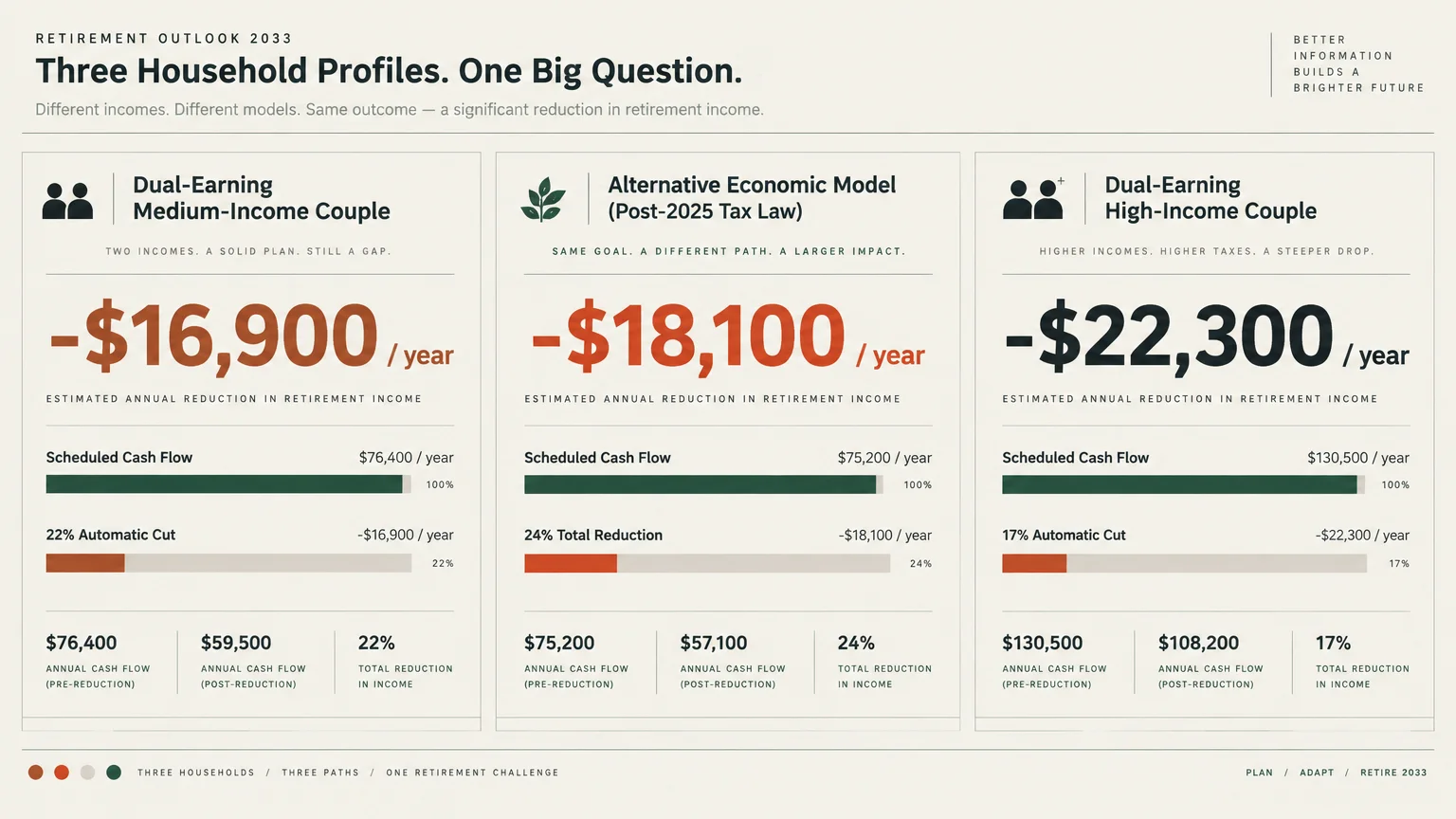
The Committee for a Responsible Federal Budget analyzed how these cuts would affect newly retired households. A typical dual-earning, medium-income couple retiring in early 2033 faces an estimated loss of $16,900 per year.
Under alternative economic models accounting for recent tax laws, that annual loss could climb to $18,100 per year. That represents a 24 percent reduction in total household retirement cash flow.
Higher-earning couples face an even larger absolute dollar drop. A dual-earning high-income couple retiring in 2033 would lose an estimated $22,300 annually under a 22 percent cut.
Even lower-income households face severe disruption. A dual-earning low-income couple faces an estimated annual reduction of $10,200, which threatens their ability to cover basic shelter and medication.
To understand the immediate effect, consider current benefit benchmarks. In 2026, the average monthly benefit for an aged married couple is $3,208 per month, or $38,496 annually, following a 2.8 percent cost-of-living adjustment.
Applying a 22 percent reduction to today’s average couple benefit eliminates roughly $706 per month. That erases $8,469 per year directly from a couple’s baseline budget.
State-by-state data shows that individual monthly reductions under a 24 percent cut range from $459 to $556 per month. Retirees in 29 states would experience individual cuts exceeding $500 every single month.
Connecticut leads the nation with an average projected individual loss of $556 per month. New Jersey follows closely at $554, with New Hampshire retirees facing a monthly reduction of $553.
| Household Profile | Estimated Scheduled Annual Benefit | Projected Annual Loss (22% Cut) | Projected Annual Loss (24% Cut) | Estimated Monthly Loss |
|---|---|---|---|---|
| Low-Income Dual-Earner Couple | $46,360 | $10,200 | $11,120 | $850 – $927 |
| Medium-Income Dual-Earner Couple | $76,800 | $16,900 | $18,100 | $1,408 – $1,508 |
| High-Income Dual-Earner Couple | $101,360 | $22,300 | $24,320 | $1,858 – $2,027 |
| Current Average Couple (2026 Benchmarks) | $38,496 | $8,469 | $9,239 | $706 – $770 |
These numbers prove that couple Social Security benefits provide irreplaceable support for household balance sheets. Losing between $1,400 and $1,800 every month forces fundamental changes to daily living standards.

How Benefit Reductions Threaten Core Household Expenses
Middle-class budgets do not contain endless discretionary fat. When your household absorbs a five-figure annual pay cut, non-negotiable fixed living expenses bear the immediate brunt.
According to research from AARP, Social Security provides the majority of income for 43 percent of American seniors. For more than 71 million recipients nationwide, these payments represent essential survival funds rather than vacation money.
Housing costs remain the largest regular expense for retirees. Property taxes, homeowners insurance, and routine home maintenance continue to climb regardless of your fixed income status.
A reduction of $1,400 per month often exceeds a couple’s combined utility and property tax obligation. Absorbing that deficit requires either slashing spending elsewhere or taking hazardous portfolio withdrawals.
Food inflation and transportation expenses compound the financial pressure. Unlike younger workers, retirees cannot simply log overtime hours or secure rapid promotions to bridge sudden revenue deficits.
Middle-class retirees frequently fall into an uncomfortable income tier. You earn too much to qualify for Medicaid or Supplemental Security Income, yet lack the vast wealth needed to ignore five-figure losses.
This vulnerability turns benefit reductions into a direct threat against aging in place. Many couples could find themselves forced into downsizing or selling cherished family homes decades ahead of schedule.
Medicare Premium Offsets: The Hidden Squeeze on Monthly Cash Flow
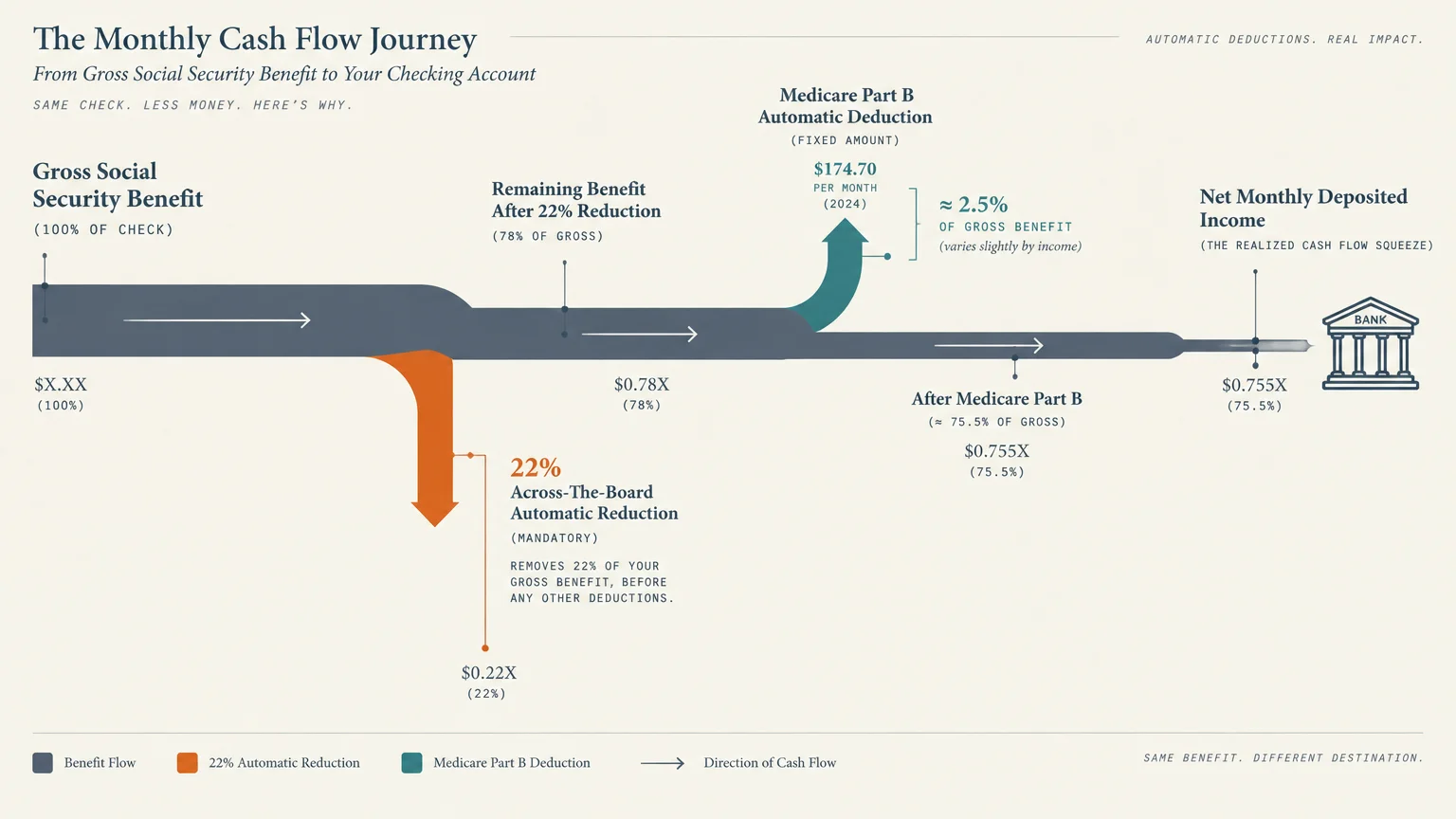
The headline benefit check you anticipate is rarely the exact cash amount deposited into your checking account. Medicare premium deductions create an additional squeeze that amplifies the impact of benefit cuts.
Most retirees have their Medicare Part B premiums deducted automatically from their Social Security checks. Many also opt to deduct Medicare Part D prescription drug coverage directly from their benefits.
These healthcare premiums rise consistently over time due to broad medical inflation. If baseline Social Security checks drop by 22 percent while healthcare costs rise, your net deposit shrinks disproportionately.
Consider a couple receiving two individual benefit checks. When medical premiums consume an expanding share of a reduced gross check, net discretionary cash collapses faster than the headline cut suggests.
Guidelines from the Consumer Financial Protection Bureau encourage seniors to examine net income rather than gross entitlement figures. Planning around net deposits prevents catastrophic budget shortfalls during retirement.
The statutory hold harmless provision normally prevents your net benefit from dropping due to Part B increases. However, that rule does not shield retirees from automatic trust fund depletion cuts.
Couples must recognize that healthcare expenses will demand a larger percentage of their remaining income. Preparing an emergency healthcare reserve helps cushion the blow when automatic reductions arrive.
Why Automatic Cuts Happen: The Legal and Demographic Drivers
Many Americans mistakenly assume that the federal government will simply print money to keep benefit checks whole. Current statutory law prevents that automatic bailout from happening without explicit congressional action.
The Social Security Act strictly limits benefit payments to the balances available in the trust funds. By law, the program cannot tap general tax revenues or incur federal debt to cover shortfalls.
If the Old-Age and Survivors Insurance fund empties its reserves in late 2032, the law mandates payments equal to incoming tax receipts. That limitation creates the automatic 22 percent cut.
A theoretical combined view of the trust funds provides only slight relief. If Congress merges the retirement fund with the Disability Insurance fund, insolvency is delayed until 2034.
Under that combined OASDI scenario, incoming revenue would support 83 percent of benefits, causing a 17 percent reduction. The standalone Disability Insurance fund remains fully solvent through at least 2100.
However, combining the funds requires lawmakers to pass legislation. Without a formal vote, the retirement fund hits the wall independently in late 2032.
Tax policy also plays a fundamental role in the shortfall. In 2026, the Social Security payroll tax applies to earnings up to $184,500, up from $176,100 in 2025.
Employees and employers each contribute 6.2 percent, generating a combined 12.4 percent tax on covered wages. Yet this earnings cap currently covers only about 83 percent of national wages, down from 90 percent in 1983.
Closing the entire 75-year shortfall through payroll taxes alone would require a permanent 4.42 percentage point hike. Such an increase would raise the total tax rate from 12.4 percent to nearly 16.8 percent.
Political disagreement over whether to raise payroll taxes or adjust benefit formulas has stalled corrective legislation for decades. As the 2032 deadline nears, the cost of delay grows exponentially for future retirees.

Strategic Steps to Protect Your Household Income
You cannot control congressional deliberations, but you retain full command over your personal financial blueprint. Taking deliberate steps today neutralizes much of the threat posed by future benefit cuts.
Your claiming age represents the single most powerful lever in Social Security planning. Delaying your claim past Full Retirement Age increases your base benefit by 8 percent per year until age 70.
In 2026, the maximum monthly benefit for a worker retiring at Full Retirement Age is $4,152. Delaying to age 70 establishes a substantially higher permanent floor that blunts the impact of future reductions.
“A delay in claiming Social Security is the best financial return you can guarantee in retirement.” — Suze Orman, Personal Finance Expert
Retirees also benefit from annual inflation adjustments. The SSA announced a 3.6 percent cost-of-living adjustment for 2027, lifting the average individual retired worker benefit to $2,170 per month starting January 2027.
If you continue working while receiving benefits before Full Retirement Age, monitor the retirement earnings test. For 2026, the exempt earnings limit is $24,480 per year, with $1 withheld for every $2 earned above.
During the calendar year you attain Full Retirement Age, the limit rises to $65,160. Understanding these thresholds prevents unexpected benefit withholding while you build extra retirement savings.
Tax diversification offers another critical defense against future policy shocks. Managing distributions across taxable, tax-deferred, and tax-free accounts gives you flexible control over your annual taxable income.
Financial reporting from Kiplinger notes that executing gradual Roth conversions before 2032 can reduce required minimum distributions and minimize future tax brackets. This strategy creates a dependable, tax-free income buffer.
Implement these proactive adjustments to reinforce your household financial foundation:
- Maximize Delayed Retirement Credits: Have your higher-earning spouse delay claims until age 70 to maximize both retirement and survivor benefits.
- Eliminate Consumer and Mortgage Debt: Entering retirement debt-free reduces baseline fixed cash obligations, making benefit cuts far easier to absorb.
- Build a Dedicated Buffer Asset: Maintain two to three years of living expenses in short-term cash reserves or Treasury bills to avoid selling stocks in market downturns.
- Execute Strategic Roth Conversions: Move assets from traditional IRAs to Roth accounts during lower-income bridge years between work and age 70.
- Diversify Retirement Income Streams: Develop dividend-paying portfolios, annuities with lifetime income riders, or modest part-time consulting income.
Common Mistakes to Avoid When Planning Around Potential Cuts
Emotional reactions to insolvency headlines often cause retirees to make costly financial miscalculations. Avoiding these common missteps preserves your wealth regardless of what happens in Washington.
Mistake 1: Claiming Benefits Early Out of Panic
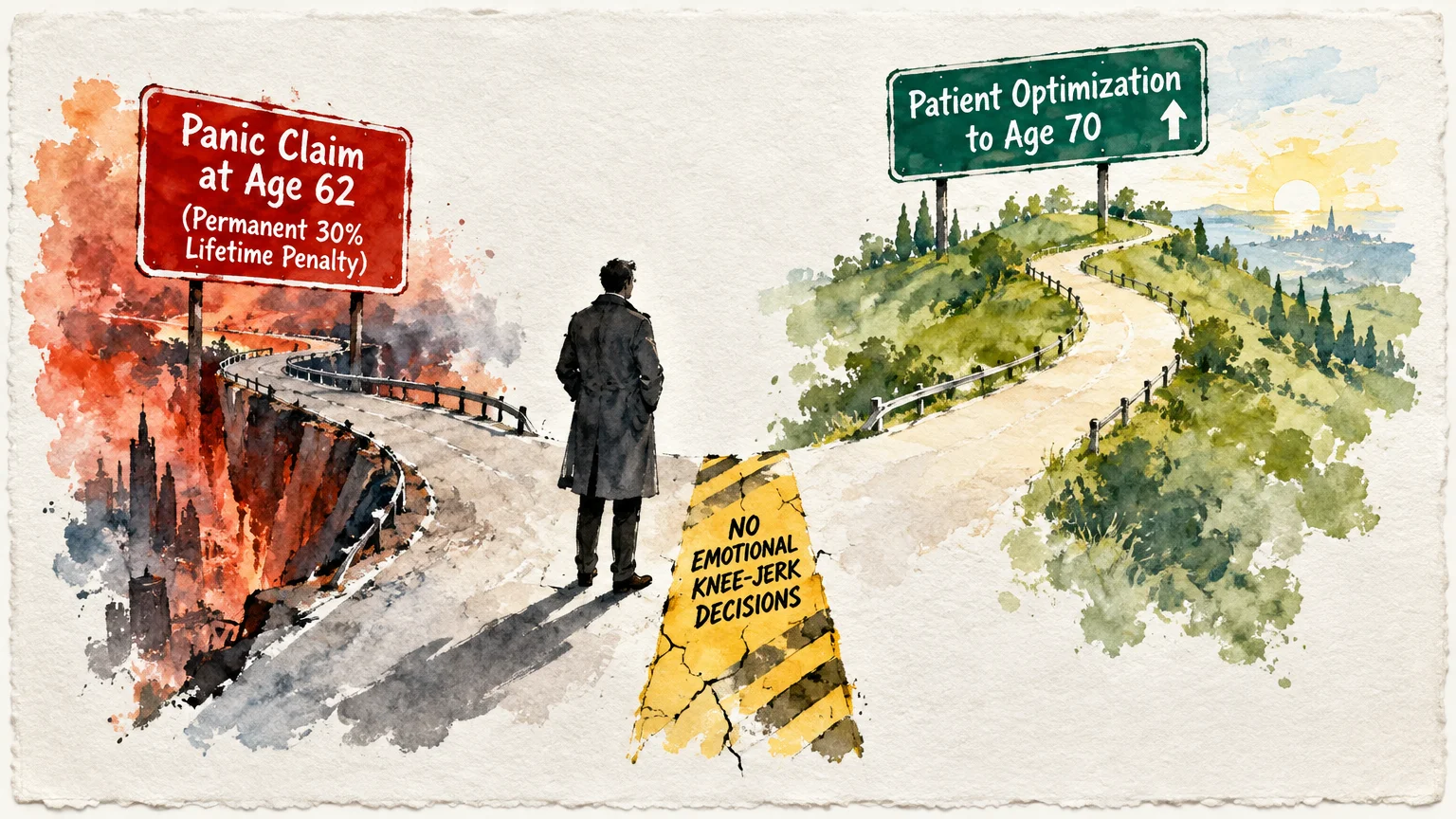
Fearing a 22 percent cut in 2032, some workers rush to claim benefits at age 62. Claiming at 62 permanently locks in a 30 percent reduction compared to your Full Retirement Age benefit.
If you take an early 30 percent cut and automatic 22 percent cuts follow, your income drops drastically. Waiting locks in a much larger starting baseline that withstands potential cuts far better.
Mistake 2: Assuming Congress Will Never Act
Assuming zero legislative reform is just as dangerous as panicking. Lawmakers historically address Social Security shortfalls at the eleventh hour, often protecting older retirees while phasing in gradual changes.
Basing your entire retirement plan on extreme catastrophic scenarios can cause you to live far below your means unnecessarily. Prudent planning balances sensible caution with realistic expectations.
Mistake 3: Overlooking Survivor Benefit Protection
Couples often treat Social Security as two independent checks without considering what happens when one spouse dies. When a spouse passes away, the surviving partner retains only the larger of the two benefits.
If the higher earner claimed early, the surviving spouse remains permanently stuck with an inferior survivor benefit. Maximizing the primary earner’s benefit shields the surviving spouse against both personal loss and federal cuts.
Mistake 4: Increasing Portfolio Withdrawal Rates Carelessly
Attempting to replace lost Social Security dollars by increasing your 401(k) withdrawal rate can ruin your portfolio. Raising withdrawal rates during market downturns accelerates sequence-of-returns risk and risks early portfolio depletion.

Professional vs. Self-Guided Retirement Strategy
Navigating potential benefit reductions requires an honest assessment of your financial complexity. Choosing between self-guided management and professional advisory support depends on your household resources and knowledge.
Scenario 1: Simple Dual-Income Household with Minimal Complexity (Self-Guided)
If both spouses have similar lifetime earnings, modest savings in standard index funds, and clear health histories, self-guided tools work well. You can model claiming strategies using free government calculators without paying advisory fees.
Scenario 2: Significant Earnings Gap and Spousal Age Disparity (Professional Guidance)
When one spouse earned substantially more or is several years younger, claiming coordination becomes mathematically complex. A fee-only financial planner helps coordinate survivor benefit optimization and bridge-year withdrawals.
Scenario 3: Substantial Pre-Tax Assets Facing Tax Torpedoes (Professional Guidance)
If you hold significant balances in traditional IRAs, future required minimum distributions will push you into higher tax brackets. Professional tax planners design multi-year Roth conversion schedules that offset potential Social Security losses.
Scenario 4: Pension-Backed Retirees with Debt-Free Real Estate (Self-Guided)
Retirees who enjoy guaranteed defined-benefit pensions covering their baseline living expenses need less professional intervention. A 22 percent cut to Social Security will not disrupt their fundamental housing or healthcare security.
Frequently Asked Questions About Potential Social Security Cuts
Will current retirees be exempt from Social Security benefit reductions in 2032?
Current law contains no exemption for existing beneficiaries if trust fund reserves are exhausted. Under the statutory formula, across-the-board cuts apply equally to current retirees and newly eligible claimants unless Congress passes protective legislation.
What would it take for Congress to fully solve the Social Security shortfall?
Eliminating the 75-year actuarial deficit solely through payroll taxes requires an immediate permanent increase of 4.42 percentage points. Alternatively, lawmakers could raise the $184,500 earnings cap, increase the Full Retirement Age, or adjust benefit formulas.
Should a middle-class couple claim Social Security early to beat the 2032 cuts?
Claiming early out of fear is almost always mathematically disadvantageous. Filing at age 62 locks in a permanent 30 percent reduction, leaving you with even less income if automatic cuts take effect later.
How does an automatic cut affect survivor benefit payments?
Survivor benefits are calculated directly from the deceased worker’s primary benefit amount. If an across-the-board reduction occurs, payable survivor benefits decrease by the same percentage as retirement payments.
Securing Your Financial Future in Changing Times
Headlines regarding the 2032 depletion cliff sound daunting, but knowledge gives you an undeniable advantage. Middle-class couples who take action today can adapt their savings, spending, and claiming schedules long before automated reductions arrive.
Focus on controllable variables by paying down fixed debts, diversifying your tax exposure, and coordinating claiming ages. Proactive financial management ensures that your retirement lifestyle remains secure regardless of federal policy shifts.
The information in this guide is meant for educational purposes, as your specific circumstances—including income, health needs, tax situation, and goals—may require different approaches. When in doubt, consult a licensed professional.
Last updated: November 2026. Retirement benefits, tax rules, and healthcare regulations change frequently—verify current details with official sources.








Leave a Reply