
Missing a critical Medicare deadline can quietly destabilize an otherwise meticulous retirement financial plan, triggering permanent monthly penalties and unexpected lapses in health coverage. Many retirees assume Medicare enrollment happens automatically at age 65, but unless you already draw Social Security benefits, you must proactively sign up during specific enrollment windows. Failing to navigate these strict timeline rules can increase your Part B premiums by ten percent for every year delayed and add lifetime surcharges to your drug plan. Understanding your initial enrollment period, seasonal open enrollments, and qualifying special circumstances ensures you secure comprehensive medical coverage while protecting your hard-earned savings from avoidable financial penalties.

The Core Medicare Enrollment Windows You Must Track
Navigating Medicare requires a clear understanding of five primary enrollment periods. Each window serves a distinct purpose, operates under strict calendar rules, and dictates when your healthcare coverage officially begins.
1. Initial Enrollment Period (IEP)
Your Initial Enrollment Period is your first opportunity to sign up for Medicare. This individualized 7-month window revolves around your 65th birthday—starting three months before the month you turn 65, including your birth month, and ending three months after your birth month.
If your birthday falls on the first day of a month, Medicare treats your entire timeline as if you turned 65 in the preceding month. Enrolling during the three months leading up to your 65th birthday ensures your coverage begins on the first day of your birthday month, eliminating any gap in medical coverage.
2. Annual Enrollment Period (AEP / Open Enrollment)
Every year from October 15 through December 7, Medicare conducts its Annual Enrollment Period. This seasonal window allows current beneficiaries to review and adjust their existing coverage for the upcoming calendar year. During AEP, you can:
- Switch from Original Medicare (Parts A and B) to a Medicare Advantage plan (Part C).
- Transition from a Medicare Advantage plan back to Original Medicare.
- Switch from one Medicare Advantage plan to another.
- Enroll in, drop, or change your standalone Medicare Part D prescription drug plan.
Any coverage modifications made during the Annual Enrollment Period take effect on January 1 of the following year. Because private insurance carriers update their drug formularies, provider networks, and out-of-pocket maximums annually, reviewing your plan every autumn prevents surprise out-of-pocket expenses.
3. Medicare Advantage Open Enrollment Period (MA OEP)
If you already hold a Medicare Advantage plan, you receive an additional window from January 1 to March 31 each year. During the Medicare Advantage Open Enrollment Period, you can make a one-time change. You may switch to a different Medicare Advantage plan or disenroll from Medicare Advantage to return to Original Medicare and add a standalone Part D prescription drug plan.
4. General Enrollment Period (GEP)
If you miss your Initial Enrollment Period and lack qualifying employer coverage, you must wait for the General Enrollment Period to sign up. Running annually from January 1 through March 31, the GEP allows you to enroll in Part A and Part B. Coverage begins on the first day of the month following your sign-up date; however, enrolling during this period frequently triggers lifetime late enrollment penalties.
5. Special Enrollment Periods (SEP)
Life changes do not always align with fixed calendar dates. Special Enrollment Periods allow you to sign up for or change Medicare coverage outside standard windows. Common life events that trigger a Special Enrollment Period include:
- Retiring and losing group health insurance coverage through an employer or spouse.
- Moving outside your current plan’s geographic service area.
- Losing creditable prescription drug coverage.
- Gaining or losing eligibility for Medicaid or Extra Help assistance programs.
You can verify current enrollment timelines and check your eligibility for special enrollment windows directly through the official Medicare.gov portal.
The Lifetime Cost of Missing Medicare Deadline Dates
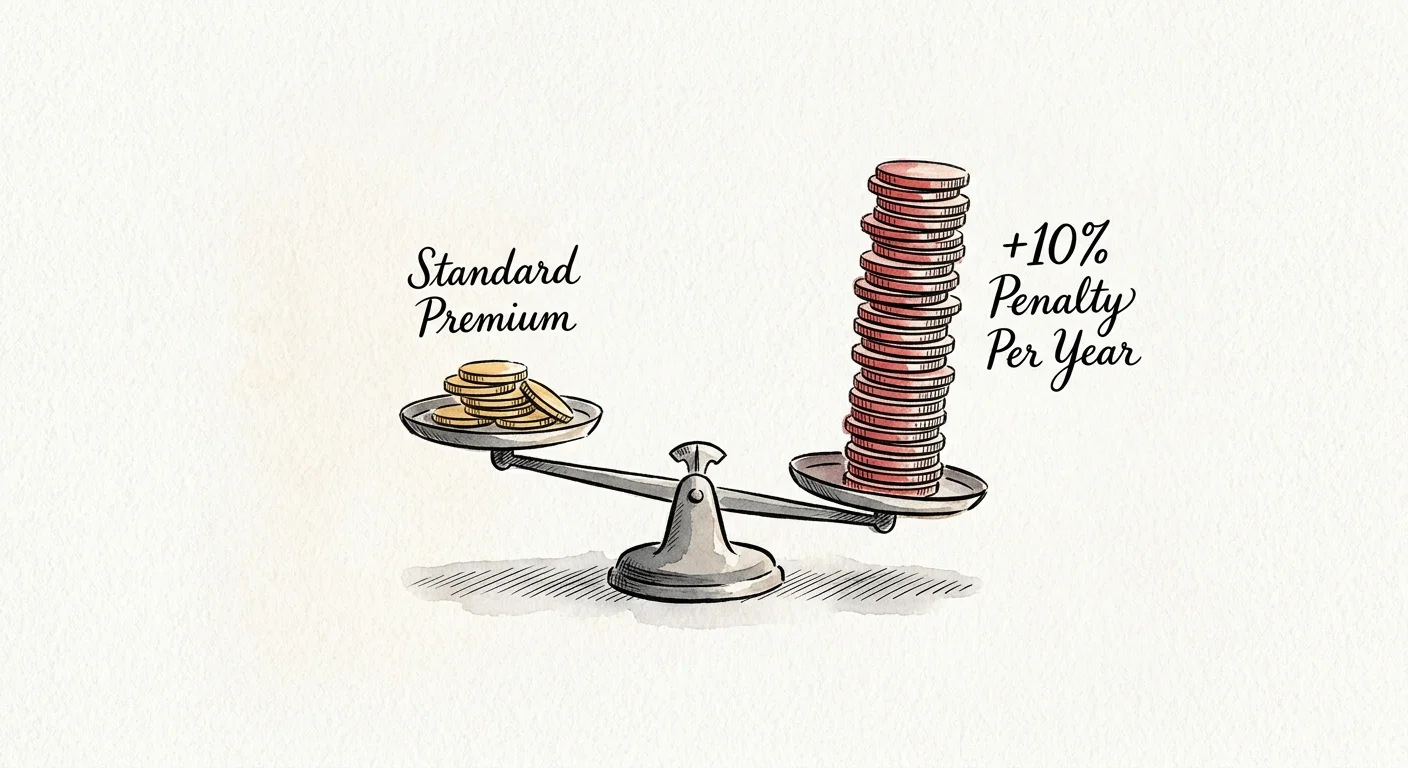
Federal regulations mandate strict financial penalties for beneficiaries who delay enrollment without maintaining qualifying, creditable health coverage. Unlike simple late fees, Medicare late enrollment penalties accumulate over time and remain attached to your monthly premiums for life.
Medicare Part B Late Enrollment Penalty
The Part B penalty applies to anyone who fails to sign up for Part B when first eligible, provided they do not have creditable coverage based on active employment. The penalty adds a permanent 10% charge to the standard monthly Part B premium for each full 12-month period you delayed enrollment.
Consider a practical financial scenario: express the math behind a two-year enrollment delay. For 2026, the standard Medicare Part B monthly premium is $202.90, alongside an annual deductible of $283. If you delay signing up for Part B for 24 full months without creditable employer insurance, Medicare applies a 20% penalty (10% for each 12-month period).
To calculate your added monthly expense:
$202.90 standard premium × 20% penalty = $40.58 monthly penalty
Your total monthly Part B payment becomes $243.48. Because the penalty is calculated as a percentage of the standard premium, your penalty dollar amount increases every year that the base Part B premium rises.
Medicare Part D Late Enrollment Penalty
The Medicare Part D drug coverage penalty activates if you go 63 consecutive days or more without creditable prescription drug coverage after your Initial Enrollment Period ends. Creditable coverage means insurance that pays, on average, at least as much as Medicare’s standard drug coverage.
Medicare calculates the Part D penalty by multiplying 1% of the national base beneficiary premium ($38.99 per month) by the number of full, uncovered months you were eligible but uninsured. That total is rounded to the nearest $0.10 and added to your monthly Part D plan premium permanently.
For instance, if you delay enrolling in a drug plan for 30 months without creditable coverage, your calculation looks like this:
30 months × 1% = 30%
30% of $38.99 base premium = $11.697 (rounded to $11.70)
You will pay an extra $11.70 every single month on top of your standard prescription plan premium, year after year.
Medicare Part A Late Enrollment Penalty
Most Americans earn premium-free Medicare Part A by accumulating 40 work quarters (10 years) of Medicare tax contributions. If you have not reached 40 quarters, you must purchase Part A. Failing to enroll in Part A when eligible results in a 10% premium penalty. Unlike Parts B and D, this penalty is temporary; you must pay the 10% surcharge for twice the number of years you delayed enrollment.
“Planning for healthcare costs in retirement isn’t just about budgeting for doctor visits; it’s about protecting your wealth from unexpected coverage gaps and permanent surcharges.” — Jean Chatzky, Financial Journalist and Author

The Employer Health Plan Trap: COBRA, Retiree Health, and HSAs
Working past age 65 has become common, yet doing so creates subtle compliance traps regarding healthcare coverage. Assuming your post-65 health coverage automatically protects you from Medicare late enrollment penalties often leads to costly mistakes.
The COBRA Misconception
Transitioning from active work to severance or retirement often involves COBRA continuation coverage. A dangerous misconception among new retirees is believing COBRA qualifies as active employer health coverage for Medicare Part B. Federal rules explicitly state that COBRA does not count as coverage based on current employment.
If you leave your job at age 65, decline Part B, and rely on COBRA for 18 months, your 8-month Special Enrollment Period begins the month your active employment ends—not when your COBRA coverage expires. Once that 8-month window closes, you cannot sign up for Part B until the next General Enrollment Period, leaving you vulnerable to health insurance gaps and permanent late penalties.
Retiree Health Insurance Coverage
Similar rules apply to retiree health plans offered by former employers. While retiree plans provide valuable supplemental benefits, Medicare considers them secondary coverage to Medicare Part B. If you turn 65 and transition to a retiree health plan without enrolling in Part B, your retiree plan may refuse to pay primary claims, leaving you responsible for large medical bills.
Employer Size Rules (The 20-Employee Rule)
If you or your spouse continue working past 65 and maintain coverage through an employer plan, company size dictates your enrollment strategy:
- 20 or more employees: The group health plan acts as your primary insurance, and Medicare acts as secondary insurance. You can safely delay Medicare Part B without penalty until active employment ends.
- Fewer than 20 employees: Medicare becomes your primary coverage. You must enroll in Medicare Part A and Part B during your 7-month IEP. If you fail to enroll, your small-employer plan may deny coverage for services Medicare would have paid.
Health Savings Accounts (HSAs) and Medicare Part A
If you contribute to a Health Savings Account (HSA) past age 65, pay close attention to Medicare Part A rules. Once you enroll in any part of Medicare, you can no longer make tax-deductible contributions to an HSA. Furthermore, when you apply for Medicare Part A after age 65, your Part A coverage retroactively dates back six months (but no earlier than your 65th birthday month).
To prevent tax penalties for excess HSA contributions, stop contributing to your HSA at least six full months before applying for Medicare or claiming Social Security benefits.
You can review detailed official employer rules directly through the Centers for Medicare & Medicaid Services.
Comparing Medicare Enrollment Windows and Deadline Dates
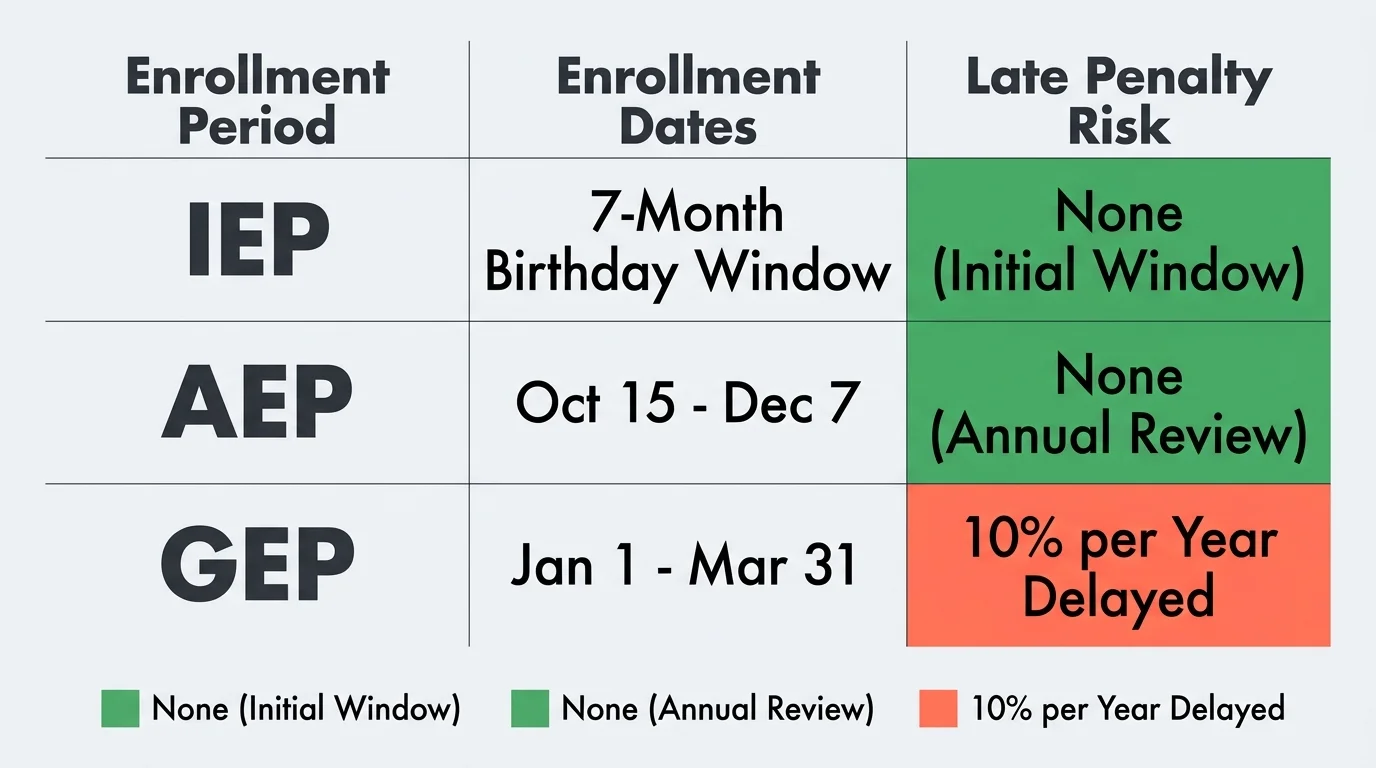
Understanding when each enrollment window opens and what actions you can take helps you avoid missing critical dates. Use this comparative overview to align your retirement timeline with federal deadlines.
| Enrollment Period | Key Dates & Window | Eligible Individuals | Permitted Actions | Penalty Risk |
|---|---|---|---|---|
| Initial Enrollment Period (IEP) | 7-month window around your 65th birthday | Individuals turning 65 | Enroll in Parts A, B, D, or Medicare Advantage | High risk of lifetime penalty if missed without active group plan |
| Annual Enrollment Period (AEP) | October 15 – December 7 annually | Current Medicare beneficiaries | Switch, add, or drop Medicare Advantage and Part D plans | No penalty risk; operational changes take effect Jan 1 |
| Medicare Advantage Open Enrollment (MA OEP) | January 1 – March 31 annually | Current Medicare Advantage enrollees | Switch Advantage plans or return to Original Medicare | No direct penalty; limited to one plan change |
| General Enrollment Period (GEP) | January 1 – March 31 annually | Those who missed IEP without active employer insurance | Sign up for Part A and Part B | High risk of permanent Part B late enrollment penalties |
| Special Enrollment Period (SEP) | Varies (typically 8 months for Part B; 60 days for Part D) | Individuals losing active work coverage or moving | Sign up for Parts A, B, D, or switch plans post-qualifying event | Low risk if actions are taken within specified windows |

Professional vs. Self-Guided: Navigating Your Enrollment Strategy
Deciding whether to manage your Medicare transition independently or work with a certified healthcare counselor depends on the complexity of your financial and medical landscape.
Scenario 1: Working Past 65 at a Mid-Sized Company
- Self-Guided Approach: You independently review your company’s benefits document, confirm your company has 30 employees, verify your drug coverage meets “creditable” standards, and elect to delay Part B while signing up for premium-free Part A.
- Professional Guidance: A benefits advisor evaluates your employer’s high-deductible plan against standard Part B ($202.90/month) and a Medigap policy. The advisor calculates that switching to Original Medicare with supplemental coverage reduces your out-of-pocket costs while eliminating HSA contribution compliance hazards.
Scenario 2: Retiring with Multiple Prescriptions
- Self-Guided Approach: You sign up for Medicare Advantage during your IEP based on low monthly premium advertisements, assuming all your prescription drugs receive coverage.
- Professional Guidance: An independent agent analyzes your specific medication list against every local Part D formulary. Under recent policy updates capping Part D out-of-pocket prescription expenses at $2,100 annually, the advisor selects a plan that lowers overall medication spending while ensuring your preferred pharmacies remain in-network.
Scenario 3: Transitioning Off Employer COBRA Coverage
- Self-Guided Approach: You exhaust 18 months of COBRA coverage post-retirement, assuming you can transition directly into Medicare Part B when COBRA ends. You run into a coverage denial and incur lifetime late enrollment penalties.
- Professional Guidance: A State Health Insurance Assistance Program (SHIP) counselor warns you prior to retirement that COBRA does not count as active employment coverage. They assist you in submitting CMS Form L564 to claim your Special Enrollment Period immediately upon leaving your job.
Scenario 4: Relocating to a New State in Retirement
- Self-Guided Approach: You move to a new state and continue paying premiums on your existing Medicare Advantage plan, assuming your coverage travels with you. Your doctors suddenly register as out-of-network, triggering high out-of-pocket costs.
- Professional Guidance: A licensed Medicare specialist identifies your change of address as a Special Enrollment Period trigger, executing a seamless transition into a top-rated plan in your new region before your move date.

Common Mistakes to Avoid When Managing Medicare Deadlines
Avoiding administrative traps requires vigilance. Watch out for these common errors that catch retirees off guard every year:
- Assuming automatic enrollment: If you are not drawing Social Security benefits at age 65, the federal government will not enroll you in Medicare automatically. You must initiate enrollment yourself through the Social Security Administration.
- Confusing creditable drug coverage: Not all prescription drug plans offered by retirement packages or private policies qualify as creditable. Always request a written Notice of Creditable Coverage from your plan provider every year.
- Ignoring the Annual Notice of Change (ANOC): In late September, your Medicare Advantage or Part D plan sends an ANOC detailing changes to pricing, co-pays, networks, and drug formularies for the coming year. Ignoring this document can lead to costly surprises on January 1.
- Missing Medigap Guaranteed Issue Windows: Your one-time 6-month Medigap Open Enrollment Period begins the first month you have Part B and are 65 or older. During this period, insurance companies cannot deny you a Medigap policy or charge higher rates due to pre-existing health conditions. Missing this window can permanently lock you out of purchasing a Medicare Supplement policy.
- Failing to track prescription cap changes: With the Inflation Reduction Act capping out-of-pocket Part D drug costs at $2,100 per year, failing to review your formulary annually could cause you to overpay for tier-level prescription co-pays.
“An ounce of prevention is worth a pound of cure.” — Benjamin Franklin, Statesman and Inventor
Frequently Asked Questions About Medicare Deadlines
What happens if I miss my Medicare Initial Enrollment Period?
If you miss your Initial Enrollment Period without having qualifying coverage based on active employment, you must wait until the General Enrollment Period (January 1 to March 31) to sign up. Your coverage will begin the first day of the month after you sign up, but you will likely owe lifetime late enrollment penalties for Part B and Part D.
Does COBRA count as creditable coverage for Medicare Part B?
No. COBRA health coverage is not considered coverage based on active employment. Delaying Part B enrollment while taking COBRA will trigger late enrollment penalties and prevent you from accessing a Special Enrollment Period when your COBRA coverage ends.
How is the Part B late enrollment penalty calculated?
The Part B penalty adds 10% to your monthly Part B premium for every full 12-month period you were eligible but failed to enroll without qualifying employer coverage. This penalty is permanent and recalculated annually based on the current standard Part B premium ($202.90 per month in 2026).
Can I make changes to my Medicare plan outside of the Open Enrollment Period?
Yes, provided you qualify for a Special Enrollment Period (SEP). Common triggers for an SEP include moving outside your plan’s geographic service area, losing active employer-sponsored health coverage, or qualifying for assistance programs like Extra Help. You can find detailed resources on state-level support programs through the National Council on Aging.
Taking Action: Your Next Steps for Medicare Planning
Preventing Medicare deadline mistakes requires systematic planning well before your 65th birthday or retirement date. Mark your calendar six months before turning 65 to audit your current health coverage, verify active work status with your employer’s HR department, and request written confirmation of creditable drug coverage.
If you plan to retire soon, coordinate your health plan transitions to prevent gaps in coverage. Download official application forms from Social Security, consult licensed insurance specialists if navigating complex medical conditions, and stay proactive during every Annual Enrollment Period to keep your retirement health strategy aligned with your overall financial plan.
This is educational content based on general retirement and financial principles. Individual results vary based on your situation. Always verify current benefit rules, tax laws, and eligibility requirements with official sources like SSA, Medicare.gov, or the IRS.
Last updated: March 2026. Retirement benefits, tax rules, and healthcare regulations change frequently—verify current details with official sources.









Leave a Reply