
Relocating across state lines can instantly reduce your living costs, but unexpected state levies often erase those anticipated savings. Understanding how local revenue departments treat your pensions, investments, and real estate protects your hard-earned nest egg.
Many retirees move toward warmer climates or zero-income-tax states without reviewing local property, sales, and legacy rules. Unfortunately, tax codes vary wildly from border to border.
Before you pack your moving boxes, learn the hidden tax traps that catch relocating seniors off guard. A proactive plan ensures your retirement dollars stay where they belong—in your pocket.
Surprise 1: The Zero-Income-Tax Mirage and Higher Ancillary Levies
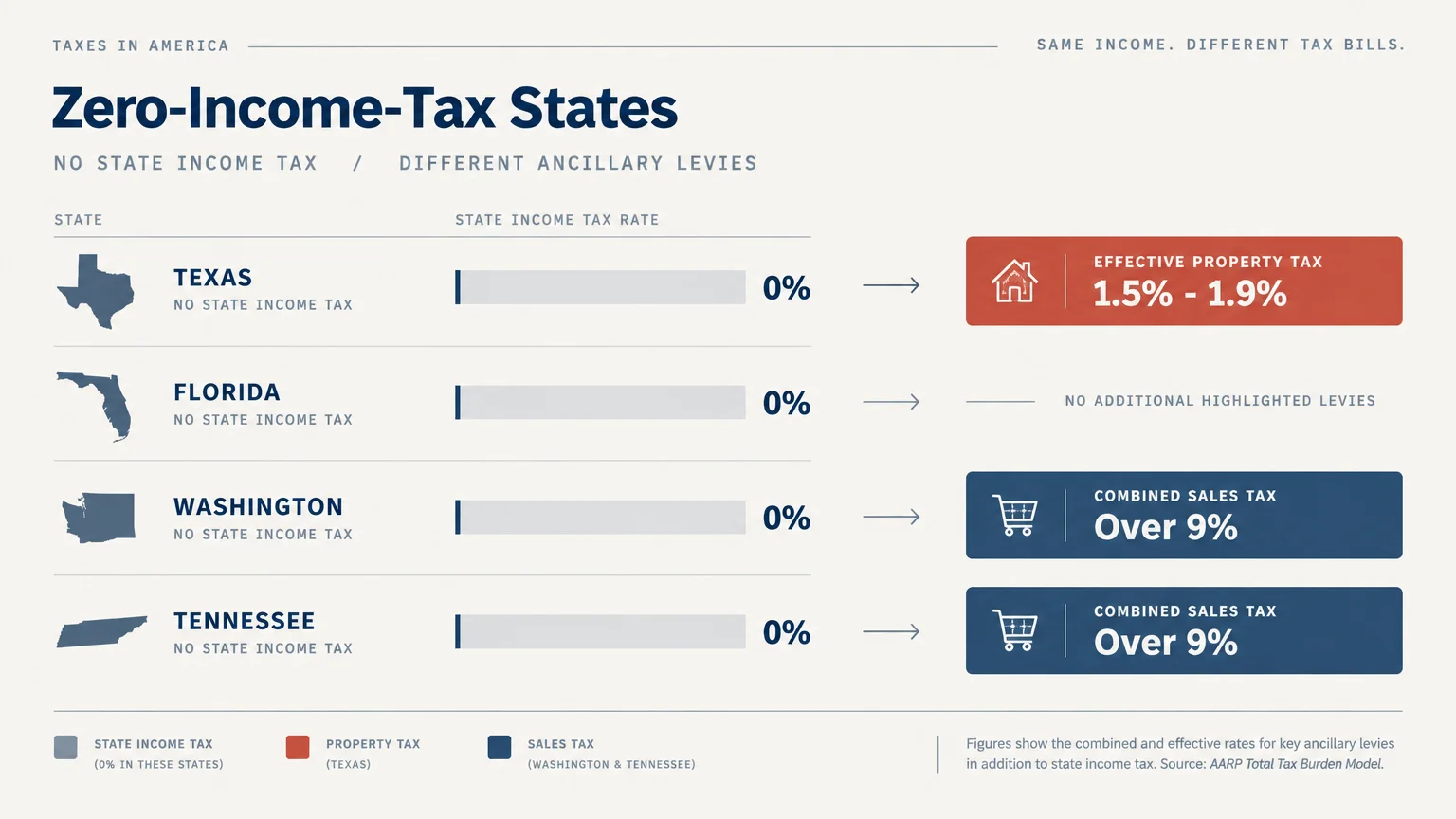
Nine states do not levy a traditional earned income tax: Alaska, Florida, Nevada, New Hampshire, South Dakota, Tennessee, Texas, Washington, and Wyoming. Many movers assume this absence translates directly to lower overall living expenses.
State governments must fund essential public infrastructure, emergency services, and education regardless of income tax policies. When a jurisdiction foregoes income taxes, it invariably recoups that revenue elsewhere.
Texas and New Hampshire offset their lack of individual wage taxes by collecting effective property tax rates between 1.5% and 1.9%. A modest home in these states carries annual real estate tax bills that shock unvetted buyers.
Similarly, Tennessee and Washington compensate with steep consumption taxes. Combined state and local sales tax rates in both states regularly exceed 9%, raising the daily cost of goods and retail purchases.
According to consumer research from AARP, evaluating total tax burden gives a much clearer picture than focusing entirely on income tax rates alone. Compare property, sales, and excise taxes together before settling on a destination.

Surprise 2: Statutory Residency and Aggressive “183-Day Rule” Audits
Relocating involves much more than buying a house down south and changing your mailing address. Your former home state may still claim you as a resident if you leave loose ends behind.
High-tax states like New York, California, and New Jersey aggressively audit taxpayers who attempt to relocate. If these states determine you retained residency, they will demand taxes on your worldwide income.
Two distinct legal tests determine your tax liability: domicile and statutory residency. Domicile represents your primary, permanent home—the place you intend to return to whenever absent.
Statutory residency, however, is purely mechanical. If you maintain a permanent place of abode in a state and spend more than 183 days there during the calendar year, you owe full resident taxes.
New York tax auditors enforce an uncompromising standard: spending any fraction of a minute within state borders legally counts as an entire day. An afternoon spent visiting grandchildren counts against your 183-day limit.
Auditors regularly review mobile phone records, toll transponder logs, veterinary records, and credit card statements to track your location. Clear Investopedia guides emphasize keeping pristine calendar records to defeat state residency taxes during an audit.

Surprise 3: Property Tax Reassessments and Reset Assessment Caps
Longtime homeowners often enjoy significant statutory protections that limit how fast their assessed property values can rise. When you move across state borders, those protective caps instantly disappear.
In California, Proposition 13 restricts annual taxable value increases to just 2% unless the property sells. Florida caps taxable value increases for homesteads at 3% annually under its “Save Our Homes” amendment.
When you purchase a replacement residence in a new state, the tax assessor recalibrates the property value to current market prices. You start at the top of the valuation cycle.
You cannot estimate your future property taxes by checking what the seller currently pays. The seller may benefit from legacy exemptions and multi-decade assessment caps that vanish the moment the deed transfers.
Call the county assessor directly before making an offer on a retirement home. Request an estimate of the property taxes based on your prospective purchase price rather than historical payments.

Surprise 4: The 8-State Trap on Social Security Benefits
At the federal level, the Internal Revenue Service taxes up to 85% of your Social Security benefits depending on your combined income. Most states exempt these monthly retirement benefits entirely, but several notable exceptions remain.
Only eight states still tax Social Security benefits to varying degrees: Colorado, Connecticut, Minnesota, Montana, New Mexico, Rhode Island, Utah, and Vermont. If you relocate to one of these states, your monthly checks face state-level haircuts.
Fortunately, legislative momentum strongly favors retirees. Kansas, Missouri, and Nebraska officially eliminated their taxes on Social Security benefits in 2024, and West Virginia completed its full phase-out.
The remaining eight states generally provide income-based exemptions, but higher-income retirees frequently exceed those thresholds. Research each state’s specific adjusted gross income phaseouts before establishing your new domicile.
Surprise 5: Low Exemption Cliffs for State-Level Estate Taxes
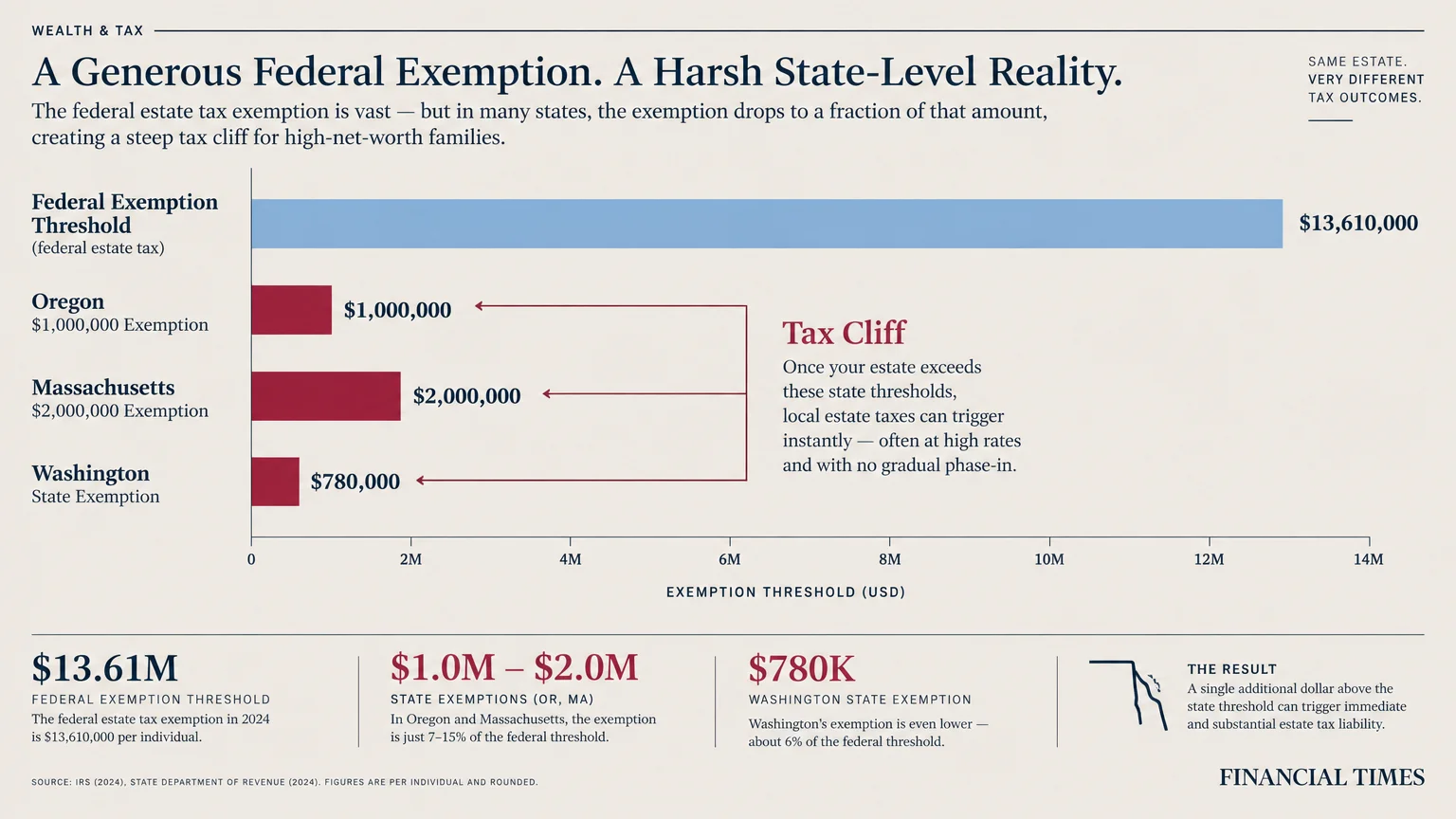
Federal estate taxes affect only high-net-worth households due to generous statutory exemptions. However, twelve states and the District of Columbia enforce separate, independent estate taxes with substantially lower thresholds.
Oregon maintains the lowest estate tax exemption in the country at just $1,000,000. Massachusetts enforces a $2,000,000 exemption threshold, while several other northeastern states set limits well below federal benchmarks.
In these jurisdictions, a home, life insurance payouts, and retirement accounts can easily trigger a six-figure estate tax liability. What seems like a modest family estate suddenly faces mandatory state filings.
Furthermore, several state estate tax systems operate as a “cliff.” If your estate exceeds the exemption threshold by a single dollar, the state taxes the entire value, not just the excess.
“A great retirement requires knowing where your money goes every single month, especially when moving to a new state.” — Suze Orman, Personal Finance Author

Surprise 6: Sneaky Inheritance Taxes Charged to Your Heirs
Estate taxes apply directly to an estate before wealth distributes to heirs. Inheritance taxes work differently; the state levies the tax directly on the beneficiary receiving the assets.
Only five states still collect an inheritance tax: Kentucky, Maryland, Nebraska, New Jersey, and Pennsylvania. Iowa officially eliminated its inheritance tax on January 1, 2025.
Maryland holds the unique distinction of being the only state in the country that imposes both an estate tax and an inheritance tax. Relocating there creates compounding estate transfer obligations.
Inheritance tax rates depend heavily on the beneficiary’s legal relationship to the deceased. While spouses and immediate children are frequently exempt or taxed lightly, siblings, nieces, nephews, and friends face tax rates up to 16%.
If you leave assets to non-lineal relatives, moving states in retirement can dramatically diminish their legacy. Estate planning updates remain essential whenever moving into an inheritance-tax state.

Surprise 7: Federal Protections vs. Non-Qualified Deferred Compensation
Retirees often worry that their former high-tax home state will tax their monthly corporate pension payments or 401(k) withdrawals after they move. Fortunately, federal law prevents this double taxation for qualified accounts.
Under 4 U.S.C. Section 114—known as the Pension Source Act—states cannot tax retirement distributions paid to former residents from qualified plans. This protection covers traditional 401(k) plans, 403(b) plans, individual retirement accounts, and qualified pensions.
However, non-qualified deferred compensation plans do not receive automatic immunity. If you receive corporate executive bonuses, supplemental executive retirement plans, or phantom stock payments, your former state may claim its share.
To qualify for federal protection under Section 114, non-qualified deferred compensation distributions must meet specific timing rules. The plan must disburse payments as a life annuity or in substantially equal installments over at least ten years.
If you take non-qualified balances as a lump-sum payout after relocating, your former home state can tax the entire distribution. Review deferred compensation plan terms with your benefits administrator before scheduling withdrawals.
Comparing Total Tax Burdens Across Popular Retirement States
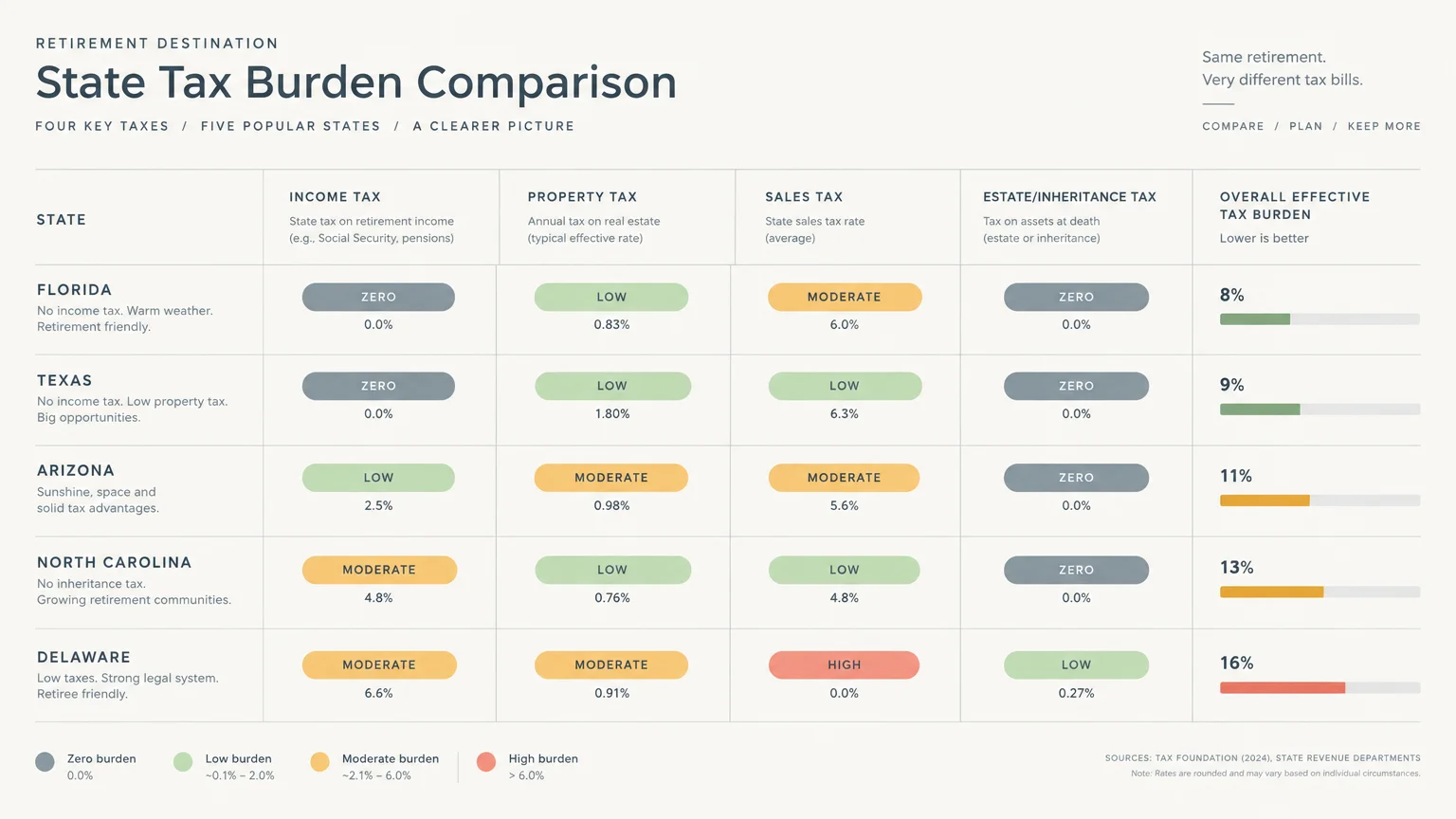
Evaluating state tax systems requires comparing income levies, asset protections, and consumption taxes side by side. The table below demonstrates how popular retirement destinations handle core retiree revenues.
| State | State Income Tax | Social Security Taxed? | Average Combined Sales Tax | Estate or Inheritance Tax? |
|---|---|---|---|---|
| Florida | None | No | 7.02% | Neither |
| Texas | None | No | 8.20% | Neither |
| Pennsylvania | 3.07% (Retirement Exempt) | No | 6.34% | Inheritance Tax |
| Oregon | Up to 9.9% | No | 0.00% | Estate Tax ($1M Exemption) |
| Maryland | Up to 5.75% | No | 6.00% | Both Estate and Inheritance |
| Vermont | Up to 8.75% | Yes (Subject to Income Limits) | 6.36% | Estate Tax ($5M Exemption) |

Common Mistakes to Avoid
Retirees eager to establish their new life often make procedural errors that cost thousands in retroactive taxes and penalties. Avoid these regular missteps during your transition:
- Retaining Primary Ties to Your Former State: Leaving bank accounts, doctors, club memberships, and primary vehicle registrations in your previous state invites residency challenges.
- Ignoring Assessment Roll Dates: Missing county homestead filing deadlines leaves you paying standard commercial property tax rates for an entire year.
- Overlooking Vehicle Excise Taxes: Several low-income-tax states charge expensive annual personal property taxes or ad valorem registration fees on cars, RVs, and boats.
- Failing to Track Travel Days: Discarding flight receipts and travel itineraries makes proving statutory non-residency difficult if your former state audits your departure.
- Leaving Non-Qualified Deferred Compensation Unstructured: Taking lump-sum executive distributions allows former home states to tax that income under source-tax rules.

Professional vs. Self-Guided Relocation Planning
Deciding whether to handle your relocation yourself or hire specialized legal and tax help depends entirely on the complexity of your financial life. Review these scenarios to determine your optimal path.
Scenario 1: Straightforward Relocation with Pure Qualified Assets. If you sell your previous residence completely, lease or buy a single home, and hold income exclusively in Social Security and standard 401(k) or IRA accounts, a self-guided process works well. State source protections shield your qualified balances automatically.
Scenario 2: Dual-State Living and Seasonal Vacation Properties. If you plan to split time between a summer cottage up north and a condo down south, hire a certified public accountant. Navigating the 183-day rule and defending against aggressive state residency audits requires disciplined documentation.
Scenario 3: Concentrated Equity, Deferred Compensation, or Business Pass-Throughs. Executives receiving executive retention payments or business owners collecting earn-out distributions should retain cross-border tax counsel. Structuring distributions properly prevents your former home state from seizing a percentage of non-qualified payouts.
Scenario 4: Estates Exceeding Low State Exemptions. If you own real estate or assets approaching $1,000,000 and move to states like Oregon, Massachusetts, or Maryland, consult an estate planning attorney. Establishing revocable living trusts and gifting strategies prevents catastrophic state death levies.
Frequently Asked Questions
Can my old state tax my 401(k) after I relocate?
No. Under federal statute 4 U.S.C. Section 114, states cannot tax retirement income from qualified plans paid to individuals who are no longer legal residents.
How long do I need to live in a new state to establish tax domicile?
Domicile is not based purely on days; it requires demonstrating true permanent intent. Registering to vote, obtaining a driver’s license, and buying your primary home establish immediate legal domicile.
What is the 183-day rule for state residency taxes?
If you maintain a permanent place of abode in a state and spend more than 183 days there annually, you become a statutory resident liable for state income tax.
Do zero-income-tax states always save retirees money?
Not necessarily. High property tax rates, higher sales taxes, and elevated utility fees in zero-income states frequently offset the savings on wages or investments.
Comprehensive tax planning turns cross-border retirement dreams into lasting financial security. Consult qualified tax and estate planning specialists before changing your primary address to guarantee your relocation delivers the exact savings you planned.
This is educational content based on general retirement and financial principles. Individual results vary based on your situation. Always verify current benefit rules, tax laws, and eligibility requirements with official sources like SSA, Medicare.gov, or the IRS.
Last updated: March 2026. Retirement benefits, tax rules, and healthcare regulations change frequently—verify current details with official sources.









Leave a Reply