
Recent federal tax legislation fundamentally alters how you write off gifts to your favorite causes starting in 2026. Understanding these charitable giving tax changes helps you protect your retirement nest egg while supporting organizations you love.
The One Big Beautiful Bill Act, signed into law on July 4, 2025, introduces new relief for everyday donors while tightening limits on wealthier taxpayers. These adjustments directly reshape philanthropic planning across the country.
Whether you claim the standard deduction or itemize your returns, these rules affect your annual bottom line. Preparing your finances now guarantees that your hard-earned dollars generate the highest possible financial impact.
The 2026 Charitable Giving Landscape: An Overview
Charitable giving has long offered a meaningful way for retirees to support vital community institutions. At the same time, giving provides valuable tax relief that preserves hard-earned savings.
On July 4, 2025, federal lawmakers enacted the One Big Beautiful Bill Act, also known as the Working Families Tax Cuts. This landmark legislation established three major changes to the charitable deduction starting in the 2026 tax year.
For several years, the vast majority of retirees received no direct tax write-off for their donations. Skyrocketing standard deductions meant only a small fraction of households chose to itemize their tax returns.
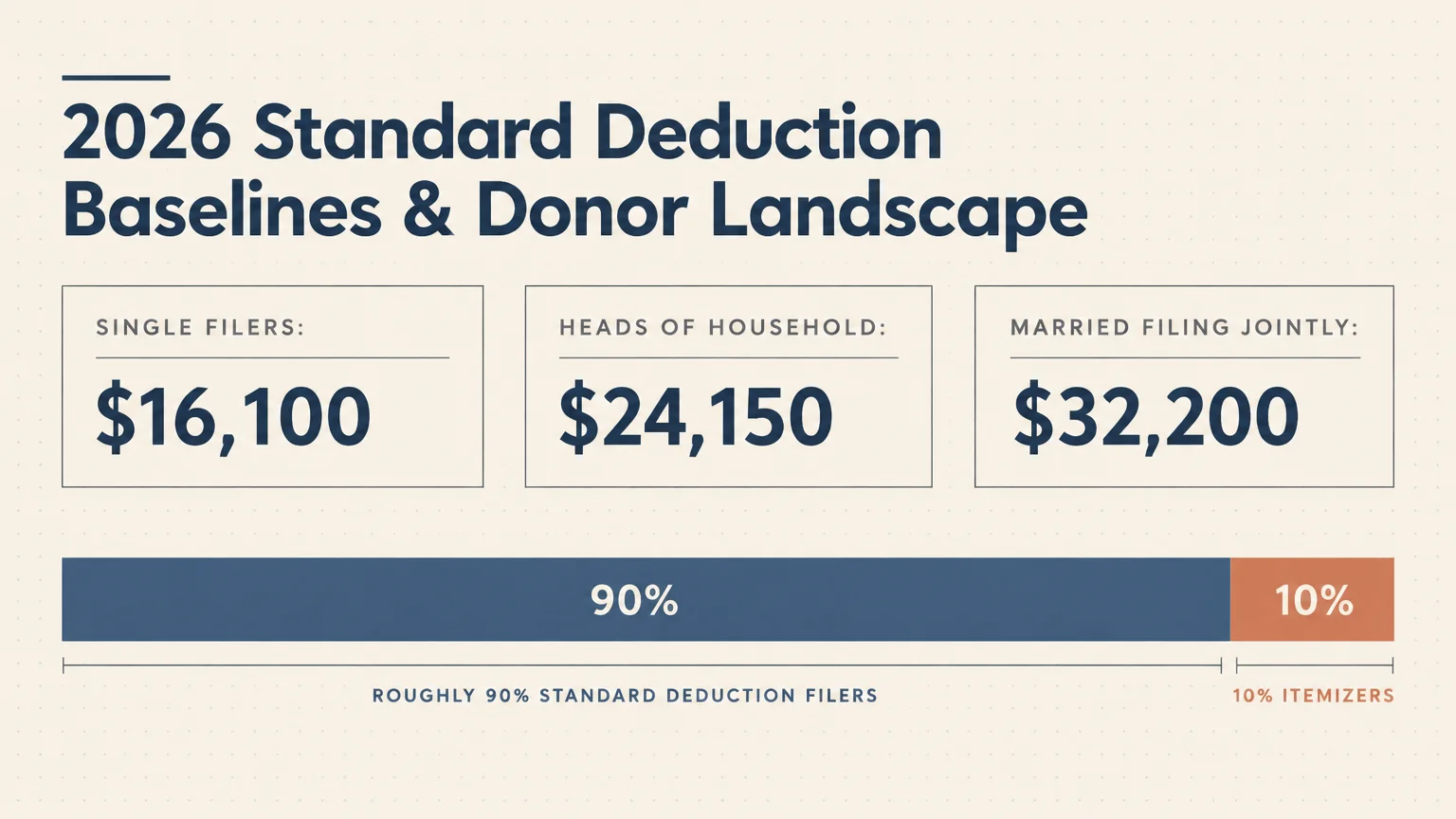
For the 2026 tax year, the base standard deduction rises to $16,100 for single filers. Married couples filing jointly receive a standard deduction of $32,200, while heads of household receive $24,150.
Because roughly 90% of all taxpayers take the standard deduction, most charitable gifts produced zero federal tax savings. The new legislation rebalances this framework by offering new incentives while curbing deductions elsewhere.
To navigate these updates effectively, you must understand how federal tax codes treat different taxpayers. Some rules reward regular givers, while other provisions demand sharper attention from high-income households.
“If you’re in the luckiest 1 percent of humanity, you owe it to the rest of humanity to think about the other 99 percent.” — Warren Buffett, Chairman and CEO of Berkshire Hathaway
Change 1: The New Non-Itemizer Charitable Deduction
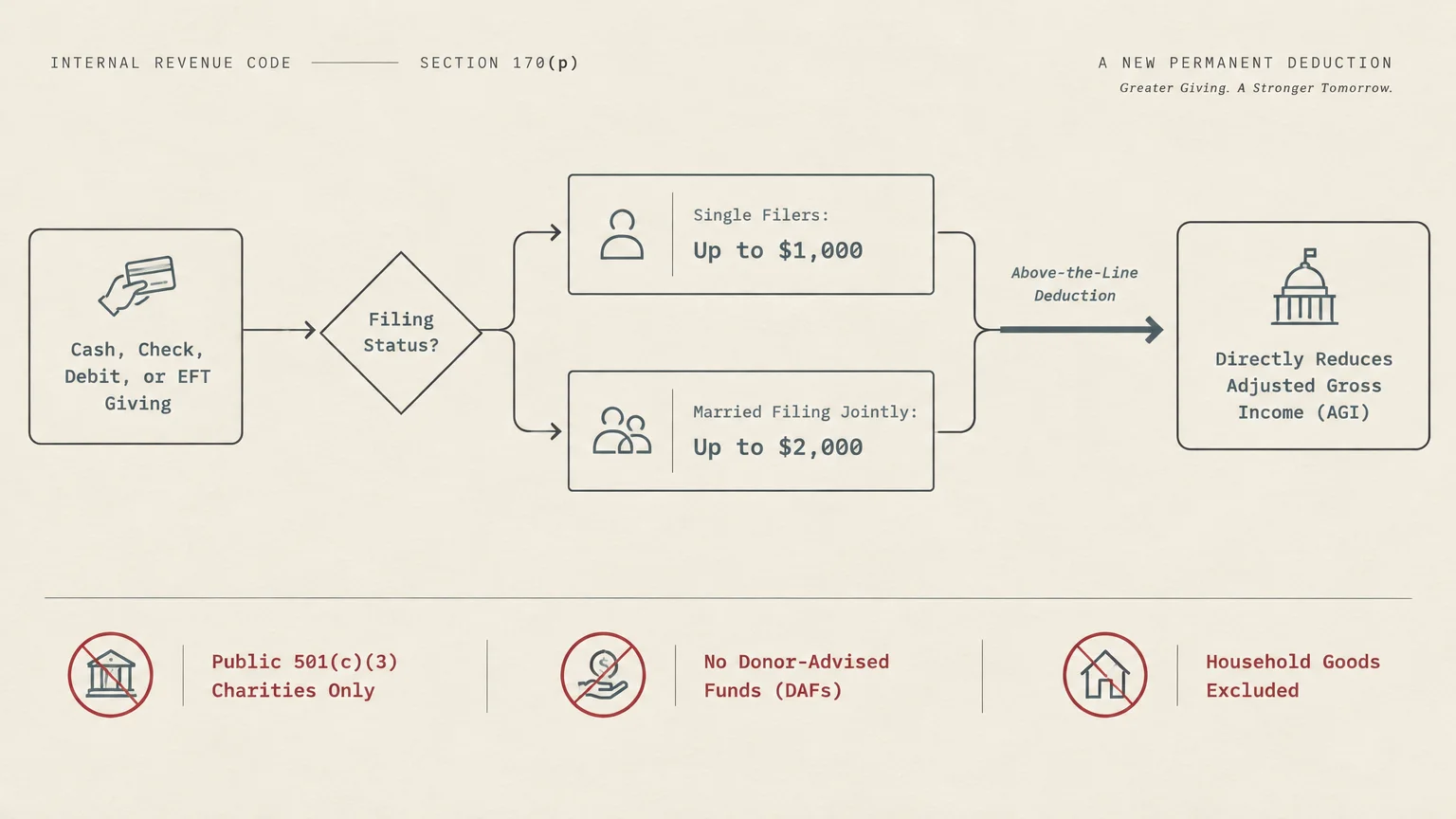
The first major shift establishes a permanent non-itemizer charitable deduction under Internal Revenue Code Section 170(p). This provision allows you to claim a direct deduction even if you claim the standard deduction.
Under this rule, single filers can deduct up to $1,000 of qualifying donations on their 2026 tax returns. Married couples filing jointly can deduct up to $2,000 of charitable gifts.
This deduction functions as an above-the-line deduction, meaning it directly reduces your Adjusted Gross Income (AGI). Lowering your AGI can yield broad financial benefits across your entire retirement plan.
A lower AGI can reduce your taxable income, lower state taxes, and preserve eligibility for income-tested credits. It can also help retirees manage Medicare premium surcharges and Social Security tax thresholds.
However, this new tax benefit comes with strict legislative conditions you must follow closely. You cannot simply write off every form of gift you provide to non-profit entities.
- Cash Donations Only: You must make contributions via cash, check, debit card, credit card, or electronic funds transfer. Household goods, used cars, and clothing donations do not qualify.
- Direct Public Charities: Gifts must go directly to active 501(c)(3) public charities, religious congregations, or accredited educational institutions.
- No Donor-Advised Funds (DAFs): Contributions funneled into donor-advised funds are strictly ineligible for this non-itemizer deduction.
- No Private Non-Operating Foundations: Transfers to private grant-making foundations or supporting organizations do not qualify for this write-off.
- Fixed Dollar Limits: The $1,000 single and $2,000 married caps are permanent and are not indexed for future annual inflation.
Consider an illustrative scenario involving a retired couple taking the $32,200 standard deduction in 2026. Under prior guidelines, donating $2,000 in cash to their local food pantry provided zero tax benefit.
Under the new rules, this couple deducts the full $2,000 directly from their income. If they sit in the 22% tax bracket, this provision saves them $440 in federal taxes.
To secure this deduction, you must retain rigorous financial documentation. The Internal Revenue Service (IRS) requires written bank records or contemporaneous acknowledgments from the recipient charity for all claimed amounts.
Change 2: The New 0.5% AGI Floor for Itemizers
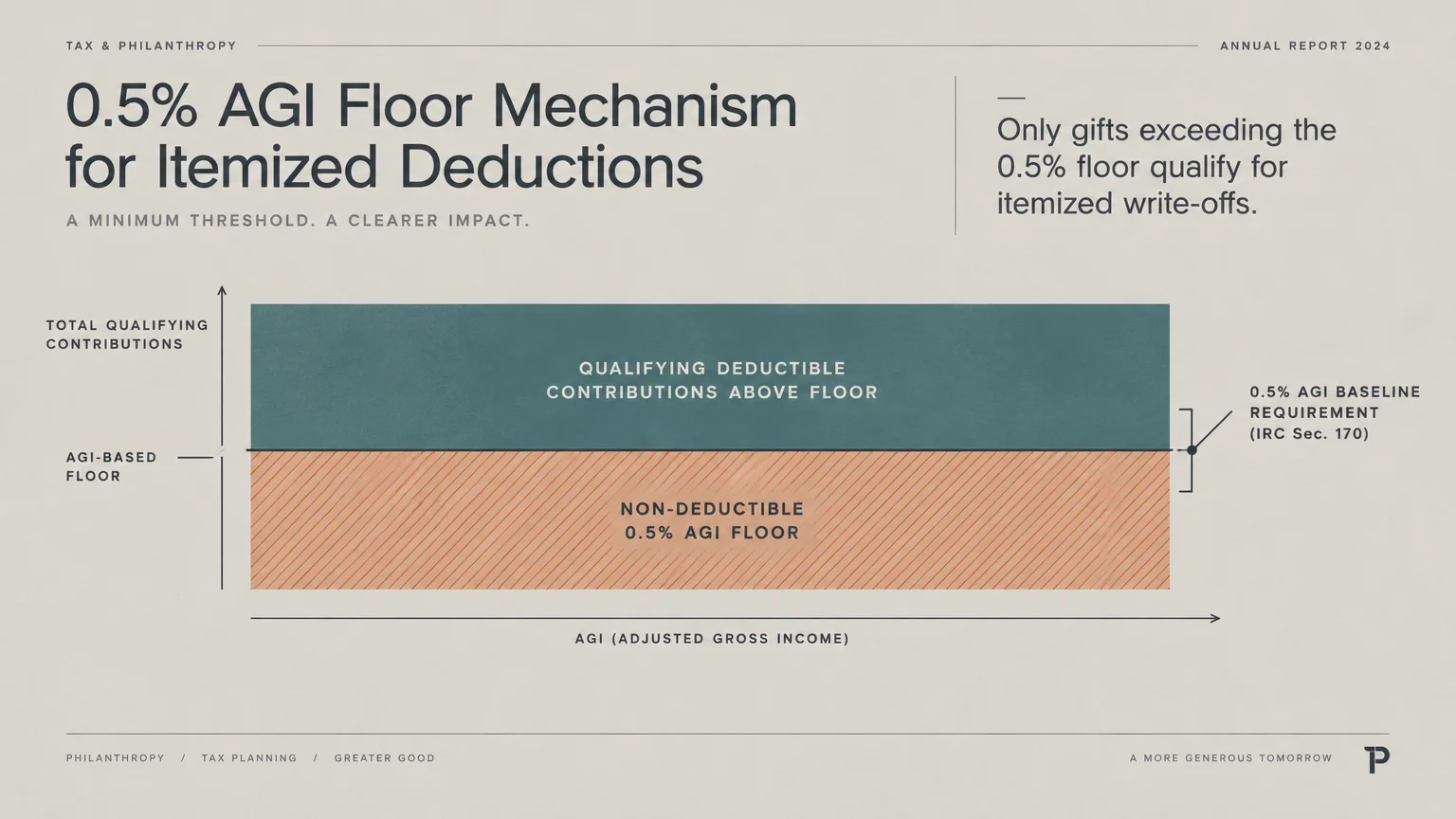
While non-itemizers gained a valuable write-off, itemizing taxpayers face an unexpected hurdle in 2026. The legislation introduces a new 0.5% Adjusted Gross Income deduction floor for all itemized charitable gifts.
Under this provision, you can only deduct charitable donations to the extent that your total qualified giving exceeds 0.5% of your AGI. Any contributions below that 0.5% threshold provide no tax deduction.
This structural mechanism mirrors the medical expense deduction floor, although at a significantly lower percentage. Congress designed this threshold to eliminate small, administrative deduction claims among high-income earners.
For corporate filers, the legislation establishes an even steeper 1% taxable income floor for charitable contributions in 2026. However, individual retirees must navigate the personal 0.5% baseline calculation.
Calculating your specific deduction floor requires multiplying your annual AGI by 0.005. Let us review how this math applies across several retirement income scenarios.
- $100,000 AGI: Your charitable giving floor equals $500. You only deduct contributions that exceed this $500 mark.
- $200,000 AGI: Your charitable giving floor equals $1,000. You cannot deduct the first $1,000 of your total charitable gifts.
- $400,000 AGI: Your charitable giving floor equals $2,000. Any donations up to $2,000 yield zero itemized tax deductions.
- $600,000 AGI: Your charitable giving floor equals $3,000. Deductions only begin once your giving surpasses this threshold.
Imagine a retired executive couple with an AGI of $200,000 who itemizes deductions due to high state taxes and medical costs. During 2026, they donate $6,000 in cash to their university alumni fund.
Because their 0.5% AGI floor equals $1,000, they subtract $1,000 from their $6,000 total giving. They may only claim an itemized charitable deduction of $5,000 on Schedule A.
This new restriction makes spontaneous or modest donations less tax-efficient for itemizing households. Donors must plan total contribution amounts carefully to ensure they clear the mandatory threshold.
If you fail to surpass the floor, your charitable contributions produce no tax relief on your return. This reality demands coordinated giving timelines rather than scattering small checks throughout the calendar year.
Change 3: The 35% Tax Benefit Cap for Top Earners
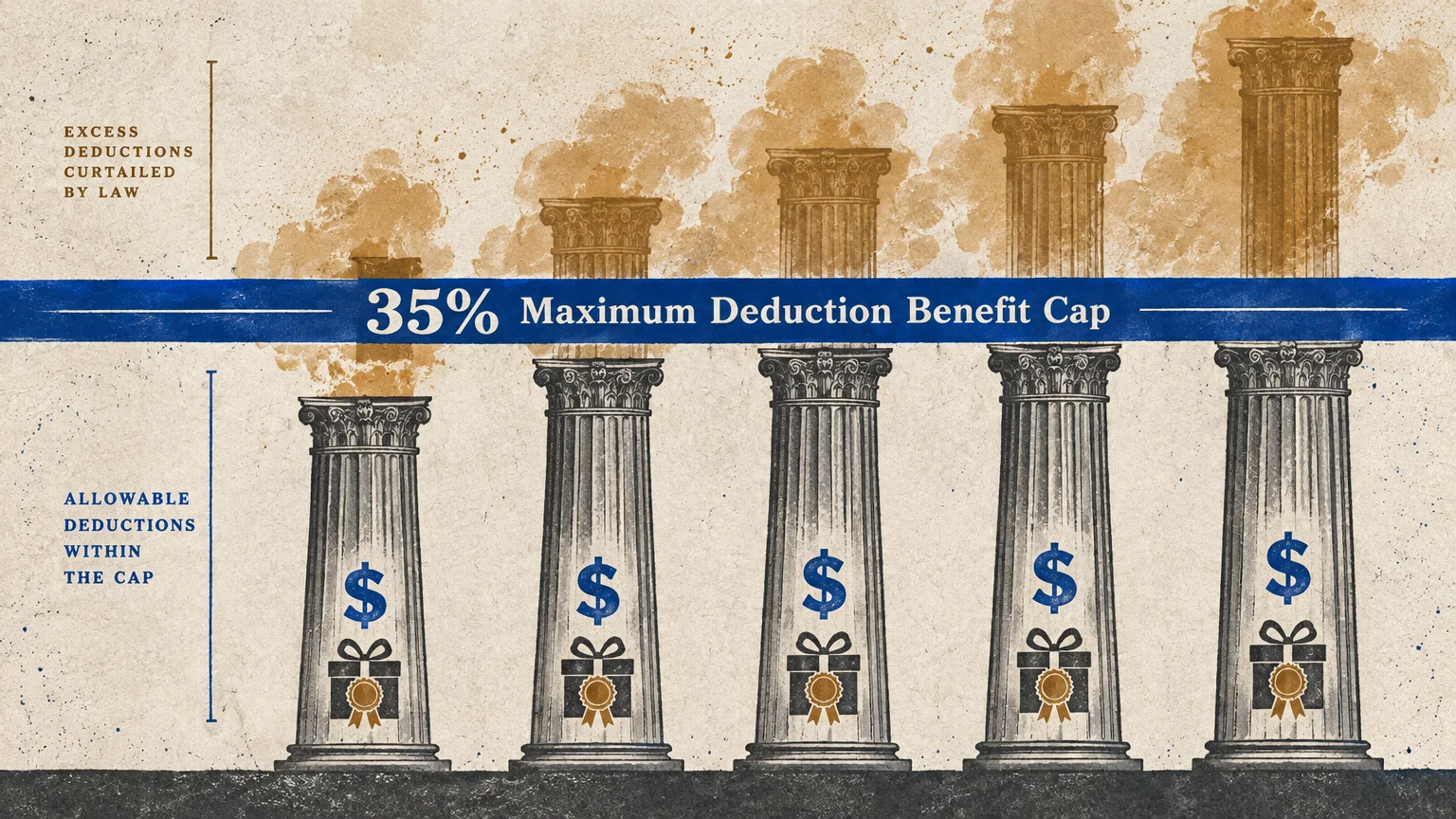
The third major change directly impacts wealthy retirees and high-earning households. Beginning in 2026, the tax savings rate for itemized deductions is capped at 35% for filers in the top tax bracket.
Under standard tax rules, deductions normally reduce taxable income at the taxpayer’s highest marginal tax rate. A taxpayer paying a 37% marginal rate historically saved $0.37 for every dollar deducted.
Starting in 2026, that relationship changes for top-bracket taxpayers claiming itemized write-offs. Congress capped the maximum tax benefit of itemized deductions at 35%, including the donation tax deduction.
This change decouples your deduction value from the top 37% federal income tax bracket. In practice, high earners lose two cents of federal tax savings for every dollar they donate.
Suppose an affluent retiree in the 37% tax bracket donates $100,000 to construct a community health clinic. Under previous tax guidelines, that donation would reduce federal tax liability by $37,000.
Under the 2026 rules, the tax reduction cannot exceed 35% of the allowable deduction. That same $100,000 gift now yields a federal tax reduction of $35,000, costing the donor an extra $2,000.
This limitation affects all itemized deductions, not just gifts to charitable organizations. High-income retirees must evaluate how mortgage interest, state tax caps, and charitable contributions interact under the 35% limit.
Financial educators at Investopedia point out that this reduction in tax value may encourage top earners to explore alternative distribution tools. High-net-worth donors may pivot away from standard cash gifts toward more sophisticated vehicles.
Permanent Extension of the 60% Cash Giving Limit
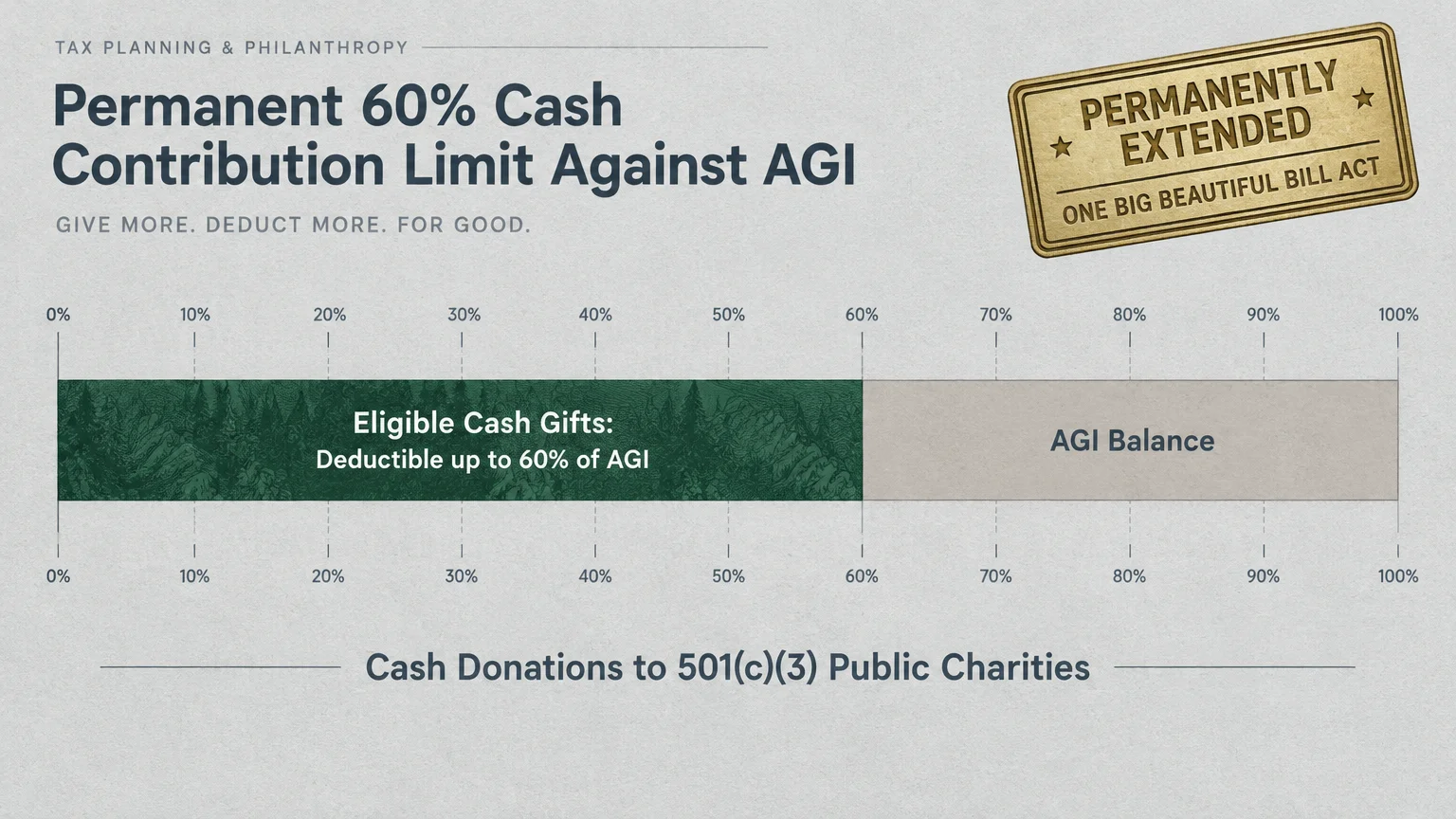
While the 2026 changes introduce new limitations, the legislation delivered welcome news regarding annual giving limits. The One Big Beautiful Bill Act permanently extended the 60% AGI limitation for cash gifts.
The 2017 Tax Cuts and Jobs Act had temporarily raised the cash deduction limit from 50% to 60% of AGI. That temporary enhancement was scheduled to expire after December 31, 2025.
Without legislative intervention, the maximum deduction limit would have reverted to 50% of AGI in 2026. Lawmakers prevented that drop by establishing the 60% cap as a permanent fixture of the tax code.
This rule permits generous retirees to offset substantial portions of their taxable income through charitable gifts. If you record an AGI of $150,000, you can deduct up to $90,000 in cash donations during a single year.
Any cash contributions exceeding the 60% AGI limitation do not disappear into thin air. You can carry forward unused charitable deductions for up to five subsequent tax years.
This permanent extension provides stability for retirees executing substantial liquidity events or estate distribution strategies. It guarantees predictable tax planning boundaries for philanthropists funding major endowment campaigns.

Comparing 2026 Charitable Giving Rules
The interplay between standard deductions, floors, and giving caps creates diverse tax outcomes for American retirees. Choosing the correct giving mechanism depends on your filing status, your total income, and your preferred payment method.
The table below summarizes how the new 2026 charitable contribution rules compare across different taxpayer profiles and distribution strategies.
| Tax Strategy | Eligible Donors | 2026 Contribution Limit | Tax Benefit Mechanics | Key Restrictions |
|---|---|---|---|---|
| Non-Itemizer Deduction | Standard deduction filers | $1,000 single / $2,000 married | Direct above-the-line deduction against gross income | Cash only; no DAFs or private foundations |
| Itemized Charitable Deduction | Schedule A itemizers | Up to 60% of AGI for cash gifts | Itemized write-off against taxable income | Subject to 0.5% AGI floor; capped at 35% for top bracket |
| Qualified Charitable Distribution (QCD) | IRA owners age 70½ and older | $111,000 per person ($222,000 married) | Direct exclusion from adjusted gross income | Traditional IRAs only; direct transfer to eligible charity |
| Split-Interest QCD Gift | IRA owners age 70½ and older | $55,000 lifetime election | Direct exclusion funding CRT or gift annuity | Once-in-a-lifetime election; subject to strict annuity rules |
This comparison highlights how different channels deliver unique financial outcomes. Analyzing these paths ensures you choose the strategy that best fits your household budget.

Why Qualified Charitable Distributions (QCDs) Win in 2026
Given the new 0.5% itemized floor and the 35% deduction cap, one retirement tool stands out as clearly superior. The Qualified Charitable Distribution (QCD) has become the gold standard for philanthropic retirees.
A QCD permits individuals age 70½ and older to transfer money directly from a traditional IRA to a qualified 501(c)(3) charity. The distributed funds transfer tax-free without appearing on your return as taxable income.
For the 2026 tax year, the annual QCD cap increases to $111,000 per person, pursuant to IRS Notice 2025-67. A married couple with separate IRAs can donate up to $222,000 tax-free.
Additionally, the indexed lifetime limit for funding split-interest vehicles via a QCD increases to $55,000 for 2026. This option allows retirees to establish a Charitable Gift Annuity (CGA) or Charitable Remainder Trust (CRT).
The primary advantage of a QCD in 2026 is that it acts as an exclusion from income rather than an itemized deduction. Because money exits your IRA tax-free, it never enters your Adjusted Gross Income.
By excluding the distribution from your AGI, you bypass the new 0.5% itemized deduction floor entirely. Every single dollar transferred through a QCD delivers direct, dollar-for-dollar tax relief.
Furthermore, QCDs sidestep the new 35% deduction benefit cap that penalizes top-bracket itemizers. An IRA owner in the 37% bracket avoids paying 37% tax on the transferred amount, securing full financial value.
QCDs also count toward satisfying your annual Required Minimum Distributions (RMDs). If you must withdraw funds from an IRA you do not need for living expenses, direct gifts solve that problem cleanly.
Suppressing your AGI via QCDs protects you against secondary tax traps that catch retirees by surprise. Lower gross income shields you from Medicare Part B and Part D Income-Related Monthly Adjustment Amount (IRMAA) surcharges.
Reporting a reduced AGI also curbs the taxable portion of your Social Security benefits. This dual advantage makes the QCD far more powerful than traditional cash gifts written from your checking account.
“Retirement is not the end of the road. It is the beginning of the open highway, provided your financial plan is solid.” — Jean Chatzky, Financial Journalist and Author
Strategic Giving Techniques for Retirees
Adapting to the 2026 tax environment requires thoughtful planning and fresh giving habits. Traditional patterns of writing small, scattered checks at year-end may no longer optimize your financial position.
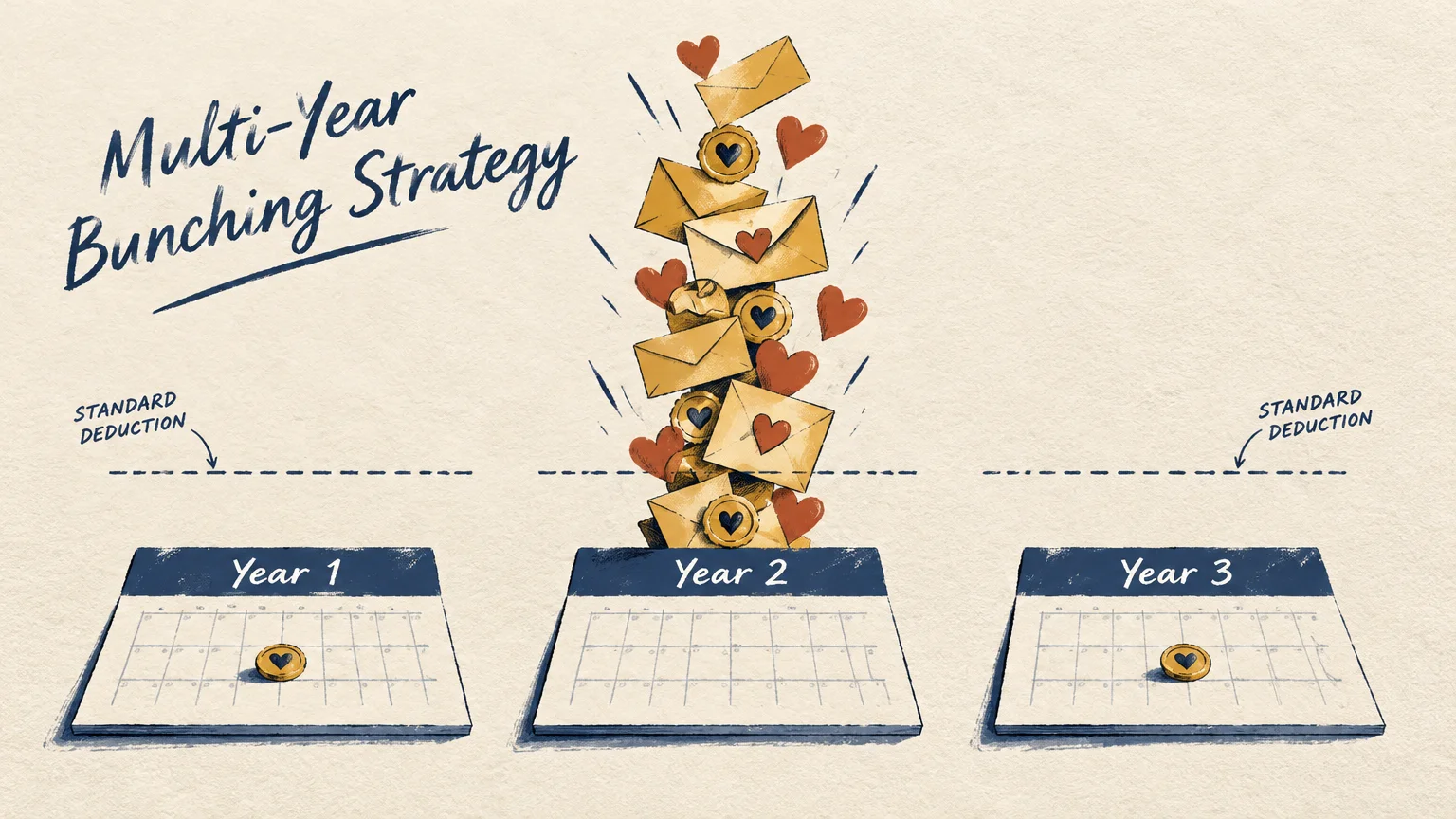
One reliable approach for moderate donors is donation bunching. By consolidating two or three years of planned giving into a single calendar year, you push total deductions far above the standard deduction threshold.
During the bunching year, you itemize deductions and surpass the 0.5% AGI floor with ease. In alternate years, you claim the standard deduction alongside the new non-itemizer cash deduction of up to $2,000.
Retirees holding appreciated stocks or mutual funds in taxable brokerage accounts should also reassess their tactics. Donating long-term appreciated shares directly to charity avoids capital gains taxes while generating an itemized deduction.
However, appreciated securities do not qualify for the new non-itemizer deduction. If you take the standard deduction, you must donate cash to capture that specific $1,000 or $2,000 tax benefit.
Tax analysts at Kiplinger emphasize that pairing standard deductions with non-itemizer cash gifts offers an effortless baseline strategy. This layered approach guarantees tax savings without the headache of tracking miscellaneous itemized expenses.

What Can Go Wrong: Costly Giving Mistakes to Avoid
Navigating new tax codes can easily lead to costly missteps if you rely on outdated information. Avoiding simple errors ensures your generous donations yield the exact tax reductions you anticipate.
The most frequent error under the new law involves donating non-cash property expecting an above-the-line write-off. The 2026 non-itemizer deduction applies exclusively to cash, checks, or electronic monetary transfers.
Dropping off clothing, furniture, or household goods at a charity thrift store delivers zero tax deduction if you claim the standard deduction. Non-cash donations remain deductible only for taxpayers who file Schedule A.
Another major trap involves contributing to Donor-Advised Funds (DAFs) expecting the non-itemizer write-off. Congress specifically barred DAF contributions from qualifying for the $1,000 and $2,000 non-itemizer deduction.
Retirees executing Qualified Charitable Distributions also face operational hazards with IRA custodians. You must never withdraw IRA funds to your personal bank account before forwarding the money to charity.
If an IRA distribution touches your personal account, the IRS classifies it as a fully taxable withdrawal. The transaction loses its QCD tax-exempt status immediately, destroying your tax advantage.
You must instruct your IRA custodian to send the check directly to the 501(c)(3) organization. Alternatively, the custodian can issue a check made payable directly to the charity and deliver it to you for physical delivery.
Finally, do not overlook receipt rules established by the federal government. The IRS requires a formal written acknowledgment letter from the charity for any single contribution of $250 or more before filing your tax return.

When to Consult a Professional
Charitable tax planning can quickly intersect with broader retirement issues, including estate plans and tax brackets. Seeking customized advice from a qualified financial professional prevents unintended tax consequences.
You should consider scheduling a planning session with a Certified Financial Planner (CFP) or CPA under the following specific circumstances:
- Planning Large Roth IRA Conversions: Significant conversions spike your AGI, which dramatically increases your 0.5% charitable deduction floor for that year.
- Managing Medicare IRMAA Surcharges: A professional can help coordinate QCDs to keep your modified income safely beneath cliff-based Medicare premium brackets.
- Establishing Split-Interest Gifts: Funding a Charitable Gift Annuity or Charitable Remainder Trust using the $55,000 lifetime QCD election requires strict legal precision.
- Balancing Multi-Year Bunching Strategies: An advisor can run multi-year tax projections to identify whether bunching or standard deductions yield the greatest lifetime tax savings.
Frequently Asked Questions
Can I claim the new non-itemizer deduction if I donate stock?
No, you cannot claim the non-itemizer deduction for gifts of stock or other securities. Internal Revenue Code Section 170(p) requires that contributions be made exclusively in cash, check, or electronic funds.
Does the 0.5% AGI floor apply to Qualified Charitable Distributions?
No, QCDs are completely exempt from the 0.5% AGI itemized deduction floor. Because QCDs are excluded from gross income rather than reported as itemized deductions, the floor does not apply.
Can married couples filing separately claim the $2,000 non-itemizer deduction?
No, the $2,000 limit is reserved exclusively for married couples filing jointly. Married individuals who file separate returns are limited to a maximum non-itemizer deduction of $1,000 each.
Can I donate to my private family foundation to claim the non-itemizer write-off?
No, contributions to private non-operating foundations do not qualify for the non-itemizer charitable deduction. The law mandates that donations go directly to qualified 501(c)(3) public charities or religious houses of worship.
Are unused portions of the non-itemizer deduction carried over to future tax years?
No, the non-itemizer charitable deduction does not offer a carryover provision for unused amounts. If your annual cash donations fall below the $1,000 or $2,000 limit, you simply deduct the actual cash amount given.
Thoughtful charitable planning allows you to express your values while safeguarding your retirement security. Review your donation methods today, take advantage of the new rules, and verify that every dollar works effectively for you and your community.
This article provides general retirement education and information only. Every retiree’s situation is unique—what works for others may not work for you. For personalized advice, consider consulting a qualified financial professional such as a CFP or CPA.
Last updated: October 2026. Retirement benefits, tax rules, and healthcare regulations change frequently—verify current details with official sources.









Leave a Reply