
Receiving a sudden sum of money can secure your retirement, but the resulting tax bill can deliver an unpleasant shock. A single lump sum can push you into a higher tax bracket and disrupt your monthly retirement benefits.
The IRS treats various financial windfalls differently depending on their exact legal source. While certain windfalls arrive completely tax-free, others face federal and state levies that consume more than a third of the cash.
Understanding these rules empowers you to keep more of your funds. Here is how windfalls are taxed and how you can shield your retirement nest egg.
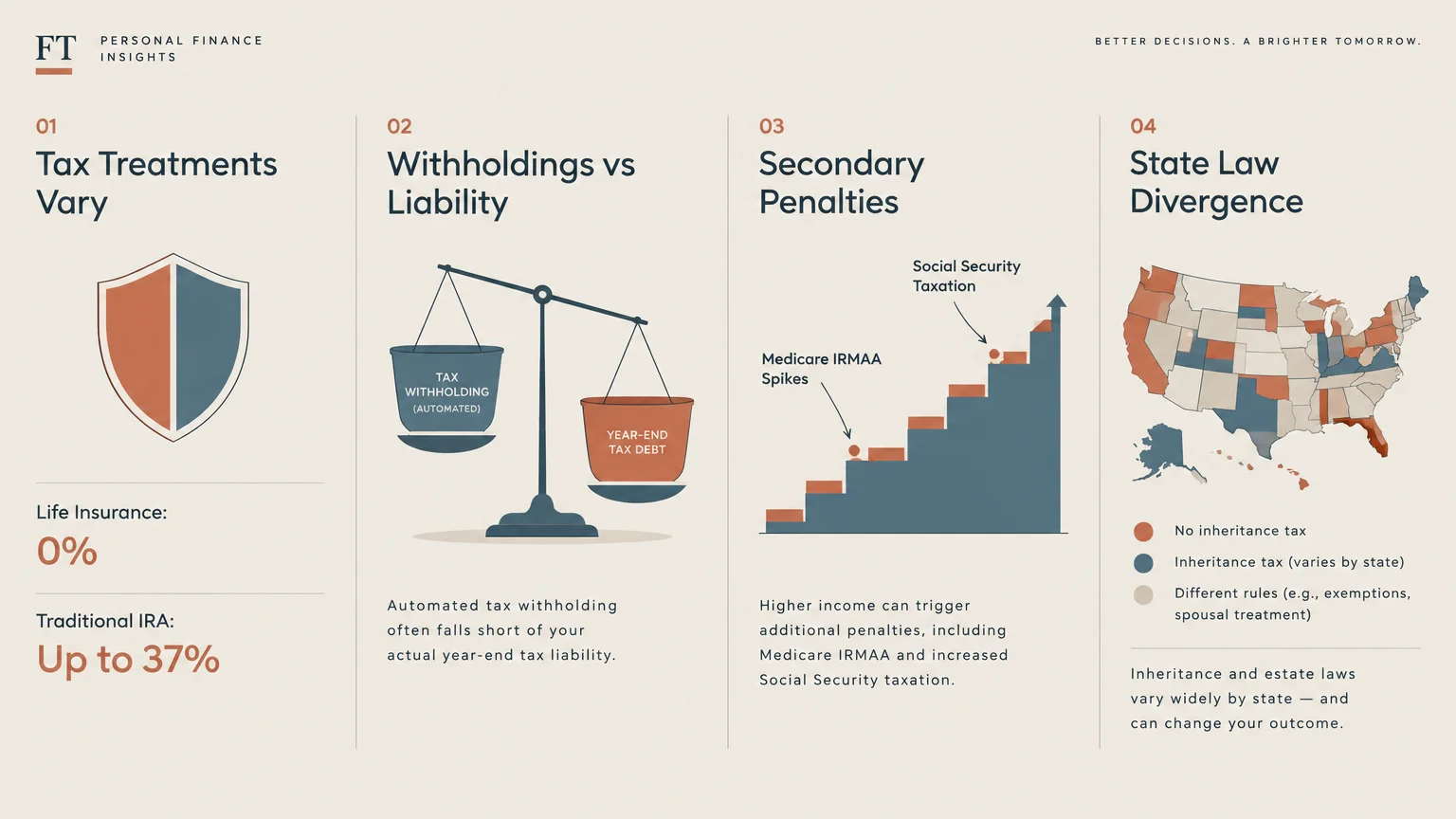
At a Glance: The Reality of Taxable Windfalls
A sudden liquidity event rarely acts like ordinary monthly income. The tax code sorts windfalls into distinct categories, each carrying its own filing procedures, withholding rates, and deadlines.
Before you spend, transfer, or invest a single dollar, evaluate these core realities:
- Tax treatments vary widely: Life insurance proceeds usually arrive tax-free, whereas traditional retirement accounts face ordinary income rates up to 37%.
- Withholding rarely matches liability: Automated tax withholdings on gambling or pension distributions often fall short of your actual year-end tax liability.
- Secondary penalties lurk: A temporary income spike can inflate your Medicare premiums and trigger extra taxation on your Social Security benefits.
- State laws diverge: State-level inheritance and estate rules vary dramatically from federal guidelines across the country.
“A windfall is only as good as the plan you have to protect it.” — Suze Orman, Personal Finance Author

1. Cash and Physical Property Inheritances
Receiving an inheritance from a family member represents one of the most common retirement windfalls. Fortunately, the federal government does not levy a federal inheritance tax on beneficiaries who receive cash, real estate, or personal property.
Federal estate taxes apply to the estate itself before distribution, not to you as the recipient. For 2026, the federal estate tax exemption stands at $15,000,000 per individual and $30,000,000 for married couples filing jointly.
Taxable estates exceeding that threshold face a 40% top federal rate paid by the decedent’s estate. Unless you inherit from a multi-million-dollar estate, you will owe nothing to the IRS on inherited cash.
Physical assets like real estate, vehicles, and standard brokerage investments also benefit from a step-up in basis. The IRS resets the asset’s cost basis to its fair market value on the date of the decedent’s death.
If you sell an inherited home immediately for its appraised value, you will owe zero capital gains tax. However, you must track local state laws carefully.
Five states enforce their own inheritance tax rules: Pennsylvania, New Jersey, Maryland, Kentucky, and Nebraska. In those states, your tax rate depends on your relationship to the deceased person.
2. Inherited Traditional IRAs and 401(k) Plans
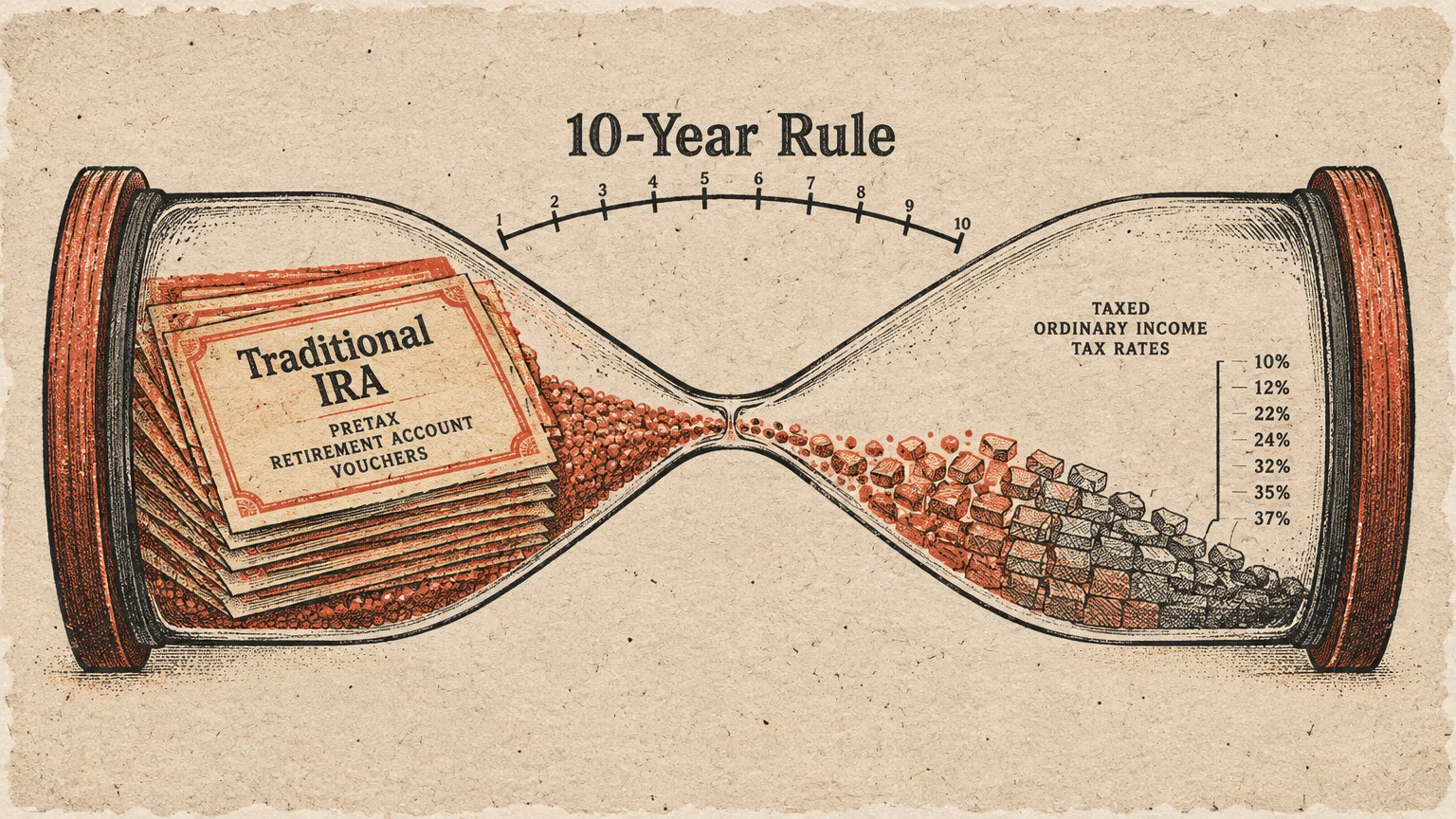
Inheriting a pretax retirement account triggers very different rules than inheriting cash. The IRS treats every dollar withdrawn from a traditional IRA or 401(k) as taxable windfalls subject to ordinary income rates.
You cannot roll an inherited IRA into your personal traditional IRA unless you are the surviving spouse. Non-spouse beneficiaries must establish an inherited IRA account and follow strict statutory distribution timelines.
Under current rules, most non-spouse beneficiaries must withdraw the entire account balance within 10 years of the original owner’s death. You cannot stretch distributions across your own life expectancy.
If the original owner had already reached their required beginning age, you must also take annual Required Minimum Distributions in years one through nine. Draining the account rapidly can push you into higher tax brackets.
Consider pacing distributions evenly over the 10-year window rather than taking a massive lump sum at the end. Spreading out withdrawals minimizes the overall tax impact across consecutive filing years.

3. Lump-Sum Pension Buyouts
Many legacy employers offer retirees a single lump-sum buyout in exchange for giving up lifetime monthly annuity payments. Taking the cash grants flexibility, but it generates major lump sum taxes retirees must navigate.
If you take the pension buyout directly as cash, the plan administrator must withhold a mandatory 20% for federal income taxes. The entire buyout amount counts as ordinary income in that specific calendar year.
A $300,000 payout can easily push a modest retirement household into the 32% or 35% federal tax bracket. The 20% withheld at distribution will not cover your total liability, leaving you with a balance due in April.
You can avoid immediate taxation by requesting a direct trustee-to-trustee transfer into a traditional IRA. The money moves tax-free, and you preserve the option to withdraw funds gradually over time.
Never take possession of the check made out to your personal name. If funds touch your personal bank account, the mandatory 20% withholding applies immediately even if you plan to roll it over later.

4. Downsizing Gains from Selling Your Primary Home
Retirees often downsize to single-story homes or active adult communities, freeing up significant home equity. Real estate appreciation can create an enormous windfall when you sell your long-held residence.
The Internal Revenue Service grants significant relief under Section 121 of the Internal Revenue Code. You can exclude up to $250,000 of capital gain if you file as single, or up to $500,000 if married filing jointly.
To qualify for this exclusion, you must have owned and occupied the property as your primary residence for at least two of the five years preceding the sale. Any profit above these exclusion thresholds faces long-term capital gains taxes.
For 2026, long-term capital gains brackets apply preferential tax rates to profits exceeding the exclusion:
- 0% rate: Taxable income up to $49,450 for single filers, or $98,900 for married couples filing jointly.
- 15% rate: Taxable income between $49,451 and $545,500 for single filers, or between $98,901 and $613,700 for married couples.
- 20% rate: Taxable income exceeding $545,500 for single filers, or $613,700 for married couples filing jointly.
High-income sales also trigger the 3.8% Net Investment Income Tax once Modified Adjusted Gross Income surpasses $200,000 for single filers or $250,000 for married couples. Retain receipts for major home improvements to raise your cost basis.

5. Lottery and Casino Windfalls
Whether you hit a casino jackpot or match numbers on a state lottery ticket, prize money counts as ordinary income. The IRS classifies all gambling winnings as fully taxable income from the first dollar.
Lottery winnings taxes require immediate upfront withholding. Payer organizations must withhold 24% for federal income tax on prizes exceeding $5,000, and reporting occurs on Form W-2G when winnings hit statutory thresholds.
For slot machines, keno, and bingo, the W-2G reporting threshold is set at $2,000. However, the mandatory 24% withholding is rarely enough to satisfy your total federal liability for a substantial jackpot.
A multi-million-dollar lottery prize pushes you directly into the top federal tax bracket of 37%. In 2026, that 37% bracket applies to taxable income over $640,600 for single filers and $768,700 for married couples.
Taxpayers who itemize deductions can deduct gambling losses, but recent rules restrict that benefit. Under current law, you can only deduct gambling losses up to 90% of your total winnings, eliminating the old 100% loss offset.
6. Life Insurance Payouts and Policy Surrenders
Life insurance proceeds can arrive either as a death benefit payout or through surrendering a permanent cash-value contract. Each scenario carries fundamentally different tax implications for retirees.
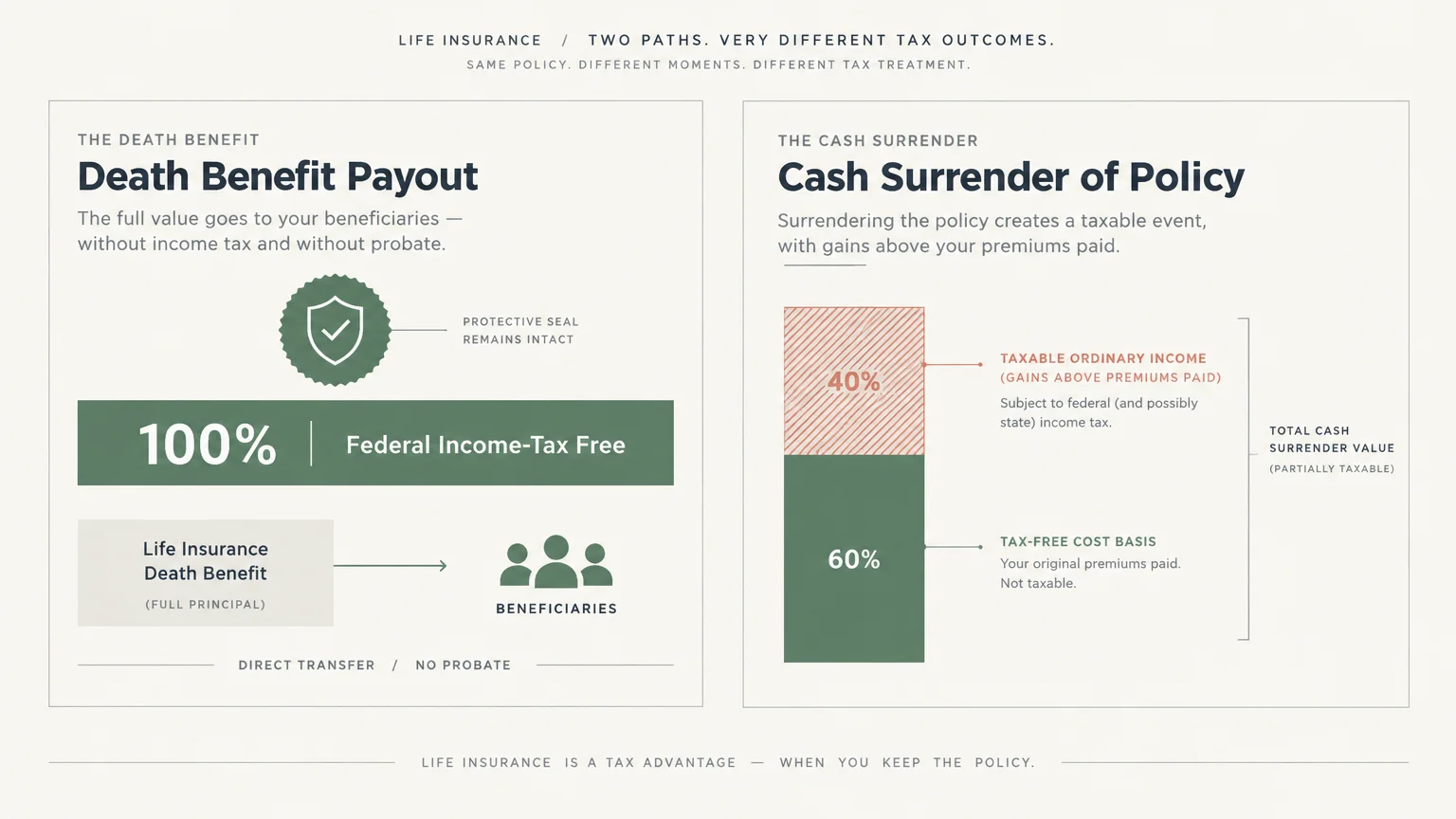
When you receive a life insurance death benefit as a named beneficiary, the proceeds are 100% free from federal income tax. You do not report the death benefit payment on your annual Form 1040.
If the insurance company holds the money and pays you interest before disbursing the lump sum, that accrued interest is fully taxable. The insurer will mail you a Form 1099-INT detailing the taxable interest income.
Surrendering a whole life or universal life policy for cash value operates under different tax mechanics. The cash surrender value is tax-free up to your basis, which equals the total premiums you paid over the years.
Any cash value received in excess of your cumulative paid premiums counts as ordinary income. A 1035 exchange allows you to roll cash value into an annuity without triggering immediate tax liability.

7. Legal Settlements and Court Awards
Resolving a personal injury case or class-action lawsuit can produce a substantial financial award. The tax treatment of legal proceeds depends entirely on the legal origin and wording of the underlying claim.
Under Internal Revenue Code Section 104, settlements paid for physical injuries or physical sickness are completely tax-free. Compensation for medical bills, physical pain, and physical rehabilitation does not count as taxable income.
Settlements designed to replace lost wages or compensate for emotional distress unrelated to physical trauma are fully taxable. If you receive damages for wage discrimination or defamation, the proceeds face ordinary income taxes.
Punitive damages awarded by a court are always taxable, even if they originate from an underlying physical injury claim. Courts award punitive damages to punish bad actors, making the entire punitive portion taxable ordinary income.
Always work with your legal team during settlement negotiations to clearly allocate funds between compensatory and punitive categories. Vague settlement language often causes the IRS to reclassify tax-exempt payments as taxable income.

8. Sales of Appreciated Stock or a Family Business
Selling a private business, a rental property, or a block of legacy stock creates a major liquidity event. Liquidating long-term investments held for more than 12 months produces preferential capital gains rather than ordinary income.
You pay long-term capital gains rates of 0%, 15%, or 20% on the difference between the sale price and your basis. This tax treatment saves substantial money compared to ordinary income brackets reaching 37%.
High proceeds expose you to the 3.8% Net Investment Income Tax surtax. This levy applies to investment income when your Modified Adjusted Gross Income surpasses $200,000 for single filers or $250,000 for joint returns.
When selling a small business, negotiate asset allocations strategically across physical equipment, real estate, and goodwill. Allocating purchase value toward capital assets rather than ordinary inventory lowers your overall tax rate.
Utilizing an installment sale under Section 453 allows you to collect payments over multiple years. Spreading out payments avoids concentrating massive capital gains into a single calendar tax year.

9. Substantial Cash Gifts from Loved Ones
Sometimes adult children, siblings, or wealthy friends offer generous financial gifts to help you enjoy retirement. Many retirees mistakenly believe that receiving a large gift creates an immediate income tax liability.
The federal gift tax is paid by the person giving the money, not by the recipient. Beneficiaries never pay federal income tax or gift tax on bona fide gifts they receive.
For 2026, the annual gift tax exclusion stands at $19,000 per recipient, or $38,000 for married couples splitting gifts. If someone gives you more than $19,000, they must file an informational IRS Form 709.
That Form 709 merely counts against their lifetime gift and estate exemption of $15,000,000. You, as the recipient, do not report the gift on your income tax return or owe any taxes.
Once you deposit the gift, any interest, dividends, or capital gains that the money subsequently earns will be taxable. Keep records showing the funds were a gift to avoid confusion during future financial audits.

10. Retroactive Lump-Sum Social Security Benefits
Retirees who wait to resolve complex Social Security claims often receive substantial back-pay awards. Receiving several years of retroactive payments in a single check creates unexpected tax complications.
Social Security benefits are partially taxable based on your provisional income. If your provisional income exceeds $34,000 as a single filer or $44,000 as a couple, up to 85% of your benefits become taxable.
A $40,000 back-pay check received in one year could force 85% of your total Social Security benefits into taxable status. Thankfully, the tax code provides special relief through the lump-sum election method.
Under Section 86(e), you can elect to figure your tax on the retroactive amount using the prior years’ lower income figures. You calculate the tax on your current return without having to file complex amended returns for past years.
The Social Security Administration issues Form SSA-1099 with Box 3 showing the breakdown of benefits paid for prior tax years. Utilizing this calculation method prevents a multi-year award from inflating your current bracket.
11. Nonqualified Deferred Compensation Buyouts
Corporate executives and professionals often leave behind Nonqualified Deferred Compensation plans upon retirement. These plans allow high earners to defer salary during working years to be paid out later.
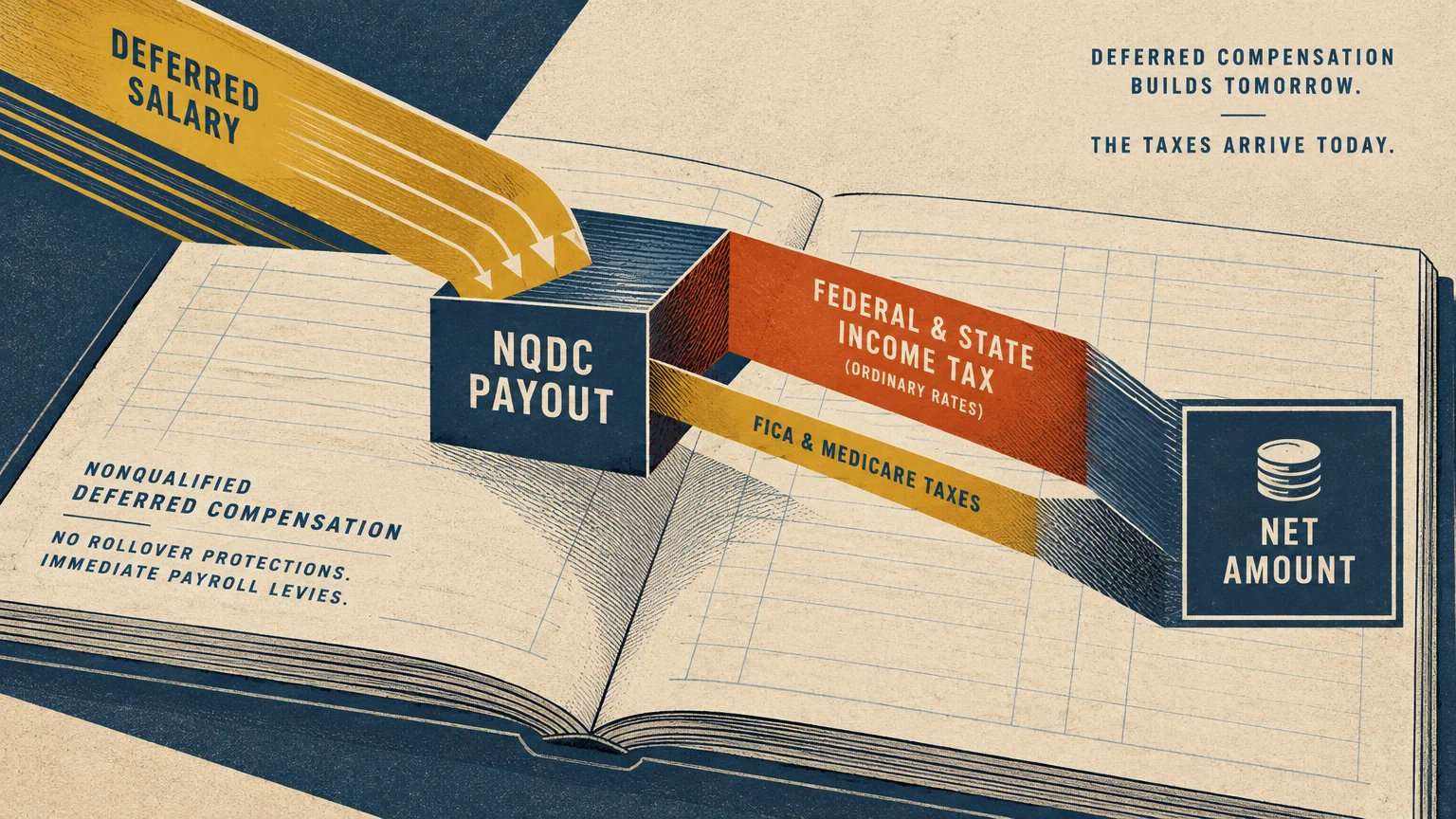
If your plan agreement mandates a lump-sum distribution upon retiring, the entire deferred balance pays out at once. Unlike qualified retirement accounts, you cannot roll nonqualified deferred compensation balances into an IRA.
The company reports the entire lump-sum distribution on Form W-2 as ordinary wages. The payout is subject to regular income taxes, supplemental wage withholding, and remaining applicable payroll taxes.
A large distribution frequently lands in the top 37% federal tax bracket, plus applicable state and local income taxes. Because you cannot roll these funds into an IRA, tax sheltering options remain limited.
Planning deductions in the year of payout helps mitigate this massive taxable hit. Making large charitable donations or utilizing donor-advised funds can offset a portion of the surge in taxable compensation.
The Stealth Taxes: How Sudden Wealth Impacts Benefits
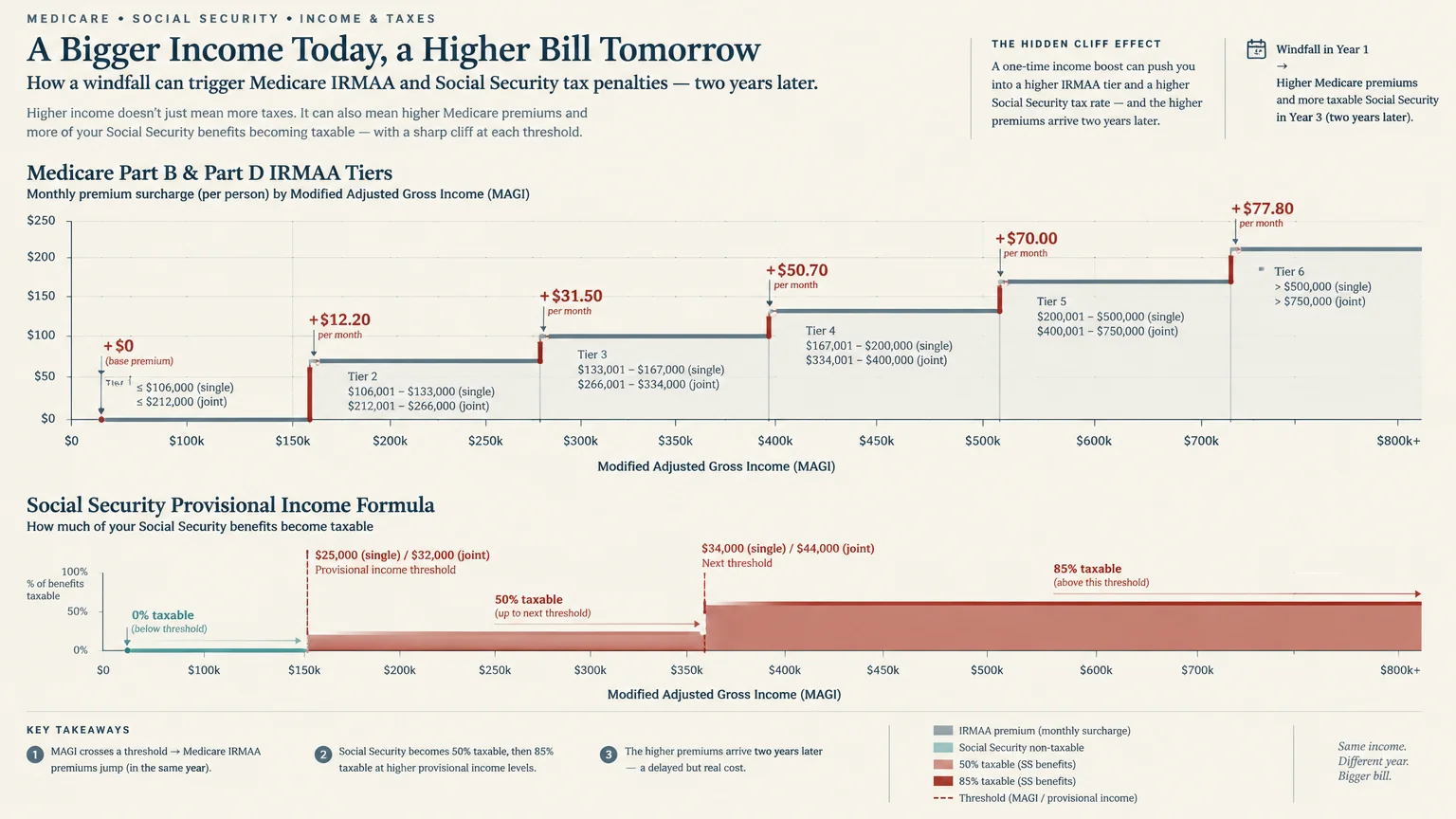
When windfalls taxed as ordinary income or capital gains hit your return, the damage extends beyond federal income brackets. A sudden spike in income activates secondary tax mechanisms that silently drain retiree wealth.
The most punishing secondary effect involves Medicare Part B and Part D premiums through Income-Related Monthly Adjustment Amount surcharges. The Medicare program uses a two-year lookback period to adjust your premiums based on Modified Adjusted Gross Income.
For 2026, the standard Medicare Part B premium is $202.90 per month. If your 2024 income surpassed $109,000 for single filers or $218,000 for joint filers, you pay higher monthly surcharges.
At the highest IRMAA tier, which begins at $500,000 for single filers and $750,000 for couples, total Part B premiums reach $689.90 monthly. Surcharges add an extra $91.00 monthly for Part D prescription coverage per person.
Retirees also encounter the Social Security tax torpedo when windfalls elevate provisional income. Provisional income equals your Adjusted Gross Income plus nontaxable interest and half of your annual Social Security benefits.
Crossing the $25,000 threshold for singles or $32,000 for married couples taxes up to 50% of your benefits. Crossing $34,000 for singles or $44,000 for couples taxes up to 85% of your benefits.
Fortunately, current law provides a temporary senior deduction through 2028. Eligible individuals age 65 and older can deduct an extra $6,000, or $12,000 for qualifying married couples, cushioning modest windfalls.
Comparing Windfall Tax Rules
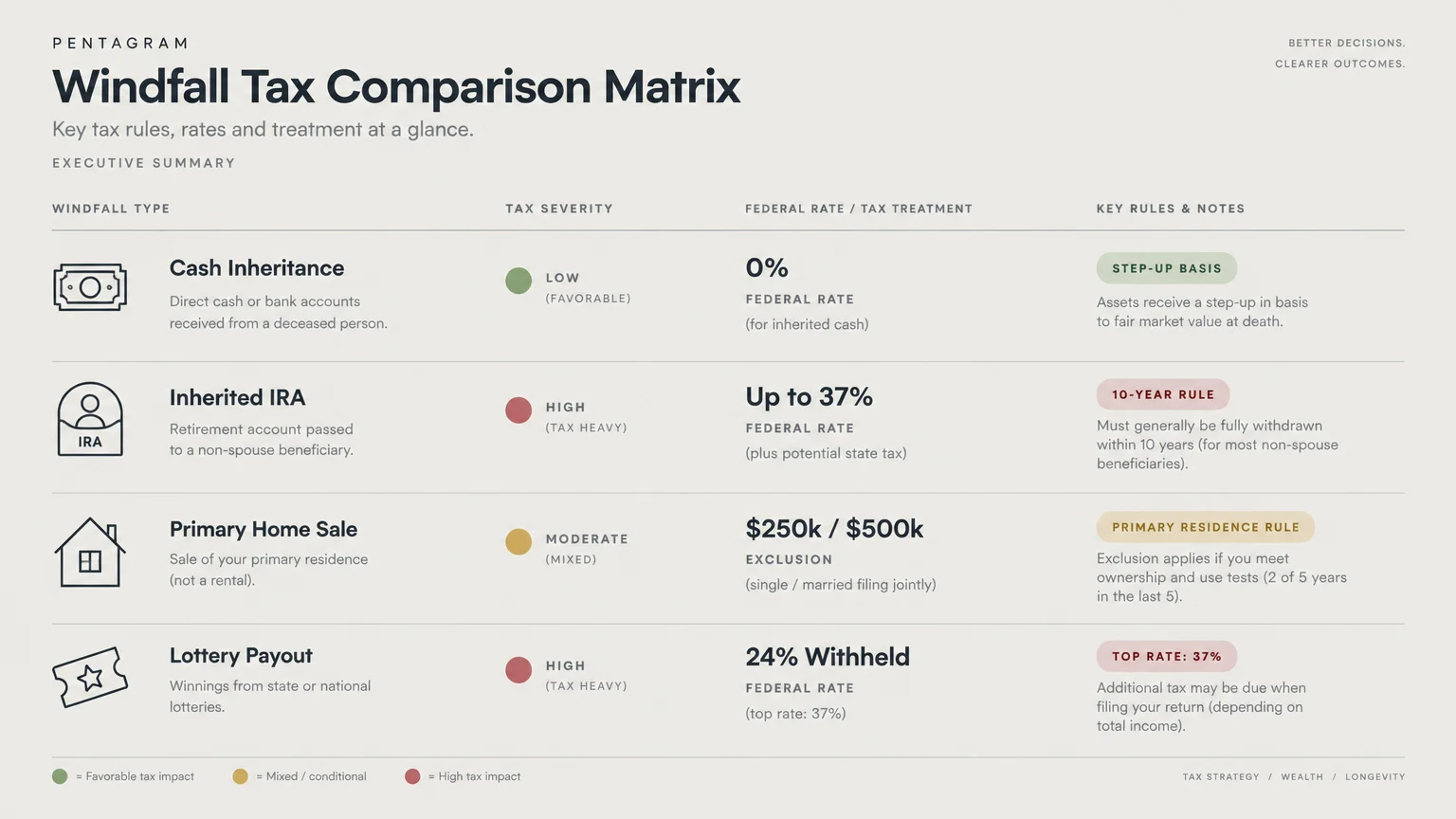
Every windfall requires an individual tax management strategy. The table below outlines how common windfalls are taxed, typical withholding rates, and key planning traps to monitor.
| Windfall Category | Federal Tax Classification | Mandatory Withholding | Primary Trap or Consideration |
|---|---|---|---|
| Cash Inheritance | Tax-free federal; state taxes vary | 0% | State inheritance taxes in 5 specific states |
| Inherited Pretax IRA | Ordinary income (up to 37%) | Optional (varies) | 10-year rule requires complete account liquidation |
| Pension Buyout (Cash) | Ordinary income | 20% mandatory | Withholding is insufficient to cover top brackets |
| Primary Home Sale | Capital gains (0%, 15%, 20%) | 0% | Exclusion capped at $250k single / $500k joint |
| Lottery & Gambling | Ordinary income | 24% mandatory (> $5,000) | Loss deductions are capped at 90% of winnings |
| Life Insurance Benefit | Tax-free death proceeds | 0% | Delayed interest payments count as ordinary income |
| Physical Injury Award | Tax-free under Section 104 | 0% | Punitive damages remain fully taxable |
| Appreciated Stock Sale | Capital gains (0%, 15%, 20%) | 0% | Subject to 3.8% Net Investment Income Tax |
| Family Cash Gift | Tax-free to recipient | 0% | Giver files Form 709 if exceeding $19,000 |
| Social Security Back Pay | Ordinary income (up to 85%) | 0% (voluntary) | Triggers benefit taxation without lump-sum election |
| Deferred Comp (NQDC) | Ordinary wage income | Supplemental wage rate | Cannot be rolled over into tax-deferred IRAs |

Avoiding Common Errors
Managing sudden wealth requires patience and calculated timing. Avoiding standard mistakes protects your windfall from unforced tax penalties and unnecessary administrative clawbacks.
- Spending before calculating taxes: Depositing a gross windfall into a checking account creates an illusion of wealth. Always escrow estimated taxes before spending.
- Ignoring quarterly estimated taxes: Large payouts without withholding trigger IRS underpayment penalties. Make estimated tax payments via Form 1040-ES in the quarter received.
- Taking all-cash pension payouts: Cashing out a pension creates an immediate ordinary income spike. Direct rollovers preserve tax deferral and control over future withdrawals.
- Missing the 10-year inherited IRA deadline: Neglecting mandatory distributions triggers severe IRS excise penalties. Plan your annual withdrawals methodically across the permitted 10-year timeframe.
- Overlooking Medicare IRMAA consequences: A single large gain today inflates healthcare costs two years later. Set aside emergency funds to cover higher future Medicare premiums.
“In this world nothing can be said to be certain, except death and taxes.” — Benjamin Franklin, Statesman and Author

When DIY Isn’t Enough
Handling modest gifts or straightforward home sales falls within the comfort zone of many confident retirees. However, multifaceted windfalls introduce cross-regulatory rules that demand professional oversight.
Consider retaining a Certified Financial Planner or CPA under the following scenarios:
- Navigating multi-state inheritance rules: Inheriting property located in a state that levies an inheritance tax requires navigating out-of-state probate filings and varying state exemption rules.
- Structuring installment sales for private businesses: Liquidating a business or private partnership involves depreciation recapture, goodwill valuation, and Section 453 installment timing.
- Evaluating pension lump sums against lifetime annuities: Comparing immediate lump sums against guaranteed lifetime payouts requires complex present-value and life-expectancy calculations.
- Resolving complex mixed-damages legal settlements: Handling court settlements with mixed compensatory and punitive awards requires professional tax allocation to prevent IRS audits.
Frequently Asked Questions
How do lump sum taxes retirees pay differ from regular salary taxes?
Lump-sum distributions arrive all at once, which concentrates massive taxable income into a single year. This spike frequently pushes your earnings into peak tax brackets that regular wages never reached.
Regular salary withholdings spread liability evenly across pay periods throughout the year. In contrast, flat mandatory withholdings on windfalls often underpay your ultimate tax liability, resulting in spring tax surprises.
Does a cash inheritance count toward the Medicare IRMAA threshold?
Direct cash inheritances do not count toward your Modified Adjusted Gross Income because cash inheritances are not taxable income. They will not trigger Medicare IRMAA premium adjustments.
However, if you inherit a traditional IRA, every dollar withdrawn increases your Adjusted Gross Income. Those withdrawals directly count toward IRMAA income tiers and can spike your Medicare premiums.
Can I give away part of my windfall to avoid paying taxes on it?
Gifting money to children, friends, or relatives does not reduce your personal income tax liability. You still owe income or capital gains taxes on the initial windfall before you make gifts.
Only direct gifts made to qualified 501(c)(3) charities provide an income tax deduction. Charitable contributions can help offset the taxable income created by a major financial windfall.
What is the best way to handle taxes on an inherited traditional 401(k)?
Transfer the funds via a direct rollover into an inherited traditional IRA account. This avoids immediate withholding and gives you full control over future distribution timing.
Once inside the inherited IRA, withdraw the assets strategically across the mandatory 10-year window. Taking equal annual amounts prevents pushing your income into top brackets during a single tax year.
Protecting Your Wealth for the Long Run
Receiving an unexpected windfall provides a unique opportunity to secure your retirement lifestyle and leave an enduring family legacy. Taking time to pause, assess tax obligations, and build a measured strategy prevents avoidable financial loss.
Set aside estimated taxes immediately, verify state-level filing duties, and account for downstream impacts like IRMAA surcharges. Treating every windfall with tax-conscious discipline ensures that your sudden wealth serves your long-term goals.
This article provides general retirement education and information only. Every retiree’s situation is unique—what works for others may not work for you. For personalized advice, consider consulting a qualified financial professional such as a CFP or CPA.
Last updated: October 2026. Retirement benefits, tax rules, and healthcare regulations change frequently—verify current details with official sources.









Leave a Reply