
Your mailbox will soon hold critical documents that directly dictate your net income for the coming year. Checking these winter mailings immediately ensures your monthly Social Security benefit checks arrive accurately and without interruption.
Between late November and early February, the federal government issues payment updates, tax reporting statements, and healthcare premium adjustments. Overlooking these notices can trigger unexpected tax surprises or lead to missed appeal deadlines.
Knowing what each envelope contains helps you spot costly calculation errors before they compromise your monthly cash flow. Here are the eight essential notices heading your way and the exact actions you must take.
1. The 2027 Cost-of-Living Adjustment (COLA) Notice
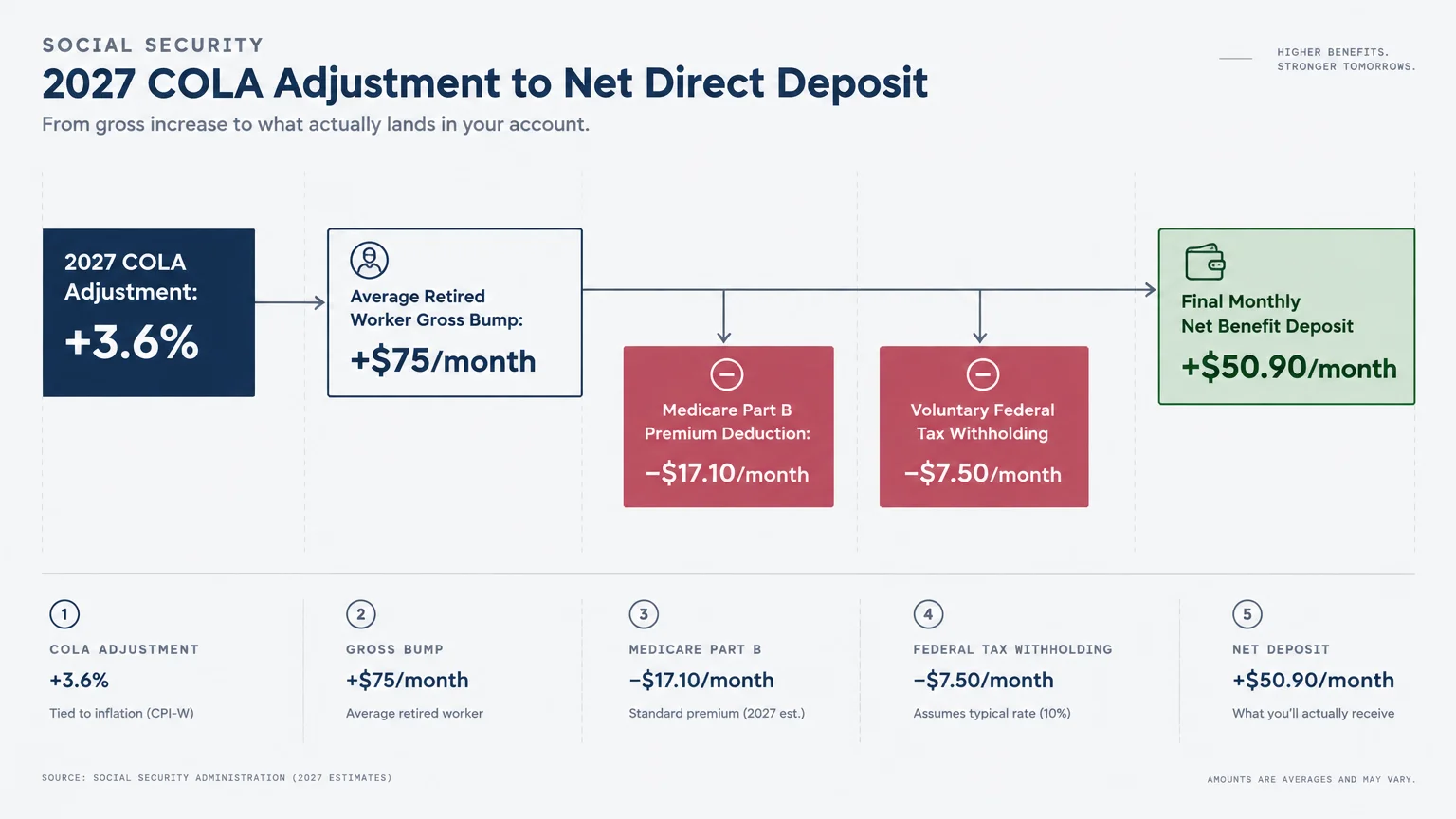
The annual Cost-of-Living Adjustment notice details the exact gross and net dollar amounts you will receive each month. It arrives in mailboxes throughout December, though you can view it earlier online.
On October 14, 2026, the federal government established a 3.6% COLA increase for 2027. This adjustment applies to roughly 72 million Social Security beneficiaries and 7.3 million Supplemental Security Income recipients.
For the average retired worker, this 3.6% boost raises monthly retirement benefits by approximately $75 starting in January 2027. SSI recipients see their higher payments arrive one day early, on December 31, 2026.
If you set up paperless notices in your personal account at the Social Security Administration (SSA) by November 18, 2026, you can access your statement in late November.
Beneficiaries who prefer traditional paper delivery will receive their notices in the mail throughout December 2026. The agency asks that you wait until January 2027 before calling about an unreceived paper notice.
Do not simply file this letter away when it arrives. You must confirm that the new gross amount reflects the full 3.6% increase on your primary insurance benefit.
Next, examine the line items showing deductions for Medicare Part B premiums, voluntary tax withholding, and supplemental insurance. Your final net deposit could differ significantly from your gross calculation.
2. Form SSA-1099 and Form SSA-1042S (Social Security Benefit Statements)
Every January, the agency distributes Form SSA-1099 to all domestic beneficiaries who received benefits during the previous calendar year. Non-citizens living abroad receive Form SSA-1042S instead.
For the 2026 tax year, the agency ships these tax forms via first-class mail between January 3 and January 24, 2027. The postal service should deliver yours by January 31, 2027.
If your form fails to arrive in time, printable digital replacements become available through your online account starting February 1, 2027. Never file your federal taxes without this official document in hand.
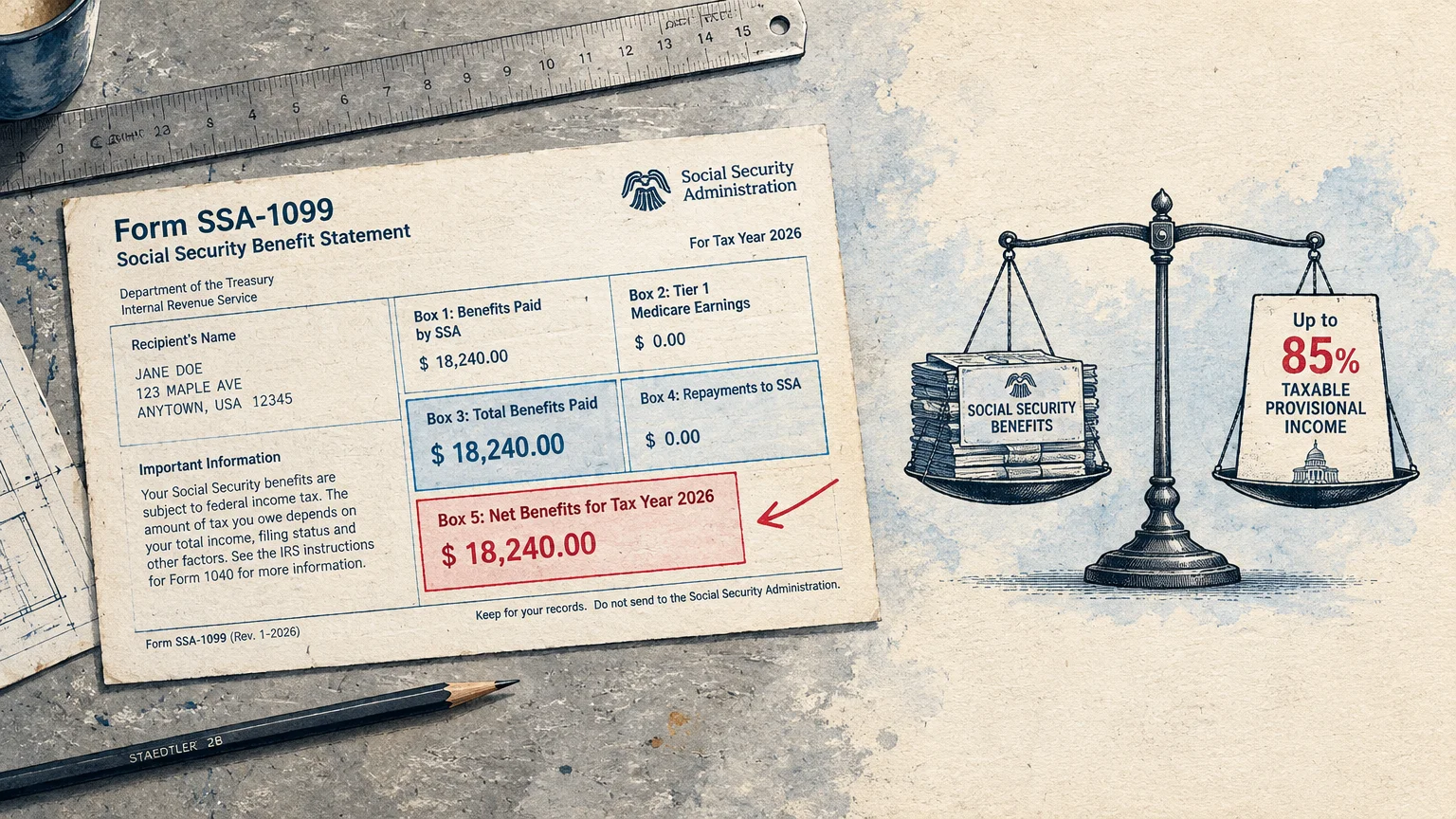
Box 3 reports the total benefits paid to you during 2026. Box 4 lists any repayments you returned to the government, while Box 5 reveals your net benefits for tax purposes.
According to the Internal Revenue Service (IRS), up to 85% of your Social Security benefits can become subject to federal income taxation. Your liability depends directly on your combined provisional income.
Provisional income includes your adjusted gross income, nontaxable interest from municipal bonds, and exactly half of your total Social Security benefits. Crossing specific statutory income thresholds activates the tax formula.
Note that Supplemental Security Income recipients will never receive Form SSA-1099. SSI payments are needs-based public assistance and remain completely exempt from federal and state income taxes.

3. Medicare Part B and Part D IRMAA Determination Notices
Higher-income retirees receive an unwelcome envelope each November or December titled the Income-Related Monthly Adjustment Amount (IRMAA) notice. This letter notifies you of mandatory surcharges added to your Medicare premiums.
While the standard Part B premium was $202.90 per month in 2026, trustees project the 2027 baseline to rise to $209.50. The annual Part B deductible also climbs to an estimated $292.
Beneficiaries in higher tax brackets must pay substantial surcharges on top of those standard baseline rates. These extra fees apply to both outpatient medical care and prescription drug plans.
For 2027 prescription coverage, the Part D annual out-of-pocket spending cap increases to $2,400, while the standard deductible rises to $700. The base beneficiary premium sits at $41.33 before any IRMAA surcharges.
The government calculates your 2027 IRMAA surcharges by pulling your 2025 federal tax return data from two years prior. A spike in earnings from two years ago can trigger surcharges today.
If you retired, downsized, or lost spousal income in 2025 or 2026, you do not have to accept this surcharge quietly. You have the legal right to challenge the determination immediately.
File Form SSA-44 to request a formal redetermination based on an official life-changing event. Submitting proof of work stoppage, pension reduction, or marital status change can erase these surcharges entirely.
Pay close attention to healthcare deadlines alongside your Social Security paperwork. The annual Medicare Open Enrollment period closes promptly on December 7, 2026, with plan changes taking effect January 1, 2027.
4. Annual Earnings Test and Work Activity Review Notices
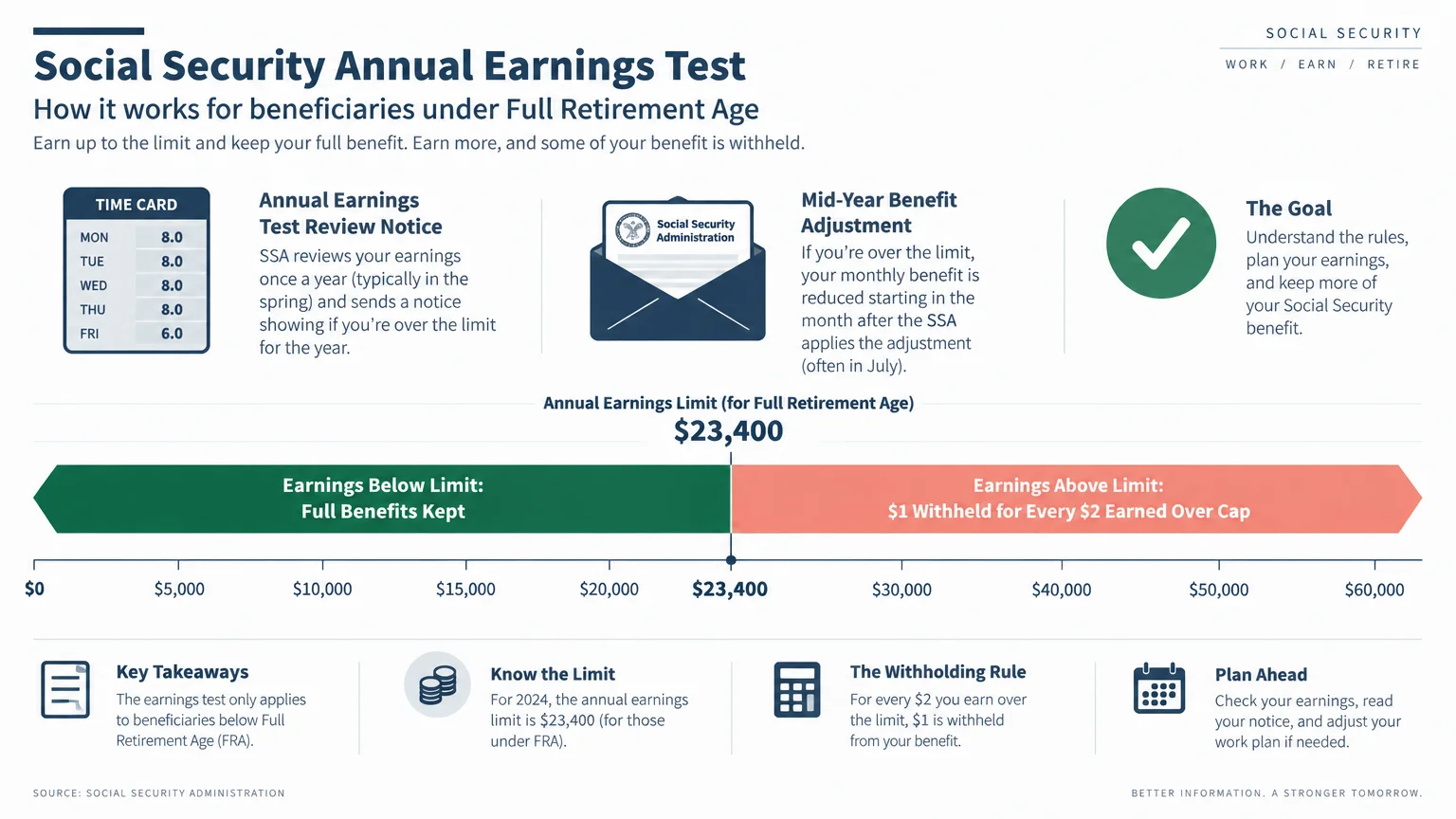
Claiming retirement benefits before reaching your full retirement age creates strict limitations if you plan to continue working. Exceeding specific earnings limits results in automatic benefit withholdings.
In 2027, the baseline earnings test limit increases to $25,560 for workers who remain below their full retirement age throughout the entire calendar year. The agency withholds $1 of benefits for every $2 earned above that ceiling.
A separate rule applies during the single calendar year you reach full retirement age. In 2027, the earnings cap for that transitional period climbs to $67,920.
During the months leading up to your birthday milestone, the government deducts $1 in benefits for every $3 you earn above $67,920. Once you reach full retirement age, all earnings caps vanish permanently.
Working retirees also face an updated wage base cap. For 2027, the maximum earnings amount subject to the 6.2% Social Security payroll tax rises to $192,300, up from $184,500 in 2026.
If the agency suspects your earnings will exceed legal thresholds, they mail an earnings review questionnaire in early winter. Failing to answer promptly can prompt the government to suspend your monthly checks.
Respond with accurate estimates of your wages and net self-employment income. Accurate reporting prevents the agency from withholding too much cash or creating an accidental overpayment.

5. Social Security Benefit Recalculation Notices
Retirees who continue working often receive a welcome adjustment notice between December and February. This letter confirms an upward adjustment in your regular monthly benefit amount.
The agency reviews your lifetime earnings record every autumn by comparing your latest annual tax data against your historical 35 highest-earning years. All historical earnings are indexed for wage growth.
If your latest earnings year ranks higher than any previous year used in your baseline calculation, the agency recalculates your Primary Insurance Amount. This adjustment permanently increases your future monthly checks.
The letter clearly outlines your previous benefit rate, your newly recalculated monthly amount, and the precise month the adjustment takes effect. It also details any retroactive back pay owed to you.
Verify that the agency correctly recorded your recent W-2 wages or net self-employment profits. Mistakes in wage reporting by employers or contractors can artificially suppress your recalculated check.
You have exactly 60 days from the date you receive this recalculation notice to submit a formal written appeal if the numbers look incorrect. Always keep a photocopy of your appeal paperwork.

6. Overpayment Notice and Demand Letters
Receiving an overpayment demand letter from the government can cause tremendous anxiety. These winter notices allege that the agency sent you more money than you were legally entitled to receive.
Overpayments usually stem from delayed earnings reports, changes in marital status, worker compensation offsets, or administrative processing errors by agency staff. The letter specifies an alleged debt balance.
Fortunately, revised regulations limit automatic monthly withholdings to 50% of your total benefit check. Previously, the government could withhold 100% of your payment until the debt cleared.
You have 90 days from the notice date to negotiate an affordable repayment schedule, file an administrative appeal, or request a complete waiver before benefit reductions begin. Taking prompt action protects your income.
If you submit Form SSA-561 for reconsideration or Form SSA-632 for a waiver within 30 days of the notice date, the agency pauses all recovery actions during the review process.
The agency also maintains a streamlined waiver threshold of $2,000 for small administrative debts. Debts beneath this amount qualify for simplified administrative relief if you were not at fault.
To win a formal waiver on larger sums, you must establish that the overpayment was not your fault and that repayment would deprive you of income needed for basic living expenses.
“A delay in claiming Social Security is the best insurance policy against longevity risk, but managing what you actually receive requires relentless vigilance over every statement.” — Suze Orman, Personal Finance Expert
7. Representative Payee Accounting and Review Forms
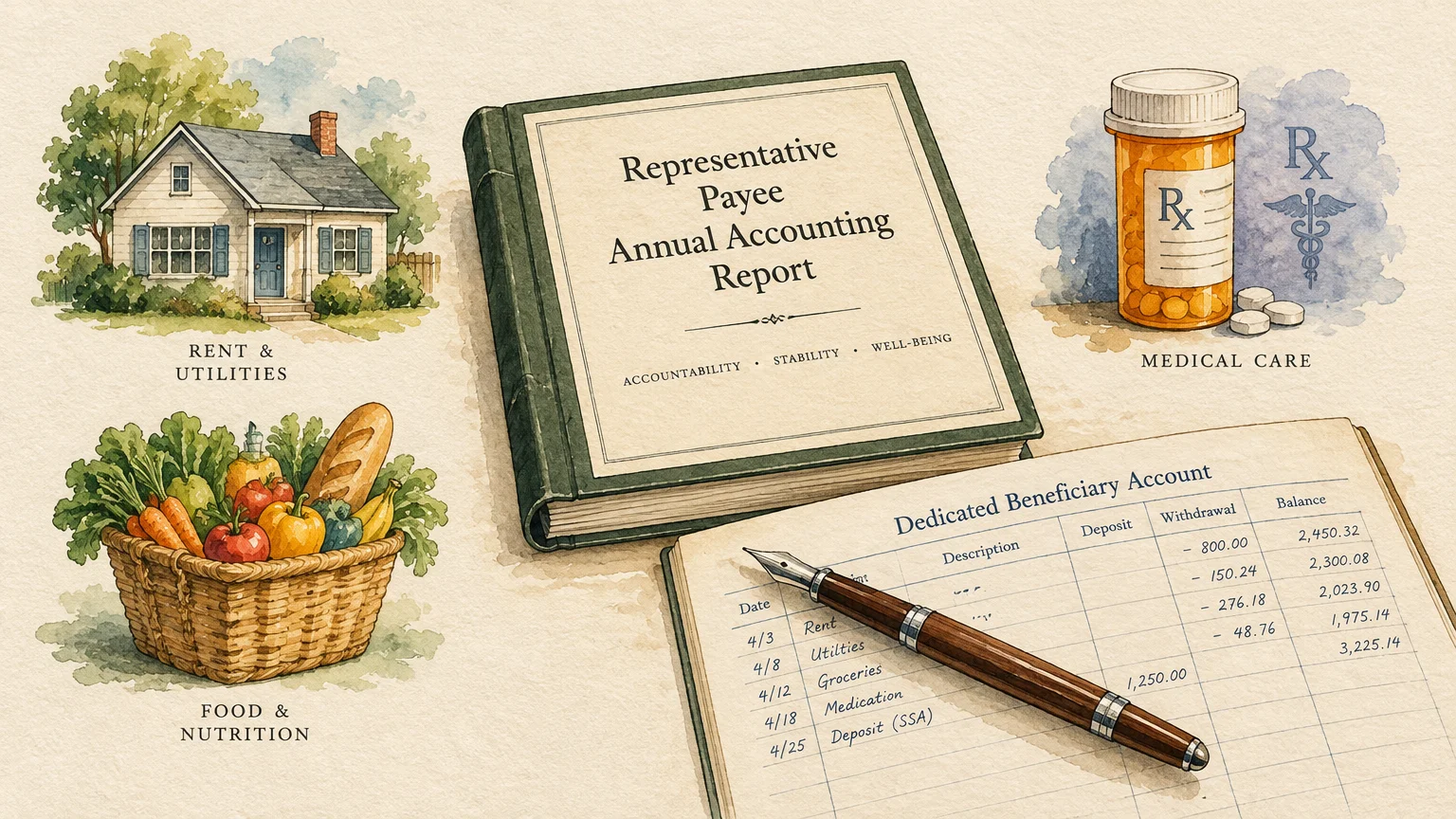
When an individual cannot manage their own financial affairs, the agency designates an authorized representative payee to manage payments. Winter is peak season for representative payee reporting forms.
These notices confirm how benefits were spent on behalf of the beneficiary over the preceding twelve months. Payees must document housing costs, grocery expenditures, clothing, and medical care.
While custodial parents and legal spouses living in the same household are exempt from annual accounting forms, non-exempt organizational and individual payees must file detailed records. Failure to report triggers formal investigations.
The review letter reminds payees that benefit funds must remain in dedicated fiduciary accounts. Commingling retirement or disability benefits with personal funds represents a serious violation of federal law.
Any funds remaining after covering necessary living expenses must sit in an interest-bearing account or U.S. savings bonds. Complete these forms accurately and return them within the specified 30-day window.
8. Supplemental Security Income (SSI) Annual Redetermination Notices
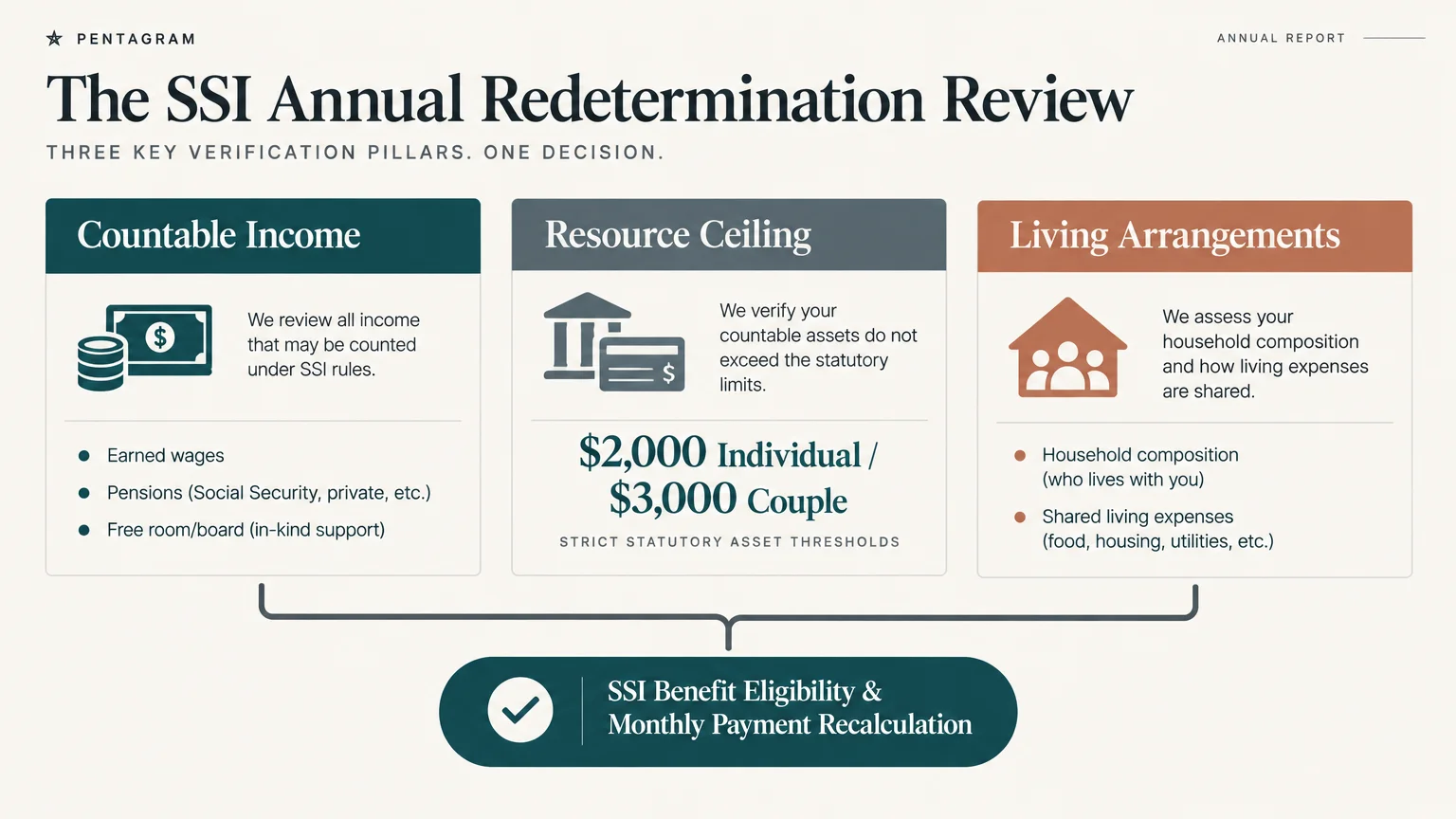
Supplemental Security Income recipients undergo periodic eligibility reviews, which frequently land in mailboxes during winter months. SSI redeterminations assess your financial resources and current living arrangements.
The agency enforces strict statutory asset limits of $2,000 for single individuals and $3,000 for married couples. Crossing these liquid asset limits results in immediate benefit suspension.
The redetermination questionnaire requires you to present updated bank statements, documentation of cash surrender value on life insurance, and proof of any outside financial assistance.
Even non-monetary assistance can reduce your monthly payment. Receiving free shelter or groceries from relatives can trigger an in-kind support and maintenance reduction against your monthly SSI check.
Complete every section of this review package honestly and attach copies of your supporting financial records. Missing an agency deadline will halt your monthly support payments entirely.
Winter Social Security Mailings: Quick Comparison Guide
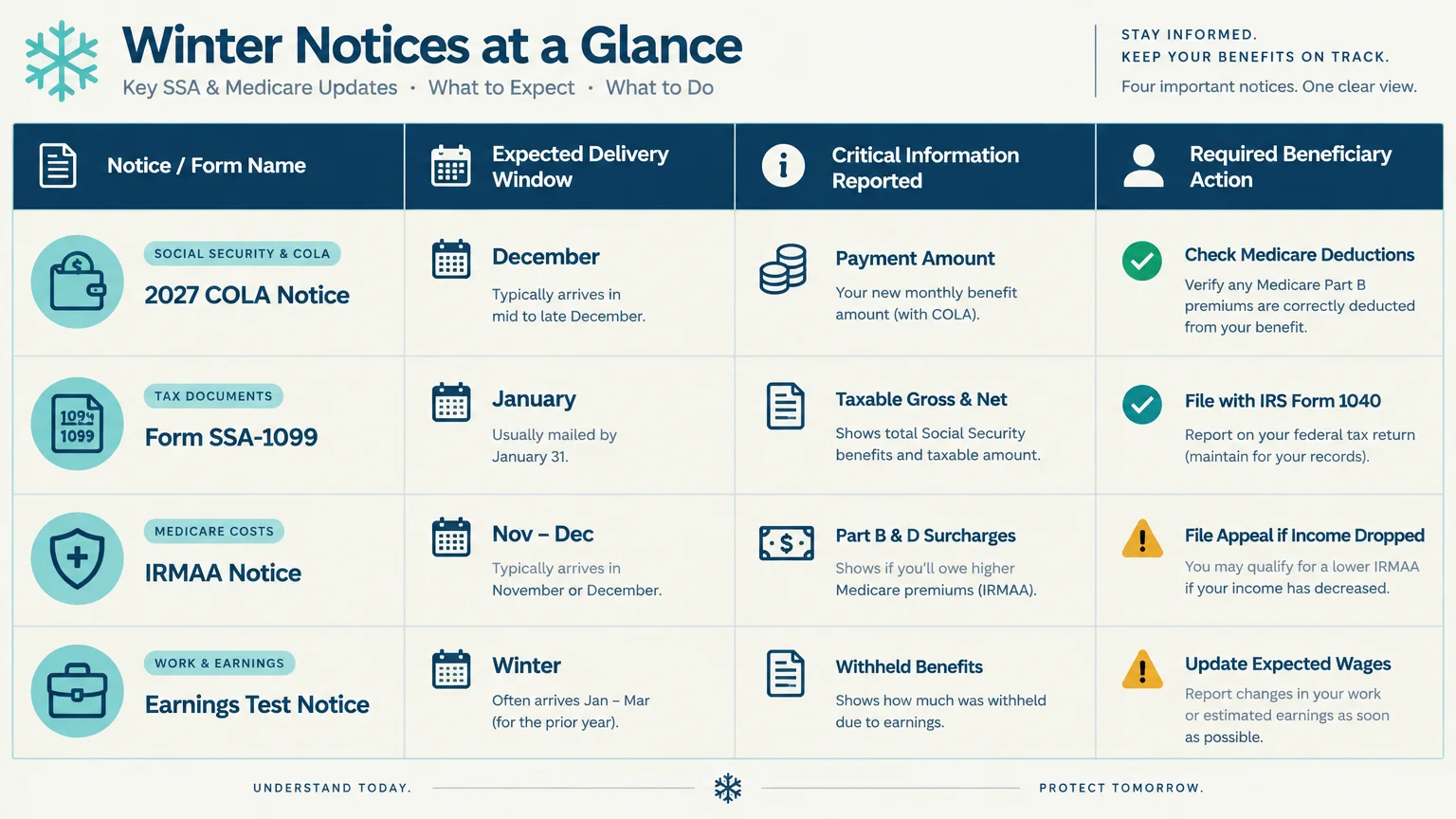
Sorting through official federal correspondence requires a clear understanding of deadlines and necessary actions. Use the reference table below to identify your winter mailings and manage your response times.
| Notice Name | Expected Arrival | Key Deadlines | Primary Action Required |
|---|---|---|---|
| 2027 COLA Notice | Late Nov 2026 (online); Dec 2026 (mail) | Nov 18, 2026 (paperless opt-in) | Verify new gross rate and net deductions. |
| Form SSA-1099 / SSA-1042S | Jan 3–31, 2027 (mail); Feb 1 (online) | April 15, 2027 (tax filing) | Report taxable benefits on federal return. |
| IRMAA Determination Notice | Nov–Dec 2026 | 60 days from receipt | Submit Form SSA-44 if income dropped. |
| Earnings Test Notice | Dec 2026–Jan 2027 | 30 days from notice date | Report anticipated wages under FRA. |
| Benefit Recalculation Letter | Dec 2026–Feb 2027 | 60 days to file appeal | Confirm accurate indexing of earnings. |
| Overpayment Demand Letter | Anytime (frequent in winter) | 30 days (pause) / 90 days (limit) | Submit Form SSA-632 or request appeal. |
| Representative Payee Report | Dec 2026–Jan 2027 | 30–60 days from receipt | Submit accounting of spent benefit funds. |
| SSI Redetermination Form | Dec 2026–Feb 2027 | 30 days from receipt | Provide bank records and asset values. |

Common Mistakes to Avoid With Winter Social Security Mail
Treating government correspondence casually is one of the most dangerous mistakes retirees make. Misplacing an envelope can cost you hundreds of dollars in lost benefits or missed tax breaks.
Here are several frequent mistakes you must avoid when dealing with winter Social Security mail:
- Ignoring the 60-day appeal clock: Most adverse determinations grant exactly 60 days from delivery to lodge an administrative objection. Missing this strict statutory window forfeits your legal right to dispute calculations.
- Discarding the envelope without opening: Many retirees mistake official notifications for junk promotional mail. Always open every piece of mail carrying the official Social Security seal immediately.
- Overlooking Medicare Part B premium hikes: Failing to verify your Medicare deduction means you might miscalculate your true net living budget. Deductions come out before cash hits your account.
- Failing to dispute outdated IRMAA calculations: Many seniors assume Medicare surcharges are permanent. You must submit Form SSA-44 whenever you experience a life-changing financial disruption.
- Delaying overpayment responses: Waiting longer than 30 days to address an overpayment demand allows recovery machinery to start moving. Early filing freezes collections and buys time to assemble evidence.

Professional vs. Self-Guided: Managing Complex Notices
Most routine paperwork can be managed independently from your home computer. However, complex disputes or high-stakes adjustments often warrant professional assistance from qualified advisors.
Use these distinct scenarios to determine whether you should handle your winter paperwork yourself or hire an expert:
Scenario 1: Filing an IRMAA Appeal (Form SSA-44)
Self-Guided: If you experienced a simple life-changing event like retirement or spousal death, handling it yourself is straightforward. You only need a completed Form SSA-44 alongside a signed employer letter or marriage certificate.
Professional Guidance: If your income drop involved stock sales, trust distributions, real estate sales, or business liquidations, work with a certified financial planner or tax accountant. They can structure capital distributions properly to eliminate future surcharges.
Scenario 2: Contesting an Overpayment Notice
Self-Guided: Small administrative errors below the $2,000 threshold can be handled on your own. You can request a streamlined administrative waiver directly through your regional field office.
Professional Guidance: If the government demands repayment of tens of thousands of dollars, hire an elder law attorney or accredited representative. An attorney can prove lack of fault and prevent crippling financial garnishment.
Scenario 3: Working While Claiming Under Full Retirement Age
Self-Guided: W-2 employees with fixed, predictable salaries can easily forecast annual wages. You can update your estimated earnings through the official portal without outside help.
Professional Guidance: Self-employed contractors, business owners, and sales professionals with fluctuating commissions benefit from professional planning. A tax advisor ensures your declared earnings do not trigger unexpected benefit suspensions.
Scenario 4: Coordinating Income Taxes on Form SSA-1099
Self-Guided: Retirees whose sole income sources are Social Security and modest pensions can easily enter their Box 5 figures into standard tax preparation software.
Professional Guidance: If you manage significant required minimum distributions, Roth conversions, or brokerage portfolios, consult an enrolled agent or certified financial planner. Advanced tax planning minimizes the percentage of benefits subject to taxation.
Frequently Asked Questions About Winter SSA Notices
Can I opt out of paper mailings completely?
Yes, you can opt out of paper mailings for many notices by adjusting your communication preferences in your online account. However, critical legal documents and tax statements may still arrive via postal mail.
What should I do if my Form SSA-1099 does not arrive by January 31?
Do not panic if your tax statement is delayed in the postal system. You can log into your personal profile online and download an official printable replacement starting February 1, 2027.
Why did my monthly check increase by less than the full 3.6% COLA?
Your gross benefit received the full 3.6% increase, but higher Medicare Part B premiums and private insurance deductions were subtracted first. The rising Part B baseline premium reduces your net deposit.
Can the Social Security Administration reduce my checks without advance notice?
No, federal law requires the agency to issue advance written notice before lowering or suspending monthly payments. This official letter gives you a designated window to challenge the action or request a hearing.
Securing Your Benefits for the Year Ahead
Taking a proactive approach to your winter paperwork protects your financial peace of mind. Inspect every statement thoroughly, cross-reference deductions against your health coverage, and store essential tax forms safely.
Whenever you spot a potential clerical error, take immediate action before administrative deadlines close. Diligent attention to these seasonal mailings ensures your hard-earned benefits remain secure all year long.
This is educational content based on general retirement and financial principles. Individual results vary based on your situation. Always verify current benefit rules, tax laws, and eligibility requirements with official sources like SSA, Medicare.gov, or the IRS.
Last updated: November 2026. Retirement benefits, tax rules, and healthcare regulations change frequently—verify current details with official sources.









Leave a Reply