
Your Social Security check directly determines your retirement lifestyle, yet claiming age shifts your monthly payout by hundreds of dollars. In 2026, the average monthly benefit for retired workers reached approximately $2,071.
Deciding when to claim shapes your lifetime income. Claiming at age 62 permanently slashes your check, while delaying until age 70 maximizes your guaranteed monthly cash flow.
Knowing the average Social Security benefit across every age bracket helps you benchmark your savings and choose the best claiming strategy for your financial future.
The Essentials: Key Social Security Benchmarks for 2026
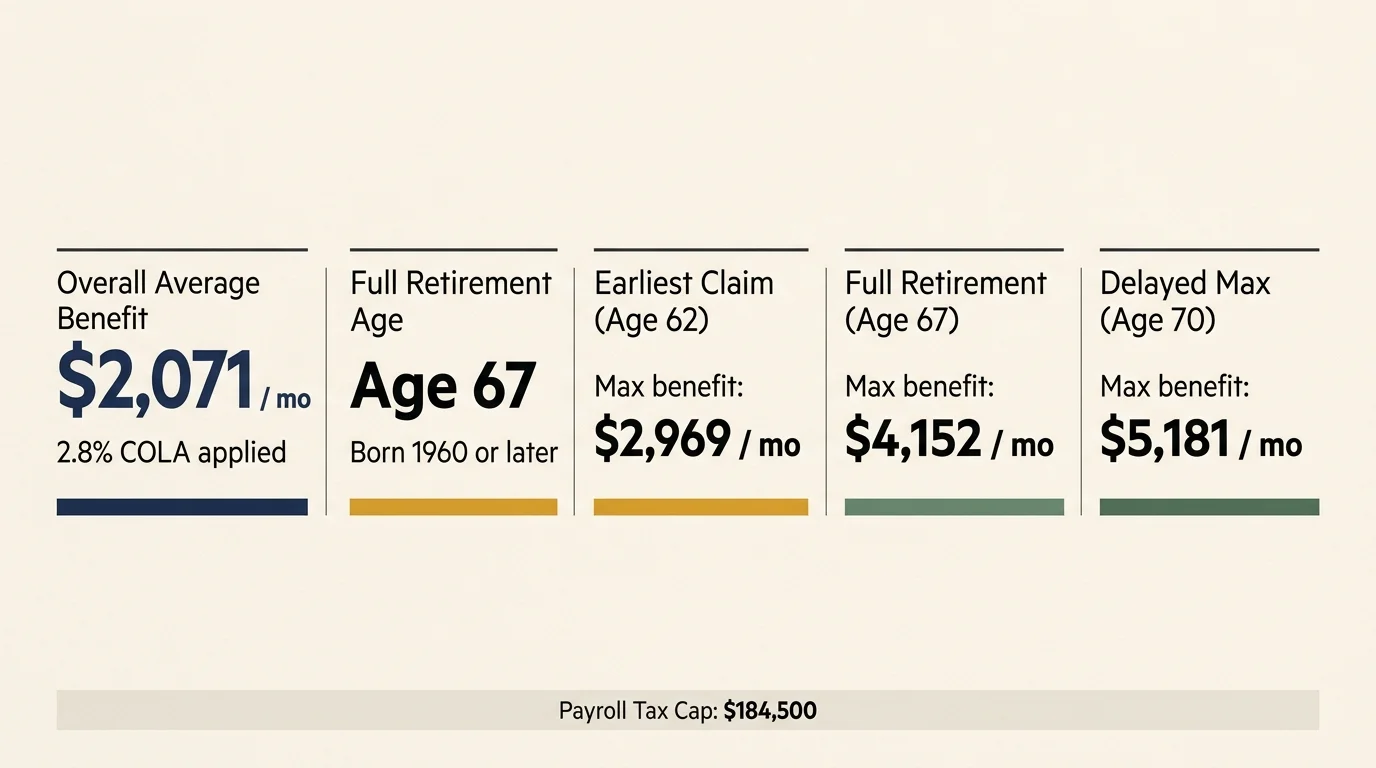
Understanding where your benefit stands begins with the latest federal adjustments. The Social Security Administration implemented a 2.8% Cost-of-Living Adjustment (COLA) for 2026, boosting monthly checks to help older Americans maintain purchasing power against persistent living costs.
- Overall Average Benefit: Approximately $2,071 per month across all retired workers, rising beyond $2,080 by mid-2026.
- Full Retirement Age (FRA): Exactly 67 years old for anyone born in 1960 or later.
- Maximum Monthly Benefit at Age 62: $2,969 per month for high earners who claim at the earliest eligibility milestone.
- Maximum Monthly Benefit at FRA (Age 67): $4,152 per month.
- Maximum Monthly Benefit at Age 70: $5,181 per month, achieved through delayed retirement credits.
- Payroll Tax Cap: $184,500 in maximum taxable earnings subject to the 6.2% Social Security payroll tax.
Average Social Security Benefit by Age: What Retirees Actually Receive
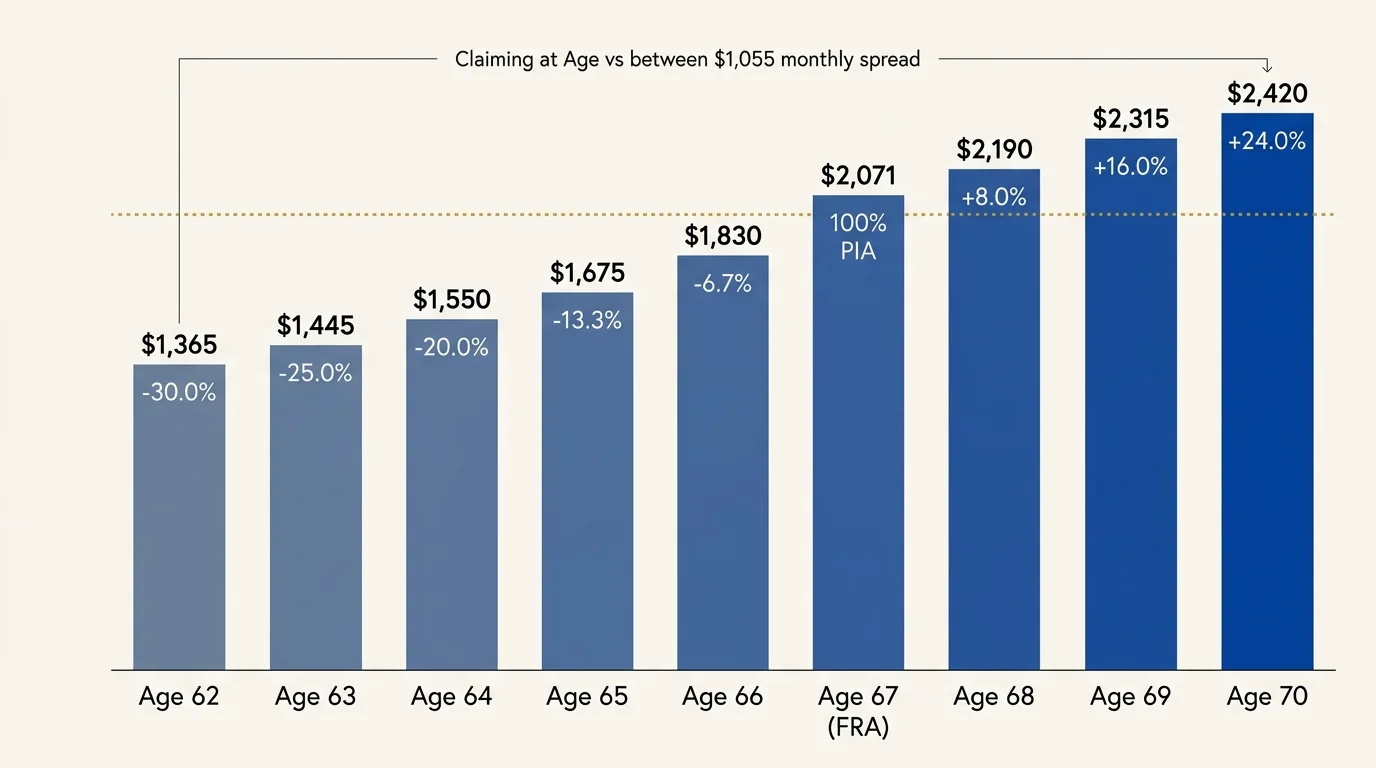
While theoretical calculations show what you could receive, real-world data reveals distinct patterns. The average social security benefit climbs steadily from age 62 through age 70. This variance reflects two main forces: actuarial reductions for early filers and the accumulating value of delayed retirement credits for those who postpone claiming.
The table below outlines the average social security amount by age based on published Social Security Administration (SSA) data adjusted for 2026 benefit levels, alongside the maximum statutory payout for each age bracket.
| Claiming Age | Estimated Average Monthly Check | Benefit Adjustment Relative to FRA (Age 67) | 2026 Maximum Possible Benefit |
|---|---|---|---|
| 62 | $1,365 | -30.0% (Permanent Reduction) | $2,969 |
| 63 | $1,445 | -25.0% | $3,180 |
| 64 | $1,550 | -20.0% | $3,393 |
| 65 | $1,675 | -13.3% | $3,605 |
| 66 | $1,830 | -6.7% | $3,878 |
| 67 (FRA) | $2,071 | 100% of Primary Insurance Amount (PIA) | $4,152 |
| 68 | $2,190 | +8.0% (Delayed Credits) | $4,484 |
| 69 | $2,315 | +16.0% (Delayed Credits) | $4,816 |
| 70 | $2,420 | +24.0% (Maximum Delayed Credits) | $5,181 |
Notice that the average check at age 70 ($2,420) sits significantly higher than the average at age 62 ($1,365)—a difference of more than $1,000 every single month. Many older workers who wait until age 70 also possess longer, higher-earning work histories, which elevates their baseline Primary Insurance Amount before applying delayed credits.
How Social Security Calculates Your Monthly Payout
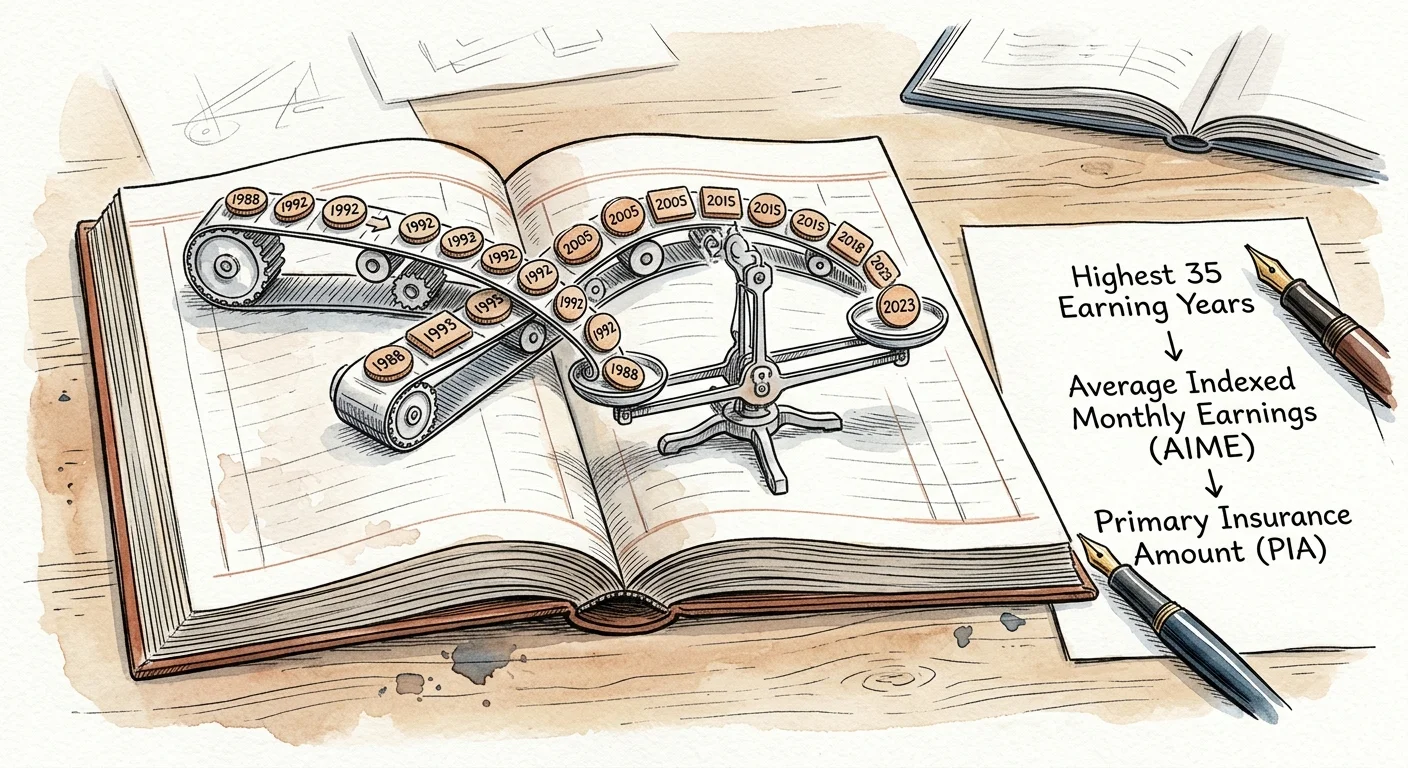
To understand where your payment lands relative to national averages, you must examine the mechanics behind the calculation. The SSA does not evaluate your entire working life equally; instead, it indexes your earnings history to account for wage growth over time.
The system evaluates three distinct components to establish your baseline check:
- Your 35 Highest-Earning Years: The SSA selects your top 35 years of wage-indexed earnings. If you worked only 28 years, the agency inserts seven years of zero earnings into the formula, pulling your average down substantially.
- Average Indexed Monthly Earnings (AIME): The agency sums your top 35 indexed years and divides that number by 420 (the number of months in 35 years) to calculate your AIME.
- Primary Insurance Amount (PIA) Bend Points: The SSA applies a progressive formula to your AIME. For workers reaching eligibility in 2026, the formula awards you 90% of your earnings up to the first threshold, 32% of earnings between the first and second thresholds, and 15% of any earnings above the final threshold.
This progressive structure replaces a larger percentage of pre-retirement income for lower-wage earners while delivering higher dollar amounts—though lower replacement percentages—to high-wage earners. To build eligibility in the first place, you must earn 40 work credits throughout your career; in 2026, you earn one credit for every $1,890 in wage income, up to the annual maximum of four credits ($7,560).
“Social Security is the only guaranteed, inflation-protected income stream most Americans will ever have. Treating it like an afterthought or claiming prematurely without a plan costs retirees tens of thousands of dollars over their lifetimes.” — Suze Orman, Personal Finance Author and Host

The Financial Cost of Claiming Early vs. Waiting for Age 70
The decision of when to start collecting benefits represents one of the most substantial financial choices you will make. When you claim at age 62, you lock in a permanent 30% reduction compared to your Full Retirement Age benefit. Conversely, every year you delay claiming past age 67 adds an 8% simple increase to your check via delayed retirement credits.
Consider the math for someone whose Primary Insurance Amount at age 67 equals $2,000 per month:
- Claiming at Age 62: You receive $1,400 monthly ($16,800 annually). Over a 20-year retirement, you collect $336,000 in baseline benefits before COLA adjustments.
- Claiming at Age 67: You receive $2,000 monthly ($24,000 annually). Over a 20-year retirement, you collect $480,000 in baseline benefits.
- Claiming at Age 70: You receive $2,480 monthly ($29,760 annually). Over 17 years of collection (to reach the same age 87 benchmark), you collect $505,920.
A reliable social security payout calculator illustrates that the breakeven age—the point where total cumulative dollars from delayed claiming overtake early claiming—typically falls between ages 78 and 82. If family longevity and current health suggest you will live past age 80, delaying your claim yields significantly higher cumulative wealth and provides vital longevity insurance for your later years.

The Retirement Earnings Test: Working While Collecting Social Security
Many retirees discover that stepping away from work entirely does not suit them. If you claim Social Security before your Full Retirement Age and continue to work, the Retirement Earnings Test temporarily withholds a portion of your benefits once your earnings surpass federal thresholds.
For 2026, the Retirement Earnings Test operates under two distinct rules depending on your age:
- Under FRA for the Entire Calendar Year: The annual earnings limit is $24,480 ($2,040 per month). The SSA withholds $1 from your benefits for every $2 you earn above this threshold.
- The Year You Reach Full Retirement Age: The earnings limit expands to $65,160 ($5,430 per month) for earnings accumulated during the months prior to your birth month. The SSA withholds $1 for every $3 earned above this limit.
- Month of Reaching FRA and Beyond: The earnings test disappears entirely. You can earn an unlimited income with zero withholding from your monthly Social Security check.
Many workers misunderstand how this withholding operates. The withheld funds are not permanently lost; rather, once you reach your Full Retirement Age, the SSA recalculates your monthly check upward to credit you for the months during which benefits were withheld. Nevertheless, working full-time while claiming at 62 rarely makes sense if the earnings test suppresses the majority of your early checks.

Spousal and Survivor Benefits: How Age Alters the Equation
Your claiming age does not merely dictate your own income; it fundamentally impacts your household’s collective security. Spousal and survivor benefits provide essential protections, but they follow separate statutory rules that every couple must navigate carefully.
Under federal regulations, a spouse can claim up to 50% of the primary earner’s Primary Insurance Amount if claiming at Full Retirement Age. If the non-working or lower-earning spouse claims earlier—such as age 62—their spousal check shrinks to as little as 32.5% of the primary earner’s PIA. Spousal benefits do not earn delayed retirement credits; waiting past age 67 does not increase a spousal payment above the 50% maximum cap.
Survivor benefits follow a different set of rules. A surviving spouse can collect up to 100% of the deceased worker’s actual benefit—including any delayed retirement credits earned up to age 70. If the higher-earning spouse delays claiming until age 70, they permanently maximize the survivor benefit that protects the surviving spouse for the rest of their life. You can evaluate household claiming strategies by consulting guidance on AARP and official SSA publication channels.
Avoiding Common Errors When Timing Your Benefits
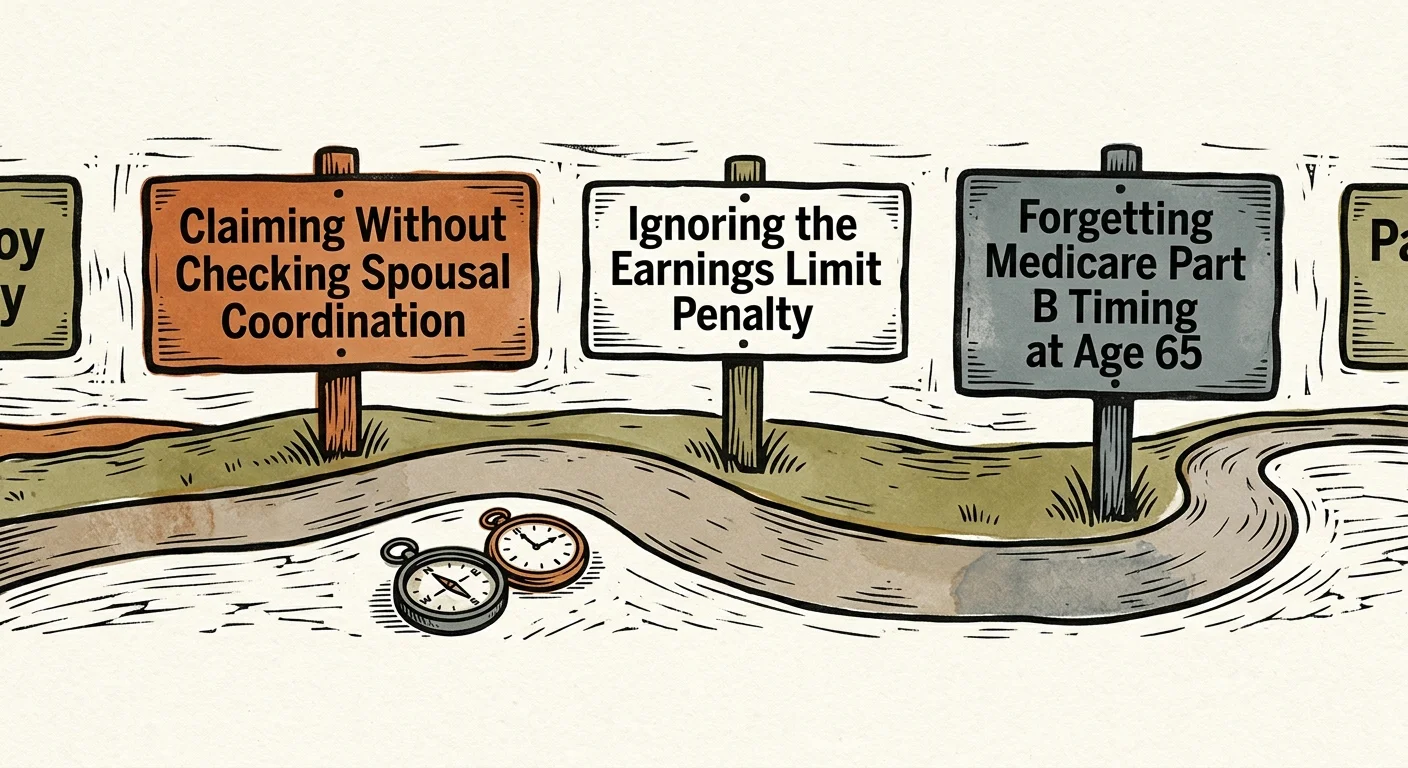
Navigating the transition from payroll to retirement benefits involves several traps that can derail your financial plans. Avoid these critical missteps when setting your claiming date:
- Rushing to Claim at 62 While Working Full-Time: Claiming early while earning a substantial salary often results in having most or all of your benefits withheld under the earnings test, locking you into a permanently reduced rate without providing usable current income.
- Ignoring the Tax Torpedo on Social Security: Up to 85% of your Social Security benefits become subject to federal income tax if your combined income (adjusted gross income plus non-taxable interest plus half of your Social Security benefit) exceeds $34,000 for individual filers or $44,000 for married couples filing jointly. Failing to project this provisional income can trigger unexpected tax bills.
- Overlooking Medicare Part B Premium Deductions: If you collect Social Security when you enroll in Medicare at age 65, the federal government automatically deducts your Part B premiums directly from your monthly check. Check current guidelines on Medicare.gov so you do not overestimate your net take-home pay.
- Failing to Audit Your SSA Earnings Record: The SSA calculates your check based on the historical earnings reported under your Social Security number. An uncorrected employer reporting error from a decade ago can depress your monthly check permanently. Review your statement annually via your personal online SSA account to ensure every year reflects accurate numbers.

When DIY Isn’t Enough: Scenarios That Demand Professional Guidance
While many individuals manage their Social Security strategy using basic calculators, complex financial profiles require professional insight from a fee-only financial planner or qualified tax professional. Consider securing dedicated advice if your situation involves any of the following scenarios:
- Significant Age and Earnings Disparities Between Spouses: When one spouse earned substantially more and is several years older than the other, coordinating claiming ages becomes mathematically intricate. Optimizing for both lifetime income and long-term survivor protection requires detailed cash-flow modeling across several decades.
- Public Pensions Affected by WEP or GPO: If you worked as a teacher, firefighter, or government employee where you did not pay Social Security payroll taxes, the Windfall Elimination Provision (WEP) or Government Pension Offset (GPO) may severely reduce your personal or spousal Social Security benefits. Navigating these formulas requires specialized analysis.
- Large Traditional Tax-Deferred Balances (IRAs and 401ks): If substantial Required Minimum Distributions (RMDs) loom at age 73 or 75, drawing down those tax-deferred accounts between ages 62 and 70 while delaying Social Security can lower your lifetime tax burden and protect your benefits from aggressive taxation.
- Chronically Ill Dependents or Disabled Adult Children: Households supporting disabled adult children can access distinct family benefit maximums. Structuring these benefits without inadvertently disqualifying dependents from critical Medicaid or Supplemental Security Income (SSI) programs requires specialized legal and financial planning.
Frequently Asked Questions About Social Security Benefit Amounts
How much does the average American get from Social Security each month?
In 2026, the average Social Security check for a retired worker is approximately $2,071 per month. Payouts range from an average of $1,365 at age 62 up to $2,420 or more for those who wait until age 70.
What is the highest possible Social Security check in 2026?
The maximum possible benefit in 2026 is $5,181 per month. To receive this maximum payout, a worker must have earned at or above the maximum taxable earnings cap for at least 35 years and delayed claiming benefits until age 70.
Does my monthly check increase once I reach Full Retirement Age if I claimed early?
No. If you claim your benefits at age 62, your reduction is permanent. Your check will receive annual Cost-of-Living Adjustments (COLAs), but it will never automatically convert to the full 100% FRA amount simply because you grew older.
How do cost-of-living adjustments (COLA) affect my check?
COLA adjustments apply as a percentage increase to your existing benefit amount to offset inflation. The 2026 COLA added 2.8% to monthly checks starting in January 2026, building upon the 2.5% adjustment from 2025.
Can I change my mind after claiming Social Security early?
You can withdraw your application within the first 12 months of claiming through a formal “withdrawal of application” process. However, you must repay all benefits received by you and your family members to date. After reaching Full Retirement Age, you can alternatively suspend your benefits to earn delayed retirement credits up to age 70 without repaying prior funds.
Taking the Next Steps for Your Retirement
Examine your personal Social Security statement through your online federal portal today to verify your work credits and projected benefit amounts. Compare your numbers against your expected household spending, coordinate your claiming timetable with your spouse, and evaluate whether your retirement savings can bridge the gap if you decide to delay claiming for a higher monthly check.
The information in this guide is meant for educational purposes. Your specific circumstances—including income, health needs, tax situation, and goals—may require different approaches. When in doubt, consult a licensed professional.
Last updated: March 2026. Retirement benefits, tax rules, and healthcare regulations change frequently—verify current details with official sources.









Leave a Reply