
Long-term healthcare expenses can wipe out decades of diligent retirement savings in a few short years. Knowing when to hire an elder law attorney protects your independence, your assets, and your family’s future.
While standard estate planning focuses on distributing wealth after death, elder law secures your quality of life while you are alive. Recognizing specific turning points lets you act proactively before health crises force costly compromises.
Watch for these nine critical signs to determine whether your family needs specialized legal and financial guidance right now.

At a Glance: Why Legal Guidance Matters
Elder law addresses the complex intersection of healthcare, government benefits, and asset protection. Waiting too long often limits your legal options and increases overall care costs.
- Healthcare Crisis Management: Rapid health changes demand swift legal authorizations to manage medical decisions.
- Financial Preservation: Proper planning shields family assets from devastating long-term care bills.
- Benefit Eligibility: Strategic structuring unlocks vital programs like Medicaid and VA Aid and Attendance.
- Family Harmony: Clear legal designations prevent contentious court-supervised guardianships among relatives.
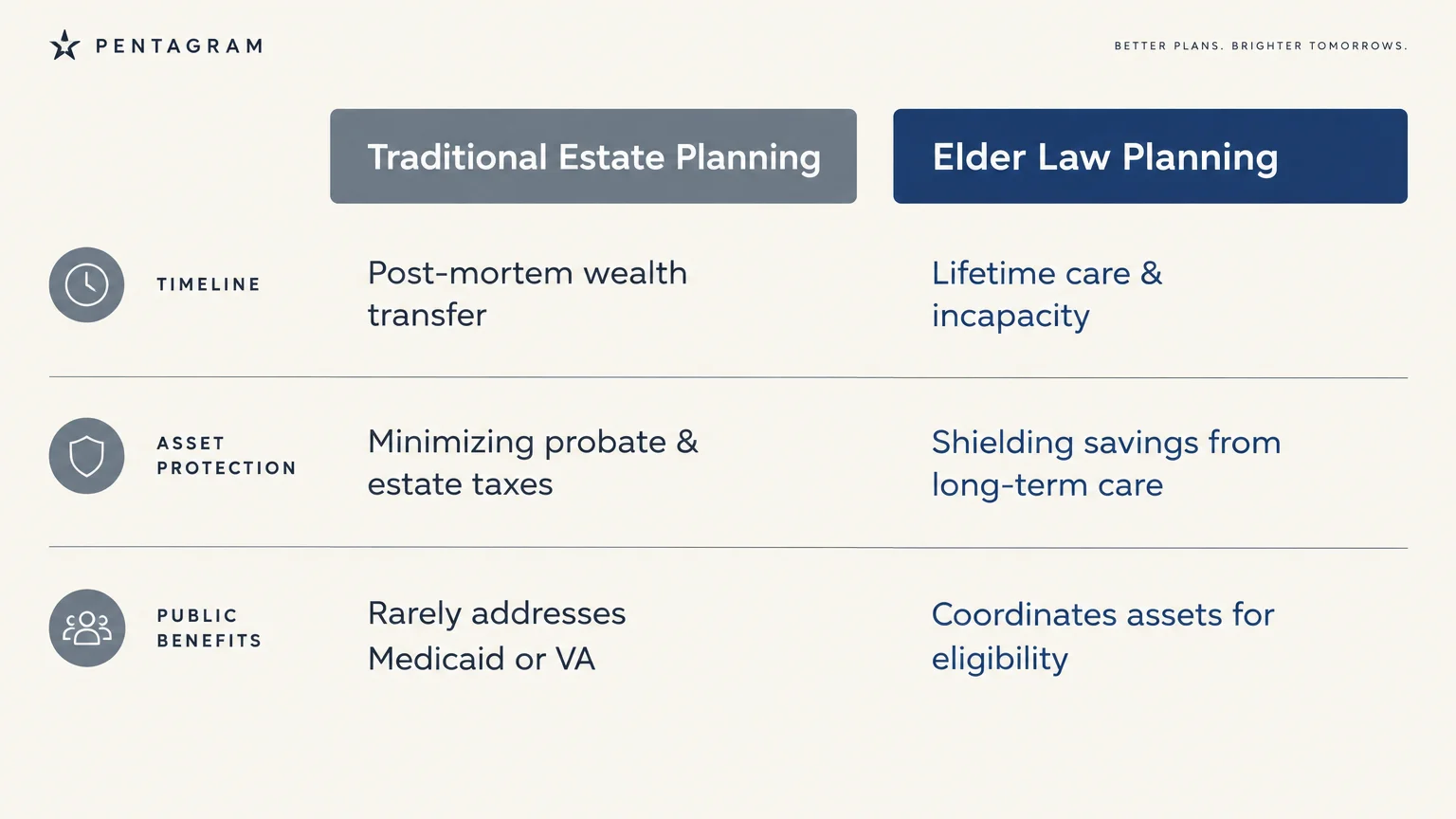
Elder Law vs. Traditional Estate Planning
Many retirees assume their existing last will and testament provides complete protection. However, traditional estate planning primarily governs the distribution of assets after you pass away.
Elder law estate planning concentrates heavily on lifetime advocacy and incapacity management. An elder law attorney structures your assets so you can afford quality care without going broke.
| Planning Aspect | Traditional Estate Planning | Elder Law Planning |
|---|---|---|
| Primary Timeline | Post-mortem wealth transfer | Lifetime care and incapacity |
| Asset Protection | Minimizing probate and estate taxes | Shielding savings from long-term care costs |
| Public Benefits | Rarely addresses Medicaid or VA rules | Coordinates assets to achieve benefit eligibility |
| Decision Directives | Standard statutory power of attorney | Custom durable powers with broad gifting authority |
| Housing Focus | Real estate transfer to heirs | Protecting the home from Medicaid estate recovery |

9 Signs You Need an Elder Law Lawyer
1. A Recent Diagnosis of Cognitive Decline or Chronic Illness
Receiving an early diagnosis of Alzheimer’s disease, Parkinson’s, or vascular dementia represents a crucial legal turning point. According to data from the National Institute on Aging, over seven million older Americans currently live with dementia.
You must execute legal instruments while you retain sound mental capacity; once capacity diminishes, you cannot legally sign contracts. Missing this window forces your family into expensive, stressful probate court proceedings to establish legal guardianship.
A specialized attorney drafts robust incapacity documents tailored specifically to anticipated cognitive decline. These tools authorize trusted family members to handle complex financial transactions on your behalf without judicial intervention.
2. Long-Term Care Costs Threaten Your Life Savings
Long-term care expenses routinely overwhelm private family budgets. CareScout research shows the national median cost for a private room in a skilled nursing facility exceeds $10,798 monthly.
Assisted living facilities average $6,200 each month, while home health aides bill roughly $35 per hour. Paying these staggering bills entirely out of pocket can exhaust a lifetime of thrift within two years.
Consulting an elder law attorney helps you establish legal asset shelters before private resources disappear. Legal strategies preserve your dignity and care quality while protecting an inheritance for your heirs.
“Failing to plan for long-term care is the single greatest threat to your retirement security.” — Jean Chatzky, Financial Journalist and Author
3. You Are Within Five Years of Needing Medicaid
To qualify for long-term care coverage through Medicaid, an individual applicant cannot possess more than $2,000 in countable liquid assets. Furthermore, 49 states enforce a strict 60-month look-back period on all asset transfers.
Giving money to children or selling property below market value triggers substantial penalty periods of Medicaid ineligibility. A knowledgeable Medicaid planning attorney structures transfers into compliant irrevocable trusts or allowable exempt purchases.
Planning ahead of the five-year window protects your property while shielding you from costly regulatory penalties. Even if you need immediate placement, specialized attorneys use emergency spend-down techniques to preserve a portion of your wealth.
4. One Spouse Needs Care While the Other Stays Home
When one partner requires institutional care, the healthy spouse—known as the community spouse—frequently fears catastrophic poverty. Fortunately, federal spousal impoverishment provisions offer legal relief.
Under current rules, the Community Spouse Resource Allowance permits the healthy spouse to retain up to $157,920 to $162,660 in countable assets. Additionally, the Monthly Maintenance Needs Allowance protects between $2,555 and $3,948 in monthly household income.
An elder law attorney recalculates asset allocations to maximize the resources your healthy spouse keeps at home. This advocacy ensures the community spouse maintains their standard of living without compromising the sick spouse’s healthcare.
5. You or Your Spouse Served During Wartime
Wartime military veterans and their surviving spouses often overlook lucrative pension supplements. The Department of Veterans Affairs offers the Aid and Attendance benefit to offset daily care expenses.
This tax-free benefit provides up to $2,358 monthly for a single veteran and $2,795 monthly for a veteran with a dependent. Surviving spouses can receive up to $1,515 per month to help fund assisted living or in-home aides.
The VA imposes a strict net worth ceiling of $159,240 alongside a 36-month look-back rule for asset transfers. An accredited elder law lawyer aligns your finances to meet VA criteria without forfeiting future Medicaid eligibility.
6. Your Incapacity Documents Are Outdated or Generic
Standard power of attorney templates downloaded from online legal repositories rarely contain the sophisticated provisions seniors require. Most standard forms omit crucial powers such as making uncompensated transfers, creating trusts, or modifying beneficiary designations.
Without specific authorizing language, financial institutions frequently reject power of attorney documents during a crisis. Similarly, your advance healthcare directives must comply fully with state-specific medical privacy mandates.
An elder law professional updates your healthcare proxy, living will, and durable financial power of attorney. These comprehensive documents empower your agents to execute protective strategies if an emergency arises.
“A durable power of attorney is an act of love. It protects your family from impossible legal hurdles during an emotional medical crisis.” — Suze Orman, Personal Finance Author
7. You Support an Adult Dependent with Special Needs
Leaving an outright inheritance to a child or grandchild with physical or developmental disabilities can cause severe harm. A sudden direct inheritance often disqualifies them from essential government programs like Supplemental Security Income and Medicaid.
Elder law attorneys create first-party or third-party Special Needs Trusts to safeguard vulnerable dependents. These trusts hold inheritance funds to pay for lifestyle enhancements, medical therapies, and education without compromising public safety nets.
Your attorney can also establish legal arrangements for trusted guardians to oversee your child’s care after your death. This legal architecture guarantees continuous advocacy for your dependent across their entire lifetime.
8. You Own a Primary Residence at Risk of Estate Recovery
Many seniors mistakenly believe their home is permanently immune from Medicaid claims. While a primary home remains exempt during your lifetime if equity falls below state thresholds, posthumous rules change drastically.
Under the federal Medicaid Estate Recovery Program, states must attempt to claw back long-term care expenditures from a deceased recipient’s estate. If your home passes through regular probate, the state can place a lien on the property to settle the bill.
An elder law attorney shields your real estate through Medicaid-compliant trusts, ladybird deeds, or life estate deeds. These mechanisms bypass probate entirely, preserving the family home for future generations.
9. You Suspect Senior Financial Exploitation or Caregiver Conflict
Financial exploitation of vulnerable seniors continues to rise sharply nationwide. Educational resources from the Consumer Financial Protection Bureau show billions of dollars are stolen annually from older adults through scams and undue influence.
Warning signs include unexplained bank withdrawals, sudden changes to wills, or isolation imposed by an overbearing acquaintance. Elder law attorneys intervene quickly to freeze compromised accounts, revoke abusive powers of attorney, and recover stolen assets.
If siblings disagree regarding an aging parent’s daily care regimen, an attorney serves as an objective, protective legal advocate. Establishing clear personal care agreements prevents disputes and fairly compensates family caregivers.

When DIY Isn’t Enough
Simple matters—like naming a direct beneficiary on an IRA—rarely require an attorney. However, intricate eldercare challenges demand licensed legal counsel.
- Navigating the 60-Month Look-Back: Self-made gifts can generate crippling penalty periods that leave you without healthcare funding when you need it most.
- Establishing Irrevocable Trusts: Drafting Medicaid Asset Protection Trusts requires precise legal syntax to avoid unexpected tax penalties and loss of control.
- Crisis Spend-Down Execution: Moving a loved one directly from a hospital into a skilled nursing bed leaves zero room for trial-and-error mistakes.
- Defending Against Guardianship: Contested capacity battles require formal court representation to protect an aging individual’s civil liberties.
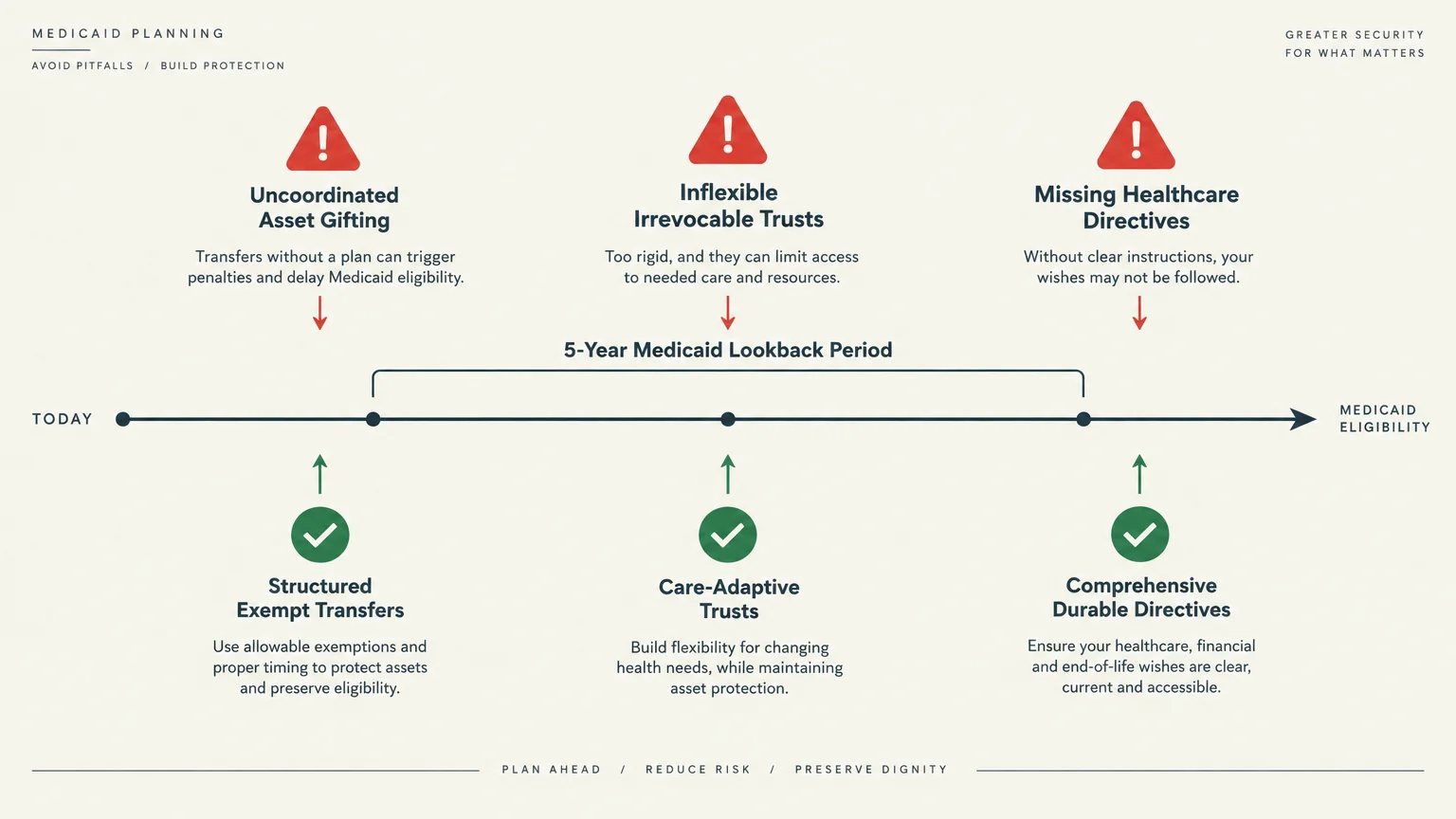
Avoiding Common Errors in Elder Planning
The most common mistake retirees make is assuming regular health insurance pays for custodial nursing care. As outlined on Medicare.gov, standard Medicare covers only short-term rehabilitative skilled nursing, not daily long-term custodial care.
Another dangerous misstep involves deeding your family home directly to adult children to protect it. Outright property transfers strip you of the property tax exemptions you enjoy as a senior homeowner.
Direct real estate transfers also pass your original tax basis to your children. When they eventually sell the property, they face massive capital gains taxes that an elder law trust easily prevents.
Finally, never procrastinate until a medical crisis strikes before seeking professional legal advice. Proactive legal planning always yields superior asset preservation and reduces emotional turmoil for your loved ones.

How to Select the Right Elder Law Attorney
Elder law represents a highly specialized legal discipline requiring distinct credentials. Look for an attorney certified as a Certified Elder Law Attorney by the National Elder Law Foundation.
Only around 500 attorneys nationwide hold the rigorous CELA credential, which demands extensive peer review and continuous testing. Confirm whether the attorney belongs to the National Academy of Elder Law Attorneys.
Elder law attorneys typically bill between $250 and $550 per hour depending on geographic market and case complexity. Comprehensive incapacity packages average $1,500 to $3,500, while complex Medicaid asset protection plans range from $5,000 to $12,000.
Frequently Asked Questions
What is the difference between an estate planning attorney and an elder law attorney?
An estate planning attorney focuses on how your wealth transfers after your death. An elder law attorney focuses on keeping you financially secure and well-cared-for during your living years.
How much does it cost to consult an elder law attorney?
Initial consultations typically cost between $250 and $500, though some firms apply this charge toward your legal package. Flat-fee arrangements are common for comprehensive incapacity and Medicaid asset protection plans.
Can an elder law attorney help if my loved one is already in a nursing home?
Yes, attorneys call this crisis Medicaid planning. Even if someone enters a facility tomorrow, an elder law attorney can often save up to half their assets using emergency legal strategies.
When should I begin working with an elder law attorney?
The best time to start is in your early sixties, or at least five years before any expected long-term care needs. Early planning ensures all asset transfers clear the strict 60-month Medicaid look-back window without triggering penalties.
Next Steps for Your Family
Do not wait for a medical emergency to dictate your family’s financial future. Schedule an exploratory consultation with a qualified elder law practitioner to review your current documents and evaluate your long-term care readiness.
Gather your recent deeds, insurance policies, and existing estate documents before meeting with legal counsel. Preparing these records in advance saves billable hours and clarifies your legal strategy from day one.
The information in this guide is meant for educational purposes. Your specific circumstances—including income, health needs, tax situation, and goals—may require different approaches. When in doubt, consult a licensed professional.
Last updated: March 2026. Retirement benefits, tax rules, and healthcare regulations change frequently—verify current details with official sources.









Leave a Reply