
Retirement reveals every financial move you made during your working life, highlighting both brilliant choices and expensive oversights. Real retirees often discover that small shifts in their workplace savings strategy could have added hundreds of thousands of dollars to their final balances.
Surveys show that more than half of recent retirees carry major regrets about their workplace plans. Most wish they had started earlier, invested more aggressively, or planned ahead for taxes in retirement.
Learning from those who have already navigated this transition protects your hard-earned nest egg. These 13 retirees share their candid experiences to help you avoid the most damaging 401(k) mistakes.
The Numbers Behind 401(k) Regrets in America
Retirement sentiment surveys reveal widespread second-guessing among older Americans. Most people do not realize their planning errors until paychecks stop arriving.
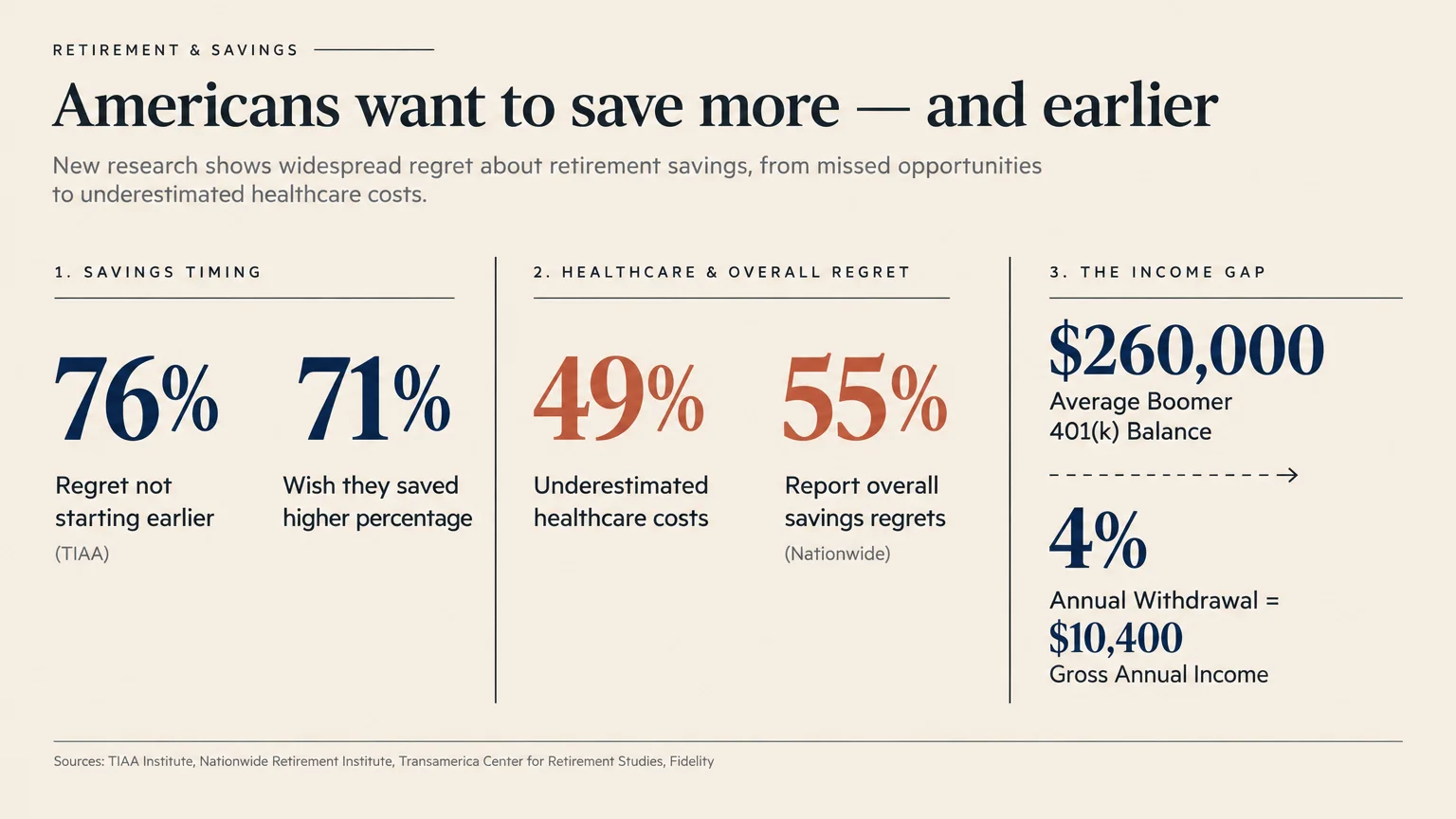
According to research from the TIAA Institute, 76% of retirees regret not starting to save earlier in life. Furthermore, 71% wish they had saved a higher percentage of their earnings each year.
The same study found that 49% of retirees underestimated healthcare and long-term care costs. Out-of-pocket medical bills frequently drain accounts faster than retirees anticipate.
Findings from the Nationwide Retirement Institute tell a similar story. They found that 55% of recent retirees report regrets over their retirement savings strategy.
Among those with regrets, 28% cited delaying their savings journey as their greatest blunder. Another 13% regretted failing to contribute enough during their peak earning years.
Data from the Transamerica Center for Retirement Studies shows that 69% of retirees wish they had saved more consistently. Additionally, 65% wished they had possessed greater financial literacy during their working careers.
Fidelity reports that the average Baby Boomer holds roughly $260,000 in a 401(k) account. While that represents years of diligence, withdrawing 4% annually yields only $10,400 in gross retirement income.
Most financial planners recommend saving at least 15% of your annual income across your career. Reaching that threshold requires consistent contributions and proactive investment decisions.
“Do not save what is left after spending, but spend what is left after saving.” — Warren Buffett, Chairman and CEO of Berkshire Hathaway
13 Retirees Share Their Hard-Earned 401(k) Lessons
Hearing firsthand accounts from those who navigated workplace plans offers invaluable perspective. Below, 13 retirees share what they would do differently if given a second chance.
1. Arthur, 68: “I Ignored the Roth 401(k) Option for Over a Decade”
Arthur spent thirty-five years contributing exclusively to a traditional pre-tax 401(k). He accumulated $1.1 million, assuming he had secured complete financial independence.
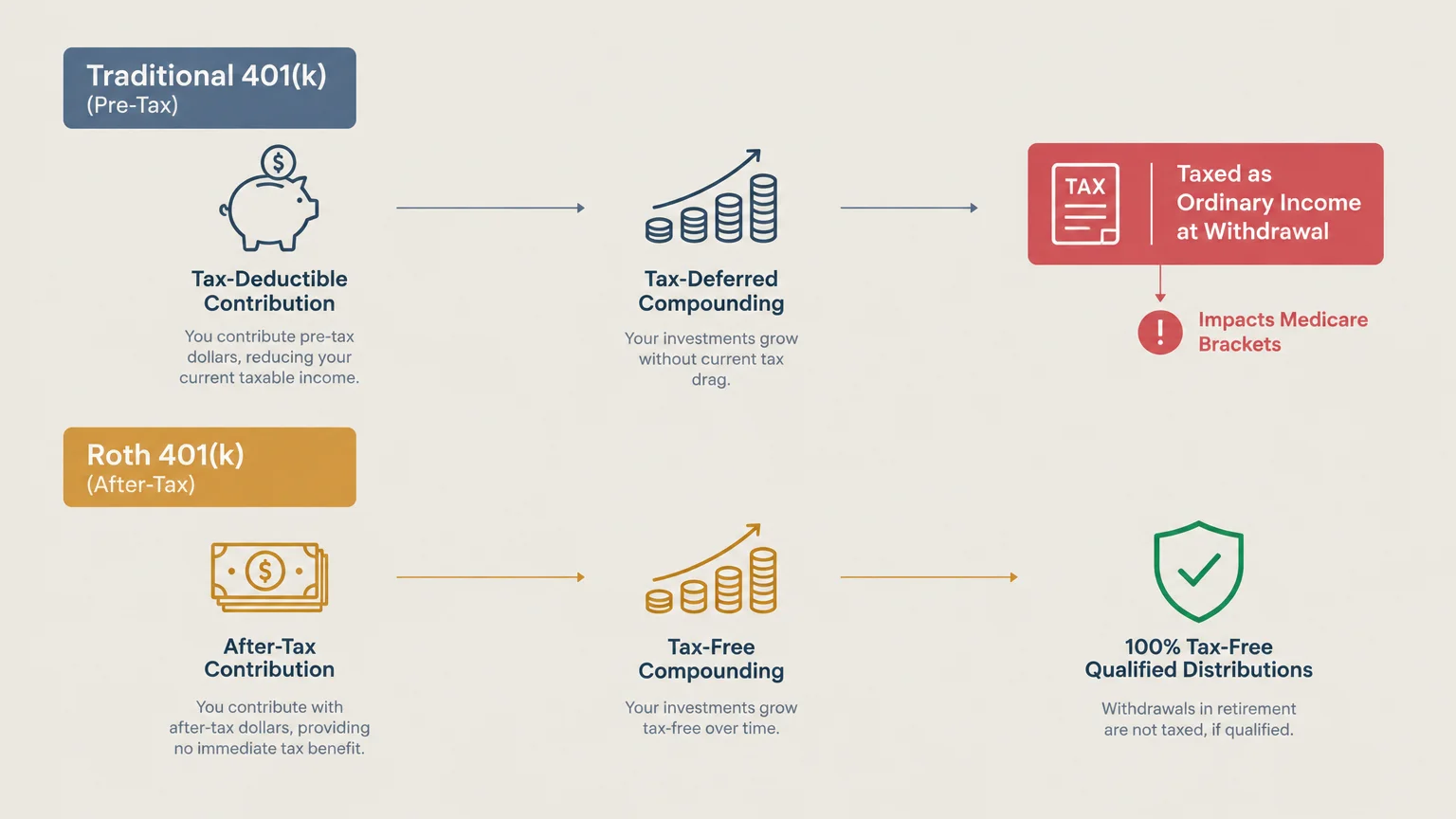
When he began drawing down funds at age 66, he realized that every withdrawal triggered ordinary income tax. His distributions pushed him into a higher federal tax bracket and triggered Medicare premium surcharges.
Arthur now wishes he had split contributions between traditional and Roth accounts. A Roth 401(k) grows tax-free and allows tax-free distributions in retirement.
“A big mistake people make is not taking advantage of a Roth 401(k) when their employer offers it. Paying taxes now gives you complete financial freedom later.” — Suze Orman, Personal Finance Author & Advisor
2. Elena, 64: “I Cashed Out My Small Balances When Changing Employers”
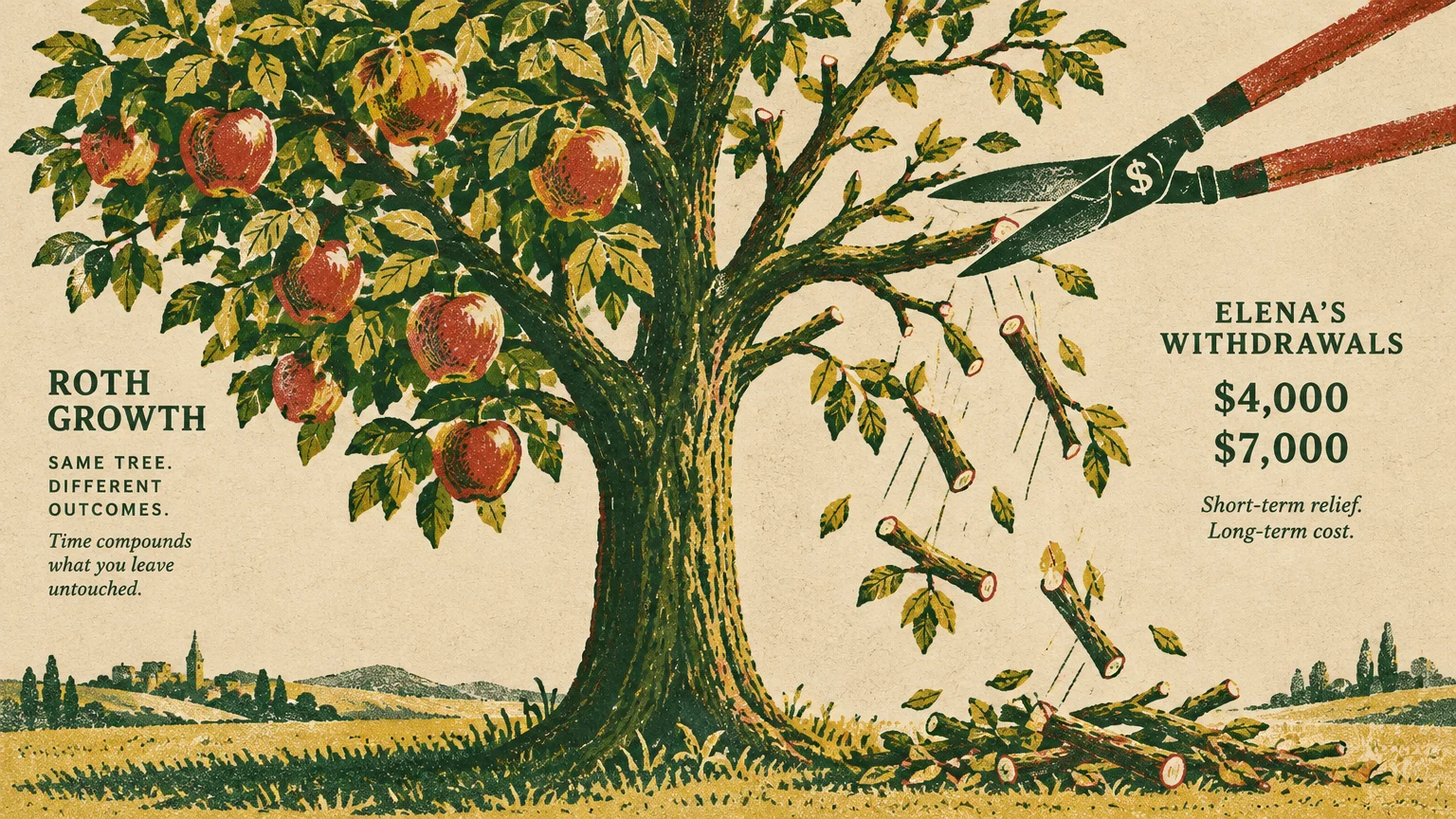
In her twenties and thirties, Elena changed jobs four times. Each time she left a position, she cashed out modest 401(k) accounts worth between $4,000 and $7,000.
She paid mandatory 20% federal tax withholding alongside a 10% early withdrawal penalty on each payout. More importantly, she destroyed three decades of potential compound growth.
Those small balances would have grown into more than $180,000 by her retirement date. She advises younger workers to always roll former accounts into a new plan or an IRA.
3. Marcus, 71: “I Invested Far Too Conservatively in My 30s and 40s”
Marcus witnessed the 2000 dot-com crash early in his career and grew terrified of stock market volatility. To protect his balance, he allocated 60% of his portfolio to stable value funds and government bonds.
While his balance never suffered dramatic drops, it failed to outpace inflation over thirty years. He missed the explosive equity bull runs that create long-term wealth.
Marcus had to work until age 70 to make up for the shortfall. He recommends keeping a strong equity allocation when your retirement horizon spans multiple decades.
4. Brenda, 67: “I Left Free Employer Match Money on the Table”
Brenda’s company offered a dollar-for-dollar match on employee contributions up to 6% of annual salary. For her first eight years, Brenda contributed only 3% because money felt tight.
By failing to contribute the full 6%, she turned down an immediate 100% return on her money. Over eight years, she surrendered tens of thousands of dollars in employer matching funds.
She urges every employee to capture the complete employer match from their very first day on the job. Missing an employer match means giving up guaranteed compensation.
5. David, 65: “I Treated My 401(k) Balance Like an Emergency Fund”
David took two separate loans against his 401(k) to finance home renovations and consolidate credit card debt. While he repaid the principal, his money missed critical years of market appreciation.
He also faced significant repayment stress when his employer unexpectedly restructured his division. Under standard plan terms, unpaid 401(k) loan balances can become taxable distributions subject to penalties.
David recommends building an external, liquid emergency fund in a high-yield savings account. Protecting your retirement account from routine borrowing preserves compound growth.
6. Patricia, 73: “I Got Crushed by the Tax Torpedo and RMDs”
Patricia entered retirement with a large traditional 401(k) balance and minimal outside taxable savings. She waited until the mandatory age to begin taking distributions.
Under the SECURE 2.0 Act, Required Minimum Distributions (RMDs) begin at age 73 for individuals born after 1950. In 2033, the age threshold rises to 75 for workers born in 1960 or later.
Patricia’s mandatory distributions pushed her combined income into the bracket where 85% of her Social Security benefits became taxable. She wishes she had completed strategic partial Roth conversions during her early sixties.
7. Greg, 62: “I Forfeited the Rule of 55 by Rolling Over to an IRA”
Greg stepped away from his corporate employer at age 56 to pursue early retirement. He immediately transferred his entire workplace 401(k) balance into an individual retirement account.
When he needed cash at age 57, he discovered he owed a 10% penalty on early IRA withdrawals. Under IRS rules, IRAs generally require account holders to wait until age 59½ for penalty-free withdrawals.
Had Greg kept his funds inside his employer plan, the IRS Rule of 55 would have protected him. This rule exempts workers who leave an employer at age 55 or older from early withdrawal penalties.
8. Sandra, 69: “I Overconcentrated My Portfolio in Company Stock”
Sandra worked for a prominent telecommunications firm that allowed employees to purchase discounted company stock inside their 401(k). At one point, company stock comprised 45% of her total savings.
A few years before her planned retirement, the company faced regulatory issues, and the stock price tumbled by 60%. Her balance plummeted, forcing her to postpone retirement by four years.
Sandra now tells everyone that company loyalty should not dictate portfolio construction. Most financial advisors recommend limiting single-company stock exposure to no more than 10% of your holdings.
9. Thomas, 66: “I Procrastinated on Catch-Up Contributions”
Thomas always planned to accelerate his savings once his children finished college. However, he delayed utilizing catch-up provisions until he was fifty-eight years old.
For 2026, savers aged 50 and older can contribute an extra $8,000 above the standard $24,500 employee deferral limit. The Internal Revenue Service updates these thresholds periodically to reflect inflation.
Thomas realized that an extra eight years of maxed catch-up contributions would have added substantial security to his portfolio. Starting catch-up contributions precisely at age 50 provides a massive tailwind.
10. Linda, 70: “I Lost Thousands to Expensive Actively Managed Funds”
Linda selected three mutual funds when she enrolled in her 401(k) in the late 1980s and never changed them. Those actively managed funds carried expense ratios exceeding 1.25% annually.
Over thirty years, those management fees consumed hundreds of thousands of dollars in potential earnings. Low-cost broad-market index funds frequently charge less than 0.05% for comparable exposure.
Tools provided by Investor.gov help savers evaluate fund expense ratios and hidden costs. Linda advises checking fund fees annually and switching to low-cost index products whenever available.
11. Robert, 63: “I Missed the New Super Catch-Up Window”
Under Section 109 of the SECURE 2.0 Act, workers aged 60 through 63 receive an enhanced “Super Catch-Up” limit. Starting in 2025, eligible employees can contribute up to $11,250 in catch-up savings.
Robert remained unaware of this rule change during his sixtieth and sixty-first years. He continued contributing at standard catch-up limits, missing the opportunity to shelter extra income.
He also noted that high earners making over $145,000 in FICA wages must direct catch-up contributions to Roth accounts starting in 2026. Keeping up with federal legislative updates protects your ability to save efficiently.
12. Diane, 72: “I Drew Down My Accounts Without Coordinating Social Security”
Diane claimed her Social Security benefits at age 62 while simultaneously withdrawing money from her traditional 401(k). Her combined income triggered unexpected income taxes on her monthly benefit payments.
She later realized that delaying Social Security until age 70 would have grown her guaranteed monthly check by 8% per year. Using her 401(k) to bridge the gap between age 62 and 70 would have increased her lifelong guaranteed income.
Diane regrets treating her workplace savings and government benefits as separate silos. Coordinating distribution timing across all income streams dramatically improves tax efficiency.
13. Carlos, 67: “I Failed to Earmark 401(k) Dollars for Healthcare Surcharges”
Carlos believed Medicare would cover virtually all medical expenses once he turned 65. He was unprepared for Part B and Part D premiums, supplemental policies, dental care, and vision needs.
When he pulled extra funds from his traditional 401(k) to pay medical expenses, his Modified Adjusted Gross Income rose. That increase triggered Medicare’s Income-Related Monthly Adjustment Amount (IRMAA), increasing his monthly premiums.
Carlos wishes he had funded a Health Savings Account (HSA) alongside his 401(k) during his working years. HSAs offer triple-tax advantages for qualifying healthcare expenses throughout retirement.
Comparing 401(k) Contribution & Tax Strategies
Managing retirement savings effectively requires understanding how different account structures handle contributions, growth, and withdrawals. The table below illustrates core differences between traditional, Roth, and taxable vehicles.
| Account Feature | Traditional 401(k) | Roth 401(k) | Taxable Brokerage |
|---|---|---|---|
| Tax Treatment on Contributions | Pre-tax dollars (reduces current taxable income) | After-tax dollars (no immediate tax reduction) | After-tax dollars (no deduction) |
| Growth Phase | Tax-deferred compounding | Tax-free compounding | Taxes owed annually on dividends and realized gains |
| Qualified Withdrawals | Taxed as ordinary income | 100% tax-free distributions | Subject to favorable capital gains tax rates |
| Pre-Death RMD Rules | Required starting at age 73 (age 75 in 2033) | No pre-death RMDs required (eliminated in 2024) | No required minimum distributions at any age |
| 2026 Contribution Limit | $24,500 ($32,500 if age 50+) | $24,500 ($32,500 if age 50+) | No annual contribution limit |
| Early Access Penalty | 10% penalty before age 59½ (Rule of 55 exception) | Earnings penalized before age 59½; contributions free | No early withdrawal penalties at any age |

Common Mistakes to Avoid
Avoiding critical errors while building your balance is just as vital as picking strong investments. Below are major 401(k) mistakes identified by seasoned retirees and financial educators.
- Failing to automate annual contribution increases: Raising your savings rate by 1% each year aligns with pay raises and prevents lifestyle inflation.
- Neglecting beneficiary designations: Plan beneficiary forms override instructions written in a will; keep primary and contingent beneficiaries current.
- Ignoring plan administrative fees: Check your annual fee disclosure statement to verify recordkeeping costs and administrative deductions.
- Overreacting during market downturns: Moving assets to cash during market corrections locks in losses and causes you to miss market rebounds.
- Forgetting about old 401(k) accounts: Abandoned accounts often languish in poor default investments or face termination fees.
- Missing RMD deadlines: Failing to take an RMD incurs an IRS penalty of up to 25%, reduced to 10% if corrected promptly.
Reviewing these details each year ensures that administrative details do not undermine decades of dedicated saving. Proactive management preserves wealth for when you need it most.
Professional vs. Self-Guided Management
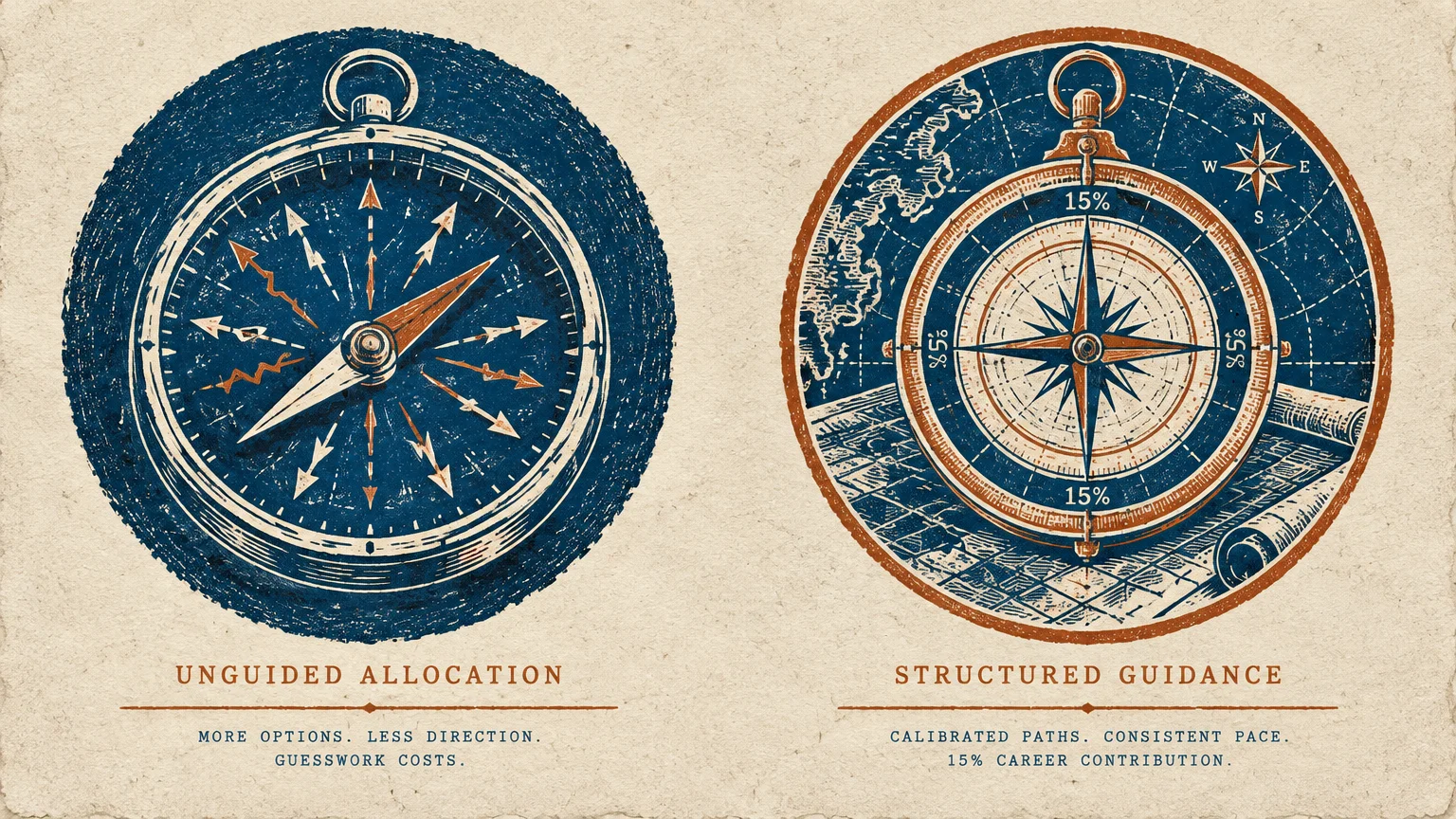
Managing a 401(k) throughout a multi-decade career requires adjusting strategies across different life stages. Some situations favor self-directed investing, while others require professional financial counsel.
Consider the following scenarios to determine which approach fits your personal financial landscape:
Scenario 1: You are early in your career with a straightforward balance. Self-guided management works well here. You can direct money into a broad-market index fund or an age-appropriate target-date fund with low expense ratios.
Scenario 2: You earn a high income and face complex tax considerations. Professional guidance adds substantial value. High earners must navigate SECURE 2.0 catch-up mandates, backdoor Roth conversions, and proactive bracket management.
Scenario 3: You are within five years of your retirement date. Working with a credentialed fiduciary planner is highly recommended. Transitioning from asset accumulation to retirement decumulation requires coordinating Social Security, Medicare, and withdrawal sequencing.
Scenario 4: You own significant company stock inside an employer plan. Professional advice is critical to evaluate Net Unrealized Appreciation (NUA) tax strategies. Mishandling employer shares can result in substantial unnecessary tax obligations.
You can verify professional credentials and find fee-only fiduciaries through the Certified Financial Planner Board. You can also research broker histories via FINRA BrokerCheck.
Frequently Asked Questions
What is the most common 401(k) regret among retirees?
Surveys consistently show that not saving early enough is the number one regret. Delaying retirement savings by even five years substantially reduces the lifetime benefits of compound growth.
How does the Rule of 55 work for 401(k) plans?
If you leave your job during or after the calendar year you turn 55, you can withdraw funds from that employer’s 401(k) without a 10% penalty. This rule does not apply to individual retirement accounts (IRAs).
Can I contribute to both a traditional 401(k) and a Roth 401(k)?
Yes, you can split contributions between both options as long as your total contributions stay within annual IRS deferral limits. For 2026, the combined limit is $24,500, plus catch-up amounts if eligible.
What happens if I miss my Required Minimum Distribution deadline?
Under the SECURE 2.0 Act, missing an RMD results in an excise tax penalty of 25% on the undistributed amount. If you correct the error and withdraw the required funds within two years, the penalty drops to 10%.
Steps to Take Right Now
You do not need to wait until your final working years to optimize your retirement strategy. Review your current deferral rate today, ensure you capture your full employer match, and confirm your asset allocation fits your timeline.
The information in this guide is meant for educational purposes. Your specific circumstances—including income, health needs, tax situation, and goals—may require different approaches. When in doubt, consult a licensed professional.
Last updated: March 2026. Retirement benefits, tax rules, and healthcare regulations change frequently—verify current details with official sources.









Leave a Reply