

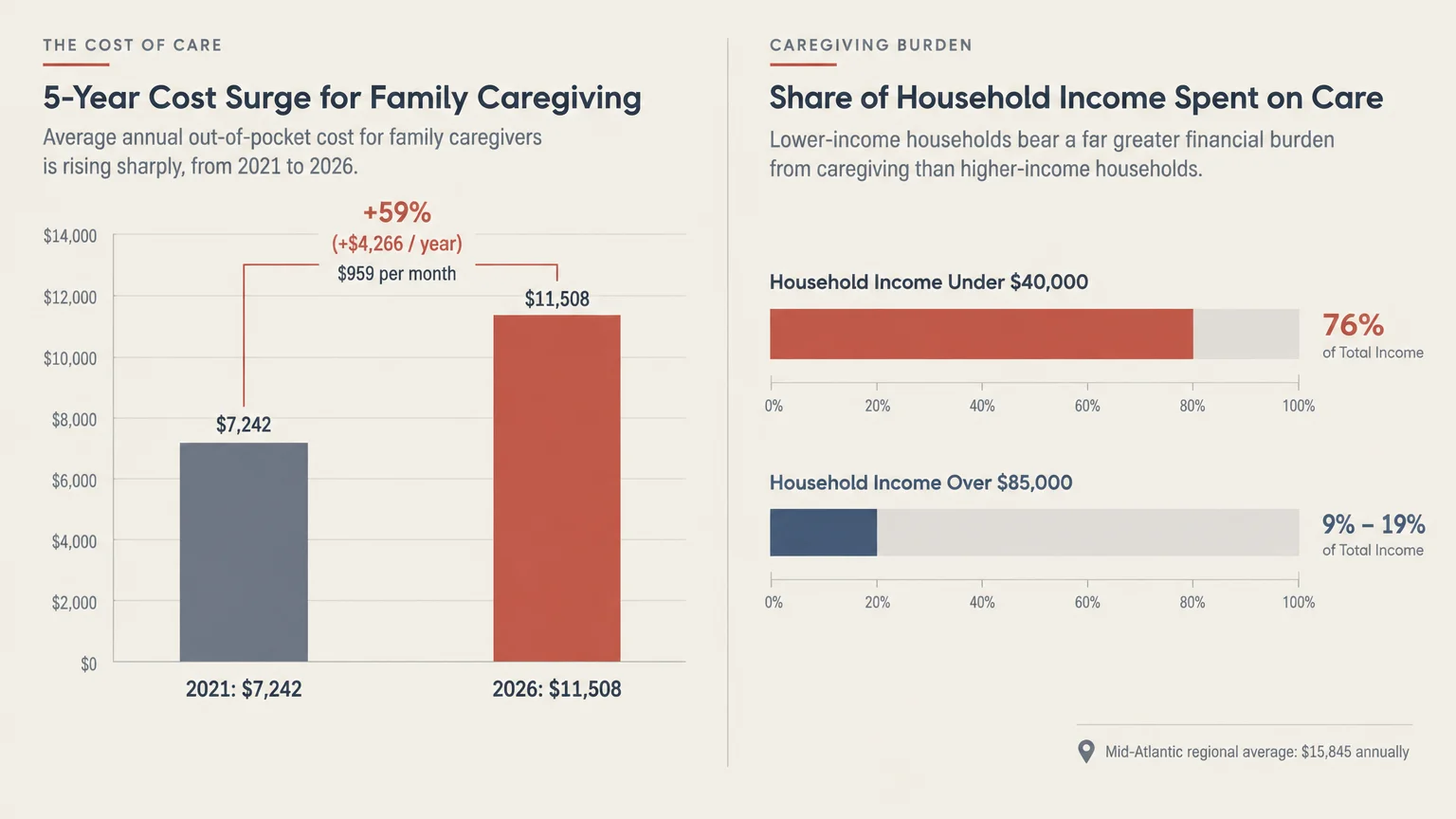
Supporting an aging parent now demands more personal capital than ever before. Family caregivers spend an average of $11,508 every year out of their own pockets to cover basic living and healthcare expenses.
That monthly drain of $959 represents a dramatic 59% jump over recent estimates. Without clear safeguards, these escalating caregiving expenses can quietly derail your own retirement plans.
Understanding where these dollars go helps you regain financial control. Practical planning ensures you support your loved ones without compromising your future solvency.
Inside the Numbers: Why Caregiving Costs Have Surged
The financial pressure on American households caring for aging parents has reached historic highs. Everyday inflation and rising medical costs continue to drive direct family contributions upward.
According to the 2026 AARP Caregiving Out-of-Pocket Costs Study, annual out-of-pocket caregiving costs surged to $11,508 in 2026. That equates to roughly $959 leaving household budgets every single month.
This burden touches almost everyone involved in personal eldercare. Nearly 9 in 10 family caregivers report spending their own money on regular caregiving expenses.
Over a five-year period, this spending surged by 59%—an increase of $4,266 per year compared to 2021, when out-of-pocket costs averaged $7,242. Daily living essentials simply cost significantly more today.
The research, fielded in mid-2026 across 2,538 family caregivers tracking real-time expense diaries, reveals that caregivers now devote an average of 31% of their annual household income to caregiving expenses.
Lower-income households endure the heaviest burden. Caregivers with household incomes under $40,000 spend an astonishing 76% of their total income on family care.
By comparison, caregivers earning more than $85,000 allocate between 9% and 19% of their annual earnings to elder assistance. Lower-income families face severe tradeoffs between groceries, utility bills, and parental medicine.
Geography also dictates your out-of-pocket exposure. Caregivers in the Mid-Atlantic region spend an average of $15,845 annually—27% above the national norm.
The Expense Breakdown: Where Caregiver Dollars Actually Go
Caregiving expenses rarely arrive as a single, neat monthly bill. Instead, small incidental purchases accumulate alongside large recurring obligations to drain liquid savings.
Housing needs and medical services consume the vast majority of personal spending. Together, these two categories account for 71% of all annual out-of-pocket caregiving costs.
Household and housing costs represent the single largest expense category. Caregivers spend an average of $4,797 per year on these needs, making up 42% of total out-of-pocket outlays.
Within household spending, food and nutrition account for 27% of outlays. Groceries, specialized meal deliveries, and dietary supplements add up quickly each week.
Direct housing payments make up another 25% of household spending. Many caregivers assist with rent, mortgage payments, or local property taxes to keep parents safely housed.
Home modifications also swallow personal cash reserves. Installing exterior wheelchair ramps, walk-in bathtubs, and safety grab bars protects parents from catastrophic falls.
Medical spending forms the second largest category, taking 29% of caregiver outlays. Family caregivers spend an average of $3,313 each year on clinical requirements.
Within healthcare outlays, direct copayments, coinsurance, provider bills, and insurance premiums claim 37% of the total. Even strong supplemental insurance rarely covers every outpatient consultation.
Nursing home and residential facility copays consume 19% of medical expenses. Prescription medications require 11%, while medical equipment, assistive supplies, and over-the-counter remedies take another 11%.
The remaining 29% of annual caregiver spending covers transportation, gas, paid legal consultations, adult day services, and personal care products.
| Spending Category | Average Annual Cost | Share of Out-of-Pocket Total | Top Expense Drivers |
|---|---|---|---|
| Household & Housing | $4,797 | 42% | Groceries, rent or mortgage, utility assistance, and home repairs |
| Direct Medical Care | $3,313 | 29% | Copayments, insurance premiums, prescriptions, and medical supplies |
| Transportation & Travel | $1,265 | 11% | Fuel, medical transit, vehicle maintenance, and parking fees |
| Personal Care & Daily Living | $1,151 | 10% | Clothing, hygiene supplies, incontinence products, and meal delivery |
| Legal, Financial & Respite | $982 | 8% | Power of attorney filings, adult day care, and emergency respite sitting |

The Dementia Multiplier: Calculating High-Need Care
Cognitive decline dramatically alters family financial calculations. Providing care for a parent with Alzheimer’s disease or other forms of dementia introduces substantial supervisory costs.
The data highlights a massive spending disparity. Caregivers supporting an individual with dementia spend an average of $15,846 annually—over 55% more than the $10,221 spent by those assisting parents without cognitive decline.
Supervision demands create immediate financial strain. Parents experiencing memory loss cannot remain home alone safely, forcing families to hire daytime companions or install specialized monitoring systems.
Home safety adaptations for memory care extend beyond physical ramps. Families purchase door sensors, GPS tracking wearables, and anti-wandering locks to prevent hazardous wandering incidents.
Incontinence care, specialized meal supplements, and durable medical supplies also compound monthly costs. These recurring consumer goods rarely receive insurance reimbursement.
General healthcare inflation intensifies these daily pressures. Recent federal data reveals home care services climbed 7.9% and nursing home rates rose 4.6% in a single year.
Since 2021, home care inflation has accelerated by a cumulative 39%. That outpaces the 27% increase seen across broader consumer services, making private professional assistance harder to afford.
The Hidden Career and Retirement Drain
The true cost of family caregiving extends far beyond current out-of-pocket receipts. The long-term damage inflicted on personal career progression and retirement savings often proves far more devastating.
Family caregivers across the country provide roughly 49.5 billion hours of unpaid support each year. This care holds an estimated economic value of $1.01 trillion, or approximately $20.41 per hour.
Providing that uncompensated labor requires heavy personal sacrifices. Working caregivers in their early-to-mid 40s who cut work hours or exit the workforce forfeit an estimated $120,500 across their lifetimes in lost wages and retirement assets.
Across the United States, working caregivers shoulder $2.3 trillion in aggregate lifetime economic losses. That total encompasses $2 trillion in lost wages, $150 billion in lost future Social Security credits, and $140 billion in forfeited workplace retirement balances.
Maintaining a conventional work schedule while managing caregiving duties remains exceptionally difficult. Only 3.4% of working caregivers report losing no work hours to their family caregiving responsibilities.
The 2026 Retirement Confidence Survey found that 19% of caregiving employees reduced their personal retirement plan contributions to cover eldercare expenses. Slicing 401(k) allocations forfeits vital compound growth and valuable employer matching funds.
This compounding pressure exacts an acute psychological toll. Workplace research shows the share of caregiving employees experiencing high or overwhelming financial stress reached 42.8% in 2026, up from 32.8% two years earlier.
“You cannot put yourself in financial jeopardy to help your parents, because if you run out of money, who will take care of you?” — Suze Orman, Personal Finance Expert and Author
Leaving the workforce prematurely carries permanent consequences. Every year out of the labor market lowers your ultimate Social Security benefit calculation, which relies on your 35 highest-earning years.
You also forfeit workplace disability insurance, group life coverage, and employer-subsidized health benefits. Sacrificing your own financial stability to assist aging parents often creates a cycle where your children must eventually support you.
Professional vs. Self-Guided: Choosing the Right Care Path
Navigating family care requires balancing your personal bandwidth against the financial cost of third-party services. Deciding whether to hire specialized professionals or handle tasks independently shapes your monthly expenses.
Reviewing concrete caregiving scenarios clarifies whether you should retain specialized experts or manage responsibilities on your own.
Scenario 1: Daily Personal Hygiene and Mobility Support
Professional Care Path: You hire a licensed home health aide through a home care agency for three hours every morning to handle bathing, dressing, and transfers.
This route costs $30 to $40 per hour, generating an expense of roughly $2,500 monthly. However, it preserves your physical health, prevents caregiver injuries, and allows you to maintain full-time employment.
Self-Guided Care Path: You perform transfers, showering, and daily dressing duties yourself before leaving for work or during remote work breaks.
This strategy eliminates agency fees and saves thousands of dollars annually. It demands physical endurance, however, and carries an elevated risk of caregiver back injuries or burnout.
Scenario 2: Chronic Disease and Medical Coordination
Professional Care Path: You engage an Aging Life Care Professional, also known as a private geriatric care manager, to manage complex appointments and hospital discharge transitions.
Care managers charge $150 to $250 per hour to coordinate physicians, oversee medication schedules, and advocate during emergencies. This professional oversight helps prevent unnecessary hospital readmissions and reduces administrative chaos.
Self-Guided Care Path: You organize patient records, manage medication pillboxes, and transport parents to clinical visits independently.
Handling medical oversight on your own requires mastering complex clinical terms and insurance formularies. If your parent manages multiple chronic conditions, tracking medication interactions demands extreme vigilance.
Scenario 3: Estate Documentation and Long-Term Care Planning
Professional Care Path: You hire a qualified elder law attorney to draft durable financial powers of attorney, healthcare directives, and irrevocable Medicaid asset protection trusts.
A comprehensive legal estate package generally requires $2,500 to $6,000 upfront. This formal structure protects parental assets, establishes clear fiduciary authority, and safeguards your own funds from accidental liabilities.
Self-Guided Care Path: You download generic legal forms online and notarize statutory financial power-of-attorney templates independently.
While generic forms save upfront cash, they frequently omit essential nursing home planning clauses. Defective documentation can complicate asset transfers and delay necessary Medicaid approvals during medical crises.
Scenario 4: Home Accessibility and Safety Upgrades
Professional Care Path: You contract a Certified Aging-in-Place Specialist (CAPS) to evaluate the home, install curbless showers, widen doorways, and build exterior ramps.
Contractor renovations can cost $5,000 to $20,000 depending on home layout. These modifications provide durable safety upgrades that allow aging parents to remain in their homes longer.
Self-Guided Care Path: You install tension shower grab bars, clear throw rugs, add high-lumen lightbulbs, and rearrange ground-floor furniture on your own.
Simple DIY modifications cost less than $300 and resolve basic tripping hazards immediately. Nevertheless, self-installed equipment may fail under heavy load if not secured properly into wall studs.
Tax Strategies and Public Resources to Offset Expenses
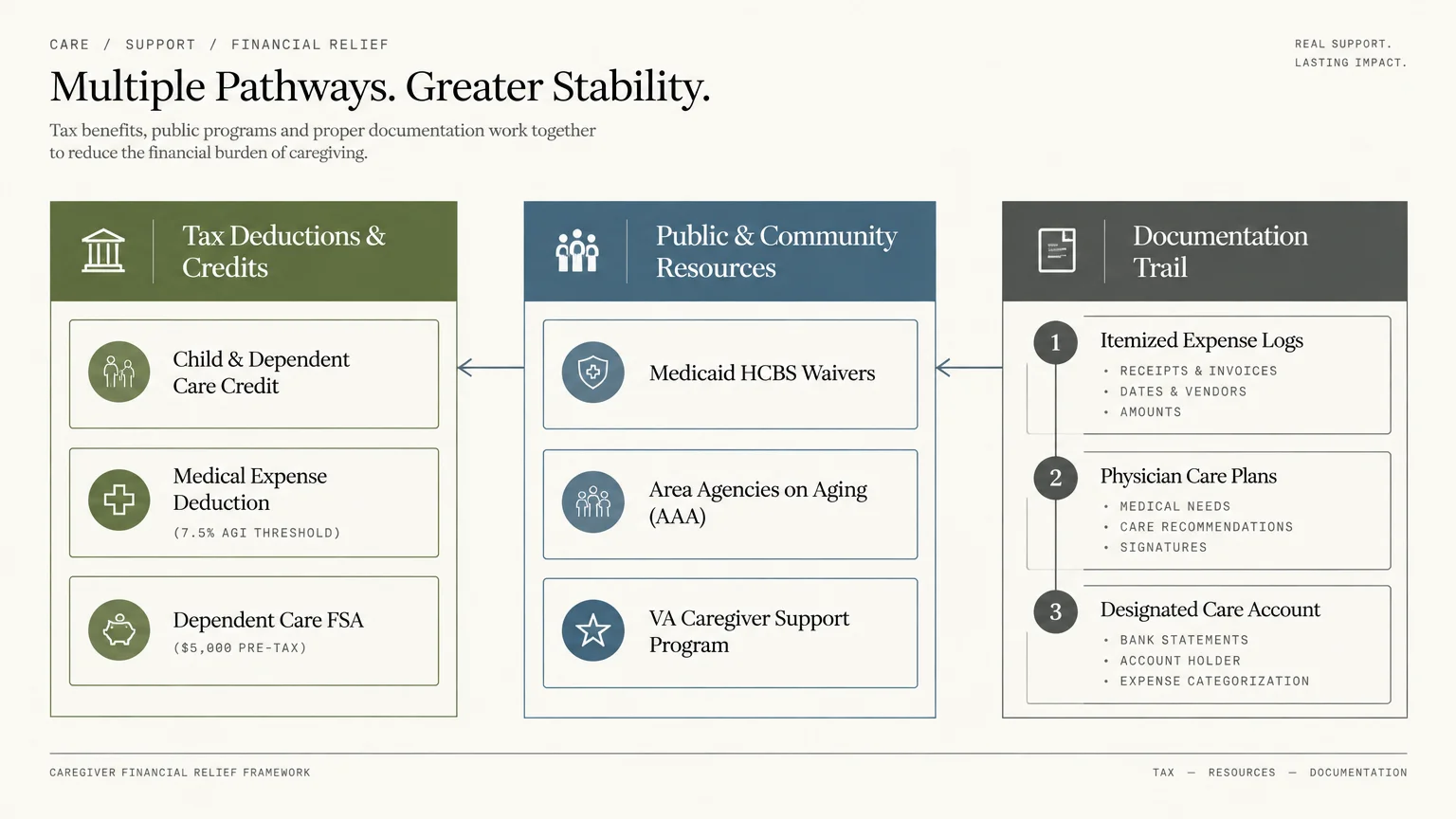
Strategic tax planning provides practical avenues to recover a portion of out-of-pocket eldercare costs. The federal tax code offers several provisions for adult children supporting aging parents.
You can review detailed dependency criteria directly on the official Internal Revenue Service website to determine your eligibility.
You may claim an aging parent as a qualifying relative dependent if you provide more than 50% of their total financial support for the calendar year.
The parent’s gross taxable income must remain below the annual federal threshold, which excludes non-taxable Social Security benefits. Claiming an eligible parent unlocks the $500 Credit for Other Dependents.
You can also deduct qualified medical expenses paid on behalf of a parent, provided you itemize deductions on Schedule A. Total medical expenses across your household must exceed 7.5% of your adjusted gross income.
Deductible expenses include prescription medications, hearing aids, dental care, nursing home custodial fees prescribed by a physician, and medical transportation mileage.
You can even deduct the cost of medically necessary home improvements, such as wheelchair lifts or ground-floor bathroom conversions, minus any increase in property value.
Flexible Spending Accounts offer another path to tax savings. If your employer provides a Dependent Care FSA, you can allocate pre-tax salary toward adult day care services while you work.
Veterans benefits offer vital funding streams that many families miss. The Department of Veterans Affairs provides the Aid and Attendance pension to qualifying wartime veterans and surviving spouses.
This program provides monthly, tax-free cash payments to help cover private in-home caregivers, assisted living facilities, or memory care fees.
Medicaid also provides self-directed care opportunities through Home and Community-Based Services (HCBS) waivers. These programs allow eligible seniors to hire family members as paid in-home care attendants.
Program rules and hourly reimbursement rates vary by state. Contact your local agency through the Administration for Community Living to explore community assistance, respite grants, and home-delivered meal services.
Common Mistakes to Avoid When Managing Care Expenses
Caregiving duties often begin during acute medical emergencies. Rushing into financial decisions without an overarching strategy can cause lasting damage to your finances.
Draining your personal emergency reserves or tapping retirement plans before reviewing your parents’ available resources is a common error. Always exhaust parental savings, pensions, and public benefits before contributing your own funds.
Another frequent misstep involves quitting work or scaling back hours prematurely. Leaving the workforce costs you current wages, employer healthcare benefits, and future Social Security credits.
Many family members provide continuous care without establishing a formal personal care agreement. Casual cash transfers between parents and adult children can complicate long-term care planning.
Medicaid enforces a strict 60-month lookback window on financial gifts and unverified asset transfers. Undocumented caregiver payments may be treated as uncompensated gifts, triggering severe eligibility penalties for nursing home coverage.
Assuming that basic health insurance covers long-term eldercare is another costly mistake. Many families do not realize that standard health coverage excludes custodial assistance until an emergency strikes.
Official guidance on Medicare.gov makes clear that Medicare covers acute hospitalization and short-term rehabilitation, but does not pay for non-skilled daily custodial care.
Finally, avoid keeping other relatives in the dark regarding caregiving expenses. Keeping secret financial ledgers often creates family resentment; maintain open records and ask siblings to share direct expenses.

Practical Action Plan: Safeguarding Your Financial Future
Balancing high-quality care for Mom or Dad with personal solvency requires deliberate systems. Adopting structured habits helps rein in unchecked monthly spending.
- Create a dedicated caregiving checking account: Never commingle personal funds with parental assets. Route parental pensions, Social Security income, and family contributions through a single, dedicated account to simplify expense tracking.
- Draft a formal Personal Care Agreement: Work with an elder law attorney to establish an employment contract between you and your parent. This document justifies market-rate caregiver compensation and protects future Medicaid eligibility.
- Maintain your workplace retirement contributions: Continue funding your 401(k) or IRA, at least up to your employer’s full matching threshold. Preserving your investment timeline protects your future independence.
- Conduct a thorough benefits checkup: Screen your parents for state pharmaceutical assistance programs, utility discount programs, and local nutrition grants to reduce monthly out-of-pocket costs.
- Schedule regular family financial meetings: Convene quarterly reviews with siblings or other beneficiaries. Present itemized spending reports and request equitable cost-sharing contributions for recurring medical and household supplies.
- Secure legal authority early: Ensure your parents execute durable financial powers of attorney and healthcare directives while they retain full legal capacity. Securing emergency guardianship through probate courts after incapacity occurs costs thousands of dollars in avoidable legal fees.
Frequently Asked Questions
Can I get paid by the government for taking care of my elderly parent?
Yes, many state Medicaid programs offer self-directed personal assistance options that permit eligible seniors to hire adult children as paid caregivers.
Veterans also access caregiver support through the VA Program of Comprehensive Assistance for Family Caregivers. Check with your state Medicaid office or local Area Agency on Aging for program requirements.
Can I claim my parent as a dependent on my federal taxes?
You can claim an aging parent as a qualifying relative dependent if you provide over half of their financial support and their taxable income falls below the federal threshold.
Qualifying provides access to the $500 Credit for Other Dependents. You may also deduct qualifying medical expenses paid on their behalf if you itemize deductions.
Does Medicare pay for in-home caregivers or assisted living?
Medicare covers short-term, skilled medical care prescribed by a physician, such as physical therapy or intermittent home nursing. It does not cover non-skilled custodial care, personal hygiene support, or assisted living fees.
How can our family split caregiving expenses fairly?
Establish a transparent care ledger using financial tracking software or a shared spreadsheet. Log every receipt, utility payment, and prescription copayment clearly.
Siblings who cannot contribute physical caregiving hours can deposit matching monthly funds into a dedicated joint account to equalize the burden.
Moving Forward with Financial Balance
Caring for aging parents is a meaningful act of devotion, but it should not require sacrificing your own financial solvency. Unchecked caregiving expenses can quietly undermine decades of diligent retirement saving.
Track every dollar, take advantage of statutory tax credits, and tap into local community support programs. Establishing healthy financial boundaries protects your parent’s comfort without placing your own retirement at risk.
This article provides general retirement education and information only. Every retiree’s situation is unique—what works for others may not work for you. For personalized advice, consider consulting a qualified financial professional such as a CFP or CPA.
Last updated: November 2026. Retirement benefits, tax rules, and healthcare regulations change frequently—verify current details with official sources.