Millions of retired Americans qualify for monthly grocery assistance yet never claim a dime. Roughly three out of five eligible older adults leave federal food aid unused every year.
Many retirees skip applying because they assume a modest Social Security check disqualifies them or only yields pocket change. In reality, enrolled households with an older member received an average of $188 per month in recent federal data.
Learning how SNAP for seniors calculates medical expenses, housing costs, and new federal age rules can put real money back into your monthly budget.
The Essentials: Food Assistance for Retirees at a Glance
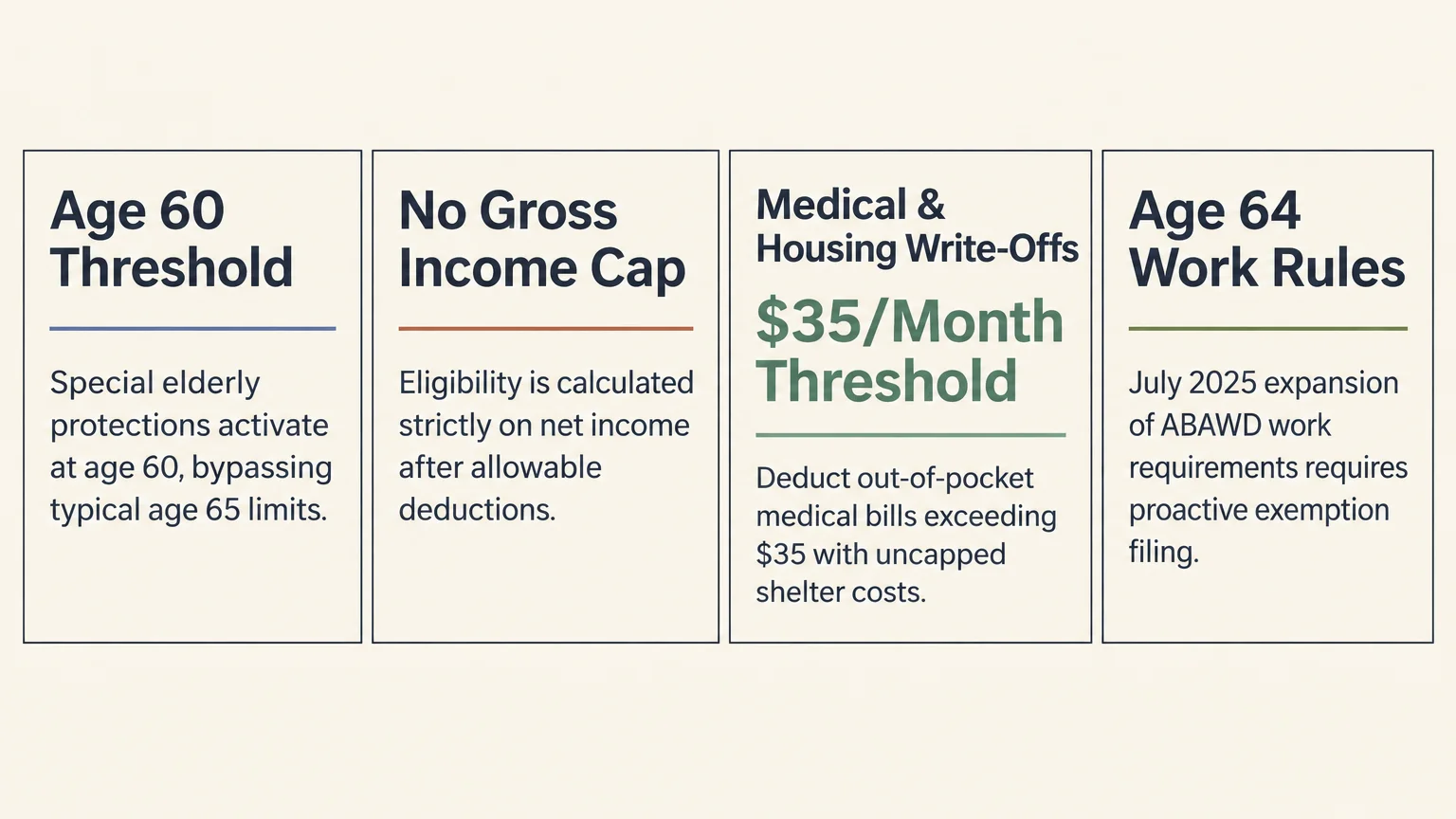
Federal nutrition rules treat older households much more generously than younger applicants. Four core realities shape your odds of qualifying today:
- Age 60 starts the clock: Under rules from the USDA Food and Nutrition Administration (FNA), special elderly protections begin at age 60, not 65.
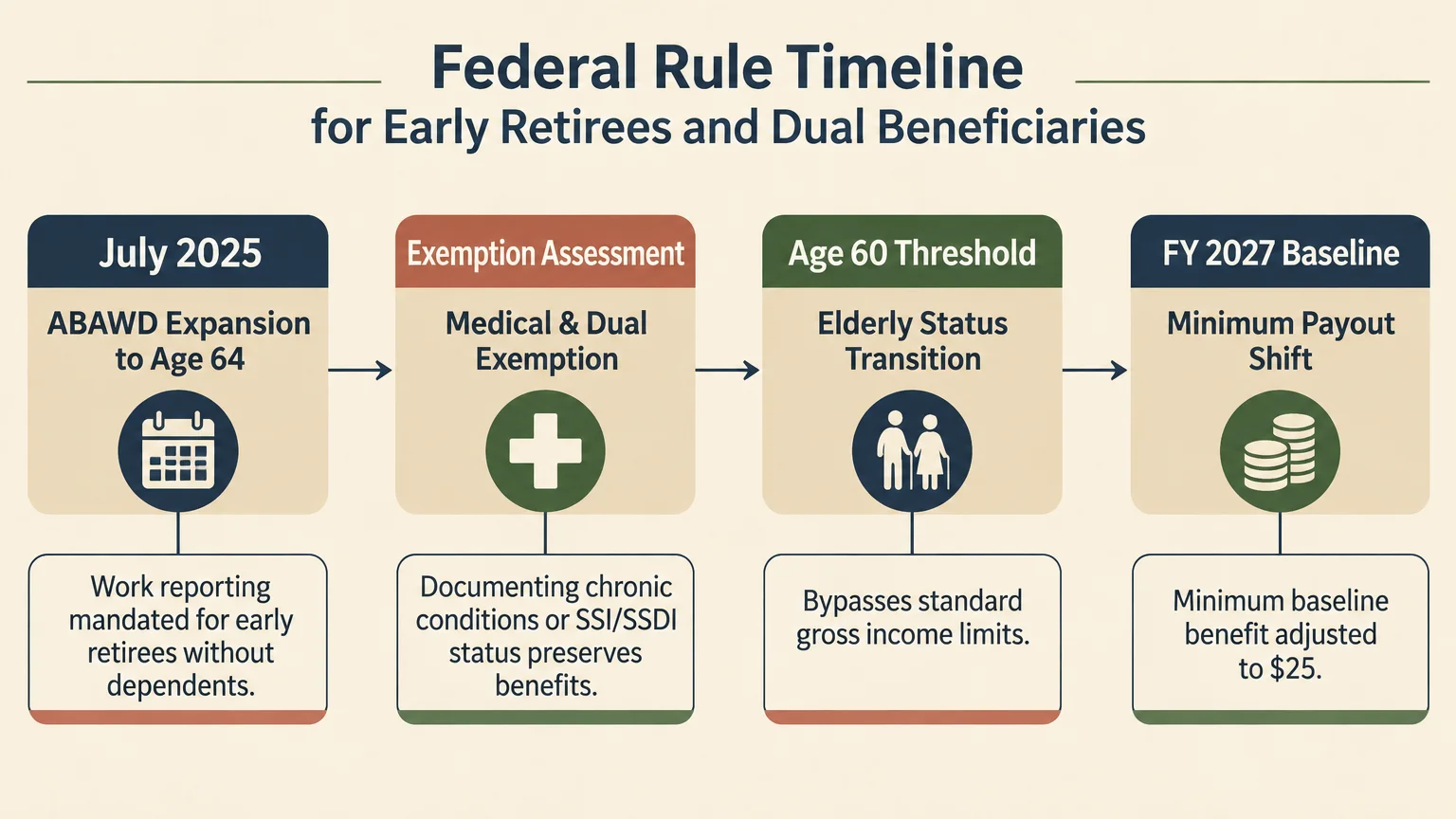
- No federal gross income ceiling: Households with a member age 60 or older bypass the federal gross income cap and qualify based on net income after deductions.
- Medical and housing write-offs add up: You can deduct out-of-pocket medical bills over $35 per month and shelter costs without the standard cap applied to younger households.
- New age 64 work rules apply: Federal legislation enacted in July 2025 expanded Able-Bodied Adults Without Dependents (ABAWD) work requirements up to age 64, making exemptions critical for early retirees.
The Participation Gap Behind Unused SNAP Benefits for Older Adults
Older Americans lag far behind younger families when it comes to claiming grocery support. According to the USDA Food and Nutrition Service (FNS), only 55% of eligible adults age 60 and older participated in SNAP in fiscal year (FY) 2022.
That figure trails the 88% participation rate seen across all eligible individuals nationwide. According to the National Council on Aging (NCOA), roughly 5 million older adults who qualify for food aid are missing out.
The cost of leaving those dollars unclaimed shows up in household pantries across the country. NCOA reports that nearly 8 million older Americans experienced food insecurity in 2024.
When retirees do enroll, the financial cushion reaches well beyond the grocery checkout lane. Data from the AARP Public Policy Institute shows SNAP supports more than 11 million adults age 50 and older and lifted nearly 2 million older households out of poverty in 2022.
Household living arrangements also drive a steep divide in enrollment rates. USDA FNS participation data for FY 2022 shows 71% of eligible older adults living alone used SNAP, compared with just 32% of eligible seniors living with others.
Many retirees who share a roof with adult children or roommates mistakenly assume everyone’s income counts against them. In practice, SNAP generally evaluates people who buy and prepare food together, not everyone who shares an address.
Why Eligible Retirees Skip Applying for Food Assistance
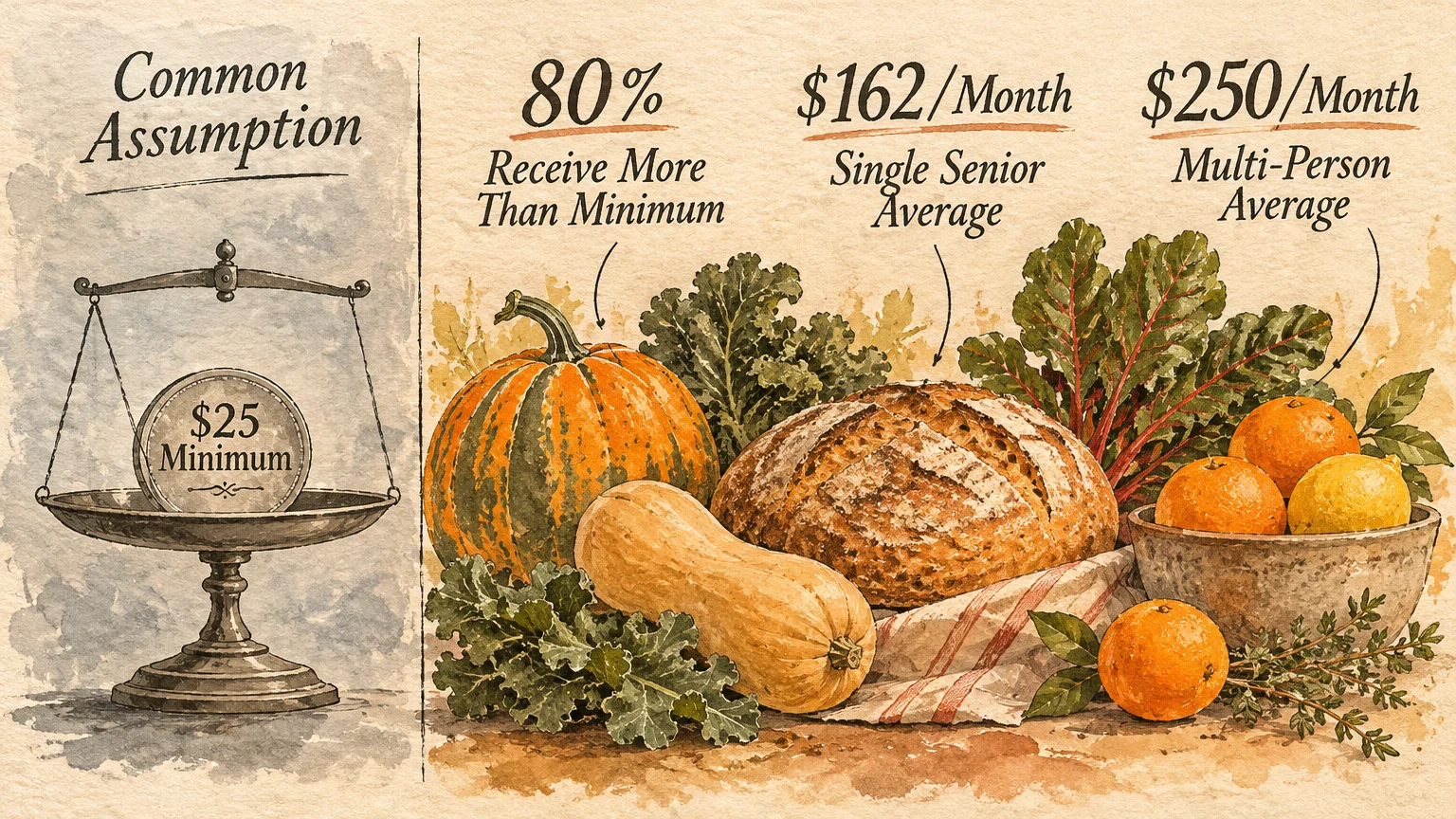
Confusion about benefit amounts keeps thousands of households on the sidelines every month. A widespread belief suggests older applicants only qualify for the minimum payout of $25 per month in FY 2027, up from $23 previously.
Federal data tells a very different story about what you can actually receive. NCOA notes that 80% of SNAP participants age 60 and older receive more than the minimum monthly benefit.
USDA FNS figures from FY 2023 illustrate how much grocery support enrolled households actually collect each month:
- Older adults living alone: $162 per month on average.
- Multi-person older-only households: $250 per month on average.
- Households with both older and younger members: $388 per month on average.
- All households with a member age 60 or older: $188 per month on average.
Another major barrier stems from assuming that Social Security benefits automatically push you over the income line. In FY 2023, 88% of SNAP households with an elderly member received Social Security (72%), Supplemental Security Income (35%), or both (19%), per USDA FNS.
Savings and home equity fears also stop qualified retirees before they fill out an application. In most states, retirement accounts and primary homes do not prevent food stamps eligibility, and many states waive asset tests altogether.
Pride and paperwork fatigue play an equally powerful role for people who spent decades working and paying taxes. You funded federal safety-net programs throughout your career, and using food assistance when medical or housing costs squeeze your fixed income is simply claiming a benefit you helped build.
Treat grocery assistance like any other retirement tax deduction or healthcare benefit; leaving money unclaimed only stretches your savings thinner than necessary.
FY 2027 Food Stamps Eligibility Limits and Benefit Amounts
To determine whether your household qualifies, agencies start with federal cost-of-living figures updated each October. For FY 2027—running from October 1, 2026, through September 30, 2027—the USDA FNA updated income limits, deductions, and maximum allotments.
The figures below apply to the 48 contiguous states and Washington, D.C. Residents of Alaska, Hawaii, Guam, and the U.S. Virgin Islands qualify under higher regional limits.
| Household Size | Net Monthly Income Limit (100% FPL) | Federal Gross Baseline (130% FPL) | Standard Monthly Deduction | Maximum Monthly Benefit |
|---|---|---|---|---|
| 1 person | $1,330 | $1,729 | $217 | $306 |
| 2 people | $1,804 | $2,345 | $217 | $562 |
| 3 people | $2,277 | $2,960 | $217 | $808 |
| 4 people | $2,750 | $3,575 | $229 | $1,023 |
For households larger than four people, allotments increase by $225 per additional member up to 17 people, with a cap of $3,887 for 18 or more. The standard deduction rises to $268 for five-person households and $308 for six or more.
Here is why that federal gross income column matters less than you might think. Because federal rules exempt households with an adult age 60 or older—or turning 60 by the end of the application month—from the gross income test, your total pre-deduction check does not block you.
Instead, your state agency subtracts allowable deductions from your income to find your net monthly income. As long as your net income falls at or below 100% of the Federal Poverty Level, you meet the federal income requirement.
Your exact monthly allotment equals the maximum benefit for your household size minus 30% of your net monthly income. Eligible one- and two-person households are guaranteed at least the $25 minimum monthly benefit.
If your state enforces an asset test, older and disabled households enjoy a higher federal limit of $4,750 in countable resources, compared with $3,000 for younger households. Many states also use Broad-Based Categorical Eligibility (BBCE) to waive asset limits or raise gross income thresholds up to 200% of poverty.
Pay close attention to state policy updates over the coming months, however. In November 2026, USDA issued a proposed rule to restrict BBCE strictly to households receiving Temporary Assistance for Needy Families (TANF), which could tighten income and asset screening in participating states if finalized.
Deductions That Unlock Higher SNAP Benefits for Older Adults
Deductions are where food assistance retirees often discover they qualify for far more help than online calculators initially suggest. The most powerful—and most overlooked—tool in the program is the excess medical expense deduction.
NCOA reports that only about 16% of older adults enrolled in SNAP claim this medical write-off. That means more than four out of five senior participants may be receiving smaller monthly allotments than federal law allows.
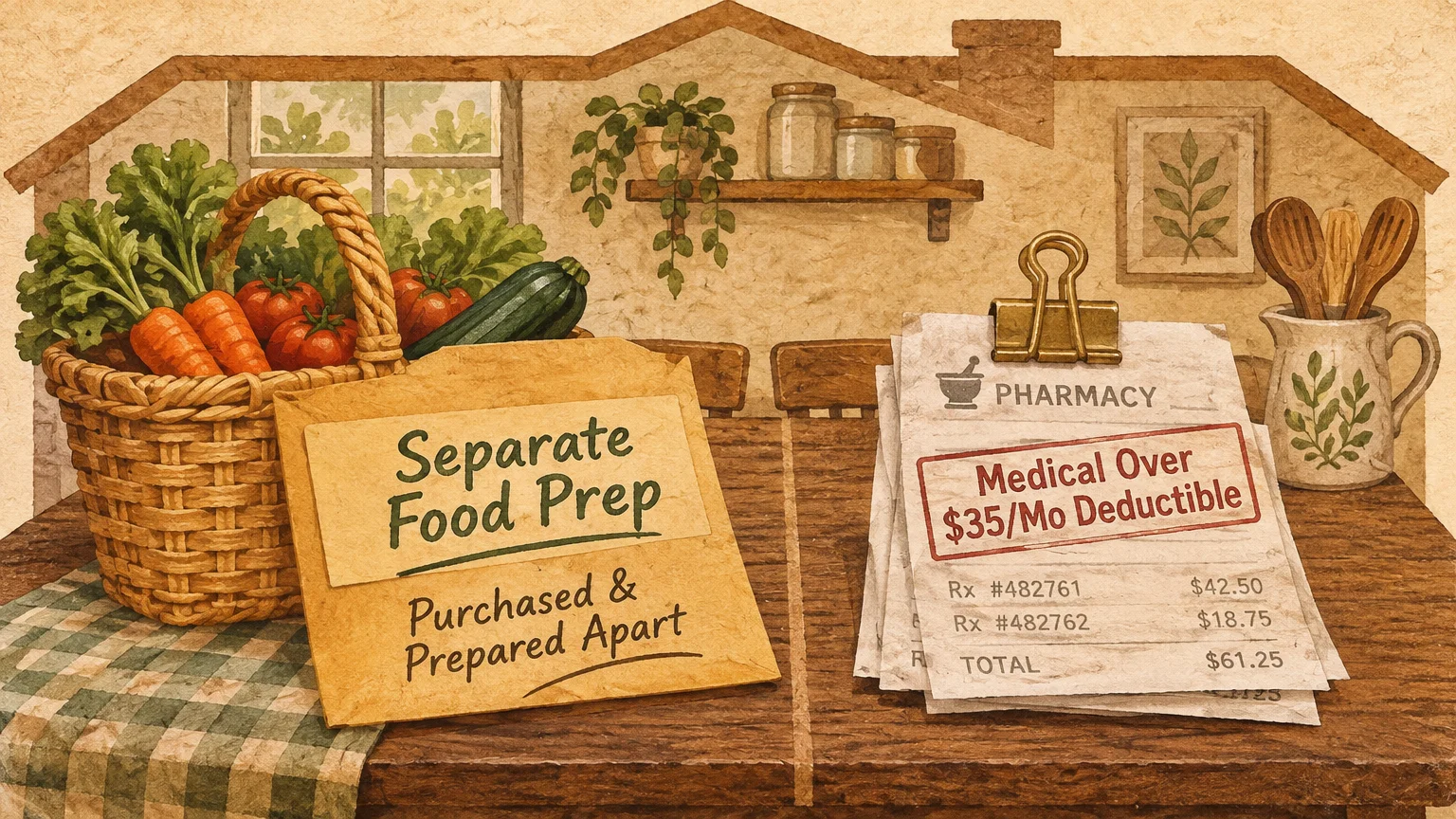
Under USDA FNA rules, households with a member age 60 or older or with a disability can deduct unreimbursed out-of-pocket medical costs exceeding $35 per month, with no upper dollar cap. Eligible expenses cover a surprisingly wide list:
- Insurance premiums: Medicare Part B premiums, supplemental Medigap plans, Part D drug coverage, and dental or vision policies.
- Medications and supplies: Prescription copays, doctor-approved over-the-counter medicines, incontinence products, and durable medical equipment.
- Clinical care: Out-of-pocket doctor visits, hospital bills, dental procedures, eyeglasses, and hearing aids.
- Support costs: Mileage or transit fares to medical appointments and expenses for a certified service animal.
To make claiming this benefit easier, many states operate a Standard Medical Deduction (SMD) under federal waivers. Once you verify at least $35.01 in monthly medical costs, your state grants a flat deduction automatically unless your documented bills run even higher.
For FY 2027, examples of flat SMD amounts include $150 in California, $160 in Arizona, and $161 in Louisiana. Asking your caseworker whether your state uses an SMD can save hours of receipt sorting.
Housing bills offer a second uncapped advantage for snap benefits older adults rely on. Younger households face a $769 monthly cap on the excess shelter deduction, whereas elderly and disabled households have no ceiling at all.
If your rent, mortgage, property taxes, homeowners insurance, and utilities exceed half of your net income after other deductions, you can deduct the entire remaining excess. Federal law enacted in 2025 also preserved your ability to claim a Standard Utility Allowance through nominal Low Income Home Energy Assistance Program (LIHEAP) aid if someone in your home is 60 or older or disabled.
New 2025–2027 Rules Affecting Early Retirees and Dual Beneficiaries
Recent federal policy changes have reshaped food assistance for people in their late fifties and early sixties. The One Big Beautiful Bill Act (H.R. 1), signed on July 4, 2025, raised the age cap for ABAWD work rules from 54 to 64.
Effective nationwide by October 1, 2026, non-exempt adults ages 18 through 64 must work, volunteer, or participate in approved training for at least 80 hours per month—or 20 hours weekly. Failing to meet that rule limits SNAP benefits to three months within any three-year period.
That shift creates a confusing gray zone for retirees between ages 60 and 64. Under USDA guidance, adults ages 60 to 64 remain exempt from general SNAP work registration rules, yet they are newly subject to the 80-hour ABAWD time limit unless they qualify for an exemption.
You can still bypass the 80-hour mandate if you document a physical or mental inability to work, receive disability benefits, or care for an incapacitated adult or a dependent child under age 14. Note that H.R. 1 eliminated automatic ABAWD exemptions for veterans, unhoused individuals, and former foster youth up to age 24.
Early indicators show these policy shifts are already shrinking program rolls nationwide. Between July 2025 and July 2026, total SNAP enrollment fell by 5.5 million people—a 13% drop to 36.1 million participants, the lowest level since 2009, according to Econofact.
The Congressional Budget Office projected H.R. 1 would reduce federal SNAP spending by $186 billion through 2034, while the Center on Budget and Policy Priorities estimated more than 1 million adults ages 55 to 64 could lose food aid. Beginning in FY 2027, states must also cover 75% of administrative costs—up from 50%—with benefit cost-sharing of up to 15% tied to error rates starting in FY 2028.
Older beneficiaries also need to watch how annual retirement raises affect their food allotments. In January 2027, Social Security and SSI benefits increase by 3.6%, lifting the average retired worker check from $2,095 to $2,170 per month according to the Social Security Administration (SSA).
Because SNAP treats Social Security as unearned income, that January raise can automatically trim your monthly grocery benefit. Submitting updated medical receipts and higher utility or property tax bills right after January helps offset that reduction.
How to Apply for SNAP Without the Paperwork Headache
You do not apply through Washington directly; instead, you apply for snap through your state or local human services agency. You can locate your state’s official portal and phone number through USA.gov Benefits.
Submitting your initial application starts the clock immediately, because approved benefits are paid retroactively back to your submission date. Follow these five steps to keep the process moving smoothly:
- Check for a streamlined senior application: Ask if your state participates in the Elderly Simplified Application Project (ESAP). Operating in 22 states plus D.C. as of FY 2024, ESAP serves households where all adults are 60 or older or disabled with no earned income, offering 36-month certification periods and waiving recertification interviews.
- Gather income and bank statements: Pull your latest Social Security award letter, pension stubs, and recent bank balances if your state checks resources.
- List every out-of-pocket medical cost: Collect pharmacy printouts, Medicare Part B deductions, and medical transit logs exceeding $35 per month.
- Include all housing bills: Bring your lease, mortgage statement, property tax bill, homeowners insurance policy, and heating or electric statements.
- Name an authorized representative if needed: If mobility, hearing, or paperwork challenges get in the way, you can authorize a trusted family member or caregiver in writing to apply and complete the phone interview for you.
Once approved, your monthly funds arrive on an Electronic Benefit Transfer (EBT) card that works just like a debit card at grocery stores, farmers markets, and participating online retailers. Keep in mind that federal rules bar using EBT for hot prepared foods—such as rotisserie chicken—as well as alcohol, tobacco, vitamins, supplements, and paper or cleaning supplies.
Avoiding Common Errors
Even small mistakes on an application or renewal form can cut your monthly grocery allotment in half or trigger an unnecessary denial. Watch out for these frequent missteps:
- Skipping the medical deduction at renewal: Many retirees report Medicare premiums once and forget to update new prescription copays, dental bills, or mileage costs during recertification.
- Including roommates who buy their own groceries: If you share a home with an adult child or friend but purchase and cook your meals separately, make that clear so their income does not count against your food stamps eligibility.
- Assuming a 2027 COLA bump ends your eligibility: A 3.6% Social Security raise rarely disqualifies an otherwise eligible household outright, especially when paired with updated shelter and medical deductions.
- Overlooking ABAWD exemptions between ages 60 and 64: Early retirees in this age bracket who cannot work 80 hours a month due to chronic health conditions or caregiving duties must actively document an exemption rather than assuming age 60 shields them.
When DIY Isn’t Enough
Many straightforward applications can be handled online or by phone, yet certain retirement situations call for hands-on guidance from a benefits counselor or local Area Agency on Aging. You can connect with free local aging specialists through the Administration for Community Living (ACL) in four common scenarios:
- Multi-generational households: A counselor can help you document separate food purchasing and preparation when you live with working relatives whose income might otherwise confuse caseworkers.
- Ages 60 to 64 work-rule exemptions: If you are retired early and need a physician statement or caregiving documentation to satisfy the new 80-hour ABAWD rule, local legal aid or aging advocates know exact state form requirements.
- Complex medical bills or irregular withdrawals: When you take sporadic IRA distributions or face steep, fluctuating hospital bills, an advocate can help structure receipts to maximize your excess medical deduction.
- Physical or cognitive barriers: If vision loss, hearing trouble, or memory changes make portals and phone interviews overwhelming, a local counselor can help you formally appoint an authorized representative.
Frequently Asked Questions About SNAP for Seniors
Can I qualify for SNAP if I own my home or have retirement savings?
Yes, your primary home and the land it sits on do not count toward SNAP asset limits. Many states waive asset tests altogether, and states that enforce them allow at least $4,750 in countable resources for households with a member age 60 or older.
Why did my food benefits drop after the January 2027 Social Security COLA?
SNAP counts Social Security and SSI payments as unearned income, so the 3.6% COLA in January 2027 increases your countable monthly income. Submitting higher utility bills, property taxes, or out-of-pocket medical receipts exceeding $35 per month can help restore part of that allotment.
Do I have to work 80 hours a month if I am retired and age 62?
Under H.R. 1, adults ages 60 to 64 must meet the 80-hour monthly ABAWD work or volunteer requirement unless they qualify for an exemption. If you have a disability, a medical condition limiting work, or care for an incapacitated adult or child under 14, submit documentation to claim an exemption.
Can I use my EBT card to buy groceries online or hot meals?
You can use EBT benefits to purchase eligible groceries at participating online retailers, supermarkets, and farmers markets. Federal rules prohibit buying hot prepared foods, alcohol, tobacco, vitamins, supplements, and nonfood household goods with SNAP funds.

Putting Your Grocery Budget Back on Solid Ground
Checking your eligibility takes very little time and could free up well over $150 a month for fresh produce, lean proteins, and pantry staples. Gather your latest Social Security statement, housing bills, and medical receipts this week, then contact your state agency or local aging office to file an application.
This is educational content based on general retirement and financial principles. Individual results vary based on your situation.
Always verify current benefit rules, tax laws, and eligibility requirements with official sources like SSA, Medicare.gov, or the IRS.
Last updated: November 2026. Retirement benefits, tax rules, and healthcare regulations change frequently—verify current details with official sources.