
A single clerical error on your Social Security earnings record can silently shrink your monthly retirement check for life. Government databases track decades of your work history, but administrative mismatches happen far more often than most workers realize.
The Social Security Administration currently holds over $1.2 trillion in uncredited wages due to simple reporting errors. Catching these discrepancies early protects your hard-earned benefits before strict federal correction windows close permanently.
Taking time to inspect your records today ensures every dollar of your lifetime labor counts toward your retirement security.
The Essentials: Why Record Accuracy Matters
Your future monthly benefit depends entirely on your documented earnings history. The government does not double-check your lifetime totals for accuracy; that responsibility rests solely on your shoulders.
Keep these fundamental facts in mind as you review your statements:
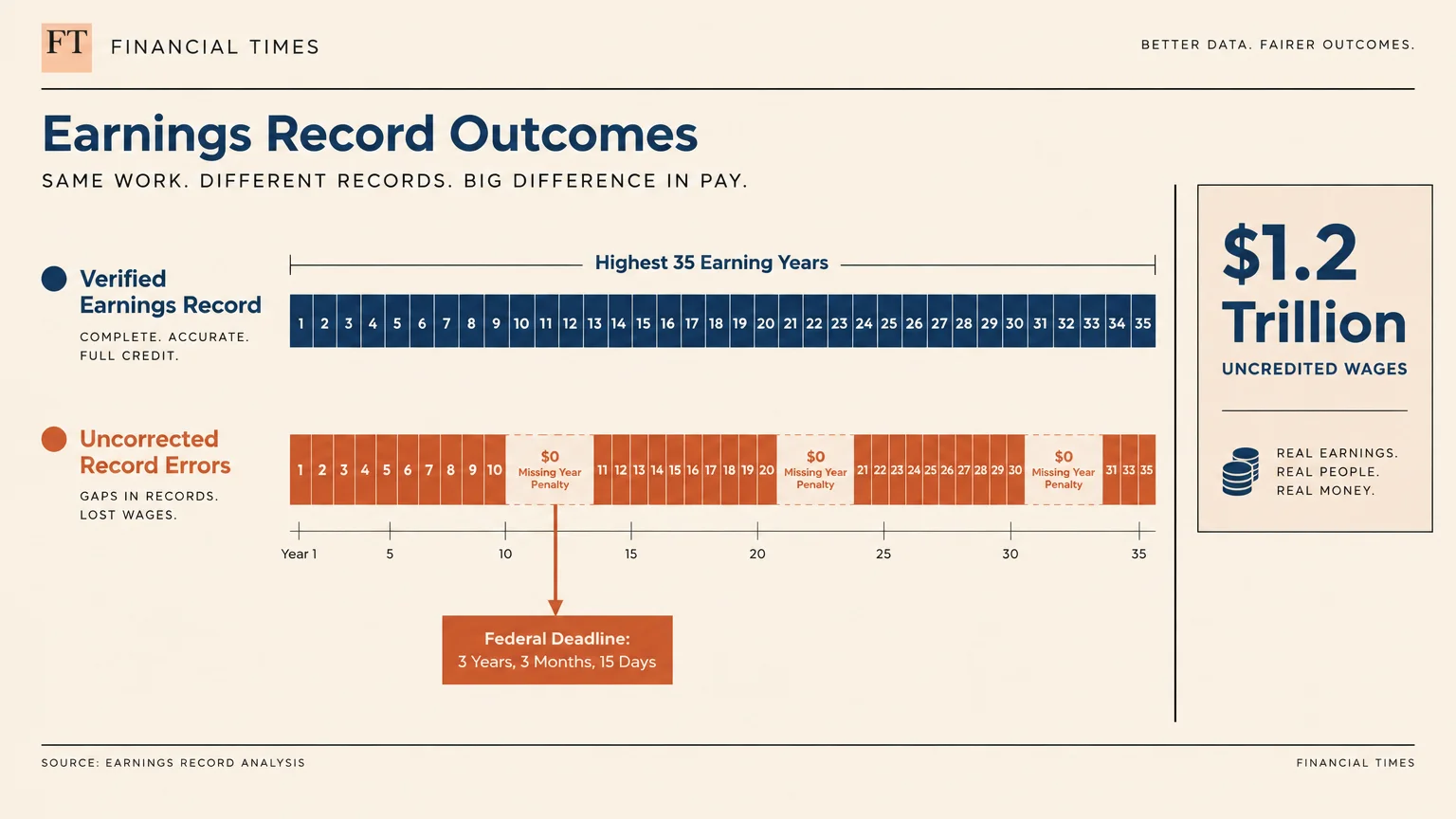
- Calculation Window: Your benefit reflects your highest 35 earning years, adjusted for national wage growth.
- Zero-Dollar Penalties: Missing wage records enter the benefit calculation as zeros, permanently reducing your monthly check.
- Strict Time Limits: Federal law sets a standard deadline of 3 years, 3 months, and 15 days to correct reported earnings.
- The Uncredited Trillion: Typos and name discrepancies send billions of dollars into government holding files every year.
- Proof Burden: You must supply tax records, pay stubs, or W-2 forms to prove your historical earnings.
Reviewing your numbers annually prevents small administrative mistakes from turning into permanent retirement income losses.
How Social Security Calculates Your Monthly Benefit
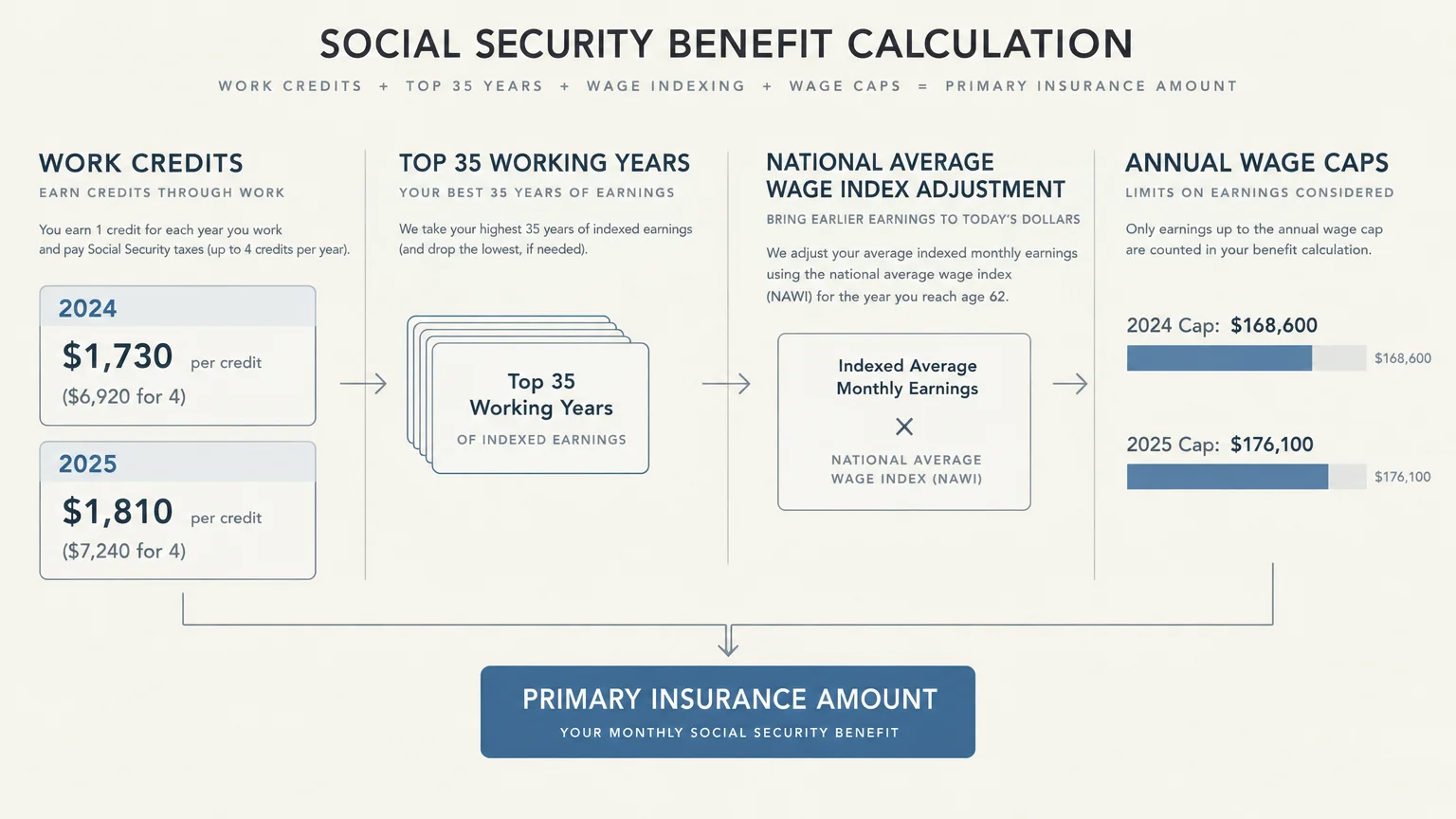
Your monthly retirement benefit relies on a specific mathematical formula created by Congress. The Social Security Administration evaluates your highest 35 years of indexed earnings to determine your baseline payout.
If you worked fewer than 35 years in covered employment, the agency fills each missing year with a zero. Even one accidental zero can significantly reduce your monthly check throughout your entire retirement.
The agency adjusts your historical wages using the National Average Wage Index. This adjustment indexes past earnings to account for wage growth before calculating your Primary Insurance Amount.
To qualify for retirement benefits, you must also accumulate at least 40 work credits over your career. You can earn a maximum of four credits per calendar year.
In 2024, you earned one work credit for every $1,730 in covered wages, requiring $6,920 for the annual maximum. In 2025, that threshold rose to $1,810 per credit, or $7,240 for the full four credits.
Annual earnings face a legal wage cap for Social Security taxation. Earnings above that threshold do not incur Social Security payroll taxes and will not appear on your statement.
The maximum taxable wage base reached $168,600 in 2024 and expanded to $176,100 in 2025. Any income you earned above those annual caps will not count toward your benefit calculation.

7 Costly Social Security Record Errors
Administrative mistakes can slip into federal databases at multiple points during your working life. Identifying these specific errors early makes correcting your employment record straightforward.
1. Missing Earnings from Part-Time or Secondary Jobs
Second jobs, summer employment, and consulting roles often fail to register on your official record. Payroll departments occasionally misclassify workers or fail to transmit supplemental tax files properly.
If you worked multiple jobs in a single year, confirm that your statement reflects combined wages from all employers. A missing second job can leave thousands of dollars out of your lifetime calculation.
2. Clerical Typos in Your Social Security Number
A single inverted digit on an onboarding form routes your payroll taxes into a federal holding file. Your employer withholds the tax, but the government credits the wages to someone else or nobody at all.
Always compare the Social Security number listed on your annual Form W-2 against your official Social Security card. Catching a transposed number immediately prevents multi-year record gaps.
3. Unrecorded Name Changes After Marriage or Divorce
Name discrepancies represent one of the most common causes of missing retirement credits. When your legal surname changes, your employer’s payroll files must match federal agency databases exactly.
If you update your name with human resources before updating your Social Security card, your earnings may vanish from your account. The agency halts automated processing whenever names and numbers do not align.
4. Omitted Self-Employment Income
Freelancers, contractors, and small business owners face distinct reporting hurdles. Your earnings only count toward Social Security if you properly file Schedule SE with your annual federal tax return.
If an accountant miscalculates self-employment tax or you fail to submit Schedule SE, the government logs zero credits for that year. Always verify that your net self-employment earnings appear accurately.
5. Employer Reporting Failures and Corporate Closures
Struggling businesses sometimes withhold payroll taxes from worker paychecks but fail to remit those funds to the government. When companies dissolve abruptly, their incomplete wage reports often leave employees with missing quarters.
If a former employer went out of business, proving your wages requires saved tax returns or pay stubs. Discovering this issue decades later makes gathering evidence far more difficult.
6. Earnings Misallocated to the Wrong Tax Year
Year-end bonuses, back pay, and deferred compensation can end up assigned to the wrong calendar year. When payroll software records December earnings in January, your historical wage indexing calculations become skewed.
Misallocated earnings can distort your highest 35 earning years, particularly during high-income seasons near the end of your career. Inspect calendar-year cutoffs carefully on every statement.
7. Missing Military Wage Credits and Special Adjustments
Service members who served on active duty between 1957 and 2001 qualify for special extra earnings credits. The federal government introduced these credits to account for non-cash military compensation like room and board.
While the agency adds most modern military credits automatically, older service records frequently lack these critical adjustments. Verifying your military wage credits requires submitting Form DD-214 to your local office.
The Earnings Suspense File: A $1.2 Trillion Black Hole
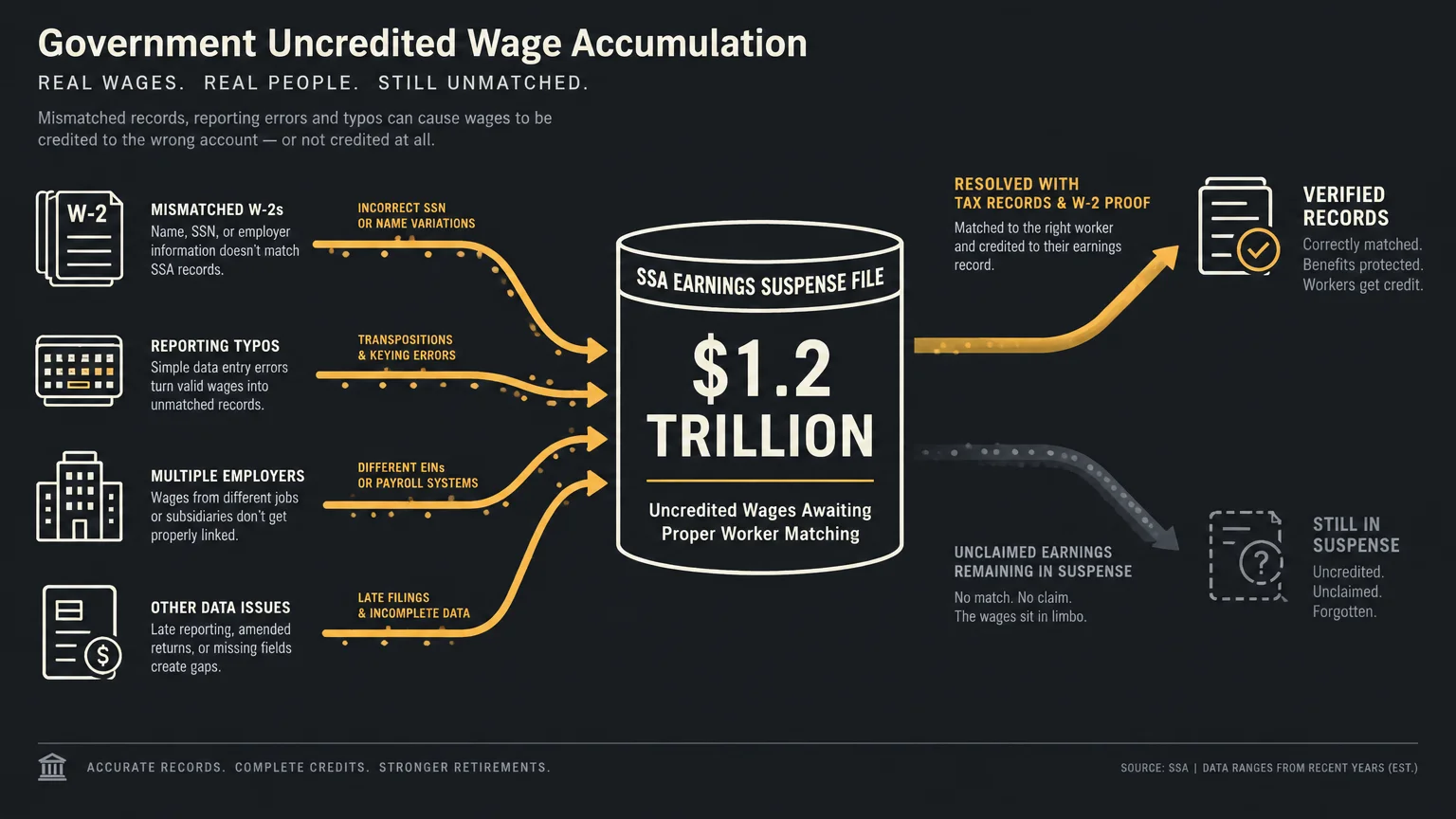
When the government receives wage reports with mismatched names or numbers, it cannot simply discard the money. Instead, the agency deposits those unverified wages into the Earnings Suspense File.
Official reports from the Social Security Office of the Inspector General reveal staggering totals. The suspense file currently holds more than $1.2 trillion in uncredited wages across more than 330 million W-2 records.
“Social Security is often the bedrock of retirement income, yet so many people never verify the underlying numbers until it is too late.” — Suze Orman, Personal Finance Author and Host
Every dollar resting inside the Earnings Suspense File belongs to an individual who worked and paid taxes. Unless workers step forward with documentation to claim those wages, the money remains permanently unassigned.
You can investigate your own employment history through the Social Security Administration (SSA) official online portal. Regular monitoring guarantees your payments end up credited to your personal record rather than the suspense file.
The Strict Correction Window: Understanding the 3-Year Rule
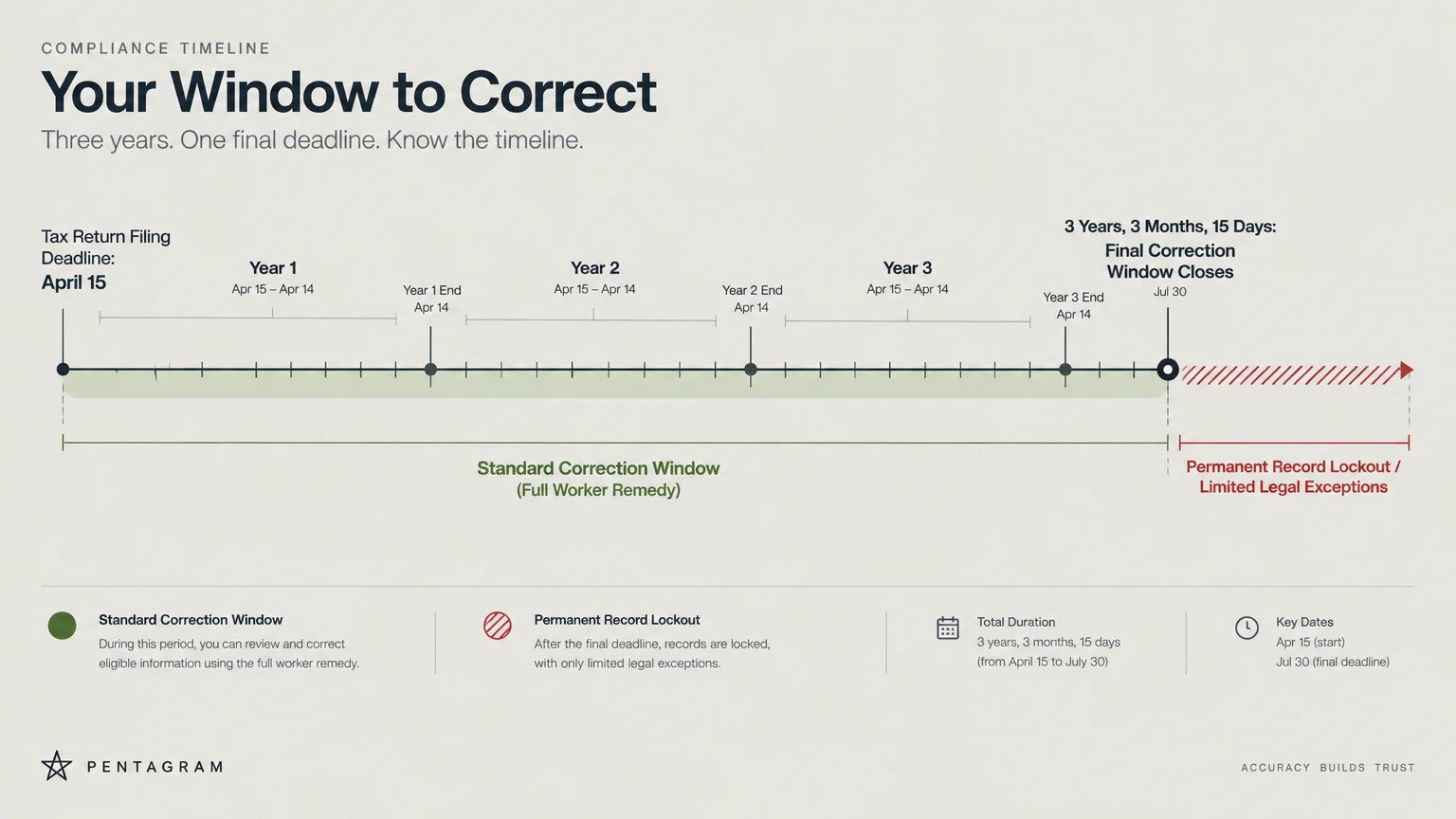
Federal law imposes a formal statute of limitations on wage record corrections. Under 20 CFR § 404.802, workers generally have 3 years, 3 months, and 15 days to challenge an error.
This statutory timeframe begins immediately after the close of the calendar year in which you earned the wages. Once this deadline passes, the government considers your earnings record conclusive evidence of your work history.
Fortunately, federal regulation 20 CFR § 404.822 establishes several vital exceptions that allow late corrections:
- Conforming to Tax Returns: The agency can correct your records if your filed federal tax returns or W-2 forms prove the discrepancy.
- Facial Record Errors: Mistakes visible on the face of the agency’s existing records remain eligible for adjustment at any time.
- Prior Inquiries: If you filed a written inquiry before the deadline expired, your case remains open for review.
- Unreported Employer Wages: The agency may investigate situations where an employer withheld taxes but failed to submit wage reports.
While these legal exceptions protect many workers, securing late corrections requires extensive documentation and significant administrative effort. Correcting errors within the standard three-year window remains the fastest approach.
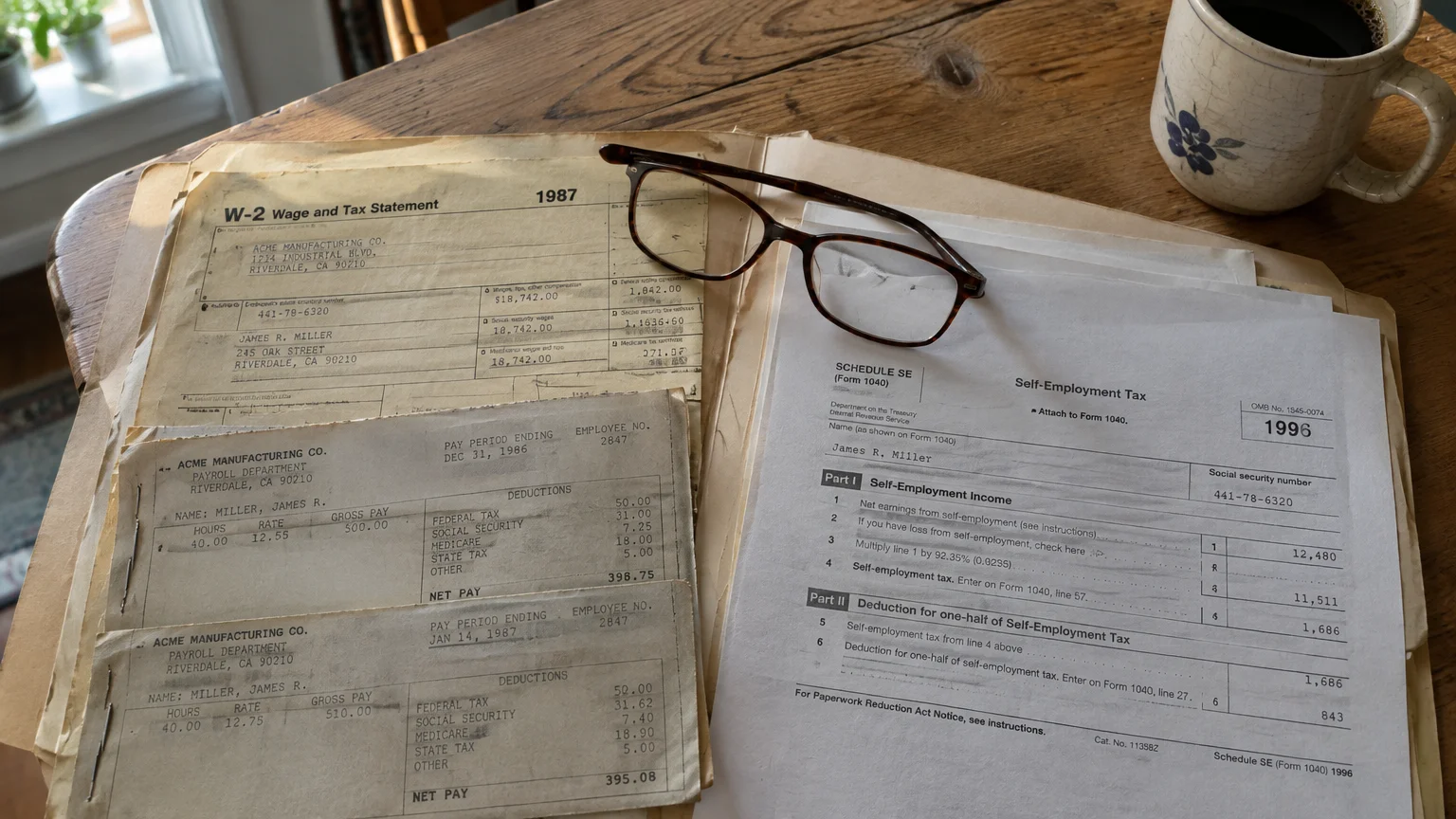
Documentation You Need to Fix Social Security Record Errors
The government requires verifiable documentary evidence before it will alter your official earnings record. You cannot simply submit a written statement claiming higher wages without primary supporting proof.
The standard tool for disputing wage discrepancies is Form SSA-7008, known as the Request for Correction of Earnings Record. You must submit this form alongside copies of your historical tax records.
Acceptable primary evidence includes:
- Form W-2 (Wage and Tax Statement) issued by your employer.
- Form 1040 federal tax returns accompanied by Schedule SE and Schedule C.
- Official pay stubs displaying FICA tax withholdings and employer identification.
- Written statements from former employers detailing your dates of employment and total compensation.
- Form SSA-7050-F4, used to order detailed, itemized earnings records to resolve a legitimate wage dispute.
If you need historical tax returns, you can request past transcripts directly through the Internal Revenue Service (IRS). Keep digital copies of every W-2 and tax return you file throughout your working career.
The table below summarizes common discrepancy types, why they occur, and the documentation required to resolve them:
| Discrepancy Type | Root Cause | Required Evidence | Resolution Form |
|---|---|---|---|
| Missing Employer Wages | Employer failed to report W-2 | W-2, final pay stubs, bank deposits | Form SSA-7008 |
| Name Mismatch | Marriage, divorce, or legal change | Marriage license, court order, ID card | Form SS-5 |
| Omitted Self-Employment | Schedule SE omitted or delayed | Form 1040, Schedule SE, proof of payment | Form SSA-7008 |
| Transposed SSN | Clerical typo on payroll filing | Original W-2, Social Security card | Form SSA-7008 |
| Military Wage Credits | Uncredited pre-2002 active duty | Military discharge document (DD-214) | Direct SSA Local Filing |

What Can Go Wrong If You Wait Too Long
Delaying your record review until your sixties introduces serious logistical obstacles. The passage of time destroys the very evidence you need to prove past earnings.
Under the Fair Labor Standards Act, employers must retain payroll records for only three years. If you attempt to investigate a missing 1995 wage entry today, your former employer likely shredded those files decades ago.
Financial institutions also purge historical records, generally destroying cancelled checks and bank statements after five to seven years. Without bank records or payroll archives, corroborating missing wages becomes nearly impossible.
Furthermore, once you file for retirement benefits, your monthly award is calculated based on existing agency records. While you can appeal an initial determination, doing so during retirement can cause cash-flow disruptions.
A lower Primary Insurance Amount also reduces lifetime spousal benefits and survivor payments for your family. Fixing errors while you are still working protects your entire household’s long-term financial security.

When to Consult a Professional
Most basic earnings corrections can be resolved directly through an online account or a visit to your local office. However, complex wage histories sometimes demand experienced guidance.
Consider seeking advice from an attorney, enrolled agent, or financial planner under the following conditions:
- Multi-Year Self-Employment Audits: If the IRS adjusted past business returns, coordinating those changes with Social Security records requires technical oversight.
- Defunct Employers and Lost Archives: When a former employer closed without filing reports, a professional can help reconstruct earnings through bank and tax affidavits.
- Government Pensions and Covered Earnings: If you split your career between non-covered public pensions and private jobs, rules like the Windfall Elimination Provision apply.
- Formal Administrative Appeals: If the agency rejects Form SSA-7008, you may need legal representation to navigate an administrative law judge hearing.
For independent guidance on retirement asset coordination, you can review consumer resources published by the Consumer Financial Protection Bureau (CFPB). A qualified professional ensures your lifetime earnings receive fair treatment under federal regulations.
“An investment in knowledge pays the best interest.” — Benjamin Franklin, Statesman and Author
Frequently Asked Questions
How often should I check my Social Security earnings record?
You should review your record at least once every calendar year. Creating a personal account on the agency website allows you to verify your latest W-2 postings within minutes.
Can I correct my earnings history after I start claiming benefits?
Yes, you can request a correction after claiming, but you must satisfy the legal exceptions under federal regulations. Providing documentation early prevents delayed or underpaid monthly checks.
Why are my earnings capped at a specific figure on my statement?
Federal law caps the amount of earnings subject to Social Security taxation each year. Any wages earned above that annual limit do not incur taxes and cannot appear on your statement.
What should I do if my former employer went out of business?
Locate your personal copy of Form W-2 or your filed federal tax returns for that year. You can also order historical IRS tax return transcripts to prove your earned wages.
Step-by-Step: How to Inspect Your Statement Today
Protecting your retirement income begins with logging into your personal online account. Navigating to the official portal at ssa.gov allows you to download your full historical earnings record immediately.
Compare each annual entry against your old tax returns or box 3 and box 5 on your historical W-2 forms. Look closely for years that show zero earnings, unexpectedly low figures, or missing employers.
If you identify a discrepancy, gather your documentation and contact your local agency office promptly. Filing Form SSA-7008 quickly protects your retirement benefits from permanent administrative reduction.
This is educational content based on general retirement and financial principles. Individual results vary based on your situation. Always verify current benefit rules, tax laws, and eligibility requirements with official sources like SSA, Medicare.gov, or the IRS.
Last updated: March 2026. Retirement benefits, tax rules, and healthcare regulations change frequently—verify current details with official sources.









Leave a Reply