
You could shield tens of thousands of dollars from federal income taxes this year under the new senior tax rules. The enhanced senior tax deduction significantly lowers tax bills for older Americans navigating fixed incomes.
Recent federal legislation created this temporary tax break to give retirees substantial relief against ongoing cost-of-living increases. Knowing how to claim it can protect your hard-earned retirement savings.
Whether you rely primarily on Social Security or manage mandatory retirement distributions, this deduction reshapes your tax strategy. Here is how the rules work and how you can maximize your annual savings.
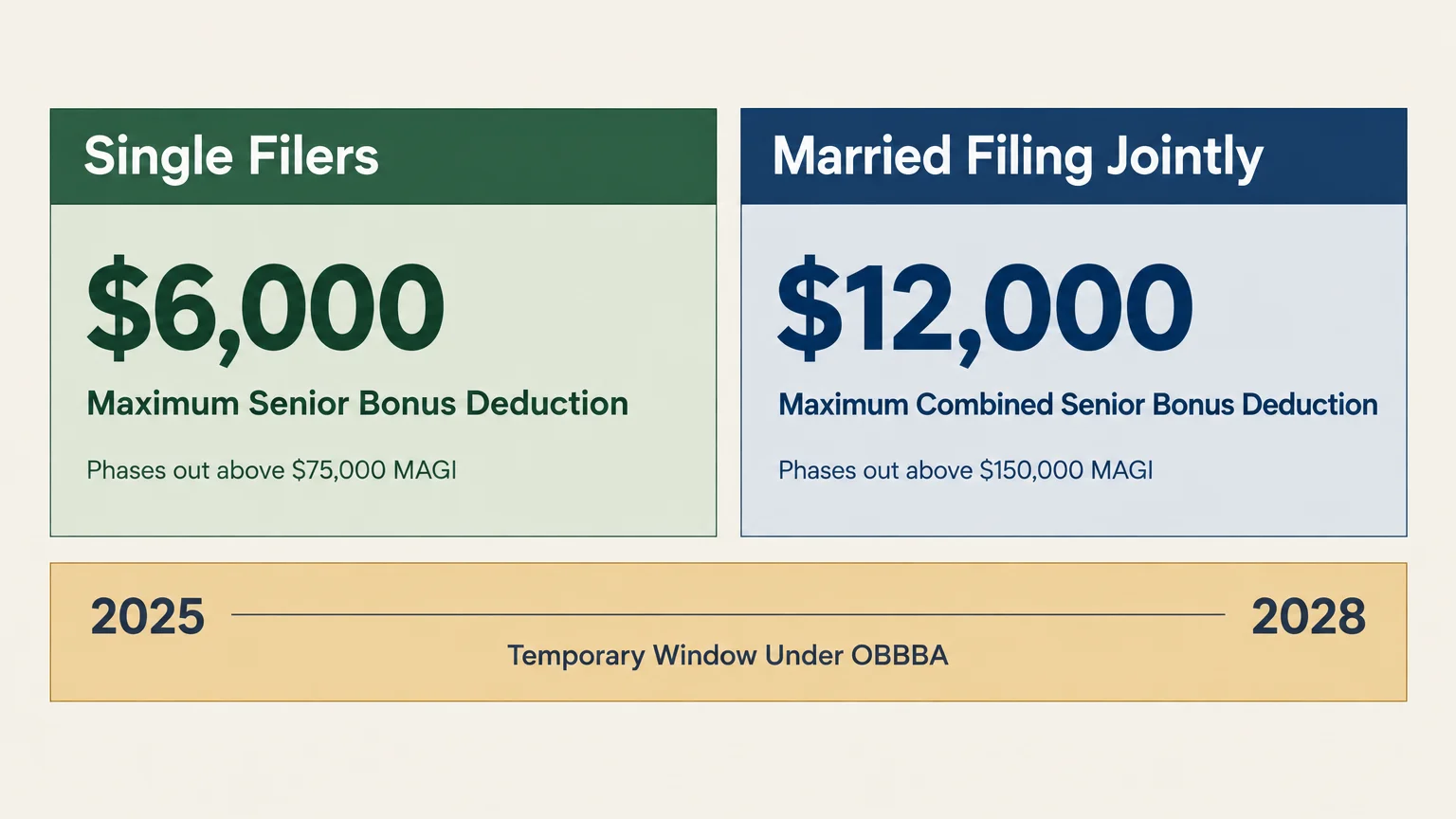
The Essentials: Key Tax Takeaways for 2026
Retirees face a rare opening to reduce their federal tax liability through 2028. Understanding these key provisions helps you coordinate withdrawals and keep more money in your accounts.
- Substantial Bonus Amounts: Eligible single filers can deduct up to $6,000, while qualifying married couples filing jointly can deduct up to $12,000.
- Universal Availability: You can claim the new deduction whether you itemize deductions or take the standard deduction.
- Layered Tax Relief: This bonus deduction stacks directly on top of the base standard deduction and the existing age-65 addition.
- Income Phaseouts: The write-off gradually phases out for single filers with income over $75,000 and married couples over $150,000.
- Bracket Permanence: The same law made the lower individual income tax rates from 2017 permanent, preventing higher rates in 2026.

Legislative Background: The One Big Beautiful Bill Act
Congress enacted the enhanced senior tax deduction under the One Big Beautiful Bill Act (OBBBA). The legislation directly targets financial pressures seniors have faced from cumulative inflation.
This special senior tax relief applies exclusively to tax years 2025 through 2028. Unless lawmakers pass future legislation to extend the provision, it will sunset after December 31, 2028.
The same law permanently locked in the individual tax rates established under the 2017 Tax Cuts and Jobs Act. Consequently, retirees will not see federal income brackets revert to higher historical levels in 2026.
You can verify current federal filing thresholds directly through the Internal Revenue Service. These coordinated tax provisions provide stability for multi-year retirement distribution strategies.
Eligibility Criteria: Who Can Claim the Bonus Deduction?
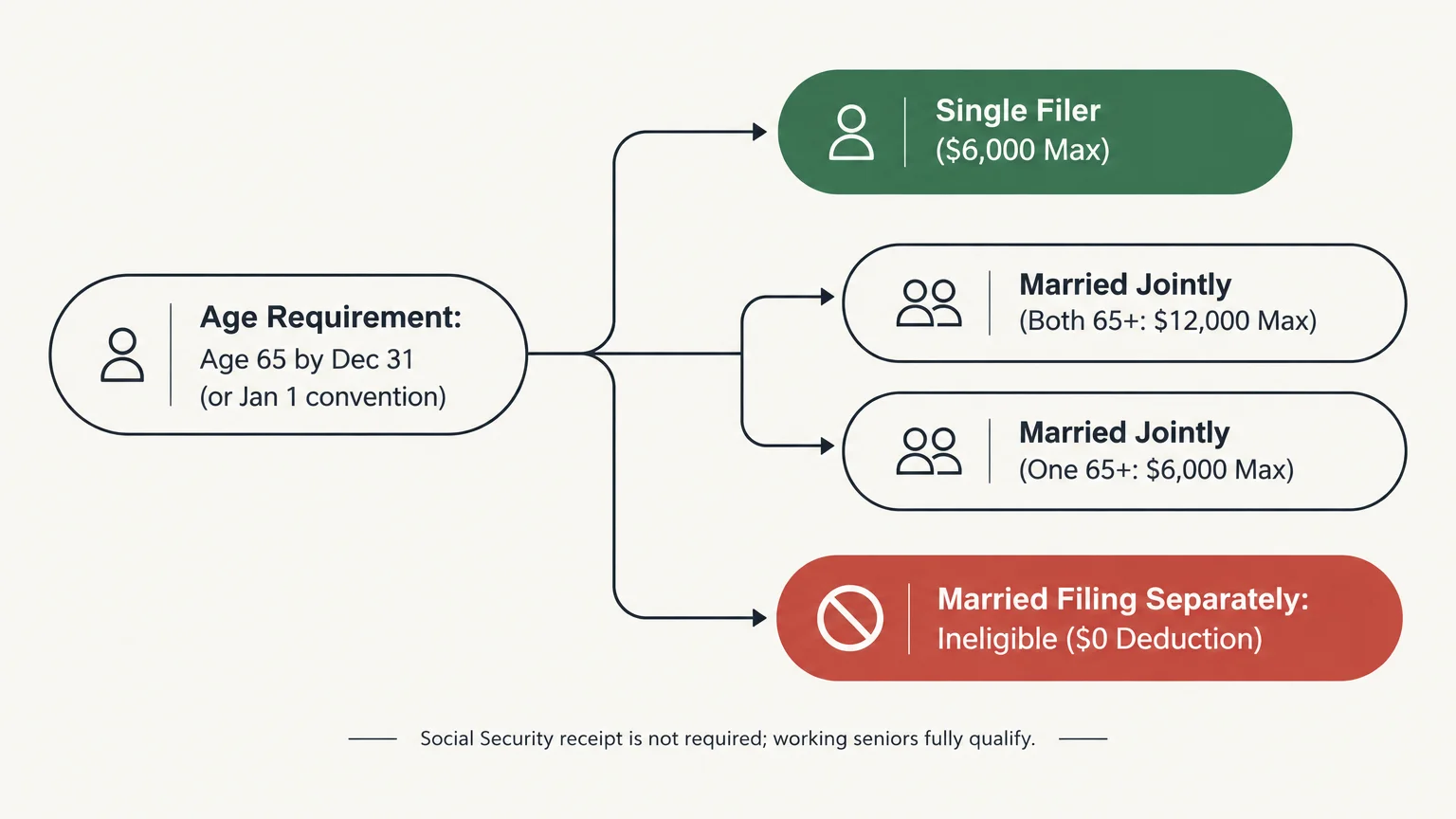
Qualifying for the bonus senior deduction requires satisfying simple age and filing parameters. Knowing these guidelines ensures you do not inadvertently forfeit your deduction.
You must reach age 65 on or before December 31 of the tax year to claim the relief. Under longstanding tax conventions, taxpayers turning 65 on January 1 qualify as age 65 on December 31.
You do not need to receive monthly benefits from the Social Security Administration to qualify. Working seniors and those delaying their claims receive the exact same tax deduction as retired workers.
Married couples filing jointly qualify for up to $12,000 if both spouses are at least 65 years old. If only one spouse meets the age requirement, your joint return qualifies for a $6,000 bonus deduction.
Filing status restrictions apply directly to this relief. The statute expressly forbids married individuals filing separately from claiming any portion of the bonus senior deduction.
Itemizers vs. Non-Itemizers: The Schedule 1-A Advantage
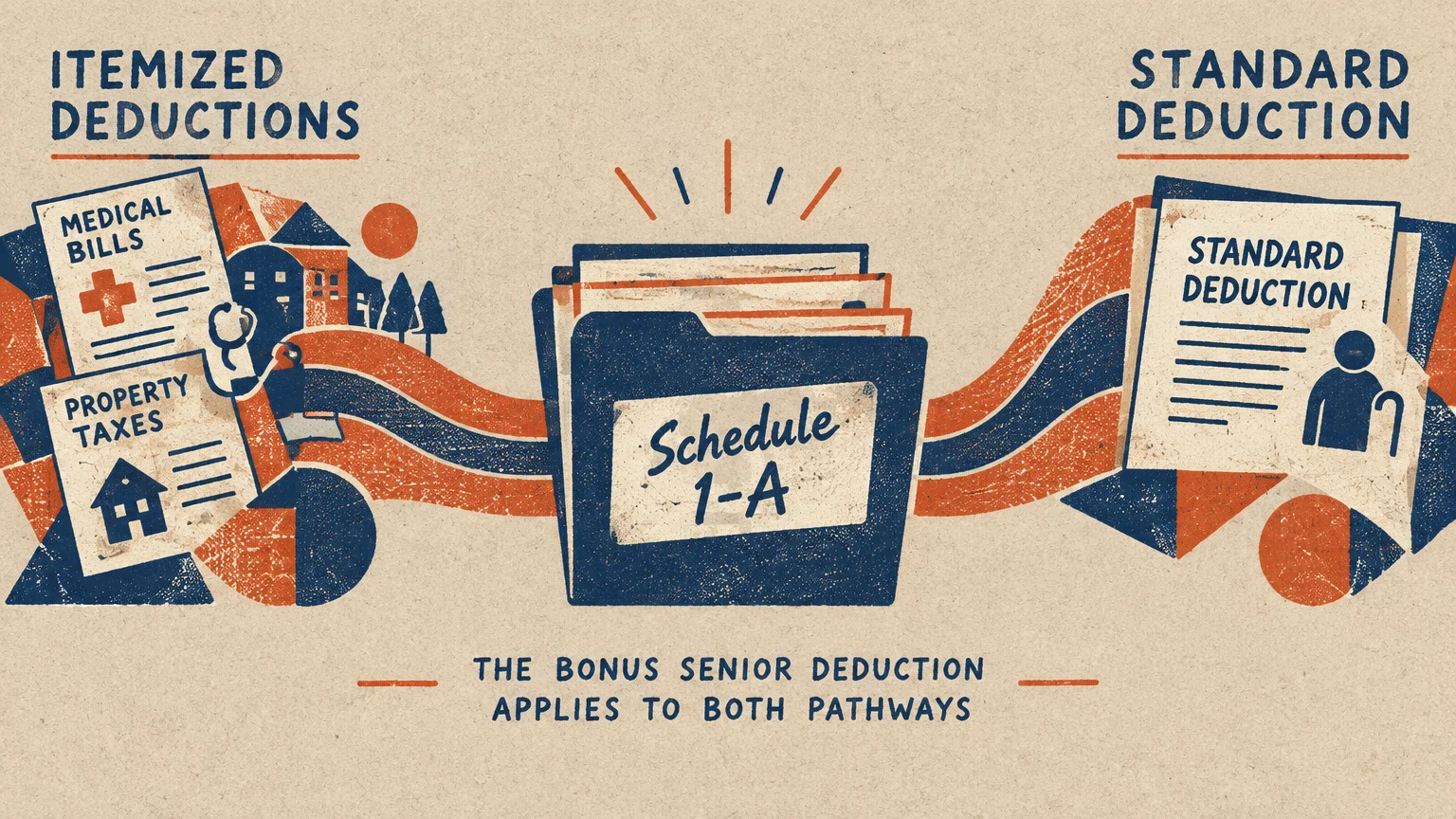
Historically, senior-specific tax deductions only benefited retirees who took the standard deduction. The bonus deduction eliminates that constraint through a dedicated filing form called Schedule 1-A.
You can claim the full bonus deduction even if you itemize mortgage interest, medical deductions, or charitable donations. This dual structure ensures that high-deduction households receive the same age-based tax relief as standard filers.
Non-itemizers also gain significant advantages because the bonus stacks directly with standard allowances. This flexibility makes tax filing simpler while expanding total deductions across diverse household budgets.

Stacking Deductions: Shielding Up to $47,400 from Federal Tax
The true power of this legislation comes from stacking multiple deductions on a single return. You can layer three separate tax shields to shelter substantial income from federal tax.
First, you claim the base standard deduction, projected at roughly $16,100 for single filers and $32,200 for married couples in 2026. This foundation protects your core baseline income.
Second, preexisting tax law under Internal Revenue Code Section 63(f) grants an additional deduction for individuals age 65 and older. This provides approximately $2,000 for single filers and $1,600 per qualifying spouse for joint filers.
Finally, you layer the new bonus deduction directly on top of those standard write-offs. A single senior can now shield over $24,000 of income before paying a single dollar in federal income tax.
A married couple where both partners have reached age 65 can shield up to $47,400 from federal taxation. This stacked relief protects a substantial portion of your annual retirement cash flow.
| Filing Status | Base Standard Deduction | Age 65+ Addition (IRC § 63(f)) | OBBBA Senior Bonus Deduction | Total Shielded Income |
|---|---|---|---|---|
| Single (Age 65+) | $16,100 | $2,000 | $6,000 | $24,100 |
| Married Joint (One Spouse 65+) | $32,200 | $1,600 | $6,000 | $39,800 |
| Married Joint (Both Spouses 65+) | $32,200 | $3,200 | $12,000 | $47,400 |
Phaseouts and the 6% Clawback: Watching Your MAGI
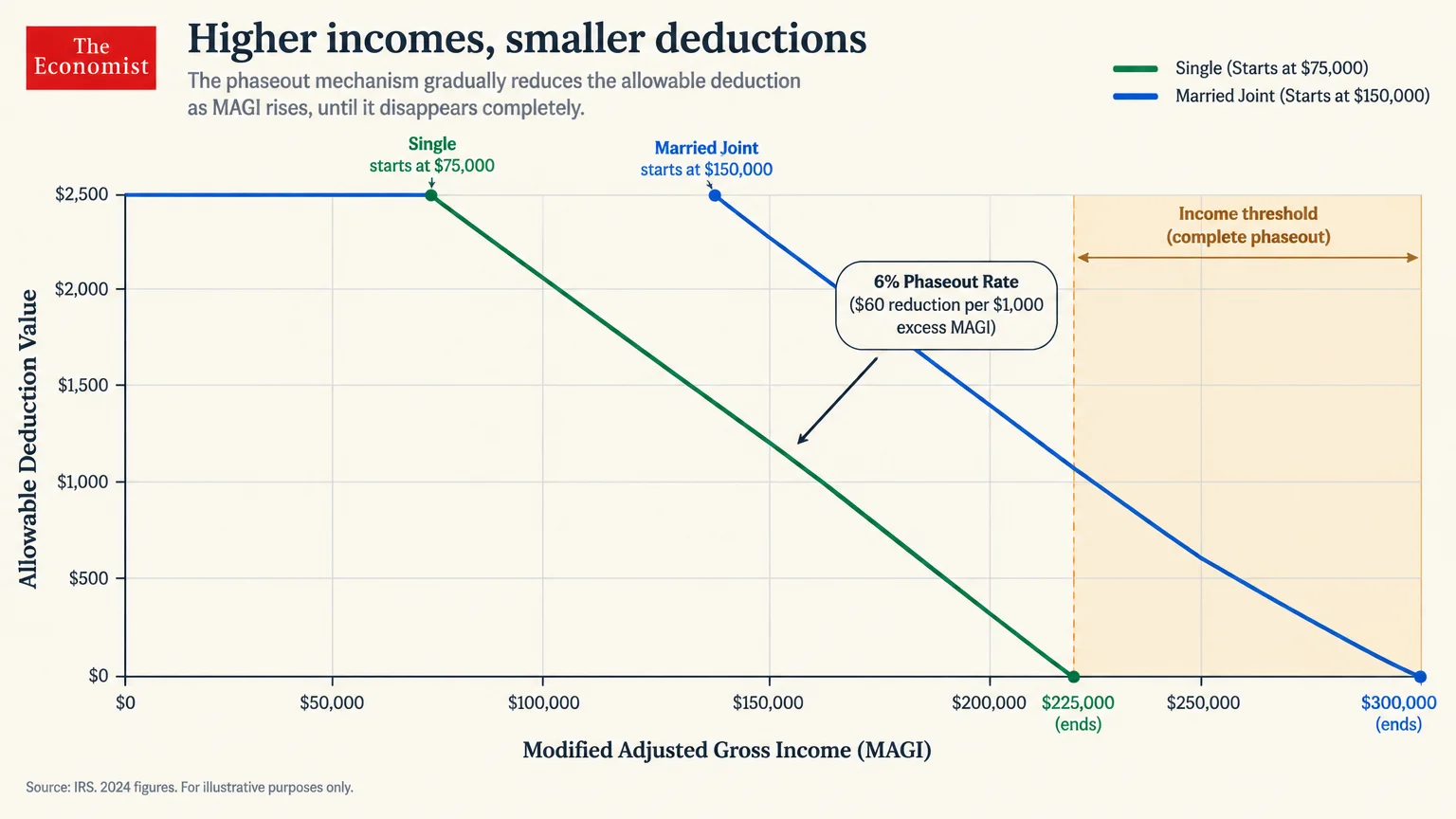
Congress instituted income phaseout rules to target this tax relief toward middle-class households. If your income surpasses specific limits, the bonus deduction begins to phase out rapidly.
For single filers, the deduction phaseout begins at $75,000 of Modified Adjusted Gross Income (MAGI). The deduction phases out completely once your MAGI reaches $175,000.
Married couples filing jointly retain the full $12,000 deduction up to $150,000 of MAGI. The joint deduction phases out entirely once combined MAGI hits $250,000.
The IRS claws back the deduction at a rate of 6 cents for every dollar above your threshold. This 6% phaseout rate creates a stealth marginal tax increase on income inside the phaseout band.
If you sit in the 22% statutory bracket, this clawback pushes your true marginal rate to 28%. You must evaluate any extra withdrawals or capital gains carefully within that specific income window.

Social Security Benefits: Relief Without Formula Changes
Many retirees hoped lawmakers would overhaul the longstanding formula governing the taxation of Social Security benefits. However, the legislation left the statutory combined income thresholds unchanged.
Single filers still encounter benefit taxation on up to 85% of payments when combined income exceeds $34,000. Married couples face the same 85% tier on income above $44,000.
Despite the static benefit formula, the bonus deduction provides real-world relief against Social Security taxes. The stacked deduction shields ordinary income, offsetting taxable benefit dollars directly on your Form 1040.
For lower- and middle-income seniors relying on Social Security and modest retirement distributions, this deduction frequently eliminates federal income tax liability entirely. You retain more cash for everyday living costs.
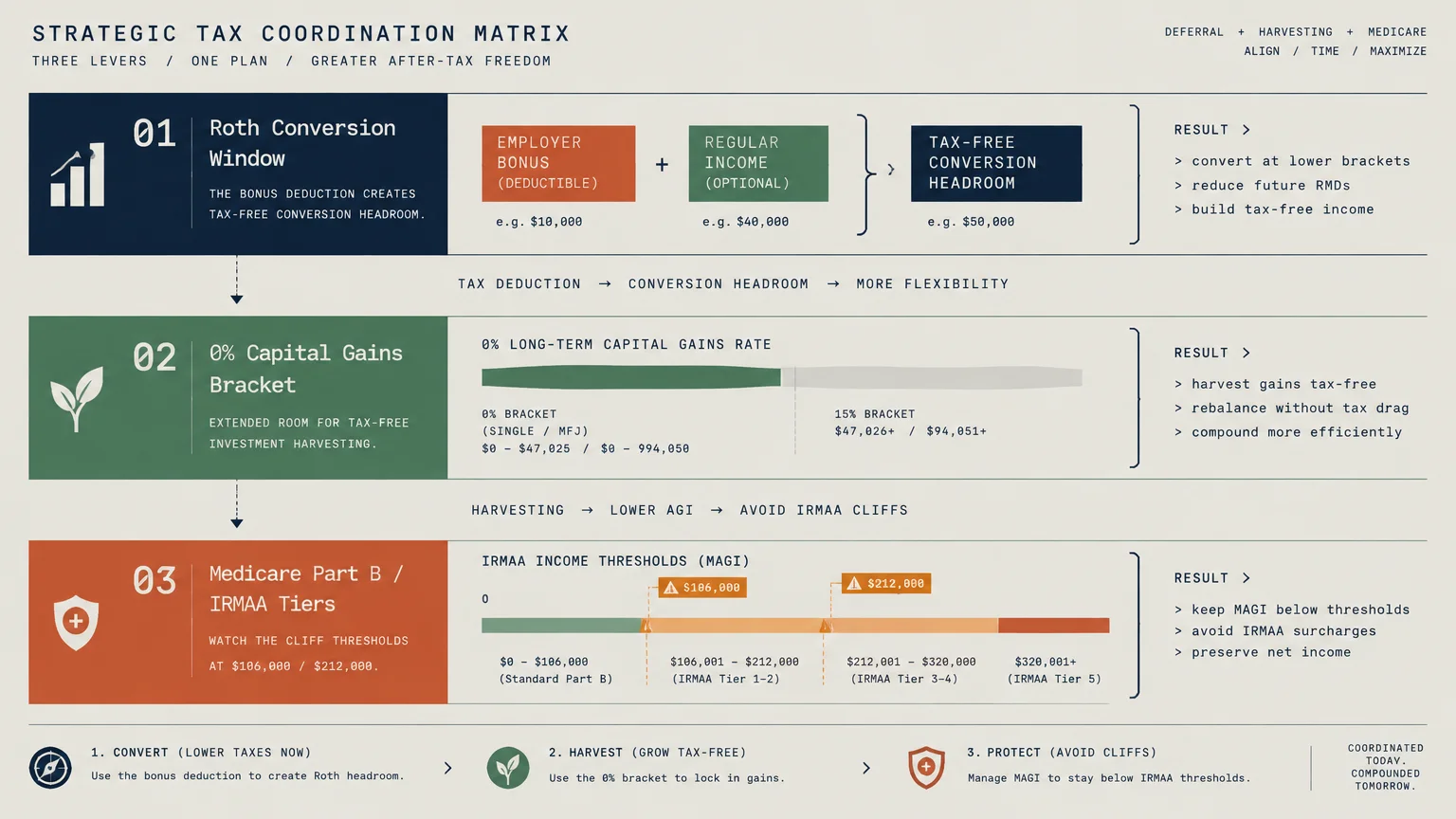
Strategic Planning: Roth Conversions, Capital Gains, and Medicare IRMAA
Roth IRA conversions represent a valuable tool for reducing future required distributions, but timing is critical. Generating sudden taxable income in 2026 can trigger the bonus deduction phaseout.
Every dollar converted counts toward your MAGI and can erode your $6,000 or $12,000 deduction allowance. Losing that deduction increases the true cost of moving funds into Roth accounts.
Review comprehensive portfolio withdrawal tactics through resources like Investopedia before executing large year-end conversions. Careful planning helps you capture conversion benefits without giving up valuable senior deductions.
Unplanned income spikes can also trigger higher Medicare Part B and Part D premiums through income adjustments. You can track current surcharge thresholds directly at Medicare.gov.
“Making your money last throughout retirement isn’t just about what you earn; it is about how much of it you keep away from the tax collector.” — Jean Chatzky, Financial Educator and Author

SALT Cap Increase: Added Value for Senior Homeowners
The One Big Beautiful Bill Act also expanded the State and Local Tax (SALT) deduction cap to $40,400 for 2026. This increase offers immense relief to senior homeowners living in states with high property taxes.
Under prior rules, seniors faced an arbitrary $10,000 cap that penalized long-term property owners. The expanded limit lets you deduct substantial property and state income taxes on Schedule A.
Because the new senior deduction is claimed on Schedule 1-A, you can itemize your local taxes while still claiming the full senior bonus. This combination delivers powerful tax savings for homeowners.
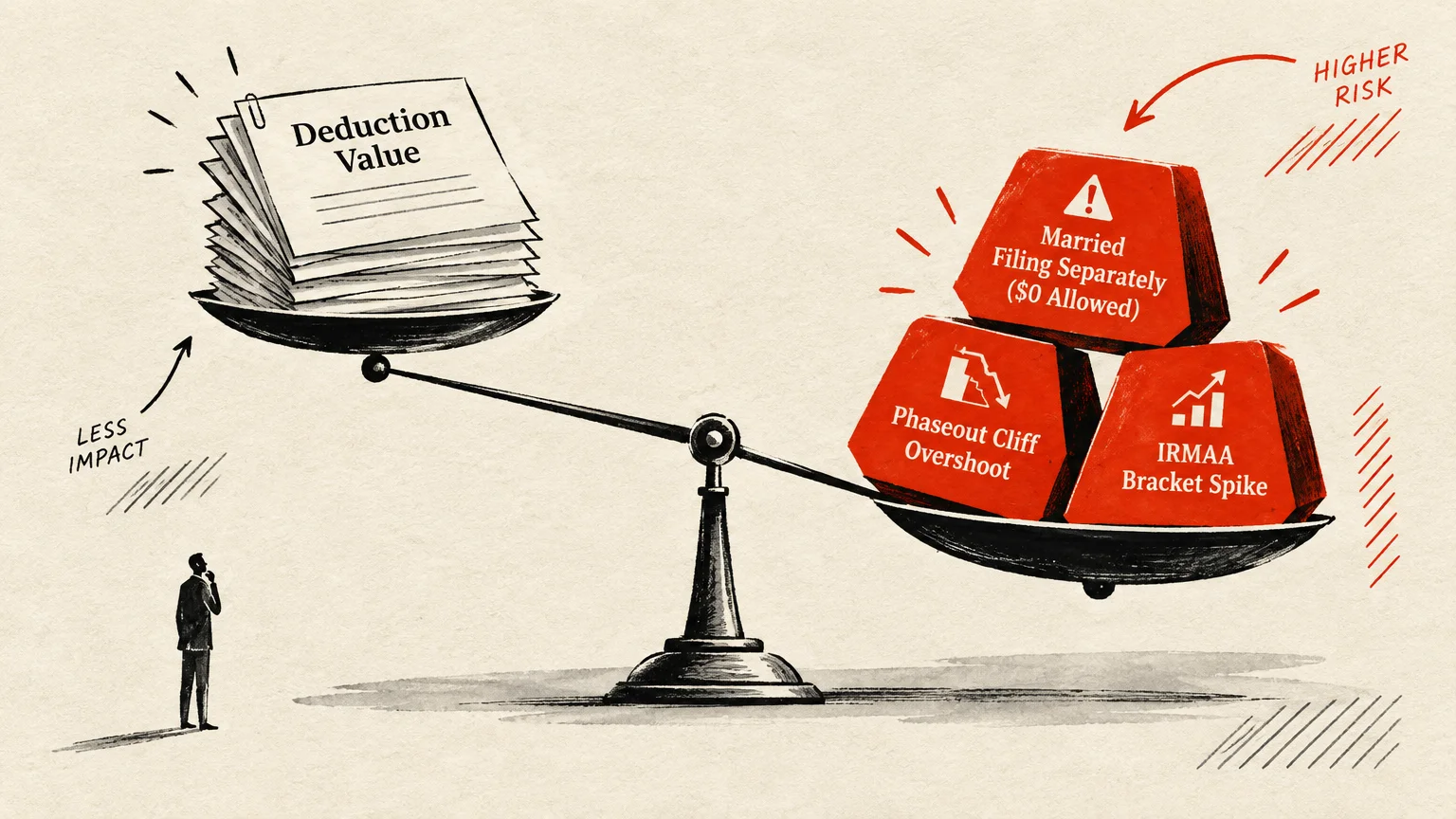
What Can Go Wrong: Critical Mistakes to Avoid
New tax rules frequently cause confusion, and small misunderstandings can lead to costly mistakes on your return. Watch out for these specific traps when planning your filing strategy.
- Choosing Married Filing Separately: Spouses who file separate tax returns forfeit the entire bonus senior deduction under the statutory rules.
- Ignoring the 6% Phaseout Clawback: Taking large taxable distributions or realizing big capital gains can push your MAGI over $75,000 or $150,000, triggering an unexpected tax hit.
- Assuming Social Security Thresholds Changed: The bonus deduction reduces your overall taxable income, but the calculation that makes benefits taxable remains strictly enforced.
- Failing to Attach Schedule 1-A: Itemizing filers must remember to include Schedule 1-A with their tax return to receive the bonus deduction.
Reviewing these potential pitfalls before filing safeguards your return against processing delays and unnecessary payments. A small amount of attention prevents avoidable financial losses.

When to Consult a Professional
While many retirees manage their own filings easily, intersecting tax provisions can make professional advice worthwhile. Consider scheduling a tax planning consultation in the following situations:
- You Plan Substantial Roth Conversions: A tax professional can determine the exact distribution amount that maximizes your conversion without triggering the 6% deduction clawback.
- Your Income Nears Medicare IRMAA Surcharges: An adviser helps balance retirement distributions to prevent both deduction phaseouts and costly Medicare Part B and Part D premium hikes.
- You Own Property in High-Tax States: An expert can model whether itemizing under the $40,400 SALT limit yields larger overall deductions than standard amounts.
- Your Household Has an Age Gap: If one spouse turns 65 before the other, specialized planning ensures you optimize your deductions across different tax years.
A qualified financial planner or CPA can calculate exact projections to protect both your deductions and your Medicare premiums. Their guidance helps you preserve your retirement wealth over the long term.
Frequently Asked Questions
Do I have to be retired or receiving Social Security to claim the deduction?
No, you do not need to be retired or collecting Social Security benefits. As long as you reach age 65 by December 31, you can claim the deduction regardless of employment status.
Can I claim the bonus deduction if I itemize?
Yes, you claim the bonus senior deduction on Schedule 1-A, which is available whether you itemize or take standard deductions. This ensures itemizing homeowners keep their senior tax relief.
How long will this new senior tax deduction last?
The bonus deduction applies to tax years 2025 through 2028 under current law. Unless Congress enacts legislation to extend the relief, the bonus expires after December 31, 2028.
Does the bonus deduction reduce state income taxes?
State tax treatment depends on whether your state automatically conforms to federal standard deduction adjustments. Check with your state tax authority or a local professional to determine state-level eligibility.
Next Steps for Your Retirement Tax Strategy
Begin by calculating your projected 2026 Modified Adjusted Gross Income alongside planned portfolio distributions. Establishing your baseline income early ensures you avoid crossing into the 6% phaseout zone unexpectedly.
Coordinate retirement distributions, charitable gifts, and capital gains to maximize your stacked deductions while this law remains active. Thoughtful preparation keeps more of your hard-earned income working for you throughout retirement.
This is educational content based on general retirement and financial principles; individual results vary based on your situation. Always verify current benefit rules, tax laws, and eligibility requirements with official sources like SSA, Medicare.gov, or the IRS.
Last updated: March 2026. Retirement benefits, tax rules, and healthcare regulations change frequently—verify current details with official sources.









Leave a Reply