
Inheriting a retirement account presents a welcome financial boost, but mishandling it triggers swift tax penalties. Understanding the withdrawal rules protects the assets your loved one worked hard to save.
Federal legislation significantly changed the distribution rules for most heirs, shortening timelines and altering tax strategies. You can make intentional moves today to shield your inheritance from unnecessary depletion.
This guide outlines nine practical actions to help you manage an inherited retirement plan wisely. Taking prompt, informed steps keeps your money secure and honors your benefactor’s legacy.

1. Identify Your Beneficiary Category
The SECURE Act divided retirement heirs into distinct categories, each subject to separate distribution timetables. Your legal relationship to the deceased account owner determines your exact withdrawal rules.
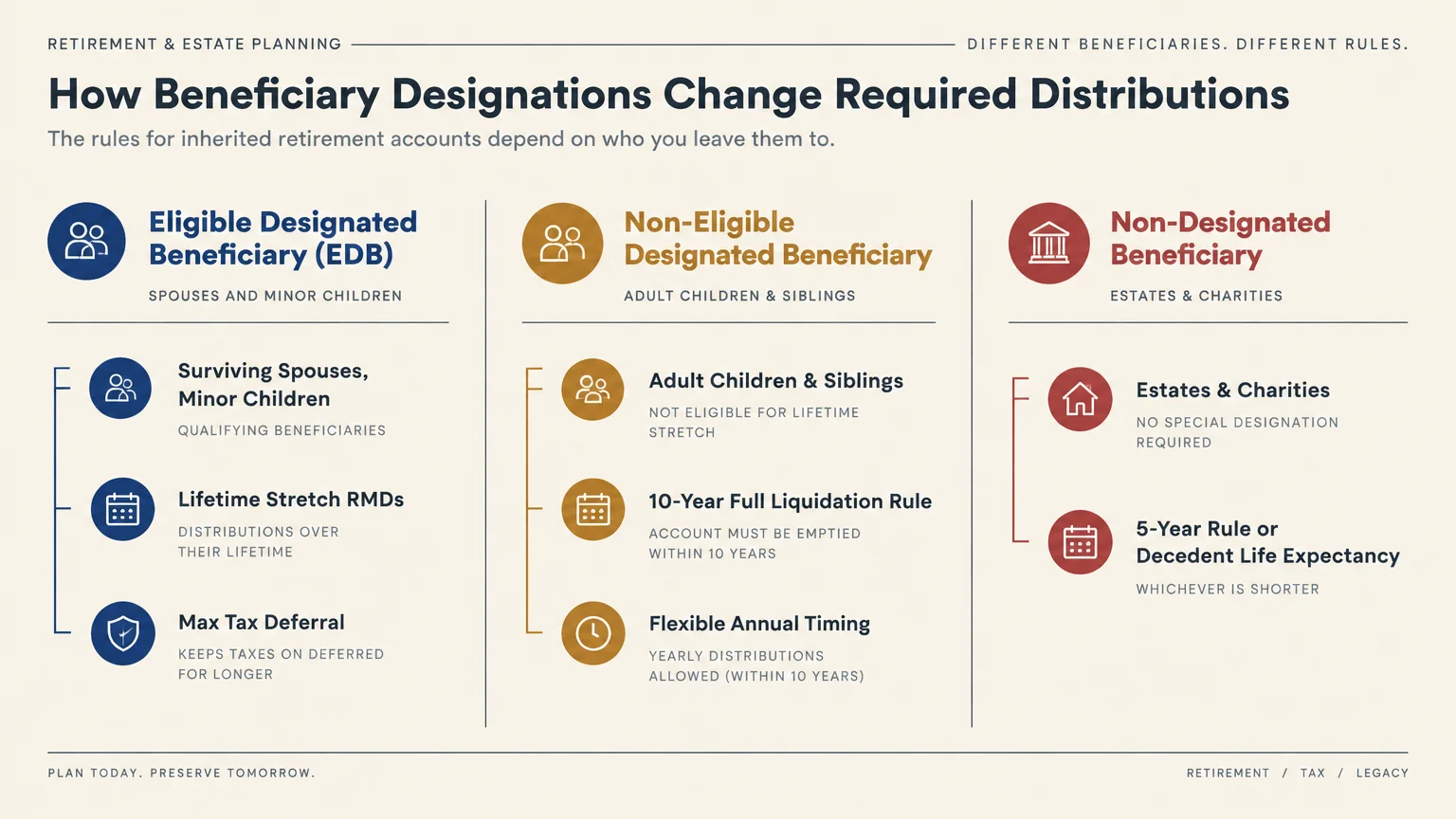
Spouses, minor children, disabled individuals, and beneficiaries not more than ten years younger qualify as Eligible Designated Beneficiaries. Most adult children, siblings, and grandchildren fall under the standard Non-Eligible Designated Beneficiary status.
Non-eligible heirs must empty the account within ten years. In contrast, eligible beneficiaries retain more flexible lifetime withdrawal options.
Beneficiary IRA Options Compared
Understanding your beneficiary classification allows you to select the correct payout strategy. The table below outlines how current federal regulations govern each heir category.
| Beneficiary Type | Who Qualifies | Distribution Requirement | Key Tax Advantage |
|---|---|---|---|
| Eligible Designated Beneficiary (EDB) | Surviving spouses, minor children, disabled or chronically ill heirs, individuals within 10 years of decedent’s age | May stretch distributions over their single life expectancy; spouses can roll into personal IRAs | Maximum tax deferral across decades of retirement |
| Non-Eligible Designated Beneficiary | Adult children, grandchildren, siblings, friends, and most non-spouse individual heirs | Must fully withdraw account balance by the end of the tenth year following death | Flexibility to time withdrawals across low-income tax years |
| Non-Designated Beneficiary | Estates, non-qualified trusts, charities, and institutions without named living individuals | Five-year rule if owner died before RMD age; life expectancy of decedent if owner died after RMD age | No ongoing beneficiary maintenance fees once liquidated |

2. Check for an Unfulfilled Year-of-Death RMD
If the decedent had reached their required beginning date, the IRS mandates an annual withdrawal for their final year. You must verify whether the account owner already satisfied this distribution prior to passing away.
Failing to withdraw this final distribution triggers severe IRS penalties. The Internal Revenue Service (IRS) imposes an excise tax of up to 25 percent on missed amounts.
Beneficiaries must distribute this remaining required minimum distribution (RMD) by December 31 of the death year. Multiple heirs must coordinate withdrawals to fulfill the obligation proportionately.
3. Open a Properly Titled Inherited Account
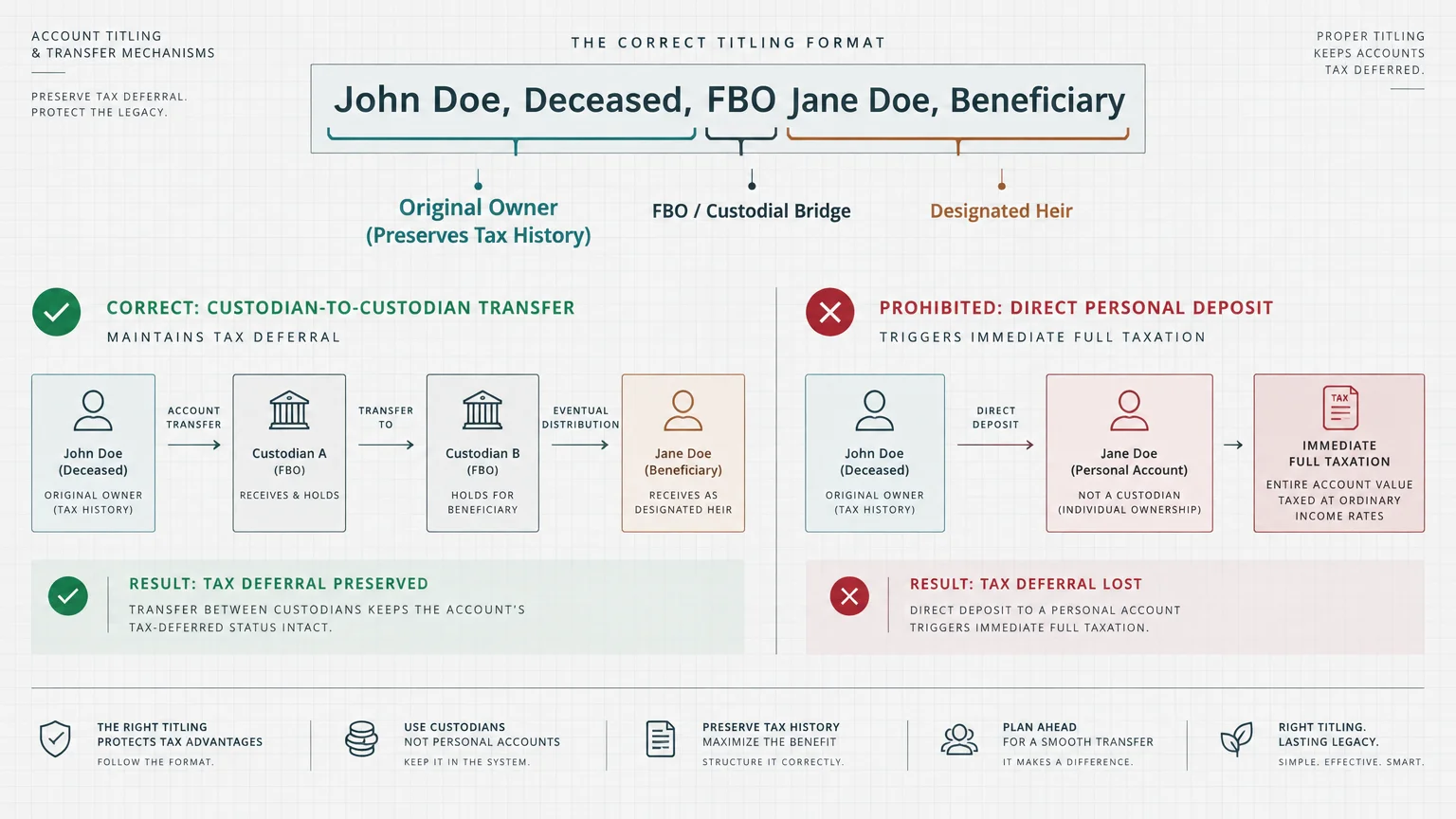
You cannot simply transfer inherited assets directly into your own traditional or Roth IRA. Doing so constitutes an illegal rollover and triggers immediate taxation on the full balance.
Instead, establish a dedicated beneficiary IRA with a custodian. Proper titling must identify the original owner while naming you as the beneficiary.
For example, the account title should read: “John Doe, Deceased, FBO Jane Doe, Beneficiary.” This specific structure maintains the tax-deferred status of your inherited retirement accounts.
“Never rush to cash out an inherited retirement account without running the tax numbers first.” — Suze Orman, Personal Finance Author
4. Navigate the 10-Year Rule Schedule
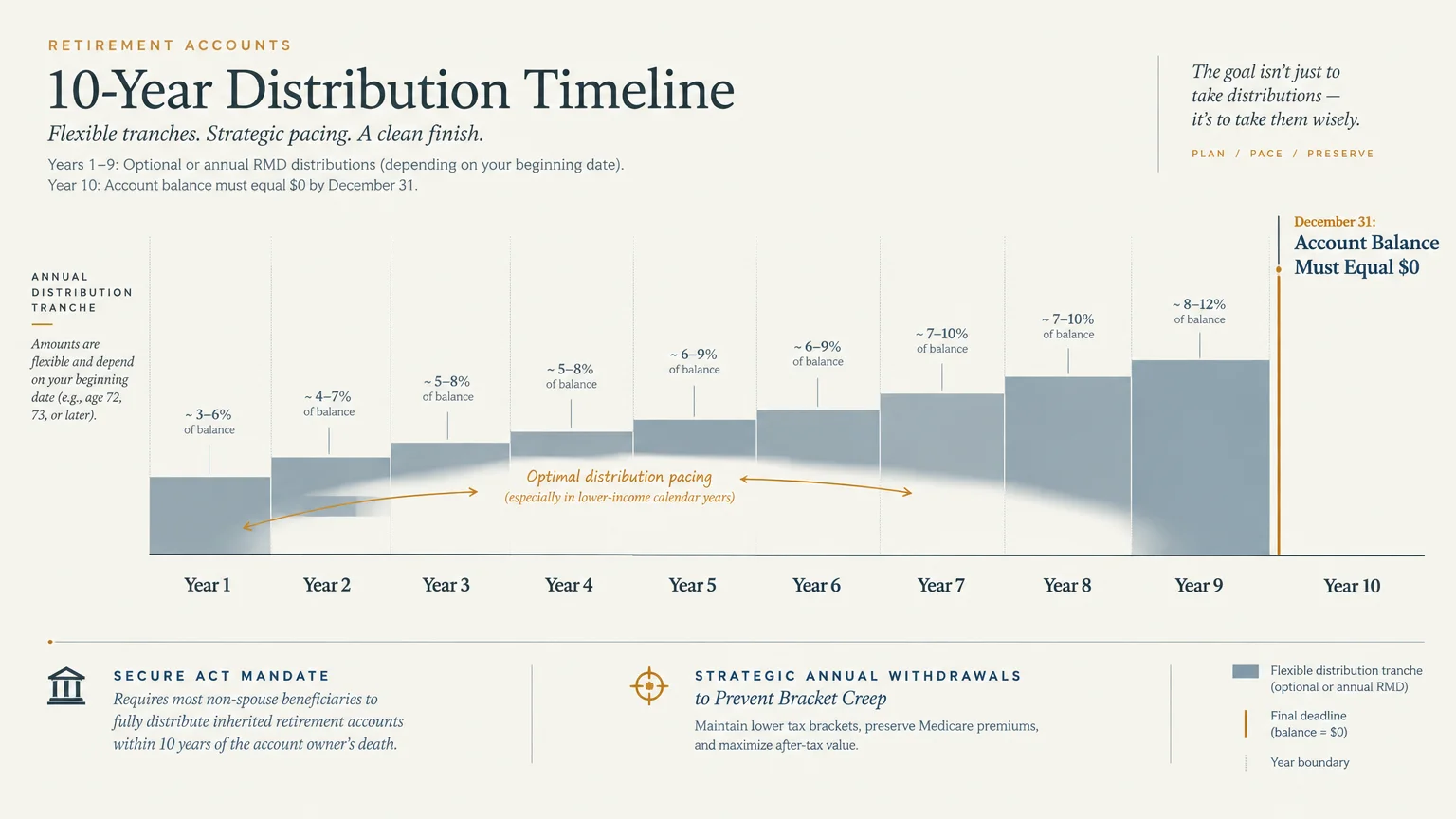
Most non-spouse heirs must withdraw all funds by December 31 of the tenth year following the owner’s death. This framework is formally known as the 10-year rule.
Under finalized inherited IRA rules, you must take annual distributions during years one through nine if the owner died after their required beginning date. You cannot defer all withdrawals to year ten.
Review educational materials from FINRA Investor Education to understand custodial processing schedules. Setting an early withdrawal schedule prevents last-minute year-end penalties.

5. Build a Multi-Year Tax Distribution Plan
Distributions from traditional accounts count as ordinary taxable income for the year you receive them. Large withdrawals can easily push you into a significantly higher federal tax bracket.
Spreading withdrawals across the entire ten-year window helps smooth out your taxable income. This measured pace prevents sudden tax spikes that diminish your inheritance.
Higher taxable income also increases your Medicare Part B and Part D premiums through IRMAA surcharges. Modeling distributions against your other income sources keeps healthcare costs predictable.
- Map out projected earnings and Social Security benefits for the next decade.
- Distribute more funds during lower-income bridge years before starting your own RMDs.
- Coordinate with charitable giving strategies to offset income spikes.

6. Maximize an Inherited Roth Account
Inherited Roth IRAs follow the same 10-year timeline, but they do not require annual distributions during years one through nine. Because original Roth owners have no lifetime RMDs, heirs avoid yearly mandates.
This favorable rule allows you to leave the entire balance invested for tax-free compounding. You can let the assets grow untouched until the final month of the tenth year.
When you finally empty the account in year ten, the entire balance comes out tax-free. This approach produces the maximum possible financial benefit from the inheritance.
7. Evaluate Inherited 401(k) Rollover Options
When managing an inherited 401k, review the specific plan document provided by the employer. Workplace plans often enforce stricter payout rules than standalone IRAs, including accelerated liquidation requirements.
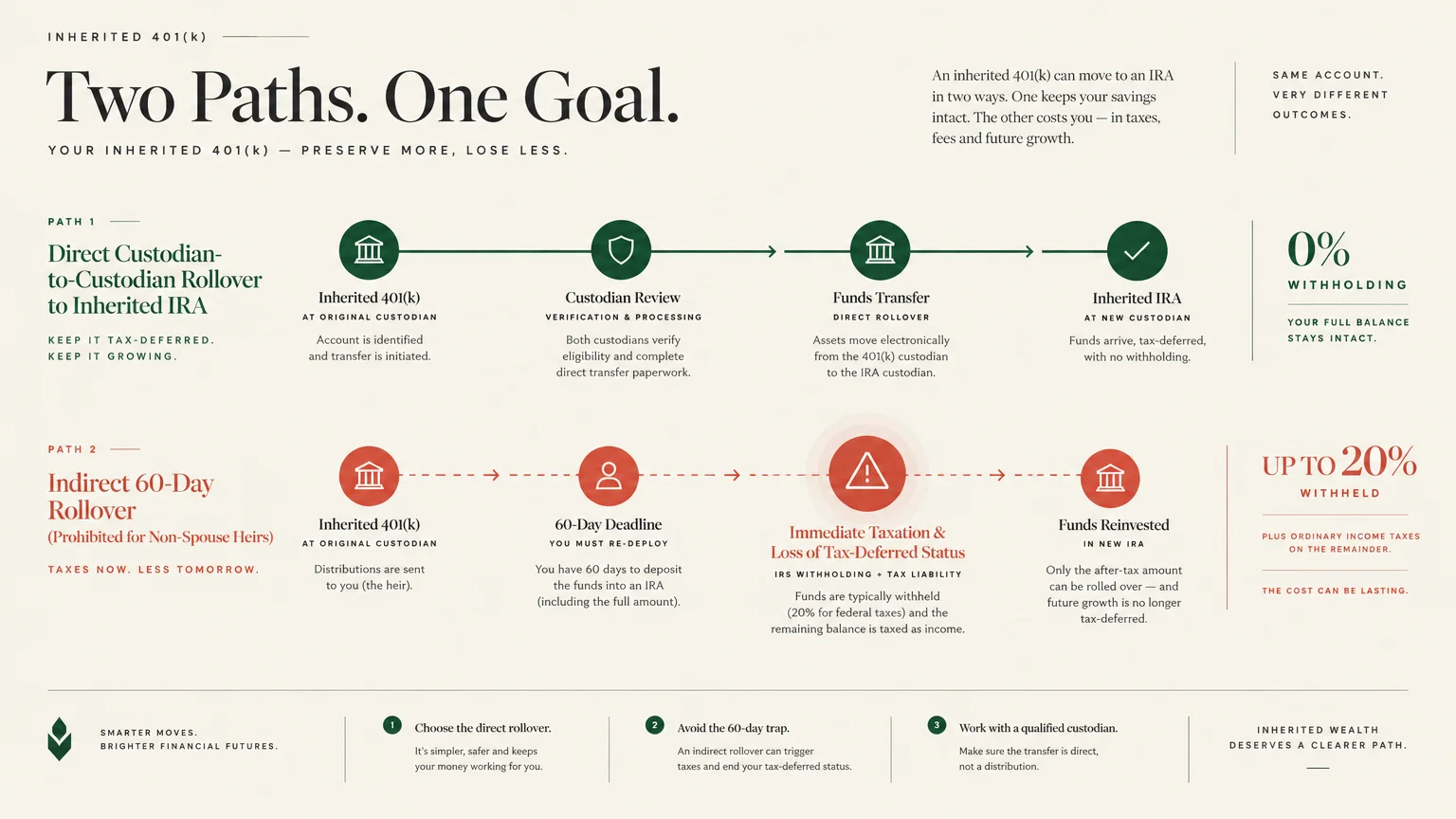
You can execute a direct trustee-to-trustee rollover into a beneficiary IRA to gain broader investment flexibility. This rollover preserves your standard ten-year withdrawal timetable.
Never request a distribution check payable directly to yourself. Plan administrators must automatically withhold 20 percent for federal taxes on direct employee distributions to heirs.
Refer to tax planning guides from Kiplinger to evaluate fees and investment options before moving your employer plan assets.

8. Review Qualified Disclaimer Options
You have the legal right to decline an inheritance through a qualified disclaimer. Disclaiming sends the retirement assets directly to the next contingent beneficiary named on the original form.
This technique proves useful if you already have a substantial estate and want the money to benefit younger generations in lower tax brackets. It also shields the funds from personal creditors.
Federal rules mandate executing the disclaimer in writing within nine months of the owner’s death. Furthermore, you cannot exercise control over or accept any funds before disclaiming.

9. Designate Your Own Successor Beneficiaries
Inherited accounts do not automatically pass to your heirs according to your standard will. You must complete a separate successor beneficiary designation form with the custodian.
Naming a successor beneficiary ensures smooth asset transition if you die before completing the ten-year schedule. Without named beneficiaries, the remaining funds may get tied up in probate.
A successor beneficiary steps directly into your remaining schedule rather than receiving a new ten-year period. Keeping beneficiary designations current provides peace of mind for your family.

Avoiding Common Errors
Rushing to liquidate an inherited account in a single lump sum remains the most frequent financial mistake heirs make. A lump sum triggers an avoidable tax bill at top marginal rates.
Another prevalent misstep involves missing the deceased owner’s final RMD deadline. Always confirm whether the decedent completed their annual requirement before year-end.
Heirs also forget to assess state income taxes alongside federal levies. Depending on where you live, state income taxes can eat up a substantial portion of each distribution.
Failing to account for Medicare IRMAA thresholds can sharply raise your healthcare premiums two years later. Always project how withdrawals impact your modified adjusted gross income.

When DIY Isn’t Enough
While straightforward inheritances are manageable alone, complex estate situations demand professional guidance. A fee-only financial planner or CPA can prevent costly, irreversible mistakes.
Consult a specialist if a trust is named as the retirement account beneficiary. Trust distribution rules are notoriously complex and can trigger punitive trust-level tax rates if handled improperly.
Professional help is also vital when multiple siblings share an account with differing financial needs. Establishing separate inherited IRAs before IRS deadlines prevents conflicts over distribution timing.
You should also consult an adviser if the deceased person’s estate owes federal estate taxes. You may qualify for an Income in Respect of a Decedent tax deduction that lowers your burden.
Frequently Asked Questions
Can I roll an inherited IRA into my own existing IRA?
Only surviving spouses can roll an inherited IRA into their personal retirement account. Non-spouse beneficiaries must maintain the assets in a separate, properly titled beneficiary IRA.
What happens if I miss the 10-year withdrawal deadline?
If you fail to withdraw all assets by December 31 of the tenth year, the IRS imposes an excise tax on the remaining balance. The penalty is 25 percent, reducible to 10 percent if corrected promptly.
Are distributions from an inherited Roth IRA taxable?
Distributions from an inherited Roth IRA are typically free from federal income tax. However, the original Roth account must satisfy the five-year aging rule for earnings to come out tax-free.
Does the 10-year rule apply to spouse beneficiaries?
Spouse beneficiaries are exempt from the 10-year rule. Surviving spouses can roll the assets into their own IRA or utilize spousal lifetime distribution options.
Next Steps for Your Inherited Accounts
Begin by gathering the decedent’s account statements, securing certified copies of the death certificate, and contacting the financial custodian. Establishing a clear timeline protects the legacy your loved one built.
The information in this guide is meant for educational purposes. Your specific circumstances—including income, health needs, tax situation, and goals—may require different approaches. When in doubt, consult a licensed professional.
Last updated: March 2026. Retirement benefits, tax rules, and healthcare regulations change frequently—verify current details with official sources.









Leave a Reply