
When you transition into retirement, a sudden spike in your Medicare premiums can trigger an unwelcome financial shock. The Social Security Administration assesses the Income-Related Monthly Adjustment Amount, known as IRMAA, using tax returns from two years prior—meaning your high pre-retirement salary or a one-time severance payout might incorrectly inflate your current Part B and Part D premiums. Luckily, you do not have to accept this unfair surcharge. By filing an IRMAA appeal using Form SSA-44 after experiencing a qualifying life-changing event like retirement, you can lower your Medicare costs back to baseline levels and preserve thousands of dollars of your hard-earned retirement savings.

What Is IRMAA and Why Does It Catch Retirees Off Guard?
The Income-Related Monthly Adjustment Amount (IRMAA) is an extra fee added to your Medicare Part B (medical insurance) and Medicare Part D (prescription drug coverage) monthly premiums. Congress established this surcharge to ensure that higher-income beneficiaries pay a larger percentage of the actual costs of their healthcare coverage. While standard Medicare premiums receive substantial government subsidies, IRMAA reduces those subsidies for retirees who cross specific income thresholds.
Data from the Centers for Medicare & Medicaid Services (CMS) shows that roughly 8% of Medicare beneficiaries pay an IRMAA surcharge each year. While 8% sounds like a modest portion of the population, it represents millions of retirees—many of whom are not actually wealthy, but simply experienced a single year of elevated income right before retiring.
For 2025, the standard baseline Medicare Part B premium is $185.00 per month. However, if your income exceeds the initial statutory threshold—$106,000 for single tax filers or $212,000 for married couples filing jointly—you will face mandatory monthly surcharges. These surcharges are progressive; as your reported income increases through specific brackets, your monthly Part B and Part D payments rise dramatically.
To determine whether you must pay IRMAA, the Social Security Administration (SSA) looks at your Modified Adjusted Gross Income (MAGI). For Medicare surcharge purposes, MAGI is calculated using a specific formula:
MAGI = Adjusted Gross Income (AGI) + Tax-Exempt Interest Income
This formula surprises many retirees because tax-exempt interest—such as interest earned from municipal bonds—is added directly back to your Adjusted Gross Income (Line 11 of IRS Form 1040) when evaluating your Medicare eligibility tiers. As a result, municipal bond portfolio interest that is completely tax-free on your federal return can easily push your MAGI into a higher IRMAA surcharge bracket.
The Two-Year Lookback Trap Explained
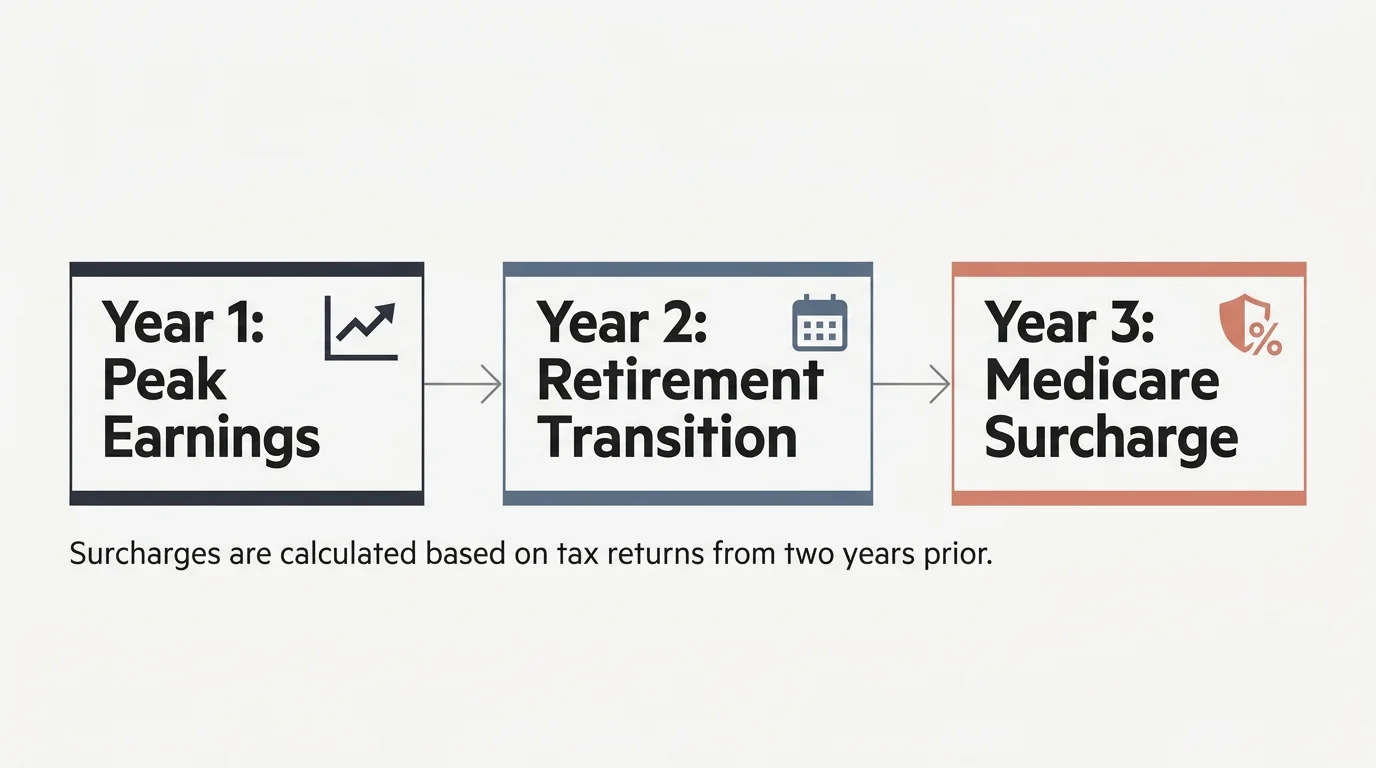
The primary reason IRMAA notices shock newly retired Americans is the two-year lookback rule. The Social Security Administration relies on processed federal income tax returns provided directly by the Internal Revenue Service (IRS). Because current-year tax returns are not complete or processed when initial Medicare calculations take place, Social Security uses your tax return from two years prior to set your current premium rates.
For example, your 2025 Medicare Part B and Part D premiums depend entirely on the MAGI reported on your 2023 tax return. Similarly, your 2026 Medicare premiums rely on your 2024 tax filing. This two-year lag creates a massive structural disconnect for individuals transitioning out of the workforce.
Consider a typical scenario: In 2023, you were working full-time in your peak earning years, generating $230,000 as a joint household income. You retired in late 2024. In 2025, your actual household income drops to $75,000, funded by Social Security benefits and modest portfolio withdrawals. However, when you enroll in Medicare for 2025, Social Security examines your 2023 tax return, sees $230,000 in income, and automatically slaps you with Tier 1 IRMAA surcharges on both Part B and Part D.
Beyond standard W-2 salary earnings, several common financial events in your final working years can trigger the two-year lookback trap:
- Receiving a large severance package or accumulated leave payout upon retirement
- Selling a primary residence, second home, or real estate investment property
- Executing a major Roth IRA conversion to optimize long-term retirement accounts
- Taking a substantial one-time distribution from a traditional IRA or 401(k) plan
- Exercising stock options or realizing significant capital gains in taxable trading accounts
Social Security assumes your current financial reality matches the high income reported on your tax return two years ago. Unless you proactively challenge their determination, you will automatically pay hundreds—or even thousands—of dollars in extra healthcare premiums every year. Fortunately, filing a targeted Medicare income-related surcharge appeal breaks this automatic link and aligns your premiums with your real-time financial situation.

The 8 Qualifying Life-Changing Events for an IRMAA Appeal
You cannot appeal an IRMAA surcharge simply because you feel it is unfair or because your investment portfolio experienced a market drop. The Social Security Administration strictly mandates that to successfully file an irmaa appeal life changing event, your income reduction must result from one of eight specific, recognized categories.
If your situation matches one of these official categories, Social Security will grant an adjustment and recalculate your premiums using your lower estimated income for the current year rather than your tax return from two years prior.
1. Work Stoppage
Work stoppage is the most common reason for filing an appeal. It applies when you or your spouse completely stop working due to retirement, layoff, resignation, or corporate closure. To support this claim, you must provide proof such as an employer letter confirming your retirement date, a formal severance agreement, or Form W-2 showing a drastic drop in income.
2. Work Reduction
If you have not fully retired but significantly reduced your working hours—such as transitioning from full-time employment to part-time, consulting, or partial retirement—you qualify under work reduction. Proof requires a written statement from your employer detailing the reduction in hours and pay, or business accounting records if you are self-employed.
3. Marriage
If you recently got married, your filing status changes. Combining tax filings or shifting from single to married filing jointly alters the income thresholds that apply to your household. You must provide a valid marriage certificate alongside an estimate of your joint MAGI.
4. Divorce or Annulment
A divorce or legal annulment often substantially reduces household income, but it also alters your tax filing status back to single. You must submit a certified copy of your legal divorce decree or annulment paper along with your updated income estimates.
5. Death of a Spouse
The loss of a spouse causes both emotional and financial strain. When a spouse passes away, pension benefits, Social Security payments, or individual earnings often decrease. Furthermore, the surviving spouse eventually shifts from “Married Filing Jointly” tax brackets to the much tighter “Single” filing brackets—a phenomenon known as the tax widow trap. Submitting a certified death certificate enables Social Security to adjust your premiums immediately.
6. Loss of Income-Producing Property
This event applies if you experienced a dramatic loss of income from income-producing property due to factors beyond your control. Qualifying events include natural disasters, severe casualty losses, property destruction, bank fraud, or eminent domain seizures. Crucially, standard real estate market fluctuations or normal equity drops do not qualify under this category.
7. Loss or Reduction of Pension Income
If your pension income was reduced or eliminated due to corporate bankruptcy, plan termination, or a fixed-period annuity payout ending, you can request an IRMAA recalculation. You must provide official documentation from the pension plan administrator outlining the reduction details.
8. Employer Settlement Payment
If you received a one-time settlement payout from a current or former employer due to corporate bankruptcy, reorganization, or litigation, that payment may have artificially inflated your tax return two years ago. Providing settlement documentation proves that this payment was a temporary event that will not recur in the present year.
“Managing your expenses in retirement isn’t just about spending less; it’s about protecting every dollar from unnecessary fees and unexpected tax penalties that quietly erode your nest egg.” — Jean Chatzky, Financial Journalist and Author
SSA-44 vs. SSA-561-U2: Choosing the Correct Appeal Form
Selecting the correct irmaa appeal form determines whether Social Security approves or denies your request. Retirees often make the mistake of using generic appeal paperwork, which causes lengthy processing delays or outright rejections.
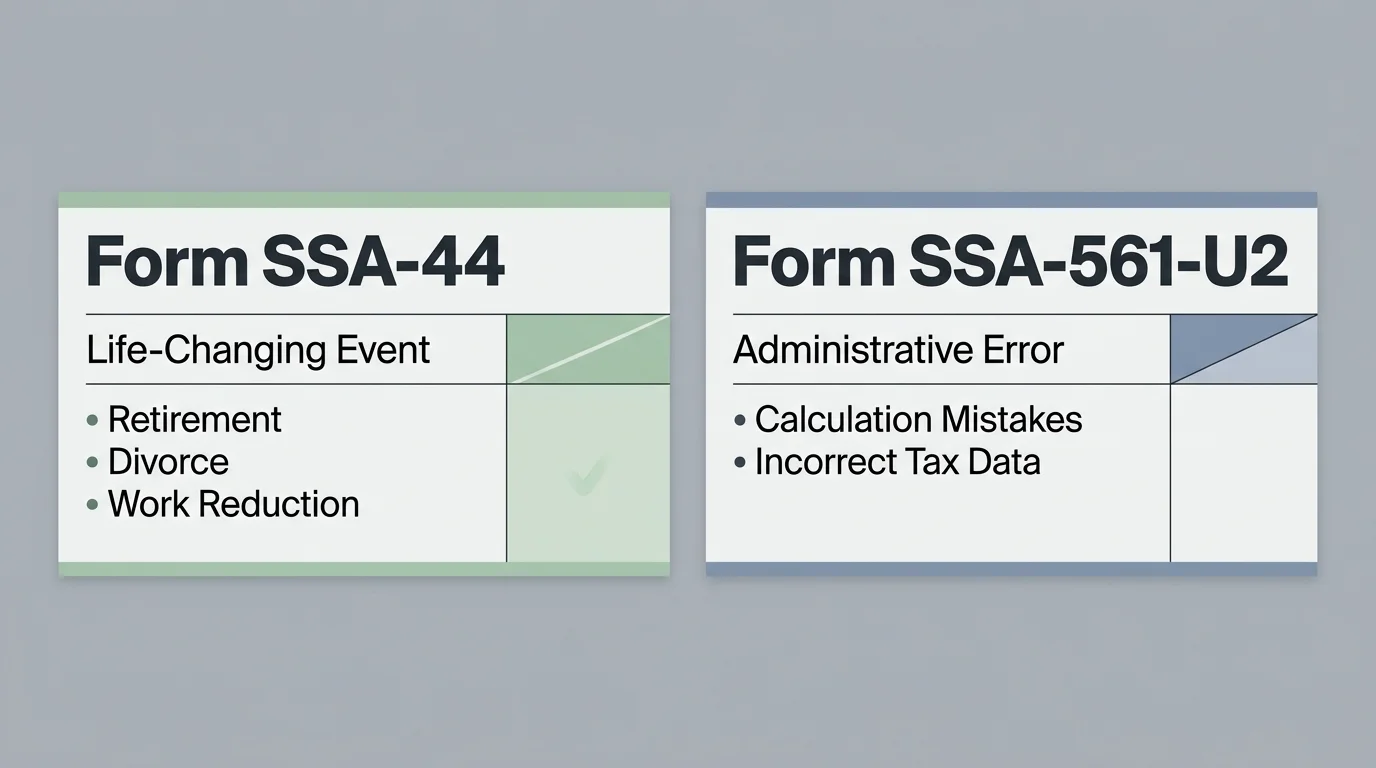
There are two primary forms used to challenge an IRMAA determination: Form SSA-44 and Form SSA-561-U2. Each serves a distinct legal and administrative purpose.
You should file Form SSA-44 (officially titled Medicare Income-Related Monthly Adjustment Amount – Life-Changing Event) when you experienced one of the eight qualifying life-changing events listed above, and your income for the current year is significantly lower than the income reported on your tax return two years ago. Form SSA-44 allows you to report your estimated MAGI for the current tax year so Social Security can base your Medicare rates on real-time numbers.
Conversely, you should submit Form SSA-561-U2 (officially titled Request for Reconsideration) when you believe Social Security made an administrative or accounting error. For example, use Form SSA-561-U2 if the IRS supplied incorrect tax transcripts, if you filed an amended tax return (Form 1040-X) that reduced your past MAGI, or if you were a victim of tax identity theft where someone fraudulently filed a return using your Social Security number.
| Feature / Criteria | Form SSA-44 | Form SSA-561-U2 |
|---|---|---|
| Primary Appeal Purpose | Income dropped due to a Qualifying Life-Changing Event | Correction of inaccurate tax data or Social Security calculation error |
| Triggering Scenario | Retirement, work reduction, spousal death, divorce, or pension loss | Amended tax return (1040-X), IRS processing error, or identity fraud |
| Core Requirement | Must estimate current/next year MAGI and provide proof of event | Must prove original tax data used by SSA was factually incorrect |
| Filing Deadline | Ideally within 60 days of receiving Initial IRMAA Notice | Strictly within 60 days of receiving Initial IRMAA Notice |
| Key Evidence Needed | Employer letters, death/marriage certificates, recent tax returns | Corrected IRS transcripts, filed 1040-X, IRS correction letters |

Step-by-Step Guide: How to File Your IRMAA Appeal Form
Knowing how to lower irmaa surcharges requires a systematic approach. Follow this step-by-step procedure to ensure Social Security processes your request efficiently and approves your premium adjustment.
Step 1: Review Your Initial IRMAA Determination Notice
In late autumn—usually around November or December—Social Security mails notice letters (Form B-1200 or similar initial determination letters) informing beneficiaries of their Medicare Part B and Part D premiums for the upcoming calendar year. Review this document carefully. Check the Modified Adjusted Gross Income figure listed on the notice and identify which tax year Social Security examined.
Step 2: Confirm Your Qualifying Life-Changing Event
Verify that your financial situation matches one of the eight qualifying categories. Gather exact dates for the event (such as your precise retirement date or the date of a spousal loss). You cannot complete the appeal form accurately without exact dates.
Step 3: Calculate Your Estimated MAGI for the Current Year
Form SSA-44 asks you to estimate your Modified Adjusted Gross Income for the current calendar year (and sometimes the upcoming year). To calculate this accurately, review your current income sources:
- Taxable pension payouts and traditional IRA/401(k) distributions
- Social Security taxable benefits
- W-2 earnings or net self-employment earnings earned prior to retirement
- Taxable interest, dividends, and realized capital gains
- Tax-exempt interest income (municipal bond interest)
Add your expected Adjusted Gross Income to your tax-exempt interest to reach your estimated MAGI. Be realistic and conservative; if you understate your income, Social Security will audit your actual tax returns later and bill you retroactively for the unpaid surcharges.
Step 4: Complete Form SSA-44
Download the official form from SSA.gov or obtain a physical copy from your local Social Security field office. Complete the sections as follows:
- Step 1: Select your specific Life-Changing Event from the checkbox list and enter the exact date the event occurred.
- Step 2: Enter your estimated MAGI for the year the income dropped, along with your tax filing status (e.g., Single, Married Filing Jointly).
- Step 3: If your income will be even lower in the following tax year, provide estimates for that subsequent year as well.
- Step 4: Sign, date, and provide contact details. Ensure both spouses sign if filing jointly and appealing shared surcharges.
Step 5: Gather Official Supporting Documentation
Social Security will reject an appeal that lacks supporting evidence. Include official documentation matching your life-changing event:
- For Work Stoppage or Reduction: A formal letter signed by your human resources department stating your retirement or hours reduction date, or a signed copy of Form W-2.
- For Death or Divorce: A certified death certificate or certified legal divorce decree.
- For Tax Documentation: A signed copy of your most recent federal tax return, IRS tax transcripts, or recent 1099/W-2 statements showing your reduced earnings.
Step 6: Submit the Appeal Package
You can submit your completed Form SSA-44 and original supporting documents using two primary methods:
Method A (Recommended): Schedule an In-Person Appointment. Call your local Social Security field office to schedule an in-person submission. An agent will review your paperwork on the spot, copy original documents (returning originals to you immediately), and input your updated MAGI estimates into the system. This speeds up processing times dramatically.
Method B: Certified Mail with Return Receipt Requested. Mail your completed packet directly to your local Social Security field office. Use USPS Certified Mail so you have physical confirmation of delivery. Avoid mailing original, irreplaceable legal documents through regular mail unless required, or request certified copies from issuing authorities.
Step 7: Track Your IRMAA Reconsideration Request
After filing your irmaa reconsideration request, Social Security typically takes between 30 and 90 days to process the paperwork. Once approved, Social Security issues a revised determination letter confirming your new Medicare Part B and Part D rates. If you already paid inflated premiums during the processing window, Social Security will credit those overpayments directly back to your Social Security benefit check or issue a reimbursement refund.

Understanding IRMAA Tiers and Potential Cost Savings
Understanding the multi-tiered structure of Medicare surcharges underscores why filing an appeal offers significant financial benefits. IRMAA works as a step-function system; earning just one single dollar over a bracket threshold forces you into the higher premium tier for the entire year.
The table below breaks down the 2025 Medicare Part B baseline rates and additional IRMAA surcharges across single and married tax filing brackets. Baseline Part D plans vary by provider, but the Part D IRMAA surcharge is added directly to your plan’s monthly premium.
| Individual Filing (2023 MAGI) | Joint Filing (2023 MAGI) | Part B Monthly Surcharge | Total Part B Monthly Premium | Part D Monthly Surcharge |
|---|---|---|---|---|
| $106,000 or less | $212,000 or less | $0.00 | $185.00 | $0.00 |
| $106,001 – $133,000 | $212,001 – $266,000 | +$74.00 | $259.00 | +$13.70 |
| $133,001 – $166,000 | $266,001 – $332,000 | +$185.00 | $370.00 | +$35.30 |
| $166,001 – $199,000 | $332,001 – $398,000 | +$295.90 | $480.90 | +$56.90 |
| $199,001 – $500,000 | $398,001 – $750,000 | +$406.90 | $591.90 | +$78.50 |
| Greater than $500,000 | Greater than $750,000 | +$443.90 | $628.90 | +$85.80 |
To put these numbers into context, consider a married couple who both enroll in Medicare Part B and Part D upon retiring in 2025. Based on their 2023 joint tax return of $300,000, Social Security places them in Tier 2. Each spouse pays $370.00 per month for Part B and an additional $35.30 per month for Part D. Combined, they pay $810.60 per month ($9,727.20 per year) in Medicare premiums.
By filing Form SSA-44 citing a work stoppage (retirement) and proving their current 2025 household MAGI will drop to $150,000, they successfully remove all IRMAA surcharges. Their combined monthly payment drops to the standard baseline of $370.00 per month ($4,440 per year). Successful execution of this simple appeal saves this couple $5,287.20 in cash every single year.
“Do not let administrative lag dictate your monthly cash flow in retirement. When your income drops, take immediate action to align your government expenses with your actual balance sheet.” — Suze Orman, Financial Expert
Common Mistakes to Avoid When Requesting an IRMAA Reconsideration
While filing an appeal is straightforward, simple mistakes can result in denials or unexpected back-taxes. Avoid these common pitfalls when appealing your Medicare surcharges:
1. Appealing Non-Qualifying Financial Events
The single most frequent error retirees make is submitting Form SSA-44 after experiencing an event that Social Security does not consider a valid life-changing event. For example, taking a large voluntary capital gain, selling stocks, completing a Roth IRA conversion, or selling an investment property do not qualify as life-changing events under SSA rules. Submitting appeals for these non-qualifying income spikes wastes time and results in automatic denials.
2. Forgetting to Include Tax-Exempt Interest in MAGI Calculations
When calculating estimated MAGI for Form SSA-44, many retirees look only at expected Adjusted Gross Income from Form 1040. Forgetting to add back tax-exempt interest (Line 2a on Form 1040) results in an inaccurate MAGI estimate. If your real MAGI ends up higher than reported, Social Security will re-evaluate your file, reverse your appeal approval, and issue a bill for unpaid retroactive surcharges.
3. Missing the 60-Day Appeal Window
Although Form SSA-44 for life-changing events offers some flexibility if a status change occurred recently, administrative reconsiderations using Form SSA-561-U2 carry a strict filing deadline. You must submit your appeal within 60 days of receiving your Initial IRMAA Determination letter. Delaying beyond this window requires proving good cause for missing the deadline.
4. Submitting Unverified or Incomplete Evidence
Social Security agents cannot process appeals based solely on self-written letters or verbal statements. Submitting Form SSA-44 without official documentation—such as an HR retirement letter, tax return copies, or legal certificates—causes processing delays. Always submit complete, verifiable proof alongside your completed appeal form.
5. Failing to Monitor Both Spouses’ Premiums
Because Medicare is an individual benefit, Social Security calculates IRMAA assessments individually, even if you file taxes jointly with your spouse. If both you and your spouse pay Medicare Part B and Part D premiums, you must ensure your appeal applies to both accounts. Submitting Form SSA-44 with signatures from both spouses ensures Social Security adjusts premiums for both individuals.

Professional vs. Self-Guided: When to Get Professional Help
Deciding whether to handle your Medicare appeal independently or seek professional assistance depends on the complexity of your financial situation. Here are standard scenarios comparing self-guided filing with professional guidance.
Scenario 1: Straightforward Retirement (Self-Guided)
If you retired from a standard W-2 employment position, experienced no unusual financial transactions, and possess a clear employer retirement letter alongside your previous tax returns, you can comfortably manage this process yourself. Completing Form SSA-44 and scheduling a local field office appointment requires minimal administrative effort and zero professional fees.
Scenario 2: Business Owners Selling Corporate Shares (Professional Guidance Recommended)
If you are a business owner selling company equity, dissolving a partnership, or receiving multi-year buyout payments alongside retirement, calculating current-year MAGI becomes complicated. Working with a Certified Public Accountant (CPA) or Certified Financial Planner (CFP®) ensures your MAGI estimates align perfectly with IRS regulations before submitting numbers to Social Security.
Scenario 3: Complex Asset Sales and Amended Returns (Professional Guidance Recommended)
If your elevated MAGI stems from an IRS reporting error or complex real estate transactions requiring amended tax returns (Form 1040-X), professional guidance is highly beneficial. A tax specialist can help navigate Form SSA-561-U2 and coordinate with IRS transcript services to ensure Social Security receives verified tax records promptly.
Scenario 4: Experiencing Multiple Life Events Simultaneously (Professional Guidance Recommended)
If you recently experienced a combination of life events—such as retiring in the same calendar year your spouse passed away or during a divorce—navigating tax filing adjustments alongside Medicare appeal brackets gets complex. A qualified financial advisory professional can model various filing options to maximize your Medicare premium savings while preventing unexpected tax liabilities.

Strategic Tax Planning to Prevent Future IRMAA Surcharges
While filing an appeal addresses immediate surcharges resulting from past income spikes, proactive financial planning helps you avoid triggering unexpected IRMAA tiers in future years. Incorporate these forward-looking tax strategies into your retirement plan:
1. Utilize Qualified Charitable Distributions (QCDs)
Once you reach age 70½, you can make Qualified Charitable Distributions (QCDs) directly from traditional IRA accounts to qualified non-profit charities. You can donate up to $105,000 per year (indexed for inflation) via QCDs. Because these funds transfer directly to charity without entering your Adjusted Gross Income, QCDs fulfill Required Minimum Distributions (RMDs) without increasing your MAGI or pushing you into higher IRMAA tiers.
2. Time Roth IRA Conversions Strategically
Roth IRA conversions represent a powerful tool for eliminating future RMDs and securing tax-free retirement growth. However, executing large conversions pushes your MAGI upward. To avoid IRMAA penalties, complete major Roth conversions in the years before you turn 63—prior to entering the two-year lookback window for Medicare enrollment at age 65. If you execute conversions after age 63, space them across multiple calendar tax years to keep your annual MAGI below the initial IRMAA threshold.
3. Manage Realized Capital Gains and Income Distribution
Instead of realizing substantial capital gains in a single tax year, stagger portfolio sales across several tax periods. Additionally, coordinate distributions across various account types—combining tax-free Roth IRA withdrawals, taxable traditional IRA distributions, and non-taxable taxable account basis—to meet cash flow needs while keeping reported MAGI under statutory IRMAA cliff lines.
4. Be Mindful of Tax-Exempt Municipal Bond Holdings
While municipal bond interest avoids federal income tax, remember that Social Security adds municipal interest directly back to AGI when evaluating your IRMAA status. Review income portfolio distributions with your investment manager to ensure municipal bond yields are not unintentionally triggering higher Medicare Part B and Part D premiums.
Frequently Asked Questions About IRMAA Appeals
How long does Social Security take to process an IRMAA appeal?
Processing times typically range from 30 to 90 days depending on your local Social Security field office’s workload. Submitting your completed Form SSA-44 in person during an official field office appointment generally yields faster processing than submitting via standard postal mail.
What happens if my actual income turns out higher than the estimate on Form SSA-44?
Social Security eventually cross-references your real tax returns from the IRS once filed. If your actual MAGI exceeds the estimate you provided on Form SSA-44 and pushes you into a higher IRMAA tier, Social Security will recalculate your premiums and issue a retroactive bill for the unpaid surcharge balances.
Can I appeal my IRMAA surcharge every single year?
Yes, you can file an appeal for subsequent years if your income remains low due to a qualifying life-changing event and tax lookback data has not yet caught up to your lower income reality. Once the two-year lookback tax return reflects your lower income level, Social Security will automatically apply the standard baseline rates without requiring further manual appeals.
Will Social Security refund surcharges I already paid before my appeal was approved?
Yes. If Social Security approves your IRMAA appeal, the rate adjustment applies retroactively to the effective date of your status change or the start of the coverage year. Any excess surcharges you paid will be refunded directly or credited back to your monthly Social Security benefit payment.
What is the strict deadline for submitting an IRMAA appeal?
If you are requesting a reconsideration based on an administrative error or tax data mistake using Form SSA-561-U2, you must submit the request within 60 days of receiving your Initial IRMAA Determination notice. For life-changing event appeals using Form SSA-44, you should file as soon as your qualifying event occurs or immediately upon receiving your annual premium determination notice.
Final Action Steps for Retirees
Receiving an unexpected Medicare surcharge notice can disrupt your financial plans, but paying elevated premiums is often unnecessary. If your household income dropped because you retired, reduced your hours, lost a spouse, or experienced another qualifying life-changing event, you have the legal right to challenge the assessment.
Take control of your retirement expenses today. Download Form SSA-44, gather your supporting HR letters or tax documents, calculate your updated MAGI, and schedule an appointment with your local Social Security field office. Taking these quick administrative steps ensures you keep more money in your pocket throughout retirement.
The information in this guide is meant for educational purposes. Your specific circumstances—including income, health needs, tax situation, and goals—may require different approaches. When in doubt, consult a licensed professional.
Last updated: March 2026. Retirement benefits, tax rules, and healthcare regulations change frequently—verify current details with official sources.









Leave a Reply