
Missing out on valuable tax credits can silently drain thousands of dollars from your retirement nest egg. A tax credit cuts your tax bill dollar for dollar, making it vastly more valuable than a standard deduction.
Many retirees assume leaving the workforce eliminates their eligibility for lucrative federal incentives. In reality, modern tax laws offer substantial relief for older adults managing healthcare, caregiving, investments, and home improvements.
Claiming these overlooked tax breaks seniors qualify for can instantly reduce what you owe or generate a substantial refund. Here are ten valuable senior tax credits you should evaluate before filing your next tax return.
Tax Credits vs. Tax Deductions: Why the Difference Matters
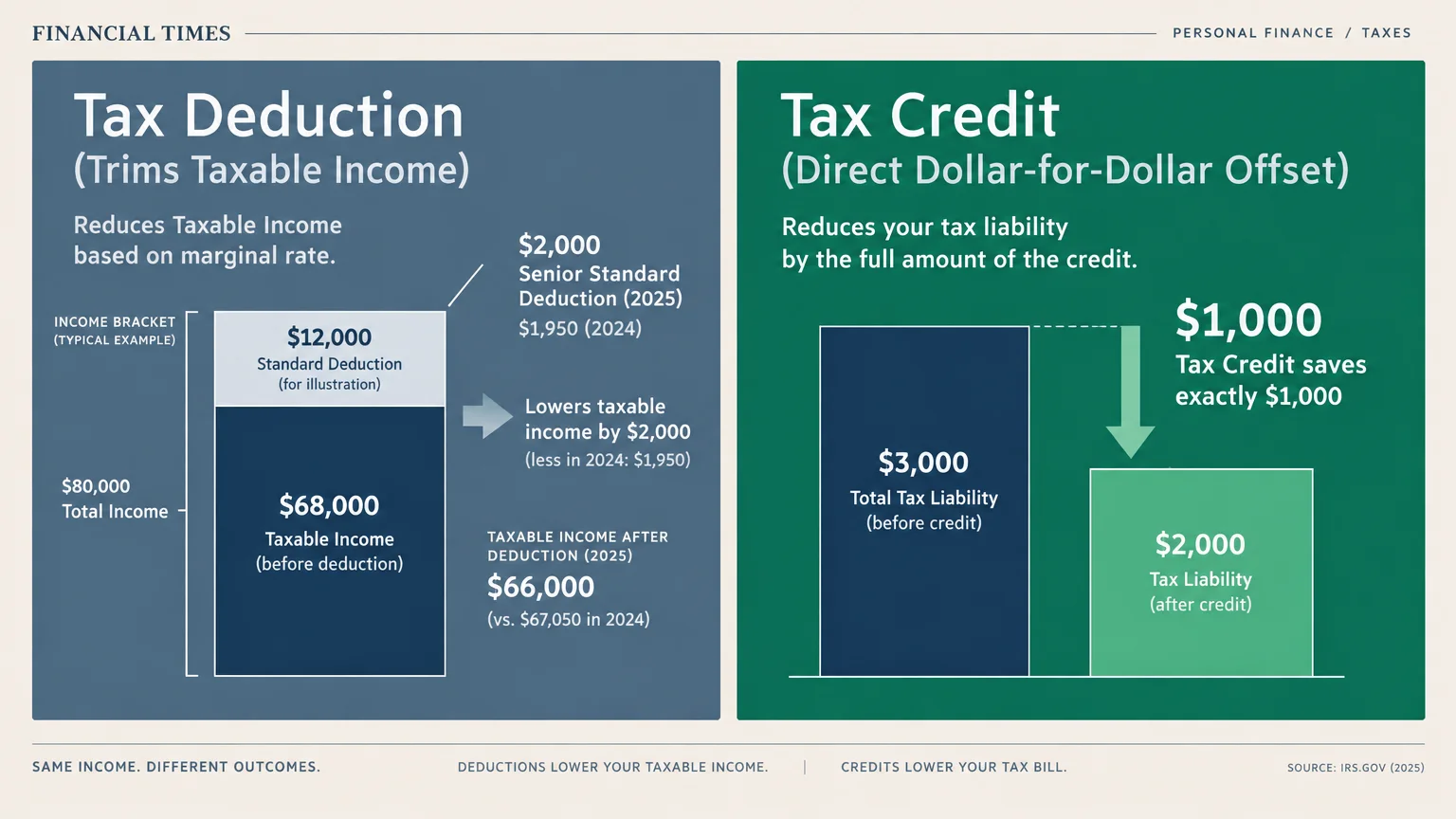
Understanding the distinction between deductions and credits is essential for maximizing your retiree tax savings. A tax deduction reduces your overall taxable income based on your marginal tax bracket.
In contrast, a tax credit directly offsets your final tax liability on a dollar-for-dollar basis. A $1,000 tax credit saves you exactly $1,000 in taxes regardless of your income bracket.
Taxpayers age 65 and older often confuse tax credits with the additional standard deduction. For tax year 2024, seniors receive an extra standard deduction of $1,950 if single or $1,550 per qualifying spouse.
For tax year 2025, that additional deduction rises to $2,000 for single filers and $1,600 per spouse. While helpful, deductions only trim your taxable income; tax credits wipe out your tax bill directly.
“An investment in knowledge pays the best interest.” — Benjamin Franklin
1. Credit for the Elderly or the Disabled (Schedule R)
The Internal Revenue Service (IRS) designed the credit for the elderly or disabled specifically for lower-income seniors. You qualify if you are age 65 or older by the end of the tax year.
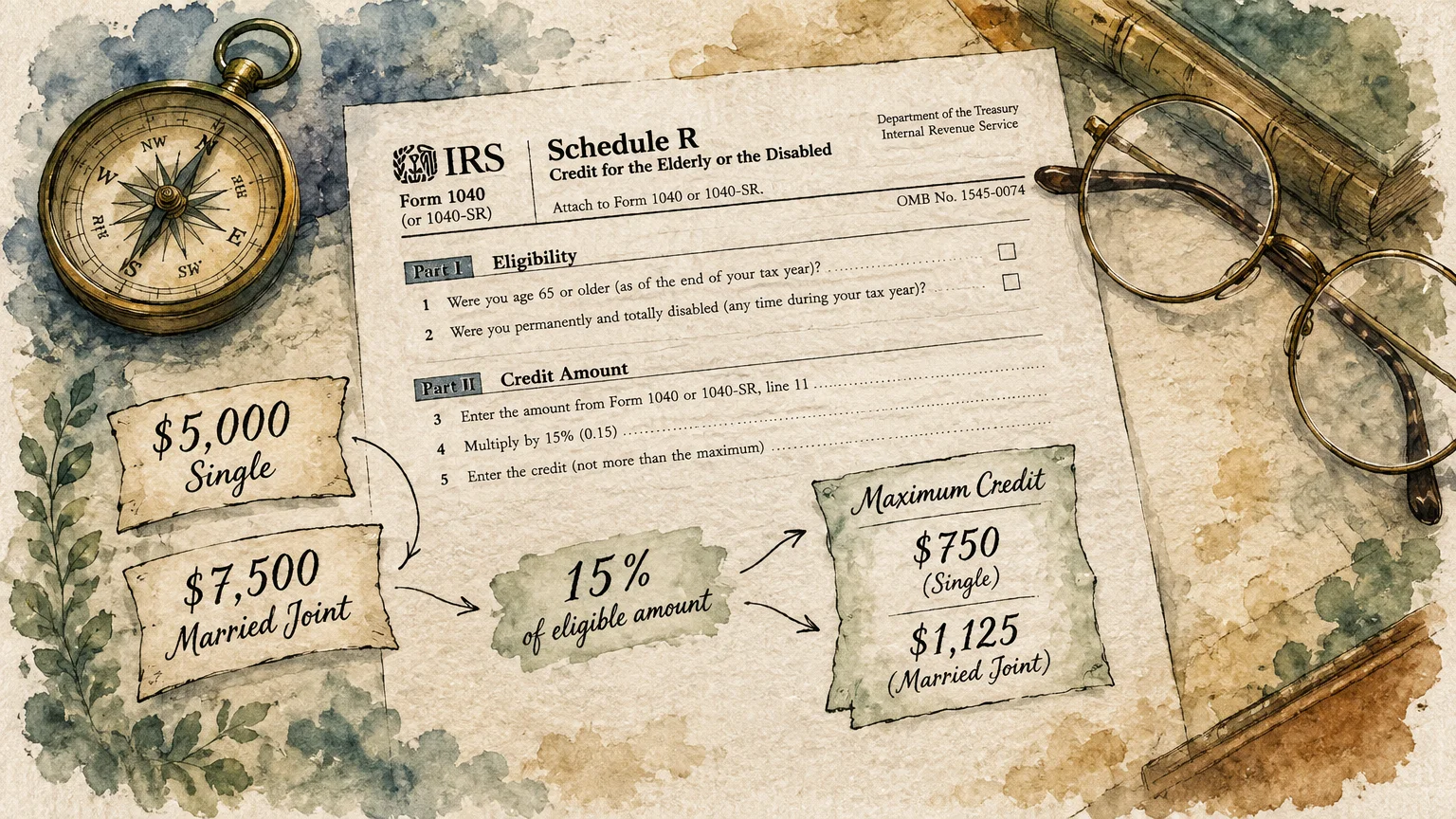
You can also qualify under age 65 if you retired on permanent and total disability. You calculate this nonrefundable credit on Schedule R and attach it to your Form 1040.
The initial statutory base amount is $5,000 for single filers and $7,500 for married couples filing jointly where both spouses qualify. Married taxpayers filing separately receive a base amount of $3,750.
The maximum credit equals 15% of that base amount. This calculation translates to a top potential credit of $750 for individuals or $1,125 for qualifying joint filers.
Strict income limits apply because Congress has not indexed these base thresholds for inflation. Your adjusted gross income (AGI) must stay below $17,500 if you file as single or head of household.
For married couples filing jointly, your AGI must remain under $20,000 with one qualifying spouse, or $25,000 when both spouses qualify. Your nontaxable Social Security or pension benefits must also stay below $5,000 single or $7,500 joint.

2. The Saver’s Credit for Part-Time Working Retirees
Many seniors transition into retirement by working part-time, consulting, or operating small passion businesses. If you earn wages and contribute to an IRA or retirement plan, you may qualify for the Saver’s Credit.
Officially called the Retirement Savings Contributions Credit, this break rewards moderate-income earners who continue building savings. You claim the credit by filing IRS Form 8880 alongside your tax return.
The credit provides a nonrefundable benefit worth 10%, 20%, or 50% of your eligible retirement plan contributions. The maximum contribution considered for the credit is $2,000 for single filers and $4,000 for joint returns.
This cap delivers a maximum possible credit of $1,000 for individuals or $2,000 for married couples filing jointly. Eligible accounts include traditional IRAs, Roth IRAs, 401(k) plans, 403(b) annuities, and ABLE accounts.
For tax year 2024, the AGI limit is $38,250 for single filers, $57,375 for heads of household, and $76,500 for married couples. In 2025, those thresholds adjust to $39,500 single, $59,250 head of household, and $79,000 married joint.
Be aware that under the SECURE 2.0 Act, major structural changes arrive in tax year 2027. The current tax credit will transform into the federal Saver’s Match, depositing up to $1,000 directly into your retirement account.

3. Credit for Other Dependents: Caring for Aging Relatives
Retirees frequently provide shelter and financial support for aging parents, elderly relatives, or adult disabled children. If you provide more than half of their financial support, you could claim the Credit for Other Dependents.
Sometimes called the Family Tax Credit, this nonrefundable incentive offers up to $500 per qualifying individual. It covers dependents who do not qualify for the traditional Child Tax Credit.
To qualify, the individual must be a U.S. citizen, U.S. national, or resident alien. You must provide over half of their annual support, including housing, food, utilities, and medical care.
The dependent’s gross taxable income must generally fall below the statutory limit for qualifying relatives, excluding nontaxable Social Security. This credit begins phasing out at an AGI of $200,000 for single filers and $400,000 for married joint filers.

4. Child and Dependent Care Credit for Caregivers
If you work part-time or manage a small business while caring for an incapacitated family member, you may qualify for substantial relief. The Child and Dependent Care Credit applies to adult care expenses under specific circumstances.
You claim this credit on Form 2441 when paying for care that allows you to work or actively look for work. The care recipient must be a spouse or dependent who is physically or mentally incapable of self-care.
The credit equals 20% to 35% of your qualifying employment-related care costs, depending on your adjusted gross income. You can claim up to $3,000 in expenses for one individual or up to $6,000 for two or more individuals.
This formula yields a maximum credit of $1,050 for one qualifying individual and up to $2,100 for two or more individuals. Qualifying expenses include adult day care center fees, licensed companion services, and in-home care attendants.

5. Earned Income Tax Credit for Senior Caregivers
The Earned Income Tax Credit (EITC) is one of the most generous refundable tax credits available. Working seniors without children typically lose eligibility once they turn 65, but an important exception protects older caregivers.
Working grandparents or seniors caring for a qualifying child or grandchild can claim the EITC at any age. There is no upper age ceiling if you maintain a home for a qualifying dependent child.
To qualify, you must have earned income from active work, consulting, or self-employment during the year. Passive income from pensions, 401(k) distributions, annuities, and Social Security benefits does not count as earned income.
Because the EITC is fully refundable, it can eliminate your tax liability and deliver a cash refund even if you owe nothing. Review your eligibility annually, as household size and earned income dictate the exact credit amount.

6. Energy Efficient Home Improvement Credit (Section 25C)
Many retirees invest in home upgrades to lower monthly utility bills and age comfortably in place. The Energy Efficient Home Improvement Credit under Internal Revenue Code Section 25C offsets these modernization expenses.
This nonrefundable credit equals 30% of the cost of qualified energy-efficiency upgrades made to an existing primary residence. The credit resets every year through 2032, allowing you to stage home improvements strategically over several years.
You can claim up to $1,200 annually for general building envelope improvements, including exterior doors, energy-efficient windows, and home insulation. Specific caps apply within this limit, such as $250 per exterior door and $600 for replacement windows.
An additional annual limit of up to $2,000 applies to qualified electric heat pumps, heat pump water heaters, and biomass stoves. By pairing weatherization with a heat pump installation, you can secure up to $3,200 in annual tax credits.

7. Residential Clean Energy Credit (Section 25D)
If you plan a major green energy renovation on your retirement property, Section 25D provides exceptional financial backing. The Residential Clean Energy Credit offers a 30% tax credit for qualified clean energy equipment installed through 2032.
Unlike standard home improvement incentives, this credit features no maximum annual dollar cap. Eligible upgrades include rooftop solar electric panels, solar water heating systems, geothermal heat pumps, and small wind energy systems.
Home battery storage systems with a capacity rating of 3 kilowatt-hours or greater also qualify for the full 30% credit. Adding battery storage helps seniors maintain reliable backup power during extreme weather grid outages.
Because this credit is nonrefundable, it cannot reduce your tax balance below zero in a single filing year. However, you can carry forward any unused credit balance into future tax years to offset upcoming liabilities.
“Retirement is not the end of the road. It is the beginning of an open highway where controlling your costs matters more than ever.” — Jean Chatzky, Financial Educator

8. Used Clean Vehicle Credit (Section 25E)
Retirees looking to lower driving costs often downsize to an efficient electric or plug-in hybrid vehicle. Under Section 25E, purchasing an eligible pre-owned clean vehicle provides a valuable nonrefundable tax credit.
The credit equals 30% of the vehicle purchase price, up to a maximum credit of $4,000. You can take the credit at tax filing or transfer it directly to an eligible dealer to lower the purchase price immediately.
To qualify, the pre-owned vehicle must have a sales price of $25,000 or less and be at least two model years old. You must purchase the vehicle through a licensed automobile dealership that reports the transaction directly to the IRS.
Your modified AGI cannot exceed $75,000 for single filers, $112,500 for heads of household, or $150,000 for married couples filing jointly. You can only claim this credit once every three years.
9. Simplified Foreign Tax Credit for Brokerage Accounts
Many retirees invest in international mutual funds or broad market exchange-traded funds (ETFs) to diversify their portfolios. These foreign holdings often pay taxes directly to overseas governments before distributing dividends to U.S. investors.
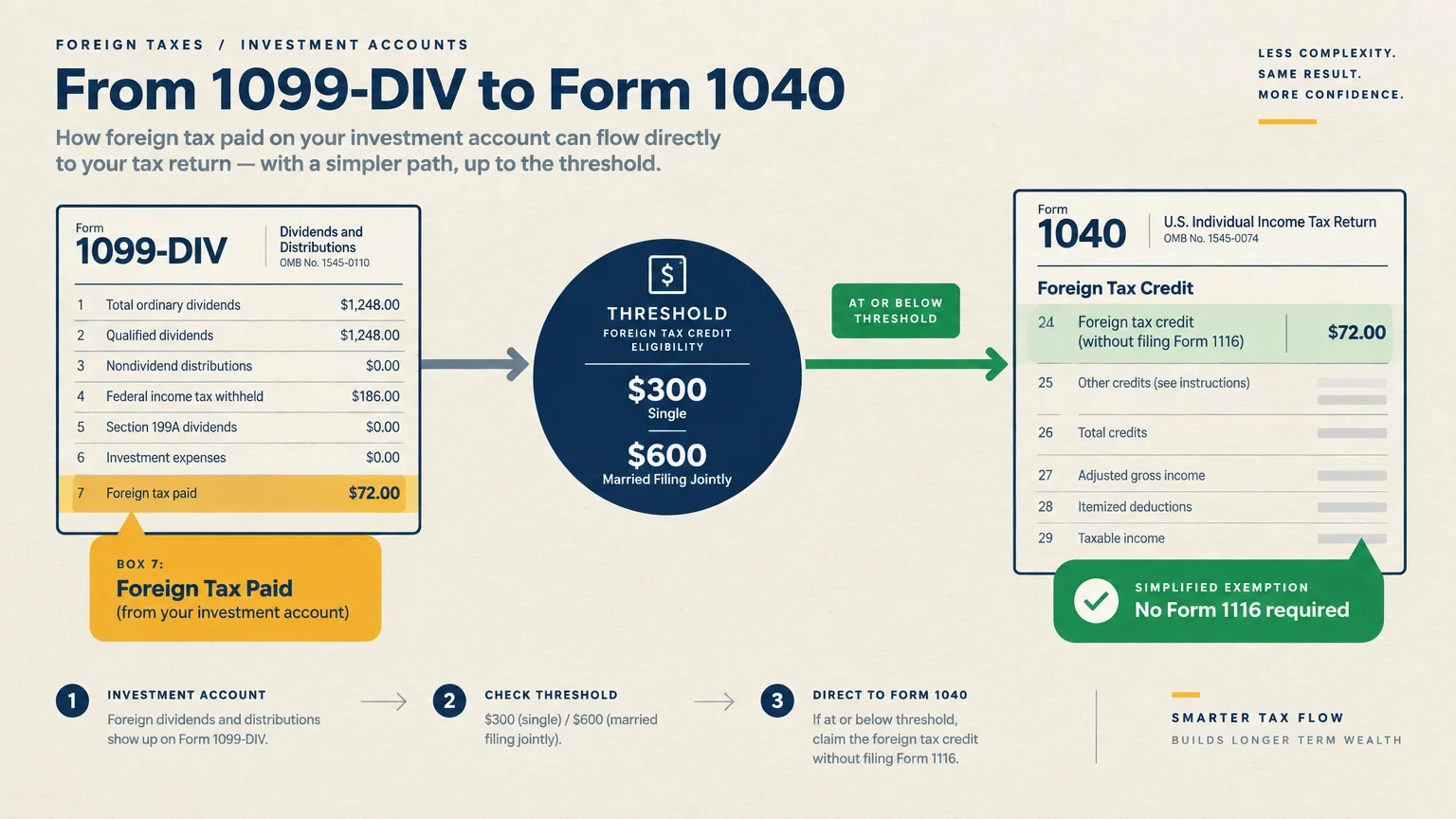
The IRS allows you to claim the Foreign Tax Credit to prevent double taxation on that investment income. You can locate your creditable foreign taxes paid in Box 7 of your annual Form 1099-DIV.
Filing IRS Form 1116 to calculate this credit is notoriously complex and time-consuming. Fortunately, the IRS offers a simplified exemption rule designed for retail investors holding standard taxable brokerage accounts.
If your creditable foreign taxes do not exceed $300 for single filers or $600 for married filing jointly, you bypass Form 1116 entirely. You can claim the full credit directly on Form 1040, eliminating redundant paperwork.
10. Premium Tax Credit for Pre-Medicare Early Retirees
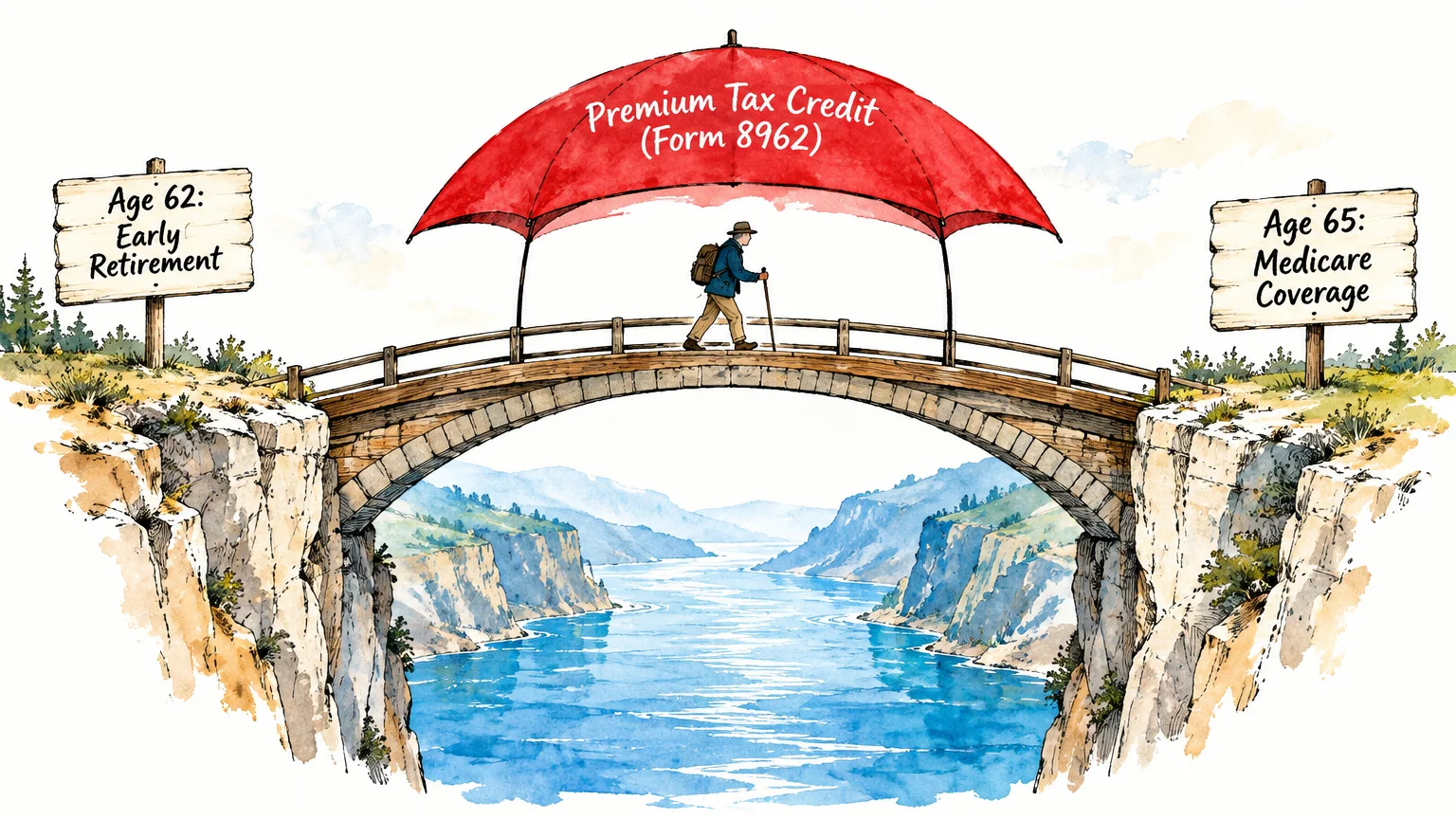
Retiring before age 65 requires finding health coverage before federal Medicare eligibility begins. The Premium Tax Credit (PTC) helps early retirees afford health insurance purchased through the Health Insurance Marketplace.
You calculate and reconcile this refundable credit on IRS Form 8962 when you file your annual tax return. You can receive advance credit payments directly toward monthly premiums or claim the entire credit as a lump sum.
Under provisions extended by the Inflation Reduction Act through 2025, the strict 400% federal poverty level income cutoff remains eliminated. Instead, your required premium contribution for benchmark silver plans is capped at no more than 8.5% of household income.
Early retirees can strategically manage IRA withdrawals and capital gains to lower their modified AGI. Keeping your taxable income modest maximizes this credit and significantly reduces your pre-Medicare healthcare expenses.
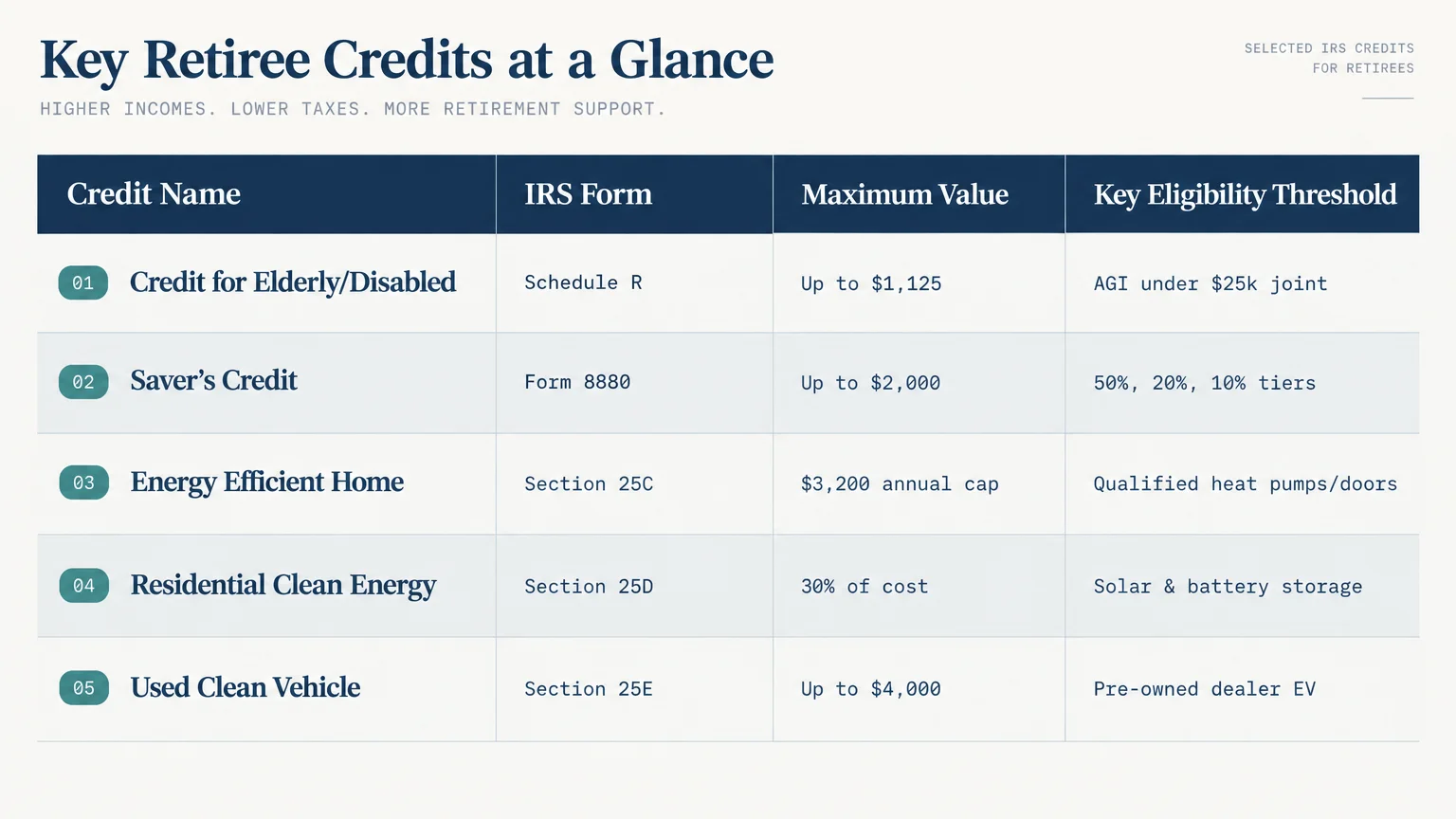
Comprehensive Comparison of Retiree Tax Credits
Reviewing tax credits side by side clarifies which opportunities match your financial situation this year. The table below outlines maximum values, core qualifications, and associated forms for these ten senior tax credits.
| Tax Credit | Maximum Benefit | Key Eligibility Rule | IRS Tax Form |
|---|---|---|---|
| Credit for the Elderly or Disabled | $750 single; $1,125 married | Age 65+ or disabled; strict AGI caps under $17.5k–$25k | Schedule R |
| Saver’s Credit | $1,000 single; $2,000 married | Part-time earned income; retirement contribution made | Form 8880 |
| Credit for Other Dependents | $500 per dependent | Support elderly parent or disabled adult relative | Form 1040 |
| Child & Dependent Care Credit | $1,050 one person; $2,100 two+ | Incapacitated spouse or dependent care during work | Form 2441 |
| Earned Income Tax Credit | Varies by income and children | Working senior caring for qualifying grandchild or child | Schedule EIC |
| Energy Efficient Home Improvement | Up to $3,200 annually | Qualified doors, windows, insulation, or heat pumps | Form 5695 |
| Residential Clean Energy Credit | 30% of cost (uncapped) | Solar electric, battery storage (3+ kWh), geothermal | Form 5695 |
| Used Clean Vehicle Credit | Up to $4,000 | Used EV priced under $25k bought from licensed dealer | Form 8936 |
| Foreign Tax Credit (De Minimis) | $300 single; $600 married | Taxes reported on 1099-DIV from global funds or ETFs | Form 1040 |
| Premium Tax Credit | Varies by income and premium | Ages 55–64 buying coverage on ACA Marketplace | Form 8962 |

Pitfalls to Watch For
Claiming senior tax credits requires precision, as common filing errors can delay refunds or trigger IRS notices. Watch for these frequent mistakes when preparing your annual filing:
- Confusing Nonrefundable and Refundable Credits: A nonrefundable credit reduces your tax liability to zero, but will not return excess funds as cash. Only refundable credits, like the EITC or Premium Tax Credit, trigger direct refund checks for unused amounts.
- Missing Strict Income Thresholds: Credits like Schedule R feature unindexed AGI limits that make eligibility narrow. Review your total income, including municipal bond interest and pension payments, before assuming you qualify.
- Discarding Invoices and Certifications: Clean energy and home efficiency credits require specific manufacturer certification statements. Retain receipts, contractor invoices, and itemized proof of purchase in your records for at least three years.
- Overlooking Social Security Offsets: Certain credits require you to count nontaxable Social Security benefits against base eligibility limits. Miscalculating this income can disqualify your claim for the Credit for the Elderly or Disabled.

Getting Expert Help
While tax preparation software identifies basic deductions, complex retirement tax planning often requires professional analysis. Navigating how investments, retirement distributions, and tax credits intersect can be challenging.
Consider consulting a qualified Certified Financial Planner (CFP) or Certified Public Accountant (CPA) in the following scenarios:
- Managing Required Minimum Distributions (RMDs): Mandatory retirement withdrawals can artificially raise your AGI, unintentionally phasing you out of lucrative credits. An expert can model distribution timing or suggest qualified charitable distributions (QCDs) to keep income low.
- Bridging Pre-Medicare Health Subsidies: Early retirees must carefully balance capital gains and Roth conversions with the Premium Tax Credit. A tax advisor ensures your taxable income stays within optimal ranges to protect your healthcare subsidies.
- Coordinating Multi-Generational Family Care: Claiming an aging parent or disabled relative involves intricate dependent support tests. A professional confirms whether you meet the 50% support requirement without triggering dependent filing errors.
- Structuring Staged Clean Energy Improvements: Major home energy renovations can be divided across consecutive tax years to maximize annual credit caps. A CPA helps schedule equipment purchases so you capture the full $1,200 and $2,000 allowances repeatedly.
You can also research consumer educational resources through AARP Foundation Tax-Aide, which provides free tax assistance to older adults. The federal government also offers educational materials on investment accounts through Investor.gov.
Frequently Asked Questions
Can I claim retiree tax credits if I take the standard deduction?
Yes, you can claim all eligible tax credits regardless of whether you itemize deductions or take the standard deduction. Tax credits calculate separately from deductions on Form 1040.
Can I claim the Residential Clean Energy Credit on a vacation home?
Yes, you can claim the 30% clean energy credit on a secondary home or vacation property you use as a residence. However, energy-efficiency weatherization credits under Section 25C only apply to your existing primary home.
Does Social Security count as earned income for the Saver’s Credit?
No, the IRS does not classify Social Security benefits, pension payouts, or IRA distributions as earned income. You must have wages, salaries, tips, or net self-employment earnings to contribute to an IRA and claim the Saver’s Credit.
Can both spouses claim the Used Clean Vehicle Credit?
Yes, each individual taxpayer can claim the pre-owned clean vehicle credit once every three years. If a married couple purchases two qualifying used electric vehicles, each spouse can qualify if all statutory rules are satisfied.
Protecting Your Hard-Earned Wealth
Retaining your wealth during retirement requires proactive tax planning alongside disciplined spending. Identifying overlooked tax breaks seniors qualify for ensures you preserve capital for healthcare, family support, and personal travel.
Review these ten credits each year as your income sources and household priorities shift over time. Strategic use of the tax code empowers you to protect your savings and enjoy a secure, worry-free retirement.
This article provides general retirement education and information only. Every retiree’s situation is unique—what works for others may not work for you. For personalized advice, consider consulting a qualified financial professional such as a CFP or CPA.
Last updated: March 2026. Retirement benefits, tax rules, and healthcare regulations change frequently—verify current details with official sources.









Leave a Reply