
Missing your initial Medicare enrollment window can permanently increase your monthly healthcare costs for the rest of your life. Millions of retirees unknowingly trigger a lifetime medicare surcharge by delaying Medicare Part B or Part D coverage due to common misconceptions about COBRA, retiree health plans, or active employment rules. In 2026, every full 12-month delay in signing up for Part B adds a permanent 10% penalty to your standard monthly premium of $202.90, compounding year after year. Understanding how these late enrollment penalties work—and how to avoid medicare enrollment mistakes before turning 65—protects your fixed retirement income and preserves your long-term financial security.
Understanding the Medicare Enrollment Landscape
Navigating Medicare requires strict adherence to federal timelines. The federal government establishes rigid windows during which you must choose your coverage. Missing these deadlines without qualifying for an exemption triggers financial penalties that follow you for life.
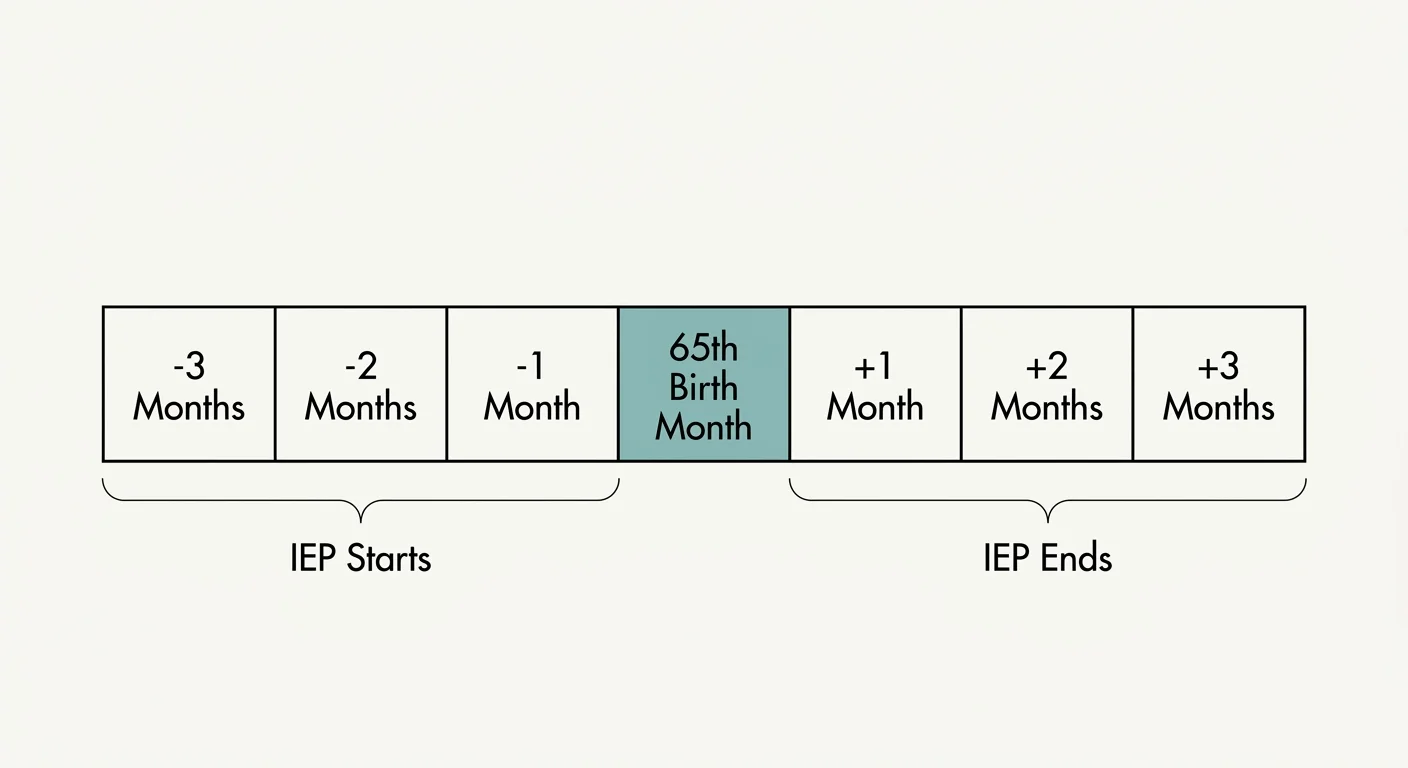
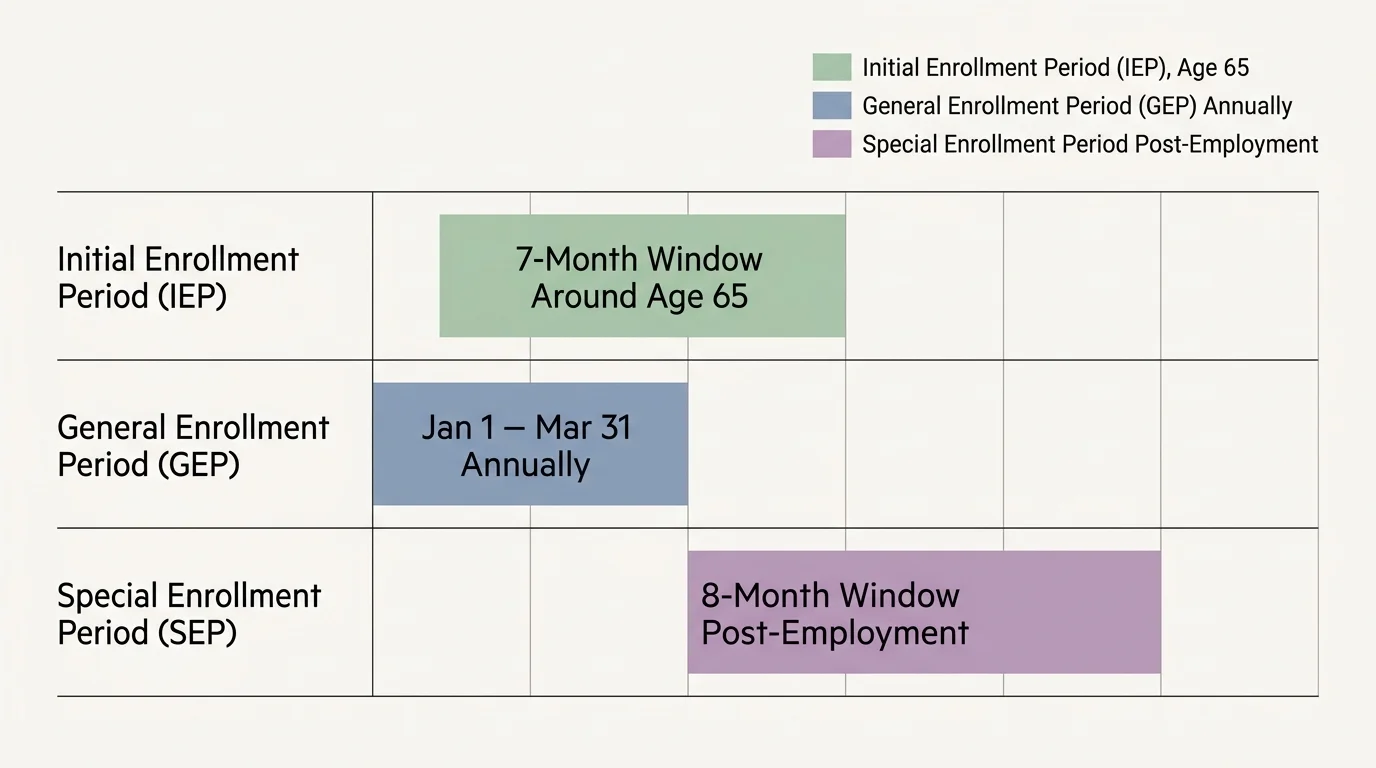
Your primary doorway into the system is the Initial Enrollment Period (IEP). This seven-month window opens three months before the month you turn 65, includes your birth month, and closes three months after your birth month. If you enroll during the first three months of your IEP, your coverage begins on the first day of your birth month. If your birthday falls on the first day of the month, your IEP shifts forward, starting four months before you turn 65.
If you fail to enroll during your IEP and do not qualify for a Special Enrollment Period (SEP), you must wait for the General Enrollment Period (GEP). The GEP runs annually from January 1 through March 31. Under current rules administered by the Centers for Medicare & Medicaid Services (CMS), coverage signed up for during the GEP takes effect on the first day of the following month. However, waiting for the GEP often creates coverage gaps and exposes you to substantial late enrollment fees.
Special Enrollment Periods allow you to sign up for Medicare outside standard windows without incurring penalties. To qualify for a Part B SEP, you must demonstrate continuous coverage under an active employer-sponsored group health plan based on your current work or your spouse’s current work. The federal government grants you an eight-month window to enroll in Part B, starting the month after active employment ends or group health plan coverage terminates, whichever occurs first.
The Medicare Part B Penalty: A Permanent Monthly Tax
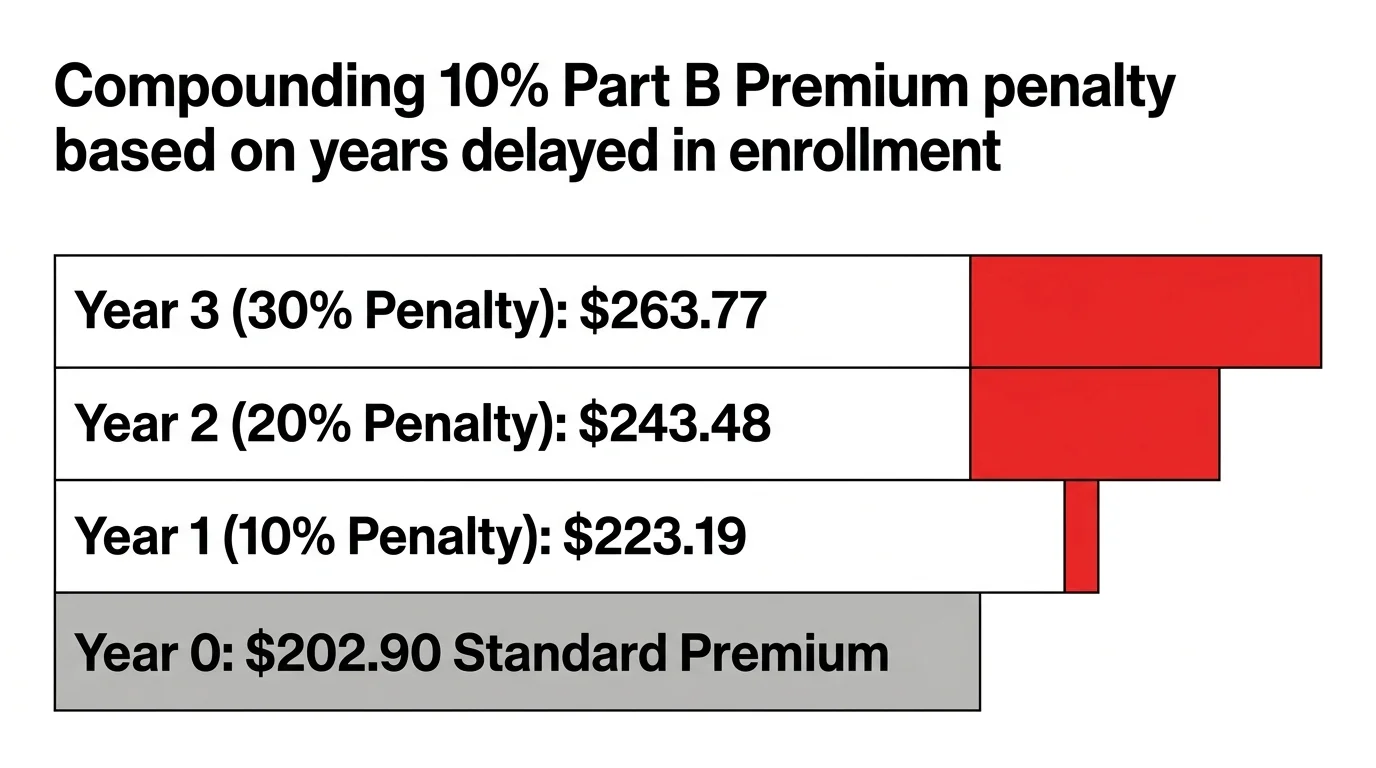
The medicare part b penalty represents one of the most expensive financial mistakes in retirement planning. Federal law assesses a 10% premium surcharge for every full 12-month period you were eligible for Part B but did not enroll, provided you lacked qualifying coverage based on active employment.
Unlike standard administrative fees, this surcharge is not a one-time fine; it is a lifetime medicare surcharge added directly to your monthly Part B premium for as long as you maintain coverage. Furthermore, Medicare calculates the penalty percentage against the current year’s standard Part B premium, not the premium from the year you were first eligible. As overall Medicare premiums increase over time, your monthly penalty dollar amount rises along with them.
For context, the standard monthly Part B premium in 2025 was $185.00. In 2026, the standard monthly Part B premium increased to $202.90. The following examples demonstrate how the 10% annual penalty compounds over time based on the 2026 baseline rate:
- 2-Year Delay (24 Months): You face a 20% penalty. In 2026, 20% of $202.90 equals $40.58. Your revised monthly Part B premium becomes $243.48 per month. Over 20 years of retirement, this single delay costs you $9,739.20 in extra premiums, assuming premiums never rise further.
- 3-Year Delay (36 Months): You face a 30% penalty. In 2026, 30% of $202.90 equals $60.87 extra per month, bringing your total monthly bill to $263.77. Over a 20-year span, you will pay $14,608.80 in penalties alone.
- 5-Year Delay (60 Months): You face a 50% penalty. In 2026, 50% of $202.90 adds $101.45 to your monthly bill, pushing your Part B cost to $304.35 per month. Over 20 years, that equates to $24,348.00 in total penalty charges.
Partial 12-month periods do not count toward the Part B penalty calculation. For instance, if you delay Part B enrollment for 19 months without qualifying coverage, CMS rounds down to one full 12-month period, resulting in a 10% penalty rather than 15% or 20%. However, waiting those additional seven months leaves you without health insurance coverage, exposing you to catastrophic medical bills.
“Navigating Medicare timing is one of the most vital financial decisions in your 60s. Making an error doesn’t just impact your health—it creates a permanent drain on your wealth.” — Jean Chatzky, Financial Journalist and Author
The COBRA and Retiree Health Insurance Trap
The single most common cause of a medicare late enrollment penalty is the widespread misunderstanding of COBRA and retiree health insurance. Thousands of retirees leave full-time employment at or after age 65, elect COBRA continuation coverage or transition to a former employer’s retiree medical plan, and assume they are fully protected from Medicare penalties.
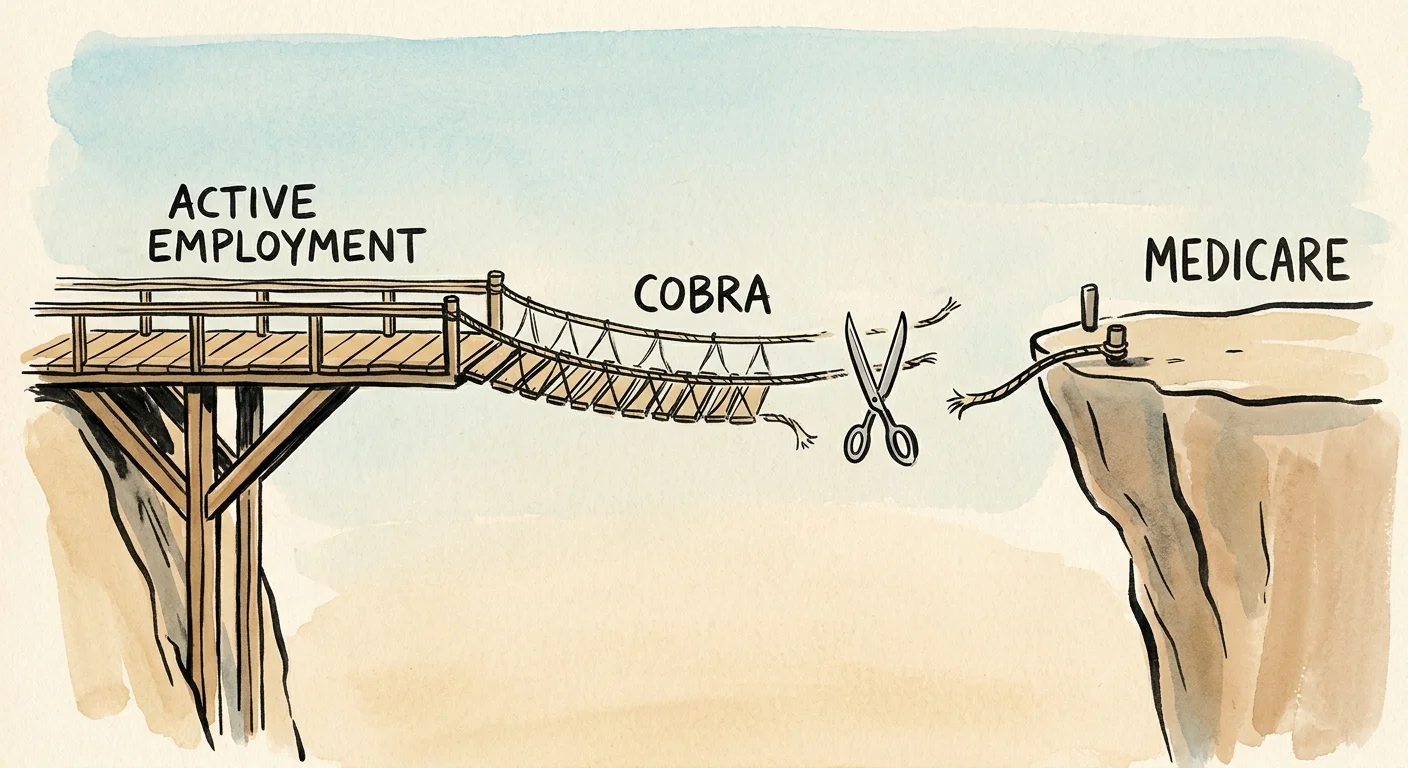
Federal law distinguishes sharply between active employment coverage and non-active continuation coverage. Under rules enforced by the Social Security Administration (SSA) and Medicare, neither COBRA continuation coverage nor retiree health plans qualify as coverage based on active employment. COBRA allows you to maintain group health benefits, but it does not pause the Medicare enrollment clock.
When you stop active work at age 65 or older, your eight-month Special Enrollment Period for Part B begins immediately. If you elect COBRA for 18 months, your eight-month SEP expires while you are still on COBRA. When your COBRA coverage finally ends at month 18, you will attempt to sign up for Medicare Part B, only to discover three devastating realities:
- Your Special Enrollment Period has completely expired, leaving you unable to sign up for Part B immediately.
- You must wait until the next General Enrollment Period (January 1 through March 31) to submit an application.
- CMS will assess a permanent Part B late enrollment penalty because you went more than 12 full months without qualifying coverage based on active work.
To avoid medicare penalties, you must sign up for Medicare Part B when active employment ends, regardless of whether your former employer offers COBRA, severance coverage, or retiree health insurance. You can keep COBRA as secondary coverage to Medicare if you wish, but COBRA can never serve as a substitute for primary Medicare Part B after age 65.

The Medicare Part D Penalty: Hidden Prescription Costs
While the Part B penalty receives significant attention, delaying prescription drug coverage creates its own long-term financial burden. The Medicare Part D penalty applies if you go without creditable prescription drug coverage for 63 consecutive days or more after your Initial Enrollment Period ends.
Creditable coverage means a prescription drug plan—whether through a current employer, retiree plan, VA health program, or individual policy—that pays, on average, at least as much as Medicare’s standard prescription drug coverage. Employers must send you an annual notice every October informing you whether your health plan’s drug coverage is creditable. You must keep these written notices in your permanent records.
CMS calculates the Part D late enrollment penalty using a specific formula: 1% of the national base beneficiary premium multiplied by the number of full uncovered months you went without creditable coverage. CMS rounds the final product to the nearest $0.10 and adds it permanently to your monthly Part D plan premium.
In 2025, the national base beneficiary premium was $36.78. In 2026, the national base beneficiary premium rose to $38.99 per month. Consider how this calculation works in practice:
- If you go 24 months without creditable drug coverage, CMS calculates 24% of $38.99, which equals $9.3576.
- CMS rounds $9.3576 to the nearest ten cents, resulting in a permanent $9.40 monthly surcharge.
- This $9.40 penalty gets added to whatever Part D plan premium you choose every single month for life.
- If you select a basic Part D plan costing $25.00 per month in 2026, your actual bill will be $34.40 per month.
Even if you currently take no prescription medications, enrolling in a low-cost, stand-alone Part D plan during your IEP protects you from this lifetime fee. Under the Inflation Reduction Act provisions effective in 2026, annual out-of-pocket prescription costs under Part D plans are capped at $2,100 (with a maximum plan deductible of $615). Securing a prescription plan early locks in financial protection against unexpected future medication costs while avoiding medicare penalties entirely.
* Let’s double check the word count of:
“A single empty square in a blu
Medicare Part A Penalties for Workers Without 40 Credits
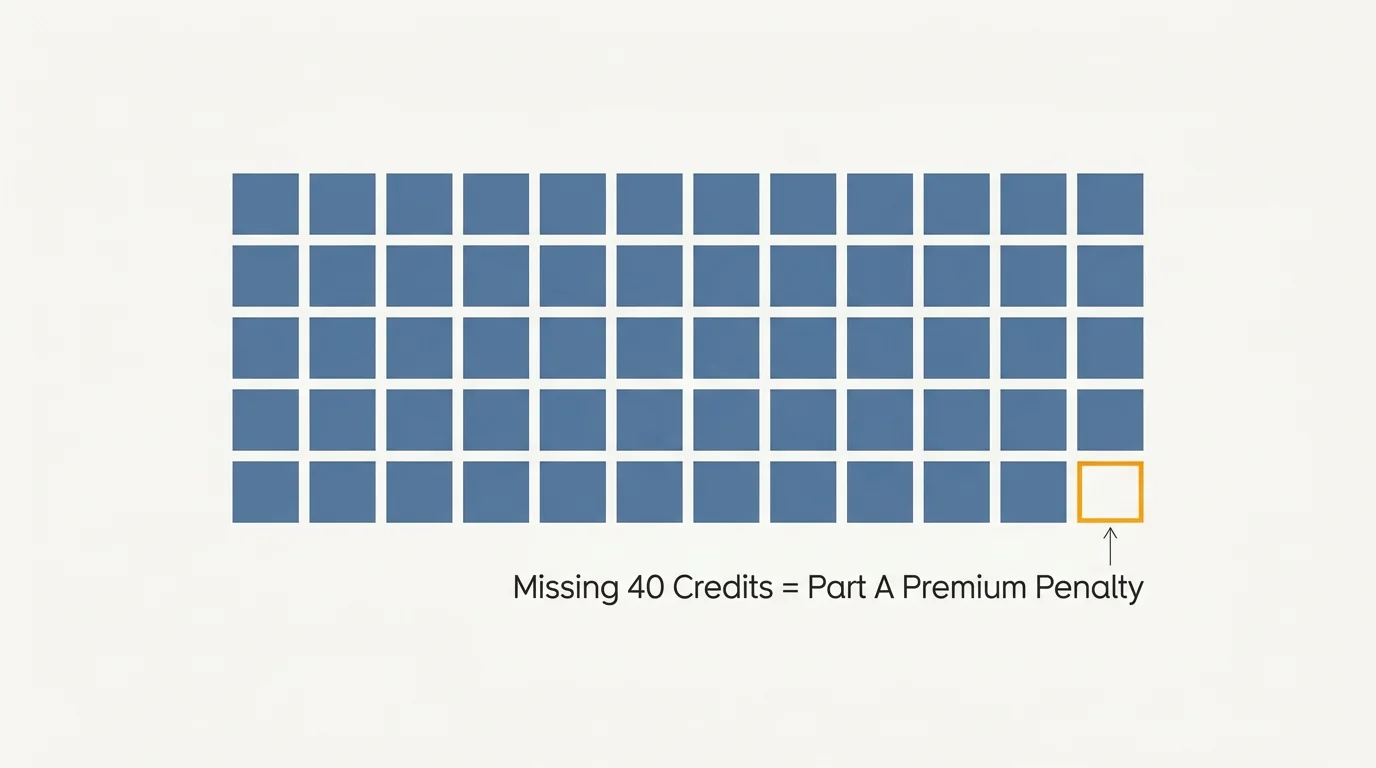
Most American workers earn premium-free Medicare Part A by working and paying Medicare payroll taxes for at least 40 calendar quarters (10 years). If you qualify for premium-free Part A, no late enrollment penalty applies to Part A, even if you sign up after age 65.
However, if you have earned fewer than 40 quarters of Medicare-covered employment—and do not qualify for premium-free Part A through a spouse’s work record—you must pay a monthly premium for Part A. Individuals with 30 to 39 work quarters pay a reduced monthly premium, while those with fewer than 30 quarters pay the full standard Part A premium.
If you must buy Part A and fail to enroll when first eligible, you face a Part A late enrollment penalty. CMS assesses a 10% premium surcharge on your monthly Part A cost. Unlike the lifetime penalties for Part B and Part D, the Part A penalty duration is limited: you must pay the 10% surcharge for twice the number of years you delayed enrollment.
For example, if you were eligible for Part A but delayed enrolling for two full years, you must pay the 10% monthly premium surcharge for four years. Once those four years expire, your Part A premium returns to the standard monthly rate.
Comparing Medicare Enrollment Windows and Penalties
Understanding how enrollment periods, penalty formulas, and coverage rules differ across Medicare’s distinct components helps you structure your transition into retirement smoothly. The following comparison highlights key elements for each part of Medicare:
| Medicare Component | Initial Enrollment Trigger | Penalty Calculation Formula | Penalty Duration | Primary Risk Factor |
|---|---|---|---|---|
| Part A (Hospital Insurance) | Turning 65 (7-month window around birth month) | 10% premium surcharge applied to monthly cost | Twice the number of full years enrollment was delayed | Having under 40 work quarters and failing to buy coverage when first eligible |
| Part B (Medical Insurance) | Turning 65 or leaving active group employer coverage | 10% surcharge per full 12-month period delayed, based on current standard premium ($202.90 in 2026) | Lifetime (permanent monthly surcharge) | Relying on COBRA, retiree health plans, or severance coverage after age 65 |
| Part D (Prescription Drugs) | Turning 65 or losing creditable prescription drug coverage | 1% of national base premium ($38.99 in 2026) per uncovered month (gap >= 63 days) | Lifetime (permanent monthly surcharge) | Assuming good health means drug coverage is unnecessary, or losing employer notices |

Pitfalls to Watch For
Avoidable administrative oversights account for most Medicare penalties. Review these critical pitfalls to protect your financial security:
- Contributing to an HSA After Age 65: If you enroll in Medicare Part A or Part B, you and your employer can no longer make tax-advantaged contributions to a Health Savings Account (HSA). Furthermore, when you apply for Social Security benefits after age 65, Medicare Part A retroactively covers you up to six months prior (but not before your 65th birthday month). Any HSA contributions made during those retroactive months trigger IRS tax penalties and excise taxes.
- Misinterpreting Company Size Rules: Special Enrollment Period rules depend heavily on employer size. If your employer has fewer than 20 employees, Medicare is primary to your group health insurance. In small company plans, your employer coverage may refuse to pay medical claims if you do not sign up for Part B at age 65. Always confirm employer group size rules with your HR department.
- Assuming VA Healthcare Replaces Part B: Veterans Affairs (VA) health benefits provide excellent medical care at VA facilities, but the federal government does not consider enrollment in VA healthcare to be active group health coverage for Medicare Part B. If you drop Part B while keeping VA benefits, you lose access to civilian doctors under Medicare and will incur a lifetime Part B penalty if you re-enroll later.
- Failing to Collect Written Proof of Creditable Coverage: Never rely on verbal statements from insurance agents or former employers. You must secure written proof—specifically Form CMS-L564 filled out by your former employer—verifying continuous group health plan coverage tied to active employment.
- Ignoring TRICARE For Life Rules: Military retirees receiving TRICARE must enroll in Medicare Part A and Part B upon turning 65 to retain TRICARE For Life (TFL) benefits. Declining Part B causes a complete loss of TFL coverage and subjects you to late penalties.
“An ounce of prevention is worth a pound of cure.” — Benjamin Franklin, Founding Father and Author

How to Fix or Appeal a Late Enrollment Penalty
If Medicare notifies you of a late enrollment penalty that you believe is incorrect, you have the legal right to challenge the decision. SSA handles enrollment processing and penalty assessments on behalf of Medicare. You must act promptly to preserve your rights.
First, examine the formal letter sent by Social Security detailing the penalty determination. You have 60 days from the date you receive this notice to file an official appeal, known as a Request for Reconsideration. You can file this request online at Medicare.gov or by completing Form SSA-561-U2 and submitting it to your local Social Security field office.
To win an appeal, you must provide documentary evidence showing that you maintained continuous creditable coverage or qualified for a Special Enrollment Period. Key evidence includes:
- Form CMS-L564 (Request for Employment Information): Completed and signed by your former employer’s Human Resources department, verifying your exact dates of active employment and health plan coverage.
- Form CMS-40B (Application for Enrollment in Medicare – Part B): Submitted alongside your proof of employment.
- Proof of Creditable Drug Coverage: Annual creditable coverage letters, plan benefit summaries, or premium payment receipts showing no gap over 62 consecutive days.
In rare instances, you can request “Equitable Relief.” Federal regulations allow CMS to waive late enrollment penalties or grant retroactive enrollment if you can prove that an official employee of the federal government (such as an SSA representative) gave you misinformation that caused your late enrollment. Keep detailed written logs of every contact with government agencies, including dates, times, employee names, and summary notes of conversations.

Getting Expert Help
Navigating Medicare regulations involves complex intersections between federal tax law, labor regulations, and private insurance policies. Seeking guidance from independent professionals ensures you avoid cost-heavy enrollment traps. Consider consulting an expert under these specific circumstances:
- Transitioning From a Small Business Plan: If you work for a firm with under 20 employees, an independent Medicare counselor or State Health Insurance Assistance Program (SHIP) advisor can help sequence your enrollment so you avoid claim denials and late penalties. You can access free local counselor listings through the Administration for Community Living.
- Retiring With Complex Group Health Options: When balancing union benefits, retiree health reimbursement arrangements (HRAs), and severance packages alongside Medicare, consult a Certified Financial Planner (CFP) specializing in retirement transitions to model out precise timing.
- Appealing an Incorrect Penalty Assessment: If Social Security denies your initial reconsideration request despite valid proof of active employer coverage, engage a legal advocate or senior insurance specialist experienced in SSA administrative appeals.
- Managing Combined Benefits (VA, TRICARE, HSA): Veterans and federal retirees with multi-layered benefit structures should consult benefits advisors at national veteran organizations or federal retiree associations to avoid losing secondary coverage.
Frequently Asked Questions About Medicare Penalties
Can I remove a Medicare late enrollment penalty if I go back to work?
Going back to work does not automatically erase a previously assessed Medicare late enrollment penalty. However, if you secure new group health plan coverage based on active employment at your new job, you can choose to drop Part B. When you later retire again, you will qualify for a new Special Enrollment Period based on that recent job. While your past uncovered months prior to the new job may still count toward a penalty, active work periods stop the penalty counter from growing.
Does COBRA count as creditable coverage for Medicare Part B?
No. COBRA coverage does not count as coverage based on active employment for Medicare Part B. Even though COBRA allows you to retain comprehensive medical care, relying on COBRA after active work ends will cause you to miss your eight-month Special Enrollment Period, triggering lifetime Part B penalties.
What happens if I miss my Initial Enrollment Period but don’t qualify for an SEP?
If you miss your IEP and lack qualifying coverage based on active work, you must wait for the General Enrollment Period (GEP), which runs from January 1 through March 31 each year. Your coverage will begin the month after you sign up. However, you will face lifetime late enrollment penalties for Part B and Part D based on the total number of full months you lacked coverage.
How do I prove I had creditable prescription drug coverage for Part D?
You prove creditable coverage by producing the written “Notice of Creditable Prescription Drug Coverage” sent to you annually by your employer or insurance carrier. If you lose this documentation, you can ask your former plan administrator to issue a letter on company letterhead confirming that your drug coverage met federal creditable standards during your period of enrollment.
Taking Action to Protect Your Retirement Income
Preventing a lifetime medicare surcharge requires proactive planning before you celebrate your 65th birthday. Calendar your Initial Enrollment Period early, verify whether your health coverage stems from active employment, and secure written proof of creditable prescription coverage from your plan providers. Taking these practical steps today eliminates permanent monthly surcharges, protecting your retirement savings for decades to come.
This is educational content based on general retirement and financial principles. Individual results vary based on your situation. Always verify current benefit rules, tax laws, and eligibility requirements with official sources like SSA, Medicare.gov, or the IRS.
Last updated: March 2026. Retirement benefits, tax rules, and healthcare regulations change frequently—verify current details with official sources.









Leave a Reply