
Failing to monitor your quarterly estimated tax payments during retirement can trigger unexpected penalties from the IRS, but identifying shortfalls early gives you full power to fix them. When transitioning from W-2 paychecks to retirement income streams like pension payouts, IRA distributions, capital gains, and Social Security, tax withholding no longer happens automatically. If your payments fall below IRS thresholds, daily compounding interest quickly inflates your total tax bill. Recognizing the subtle warning signs that you have underpaid your estimated taxes allows you to make immediate corrections, leverage late-year withholding strategies, and protect your hard-earned retirement savings from unnecessary federal penalties.
At a Glance
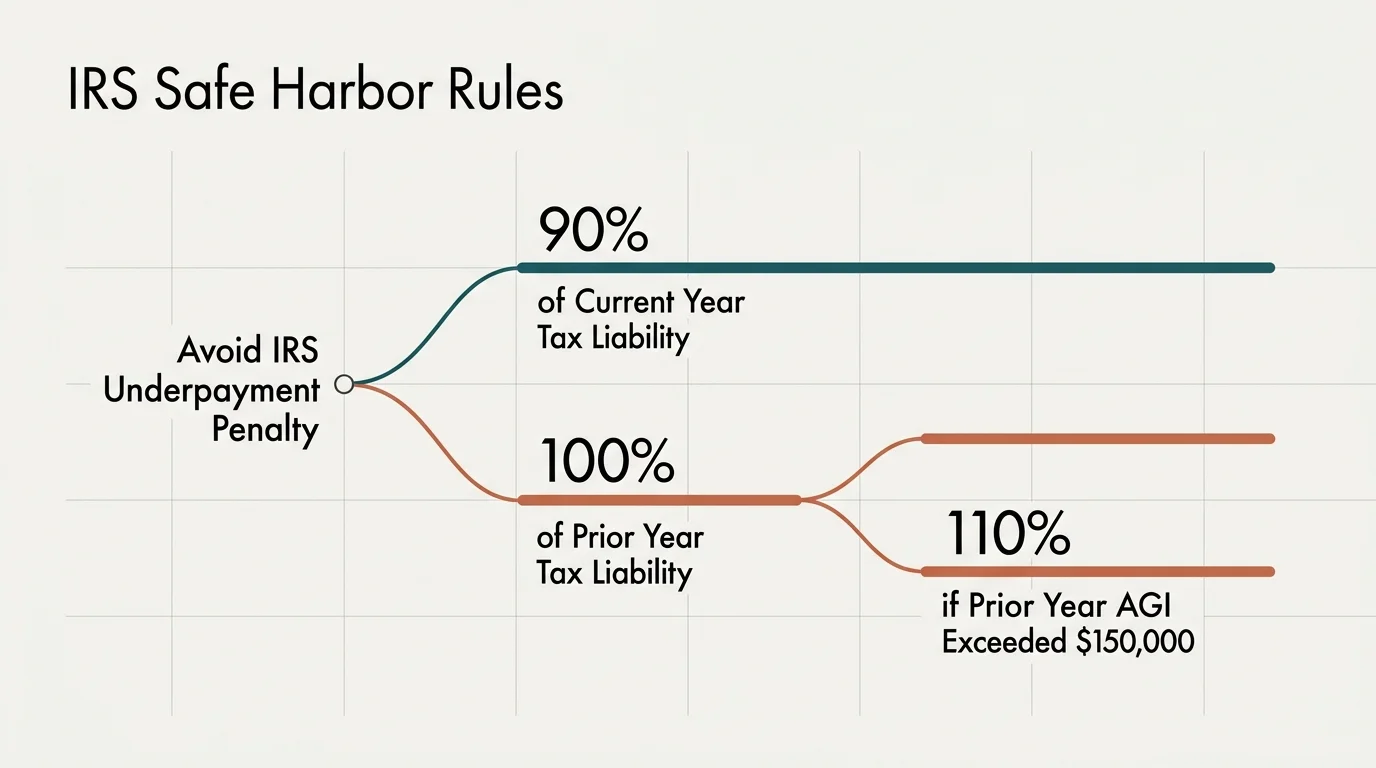
- Safe Harbor Rules: You can completely avoid IRS underpayment penalties by paying at least 90% of your current tax year’s total liability or 100% of your prior year’s liability (110% if your prior year’s Adjusted Gross Income exceeded $150,000).
- Compounding Interest Rates: The IRS assesses underpayment interest compounded daily. In 2025, the rate stood at 7%, while 2026 rates remain elevated at 7% for Q1, 6% for Q2, and 7% for Q3.
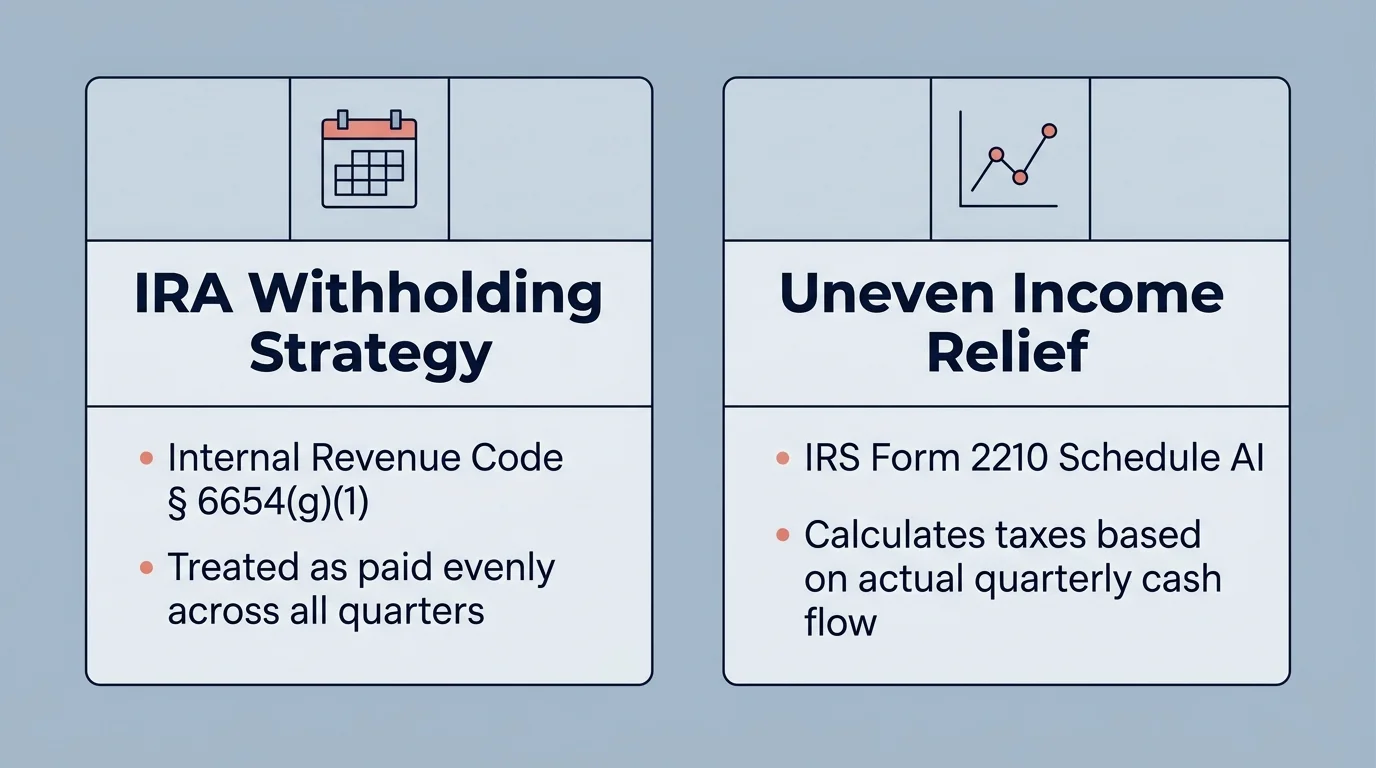
- The IRA Withholding Strategy: Under Internal Revenue Code § 6654(g)(1), tax withheld from IRA distributions or pensions is treated as paid evenly across all four quarters, providing a powerful legal tool to cure early-quarter shortfalls retroactively.
- Uneven Income Relief: If your income arrived in uneven lump sums throughout the year, IRS Form 2210 Schedule AI lets you calculate quarterly taxes based on actual cash flow rather than four equal installments.
- First-Year Retiree Exception: The IRS may grant a full penalty waiver if you retired after reaching age 62 or became disabled during the tax year, provided you had reasonable cause.

Understanding the IRS Estimated Tax Framework
The United States tax system operates on a strict pay-as-you-go model. The Internal Revenue Service expects taxpayers to remit tax obligations continuously as income earns, rather than in one lump sum at year-end. During working years, employers manage this responsibility through payroll withholding. In retirement, however, the burden shifts entirely to your shoulders.
To enforce this system, the IRS mandates quarterly estimated tax payments if you expect to owe $1,000 or more when filing your annual return. For individuals, these quarterly payments fall due on four specific dates: April 15 (Q1), June 15 (Q2), September 15 (Q3), and January 15 of the following year (Q4). Missing these mid-year deadlines or remitting insufficient amounts triggers the IRS underpayment penalty under Internal Revenue Code § 6654.
Fortunately, congress established “safe harbor” rules to protect taxpayers from penalties if they meet minimum payment metrics. You remain safe from underpayment penalties if your total tax payments through withholding and estimated quarters equal or exceed either of the following benchmarks:
- 90% of your current tax year’s total liability: This target requires accurately predicting your current income and deductions before the year ends.
- 100% of your prior tax year’s total liability: If your prior year’s Adjusted Gross Income (AGI) was $150,000 or less ($75,000 if married filing separately), paying 100% of that prior-year figure protects you completely.
- 110% of your prior tax year’s total liability: If your prior year’s AGI exceeded $150,000 ($75,000 if married filing separately), your safe harbor threshold rises to 110% of that prior tax bill.
When you fall short of these thresholds, the IRS calculates an underpayment penalty that functions like an interest charge. The rate compounds daily on the unpaid balance from the exact quarterly due date until you resolve the deficit. For 2025, the IRS set the quarterly interest rate at 7% across all four quarters. In 2026, rates remain sharp: 7% for Q1, 6% for Q2, and 7% for Q3. These high interest rates make correcting underpaid quarterly taxes an urgent financial priority.

9 Signs You Have Underpaid Estimated Taxes
Retirement income fluctuates far more than traditional W-2 wages. Capital gain distributions, Roth conversions, consulting fees, and changing distribution schedules easily throw quarterly tax calculations out of balance. Review these nine common warning signs to determine if you need an immediate estimated tax payment adjustment.
1. Your Prior-Year AGI Exceeded $150,000 and You Relied on the 100% Rule
Many retirees believe paying 100% of their prior year’s tax bill guarantees full protection under safe harbor rules. However, high-income rules introduce a costly trap. If your prior year’s Adjusted Gross Income (AGI) exceeded $150,000 as a joint or single filer ($75,000 for married taxpayers filing separately), the standard 100% safe harbor threshold increases to 110%.
Consider a retired couple whose tax liability totaled $30,000 on an AGI of $175,000. If they send four equal quarterly payments totaling $30,000, they assume they have satisfied federal rules. Because their prior-year AGI crossed the $150,000 line, the IRS expects $33,000 (110% of $30,000) to grant safe harbor protection. Sending $30,000 creates a $3,000 shortfall, exposing them to daily compounding penalty rates across all four quarters if their current year tax ends up higher.
2. You Realized Substantial Mid-Year Capital Gains or Investment Payouts
Rebalancing an investment portfolio, selling real estate, or realizing significant long-term capital gains mid-year drastically changes your tax obligation. Even if you reinvest the profits, the taxable gain increases your gross income for that specific quarter.
If you sell a stock portfolio in May for a $100,000 taxable gain, your Q2 tax obligation spikes immediately. Many retirees make the mistake of waiting until April of the following year to account for mid-year asset sales. The IRS requires tax payments in the quarter the income realizes. If you fail to boost your June 15 payment to cover that capital gain, you face underpayment interest accrued over the remaining quarters of the year.
3. You Took IRA Withdrawals or RMDs Without Tax Withholding
Once you reach the age for Required Minimum Distributions (RMDs)—currently age 73 or 75 under SECURE 2.0 legislation—or take voluntary traditional IRA distributions, every dollar withdrawn counts as ordinary taxable income. Financial institutions offer elective withholding, but account holders frequently opt out to receive full cash distributions.
Withdrawing $50,000 from a traditional IRA without withholding $6,000 to $11,000 for federal taxes creates an immediate gap in your quarterly payment balance. Unless you recalculate and remit that extra amount during the corresponding estimated payment deadline, your tax liability will far outpace your remitted funds.
4. You Executed a Partial or Full Roth IRA Conversion
Roth IRA conversions represent a powerful wealth-preservation tool, but they create immediate taxable ordinary income. Converting pre-tax traditional IRA assets into a Roth IRA generates a tax bill during the tax year of the conversion.
For example, executing a $60,000 Roth conversion in July adds $60,000 directly to your taxable income base. If you maintain your regular quarterly estimated payments without factoring in the extra income tax generated by the conversion, you fall directly into underpayment territory. Furthermore, paying conversion taxes directly out of the Roth distribution itself can trigger early withdrawal penalties if you are under age 59½—making quarterly estimated payments from taxable cash reserves necessary.
5. You Transitioned from W-2 Wages to 1099 Consulting or Self-Employment
Many retirees launch consulting businesses or take on freelance work after leaving full-time employment. Moving from employee status to self-employed status exposes your earnings to both ordinary income tax and the 15.3% Self-Employment Contributions Act (SECA) tax.
When working as a employee, your employer covers 7.65% of Social Security and Medicare taxes while deducting your matching 7.65% share from your paycheck. As a 1099 consultant, you assume responsibility for the entire 15.3% share alongside ordinary income taxes. Earning $30,000 in freelance income can easily generate over $7,000 in combined federal income and self-employment taxes. Relying on past withholding figures without adjusting for self-employment tax inevitably leads to estimated tax shortfalls.
6. Your Social Security Benefits Became Taxable Due to Income Spikes
Social Security benefits carry unique tax rules based on your “combined income” (AGI + non-taxable interest + 50% of Social Security benefits). Depending on your total income, up to 85% of your Social Security benefits become subject to federal income tax:
- Single Filers: Combined income between $25,000 and $34,000 taxes up to 50% of benefits; combined income above $34,000 taxes up to 85% of benefits.
- Married Filing Jointly: Combined income between $32,000 and $44,000 taxes up to 50% of benefits; combined income above $44,000 taxes up to 85% of benefits.
If an unexpected surge in taxable income—such as a capital gain or IRA distribution—pushes your combined income across these thresholds, your Social Security benefits suddenly face taxation. This compound effect rapidly accelerates your total tax liability beyond previous quarterly calculations.
7. IRS Underpayment Rates Increased While Your Payments Stayed Fixed
The IRS resets its penalty interest rates every quarter based on federal short-term interest rates. During periods of low interest, underpayment penalties felt minor. However, elevated rates change the math significantly. The quarterly penalty rate stood at 7% throughout 2025 and sits between 6% and 7% in 2026.
Because interest compounds daily on unpaid estimated tax amounts, holding off on making up a payment deficit until April costs substantially more today than it did several years ago. If you calculate your quarterly estimates using outdated flat formulas without adjusting for rising penalty structures, you risk compounding daily debt to the federal government.
8. You Remitted Equal Quarterly Payments Despite Front-Loaded Income
The IRS requires tax payments as you receive income throughout the year. If you receive a large lump sum in January—such as an annual pension distribution or early-year stock sale—remitting four small, equal estimated payments across the year leaves you legally underpaid for Q1 and Q2.
Even if your total annual payments equal 100% of your final tax liability by January 15, the IRS evaluates sufficiency quarter-by-quarter. Underpaying early quarters creates penalty charges that accumulate daily until late-quarter payments arrive—unless you file specialized documentation to explain your income’s timing.
9. You Relied on the $1,000 Safe Buffer Erased by Late-Year Distributions
The tax code contains a de minimis exception: if the net balance due on your annual return after subtracting withholding and tax credits is less than $1,000, the IRS waives all underpayment penalties. Many retirees rely on this $1,000 buffer to avoid remitting small estimated tax payments.
However, late-year income events easily destroy this safety buffer. A December mutual fund dividend distribution or small end-of-year IRA withdrawal can push your final balance due from $850 to $1,250. The moment your balance crosses the $1,000 mark, the de minimis exception disappears entirely. The IRS then calculates underpayment penalties retroactively across all four quarters, rather than assessing interest on just the extra $250.
“Tax planning isn’t a once-a-year event that happens in April; it requires constant tuning throughout retirement. Ignoring mid-year income changes guarantees you will pay unnecessary penalties to the government.”
— Suze Orman, Financial Educator and Author

How to Correct Underpaid Quarterly Taxes
Discovering an estimated tax shortfall mid-year requires immediate action. Fortunately, tax law offers specific strategies to correct underpayment errors and eliminate or minimize accrued IRS penalties.
Leverage the IRA Withholding Back-Dating Rule
The most effective strategy for fixing estimated tax shortfalls relies on Internal Revenue Code § 6654(g)(1). Under this rule, taxes withheld from retirement account distributions—such as traditional IRAs, pensions, or RMDs—are treated by the IRS as if paid equally across all four quarters, regardless of when during the calendar year the withholding occurred.
This creates a legal superpower for retirees. If you realize in November that you underpaid Q1, Q2, and Q3 estimated taxes by $6,000 total, writing a check to the IRS in Q4 will stop future interest, but it won’t retroactively remove penalties for the earlier quarters. Instead, you can execute an IRA withdrawal of $6,000 in December and direct your account custodian to apply 100% of the distribution to federal tax withholding.
Because the IRS treats withholding as remitted in equal 25% increments across all four quarters ($1,500 assigned to Q1, Q2, Q3, and Q4), your late-year IRA withholding back-dates to cover your earlier quarterly shortfalls, wiping out accrued underpayment penalties entirely.
You can learn more about managing federal tax obligations and quarter deadlines directly on the official Internal Revenue Service (IRS) website.
File IRS Form 2210 and Schedule AI
If your income arrived unevenly—for example, if you realized a major capital gain in Q3 or received a seasonal business distribution in Q4—the standard IRS penalty calculation method unfairly penalizes you for low Q1 and Q2 payments. The default method assumes you earned income equally across all 365 days.
To fix this, request your tax preparer file IRS Form 2210 (Underpayment of Estimated Tax by Individuals) using the Annualized Income Installment Method (Schedule AI). This form breaks down your actual income, expenses, and tax liabilities quarter-by-quarter. Proving to the IRS that your income arrived late in the year aligns your estimated tax obligations with your cash flow, legally eliminating early-quarter underpayment charges.
Request an IRS Penalty Waiver for Recent Retirees
If you recently retired, federal law provides administrative relief. Under Internal Revenue Code § 6654(e)(3)(B), the IRS possesses authority to waive underpayment penalties if you meet two conditions:
- You retired after reaching age 62 or became disabled in the current or preceding tax year.
- Your payment shortfall occurred due to reasonable cause rather than willful neglect.
Transitioning into retirement represents a major financial change. If your tax shortfall stemmed from confusion over changing income sources during your first or second year of retirement, complete Form 2210 Part II, check box A or B, and submit a written statement explaining your retirement timing to request a full penalty waiver.
Establish Voluntary Tax Withholding with Form W-4V and Form W-4P
To avoid estimated tax hassles altogether, automate your tax payments through administrative withholding forms:
- Social Security Benefits: Submit IRS Form W-4V to your local Social Security office to choose standard flat withholding rates of 7%, 10%, 12%, or 22% from your monthly checks. Additional details regarding benefit statements appear on the official Social Security Administration (SSA) site.
- Pensions and Periodic Annuities: File IRS Form W-4P with your pension administrator to set tailored tax withholding amounts.
- IRA Distributions and Non-Periodic Payments: Complete IRS Form W-4R with your broker or custodian to specify exact withholding percentages on non-periodic withdrawals.
Tax Shortfall Remediation Strategies Compared
When you discover an estimated tax deficit, selecting the right corrective path saves time and money. The table below compares the four primary strategies available to retirees.
| Remediation Strategy | Primary Mechanism | Key Benefit | Best Suited For |
|---|---|---|---|
| IRA Withholding Catch-Up | IRC § 6654(g)(1) treats withholding as paid equally across all 4 quarters. | Retroactively cures early-quarter penalties for Q1, Q2, and Q3. | Retirees with traditional IRA assets who spot shortfalls late in the year. |
| Form 2210 Schedule AI | Annualizes income to reflect actual quarterly earning dates. | Eliminates penalties when income was back-loaded or uneven. | Taxpayers with mid-year asset sales, capital gains, or lump-sum payouts. |
| Retiree Penalty Waiver | Requests administrative relief under IRC § 6654(e)(3)(B). | Full waiver of accrued penalties due to transition to retirement. | Individuals who retired after age 62 within the past two tax years. |
| Direct Q4 Estimated Payment | Remits a direct cash payment via Direct Pay or check before Jan 15. | Stops interest from continuing to compound daily into the future. | Retirees without traditional IRA accounts to leverage for withholding. |
Avoiding Common Errors in Retirement Tax Planning
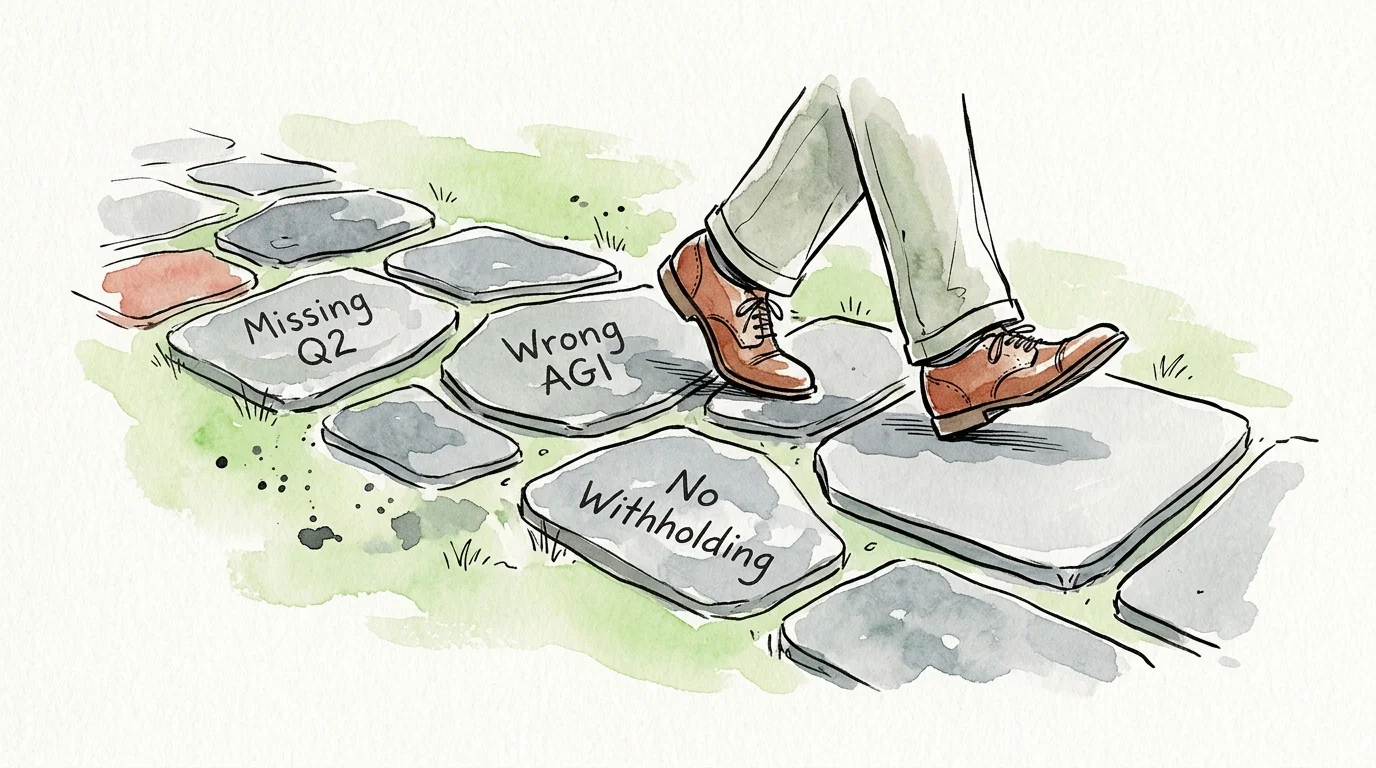
Navigating taxes in retirement requires vigilance. Avoiding these common mistakes will protect your retirement income from unexpected penalty assessments.
Mistake 1: Relying on State Rules to Match Federal Rules
Federal safe harbor thresholds do not automatically apply at the state level. Many states enforce different safe harbor percentages, different de minimis exemption levels, or different payment due dates. Assuming your state tax agency follows federal rules can result in unexpected state-level penalty notices.
Mistake 2: Writing a Lump-Sum Check Late and Assuming Penalties Disappear
Sending a extra check on January 15 covers your total tax debt, but it does not cure late payments for April, June, or September. The IRS assesses underpayment penalties per quarter. Unless you utilize IRA withholding back-dating or file Form 2210 Schedule AI, early-quarter penalties remain due.
Mistake 3: Forgetting That Municipal Bond Interest Affects Social Security Taxation
While interest from municipal bonds is exempt from federal income tax, the IRS includes municipal bond interest in your “combined income” calculation when determining how much of your Social Security benefit is taxable. Surges in tax-exempt income can push your Social Security benefits into taxable territory, unexpectedly raising your tax bill.
For additional financial management advice, review guidance hosted by the Consumer Financial Protection Bureau (CFPB).
When DIY Isn’t Enough
While many retirees manage simple quarterly payments independently, certain complex situations call for professional guidance from a Certified Public Accountant (CPA) or Certified Financial Planner (CFP). Consider seeking expert tax assistance in these scenarios:
- Executing Multi-Year Roth Conversion Ladders: Coordinating large Roth conversions across consecutive tax years requires precise projections to avoid crossing higher tax brackets, triggering IRMAA Medicare surcharges, or incurring underpayment penalties.
- Navigating the Death of a Spouse: Known as the “singles penalty trap,” a surviving spouse often moves from Married Filing Jointly to Single tax status in the year following the death. This tax status change shrinks tax brackets by half, doubling tax liabilities on similar income streams.
- Managing Business Sales or Commercial Real Estate Gains: Utilizing 1031 exchanges, installment sales, or private equity liquidity events requires structural tax planning to sequence quarterly tax payments correctly.
- Filing Form 2210 Schedule AI under Complex Circumstances: Calculating actual quarter-by-quarter income and itemized deductions on Schedule AI requires meticulous accounting. Professional tax software and CPA experience ensure you optimize this filing without triggering audit flags.
“An investment in knowledge pays the best interest. Taking time to understand tax withholding rules keeps more money in your pocket during retirement.”
— Benjamin Franklin, Founding Father and Author
Frequently Asked Questions
What is the IRS underpayment penalty rate for 2025 and 2026?
The IRS set the underpayment penalty interest rate at 7% for all quarters of 2025. For 2026, rates are set at 7% for Q1 (Jan 1–Mar 31), 6% for Q2 (Apr 1–Jun 30), and 7% for Q3 (Jul 1–Sep 30). Interest compounds daily on the unpaid balance from the original quarterly deadline until paid.
How does the IRS calculate penalties if I underpaid early in the year but overpaid later?
The IRS calculates underpayment penalties on a quarter-by-quarter basis. Overpaying in Q3 or Q4 stops interest from accumulating further, but it does not automatically erase the interest that accrued on unpaid balances during Q1 and Q2. To eliminate early penalties, you must either use the IRA withholding back-dating rule or file Form 2210 Schedule AI.
Can I avoid underpayment penalties if I just retired this year?
Yes. Under IRC § 6654(e)(3)(B), the IRS may grant a penalty waiver if you retired after age 62 or became disabled during the current or preceding tax year, provided your underpayment was due to reasonable cause and not willful neglect. You request this relief by filing Form 2210 Part II.
Does tax withholding from an IRA count for the quarter it was withdrawn?
No. Under Internal Revenue Code rules, tax withheld from pensions, Social Security, or traditional IRA distributions is treated by the IRS as if paid equally across all four calendar quarters, regardless of when during the year the withdrawal occurred. This allows late-year withholding to cure early-quarter shortfalls.
What is the de minimis threshold for estimated tax penalties?
The IRS waives underpayment penalties if the total net tax you owe after subtracting all withholding and refundable credits is less than $1,000. However, if your net balance due reaches $1,000 or more, penalties apply to the full underpaid amount back to the original quarterly deadlines.
Next Steps for Retirees
Managing taxes effectively ensures your savings last throughout your retirement years. Take action today by calculating your total withholding and estimated payments remitted so far this year. Compare that total against your prior year’s tax liability to check if you meet the 100% or 110% safe harbor criteria. If you discover a payment shortfall, consider scheduling a targeted traditional IRA distribution with dedicated federal tax withholding before December 31 to back-date your payments and avoid IRS penalties.
Every retiree’s financial landscape is distinct, featuring unique combinations of Social Security, pension payments, investment accounts, and living expenses. Reviewing your tax standing mid-year and adjusting your payments ensures you keep your wealth working for you rather than paying unnecessary penalties to the government. This article provides general retirement education and information only. Every retiree’s situation is unique—what works for others may not work for you. For personalized advice, consider consulting a qualified financial professional such as a CFP or CPA.
Last updated: March 2026. Retirement benefits, tax rules, and healthcare regulations change frequently—verify current details with official sources.









Leave a Reply