
Thousands of married and divorced Americans leave money on the table each year by overlooking auxiliary Social Security benefits. Knowing how to claim spousal benefits can increase your household retirement cash flow by hundreds of dollars each month.
While most workers focus strictly on their own earnings history, federal rules allow spouses, former partners, and surviving partners to collect substantial monthly sums. The Social Security Administration rarely volunteers these options unless you ask for them directly.
Understanding social security spousal benefits ensures you maximize every statutory payment your family earned. Here are ten vital provisions you need to examine before making your claiming decisions.

1. The 50 Percent Spousal Top-Up Rule
Under standard spousal benefits rules, you can receive up to 50 percent of your partner’s Primary Insurance Amount. This auxiliary payment steps in when your own earned retirement benefit is smaller than half of your spouse’s primary benefit.
The primary earner must already be collecting their retirement benefit for you to claim spousal support. The SSA calculates your payment by paying your personal benefit first and topping it up to the spousal figure.
Suppose your own benefit is $700 per month, while your spouse’s base benefit is $2,200. Your spousal top-up equals $400, bringing your total monthly payout to $1,100.
Spousal benefits do not earn Delayed Retirement Credits past your Full Retirement Age. Waiting beyond your FRA will not increase your monthly spousal payout beyond that 50 percent cap.
If you claim as early as age 62, your payment suffers a permanent reduction. For those with an FRA of 67, claiming at 62 permanently shrinks your spousal benefit to 32.5 percent of the worker’s primary insurance amount.
In mid-2026, the average monthly spousal benefit sits at approximately $986, compared to an average retired worker benefit of roughly $2,084. Failing to claim that top-up leaves substantial lifetime cash on the table.

2. Independent Entitlement for Divorced Spouses
Many divorced individuals assume their ex-spouse’s cooperation is required to collect divorced spouse benefits. In reality, you can claim benefits on an ex-spouse without their knowledge, permission, or involvement.
To qualify, your marriage must have lasted at least 10 consecutive years. You must also be at least 62 years old and currently unmarried.
You do not need to wait for your ex-spouse to file for their own benefits. Under the independently entitled rule, you can file if you have been divorced for at least two continuous years and your ex is at least 62.
The official Social Security Administration records process this claim confidentially. Your former partner receives no notification and experiences zero reduction in their own check.
3. Ex-Spouse Benefits Bypass the Family Maximum Cap
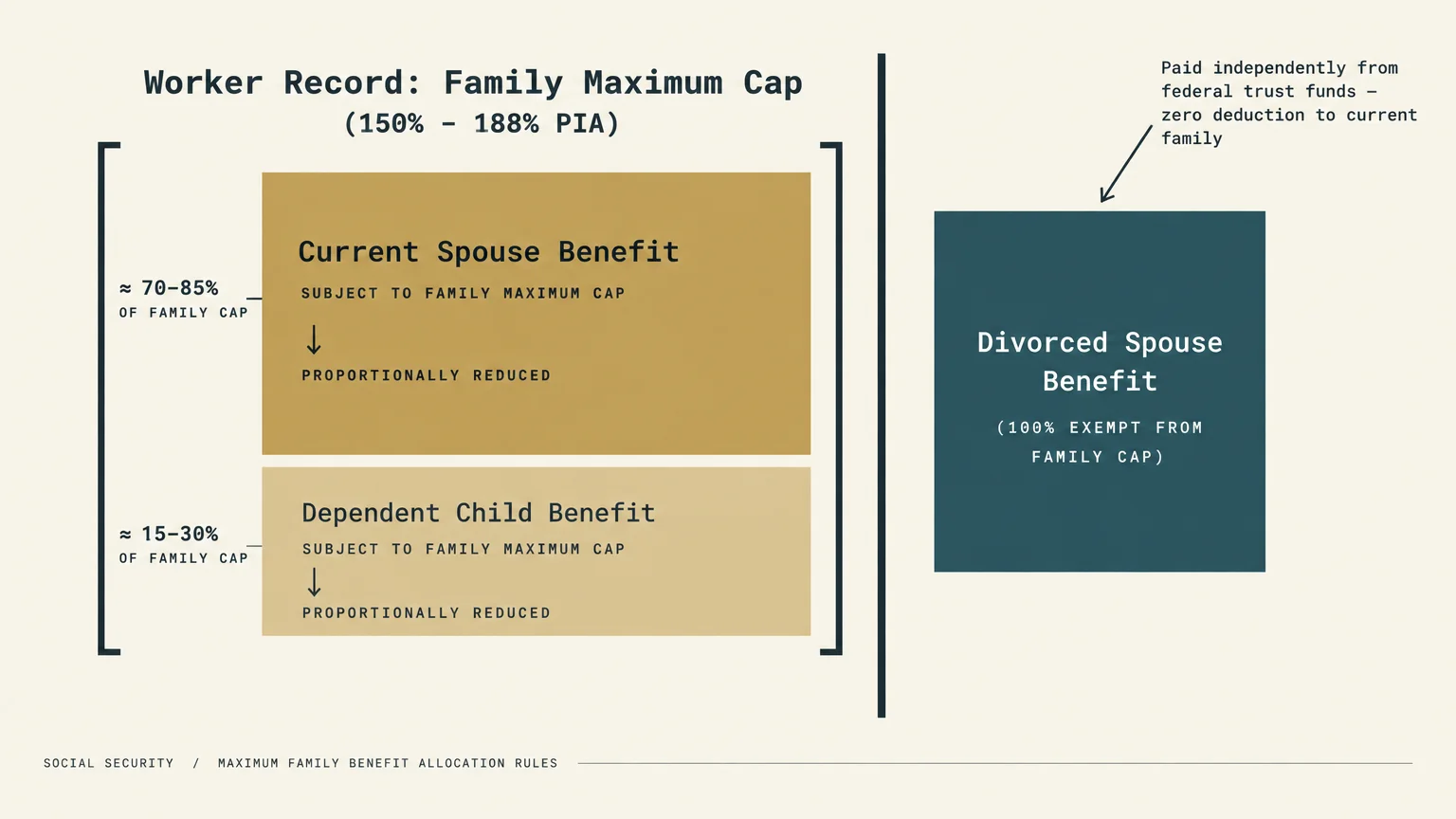
Social Security enforces a Maximum Family Benefit cap on any individual worker’s record. This family ceiling typically ranges between 150 percent and 188 percent of the earner’s primary insurance amount.
When multiple family members claim benefits on a single worker’s record, their auxiliary payouts are reduced proportionally to fit under this ceiling. However, payments made to an eligible divorced spouse are completely exempt from this restriction.
Your divorced spousal claim does not take a single penny away from your ex-spouse or their new family. The federal government funds these divorced entitlements independently outside the standard family ceiling.

4. The Child-in-Care Spousal Benefit Under Age 62
Most spouses believe they must wait until age 62 to access auxiliary payments. However, the child-in-care provision allows an eligible spouse to claim benefits at any age.
You qualify if you care for your spouse’s biological or adopted child who is under age 16. You also qualify if you care for their child who became permanently disabled before age 22.
The primary worker must be currently receiving retirement or disability benefits for you to receive this benefit. You can collect up to 50 percent of their base benefit with zero early-filing age penalty.
Once the child reaches age 16, these payments stop until you reach age 62 and file standard social security for spouses.
5. Deemed Filing Exemption for Surviving Spouses
The Bipartisan Budget Act of 2015 eliminated the popular restricted application strategy for living workers. Under universal deemed filing, claiming personal retirement or spousal benefits forces you to claim both simultaneously.
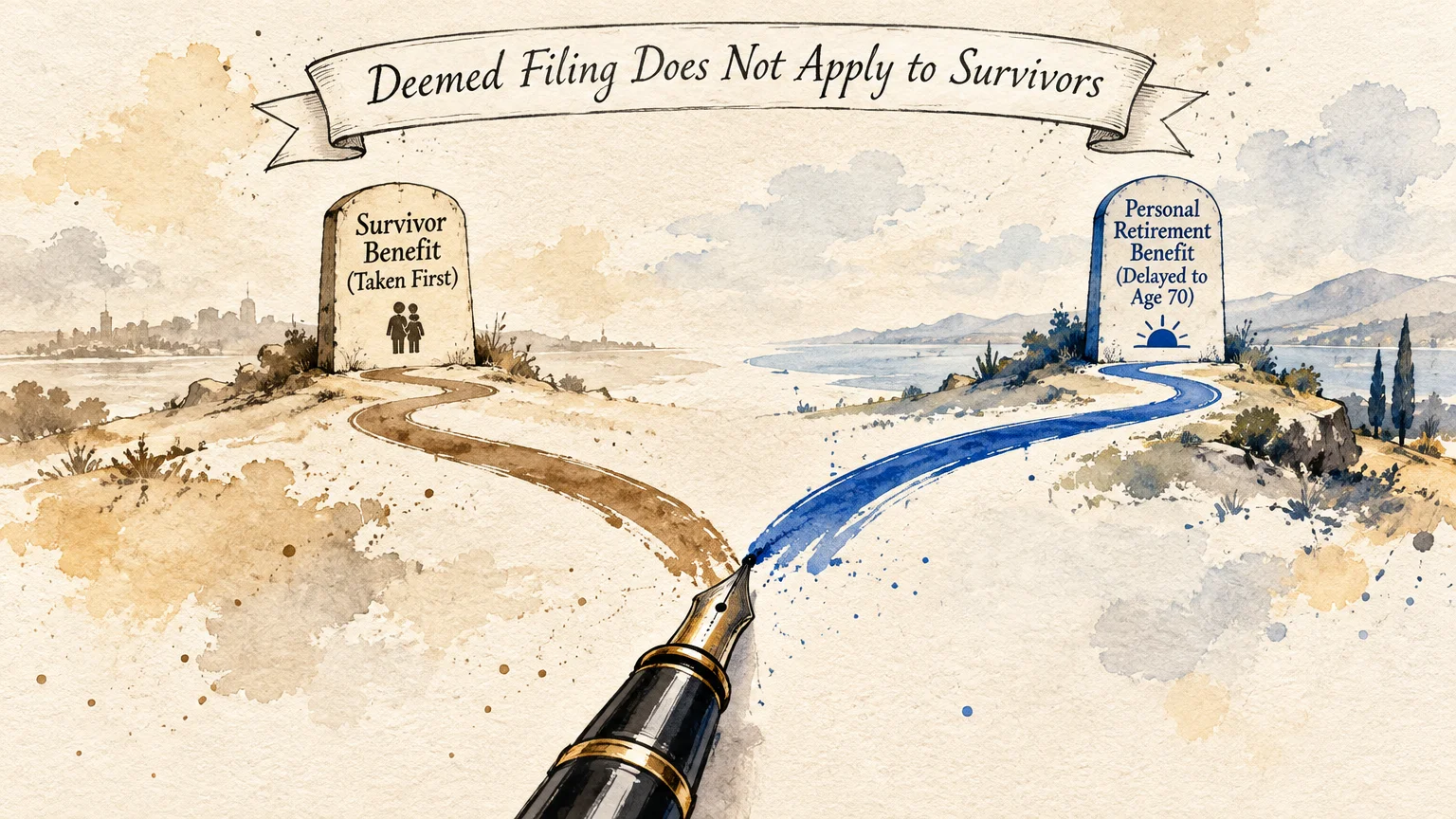
Survivor benefits are entirely exempt from deemed filing rules. Widows and widowers retain the statutory right to separate their survivor benefit from their personal retirement benefit.
You can collect a survivor benefit as early as age 60 while letting your own retirement benefit grow. At age 70, you can switch over to your own maximum earned benefit.
Alternatively, you can claim your own smaller benefit at 62 and switch to a full survivor benefit at Full Retirement Age. This tactical switching offers immense planning flexibility for surviving spouses.
6. Inherited Delayed Retirement Credits on Survivor Benefits
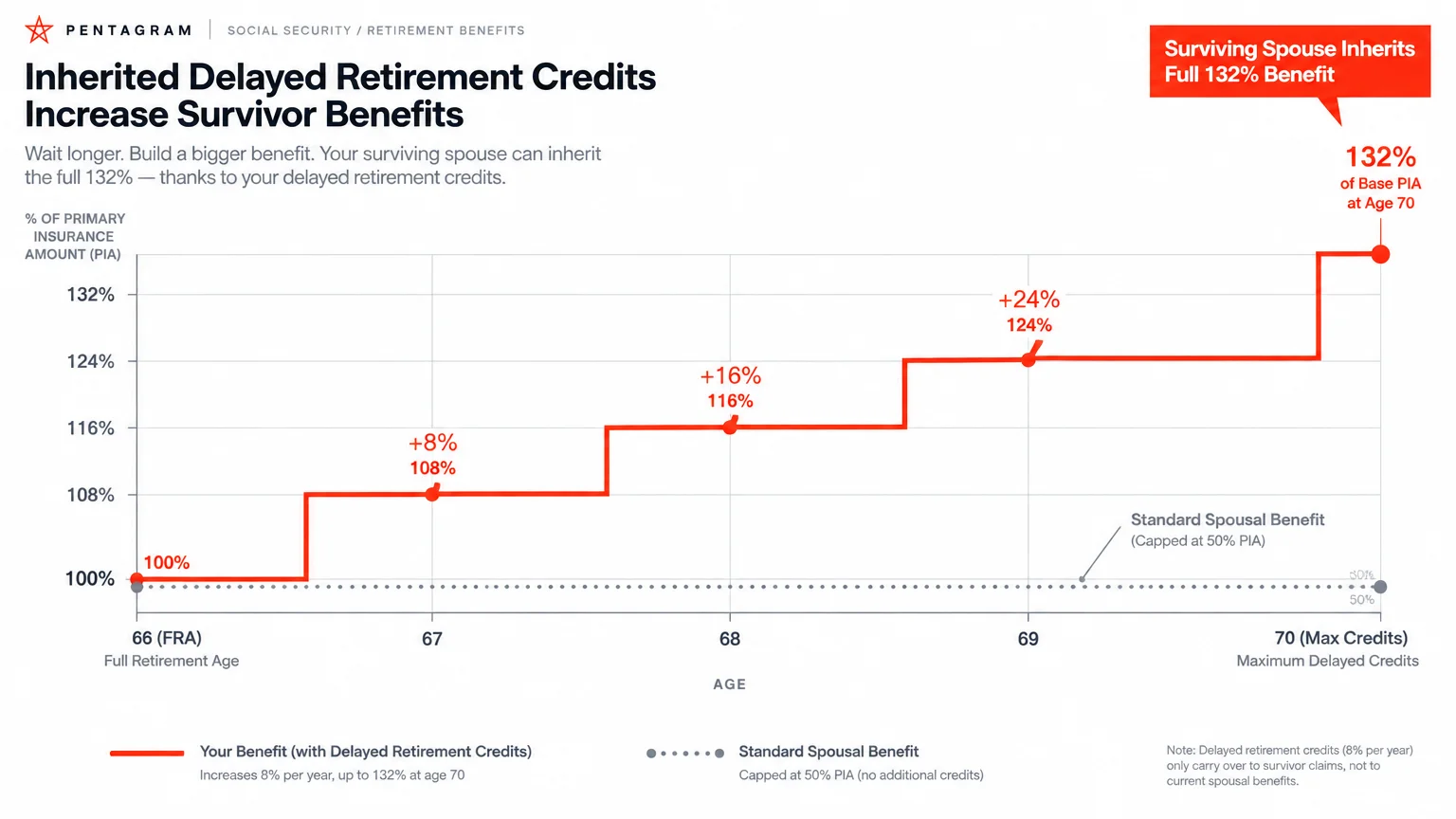
Regular spousal benefits never exceed 50 percent of the earner’s base benefit, regardless of when they file. Survivor benefits work very differently by transferring up to 100 percent of what the deceased actually received.
When a primary earner waits until age 70 to collect, they accumulate Delayed Retirement Credits. Those credits boost their check by 8 percent per year past full retirement age.
If the primary earner passes away, the surviving spouse inherits that entire enhanced monthly benefit. Delaying the primary worker’s claim protects the surviving spouse against long-term poverty late in life.
“Delaying Social Security until age 70 is the best financial investment you can make for your surviving spouse.” — Suze Orman, Personal Finance Author and Host

7. Remarriage Protections After Age 60
Divorced spousal benefits permanently end if you remarry someone else. In contrast, survivor benefits offer unique marriage flexibility once you reach age 60.
If you remarry at or after age 60—or age 50 if disabled—you keep collecting your deceased spouse’s survivor benefit. Remarriage does not interrupt or reduce those monthly checks.
You can even compare your survivor benefit against the spousal benefit of your new partner. Social Security will award you the higher amount between the two records.

8. Six-Month Retroactive Payment Opportunities
If you delay claiming benefits past your Full Retirement Age, you gain access to a retroactive lump-sum option. The SSA allows applicants past FRA to request up to six months of back pay.
Selecting retroactive benefits provides an immediate cash influx when you file your application. However, taking back pay rolls your official claiming age back by six months.
This decision permanently lowers your future monthly payments by eliminating six months of delayed growth. You must weigh the immediate cash windfall against long-term guaranteed monthly income.

9. The Overlooked $255 Lump-Sum Death Benefit
Surviving spouses often overlook the Social Security lump-sum death payment during bereavement. The government provides a one-time benefit of $255 to an eligible surviving spouse living in the same household.
While modest, this statutory payment helps offset immediate funeral or administrative expenses. You must apply for this benefit within two years of your spouse’s death, or the entitlement expires.
Funeral homes frequently notify the SSA of a death, but they rarely file this benefit application for you. You must submit Form SSA-8 directly to collect the payment.

10. Premium-Free Medicare Part A Through Your Spouse
Many spouses spend decades managing households or working in jobs without paying sufficient FICA taxes. Without 40 work credits, you cannot qualify for premium-free Medicare Part A on your own record.
Fortunately, you can qualify for premium-free Part A through your spouse’s work history once you turn 65. Your spouse must have 40 credits and be at least 62 years old.
Divorced spouses can also claim Part A on an ex-spouse’s record if the marriage lasted 10 years. Official guidance on Medicare.gov outlines how this saves thousands annually in hospital insurance premiums.
Comparing Social Security Spousal and Survivor Benefits
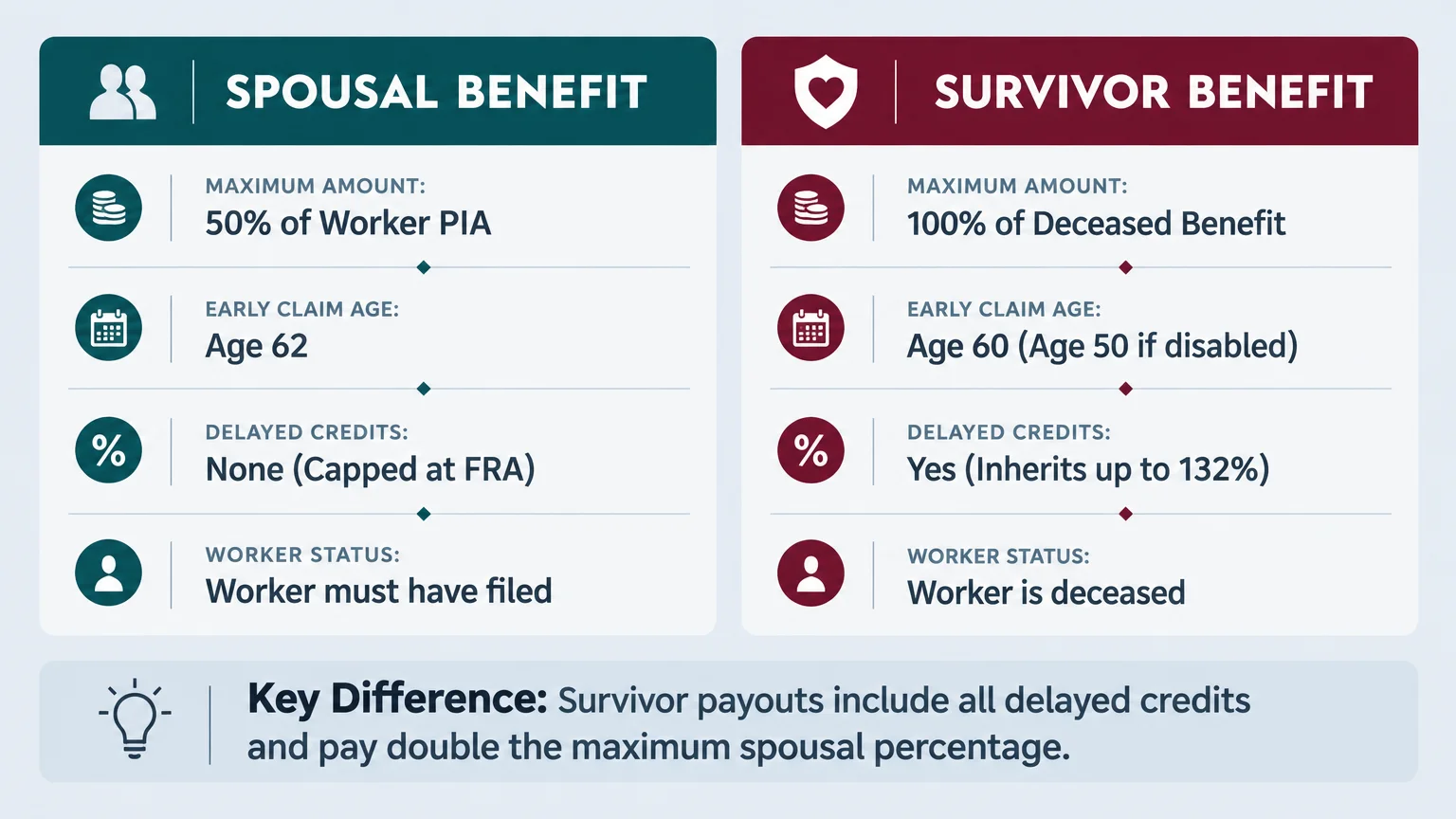
Understanding how auxiliary benefit types differ helps you choose the right claiming timeline. Review the core distinctions below to evaluate which rules match your household circumstances.
| Benefit Type | Earliest Claiming Age | Maximum Benefit Amount | Subject to Deemed Filing? | Impacted by Family Maximum? |
|---|---|---|---|---|
| Standard Spousal | 62 (or any age with qualifying child) | 50% of earner’s PIA | Yes | Yes |
| Divorced Spousal | 62 | 50% of ex-spouse’s PIA | Yes | No |
| Child-in-Care Spousal | Any age (child under 16 or disabled) | 50% of earner’s PIA | No | Yes |
| Surviving Spouse | 60 (or 50 if disabled) | Up to 100% of deceased earner’s actual benefit | No | Yes |

Common Mistakes to Avoid
Waiting past Full Retirement Age to claim spousal benefits is a widespread mistake. Spousal benefits never earn delayed credits, so delaying past FRA forfeits money permanently.
Another trap involves the Social Security Retirement Earnings Test for beneficiaries who work before reaching FRA. In 2025, the SSA withholds $1 for every $2 earned above $23,400.
In 2026, that earnings threshold increases to $24,480 before benefit withholding begins. In the calendar year you reach FRA, the earnings limit rises to $65,160.
Divorced individuals also mistakenly assume their ex-spouse will find out if they claim benefits. The claiming process is completely private and never impacts your former partner’s financial situation.
Surviving spouses often miss out on thousands by failing to coordinate personal and survivor claims. Failing to alternate between benefits eliminates one of the greatest retirement planning advantages available.

Professional vs. Self-Guided Claiming Strategies
Deciding how to claim spousal benefits depends heavily on the complexity of your household finances. Some couples can handle filing independently, while others benefit significantly from professional advisory services.
Consider a self-guided approach if you and your spouse have similar career earnings and straightforward work histories. Free estimation calculators from the Consumer Financial Protection Bureau help model basic scenarios.
Seek professional guidance if there is a significant age or earnings discrepancy between partners. A fee-only financial planner can optimize claiming ages to protect the lower-earning partner long-term.
Professional advice is essential if you navigate multiple past marriages lasting at least 10 years each. An expert can determine which former partner’s earnings record yields the largest monthly benefit.
Widows and widowers should also consult an expert before claiming any benefits. Strategically staggering personal and survivor payouts requires precise timing to prevent permanent benefit losses.
“Retirement is not the end of the road, but a change in the road.” — Mitch Anthony, Retirement Educator
Frequently Asked Questions
Can I collect spousal benefits if my spouse has not filed yet?
Your current spouse must file for their own retirement benefits before you can receive spousal payments. The only exception applies to divorced spouses who have been divorced for at least two continuous years.
How does divorce affect my spousal Social Security benefits?
Divorce does not eliminate your auxiliary benefits if your marriage lasted at least 10 consecutive years. You must remain unmarried and be at least 62 years old to qualify.
Can I collect spousal benefits and switch to my own benefit later?
Under universal deemed filing rules, you cannot claim a standard spousal benefit first and let your own benefit grow. However, surviving spouses claiming survivor benefits can execute this switching strategy.
Does my spousal benefit increase if my spouse waits until age 70 to file?
No, your living spousal benefit tops out at 50 percent of your partner’s base Full Retirement Age amount. However, if your spouse passes away, you will inherit their full enhanced benefit at age 70.
Taking Action on Your Spousal Benefits
Taking time to evaluate spousal benefit rules protects your household against unnecessary financial stress during retirement. Review your earnings records together and establish a coordinated claiming roadmap before contacting the Social Security Administration.
This is educational content based on general retirement and financial principles; individual results vary based on your situation. Always verify current benefit rules, tax laws, and eligibility requirements with official sources like SSA, Medicare.gov, or the IRS.
Last updated: March 2026. Retirement benefits, tax rules, and healthcare regulations change frequently—verify current details with official sources.









Leave a Reply