
In 2026, the absolute highest monthly Social Security benefit tops out at $5,181, generating over $62,000 in annual retirement income. Yet less than one percent of all retired workers ever see a check this large deposited into their bank accounts.
The vast majority of retirees receive an average monthly payment closer to $2,080. Securing the maximum payout demands an exceptionally rare combination of high earnings consistency and tactical claiming patience.
Understanding why this peak check remains out of reach reveals exactly how Social Security calculates your benefit; more importantly, it helps you capture every dollar you legitimately earn.

The Anatomy of the $5,181 Maximum Monthly Benefit in 2026
Every year, the Social Security Administration (SSA) establishes maximum benefit thresholds based on changes in the national wage index and annual cost-of-living adjustments (COLA). For 2026, reflecting a 2.8% COLA increase, the highest possible payment an individual worker can receive upon claiming at age 70 is $5,181 per month—or $62,172 annually.
To put that figure into perspective, the estimated national average monthly benefit for retired workers in 2026 sits between $2,071 and $2,086. The maximum check delivers roughly two-and-a-half times what typical American retirees receive. Even among high earners, your exact claiming age dramatically alters the ceiling on your monthly payment:
- Claiming at Age 62 (Earliest Eligibility): The maximum possible benefit is capped at $2,969 per month.
- Claiming at Full Retirement Age (Age 67 for those born in 1960 or later): The maximum check rises to $4,152 per month.
- Claiming at Age 70 (Maximum Delayed Credits): The payout reaches the absolute peak of $5,181 per month.
The gap between claiming early at age 62 and waiting until age 70 creates a staggering $2,212 monthly difference—or $26,544 more per year for the rest of your life. Yet achieving that peak payout requires clearing three rigid hurdles simultaneously.
The Three Non-Negotiable Rules for Qualifying for Maximum Social Security
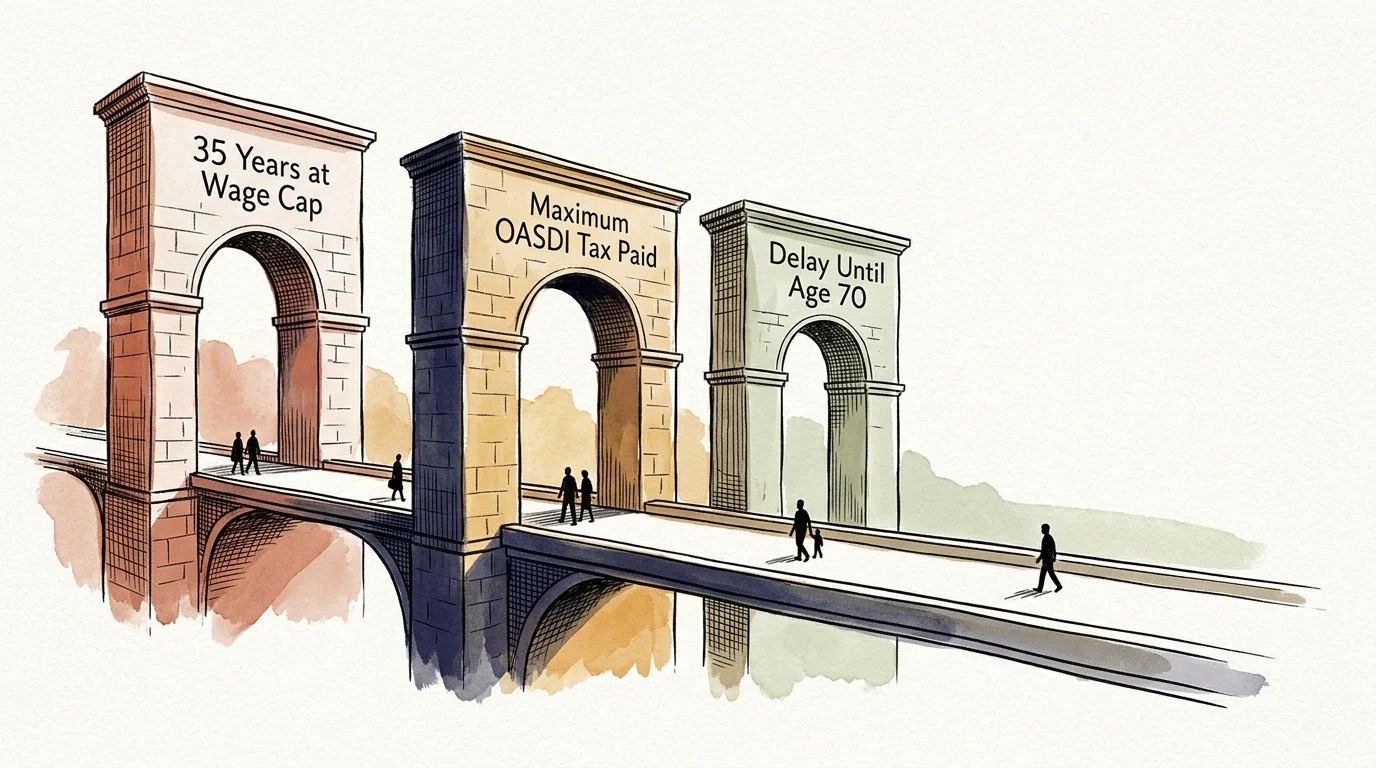
The federal government does not award top-tier benefits simply because you had a successful career or earned a high salary in your final working years. Qualifying for maximum Social Security requires satisfying three strict, non-negotiable criteria over multiple decades.
1. Earning at or Above the Taxable Wage Cap for at Least 35 Years
The Social Security calculation formula evaluates your highest 35 years of inflation-adjusted earnings. To qualify for the highest possible Social Security payment, you must earn at or above the annual “taxable maximum” (contribution and benefit base) in every single one of those 35 years.
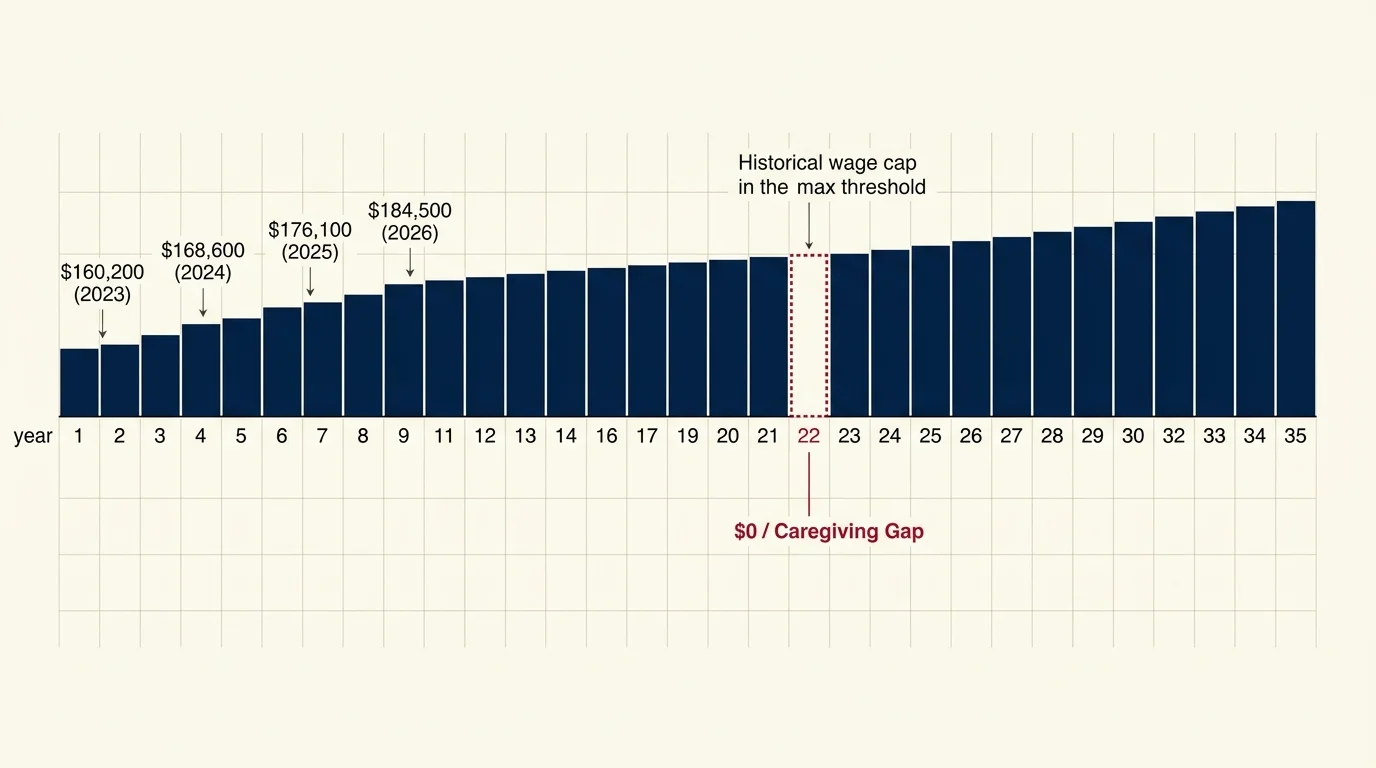
If you work 34 years at the cap and take one year off to care for family, return to school, or transition careers, the SSA inserts a zero for that 35th year. That single zero pulls down your average indexed monthly earnings and permanently eliminates your eligibility for the maximum possible check.
2. Paying Maximum OASDI Payroll Taxes Across Shifting Annual Limits
You only get credit toward your Social Security benefit record up to the annual taxable wage cap. Wages earned above this threshold are exempt from the 6.2% Old-Age, Survivors, and Disability Insurance (OASDI) payroll tax, meaning those excess dollars do not increase your future benefit check.
Because the taxable maximum rises alongside national wage growth, maintaining top-tier status requires your earnings to climb continually. Consider the recent trajectory of the taxable maximum:
- 2026: $184,500
- 2025: $176,100
- 2024: $168,600
- 2023: $160,200
Thirty years ago, in 1996, the taxable wage cap stood at $62,700; in 1986, it was $42,000. To receive the 2026 maximum payout, your historical earnings had to match or exceed whatever cap was active in each of your 35 qualifying years.
3. Delaying Your Benefit Claim Until Age 70
Even if you earned above the taxable maximum for 35 or 40 years, you cannot receive the $5,181 check if you claim benefits a single month before your 70th birthday. Workers earn Delayed Retirement Credits (DRCs) for every month they postpone claiming beyond their Full Retirement Age (FRA). For workers with an FRA of 67, waiting until age 70 provides an 8% annual increase (roughly 0.67% per month), resulting in a permanent 24% boost over their baseline benefit.
“Delaying Social Security until age 70 gives you an 8 percent annual guaranteed return on your benefit. You simply cannot find that kind of guaranteed growth anywhere else in the financial world.” — Suze Orman, Personal Finance Author & Advisor
Why Few Get Max Social Security Check: The 35-Year Consistency Hurdle
When you examine how Americans build careers, the fundamental reason behind why few get max Social Security check payments becomes obvious: sustained high earnings across three-and-a-half decades are extraordinarily rare.
According to research from the SSA, approximately 6% of working Americans earn at or above the taxable wage base in any single calendar year. However, the overlap of workers who maintain that top-earning status for 35 distinct years drops to a tiny fraction of one percent.
Several real-world career patterns disrupt 35-year wage cap consistency:
- The Early-Career Ramp: Most professionals spend their twenties in entry-level positions, internships, or graduate school. A worker entering the workforce at age 22 rarely earns $184,500 right out of college. If your high-earning years do not begin until age 35, you must work without interruption until age 70 just to accumulate 35 qualifying years.
- Career Interruptions and Caregiving: Raising children, caring for aging parents, experiencing corporate downsizing, or taking extended medical leave creates gaps in continuous earnings.
- Self-Employment and Business Structure: Many successful business owners and independent consultants pay themselves modest W-2 salaries while taking the balance of their income through distributions or reinvesting revenue back into their companies. While tax-efficient in the short term, this practice lowers the earnings credited on their SSA records.
- Economic and Industry Downturns: Volatility in commission-based roles, tech downturns, or broader recessions can push otherwise high earners below the wage cap for two or three years during their prime earning decades.

The Claiming Age Dilemma: Why Most Retirees Do Not Wait Until Age 70
The second major barrier to Social Security maximum benefit eligibility is behavioral and financial timing. Delaying benefits until age 70 requires personal savings, continuous employment, or auxiliary income to bridge the gap between stopping work and starting Social Security.
Under current law, Full Retirement Age is 67 for all workers born in 1960 or later (and 66 years, 10 months for those born in 1959 reaching FRA in 2026). Claiming at age 62 permanently reduces your monthly check by up to 30% compared to claiming at FRA. Despite this reduction, data compiled by AARP and the SSA consistently shows that only about 10% of retirees wait until age 70 to start collecting their benefits.
Retirees claim earlier for practical, understandable reasons:
- Health and Longevity Uncertainty: Workers facing chronic health conditions or shorter family life expectancies often prefer claiming earlier to maximize total lifetime months of payments.
- Involuntary Early Retirement: Many workers leave the workforce before their chosen target date due to corporate restructuring, physically demanding duties, or caregiving obligations.
- Cash Flow Demands: Without substantial 401(k), IRA, or taxable investment balances, individuals rely on Social Security immediately upon leaving their jobs to pay basic living expenses.
- Market and Policy Anxiety: Concerns over future Social Security trust fund adjustments prompt some retirees to lock in their benefits as early as possible.

Comparing Social Security Claiming Scenarios in 2026
The following table contrasts how claiming ages, earnings histories, and benefit adjustments shape your monthly and annual income in 2026.
| Claiming Age Profile | Earnings Requirement | 2026 Max Monthly Benefit | 2026 Max Annual Income | Est. Average Monthly Check |
|---|---|---|---|---|
| Age 62 (Earliest Possible) | Hit wage base 35 years | $2,969 | $35,628 | $1,360 – $1,420 |
| Age 67 (Full Retirement Age) | Hit wage base 35 years | $4,152 | $49,824 | $2,071 – $2,086 |
| Age 70 (Maximum Delay) | Hit wage base 35 years | $5,181 | $62,172 | $2,550 – $2,620 |
As the table illustrates, an individual with a flawless 35-year maximum earnings record who claims at age 62 receives a smaller monthly check ($2,969) than an average earner who delays until age 70 combined with spousal coordination benefits. Claiming age serves as the ultimate multiplier in the benefit equation.
How the Social Security Benefit Formula Compresses High Earnings
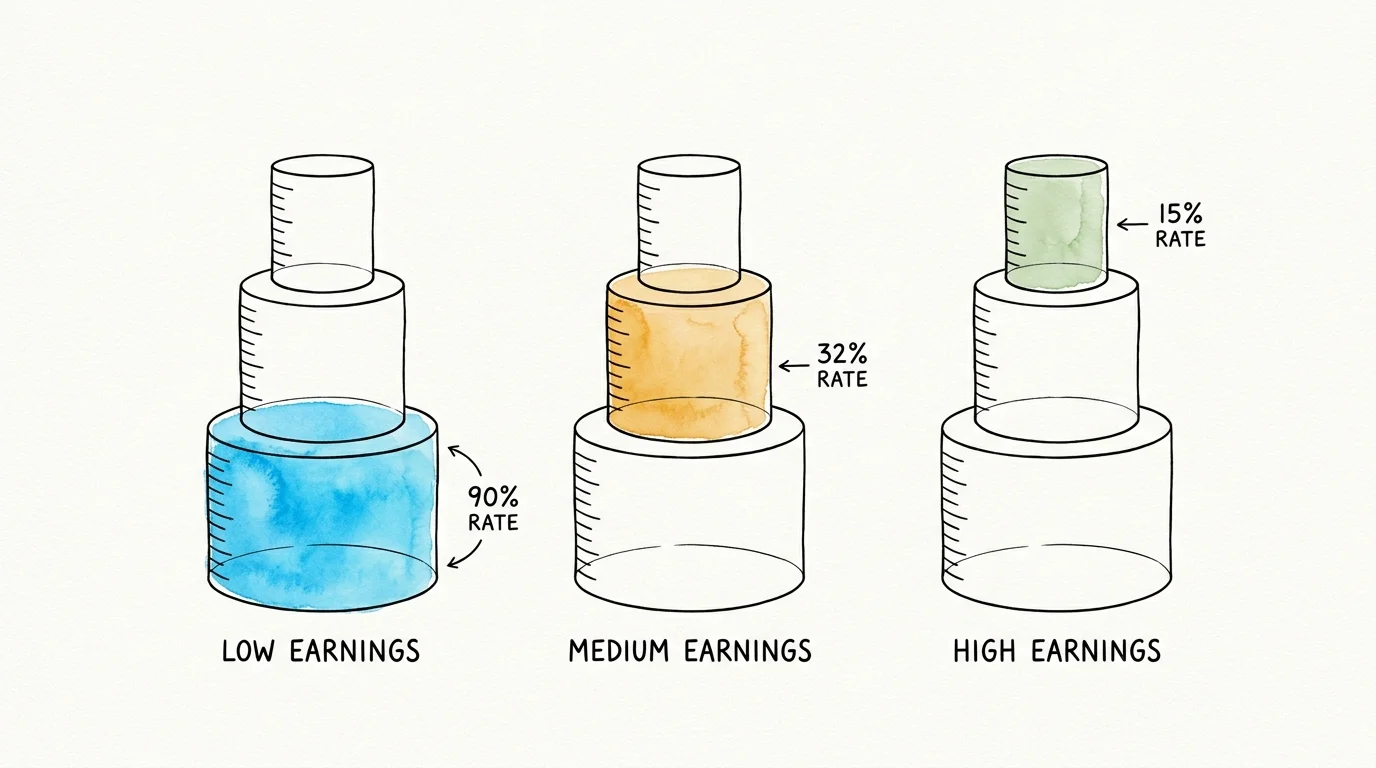
To grasp why your benefit looks the way it does, you must understand the progressive structure of the Social Security formula. The system replaces a higher percentage of pre-retirement income for lower-wage workers than for high-wage earners.
The SSA first calculates your Average Indexed Monthly Earnings (AIME) across your top 35 years. Then, it applies a progressive formula using “bend points” to determine your Primary Insurance Amount (PIA)—the base monthly check you receive at Full Retirement Age.
The formula applies three distinct replacement tiers:
- 90% of your AIME up to the first bend point.
- 32% of your AIME between the first and second bend points.
- 15% of your AIME above the second bend point up to the contribution base.
Because every dollar of average earnings above the second bend point generates only 15 cents of monthly retirement benefit, high earners experience sharp diminishing returns. For comprehensive financial analysis on progressive retirement formulas, educators at Investopedia highlight that this progressive design keeps the system focused on baseline income replacement rather than wealth accumulation.

Actionable Strategies to Maximize Your Own Benefit Check
You do not need to qualify for the theoretical maximum of $5,181 to dramatically improve your financial security. You can deploy several concrete strategies to expand your monthly check, regardless of your career earnings tier.
1. Replace Lower-Earning Years by Extending Your Career
Because the SSA uses your highest 35 years of indexed earnings, working an additional year or two in your late fifties or sixties at peak salary replaces earlier, lower-earning years (such as summer jobs or early-career roles). Each zero or low-income year you knock off your record permanently increases your AIME.
2. Coordinate Spousal and Survivor Benefits
Married couples should coordinate claiming ages strategically. The higher-earning spouse should aim to delay claiming until age 70 whenever possible. This delay achieves two goals: it maximizes the household’s primary monthly income check and guarantees the highest possible survivor benefit for the remaining spouse if the higher earner passes away first.
3. Use a Bridge Strategy with Pre-Tax Savings
If you retire from your job at age 62 or 65, you do not have to claim Social Security immediately. By drawing income from traditional IRAs, 401(k) plans, or taxable brokerage accounts between ages 62 and 70, you create a “retirement bridge.” This allows your Social Security benefit to compound at an 8% annual growth rate until age 70 while simultaneously reducing future Required Minimum Distributions (RMDs) from your retirement accounts.
4. Manage Provisional Income to Limit Taxation
Up to 85% of your Social Security benefits can become subject to federal income taxes if your “provisional income” (adjusted gross income plus non-taxable interest plus 50% of your Social Security benefit) exceeds statutory thresholds. Structuring Roth conversions in your early sixties—before claiming Social Security—lowers your future taxable income and preserves more of your net monthly payment.
Avoiding Common Errors in Benefit Planning
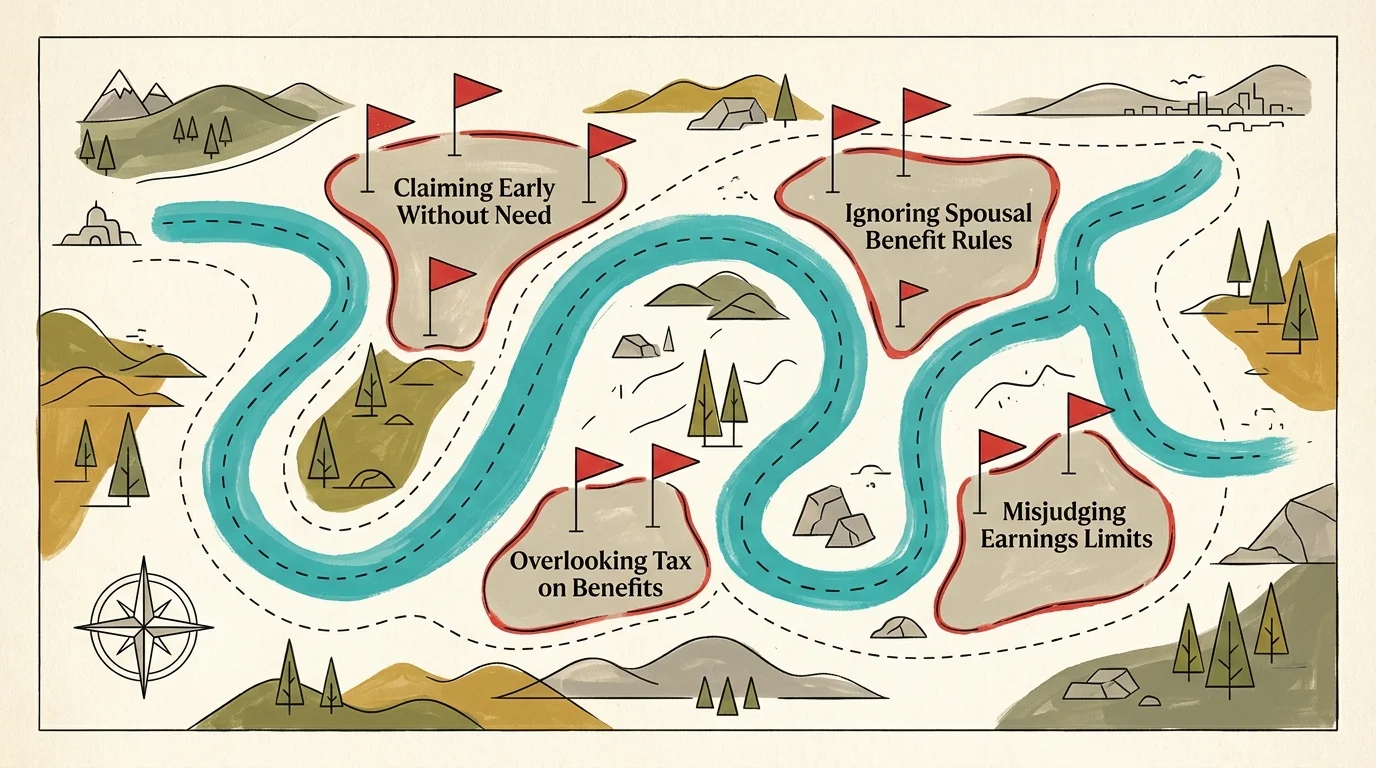
Navigating Social Security requires avoiding missteps that can permanently depress your monthly cash flow. Watch out for these four common pitfalls:
- Claiming Early While Still Working: If you claim Social Security before your Full Retirement Age and continue to work, the Retirement Earnings Test temporarily withholds $1 in benefits for every $2 you earn above the annual limit ($23,400 in 2026). While the SSA recalculates your benefit at FRA to credit those withheld payments, claiming early while working creates administrative headaches and tax inefficiencies.
- Waiting Past Age 70: Delayed Retirement Credits stop accumulating the month you turn 70. Postponing your claim past age 70 produces zero additional financial benefit and permanently forfeits monthly checks you are entitled to collect.
- Ignoring Earnings Record Errors: Employers occasionally misreport annual wages or Social Security numbers. Check your online earnings history through your my Social Security account periodically. Correcting an inaccurate zero-wage year requires providing old W-2s or tax returns to the SSA.
- Failing to Account for Windfall Provisions: If you worked in a state, municipal, or school district job that did not participate in Social Security and earned a non-covered pension, the Windfall Elimination Provision (WEP) or Government Pension Offset (GPO) may reduce your benefit. Plan your cash flow around these offsets well before your retirement date.

When DIY Isn’t Enough
While standard online calculators provide baseline estimates, certain financial situations involve complex regulatory interactions where personalized financial planning becomes essential. You should seek specialized guidance from a fiduciary advisor or a credentialed professional through the Certified Financial Planner Board in the following scenarios:
- Blended and Multi-Marriage Histories: If you have been divorced after at least 10 years of marriage, or if you are eligible for survivor benefits from a deceased spouse alongside your own retirement record, sequencing your claims can significantly increase lifetime payouts.
- Large Spousal Age and Wage Disparities: When one spouse is significantly younger or earned substantially less over their career, determining the optimal combination of spousal top-ups, individual delay strategies, and survivor protection requires precise cash flow modeling.
- Complex Tax and IRMAA Optimization: High-net-worth households managing significant pre-tax retirement balances, real estate sales, or business transitions must coordinate Social Security timing with Medicare Income-Related Monthly Adjustment Amount (IRMAA) surcharge thresholds to prevent unexpected healthcare premium spikes.
- Non-Covered Public Pension Coordination: Calculating the exact impact of WEP or GPO on combined household benefits requires manual adjustments that basic consumer calculators frequently miscalculate.
Frequently Asked Questions
Can I reach the maximum Social Security benefit if I retire before age 70 but wait to claim until 70?
Yes. You do not need to work until age 70 to get the maximum benefit, provided you already have 35 distinct years of earnings at or above the taxable wage base. If you stop working at age 62 with 35 maximum-earning years on your record, you can simply live on other savings and delay your claim until age 70 to capture the full Delayed Retirement Credits.
Does the 2026 maximum monthly benefit apply to spousal benefits?
No. Spousal benefits are capped at 50% of the primary earner’s Primary Insurance Amount (PIA) at Full Retirement Age. Spouses do not earn Delayed Retirement Credits past their own FRA. Therefore, the maximum spousal benefit in 2026 is half of the FRA maximum ($4,152 / 2 = $2,076 per month).
How does the Social Security Administration verify my 35 highest earning years?
The SSA tracks your annual covered earnings through the W-2 forms submitted by employers and Schedule SE tax filings for self-employed individuals. Each year’s historical earnings are indexed to national wage growth through age 60, after which actual unindexed dollar values are used. The system automatically selects the highest 35 indexed years to compute your benefit.
Will working past age 70 increase my Social Security check?
Working past age 70 will not add Delayed Retirement Credits. However, if your earnings in any year past age 70 are higher than one of the 35 years currently used in your calculation, the SSA will automatically recalculate your benefit and substitute the higher year, resulting in a modest boost to your check.
Final Thoughts and Next Steps
Qualifying for the highest possible Social Security payment of $5,181 in 2026 requires an extraordinary combination of top-tier earnings for 35 full years and the financial capacity to delay claiming until age 70. While fewer than 1% of retirees meet all the requirements, understanding these rules gives you total clarity over your own financial outlook.
Focus on what you can control: eliminate zero-earning years from your record, coordinate claiming timelines with your spouse, and consider using your savings to bridge the gap toward delaying your claim as close to age 70 as makes sense for your health and lifestyle.
This article provides general retirement education and information only. Every retiree’s situation is unique—what works for others may not work for you. For personalized advice, consider consulting a qualified financial professional such as a CFP or CPA.
Last updated: March 2026. Retirement benefits, tax rules, and healthcare regulations change frequently—verify current details with official sources.








Leave a Reply