Retired in America

Your Guide to a Confident Retirement

  • Home
  • Personal finance
  • Retirement Life
  • Saving & Spending

What Happens to Your Social Security If You Work Part-Time After 65

September 9, 2026 · Personal finance

Picking up a part-time job after 65 provides extra cash, but it directly affects your Social Security payments if you have already claimed benefits. Your earnings can trigger benefit withholding, alter your tax bracket, or permanently boost your future payout.

The critical factor is your Full Retirement Age, which is 67 for anyone turning 65 today. Earning wages before reaching that milestone subjects your benefits to strict government limits.

Knowing how the earnings test operates ensures you keep more of your hard-earned pay while maximizing your retirement income.
The Essentials: Working After 65 at a Glance

Before reviewing the details, examine the foundational rules that apply when you collect benefits and earn wages simultaneously.

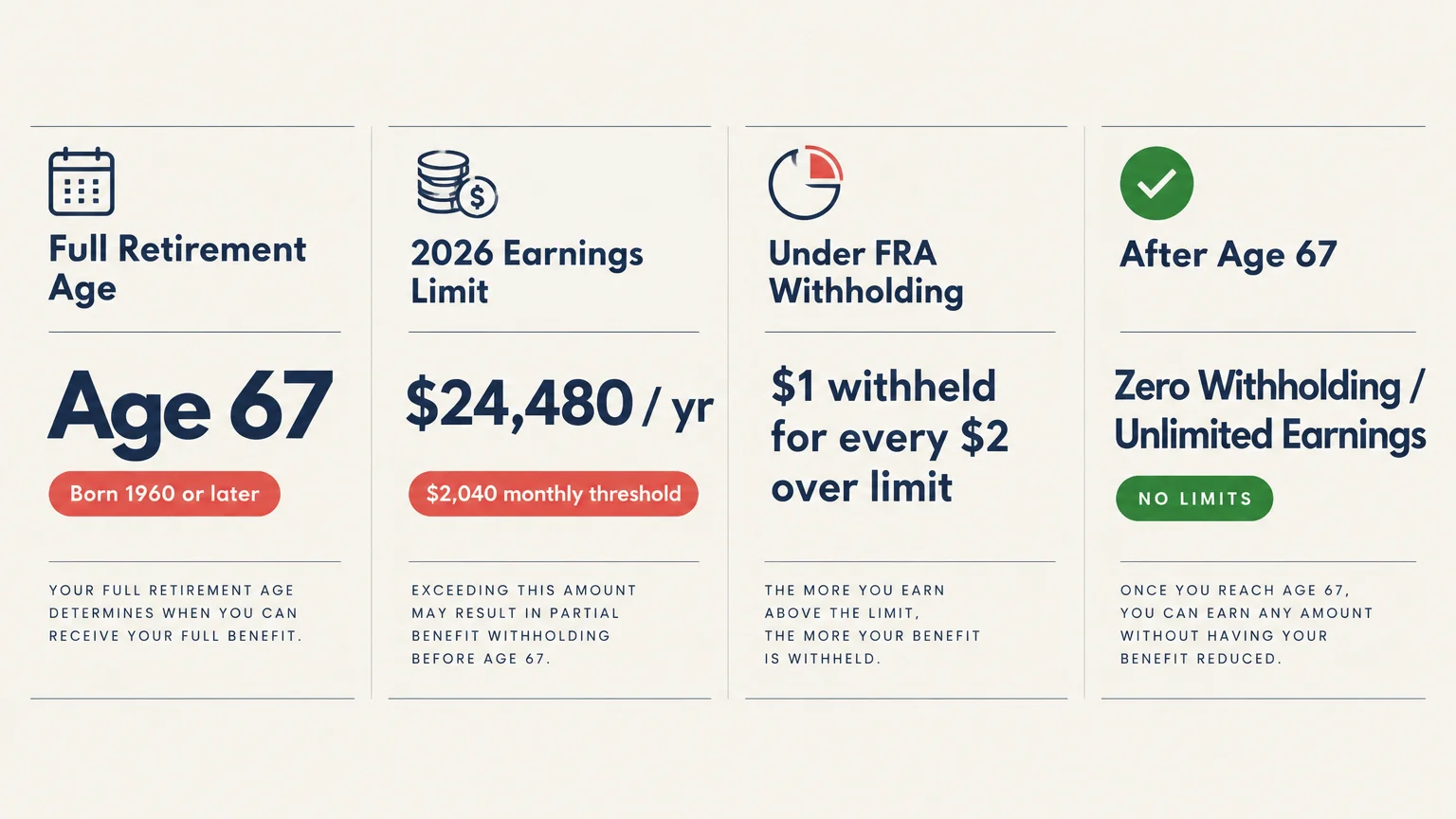
  • Full Retirement Age (FRA): Age 67 for anyone born in 1960 or later.
  • Annual Earnings Limit (2026): $24,480 ($2,040 per month); the 2025 limit was $23,400.
  • Under FRA Withholding Rate: $1 withheld for every $2 earned above the threshold.
  • Year Reaching FRA Limit (2026): $65,160 ($5,430 per month); the 2025 limit was $62,160.
  • Year Reaching FRA Withholding: $1 withheld for every $3 earned above the threshold.
  • Permanent Benefit Loss: Zero; withheld funds are credited back once you reach age 67.
  • Work After FRA: Unlimited earnings with zero benefit withholding.

Full Retirement Age: Why Age 65 Is No Longer the Finish Line

For decades, Americans viewed age 65 as the traditional benchmark for retirement. Congress changed that standard in 1983 to ensure the program’s long-term financial solvency.

If you celebrate your 65th birthday today, your Full Retirement Age is 67. Claiming benefits at age 65 permanently reduces your monthly check by roughly 13.3 percent.

Working a part-time job at 65 means you are working before your FRA. Consequently, every dollar of wage income faces federal earnings limits.

Once you reach age 67, these restrictive earnings caps disappear entirely. Until then, you must navigate the rules of the Retirement Earnings Test.


The Social Security Earnings Limit Explained

The Retirement Earnings Test applies exclusively to beneficiaries who have not yet reached Full Retirement Age. It sets a cap on your earned income before mandatory withholdings begin.

In 2025, that annual ceiling sat at $23,400. For 2026, the Social Security Administration increased the annual limit to $24,480, which equals $2,040 per month.

If your annual part-time earnings exceed $24,480 in 2026, the agency withholds $1 of benefits for every $2 you earn over the limit.

Imagine you earn $30,480 working at a local business throughout 2026. Your wages exceed the allowable limit by exactly $6,000.

The government divides that $6,000 excess by two, producing a $3,000 withholding requirement. They satisfy this penalty by withholding your full monthly benefit checks until the obligation is met.

If your monthly check is $1,500, the agency holds back your January and February payments. Regular monthly payments then resume in March.

The First-Year Retirement Grace Period

Transitioning into part-time work mid-year often creates anxiety about hitting the annual earnings threshold too quickly. Fortunately, federal regulations provide a special monthly rule during your first calendar year of retirement.

This grace rule allows you to receive a full monthly benefit for any month you earn $2,040 or less in 2026. The agency ignores your previous full-time salary from earlier months.

For example, retiring from a high-earning corporate career in May will not penalize your autumn benefits. As long as your monthly part-time wages stay under $2,040, you receive your full check.

This special safety provision applies for only one calendar year. After that initial transition, the agency evaluates your total annual earnings.

Year Reaching Full Retirement Age: Higher Limits and Milder Penalties

Earnings rules relax dramatically during the calendar year you reach your Full Retirement Age. The government recognizes that you are approaching full entitlement and applies more generous thresholds.

In 2025, that elevated threshold was $62,160. For 2026, workers reaching age 67 can earn up to $65,160 before benefit withholdings begin.

The withholding formula also becomes much gentler. The agency withholds only $1 for every $3 you earn above the threshold.

Most importantly, the agency only tallies earnings accumulated in the months prior to your birth month. Any wages you collect during or after your birthday month carry no earnings penalty whatsoever.

Where Does Withheld Money Go? The Recalculation Rule

Many working seniors assume the government permanently confiscates withheld benefits. In reality, you never lose a single dollar permanently.

“Working during retirement gives you purpose and cash flow, but you must understand how early earnings impact your Social Security checks.” — Suze Orman, Personal Finance Expert

When the agency withholds monthly checks, it credits those months back to your lifetime record. Once you attain age 67, administrators automatically recalculate your Primary Insurance Amount.

Your monthly payment increases permanently to reflect the months you did not receive a benefit. This upward adjustment ensures your lifetime payout catches up over time.

According to research from AARP, beneficiaries who survive past average life expectancy often recoup more money than was initially withheld.

What Counts as Earned Income (and What Does Not)

The Retirement Earnings Test applies solely to active labor income. The government distinguishes between money you physically work for and passive income from savings or investments.

Gross W-2 wages and net earnings from self-employment count directly toward your annual earnings ceiling. If you perform paid consulting or hourly customer service, that income counts.

Conversely, traditional retirement account distributions do not count against the limit. Withdrawals from 401(k) plans, traditional IRAs, and private pensions remain completely exempt.

Investment yields such as capital gains, corporate dividends, and bank interest do not count either. You can collect significant investment returns without triggering benefit withholdings.

Comparing Benefit Rules: Under FRA vs. Full Retirement Age

Understanding how the rules shift once you turn 67 helps you plan your work schedule effectively. The table below outlines how benefits and earnings interact across both phases.

Rule or Feature Under Full Retirement Age (Age 65–66) At or After Full Retirement Age (Age 67+)
Annual Earnings Limit (2026) $24,480 per year ($2,040 per month) Unlimited earnings allowed
Benefit Withholding Rate $1 withheld for every $2 over the threshold None ($0 withheld)
Year of FRA Milestone Limit (2026) $65,160 per year (months before birthday) Not applicable
What Income Counts Gross wages and net self-employment No earnings are tracked or restricted
Recalculation of Benefits Adjusted upward at age 67 to repay withholdings Adjusted only if current earnings beat top 35 years
FICA Tax Obligations Mandatory 7.65% (15.3% for self-employed) Mandatory 7.65% (15.3% for self-employed)

As the comparison illustrates, reaching age 67 removes the administrative friction between working and receiving monthly benefits.

How Part-Time Wages Can Increase Your Lifetime Benefits

Working after 65 offers a powerful advantage beyond immediate cash flow. Your part-time earnings can actively increase your baseline monthly benefit.

The government bases your benefit payout on your highest 35 years of inflation-indexed earnings. If your work history includes fewer than 35 years, zeroes fill the empty slots.

Taking a lucrative part-time role can replace a zero-earning year or a low-wage year from decades ago. Each replaced year raises your average lifetime earnings base.

Administrators review annual earnings data every autumn. If your part-time wages qualify among your top 35 years, they automatically raise your monthly payment retroactive to January.

Taxes on Social Security: The Combined Income Trap

Adding wages to your financial mix can produce an unexpected tax bill. The Internal Revenue Service uses a specific formula called provisional or combined income to determine tax liability.

Your combined income equals your Adjusted Gross Income, plus non-taxable interest, plus 50 percent of your annual Social Security benefit payout.

For single filers, combined income between $25,000 and $34,000 makes up to 50 percent of benefits taxable. Earning more than $34,000 exposes up to 85 percent to taxes.

For married couples filing jointly, combined income between $32,000 and $44,000 exposes up to 50 percent of benefits. Exceeding $44,000 subjects up to 85 percent to taxation.

You must also pay mandatory FICA taxes on all part-time wages. Employees pay 7.65 percent, while self-employed contractors pay the full 15.3 percent self-employment tax.

Impact on Medicare Premiums and Healthcare Coverage

Working after 65 directly influences your healthcare choices through Medicare. You become eligible for Medicare at 65 regardless of your Full Retirement Age for Social Security.

If your part-time employer provides qualifying group coverage and employs 20 or more workers, you can safely delay Medicare Part B. Delaying Part B saves you monthly premium costs.

However, small-business health plans with fewer than 20 workers do not qualify as primary coverage. In that case, you must enroll in Part B to avoid lifelong late penalties.

Higher part-time wages can also trigger Income-Related Monthly Adjustment Amounts, known as IRMAA. These surcharges significantly raise your Medicare Part B and Part D premiums.

Avoiding Common Errors

Navigating part-time work alongside Social Security requires attention to administrative deadlines and reporting requirements. Avoiding frequent pitfalls protects your household budget.

Failing to notify the agency about expected earnings is a frequent mistake. If you surpass the cap without reporting it, the agency will demand rapid overpayment repayments later.

Another error involves confusing investment income with earned wages. Do not turn down IRA distributions out of fear; retirement withdrawals never count toward the earnings limit.

Retirees often overlook self-employment tax obligations when pursuing freelance work. Independent contractors must budget for both income taxes and the 15.3 percent self-employment tax.

Finally, never decline meaningful part-time work simply to avoid the earnings test. Since withheld benefits are credited back at 67, working always leaves you with more total lifetime cash.

When DIY Isn’t Enough

While many retirees manage their schedules independently, complex financial situations benefit from professional analysis. Navigating overlapping tax and entitlement rules often requires seasoned guidance.

Consult a certified financial planner if your wages threaten to push you into Medicare IRMAA surcharge brackets. An extra thousand dollars in wages could trigger thousands in healthcare surcharges.

Seek advice if you operate an S-Corporation or LLC. Balancing reasonable salary against shareholder dividends requires careful tax compliance to satisfy both the IRS and Social Security.

Professional guidance is also essential when coordinating spousal or survivor benefits. Wage withholdings on your personal record can inadvertently affect benefits paid to dependent family members.

Frequently Asked Questions

Will my Social Security checks stop entirely if I earn too much?

Your checks stop temporarily only until the required withholding amount is satisfied. Once the penalty sum is covered, your regular monthly checks resume immediately for the remainder of the year.

Do I still pay Social Security taxes on part-time wages if I already receive benefits?

Yes, all workers must pay FICA taxes regardless of age or benefit status. Employees pay 6.2 percent for Social Security and 1.45 percent for Medicare from every paycheck.

How does the Social Security Administration know what I earn?

The agency receives wage reports directly from the IRS every year through your employer’s W-2 forms. Self-employed individuals report earnings through Schedule SE on federal tax returns.

Can working part-time ever reduce my monthly benefit amount?

No, working part-time cannot lower your primary insurance calculation. It either increases your monthly payment by replacing a lower-earning year or leaves your benefit base completely unchanged.

Next Steps for Working Retirees

Before accepting a part-time position, calculate your expected annual wages against the 2026 limit of $24,480. Establishing an online account at SSA.gov lets you monitor your reported earnings and verify upcoming adjustments.

Coordinate your anticipated wage income with your tax professional to prevent unexpected tax liabilities on your monthly checks. The information in this guide is meant for educational purposes. Your specific circumstances—including income, health needs, tax situation, and goals—may require different approaches. When in doubt, consult a licensed professional.


Last updated: March 2026. Retirement benefits, tax rules, and healthcare regulations change frequently—verify current details with official sources.

Share this article

Facebook Twitter Pinterest LinkedIn Email

Leave a Reply Cancel reply

Your email address will not be published. Required fields are marked *

Search

Latest Posts

  • Here's How Long You Should Keep Tax Records If You Own a Home
  • 5 States With Extra Payments on Top of Federal Benefits
  • The 10 Best Small Towns for Retirees to Stretch a Social Security Check
  • What Happens to Your Social Security If You Work Part-Time After 65
  • A stressed older couple sits on the floor of an empty living room surrounded by unpacked cardboard moving boxes. 5 States Retirees Regret Moving to, Based on Cost and Lifestyle
  • A smiling senior woman stands outside near a porch surrounded by lush garden greenery, hiking boots, and a warm mug. 12 Things to Do Instead of Watching TV All Day in Retirement
  • Shocked older man holding a landline phone receiver while reviewing financial bills at a kitchen table. 8 Things to Do the Moment You Realize You've Been Scammed
  • A smiling senior woman buys fresh vegetables from a vendor at a bustling outdoor farmers market. Farmers Market Vouchers for Low-Income Seniors
  • Adirondack chairs on a wooden deck overlooking a misty lake with a dock, canoe, and lakeside cabin at sunrise. 7 Lakefront Towns Where Retirees Get More House for Less
  • Senior man sitting at a wooden kitchen table reviewing a Social Security document with a pen, glasses, and calculator. 7 Ways Retirees Waste Their COLA Raise Every Year

Newsletter

Get retirement planning tips, savings strategies, and lifestyle insights delivered to your inbox.

Related Articles

11 Social Security Mistakes You Have To Avoid Before You Retire

Some seniors lean solely on their Social Security during retirement. Others are able to supplement…

Read More →
A senior woman smiling while using a tablet in a bright, modern living room.

14 Smart Home Ideas for Independent Seniors

Discover 14 practical smart home ideas and aging in place technology to help independent seniors…

Read More →

10 Essential Ways To Protect Your Retirement Accounts From Hackers

How inefficient could we be to advise on using a retirement planning app without giving…

Read More →

5 States With Extra Payments on Top of Federal Benefits

Discover 5 states offering extra monthly payments on top of federal benefits for seniors, including…

Read More →
10 Things Teachers Should Know About Their Pension Before Retiring

10 Things Teachers Should Know About Their Pension Before Retiring

Learn the 10 essential teacher pension facts before retiring, including payout options, survivor benefits, tax…

Read More →
An elegant watercolor and ink illustration of a peaceful retirement pathway with subtle red warning flags and a magnifying glass.

10 Financial Red Flags Retirees Should Never Ignore

Learn the top 10 financial red flags in retirement and practical ways to protect your…

Read More →
An older couple sits at a wooden kitchen table in morning light, carefully reviewing Medicare paperwork and calendars.

The Medicare Deadline That Sneaks Up on Retirees Every Year

Discover critical Medicare deadline dates, avoid permanent late enrollment penalties, and learn how to navigate…

Read More →
An older couple plans their retirement at a sunny wooden table with maps.

10 Ways Retirees Supplement Their Pension Income

Discover ten actionable, practical strategies to supplement your pension income, from optimizing Social Security benefits…

Read More →
2027 IRMAA Bracket Forecast: Estimated Income Thresholds by Filing Status

2027 IRMAA Bracket Forecast: Estimated Income Thresholds by Filing Status

Plan for 2027 Medicare IRMAA surcharges using projected 2025 MAGI thresholds by filing status. Learn…

Read More →
Retired in America

Your Guide to a Confident Retirement

Inedit Agency S.R.L.
Bucharest, Romania

contact@retiredinamerica.com

Trust & Legal

About Us

Editorial Policy

Advertiser Disclosure

Frequently Asked Questions

Contact Us

Disclaimer

Terms and Conditions

Privacy Policy

Subscribe

Unsubscribe

Categories

  • Personal finance
  • Retirement Life
  • Saving & Spending

© 2026 Retired in America. All rights reserved.