
How Part-Time Wages Can Increase Your Lifetime Benefits
Working after 65 offers a powerful advantage beyond immediate cash flow. Your part-time earnings can actively increase your baseline monthly benefit.
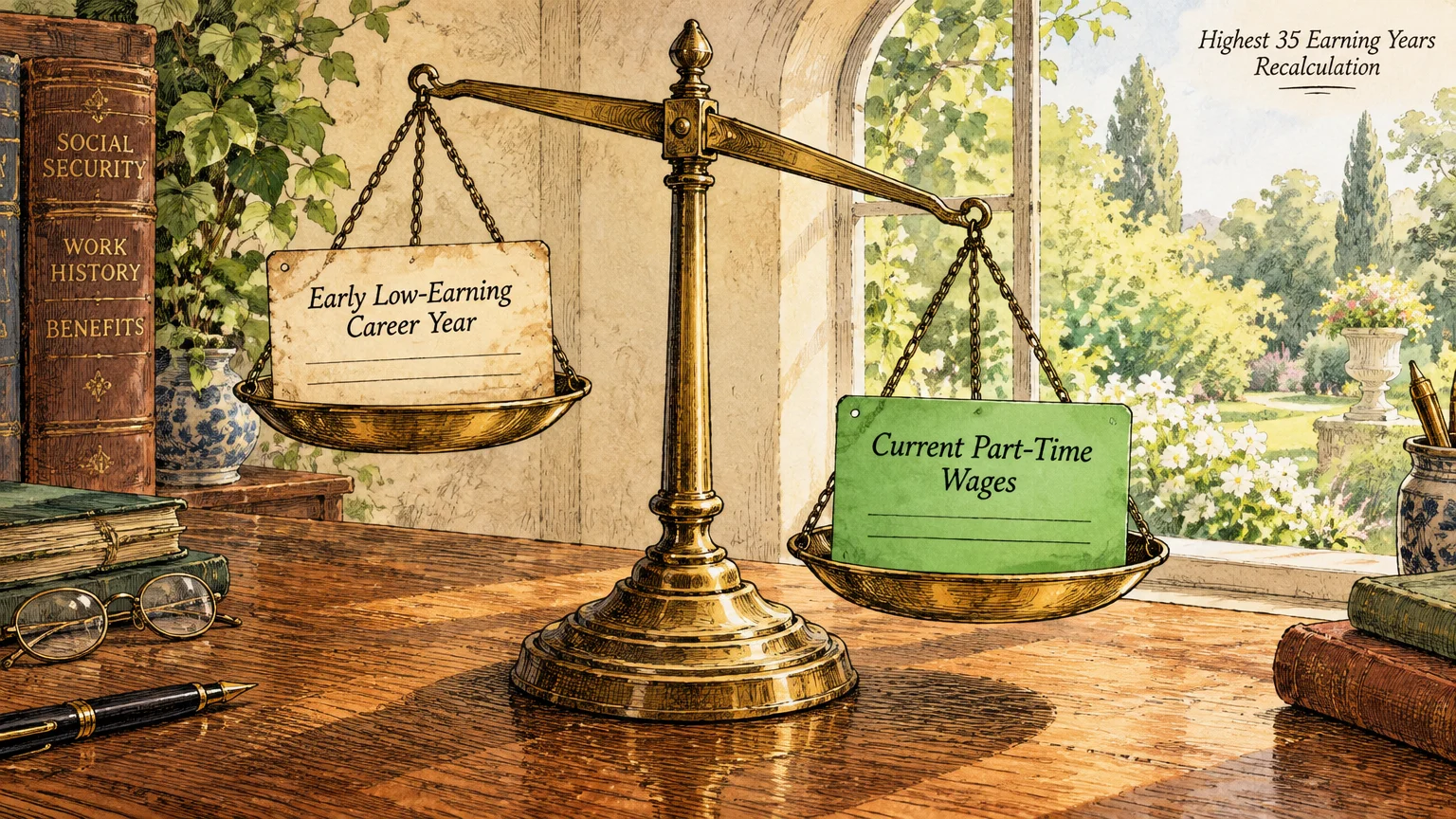
The government bases your benefit payout on your highest 35 years of inflation-indexed earnings. If your work history includes fewer than 35 years, zeroes fill the empty slots.
Taking a lucrative part-time role can replace a zero-earning year or a low-wage year from decades ago. Each replaced year raises your average lifetime earnings base.
Administrators review annual earnings data every autumn. If your part-time wages qualify among your top 35 years, they automatically raise your monthly payment retroactive to January.
Taxes on Social Security: The Combined Income Trap
Adding wages to your financial mix can produce an unexpected tax bill. The Internal Revenue Service uses a specific formula called provisional or combined income to determine tax liability.
Your combined income equals your Adjusted Gross Income, plus non-taxable interest, plus 50 percent of your annual Social Security benefit payout.
For single filers, combined income between $25,000 and $34,000 makes up to 50 percent of benefits taxable. Earning more than $34,000 exposes up to 85 percent to taxes.
For married couples filing jointly, combined income between $32,000 and $44,000 exposes up to 50 percent of benefits. Exceeding $44,000 subjects up to 85 percent to taxation.
You must also pay mandatory FICA taxes on all part-time wages. Employees pay 7.65 percent, while self-employed contractors pay the full 15.3 percent self-employment tax.
Impact on Medicare Premiums and Healthcare Coverage
Working after 65 directly influences your healthcare choices through Medicare. You become eligible for Medicare at 65 regardless of your Full Retirement Age for Social Security.
If your part-time employer provides qualifying group coverage and employs 20 or more workers, you can safely delay Medicare Part B. Delaying Part B saves you monthly premium costs.
However, small-business health plans with fewer than 20 workers do not qualify as primary coverage. In that case, you must enroll in Part B to avoid lifelong late penalties.
Higher part-time wages can also trigger Income-Related Monthly Adjustment Amounts, known as IRMAA. These surcharges significantly raise your Medicare Part B and Part D premiums.









ok i reached 67 actually 73 now have been working part time continually since so im still adding to my social security does my benefits increase since im still paying in
My rent alone is $2300 a month, so I need to work, I don’t want to end up fuckin homeless you idiots!
Hello I am 61 years old and I will be 62 on 2/5/2027 and I would like to know how soon can I go ahead and apply for my Social Security Benefits. Some say 4 months in advance and some say 3 months in advance.
I have been earning below the poverty amount. So no need to file taxes, but when I register for FRA do I need proof of taxes filed? Do I have to stop working at 67 ? I like working even when If don’t get paid. I quit for a week and almost died of a heart attack
I started my benefits at 62. Which the write move according to AI. I’ve been working full time since.I earn 2400& a month. SSA cut 2000$ from my benefits every year. Not fair. I paid in my SS for 40years!!!!!
I retired at 65 my retirement age is 66. I went to work part time was after I was 66. But they took out over 600 a month on me I feel this is so unfair.