
Retiring transforms your daily cash flow overnight, yet traditional banks rarely warn you about the costly traps waiting in your existing accounts. Transitioning smoothly into retirement requires auditing your deposit accounts before fees quietly drain your savings.
Many retirees assume decades of brand loyalty protect them from surprise charges and administrative roadblocks. In reality, retail banks operate as profit-driven businesses with rules designed for active wage earners rather than retirees.
Discover the most critical banking advice retirees wish they knew before leaving the workforce. These practical insights will protect your hard-earned wealth and prevent needless headaches.
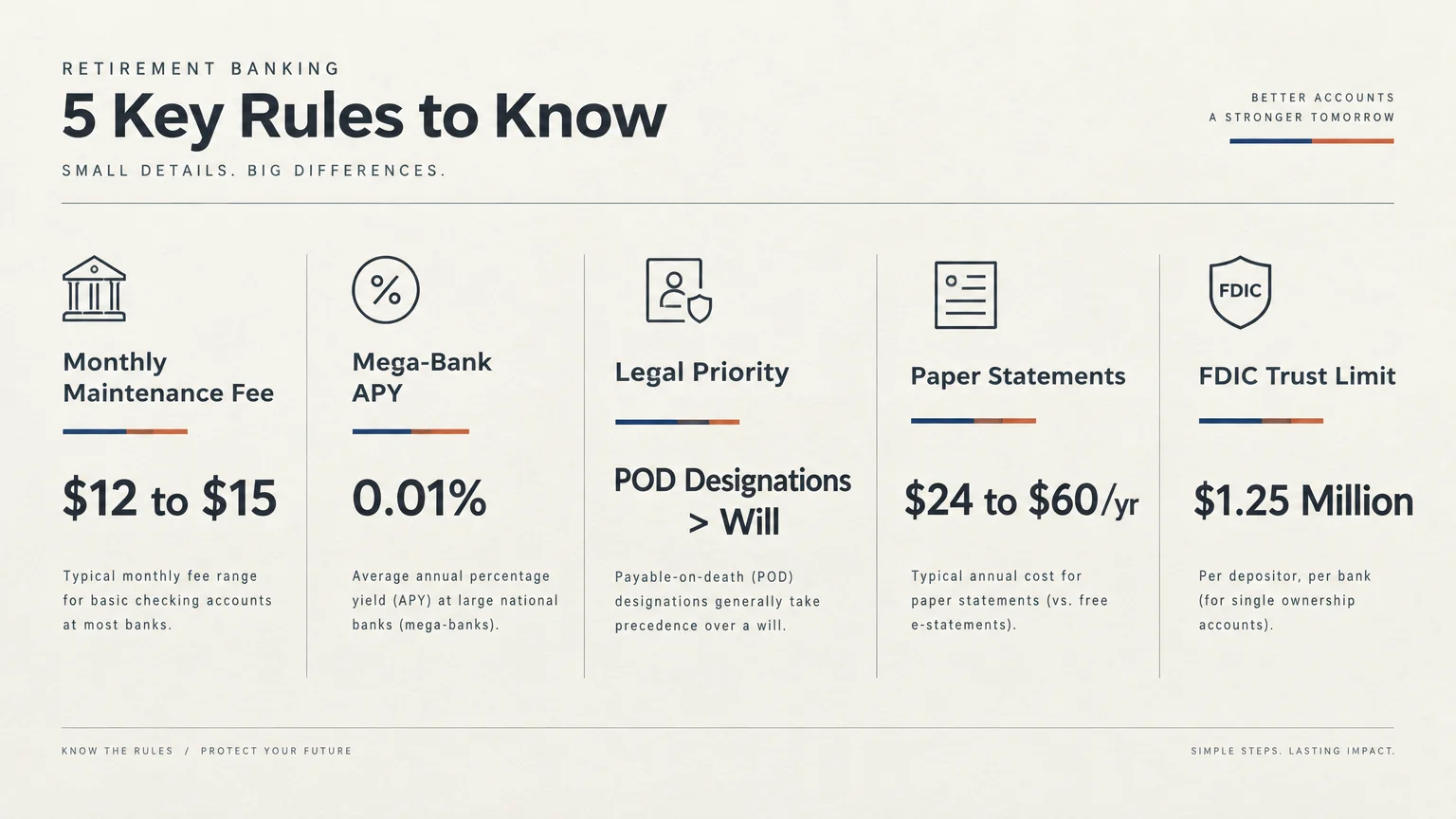
The Essentials: Retiree Banking Realities
- Checking fees return: Stopping payroll direct deposits can trigger monthly maintenance charges of $12 to $15.
- Cash drag is real: Big-bank savings accounts yielding 0.01% forfeit thousands of dollars in interest compared to high-yield alternatives.
- Wills do not rule bank accounts: Payable on Death (POD) beneficiary designations supersede your last will and testament.
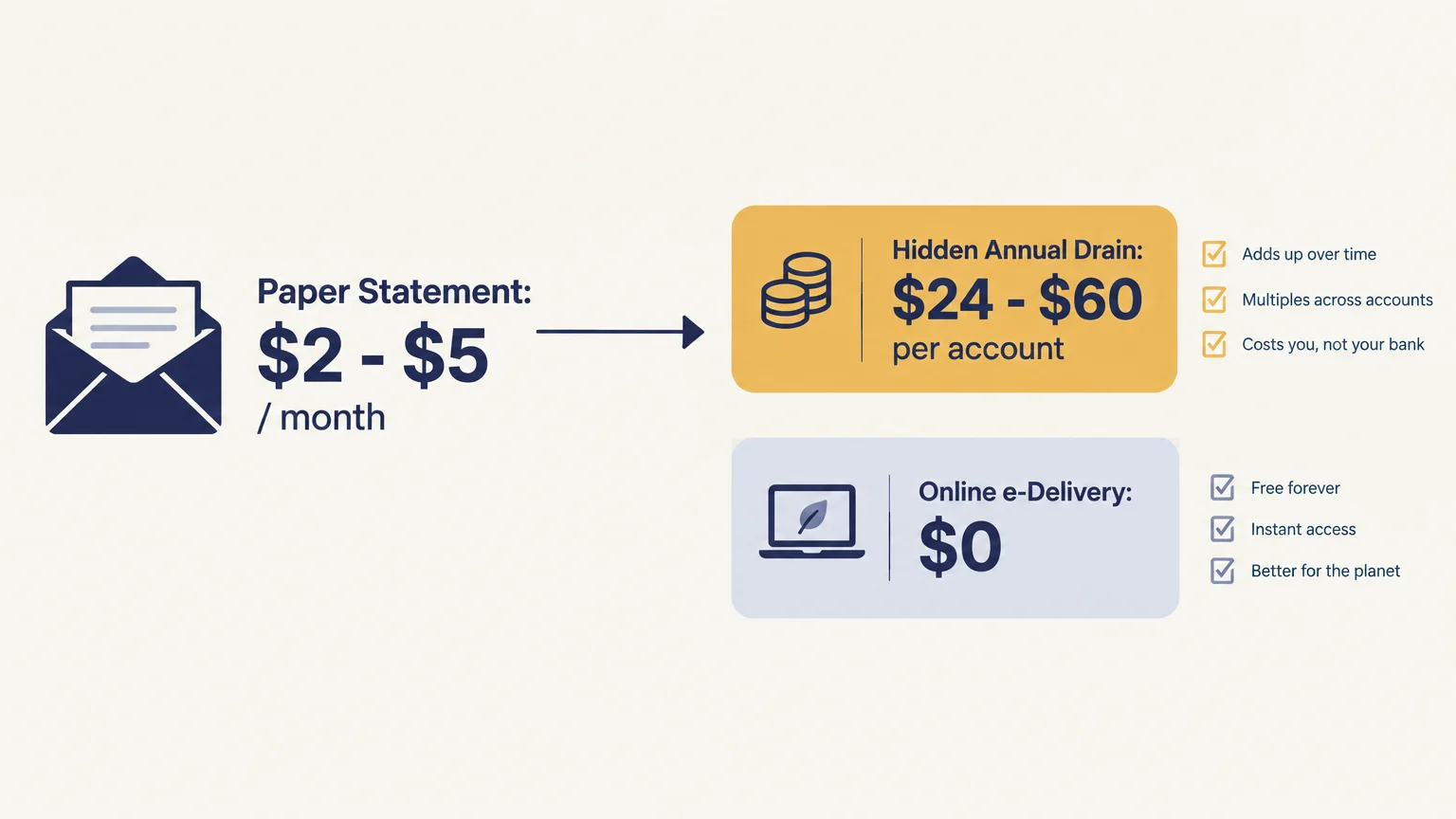
- Paper statements cost money: Physical statements can quietly siphon $24 to $60 per account each year.
- New trust rules apply: The FDIC overhauled trust insurance rules on April 1, 2024, setting a $1.25 million limit per owner across five beneficiaries.
1. Your Checking Account May Start Charging Monthly Fees
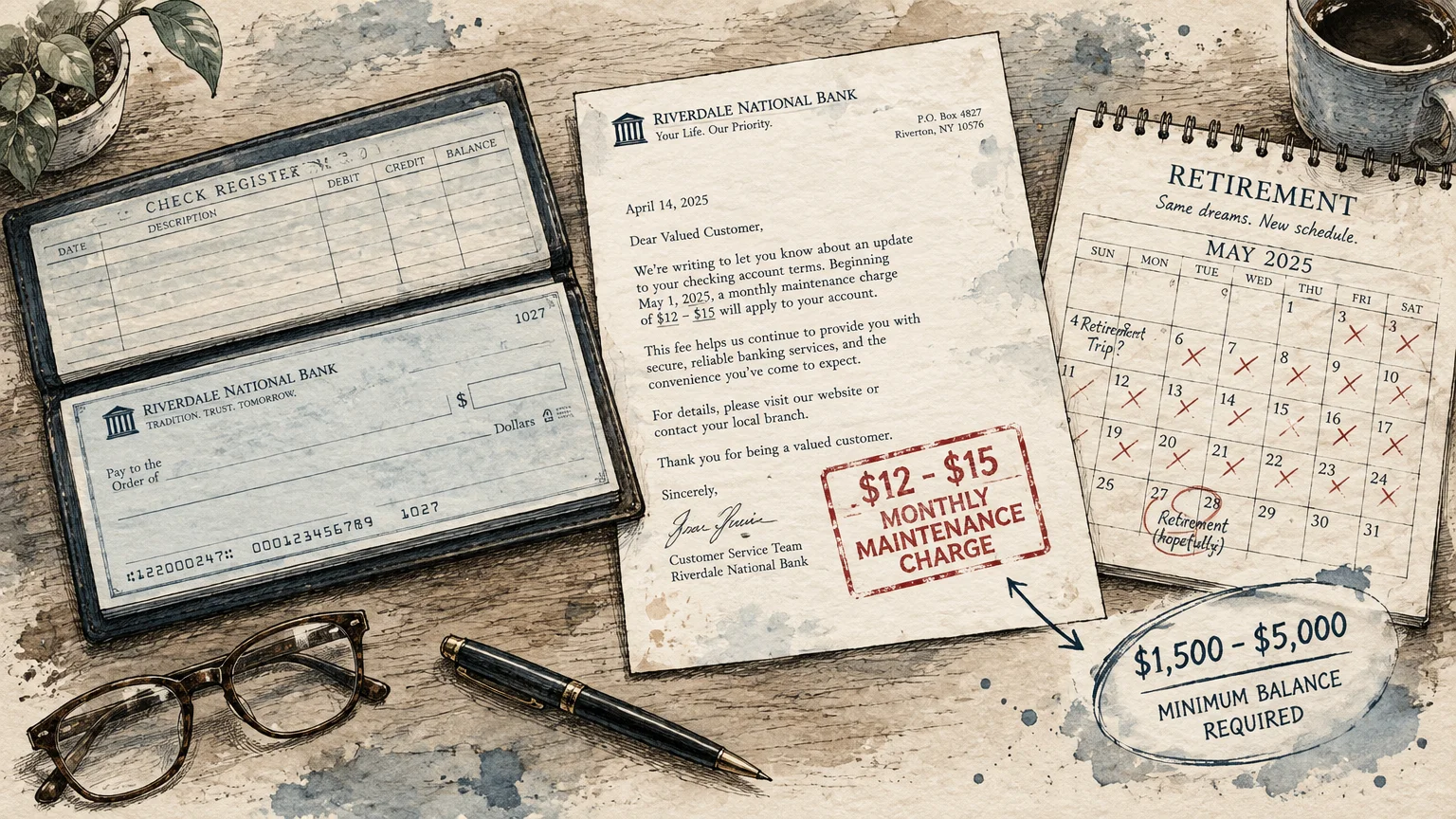
Most workers never glance at their bank fee schedule because employer payroll deposits keep their accounts fee-free. Once those recurring paychecks end, maintenance charges can silently chip away at your retirement cash reserves.
Large commercial banks routinely charge between $12 and $15 per month for basic checking. If you do not meet specific waiver requirements, you could forfeit up to $180 annually per account.
Some institutions count monthly Social Security benefits toward direct deposit waivers, but others do not. You must actively confirm whether your monthly federal deposit satisfies your bank’s waiver criteria.
If your bank excludes benefit checks, you must typically maintain a minimum daily balance between $1,500 and $5,000. Alternatively, request a no-fee senior checking tier or switch to a fee-free credit union.
2. Cash Sitting in Big Banks Silently Loses Value
Retirees often keep substantial cash buffers in traditional savings accounts to cover upcoming living expenses and medical emergencies. Unfortunately, big national banks pay next to nothing on these funds.
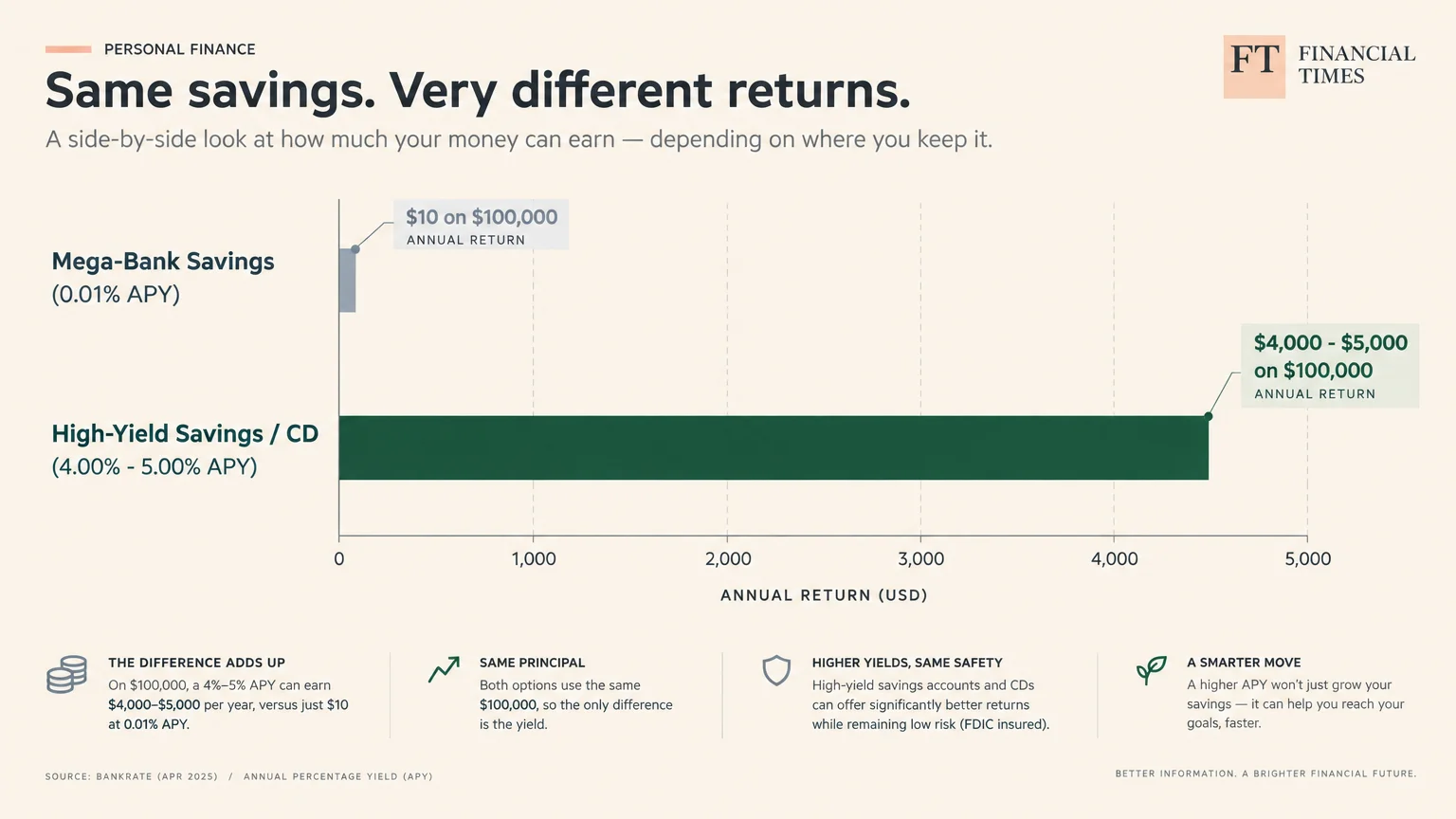
According to the FDIC, the national average savings yield hovers around 0.40%, while mega-banks frequently offer an insulting 0.01%. Leaving $100,000 in such an account earns a meager $10 over an entire year.
Top-tier high-yield savings accounts (HYSAs) and certificates of deposit (CDs) often deliver between 4.00% and 5.00% annual percentage yield. That same $100,000 deposit could generate $4,000 to $5,000 in annual passive income.
“A big mistake people make is keeping too much cash sitting in accounts earning virtually nothing. You worked hard for your money, so make sure it is working for you.” — Suze Orman, Personal Finance Expert
Check competitive rates through Bankrate to locate insured options that outpace inflation. Moving reserve funds into competitive institutions prevents cash drag from eroding your purchasing power.

3. Your Will Does Not Control Who Inherits Your Accounts
Many retirees spend thousands of dollars drafting comprehensive estate planning documents with experienced attorneys. Yet few realize that bank account paperwork completely overrules their last will and testament.
When you open a bank account, ownership contracts dictate asset distribution. If you fail to add a Payable on Death (POD) or Transfer on Death (TOD) designation, your account enters probate.
Probate freezes access to your cash for months while court costs consume a portion of the balance. Surviving spouses can struggle to pay immediate utility bills and funeral costs while awaiting judicial approval.
Worse, outdated designations can send money directly to an estranged ex-spouse or an estranged relative. Banks rarely remind you to audit beneficiary forms, making proactive annual reviews essential.

4. Banks Frequently Reject Durable Powers of Attorney
A durable power of attorney (POA) grants a trusted child or representative legal authority to handle your financial affairs if you become incapacitated. Shockingly, bank legal departments routinely decline outside POA documents during emergencies.
Bank compliance officers often reject documents they classify as “stale,” typically meaning signed more than three to five years ago. They may also demand that your agent utilize the institution’s proprietary internal POA forms.
If you have already lost mental capacity, signing new internal bank forms becomes legally impossible. Your family could then face an expensive, agonizing conservatorship battle in local court.
Avoid this nightmare by bringing your estate planning documents to your local branch manager today. Ask them to verify the paperwork and confirm your designated agent is registered in their system.

5. The FDIC Overhauled Trust Account Rules in 2024
Retirees frequently use revocable living trusts to manage wealth, protect privacy, and streamline generational transfers. However, many account holders missed the major regulatory shift that occurred recently.
Effective April 1, 2024, the FDIC enacted 12 C.F.R. § 330.10, merging revocable and irrevocable trusts into one unified deposit category. The coverage formula now provides up to $250,000 per eligible primary beneficiary, capped at five beneficiaries.
This revision establishes an absolute maximum insurance limit of $1.25 million per trust owner at any single insured institution. Complex multi-generational trust arrangements no longer expand coverage beyond that five-beneficiary cap.
If you maintain large trust balances across multiple accounts within the same bank, review your balances immediately. Deposits exceeding $1.25 million per grantor must be distributed across separate insured institutions to stay fully protected.
6. You Have Only 60 Days to Catch and Report Electronic Fraud
Retirees face relentless pressure from sophisticated digital scammers, identity thieves, and malicious debit card skimmers. Many bank customers incorrectly assume federal regulations provide unconditional fraud reimbursement.
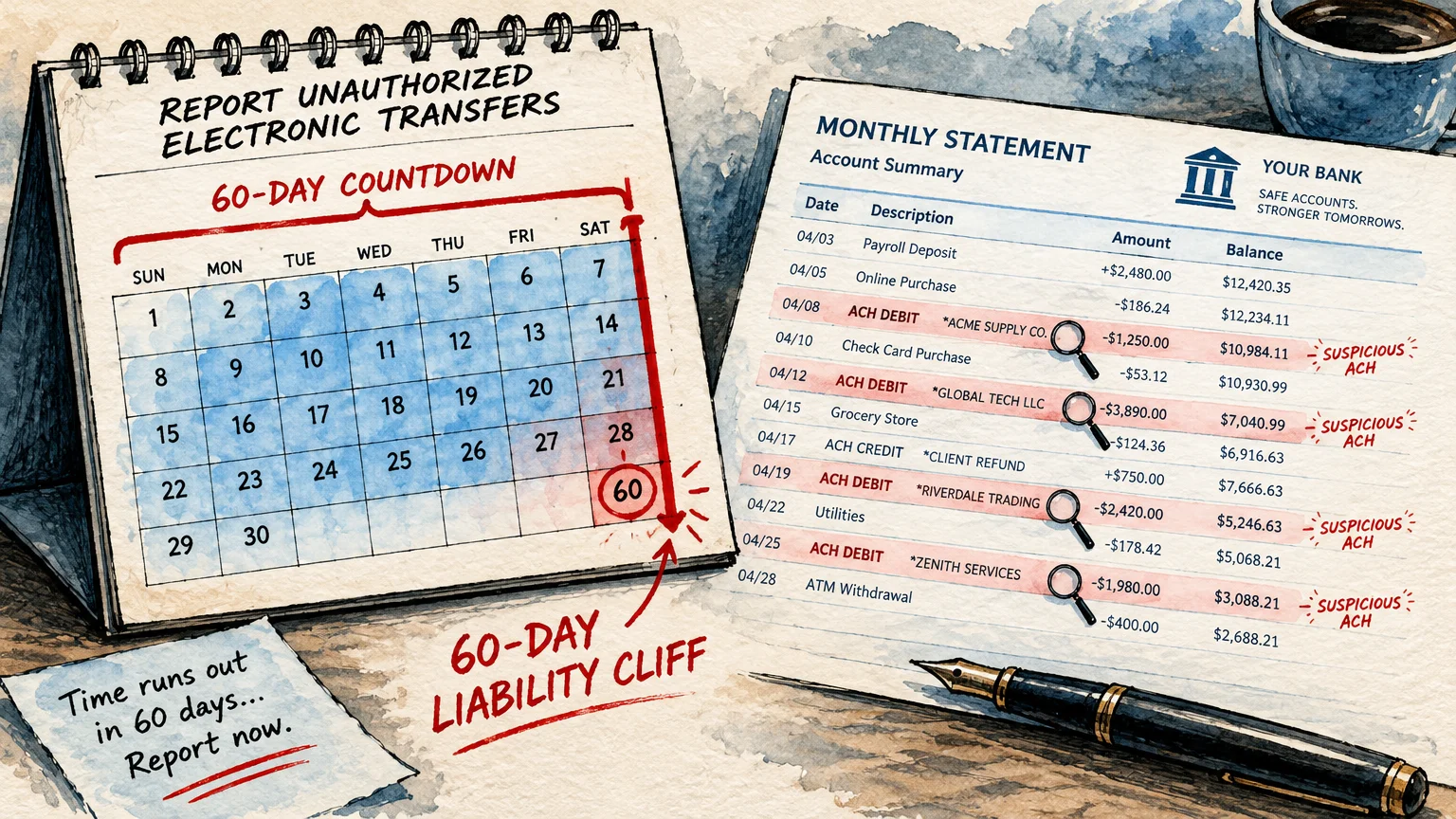
Under federal Regulation E (12 CFR § 1005.6), your legal protections depend strictly on how fast you report unauthorized electronic fund transfers. Missing reporting deadlines results in catastrophic, permanent financial losses.
If you report unauthorized card activity within two business days of learning about it, your liability cannot exceed $50. If you wait between two and sixty days after your statement is sent, your liability climbs to $500.
After 60 days from the statement date, your consumer liability becomes unlimited. That means your bank has zero legal obligation to refund a single penny stolen from your checking or savings accounts.

7. Federal Rules Prohibit Paper Checks for Social Security
Decades ago, retirees received their physical federal benefit checks directly in the mailbox every month. Some seniors still visit their local branch expecting to convert their direct deposit into paper Treasury checks.
Under federal regulation 31 CFR Part 208, the U.S. Department of the Treasury mandates electronic benefit payments. Paper checks for recurring federal retirement distributions were phased out starting March 1, 2013.
You must receive your monthly retirement payments via direct electronic deposit or on a prepaid government debit card. Review your direct deposit instructions on the Social Security Administration portal to ensure routing numbers remain current.
When closing or switching accounts, never shut down your old checking account before the first benefit check lands in the new one. Prematurely closing an account can trap your monthly income in bureaucratic transit for weeks.
8. Mailed Paper Statements Carry Hidden Recurring Fees
Many older Americans prefer tangible paper statements to reconcile accounts, audit debits, and spot unauthorized charges. Unfortunately, institutions capitalize on this preference by levying recurring fees for paper delivery.
National and regional banks commonly bill between $2.00 and $5.00 each month for every mailed paper statement. For a household maintaining checking, savings, and money market accounts, paper fees can drain over $150 annually.
Banks frame these charges as environmental initiatives, but they serve primarily to pad retail banking revenue. These charges represent one of the most avoidable bank mistakes retirees make.
You can eliminate this expense by enrolling in paperless electronic delivery through online banking portals. If you still want physical records, download the monthly PDF statements to your home computer and print them yourself.
9. Banks Still Enforce Savings Account Withdrawal Penalties
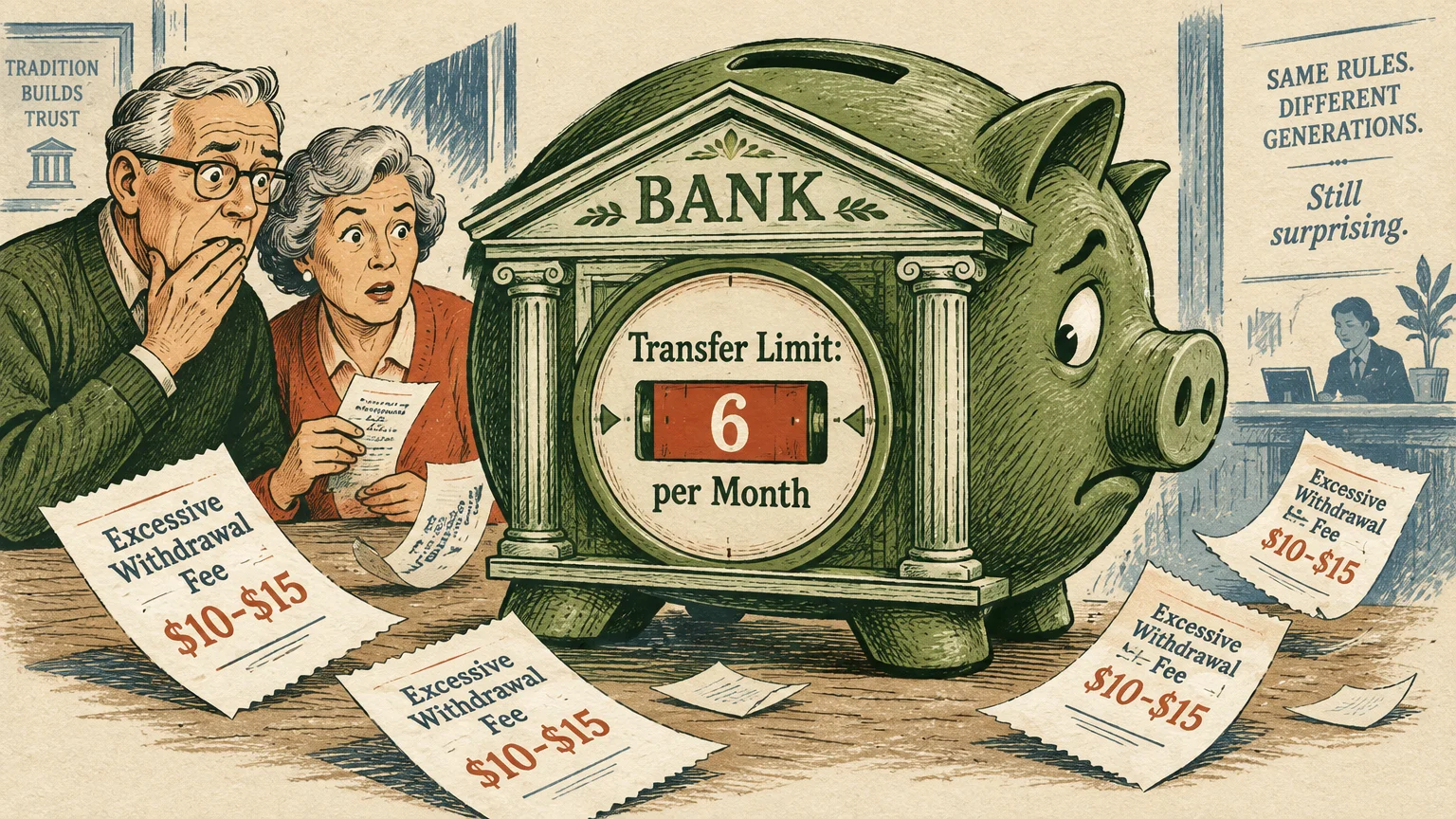
During the financial disruptions of April 2020, the Federal Reserve amended Regulation D to remove the federal six-per-month transfer cap on savings accounts. Many savers assumed this change granted unlimited, penalty-free monthly withdrawals.
Federal authorities lifted the mandatory restriction, but they did not forbid banks from enforcing internal limits. Most retail financial institutions opted to keep their legacy withdrawal caps intact.
Exceeding six monthly outbound transfers from a savings account often incurs an excess withdrawal fee of $5 to $15 per transaction. Repeated violations can prompt the bank to convert your savings account into a checking account involuntarily.
Keep your active monthly cash flow stationed in checking rather than pulling frequent transfers from savings. Structure your accounts so your liquid savings handles larger, infrequent transfers instead of routine living expenses.

10. The Bank Can Freeze Your Account Over Suspected Exploitation
Elder financial fraud robs seniors of billions of dollars annually, prompting lawmakers to enact strict institutional defenses. However, well-intentioned protections can unexpectedly lock you out of your own money.
The Senior Safe Act of 2018 shields bank personnel from civil liability when reporting suspected elder financial exploitation to Adult Protective Services or law enforcement. Furthermore, regulatory guidelines permit banks to place temporary administrative holds on transactions they deem suspicious.
While this authority stops fraudsters, overzealous branch staff can halt legitimate transactions. Large cash gifts to grandchildren, home renovation down payments, or out-of-state land purchases often trigger sudden account freezes.
Resolve this friction by communicating proactively with branch managers before executing large or atypical transactions. Contacting your bank ahead of time ensures funds disburse smoothly without triggering protective administrative holds.

11. Branch Relationship Managers Are Often Commissioned Salespeople
Walking into a quiet branch office and meeting with a “personal banker” or “relationship manager” feels reassuring. You might assume these professionals operate under an uncompromising fiduciary standard to guide your retirement.
In retail banking, relationship managers are frequently evaluated on sales quotas and product enrollments. Many hold insurance and securities credentials, allowing them to market expensive financial products to visiting retirees.
These representatives may encourage you to shift liquid cash into proprietary equity-indexed annuities or fee-laden wealth management portfolios. These transactions generate lucrative branch commissions while locking up your liquid capital in multi-year surrender schedules.
“Financial security in retirement is not just about what you have saved; it is about protecting every dollar from friction, fees, and unnecessary red tape.” — Jean Chatzky, Financial Educator
Always verify professional credentials through FINRA Investor Education before buying investment products at a retail branch. Dedicated fee-only fiduciary advisers, rather than retail branch employees, should handle your comprehensive portfolio strategy.
Comparing Retirement Banking Options
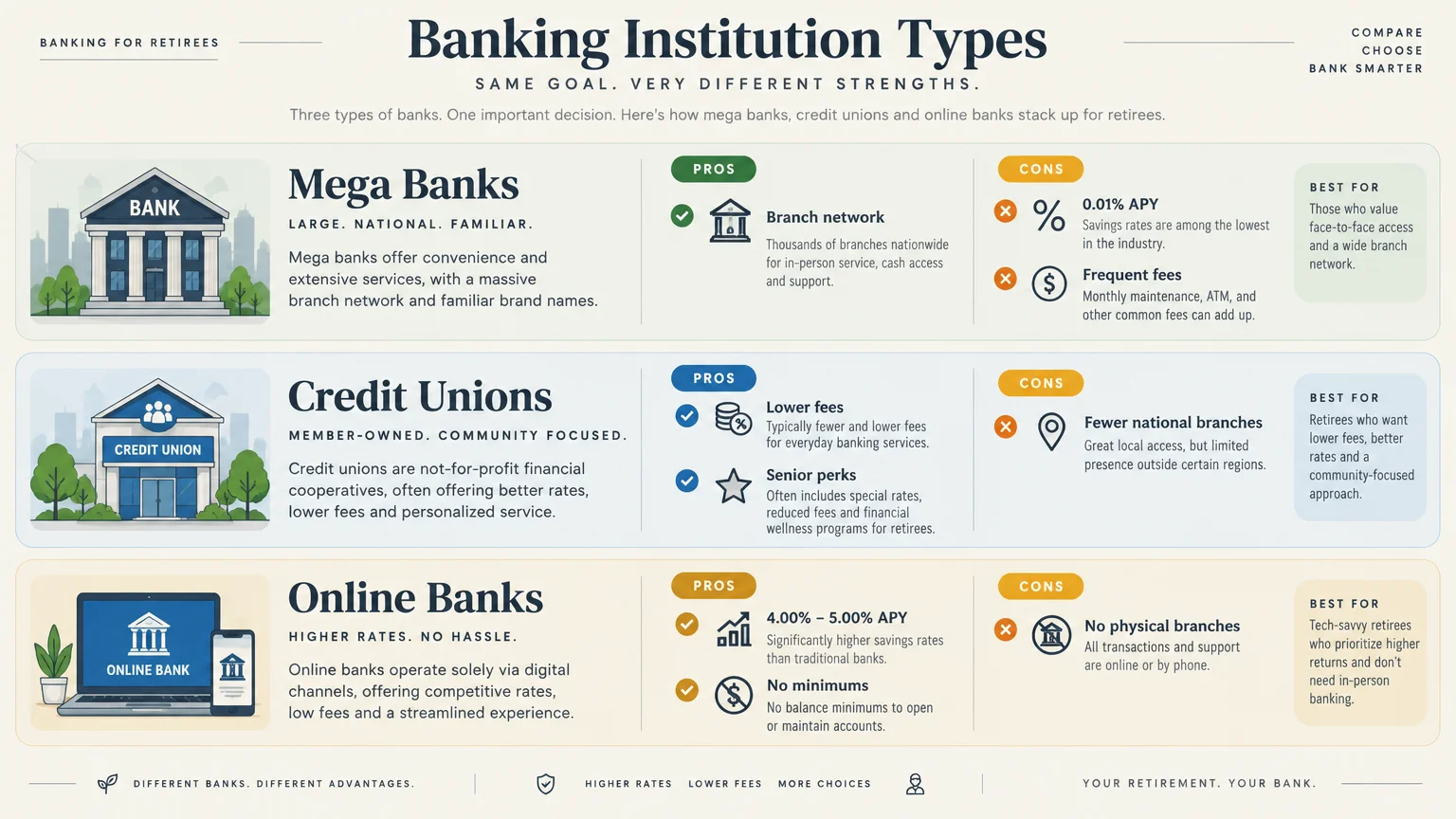
Traditional banks prioritize corporate profits, but alternative institutions offer compelling benefits tailored to retirees. Comparing retail banks against online banks and credit unions clarifies where your money belongs.
| Banking Feature | Traditional Mega-Banks | High-Yield Online Banks | Community Credit Unions |
|---|---|---|---|
| Average Savings APY | 0.01% to 0.05% | 4.00% to 5.00%+ | 1.50% to 3.00% |
| Checking Monthly Fees | $12 – $15 (waived with conditions) | $0 (standard free checking) | $0 – $5 (often free for seniors) |
| Paper Statement Fees | $2 – $5 per month | N/A (strictly digital delivery) | $0 – $2 per month |
| Beneficiary Designation Setup | Paper form or in-branch visit | Simple online portal update | In-person branch assistance |
| Branch Cash Access | Extensive nationwide branch network | ATM network only (no teller windows) | Shared branching network across US |
Avoiding Common Errors at Your Bank
Managing deposit accounts in retirement requires different habits than those used during your working career. Avoiding these standard operational pitfalls keeps your assets safe, liquid, and accessible.
- Adding adult children as joint account owners: Making a child a joint owner exposes your money to their future creditors, divorces, and legal judgments. Use durable powers of attorney and POD forms instead.
- Letting accounts slip into dormant status: Accounts with zero customer-generated activity for two to three years risk state escheatment. Set recurring automatic transfers of $10 to keep all accounts active.
- Ignoring FDIC limits across institutions: Merging multiple accounts at one institution can push you past standard insurance limits. Distribute balances over $250,000 (or $500,000 for couples) across different banks.
- Relying on debit cards for retail transactions: Debit cards link directly to your liquid cash reserves, making card compromise dangerous. Use credit cards for daily purchases to preserve your statutory fraud buffers.
- Failing to file consumer complaints: If a bank refuses to correct an error or waive improper fees, submit an inquiry through the Consumer Financial Protection Bureau for fast institutional resolution.

When DIY Isn’t Enough
Self-directed account management handles standard day-to-day banking needs effectively. Nevertheless, specific financial complications demand specialized legal or professional intervention.
Complex Trust Allocations: If your liquid net worth exceeds $1.25 million across family trusts, consult an estate planning attorney. They will review beneficiary structures to confirm complete FDIC insurance coverage.
Institutional POA Refusal: When a bank branch obstinately refuses to honor your legal durable power of attorney, engage an elder law attorney. Legal counsel can issue demand letters enforcing state-specific POA acceptance laws.
Suspected Exploitation Account Freezes: If administrative holds block legitimate access to your funds, consult legal counsel immediately. An attorney can work with bank compliance teams to lift holds without civil intervention.
Required Minimum Distribution (RMD) Logistics: Coordinating mandatory distributions from bank-held IRAs requires strict tax precision. Partner with a certified public accountant (CPA) or fee-only CFP to prevent catastrophic IRS penalties.
Frequently Asked Questions
Can my bank legally reject a valid Power of Attorney?
Yes, financial institutions possess significant latitude to review and challenge outside power of attorney documents. Many institutions enforce internal policies against documents older than three years or demand internal proprietary forms.
Does a Social Security deposit waive checking account fees?
It depends on your institution’s specific account agreement. While many banks accept Social Security direct deposits toward fee-waiver thresholds, others mandate recurring payroll transfers or strict minimum daily balances.
How do the 2024 FDIC trust changes impact my savings?
The revised rule limits deposit insurance to $250,000 per eligible primary beneficiary up to five individuals. This establishes an absolute insurance cap of $1.25 million per owner, per institution, across all trust accounts.
Why do banks charge fees for paper statements?
Banks charge $2 to $5 per statement to offset physical printing and mailing overhead. These fees also incentivize customers to adopt paperless delivery, reducing operational overhead for the financial institution.
Final Action Steps for Retirees
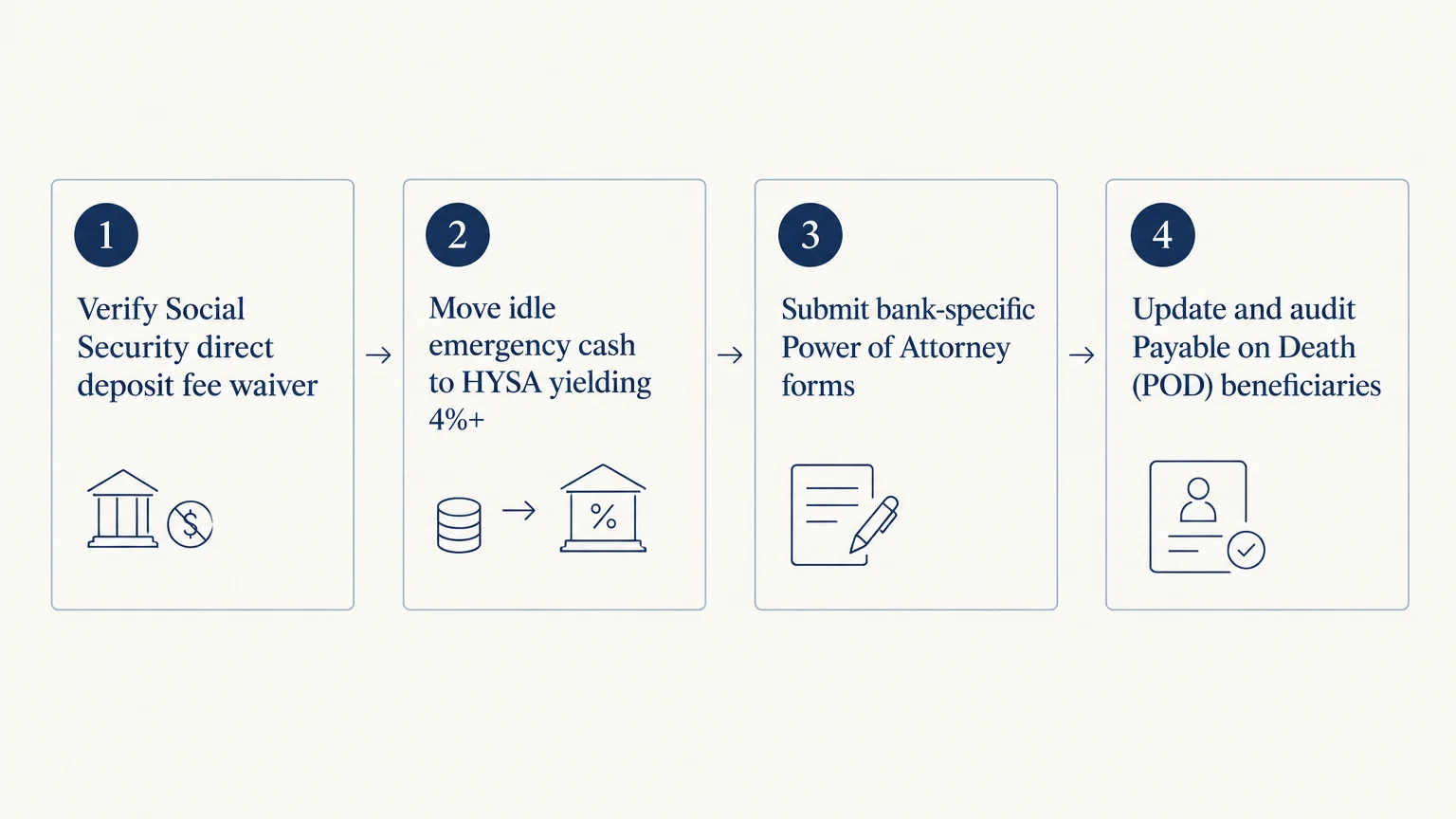
Take an afternoon to audit every deposit account, credit card, and safe-deposit box you maintain. Request a complete schedule of account fees from your branch, and eliminate unnecessary paper statement charges.
Verify that every account carries up-to-date Payable on Death designations and that your durable POA is registered with the bank. Taking these deliberate steps ensures your banking framework protects your peace of mind throughout retirement.
This article provides general retirement education and information only. Every retiree’s situation is unique—what works for others may not work for you. For personalized advice, consider consulting a qualified financial professional such as a CFP or CPA.
Last updated: March 2026. Retirement benefits, tax rules, and healthcare regulations change frequently—verify current details with official sources.









Leave a Reply