
Turning 73 alters your financial obligations faster than almost any other retirement milestone. The year you reach this age, the federal government officially shifts your tax-deferred accounts into mandatory distribution mode.
You can no longer leave your traditional retirement savings untouched to grow tax-deferred. Instead, federal law demands that you calculate, withdraw, and pay income taxes on a specific portion of your savings every year.
Understanding these automatic shifts protects you from surprise tax bills and costly penalties. Here are the eight critical changes that arrive the year you turn 73.
The Essentials: What Changes at Age 73
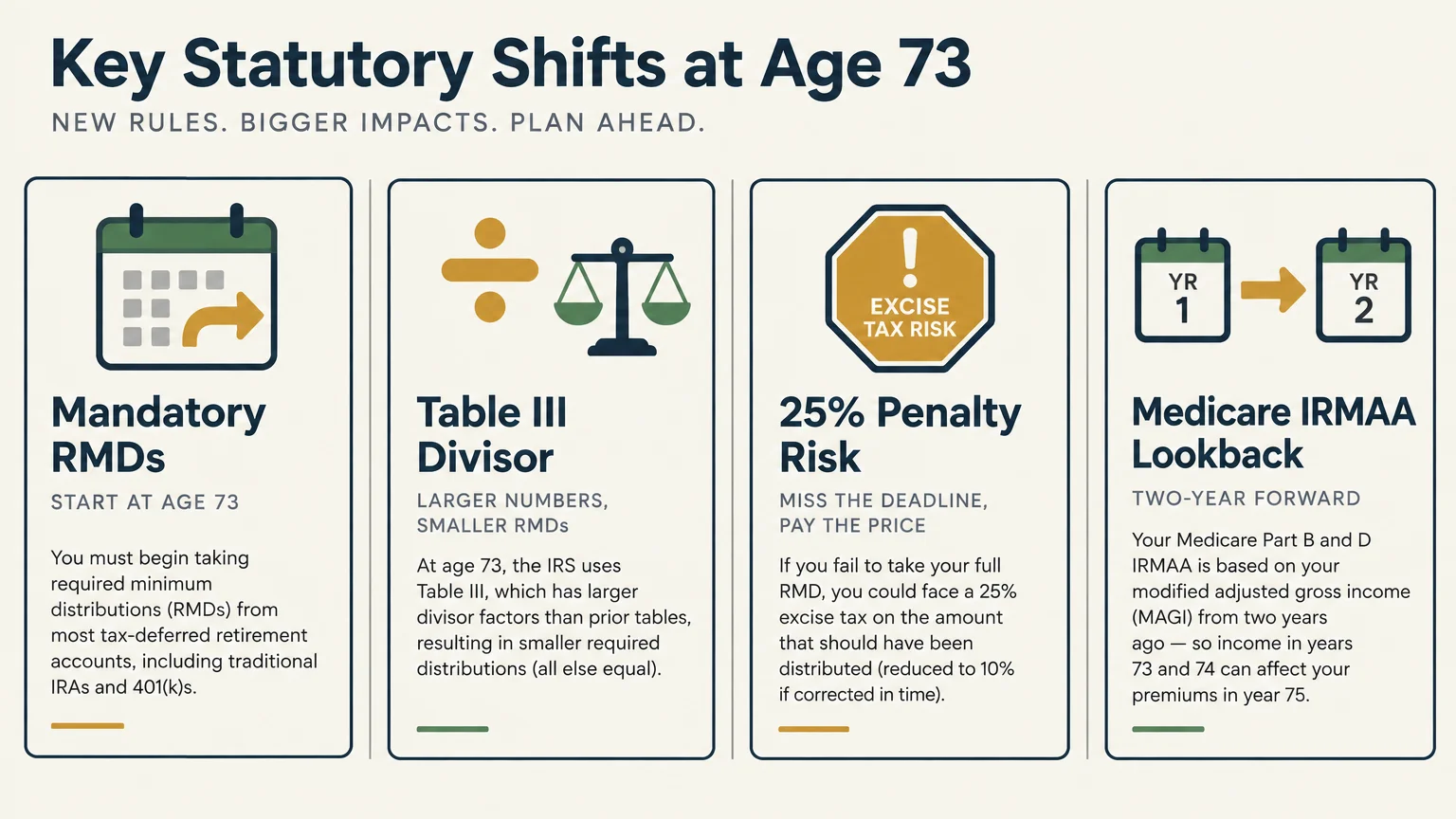
Reaching age 73 triggers automatic operational, tax, and healthcare adjustments across your entire financial life. Knowing what changes at age 73 helps you protect your retirement cash flow and avoid surprise penalties.
- Mandatory withdrawals start: The IRS requires you to begin taking annual distributions from traditional retirement plans.
- The IRS life expectancy divisor applies: Your distributions rely on an exact government formula using Table III.
- A grace period option appears: You gain the one-time choice to delay your initial distribution to April 1.
- Under-withdrawal penalties take effect: Shortfalls now incur an excise tax penalty of up to 25%.
- Social Security tax exposure rises: Added withdrawal income can expose up to 85% of your benefits to income taxes.
- Medicare IRMAA lookback locks in: Your age 73 taxable income determines your Medicare premiums at age 75.
- Charitable donations offset withdrawals: Qualified Charitable Distributions count directly against your mandatory withdrawal total.
- Workplace account rules diverge: Current employer plans and designated Roth workplace accounts follow separate rules.
1. Your Tax-Deferred Accounts Switch from Growth to Mandatory Depletion
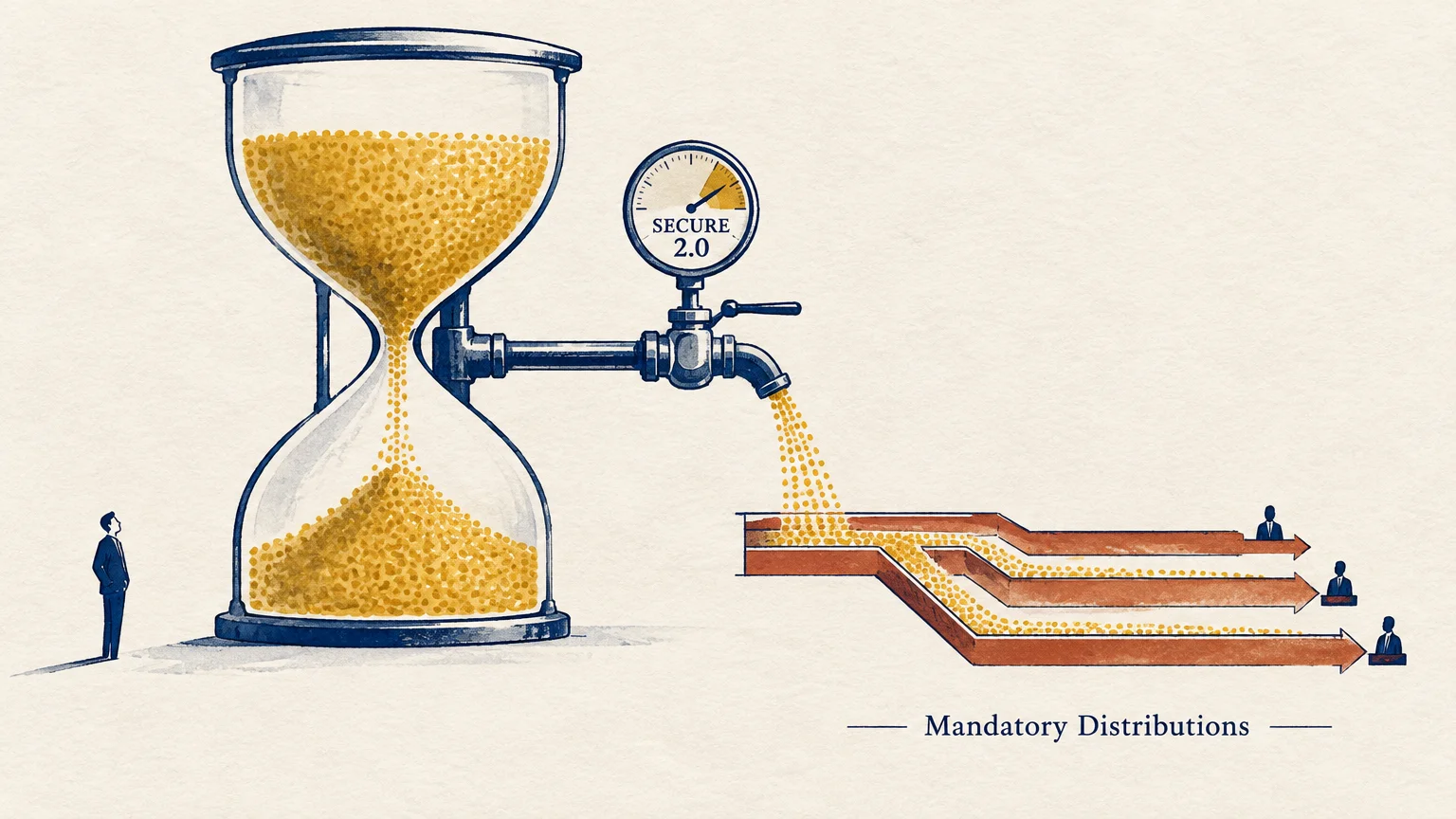
The year you turn 73 marks the official arrival of required minimum distributions (RMDs). Under the SECURE 2.0 Act of 2022, lawmakers raised the mandatory distribution age from 72 to 73.
This statutory threshold applies to anyone born between 1951 and 1959. If you were born in 1960 or later, your starting age will eventually shift to 75 in 2033.
Once you reach 73, you can no longer leave your qualified retirement assets untouched. You must begin systematically withdrawing funds from traditional IRAs, SEP IRAs, SIMPLE IRAs, and traditional 401(k) plans.
The federal government provided tax breaks during your working career when you contributed to these accounts. At 73, Uncle Sam begins collecting that deferred revenue.
These withdrawals do not happen passively. You must instruct your account custodians to liquidate assets and send you the distributions before statutory deadlines pass.
2. The IRS Imposes an Exact Withdrawal Formula on Your Accounts
You cannot choose an arbitrary withdrawal amount once you reach age 73. The Internal Revenue Service (IRS) mandates an exact calculation based on life expectancy tables.
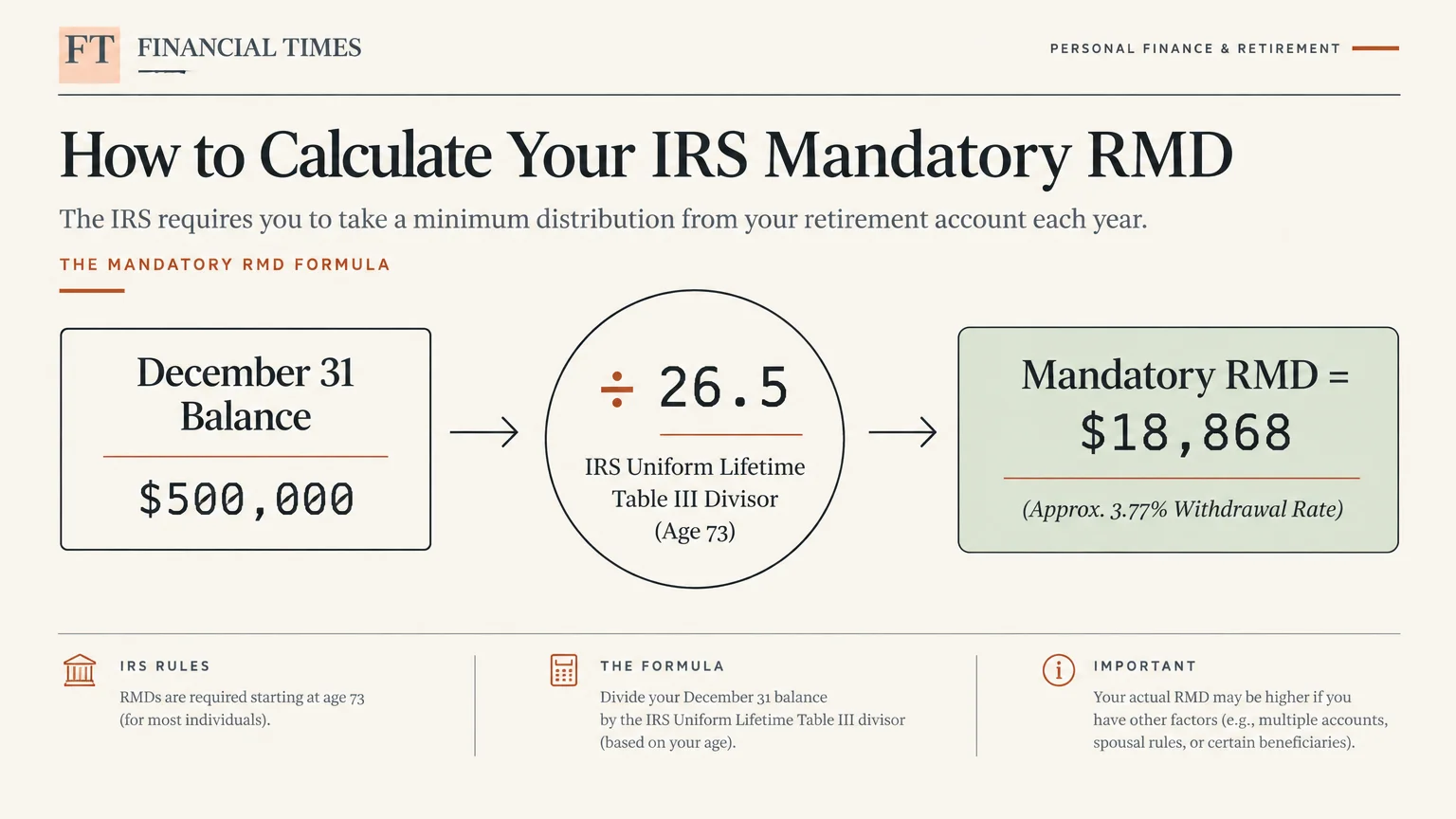
To determine your mandatory distribution, identify your account balances on December 31 of the previous calendar year. You then divide that total balance by a specific distribution factor.
For account owners who turn 73, IRS Uniform Lifetime Table III assigns a distribution factor of 26.5. This divisor establishes an initial withdrawal rate of roughly 3.77% of your total balance.
Suppose your traditional IRA held $500,000 on December 31 of the year you turned 72. Dividing $500,000 by 26.5 produces an RMD requirement of $18,868 for your 73rd year.
If you have an account balance of $1,000,000, your age 73 distribution equals roughly $37,736. The IRS considers this entire distribution ordinary taxable income for the year.
Every subsequent year, this divisor shrinks as your statistical life expectancy decreases. Consequently, your mandatory withdrawal percentage climbs steadily for the rest of your life.
3. The April 1 Grace Period Introduces a Costly Double-Tax Trap
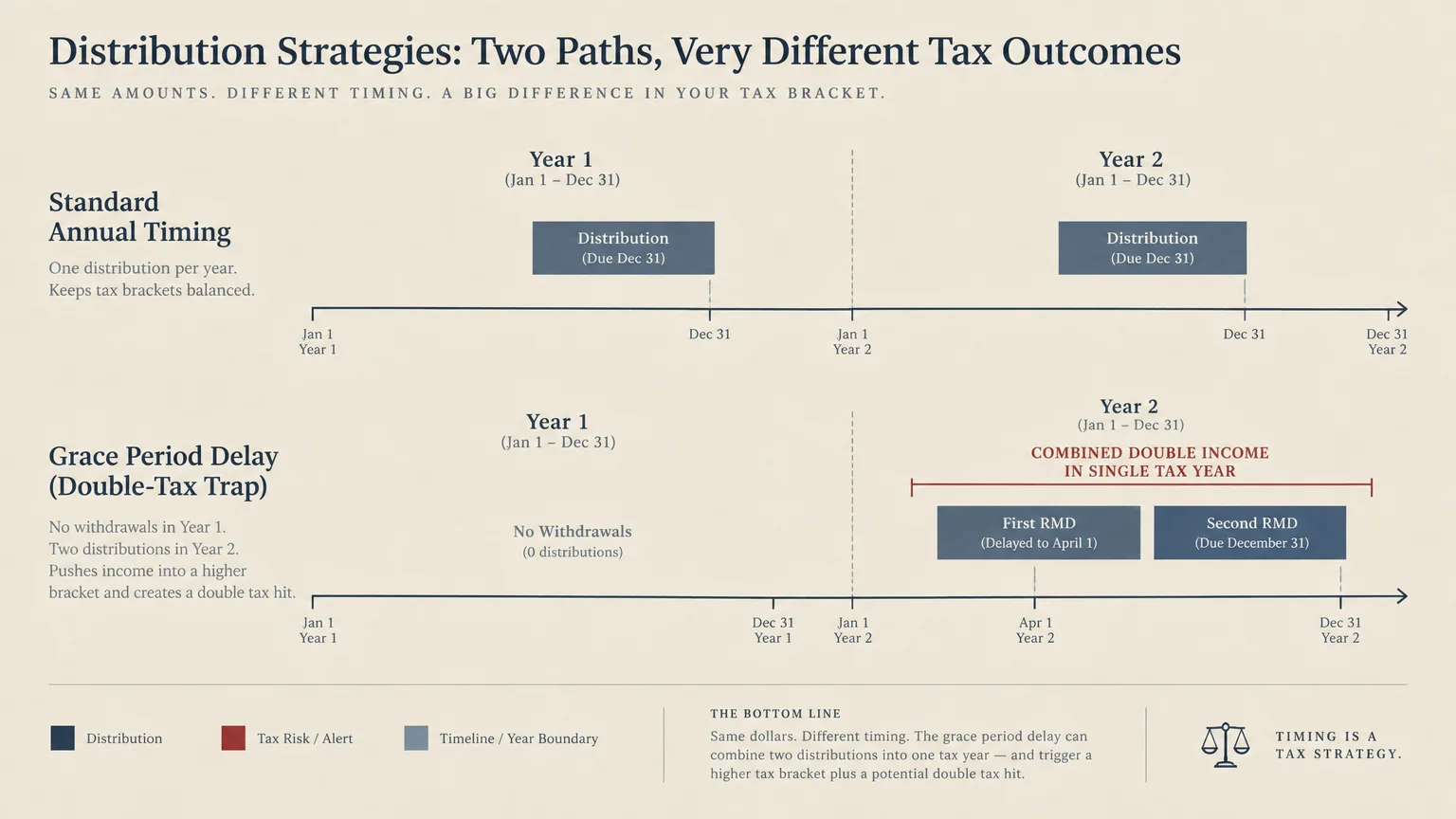
The IRS grants special calendar flexibility for your very first required distribution. You have until April 1 of the calendar year following your 73rd birthday to take that initial payout.
Tax professionals call this deadline your Required Beginning Date. While delaying your initial withdrawal may feel like a financial relief, doing so carries an expensive tax risk.
If you postpone your first RMD until April 1 of the following year, you must take two distributions in that single tax year. Your second RMD must leave your account by December 31 of that same year.
Stacking two large taxable distributions into a single calendar year can easily bump you into a higher federal income tax bracket. It can also cause you to lose valuable tax deductions.
Most retirees benefit from taking their initial RMD by December 31 of the year they turn 73. Spreading withdrawals across two distinct tax years stabilizes your taxable income.
You should calculate your projected taxable income under both timing options before making a final decision. A quick comparison helps you avoid an unnecessary tax bracket spike.
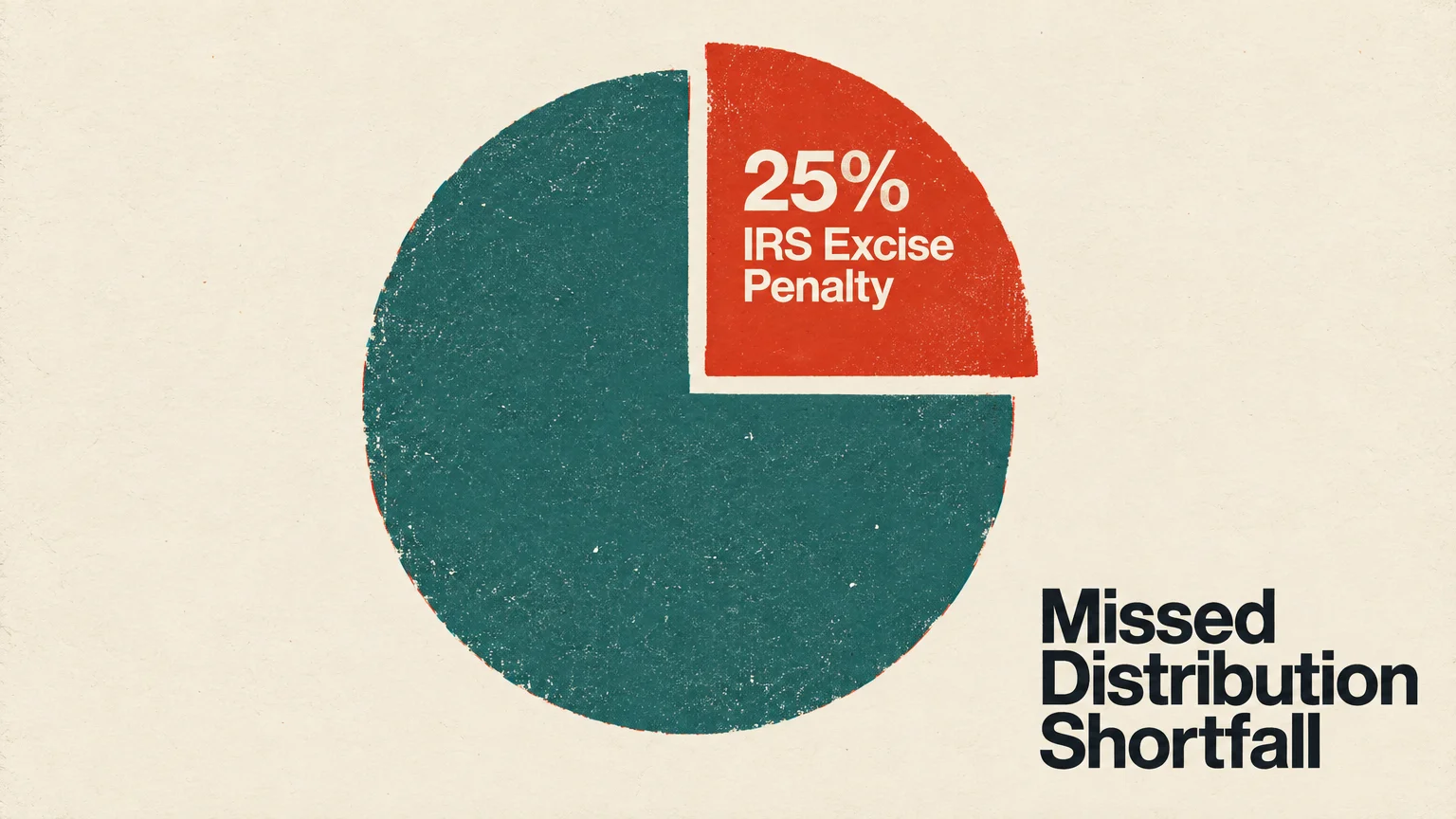
4. Missed Distributions Trigger an Immediate 25% Excise Tax Penalty
Failing to take your full distribution is one of the most penalizing mistakes in the federal tax code. The government enforces retirement rules turning 73 through strict statutory penalties.
Prior to recent legislative changes, failing to withdraw an RMD resulted in a brutal 50% penalty on the shortfall. The SECURE 2.0 Act lowered this federal excise tax penalty to 25%.
The law also introduced an opportunity for further penalty reduction if you act quickly. If you discover and correct the error within a two-year correction window, the IRS reduces the penalty to 10%.
To qualify for the 10% rate, you must withdraw the full missing amount and file IRS Form 5329. You must also submit an amended tax return for the calendar year in question.
If an unexpected illness or custodian error caused the missed distribution, you can request a total penalty waiver. You do this by attaching a written explanation of reasonable cause to your Form 5329.
Even with lower penalties, an unforced 25% haircut damages your retirement portfolio. Establishing automated annual withdrawals with your financial institution removes this risk entirely.
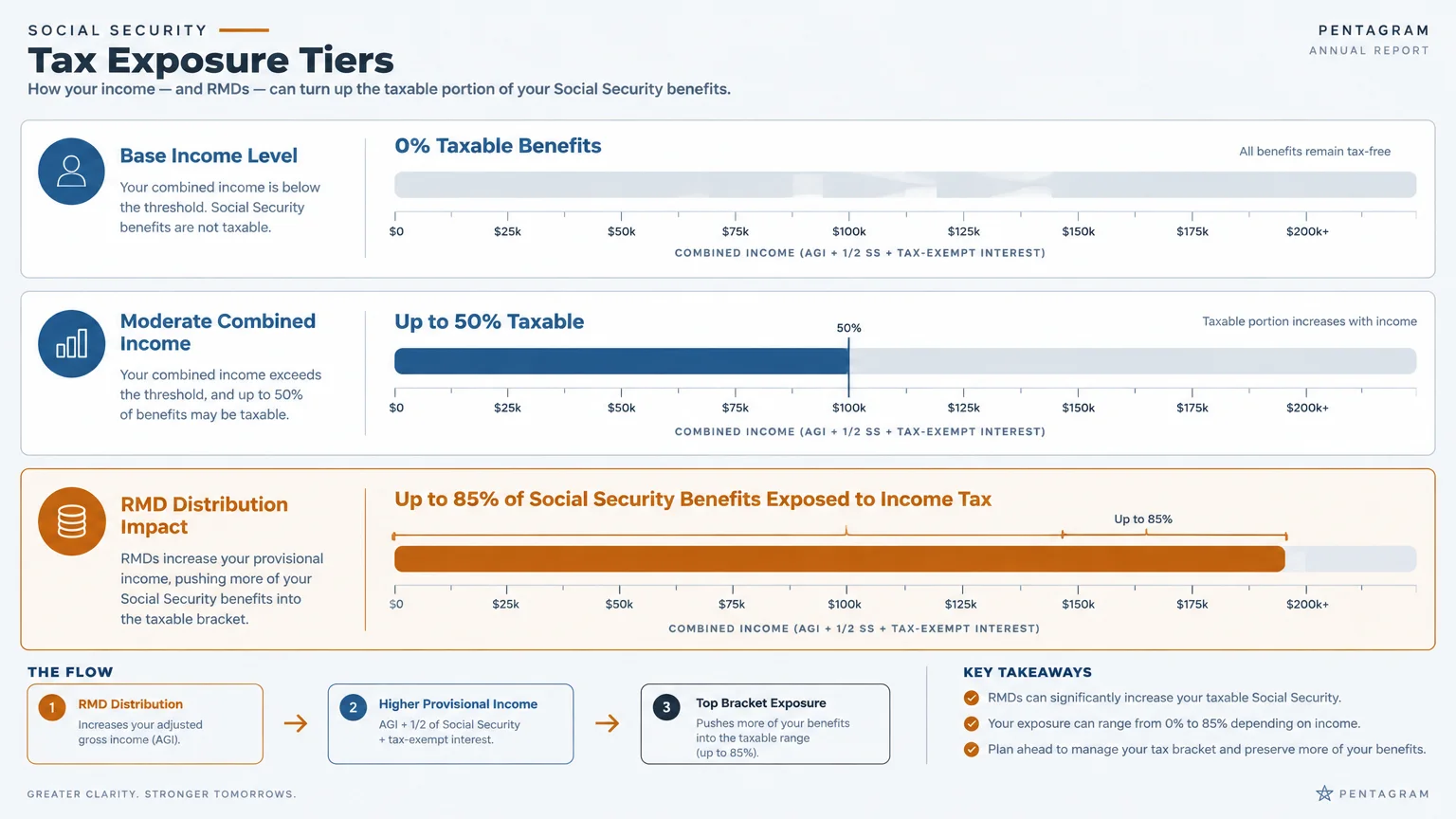
5. Mandatory Withdrawals Can Push Up to 85% of Your Social Security into the Tax Net
Many retirees assume their Social Security benefits stay completely insulated from age 73 changes. However, mandatory distributions directly alter how the government taxes your monthly retirement checks.
Every dollar you pull from a traditional retirement account counts as ordinary taxable income. This extra income increases your provisional income, which the Social Security Administration (SSA) uses to assess benefit taxation.
Provisional income equals your adjusted gross income, plus any tax-exempt interest, plus half of your annual Social Security benefits. Crossing specific statutory limits triggers income taxes on your monthly benefits.
For single filers, provisional income above $34,000 exposes up to 85% of Social Security benefits to federal income taxes. For married couples filing jointly, that threshold sits at just $44,000.
Because Congress never adjusted these provisional income tiers for inflation, mandatory withdrawals frequently push modest earners over the threshold. An unexpected distribution can turn tax-free benefits into taxable revenue.
Coordinating your withdrawal timing alongside Social Security benefits helps you anticipate the true net tax impact. You may need to increase your federal tax withholding on monthly benefits to avoid penalties.
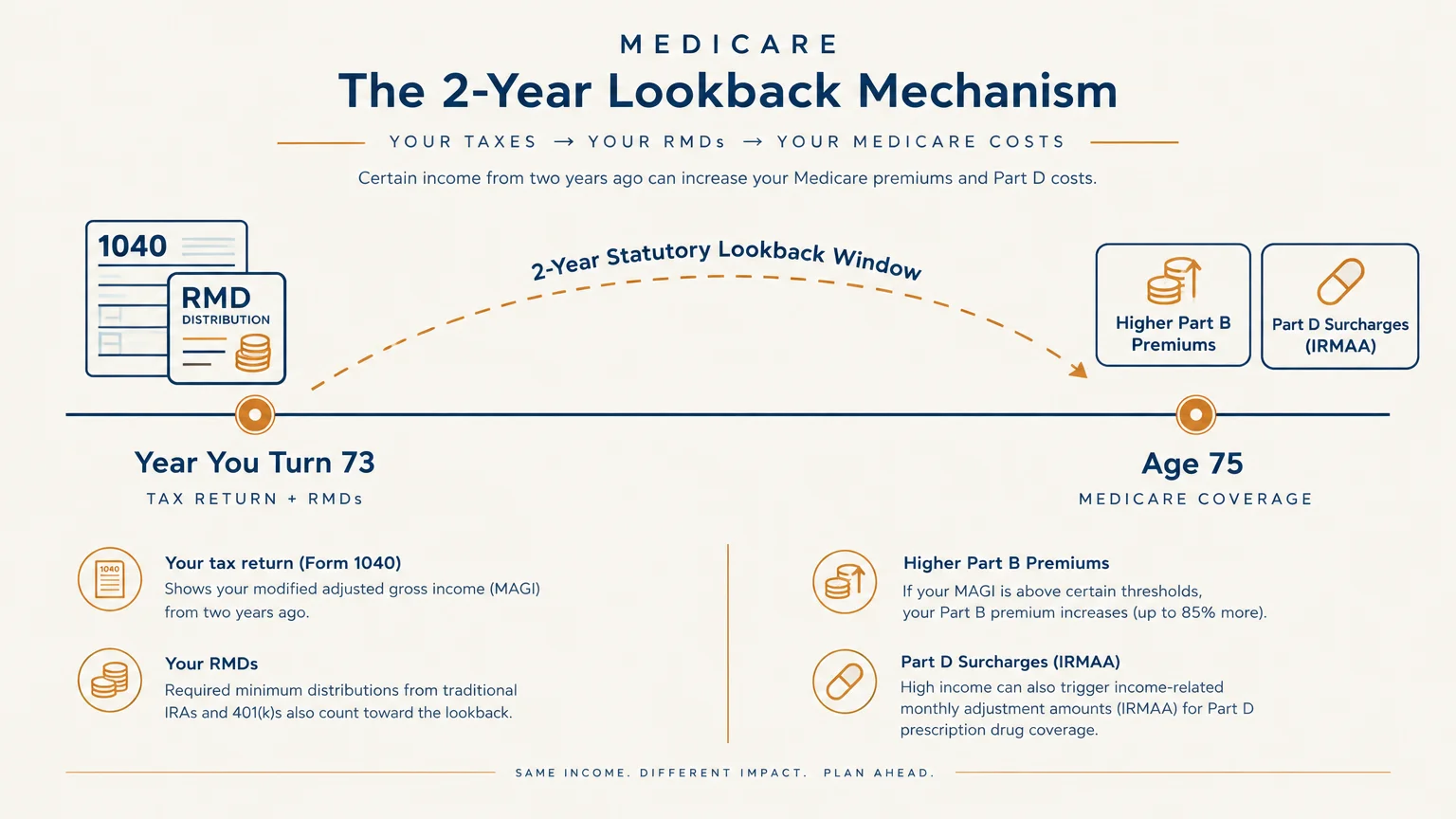
6. Your RMD Activates the Two-Year Lookback for Medicare IRMAA Surcharges
The financial changes at 73 reach well beyond the tax code and directly into your healthcare expenses. Higher taxable income from mandatory distributions can trigger substantial Medicare premium surcharges.
The federal government uses the Income-Related Monthly Adjustment Amount, or IRMAA, to determine Part B and Part D premiums. IRMAA calculations rely on your tax return from two years prior.
This means your taxable distributions at age 73 directly dictate your Medicare premium costs at age 75. Crossing an IRMAA income bracket by a single dollar increases your monthly healthcare costs for an entire year.
For example, if your distributions lift your modified adjusted gross income above the standard threshold, you pay tiered surcharges. Both Medicare Part B doctor coverage and Part D prescription plans charge these extra fees.
You can check the latest annual surcharge thresholds on Medicare.gov. Monitoring your adjusted gross income throughout your 73rd year keeps you from crossing an expensive premium cliff.
If you experience an unforeseen life-changing event that reduces your income, you can appeal an IRMAA surcharge using Form SSA-44. However, mandatory withdrawals alone do not qualify as an allowable appeal reason.

7. Qualified Charitable Distributions Turn into Dollar-for-Dollar RMD Shields
If you regularly give to charity, turning 73 gives you access to a premier tax-saving strategy. Qualified Charitable Distributions, or QCDs, take on an expanded financial role at this age.
The tax code allows individuals to make QCDs beginning at age 70½. However, once you reach age 73, these donations directly satisfy your annual distribution requirements dollar-for-dollar.
A QCD sends money directly from your traditional IRA custodian to an eligible 501(c)(3) nonprofit organization. Because the funds transfer directly, the distribution never touches your personal bank account.
As a result, the donation never enters your adjusted gross income. This critical distinction keeps your income lower, protecting your Social Security benefits and shielding you from Medicare IRMAA surcharges.
Under SECURE 2.0, lawmakers indexed the annual QCD gift limit to inflation. For 2025, the limit is $108,000 per taxpayer, rising to $111,000 for 2026.
Married couples where both spouses hold traditional IRAs and meet age requirements can each make independent QCD gifts. This allows couples to offset substantial mandatory distributions while supporting causes they value.
“The time to plan for required minimum distributions is well before you turn 73. If you wait until the checks start arriving, you forfeit your best tax-reduction strategies.” — Suze Orman, Personal Finance Expert and Author
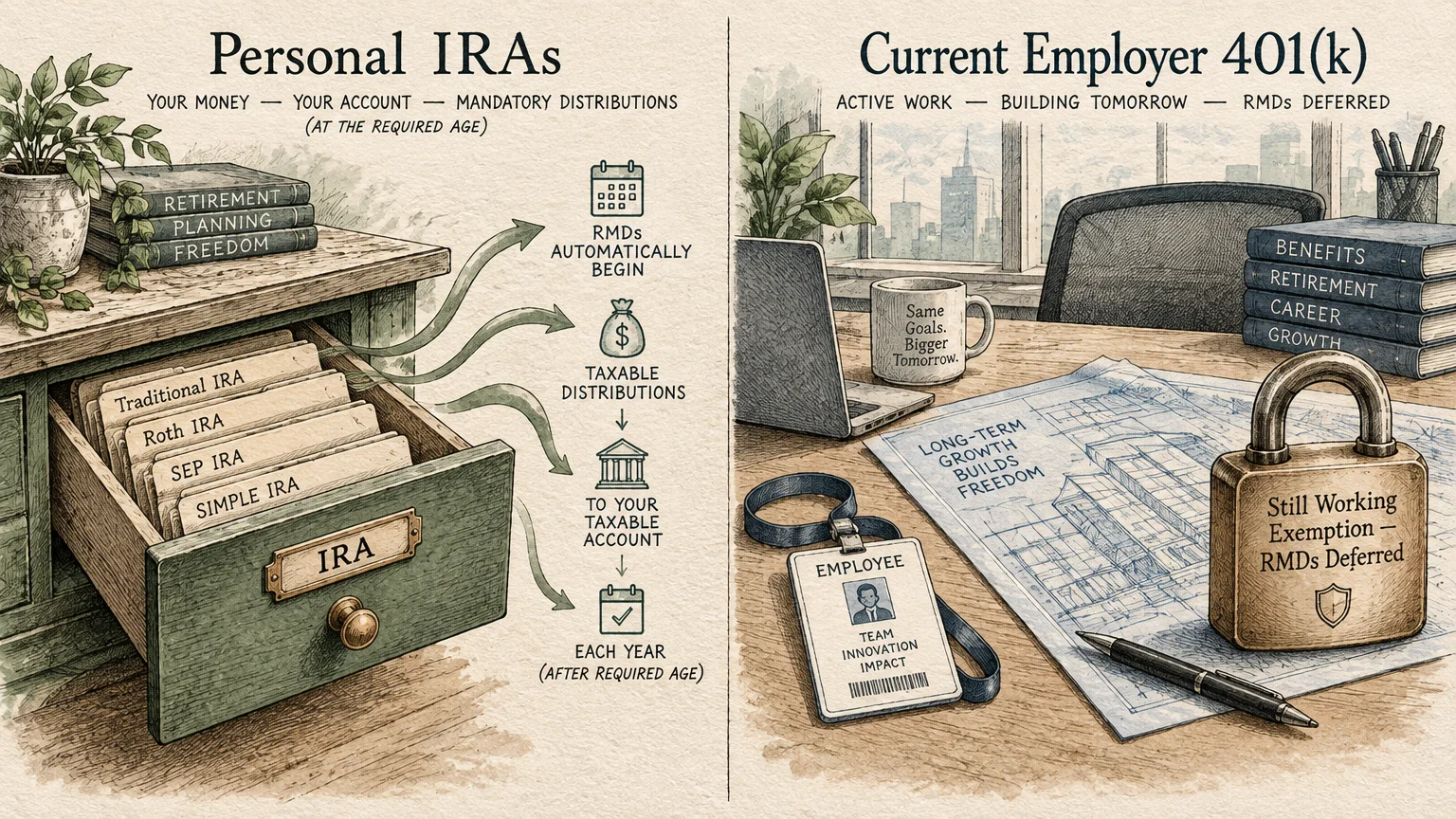
8. Workplace Retirement Accounts Follow Distinct Rules and Exemptions
Not all retirement plans follow identical protocols when you turn 73. Workplace accounts like 401(k)s and 403(b)s feature two critical exceptions that traditional IRAs do not offer.
First, if you remain actively employed at 73, you may qualify for the still-working exception. This statutory provision allows you to delay distributions from your current employer’s qualified plan until you actually retire.
This delay only applies if you do not own 5% or more of the company employing you. Furthermore, it applies strictly to your active employer plan, never to traditional IRAs or plans from previous employers.
Second, workplace Roth accounts enjoy significant new protections under recent federal legislation. Starting in 2024, designated Roth 401(k) and Roth 403(b) accounts are completely exempt from lifetime distribution rules.
Workplace Roth accounts now share the same distribution-free status as individual Roth IRAs. You can leave your Roth funds inside your employer plan to compound tax-free indefinitely.
Understanding these account distinctions prevents unnecessary liquidations. You can review detailed account guidelines on Investopedia to ensure you handle each plan type accurately.
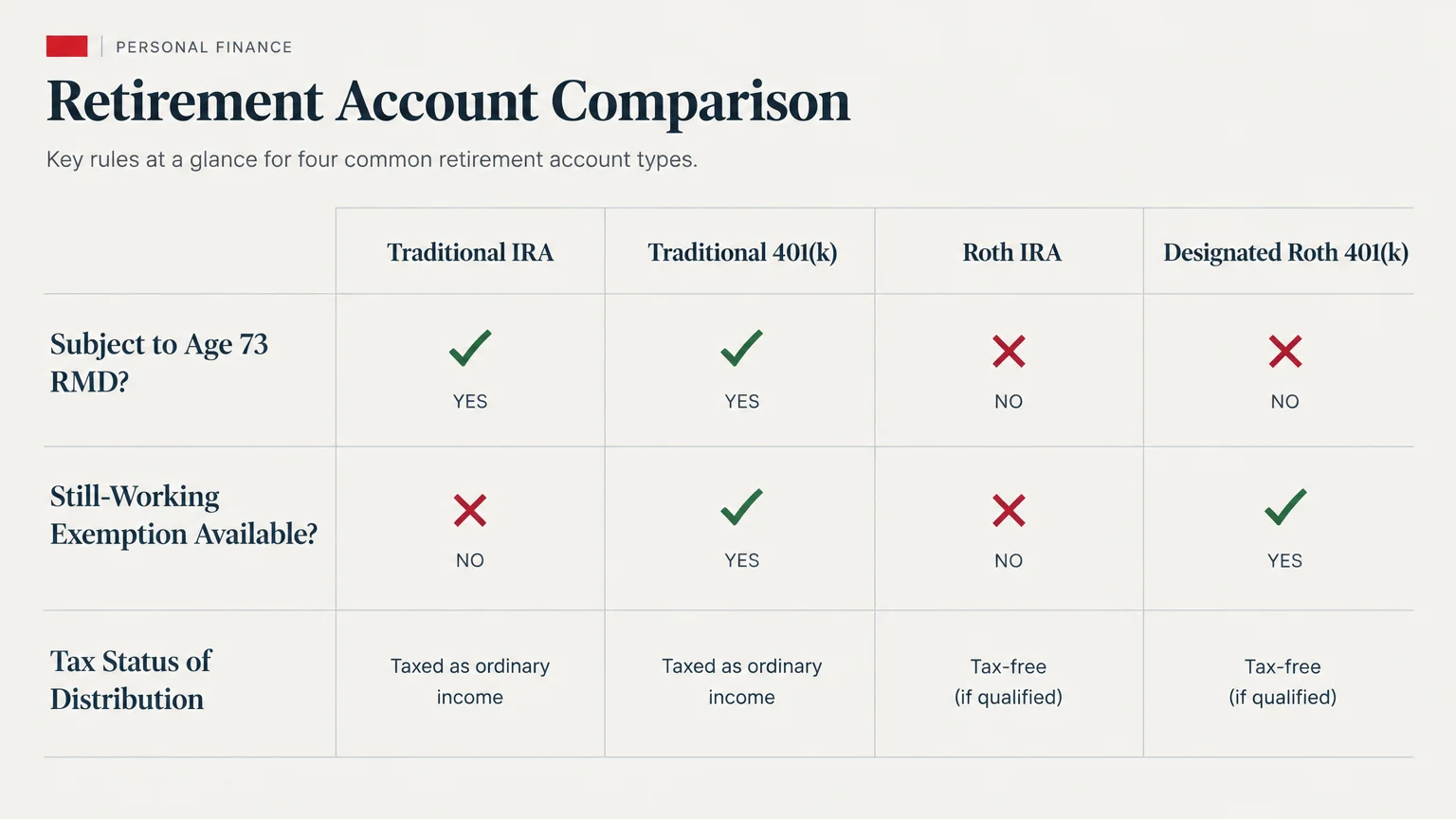
Comparing Retirement Account Rules at Age 73
Different retirement accounts follow different regulatory paths once you reach age 73. The comparison table below highlights the distribution requirements and tax rules across major retirement vehicles.
| Account Type | Mandatory at Age 73? | Still-Working Delay Allowed? | Distribution Tax Status |
|---|---|---|---|
| Traditional IRA | Yes | No | 100% Taxable Ordinary Income |
| Roth IRA | No | Not Applicable | Tax-Free Withdrawals |
| Traditional 401(k) / 403(b) | Yes | Yes (If Not 5% Owner) | 100% Taxable Ordinary Income |
| Designated Roth 401(k) | No (Starting 2024) | Not Applicable | Tax-Free Withdrawals |
| SEP / SIMPLE IRA | Yes | No | 100% Taxable Ordinary Income |
This breakdown shows why account consolidation requires careful planning prior to age 73. Mixing qualified employer accounts with individual accounts without checking rules creates unnecessary compliance headaches.
Reviewing your portfolio structure allows you to identify which specific balances require distributions this year. Keeping clean records guarantees you pull the correct amounts from the correct accounts.
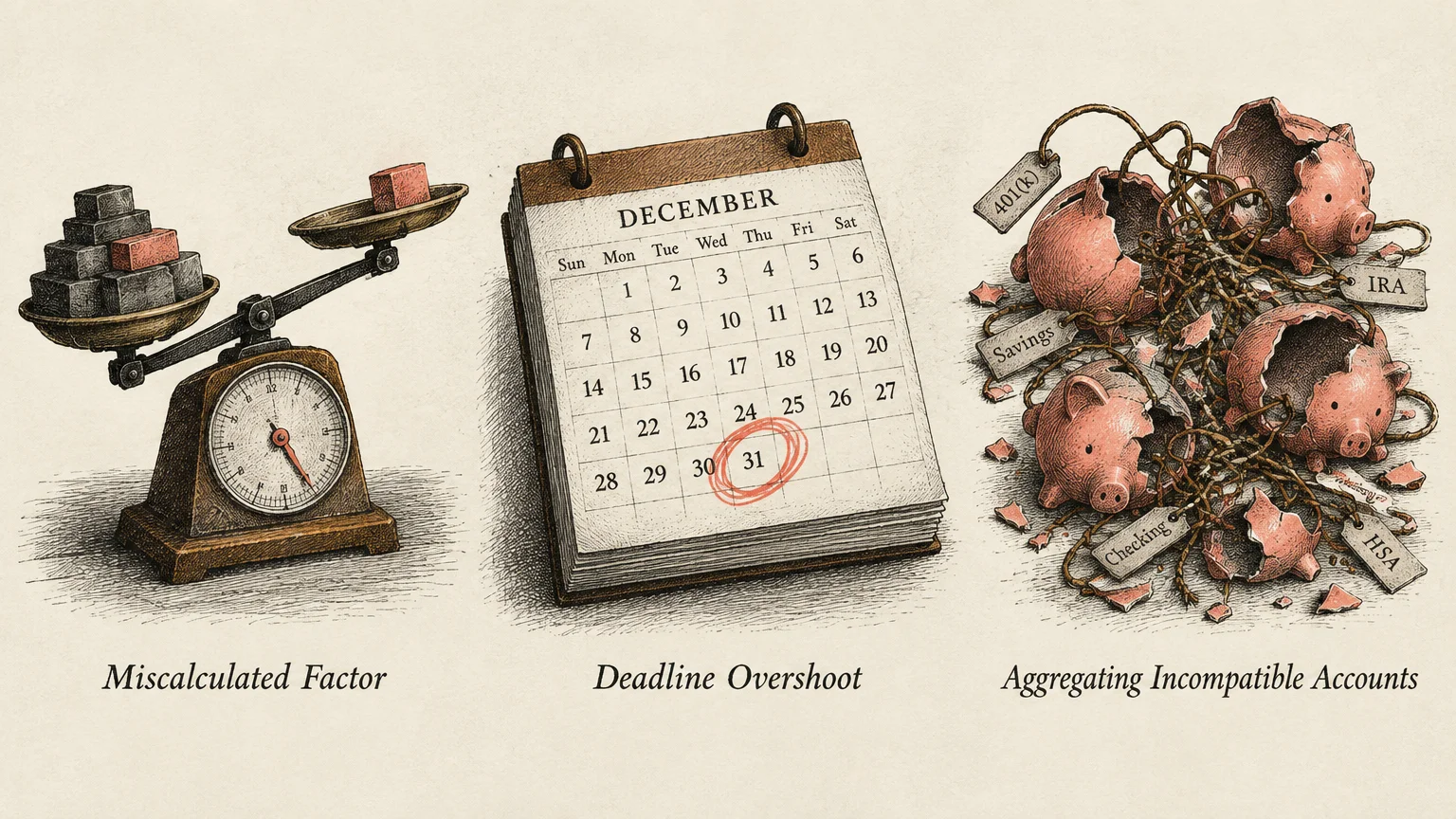
What Can Go Wrong: Common Pitfalls at Age 73
Navigating the transition into mandatory distributions can lead to costly mistakes if you move too quickly. Even financially disciplined retirees stumble when managing multiple account balances.
One frequent mistake involves cross-account withdrawal errors. You can aggregate distribution amounts across multiple traditional IRAs and withdraw the total from one account, but you cannot mix IRAs with 401(k) plans.
Every 401(k) or 403(b) plan requires its own independent distribution calculation and withdrawal. Attempting to satisfy a workplace plan distribution using an IRA withdrawal triggers IRS penalties for under-distribution.
Another common miscalculation involves your baseline account valuation dates. Distributions at age 73 rely on your account value on December 31 of the previous year, never your balance on the withdrawal date.
If the market drops during your 73rd year, your required withdrawal remains fixed to the prior year-end valuation. Failing to account for market dips can force you to liquidate more shares than expected.
Finally, do not overlook state income taxes when planning your withdrawals. While some states exempt retirement account distributions, many tax them at regular income tax rates.

When to Consult a Professional
While many retirees manage basic distributions on their own, certain financial situations demand professional guidance. You should schedule a meeting with a certified financial planner or tax professional under these conditions:
- IRMAA cliff risks: Your projected distribution approaches an income tier that would increase your Medicare Part B and Part D premiums.
- Company stock holdings: Your employer plan holds appreciated employer stock eligible for Net Unrealized Appreciation (NUA) tax treatment.
- Multi-account coordination: You manage several inherited IRAs alongside your personal traditional and Roth accounts.
- Business equity ownership: You plan to use the still-working exception while holding equity in your employer’s business.
A qualified financial educator or CPA can model multi-year tax projections on your behalf. Professional tax planning often uncovers savings that easily exceed advisory fees.
Frequently Asked Questions About Turning 73
Can I roll my required distribution directly into a Roth IRA?
No, the IRS strictly prohibits rolling over any mandatory distribution into a Roth IRA or another qualified account. You must take the distribution as taxable income before you can reinvest any leftover cash into a non-retirement brokerage account.
What happens if I turn 73 in late December?
Your birth month does not change your legal distribution requirement. Even if you turn 73 on December 31, that calendar year counts as your first distribution year under federal guidelines.
Can I take my entire IRA distribution from just one of my traditional IRAs?
Yes, the IRS allows you to aggregate distribution requirements across all of your traditional, SEP, and SIMPLE IRAs. You can calculate the total amount across all accounts and withdraw the entire sum from a single IRA.
Do inherited IRAs follow the same age 73 distribution rules?
No, inherited IRAs follow separate rules established under the original SECURE Act. Most non-spouse beneficiaries must empty an inherited account within ten years, regardless of their personal age.
Moving Forward with Confidence
Turning 73 introduces mandatory federal rules, but these requirements do not have to disrupt your financial peace of mind. Setting up automated withdrawals and tracking your income limits keeps you in complete control.
Take time today to verify your prior year-end account values with your financial custodians. Proactive planning turns regulatory requirements into an orderly, predictable part of your retirement lifestyle.
This article provides general retirement education and information only, as every retiree’s situation is unique—what works for others may not work for you. For personalized advice, consider consulting a qualified financial professional such as a CFP or CPA.
Last updated: March 2026. Retirement benefits, tax rules, and healthcare regulations change frequently—verify current details with official sources.









Leave a Reply