
Retired in America

Your Guide to a Confident Retirement

  • Home
  • Personal finance
  • Retirement Life
  • Saving & Spending

How Much You’ll Actually Get From Social Security at Every Age

August 4, 2026 · Personal finance

Deciding when to claim Social Security directly shapes your financial comfort for the rest of your life. While you can collect monthly checks as early as age 62, waiting until your Full Retirement Age or up to age 70 dramatically expands your guaranteed income. In 2026, the average retired worker collects approximately $2,071 per month, but your actual payment depends on your lifetime earnings and exact claiming age. Claiming at 62 yields a permanent 30 percent benefit reduction, whereas delaying until age 70 boosts your payout to 124 percent of your baseline amount. Understanding these monthly payout mechanics empowers you to maximize your retirement cash flow and safeguard your long-term independence.
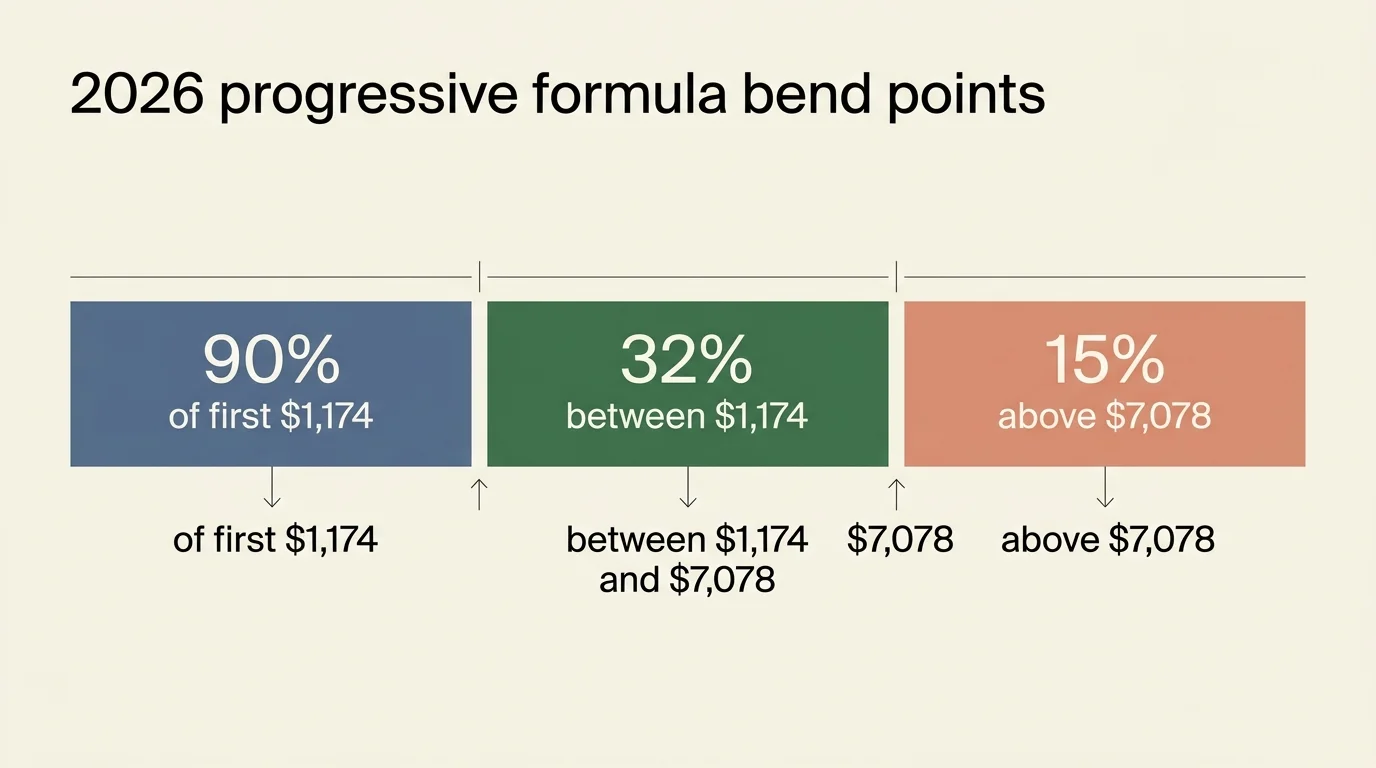
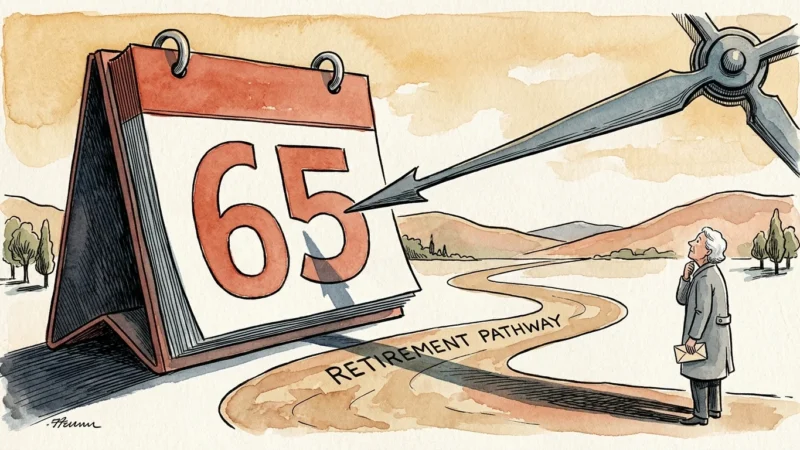
Table of Contents

  • How Social Security Is Calculated: The Mechanics Behind Your Check
  • Social Security Benefits by Age: The Complete Breakdown (Ages 62 to 70)
  • Estimating Your Personal Payout: Using a Social Security Payout Calculator
  • Working While Claiming: Earnings Limits and Tax Impacts
  • Spousal and Survivor Benefits: Maximizing Household Income
  • Common Mistakes to Avoid When Claiming Social Security
  • Professional vs. Self-Guided: Navigating Your Claiming Strategy
  • Frequently Asked Questions About Social Security Benefits
A minimalist horizontal diagram explaining the 2026 Social Security formula bend points of 90%, 32%, and 15%.
Three colored blocks illustrate the progressive formula bend points used to calculate your monthly Social Security check.

How Social Security Is Calculated: The Mechanics Behind Your Check

Understanding how Social Security calculates your monthly check takes the mystery out of retirement planning. The system relies on a specific formula created by Congress, which translates your career earnings into a lifetime inflation-indexed pension. The Social Security Administration (SSA) bases your primary insurance amount—often called your PIA—on three fundamental factors: work credits, lifetime indexed earnings, and progressive replacement rates.

First, you must qualify for retirement benefits by earning work credits. In 2026, you earn one work credit for every $1,890 in wages or self-employment income, up to a maximum of four credits per year ($7,560 in earnings). You need 40 credits—equivalent to 10 full years of work—to qualify for retirement benefits on your own work record.

Once you meet the eligibility requirement, the government calculates your Average Indexed Monthly Earnings (AIME). To find your AIME, the SSA indexes your past earnings to account for national changes in wages over time. Then, the agency selects your 35 highest-earning years. If you worked for 30 years, the formula includes five years of zero income, which lowers your overall average. Conversely, working 38 years allows the agency to drop your three lowest-earning years, replacing them with higher recent wages.

The system applies progressive formula thresholds known as “bend points” to your AIME to determine your PIA at Full Retirement Age. In 2026, the formula calculates your monthly baseline benefit through three distinct percentages:

  • 90 percent of the first $1,174 of your Average Indexed Monthly Earnings
  • 32 percent of your Average Indexed Monthly Earnings between $1,174 and $7,078
  • 15 percent of your Average Indexed Monthly Earnings above $7,078

This progressive structure provides lower earners with a higher percentage replacement of their pre-retirement income while offering higher earners larger absolute dollar checks. However, earnings capped by the Social Security payroll tax limit—set at $184,500 for 2026—do not count toward your formula or payroll tax liability. The maximum potential benefit reflects this cap, capping monthly payouts for high earners who consistently hit or exceeded maximum taxable wages across a 35-year career.

Let’s look at a practical example. Imagine a worker retiring in 2026 at Full Retirement Age with an AIME of $6,000. The SSA calculates their baseline monthly check as follows:

  1. 90% of the first $1,174 = $1,056.60
  2. 32% of the remaining $4,826 (the amount between $1,174 and $6,000) = $1,544.32
  3. 15% of earnings over $7,078 = $0.00

Adding these figures yields a monthly Primary Insurance Amount of $2,600.92. This baseline dollar figure serves as the foundation for your payouts. Claiming before or after your exact Full Retirement Age reduces or expands this baseline number permanently.

A horizontal timeline comparing Social Security benefits at Age 62 with a 30% reduction, FRA at 100%, and Age 70 at a 124% boost.
A timeline shows how Social Security benefits scale from a 30% reduction to a 124% maximum boost.

Social Security Benefits by Age: The Complete Breakdown (Ages 62 to 70)

Your claiming age serves as the ultimate multiplier for your monthly check. For anyone born in 1960 or later, Full Retirement Age (FRA) is precisely 67 years old. (For those born in 1959, FRA is 66 years and 10 months). Claiming early penalizes your monthly payout, whereas claiming late rewards you with guaranteed annual increases.

Analyzing the average Social Security benefit alongside maximum threshold amounts across claiming ages illustrates how timing impacts your long-term wealth.

Age 62: Age 62 remains the earliest possible age to claim retirement benefits. Choosing age 62 results in a permanent 30 percent reduction from your FRA baseline figure. The formula reduces your check by 5/9ths of 1 percent for each of the first 36 months before FRA, plus 5/12ths of 1 percent for each additional month. In 2026, the maximum payout at age 62 is $2,969 per month. While claiming early provides cash flow immediately, it permanently locks in the lowest possible monthly amount for the remainder of your life.

Age 63: Claiming at age 63 reduces your baseline benefit by 25 percent. You receive 75 percent of your full Primary Insurance Amount. Workers choosing age 63 often do so due to forced early retirement, health challenges, or job loss.

Age 64: Claiming at age 64 yields 80 percent of your Primary Insurance Amount, reflecting a 20 percent permanent reduction. If your FRA benefit equals $2,000 per month, claiming at 64 drops your monthly check to $1,600.

Age 65: Many Americans assume age 65 marks Full Retirement Age because Medicare eligibility starts at 65. However, claiming Social Security at 65 results in a 13.33 percent permanent reduction relative to an FRA of 67. You receive 86.67 percent of your baseline figure. You can enroll in Medicare at 65 while delaying your Social Security checks to allow them to grow.

Age 66: Claiming at age 66 yields 93.33 percent of your baseline benefit—a modest 6.67 percent reduction. For those born in 1959 whose FRA is 66 years and 10 months, claiming at 66 results in a minimal early penalty of less than 1.5 percent.

Age 67: Reaching age 67 grants you 100 percent of your calculated Primary Insurance Amount without penalties. In 2026, the average Social Security benefit for all retired workers stands between $2,071 and $2,084 per month. The maximum possible benefit for an individual reaching FRA in 2026 is $4,152 per month.

Age 68: Delaying past your FRA earns delayed retirement credits. The SSA increases your payout by 8 percent per year (0.66 percent per month) for every year you wait beyond age 67. Claiming at 68 increases your baseline check to 108 percent of your Primary Insurance Amount.

Age 69: Continuing to wait until age 69 adds another 8 percent, raising your check to 116 percent of your full baseline benefit. On a baseline check of $2,500, waiting until 69 increases your monthly check to $2,900 before accounting for annual inflation adjustments.

Age 70: Age 70 represents the maximum effective claiming age. Delayed retirement credits stop accumulating once you hit 70, making further delays unrewarding. At age 70, you receive 124 percent of your calculated baseline benefit. In 2026, the maximum possible payout for a worker claiming at age 70 reaches $5,181 per month—or $62,172 per year.

2026 Social Security Payout Projections by Claiming Age (FRA = 67)
Claiming Age Percent of Full Baseline Received Monthly Payout on $2,000 PIA Baseline Monthly Payout on $3,000 PIA Baseline 2026 Maximum Possible Monthly Benefit
62 70.0% $1,400 $2,100 $2,969
63 75.0% $1,500 $2,250 $3,195
64 80.0% $1,600 $2,400 $3,420
65 86.7% $1,733 $2,600 $3,680
66 93.3% $1,867 $2,800 $3,920
67 (FRA) 100.0% $2,000 $3,000 $4,152
68 108.0% $2,160 $3,240 $4,484
69 116.0% $2,320 $3,480 $4,816
70 124.0% $2,480 $3,720 $5,181

Examining this table reveals a stark financial contrast: waiting from age 62 to age 70 results in a 77 percent boost in your monthly benefit check ($2,480 vs. $1,400 for a $2,000 PIA baseline). This dramatic difference highlights why evaluating social security amount by age forms the bedrock of sound financial planning.

An ink and watercolor illustration of hands using a calculator next to a notebook, symbolizing personal financial calculation.
Hands use a calculator and notebook to crunch the numbers and estimate your retirement payout.

Estimating Your Personal Payout: Using a Social Security Payout Calculator

Generic statistical averages help set baseline expectations, but calculating your precise personal benefit requires personalized data. Your salary trajectory, gaps in employment, and future earning estimates directly dictate your individual social security benefits by age.

To accurately project your check, access the official online portal provided by the Social Security Administration. Creating a personal account grants you access to your official earnings record, which records every dollar of taxed earnings throughout your career. You can use the built-in social security payout calculator to model various retirement scenarios, test different retirement ages, and see estimated monthly payouts in today’s dollars.

When running calculations, incorporate annual Cost-of-Living Adjustments (COLA). Social Security protects your purchasing power by linking benefit adjustments to changes in consumer prices. For instance, the SSA instituted a 2.8 percent COLA increase for 2026 payments (announced in late 2025), following a 2.5 percent bump in 2025. These compound adjustments increase your baseline payment automatically over time, ensuring your benefits keep pace with inflation regardless of when you file.

To ensure your calculator estimates remain accurate, review your earnings history statement every year. Check for administrative errors or missing earnings records, particularly during years when you changed employers or moved states. Uncorrected zeroes in your earning history drag down your calculated AIME, reducing your monthly check permanently.

“Do not save what is left after spending, but spend what is left after saving.” — Warren Buffett, CEO of Berkshire Hathaway

An active retired woman working part-time at a plant nursery, watering green ferns in a bright greenhouse.
A senior woman happily waters greenhouse plants, earning extra income while managing Social Security limits.

Working While Claiming: Earnings Limits and Tax Impacts

Many retirees choose to continue working part-time or consulting while drawing Social Security benefits. If you claim benefits before reaching your Full Retirement Age and continue to earn wage or self-employment income, the SSA applies the mandatory Retirement Earnings Test.

The earnings test sets strict income thresholds. If your earned income exceeds these thresholds, the SSA temporarily withholds a portion of your monthly benefit checks. For 2026, the specific earnings limits are:

  • Under Full Retirement Age for the entire calendar year: The annual earnings threshold is $24,480 ($2,040 per month). The SSA withholds $1 from your benefit checks for every $2 you earn above this threshold.
  • In the year you reach Full Retirement Age: The annual earnings limit rises significantly to $65,160 ($5,430 per month) for the months preceding your birthday month. The SSA withholds $1 for every $3 you earn above this limit.
  • Upon reaching Full Retirement Age: The Retirement Earnings Test eliminates all wage limits. You can earn an unlimited income without suffering any benefit withholdings.

Many retirees misunderstand this withholding, assuming the government confiscates their hard-earned money forever. In reality, withheld benefits are not lost. Once you reach your Full Retirement Age, the SSA recalculates your baseline benefit upward to credit you for the months benefits were withheld. This adjustment permanently increases your future monthly check.

However, working while receiving benefits can trigger unexpected taxation. The federal government taxes up to 85 percent of your Social Security benefits if your “combined income” exceeds specific non-indexed statutory thresholds. Calculated by the Internal Revenue Service, your combined income equals your Adjusted Gross Income (AGI) plus non-taxable interest income plus 50 percent of your annual Social Security benefits.

Federal Income Taxation Thresholds on Social Security Benefits
Tax Filing Status Combined Income Threshold Portion of Social Security Subject to Federal Tax
Single / Head of Household Under $25,000 0%
Single / Head of Household $25,000 – $34,000 Up to 50%
Single / Head of Household Over $34,000 Up to 85%
Married Filing Jointly Under $32,000 0%
Married Filing Jointly $32,000 – $44,000 Up to 50%
Married Filing Jointly Over $44,000 Up to 85%

Because these federal income thresholds do not automatically increase with inflation, ordinary withdrawals from tax-deferred accounts—such as traditional 401(k) plans or traditional IRAs—can easily push your combined income into taxable territory. Planning distributions carefully preserves your take-home cash flow.

A conceptual watercolor illustration of two overlapping houses under a protective tree, symbolizing spousal security.
A watercolor tree shelters two homes and a family, symbolizing the financial protection of survivor benefits.

Spousal and Survivor Benefits: Maximizing Household Income

Social Security benefits extend beyond individual work records, offering crucial financial protection for spouses, ex-spouses, and surviving widows or widowers. Managing these family options strategically enhances total household retirement security.

A married individual can claim a spousal benefit worth up to 50 percent of their higher-earning partner’s Primary Insurance Amount at Full Retirement Age. To receive the maximum 50 percent spousal payout, you must wait until your own Full Retirement Age to file. If you file for spousal benefits early (as early as 62), the SSA permanently reduces the percentage. Furthermore, you can only collect a spousal benefit if your spouse has already filed for their own retirement benefit.

Divorced individuals can also collect spousal benefits based on an ex-spouse’s work record if the marriage lasted at least 10 full years, the claimant remains unmarried, and both ex-spouses have reached age 62. Crucially, claiming benefits on an ex-spouse’s record does not impact the ex-spouse’s own benefit or reduce the payout of their current family members.

Survivor benefits provide vital cash flow protection after a spouse dies. A surviving widow or widower can step into the exact monthly benefit amount the deceased spouse was receiving (or was entitled to receive). If the primary earner delayed claiming until age 70, locking in a 124 percent monthly benefit, that elevated payout transfers directly to the surviving spouse for the rest of their life. This dynamic makes delaying benefits for the primary breadwinner one of the most effective life insurance and survivorship strategies available.

“If you can afford to wait, waiting until age 70 to collect Social Security gives you the absolute best return on your money guaranteed.” — Suze Orman, Financial Author and Educator

Coordinating claiming ages across both partners optimizes long-term income. In many cases, the lower-earning spouse claims early at age 62 to establish immediate household cash flow, while the higher-earning spouse delays claiming until age 70. This maximizes the delayed retirement credits on the larger check while securing a robust lifetime survivor benefit.

A minimalist ink drawing of a compass directing a path away from a stylized pitfall, symbolizing avoiding financial mistakes.
A hand holding a compass guides you past a red flag and pitfall on your retirement path.

Common Mistakes to Avoid When Claiming Social Security

Navigating Social Security rules requires caution. Mistakes made during the initial application process can cause permanent financial loss. Watch out for these common pitfalls when developing your retirement timeline:

  • Claiming Early Without Evaluating Health and Longevity: Defaulting to age 62 out of fear that Social Security will disappear often backfires. If you live into your mid-80s or 90s, claiming early leaves tens or hundreds of thousands of dollars on the table over your lifetime.
  • Ignoring the 35-Year Calculation Rule: Leaving the workforce just a few years short of 35 working years introduces zeroes into your AIME average. Working even part-time to replace zero-earning years boosts your permanent PIA baseline calculation.
  • Violating the Earnings Test Limit: Taking benefits at age 62 while continuing to earn a substantial salary in excess of $24,480 results in unexpected benefit withholdings, tax complications, and unnecessary stress.
  • Failing to Account for Tax Thresholds: Forgetting that combined income triggers taxes on up to 85 percent of your benefits leads to surprise tax bills. Coordinate tax-free Roth IRA distributions, tax-deferred traditional IRA withdrawals, and taxable brokerage account income to manage tax brackets efficiently.
  • Overlooking Spousal and Survivor Dynamics: Focusing solely on individual breakeven points rather than combined joint lifespan planning leaves surviving spouses vulnerable to reduced income later in life.
  • Neglecting to Verify Official Earnings Statements: Assuming your recorded income record is error-free can cost you money. Check your earnings record on SSA.gov annually to correct missing or inaccurate income records before filing.
A casual, comfortable meeting between a client and an advisor in a cozy home living room discussing paperwork.
A professional advisor helps a client navigate her retirement claiming strategy in a comfortable living room.

Professional vs. Self-Guided: Navigating Your Claiming Strategy

Deciding whether to map out your claiming strategy independently or partner with a professional depends on the complexity of your financial situation. Evaluate these four scenarios to determine the right path for your household:

Scenario 1: Single Filer with a Straightforward Career History (Self-Guided)
If you are single, have a clear wage history, hold minimal tax-deferred retirement savings, and plan to work until a set age, mapping your own strategy works well. Using official calculators on SSA.gov gives you clear projections without requiring expensive financial planning software.

Scenario 2: Dual-Income Married Couples with Significant Earnings Disparities (Professional Guidance Recommended)
When spouses have unequal earnings histories, age differences, or complex retirement goals, maximizing joint lifetime payouts becomes tricky. A qualified fee-only financial advisor can run software simulations to model different claiming combinations, optimizing spousal and survivor benefit protections.

Scenario 3: High Net Worth Individuals Managing Tax and Medicare Cliffs (Professional Guidance Recommended)
If you hold substantial assets in traditional IRAs, 401(k) plans, or taxable brokerage accounts, Social Security timing directly alters your income tax bracket and Medicare Part B/Part D premiums (IRMAA surcharges). Financial planning resources like AARP and certified financial planners can help structure multi-year Roth conversions and asset-decumulation strategies around your Social Security timeline.

Scenario 4: Complex Family Dynamics with Minor Dependents or Ex-Spouses (Professional Guidance Recommended)
If you care for minor dependent children, have a disabled adult child, or have multiple marriages lasting over 10 years, claiming rules become complex. Consulting a Social Security specialist ensures you claim every benefit available to your household without breaching regulatory limits.

Frequently Asked Questions About Social Security Benefits

What happens if I claim Social Security early and later change my mind?
If you change your mind within 12 months of your initial filing, you can request a formal “withdrawal of application.” However, you must repay every dollar of benefits received—including any taxes withheld or spousal benefits paid out. You can then let your benefit grow and refile later. If more than 12 months have passed, you cannot withdraw, but once you reach Full Retirement Age, you can request to suspend your benefit payments to earn delayed credits until age 70.

Does my Social Security benefit increase automatically after I turn 70?
No, delayed retirement credits stop accruing once you reach age 70. Waiting past age 70 yields no additional benefit increases. However, your check will continue to receive annual Cost-of-Living Adjustments (COLAs) to protect against inflation.

How do work credits affect my eligibility and payment amounts?
Work credits strictly determine whether you qualify for retirement benefits. In 2026, earning $1,890 secures one work credit, and you need 40 total credits (10 years of work) to qualify. Earning extra credits beyond the 40-credit minimum does not raise your monthly benefit payout; your payment amount is governed strictly by your 35 highest-earning years.

Can I receive Social Security benefits and a private pension at the same time?
Yes, private employer pensions do not reduce your Social Security benefits. However, if you receive a pension from a government job (such as state, local, or federal civil service) where you did not pay Social Security payroll taxes, historical rules like the Windfall Elimination Provision (WEP) or Government Pension Offset (GPO) may adjust your check. Check official guidelines on SSA.gov to verify how public pensions affect your eligibility.

Where can I find consumer protections or report issues regarding benefit payments?
For financial consumer protection, financial education, and retirement resource guides, consult the Consumer Financial Protection Bureau (CFPB). For official benefit claims, application status checks, and personal earnings record updates, communicate directly with the Social Security Administration online or through local field offices.

Taking control of your Social Security strategy is one of the most effective ways to secure your financial future. Review your official earnings statements on SSA.gov, test different claiming scenarios, and align your timing with your broader retirement portfolio. Small adjustments made today can deliver tens of thousands of dollars in added lifetime income throughout your golden years.

This is educational content based on general retirement and financial principles. Individual results vary based on your situation. Always verify current benefit rules, tax laws, and eligibility requirements with official sources like SSA, Medicare.gov, or the IRS.

Last updated: March 2026. Retirement benefits, tax rules, and healthcare regulations change frequently—verify current details with official sources.


Share this article

Facebook Twitter Pinterest LinkedIn Email

Leave a Reply Cancel reply

Your email address will not be published. Required fields are marked *

Search

Latest Posts

  • A grandmother stands quietly in a cozy kitchen while her adult daughter feeds a toddler at the table, capturing a subtle family moment. 10 Signs You're Overstepping as a Grandparent
  • 2027 IRMAA Bracket Forecast: Estimated Income Thresholds by Filing Status 2027 IRMAA Bracket Forecast: Estimated Income Thresholds by Filing Status
  • A woman in her mid-60s sits at a sunlit wooden kitchen table, circling a date on a paper wall calendar. The Birthday That Changes Your Medicare Options Forever
  • An older couple sitting at a sunlit kitchen table reviewing financial documents together in a warm, candid moment. How Much You'll Actually Get From Social Security at Every Age
  • An older man with silver hair smiles warmly while working behind the front desk of a brightly lit local community center. 6 Part-Time Jobs at Community Centers for Retirees
  • An older couple sits at a wooden kitchen table in morning light, carefully reviewing Medicare paperwork and calendars. The Medicare Deadline That Sneaks Up on Retirees Every Year
  • An older couple reviewing retirement planning documents together at a sunlit kitchen table, capturing a warm and organized moment. Medicare Part B vs Part D: A Side-by-Side Breakdown
  • What $3,000 a Month Really Looks Like in Retirement Based on Where You Live What $3,000 a Month Really Looks Like in Retirement Based on Where You Live
  • An older couple in casual clothes sitting at a wooden kitchen table, looking at a tablet together in warm natural light. Here's What the Average Social Security Check Is in August (How Do You Compare?)
  • A retired couple walks down a peaceful, tree-lined suburban sidewalk during the warm golden hour. 10 Best Retirement Cities With Peaceful Neighborhoods

Newsletter

Get retirement planning tips, savings strategies, and lifestyle insights delivered to your inbox.

Related Articles

A retired couple smiling in a bright apartment, symbolizing financial peace in retirement.

25 US Cities Where Your Social Security Can Pay the Rent in 2026

The average Social Security retirement benefit in 2026 is $1,976 per month. The national median…

Read More →

12 States That Tax Social Security Benefits

You can surely bet your bottom dollar that Social Security benefits are taxable if you’ve…

Read More →
A retired couple smiling on a balcony overlooking a scenic coastal village at sunset.

12 Best Countries to Live Perfectly Well on Social Security

Discover the top 12 countries where your Social Security check provides a high quality of…

Read More →

11 Out of the Box Methods to Save for Retirement

The coronavirus pandemic has created more than just a health crisis around the world. In…

Read More →
A senior couple smiling while looking at a laptop in a bright, modern kitchen.

20 Tips to Earn More Only for Smart Seniors

Discover 20 practical ways to generate extra income in retirement without sacrificing your freedom or…

Read More →

25 Changes to Your 401(K) Plan That Can Save Your Retirement

If your place of employment doesn’t offer pension plans, then saving up for your retirement…

Read More →

8 Things Medicare Does NOT Cover Right Now

Original Medicare or Traditional Medicare, also known as Medicare Part A and Part B, covers…

Read More →
A warm gouache illustration of a retired couple looking over a vast US landscape, holding a road map under a golden sky.

The States Where SS Is Completely Exempt From State Income Tax in 2027

Discover which 42 states completely exempt Social Security from state income tax in 2027 and…

Read More →

11 States With the Best/Worst Social Security Checks in 2022

Americans that are about to retire should expect to see a 5.9% increase in their…

Read More →
Retired in America

Your Guide to a Confident Retirement

Inedit Agency S.R.L.
Bucharest, Romania

contact@retiredinamerica.com

Trust & Legal

About Us

Editorial Policy

Advertiser Disclosure

Frequently Asked Questions

Contact Us

Disclaimer

Terms and Conditions

Privacy Policy

Subscribe

Unsubscribe

Categories

  • Personal finance
  • Retirement Life
  • Saving & Spending

© 2026 Retired in America. All rights reserved.