
Social Security Benefits by Age: The Complete Breakdown (Ages 62 to 70)
Your claiming age serves as the ultimate multiplier for your monthly check. For anyone born in 1960 or later, Full Retirement Age (FRA) is precisely 67 years old. (For those born in 1959, FRA is 66 years and 10 months). Claiming early penalizes your monthly payout, whereas claiming late rewards you with guaranteed annual increases.
Analyzing the average Social Security benefit alongside maximum threshold amounts across claiming ages illustrates how timing impacts your long-term wealth.
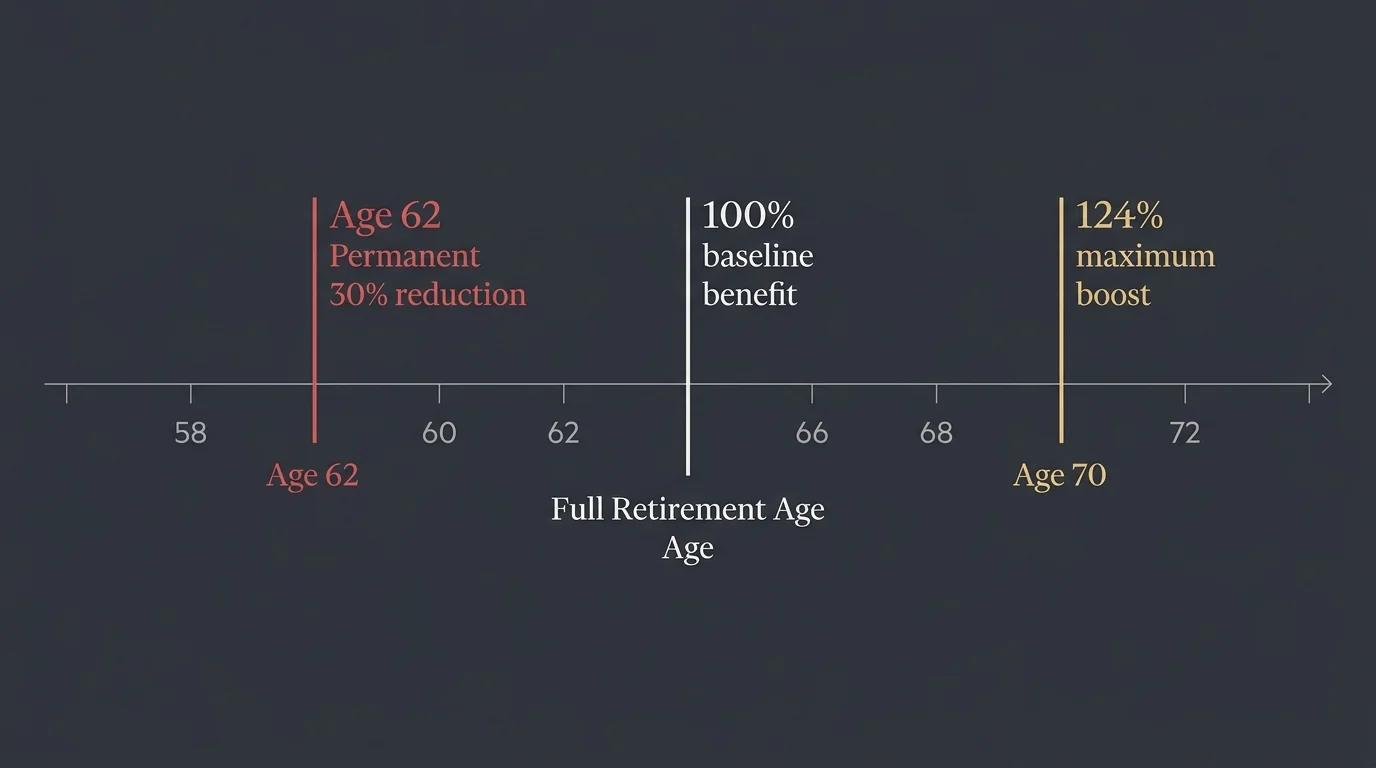
Age 62: Age 62 remains the earliest possible age to claim retirement benefits. Choosing age 62 results in a permanent 30 percent reduction from your FRA baseline figure. The formula reduces your check by 5/9ths of 1 percent for each of the first 36 months before FRA, plus 5/12ths of 1 percent for each additional month. In 2026, the maximum payout at age 62 is $2,969 per month. While claiming early provides cash flow immediately, it permanently locks in the lowest possible monthly amount for the remainder of your life.
Age 63: Claiming at age 63 reduces your baseline benefit by 25 percent. You receive 75 percent of your full Primary Insurance Amount. Workers choosing age 63 often do so due to forced early retirement, health challenges, or job loss.
Age 64: Claiming at age 64 yields 80 percent of your Primary Insurance Amount, reflecting a 20 percent permanent reduction. If your FRA benefit equals $2,000 per month, claiming at 64 drops your monthly check to $1,600.
Age 65: Many Americans assume age 65 marks Full Retirement Age because Medicare eligibility starts at 65. However, claiming Social Security at 65 results in a 13.33 percent permanent reduction relative to an FRA of 67. You receive 86.67 percent of your baseline figure. You can enroll in Medicare at 65 while delaying your Social Security checks to allow them to grow.
Age 66: Claiming at age 66 yields 93.33 percent of your baseline benefit—a modest 6.67 percent reduction. For those born in 1959 whose FRA is 66 years and 10 months, claiming at 66 results in a minimal early penalty of less than 1.5 percent.
Age 67: Reaching age 67 grants you 100 percent of your calculated Primary Insurance Amount without penalties. In 2026, the average Social Security benefit for all retired workers stands between $2,071 and $2,084 per month. The maximum possible benefit for an individual reaching FRA in 2026 is $4,152 per month.
Age 68: Delaying past your FRA earns delayed retirement credits. The SSA increases your payout by 8 percent per year (0.66 percent per month) for every year you wait beyond age 67. Claiming at 68 increases your baseline check to 108 percent of your Primary Insurance Amount.
Age 69: Continuing to wait until age 69 adds another 8 percent, raising your check to 116 percent of your full baseline benefit. On a baseline check of $2,500, waiting until 69 increases your monthly check to $2,900 before accounting for annual inflation adjustments.
Age 70: Age 70 represents the maximum effective claiming age. Delayed retirement credits stop accumulating once you hit 70, making further delays unrewarding. At age 70, you receive 124 percent of your calculated baseline benefit. In 2026, the maximum possible payout for a worker claiming at age 70 reaches $5,181 per month—or $62,172 per year.
| Claiming Age | Percent of Full Baseline Received | Monthly Payout on $2,000 PIA Baseline | Monthly Payout on $3,000 PIA Baseline | 2026 Maximum Possible Monthly Benefit |
|---|---|---|---|---|
| 62 | 70.0% | $1,400 | $2,100 | $2,969 |
| 63 | 75.0% | $1,500 | $2,250 | $3,195 |
| 64 | 80.0% | $1,600 | $2,400 | $3,420 |
| 65 | 86.7% | $1,733 | $2,600 | $3,680 |
| 66 | 93.3% | $1,867 | $2,800 | $3,920 |
| 67 (FRA) | 100.0% | $2,000 | $3,000 | $4,152 |
| 68 | 108.0% | $2,160 | $3,240 | $4,484 |
| 69 | 116.0% | $2,320 | $3,480 | $4,816 |
| 70 | 124.0% | $2,480 | $3,720 | $5,181 |
Examining this table reveals a stark financial contrast: waiting from age 62 to age 70 results in a 77 percent boost in your monthly benefit check ($2,480 vs. $1,400 for a $2,000 PIA baseline). This dramatic difference highlights why evaluating social security amount by age forms the bedrock of sound financial planning.








I plan to wait until I am 72 years old. If everyone waited a little longer, it would help in balancing the U.S. Federal Budget. How much would I receive, being born in 1967?
72 won’t change your benefits. 70 is the cut off age. So weather you retire at 70 or 72 it will be the same.
Just the fact we have to work that long is a crime..
I did stop working at age 62 had to go on disability then at 66 and a half I retired and they switched me to my social security which I received now but I’m getting ready to turn 70 in a few more months I’m trying to figure out what I get back my full retirement or does it stay the same
I had to draw disability from my late husband’s income. I was told once I turned turned 65 I would be changed to regular Social Security. I called a month after I turned 65 asking why I wasn’t changed to regular SS and the person told me I wouldn’t be. I make just over $1700 a month and if I was drawing regular SS I would be making a lot more. It is hard making ends meet even with the small pensions from the different work places my husband worked for. It’s been 27 years since I lost my husband and I still don’t know why I was told no on drawing regular SS when I know a lot of people who was changed to regular SS after drawing disability.