
Understanding how the Social Security benefit formula calculates your monthly check allows you to make strategic decisions that directly increase your retirement income. The federal system bases your lifetime baseline benefit on your highest 35 years of wage-indexed earnings, which means every year you work beyond three decades can actively replace a zero or a low-earning early career year with a higher salary. By extending your career by even two or three years during your peak earning age, you elevate your Average Indexed Monthly Earnings and maximize your delayed retirement credits. This comprehensive guide breaks down the mathematics behind the formula so you can optimize your work history, eliminate zero-earning years, and secure the maximum monthly payout possible.

The Essentials
- The 35-Year Window: Social Security calculates your monthly baseline benefit using your top 35 years of wage-indexed earnings. Missing years count as $0, which severely drags down your average.
- Replacing Low Earners: Working a 36th or 37th year doesn’t go to waste; your highest current earnings replace lower-paid early career years in the calculation.
- 2026 Earnings Cap: Up to $184,500 of annual income counts toward your Social Security record in 2026, allowing late-career high earners to significantly raise their average.
- Compounding Gains: Delaying claims past Full Retirement Age (FRA) earns you an extra 8% simple interest per year until age 70, stacking on top of a strengthened 35-year work record.
- Earnings Test Recalculation: If you work while collecting benefits before FRA, withheld funds aren’t lost permanently—Social Security recalculates your monthly check at FRA to restore those dollars.
Table of Contents
- How the 35-Year Social Security Formula Works
- The Hidden Cost of Zero-Earning Years
- Replacing Lower-Paid Early Years with Peak Earnings
- Understanding Bend Points and Benefit Progression
- The Double Benefit: Work History Meets Delayed Retirement Credits
- Working While Claiming: The Retirement Earnings Test Explained
- Avoiding Common Errors in Social Security Planning
- When DIY Isn’t Enough
- Frequently Asked Questions
How the 35-Year Social Security Formula Works
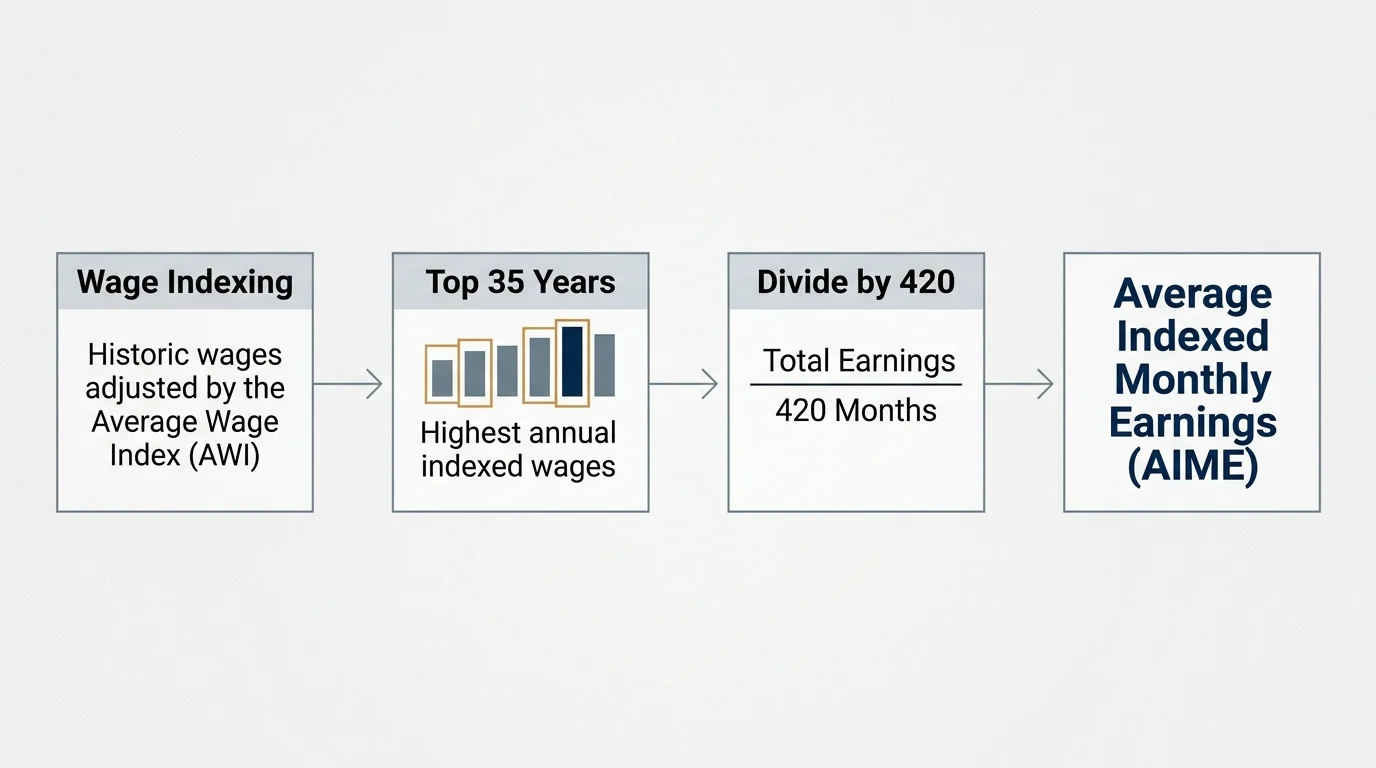
The Social Security Administration (SSA) uses a specific, step-by-step mathematical model to convert your lifetime career earnings into a monthly retirement check. Many workers assume that their benefit reflects only their final five years of salary or their overall cumulative taxes paid. In reality, the Social Security benefit formula relies on a full 35-year snapshot of your work history.
To begin the calculation, the SSA adjusts your historic wages for national wage inflation. This process, known as wage indexing, brings your past earnings up to present-day standards using the national Average Wage Index (AWI). For example, money you earned in 1990 is multiplied by an indexing factor so that it reflects current wage standards rather than nominal dollars from decades ago. Wage indexing applies to all earnings through age 50 and freezes its index factor at age 60; earnings after age 60 enter the calculation at their actual face value.
Once the SSA indexes all your annual wages, it selects the highest 35 years on your official record. It sums those top 35 years and divides the total by 420 (the total number of months in 35 years). The resulting figure represents your Average Indexed Monthly Earnings (AIME). This figure serves as the bedrock for everything else in your retirement portfolio, determining your base monthly check before accounting for claiming age adjustments or cost-of-living increases.
“An investment in knowledge pays the best interest, especially when applied to structuring your lifetime earning potential.” — Benjamin Franklin, Statesman and Polymath
The Hidden Cost of Zero-Earning Years
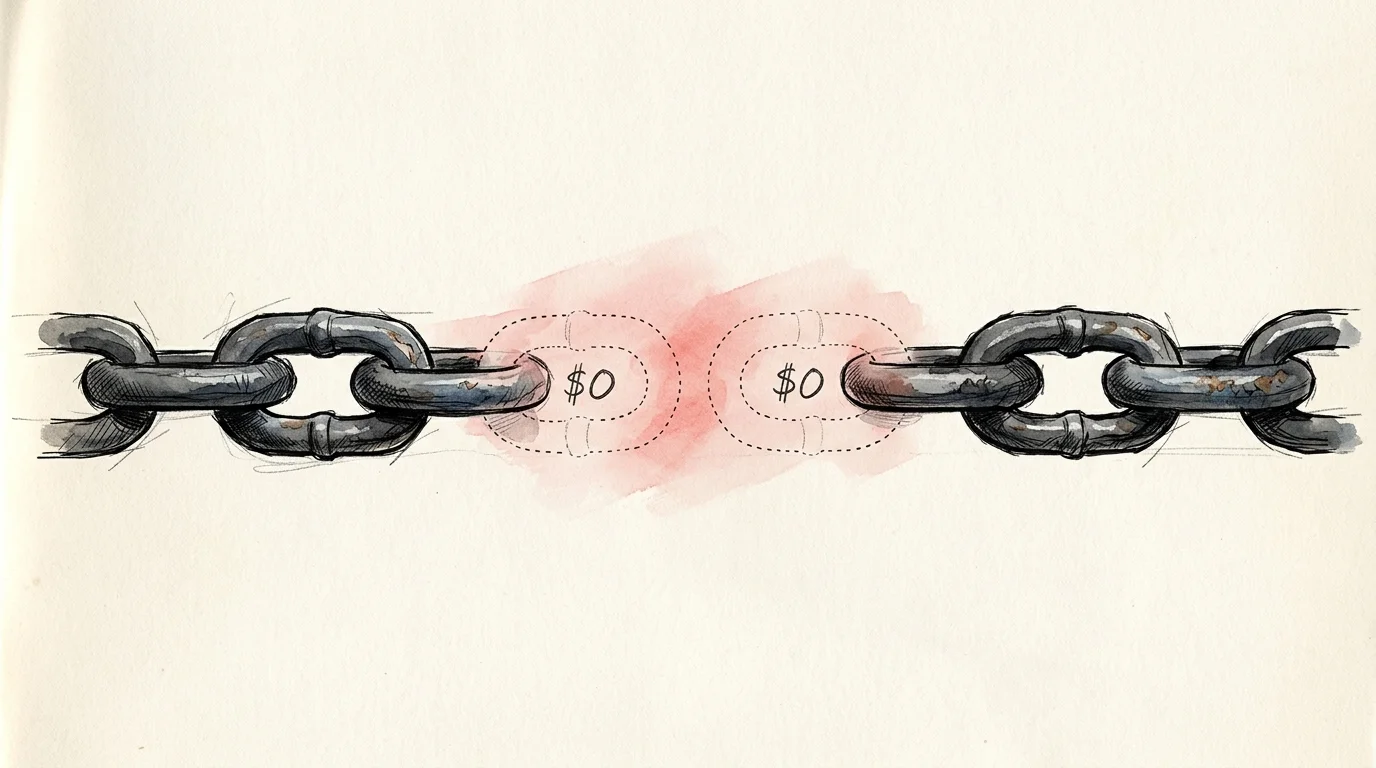
Understanding the Social Security work history impact requires looking closely at what happens when you enter the calculation window with fewer than 35 years of covered employment. Whether you stepped away from the workplace to raise children, care for aging relatives, attend graduate school, or transition between careers, every missing year up to the 35-year baseline generates a $0 entry on your earnings ledger.
Zero-earning years severely degrade your overall average because the SSA always divides your lifetime total earnings by 420 months, regardless of how many years you actually worked. If you accumulated only 30 years of employment, five full years of $0 entries enter your equation. Consider how that math plays out in actual dollars:
Assume you worked 30 years with an average indexed salary of $70,000 per year. Your total indexed career earnings would equal $2,100,000 ($70,000 × 30). Dividing $2,100,000 by 420 months results in an AIME of $5,000. However, if you decide to work five additional years late in life at that same $70,000 salary, you eliminate all five zero years. Your total career earnings rise to $2,450,000 ($70,000 × 35). Dividing $2,450,000 by 420 months raises your AIME to $5,833.33—a direct increase of $833.33 in monthly baseline earnings simply by removing zeros from your formula.
By extending your career, you systematically erase those zero-earning years. Every single year you work beyond a partial work history acts as a powerful lever, lifting your lifetime average and ensuring the federal calculation reflects a full, robust career.
Replacing Lower-Paid Early Years with Peak Earnings
What if you already completed 35 years of covered employment? Many pre-retirees ask whether continuing to work provides any additional financial gain once they hit that magic 35-year threshold. The answer lies in how late-career compensation compares to early-career earnings.
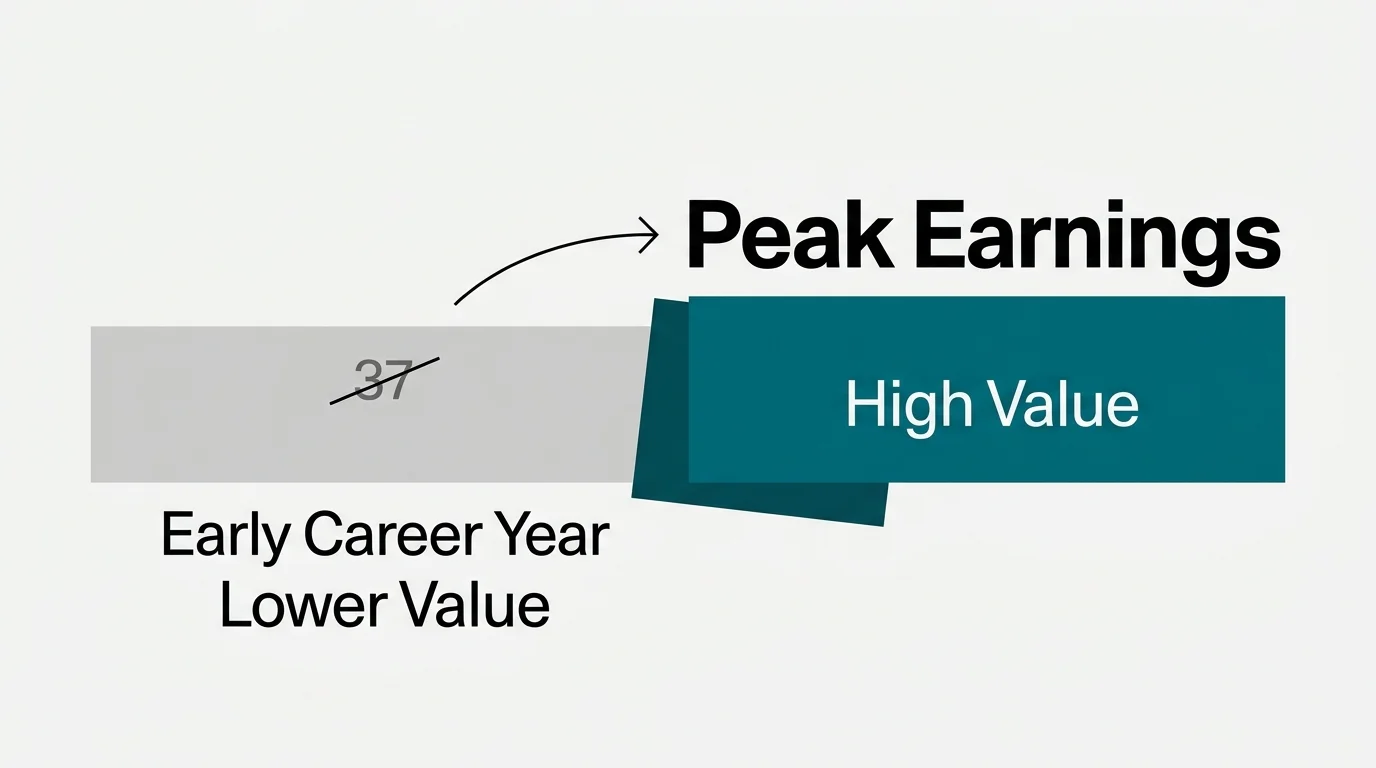
Working longer for Social Security offers a distinct advantage even when you have a complete 35-year history. The SSA continuously scans your entire record and selects only the top 35 earning years. If you work a 36th year and earn a substantial salary, that new high-earning year displaces your lowest indexed year from the 35-year average.
In your early twenties, you might have earned entry-level wages that, even after adjusting for inflation, equate to $22,000 per year today. In contrast, late-career professionals frequently reach peak earning potential. In 2026, the maximum taxable earnings cap subject to Social Security OASDI tax reaches $184,500 (up from $176,100 in 2025). If you earn $100,000 or more in your 60s, replacing a $22,000 indexed year adds $78,000 or more to your total lifetime calculation pool.
When you divide that $78,000 addition across the 420-month formula denominator, your AIME increases by approximately $185 per month. That represents a permanent bump in your baseline monthly pension benefit for the rest of your life, compounded by future annual Cost-of-Living Adjustments (COLAs).
Understanding Bend Points and Benefit Progression
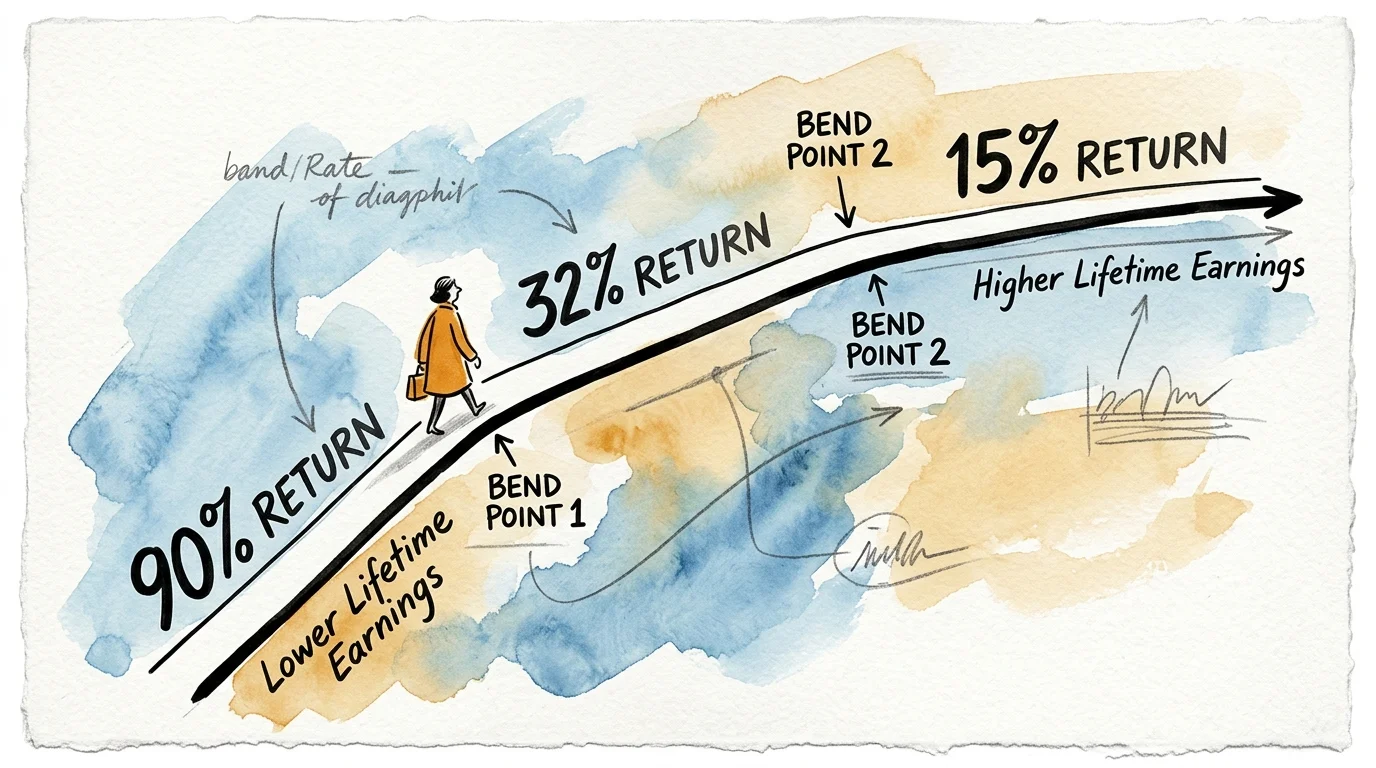
Once the SSA calculates your AIME, it passes that figure through a formula featuring progressive bracket thresholds called “bend points” to determine your Primary Insurance Amount (PIA). The PIA represents the exact monthly payment you receive if you claim benefits precisely at your Full Retirement Age (FRA).
The Social Security formula uses a three-tiered structure that provides a higher replacement rate for lower earnings while continuing to reward additional income up to the maximum taxable cap. For individuals reaching age 62 in 2026, the Social Security calculation explained involves these exact bend point percentages:
- First Tier: 90% of your AIME up to $1,286
- Second Tier: 32% of your AIME between $1,286 and $7,749
- Third Tier: 15% of your AIME above $7,749
Because most middle- and upper-income workers operate within the 32% bend point tier during their late career, every incremental increase in your AIME translates directly into a 32-cent increase in base monthly benefits. Extending your work history yields predictable, formulaic gains that elevate your underlying PIA. You can verify your historical earnings record and view your projected bend point progression directly by creating an account on the Social Security Administration website.

The Double Benefit: Work History Meets Delayed Retirement Credits
The true financial engine of a longer career emerges when you combine a strengthened 35-year earnings record with delayed benefit claiming. For individuals born in 1960 or later, Full Retirement Age sits at age 67. (For those born in 1959, FRA is 66 years and 10 months).
If you claim benefits at age 62, you suffer a permanent reduction of up to 30% compared to your full PIA. Conversely, if you continue working and delay your benefit application past your FRA, you earn Delayed Retirement Credits (DRCs). These credits grow your benefit by 2/3 of 1% for each month you wait, yielding a 8% simple annual increase up to age 70. Waiting from age 67 to age 70 generates a maximum permanent boost of 24% above your base PIA.
“If you can delay taking your Social Security benefits until age 70, you get an 8% simple annual increase for every year past your full retirement age. That is a guaranteed yield you cannot beat anywhere else in the market.” — Suze Orman, Financial Author and Host
To visualize the power of maximizing Social Security benefits through longer careers, compare three distinct worker scenarios below. Each scenario assumes a worker reaching age 62 in 2021 with an FRA of 67, evaluating how work duration and claiming age dramatically alter lifetime income:
| Strategy Scenario | Years Worked | Earnings Profile | Claiming Age | Estimated Monthly Benefit | Annual Income Impact |
|---|---|---|---|---|---|
| Early Exit / Early Claim | 30 Years (5 zeros) | $60k avg indexed | Age 62 | $1,380 | $16,560 / year |
| Standard Career / Full Claim | 35 Years (0 zeros) | $60k avg indexed | Age 67 (FRA) | $2,310 | $27,720 / year |
| Extended Career / Late Claim | 38 Years (Peak earnings) | $85k late salary boost | Age 70 | $3,250 | $39,000 / year |
As displayed in the comparison table, combining extra years of high earnings with delayed claiming more than doubles monthly income compared to taking early exit routes. Resources provided by organizations like AARP and financial planning hubs like Investopedia consistently highlight this compounding dynamic as the single most effective risk management tool against late-life inflation.

Working While Claiming: The Retirement Earnings Test Explained
A widespread source of confusion among workers centers on what happens if you decide to collect Social Security benefits while continuing to work before reaching Full Retirement Age. Many people mistakenly believe that earning income while drawing benefits destroys their Social Security entitlement. In reality, the Retirement Earnings Test (RET) is merely a temporary deferral, not a tax or penalty.
For 2026, if you remain under your Full Retirement Age for the entire year, the RET exempt earnings threshold is $24,480 per year ($2,040 per month). For every $2 you earn above $24,480, the SSA temporarily withhold $1 in benefits. In the calendar year you reach your Full Retirement Age, a higher earnings limit applies: $65,160 per year ($5,430 per month), with $1 withheld for every $3 earned above the limit until the month you reach FRA.
The moment you attain Full Retirement Age, two crucial changes occur automatically:
- Earnings Caps Vanish: The Retirement Earnings Test disappears completely. You can earn unlimited income without any benefit withholding.
- Automatic Recalculation: The SSA recalculates your monthly payment to credit you for every dollar withheld during your early claiming years. They adjust your monthly check upward permanently, restoring the withheld value over your remaining life expectancy while incorporating your additional high-earning years into your 35-year baseline.

Avoiding Common Errors in Social Security Planning
Navigating the transition from work to retirement requires dodging several prevalent missteps that systematically reduce lifetime earnings. You can safeguard your financial health by avoiding these major pitfalls:
- Stopping Work at 30 Years: Assuming that 30 years constitutes a “full record” leaves five years of $0 entries in your formula, dragging down your AIME permanently.
- Claiming Early Out of Fear: Fearing the system will run out of money leads many workers to claim at 62, permanently locking in a 30% benefit reduction and lower base calculations.
- Ignoring Survivor Benefits: The highest-earning spouse determines the survivor benefit for a remaining partner. Failing to extend your career or delay claiming can leave a surviving spouse with significantly lower guaranteed income for life.
- Neglecting Earnings Statement Audits: The SSA bases your calculations on recorded earnings. If an employer reported wages incorrectly decades ago, your benefit calculation suffers. Review your annual earnings statement on SSA.gov to verify historical record accuracy.
- Underestimating Post-FRA Recalculation: Many retirees stop working part-time because they fear taxes, missing out on late-stage opportunities to replace lower early-career years in their 35-year average.
Review guidance from consumer advocates at the Consumer Financial Protection Bureau (CFPB) to ensure you manage retirement transitions without falling into unexpected debt or liquidity traps.

When DIY Isn’t Enough
While understanding the baseline math empowers you to take control of your retirement trajectory, certain complex scenarios necessitate personalized professional advice. Consider consulting a Certified Financial Planner (CFP) or a Certified Public Accountant (CPA) when navigating these specific situations:
- Government or Non-Covered Pensions: If you worked for a municipal government, school district, or foreign entity that did not participate in Social Security OASDI payroll taxes, specialized provisions like the Windfall Elimination Provision (WEP) or Government Pension Offset (GPO) alter standard calculations.
- Complex Business Ownership: Business owners and self-employed individuals who control their W-2 salaries versus distribution dividends need tailored planning to balance current tax liabilities against long-term Social Security benefit optimization.
- Divorce and Multi-Spouse Scenarios: Claiming on an ex-spouse’s record while evaluating your own 35-year work history requires coordinating filing timings to ensure you optimize claiming order and maximum yield.
- Taxation of Benefits Thresholds: Because combined income rules can subject up to 85% of your Social Security benefits to federal income taxes, coordinate IRA withdrawals, capital gains, and late-career income with a qualified tax expert.
Frequently Asked Questions
Do extra years worked past age 65 automatically increase my benefit?
Yes, provided those additional years generate higher indexed earnings than any of your lowest 35 current earnings years. The SSA automatically recalculates your benefit every year you work and report taxable Social Security wages.
What is the maximum monthly Social Security benefit in 2026?
In 2026, the maximum monthly benefit for a worker retiring at Full Retirement Age is $4,152 per month (up from $4,018 in 2025). Workers who claim late at age 70 with a maximum 35-year wage history can receive maximum benefits approaching $5,000 per month.
How many work credits do I need to qualify for Social Security benefits?
You need a minimum of 40 work credits (equivalent to 10 years of work) to qualify for retirement benefits. In 2026, you earn one credit for every $1,890 in covered earnings, up to the maximum of four credits ($7,560) per year.
Can I replace zero-earning years if I work part-time in retirement?
Yes. Any year in which you earn covered Social Security income will replace a $0 year on your record. Even modest part-time earnings will produce a total higher than zero, lifting your 35-year average overall.
Building a successful retirement requires aligning your personal health goals, lifestyle expectations, and income streams. Extending your work history by even a couple of years pays dividend after dividend by replacing low earning years, elevating your base baseline calculation, and multiplying your monthly payouts for the rest of your life.
This article provides general retirement education and information only. Every retiree’s situation is unique—what works for others may not work for you. For personalized advice, consider consulting a qualified financial professional such as a CFP or CPA.
Last updated: March 2026. Retirement benefits, tax rules, and healthcare regulations change frequently—verify current details with official sources.









Leave a Reply