
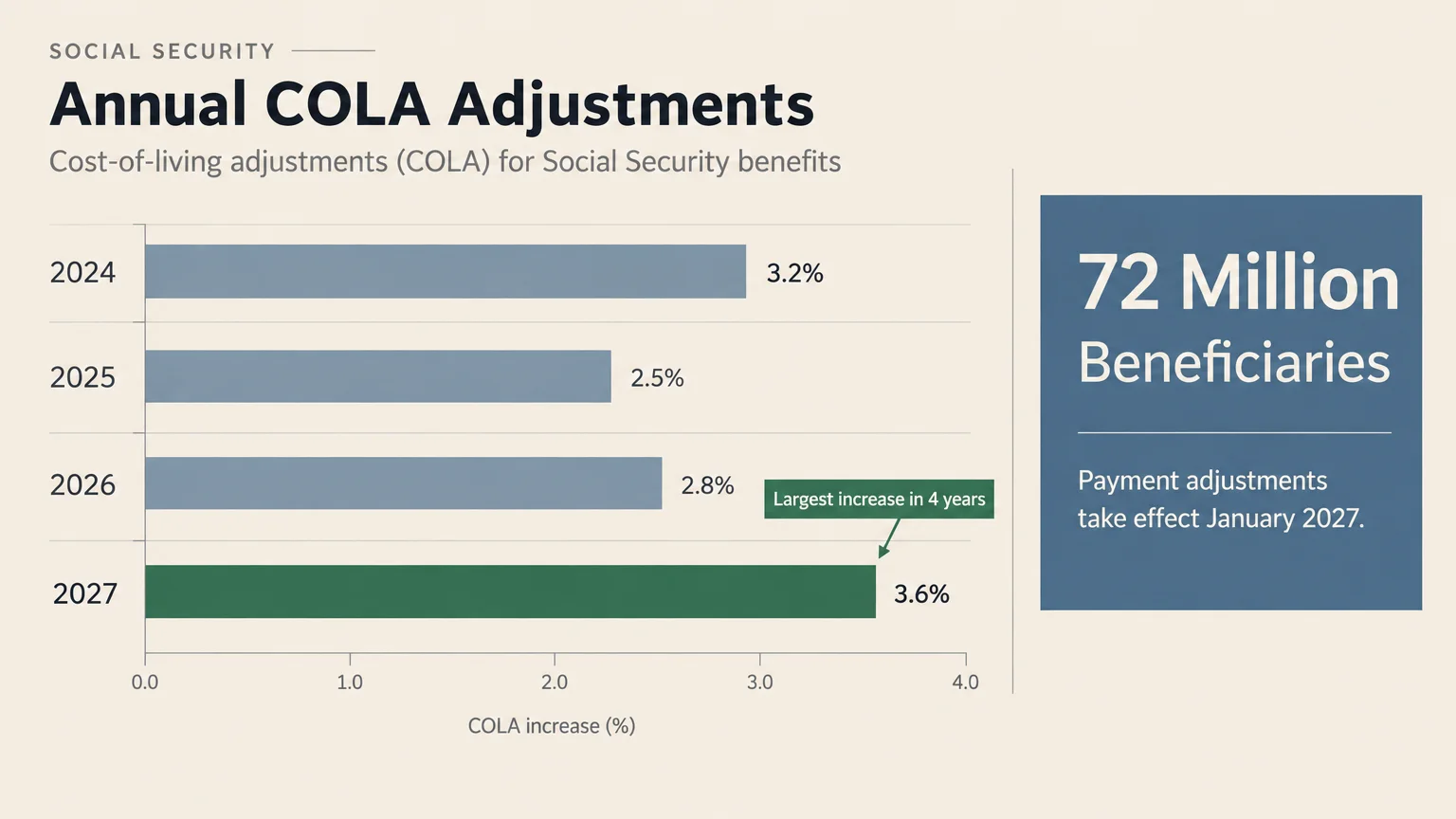
Married couples receiving Social Security will see their monthly payments rise by 3.6% starting in January 2027. This cost-of-living adjustment marks the largest annual increase for beneficiaries in four years.
For millions of Americans collecting spousal benefits, the average monthly check will cross the four-figure threshold for the first time. The bump provides meaningful relief against stubborn living costs.
Understanding how this spousal benefit increase works helps you and your partner coordinate claiming dates and protect your household income. Small timing decisions today can permanently alter your lifetime payout.
Inside the 2027 COLA: The Numbers Couples Need to Know
The Social Security Administration officially announced a 3.6% Cost-of-Living Adjustment (COLA) on October 14, 2026. This upward adjustment outpaces the increases seen over the previous three years.
Beneficiaries received a 3.2% increase in 2024, 2.5% in 2025, and 2.8% in 2026. The 2027 adjustment represents the most substantial raise since the historic 8.7% bump implemented in 2023.
Nearly 72 million Americans will see higher payments starting with their January 2027 checks. However, approximately 7.3 million Supplemental Security Income recipients will see their higher payments arrive earlier, on December 31, 2026.
You can review your personalized payment increase online through your personal account on the Social Security Administration website. Beneficiaries who enrolled in paperless alerts by November 18, 2026, can access notices in late November.
Traditional paper notices will arrive by mail throughout December 2026. Tracking your exact dollar amount early allows you to plan your household cash flow for the coming year.
How the 3.6% Increase Changes Average Monthly Payouts
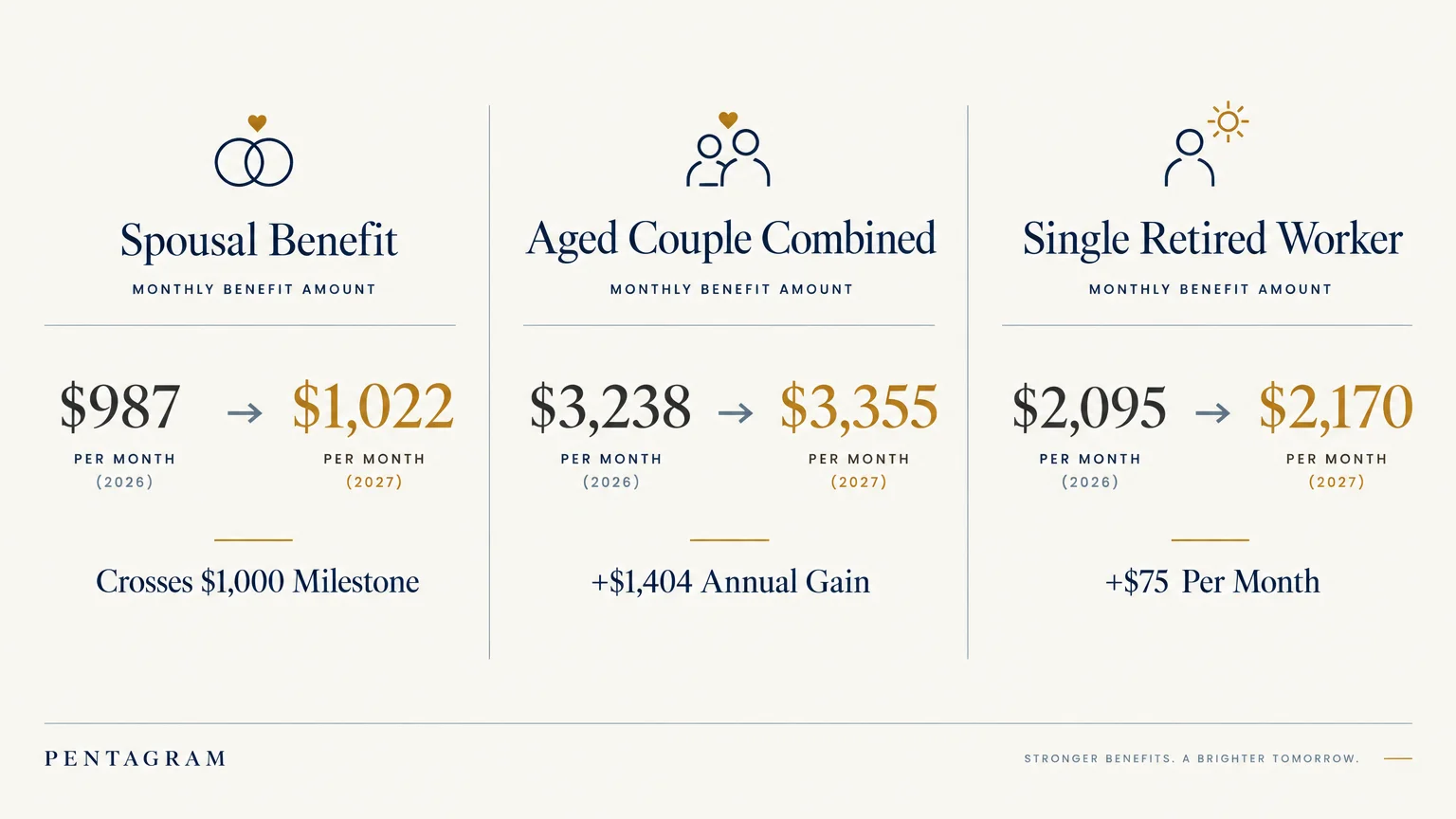
Prior to this adjustment, the average spousal benefit hovered around $987 per month in late 2026. The 3.6% increase adds roughly $35.50 each month to that baseline figure.
This boost pushes the typical spousal benefit to approximately $1,022 to $1,023 per month beginning in January 2027. Crossing the $1,000 threshold represents a major milestone for secondary earners nationwide.
Couples where both partners collect benefits will experience an even larger cumulative dollar gain. The SSA estimates the average payment for an aged couple will rise by $117 per month.
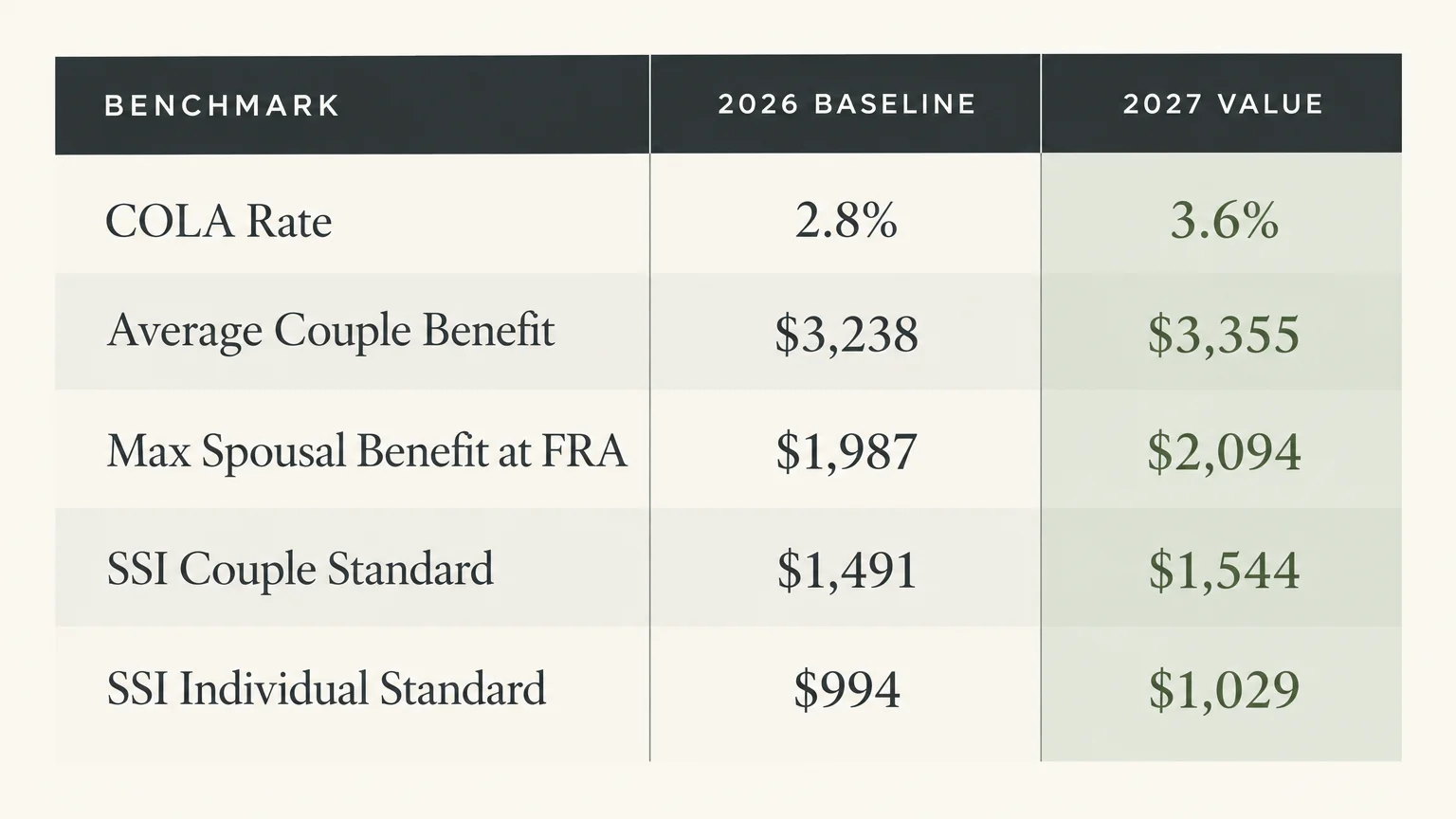
That adjustment lifts the typical couple’s combined monthly benefit from $3,238 in 2026 to $3,355 in 2027. Over a full calendar year, that change delivers an extra $1,404 in guaranteed income.
Single retired workers will see their average benefit rise from $2,095 to $2,170 per month, reflecting a $75 increase. Widows and widowers living alone will see monthly payments rise from $1,936 to $2,005.
The maximum monthly benefit for a worker retiring at Full Retirement Age (FRA) rises to $4,188 in 2027. Because spousal benefits top out at half that level, the maximum spousal benefit at FRA becomes $2,094.
Low-income elderly couples receiving Supplemental Security Income will also receive larger federal baselines. Federal SSI standards rise from $1,491 to $1,544 for eligible couples, and from $994 to $1,029 for individuals.
How Spousal Social Security Benefits Actually Work
Spousal benefits allow one partner to receive retirement income based on the other partner’s earnings history. This rule provides essential financial security for spouses who took time away from paid employment.
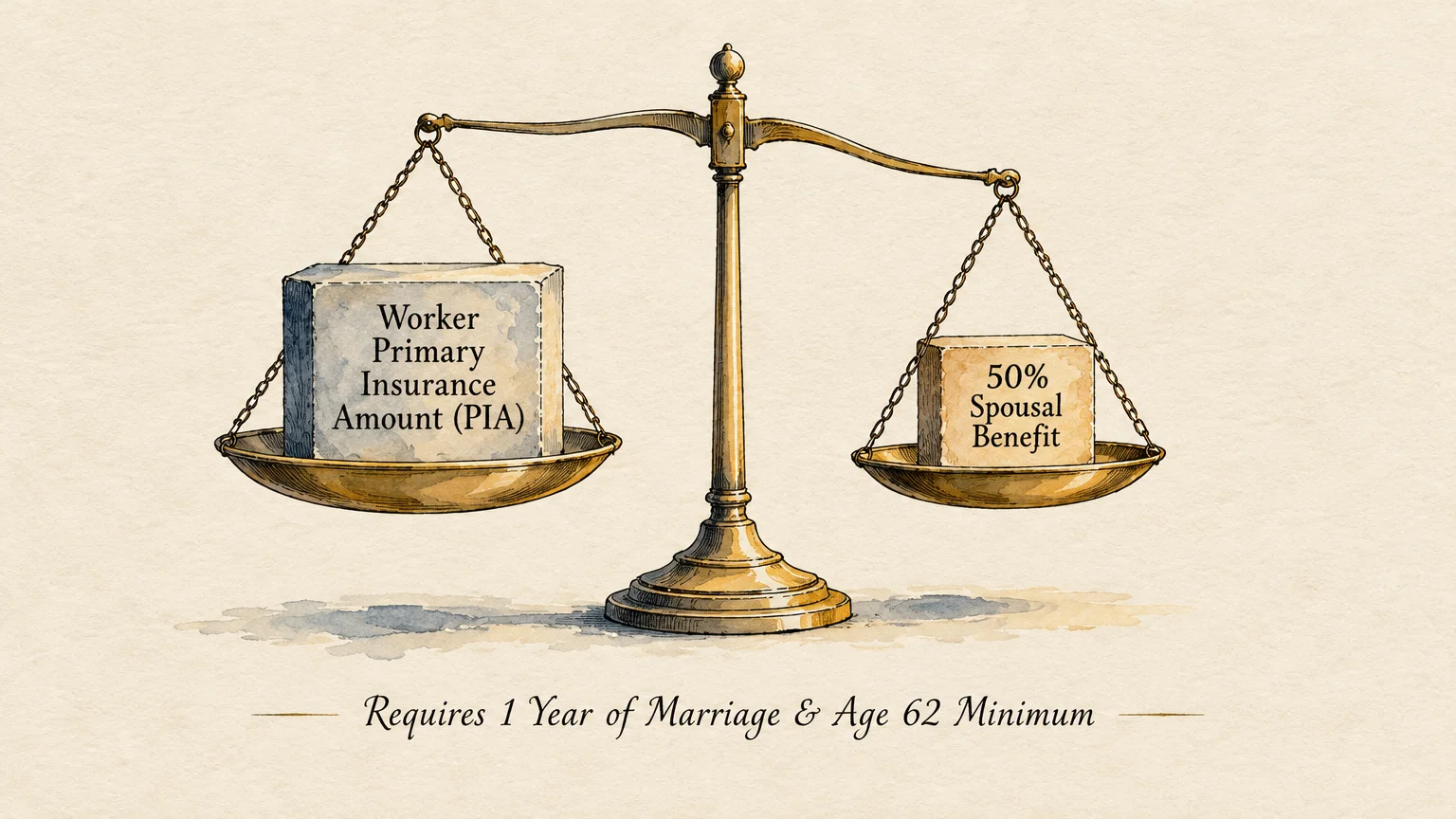
To qualify, you must have been married for at least one continuous year to an insured worker. In addition, you must be at least 62 years old, unless caring for a qualifying dependent child.
The maximum spousal benefit equals 50% of your partner’s Primary Insurance Amount (PIA). The PIA represents the benefit your spouse earned based on their thirty-five highest-earning working years.
Your spouse must already be collecting their own retirement benefits before you can receive spousal payments. You cannot claim benefits against your living partner’s record while they delay their own claim.
The Social Security Administration also applies a strict deemed filing rule when you submit your application. This regulation prevents beneficiaries from double-dipping or cherry-picking which benefit to collect first.
When you file, the agency reviews both your own work record and your partner’s record simultaneously. The system automatically awards your own retirement benefit first before calculating any spousal addition.
If your own benefit is higher than the spousal payment, you receive only your own earned amount. If the spousal calculation exceeds your personal benefit, the agency adds a top-up payment to make up the difference.
Claiming Age: Why Timing Dictates Your Lifetime Check
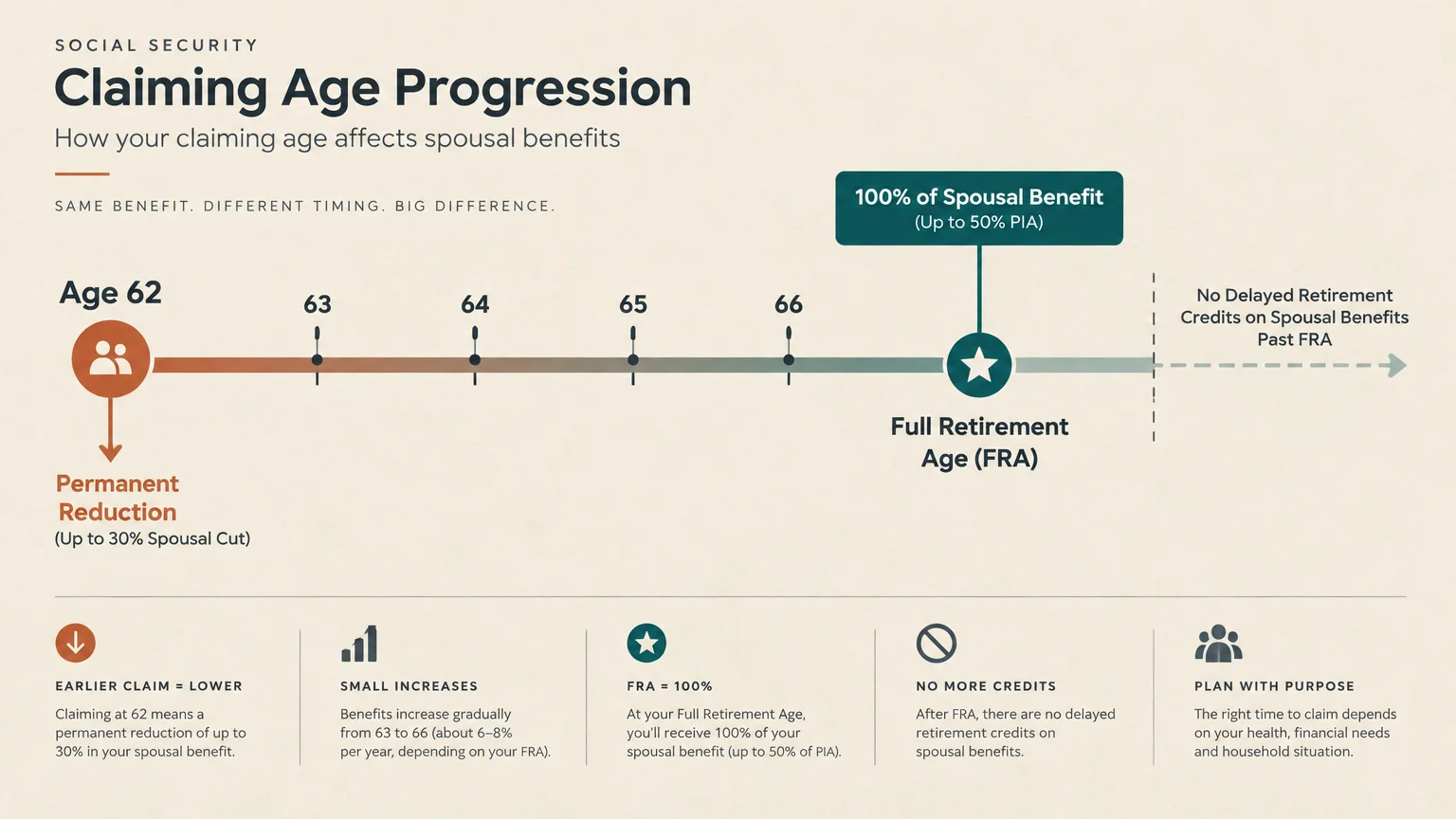
Your claiming age directly dictates the percentage of your partner’s primary benefit you will ultimately collect. Full Retirement Age is 67 for anyone born in 1960 or later.
Claiming a spousal benefit before your Full Retirement Age results in a permanent financial reduction. While you can claim as early as age 62, doing so reduces your payment substantially.
If your Full Retirement Age is 67, claiming at age 62 reduces your spousal payout to 32.5% of your partner’s PIA. That amounts to a permanent 35% cut compared to your full spousal entitlement.
The reduction shrinks each month you delay your application between age 62 and your Full Retirement Age. Reaching age 67 unlocks the full 50% spousal allocation.
“Delaying your Social Security claim can be the single best investment you ever make, but couples must coordinate their timing together.” — Suze Orman, Personal Finance Expert
Unlike personal retirement benefits, spousal benefits never earn delayed retirement credits. Your personal worker benefit grows by 8% per year for every year you delay past Full Retirement Age until age 70.
Spousal benefits, by contrast, stop growing the moment you reach your Full Retirement Age. Waiting until age 70 to claim a spousal benefit produces zero additional money and leaves cash on the table.
Furthermore, your spousal benefit cannot grow based on your partner’s delayed retirement credits. If your spouse waits until age 70 to collect, your spousal benefit still caps at 50% of their FRA baseline.
Comparing 2026 and 2027 Social Security Benchmarks
The annual COLA influences numerous thresholds across the Social Security system simultaneously. Reviewing these figures side by side clarifies how the update alters your household planning.
| Benefit or Metric | 2026 Baseline | 2027 Rate / Amount | Total Change |
|---|---|---|---|
| Annual Cost-of-Living Adjustment (COLA) | 2.8% | 3.6% | +0.8 percentage points |
| Average Monthly Spousal Benefit | $987 | $1,023 | +$36 per month |
| Average Couple (Both Receiving Benefits) | $3,238 | $3,355 | +$117 per month |
| Average Retired Worker Benefit | $2,095 | $2,170 | +$75 per month |
| Maximum Spousal Benefit at Full Retirement Age | $2,076 | $2,094 | +$18 per month |
| Earnings Test Limit (Under FRA All Year) | $23,400 | $25,560 | +$2,160 allowable earnings |
| Earnings Test Limit (Year Reaching FRA) | $62,160 | $67,920 | +$5,760 allowable earnings |
| Social Security Taxable Wage Base | $184,500 | $192,300 | +$7,800 maximum taxed |
These benchmark shifts demonstrate that inflation adjustments affect both the benefits you collect and the payroll taxes active workers pay. Higher wage caps mean higher-earning spouses contribute more to the system throughout 2027.
The Hidden Offsets: Medicare Part B and Benefit Taxes
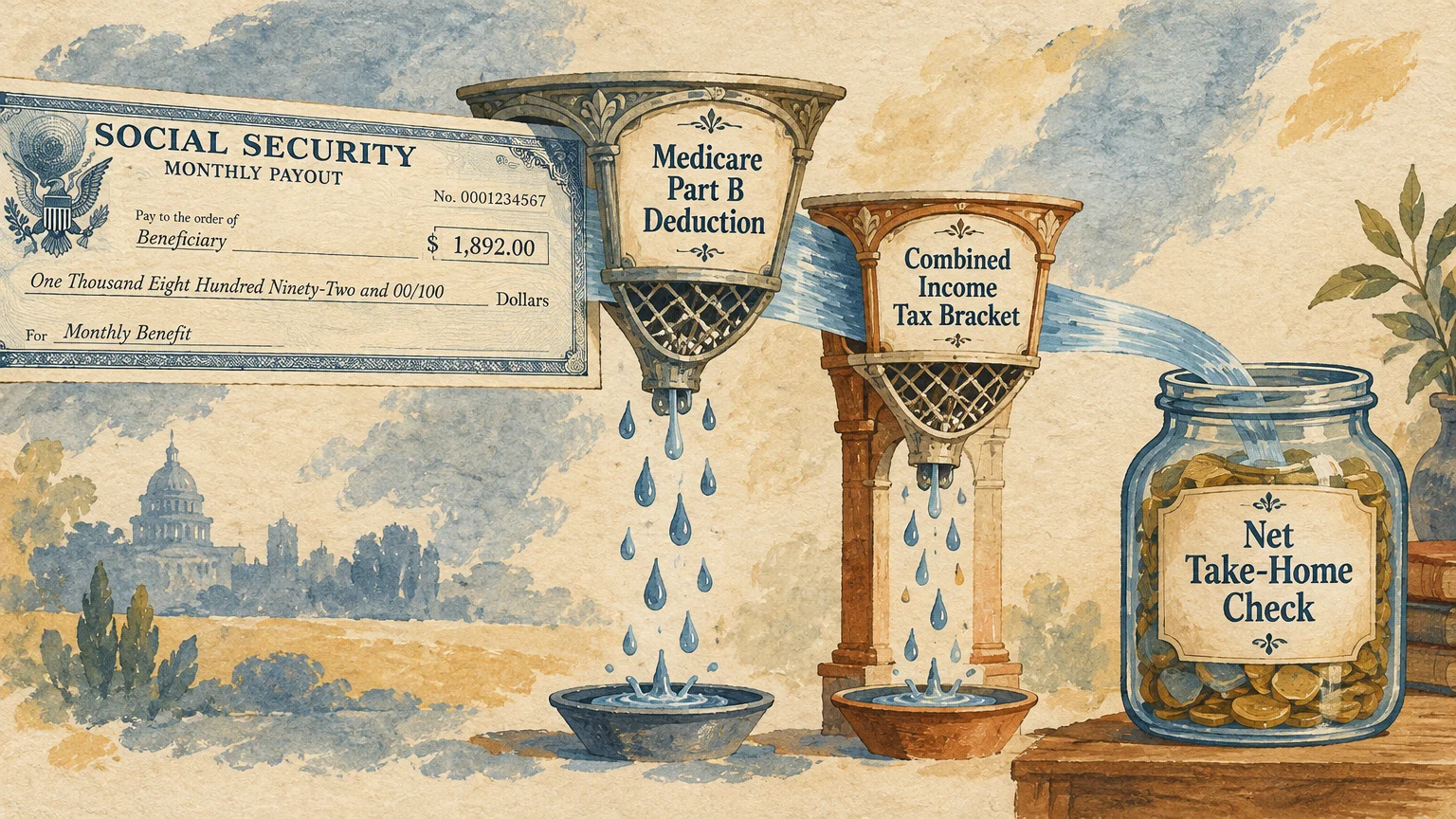
A headline benefit increase does not always translate into an equivalent surge in spendable cash. Most retirees have their monthly Medicare Part B premiums deducted directly from their Social Security checks.
Standard Medicare Part B premiums are projected to increase by $6.60 per month in 2027. You can check current healthcare rates and coverage rules directly at Medicare.gov.
When healthcare premiums rise, they consume a portion of your annual COLA gain before the deposit reaches your bank. If your spousal benefit increases by $35.50, a $6.60 premium hike leaves you with a net gain of $28.90.
Taxes represent another major factor that can quietly erode your household increase. The federal government taxes Social Security benefits based on a statutory calculation called combined income.
Your combined income equals your Adjusted Gross Income, plus any nontaxable municipal bond interest, plus one-half of your household Social Security benefits. Official guidance on this calculation is available through the Internal Revenue Service.
If you and your spouse file a joint tax return, the taxation thresholds kick in at surprisingly low levels:
- Combined income between $32,000 and $44,000 exposes up to 50% of your benefits to federal income taxes.
- Combined income exceeding $44,000 subjects up to 85% of your Social Security benefits to taxation.
- Single filers face taxation starting at just $25,000 in combined income.
Congress established these tax thresholds decades ago and never indexed them for inflation. Because benefit payments rise with the 2027 COLA while thresholds remain frozen, more couples will face unexpected tax bills.
The 2027 Earnings Test: Working While Collecting Spousal Benefits
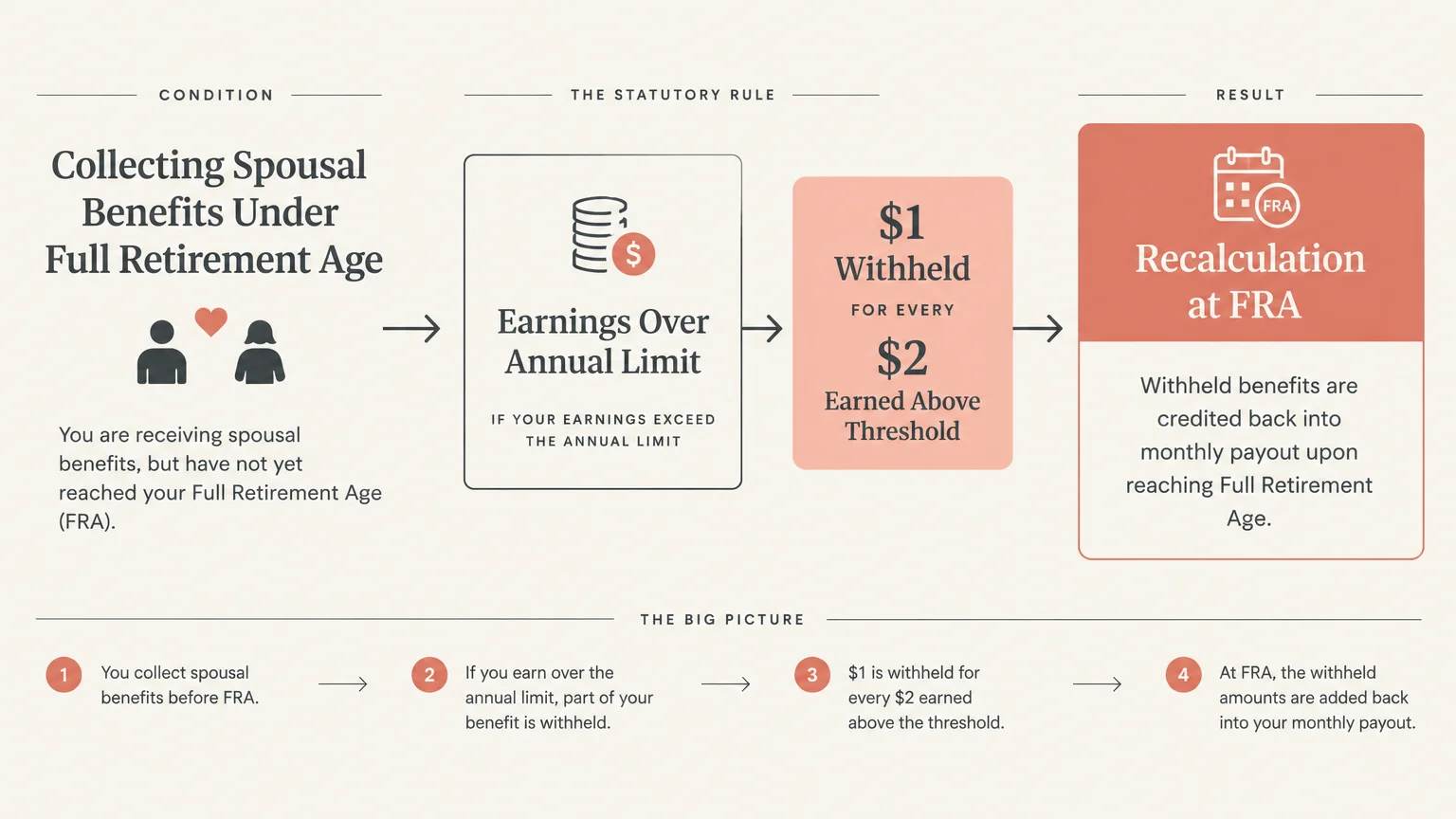
Many spouses choose to maintain part-time employment or consulting work while collecting monthly Social Security payments. If you claim benefits before your Full Retirement Age, the Retirement Earnings Test restricts how much you can earn.
For 2027, the earnings threshold for individuals below their Full Retirement Age all year rises to $25,560. The SSA withholds $1 of benefits for every $2 you earn above that threshold.
A higher limit applies during the specific calendar year you reach your Full Retirement Age. In 2027, that upper threshold increases to $67,920.
In the year you attain Full Retirement Age, the agency withholds $1 for every $3 earned above the limit. Crucially, the agency only counts income earned during the months prior to your actual birth month.
Once you reach Full Retirement Age, the earnings test disappears entirely. You can earn an unlimited income from wages or self-employment without losing a single dollar of your spousal benefit.
Withheld benefits are not permanently lost; the agency recalculates your monthly benefit when you hit Full Retirement Age. The system increases your future checks to credit you for the benefits withheld during your working years.

Divorced Spousal Benefits: Rules and Qualifications
Divorce does not necessarily eliminate your ability to collect Social Security income based on an ex-spouse’s work record. Former spouses can access the exact same 3.6% COLA raise if they meet specific statutory criteria.
To qualify for benefits on an ex-partner’s record, your previous marriage must have lasted for at least ten continuous years. In addition, you must be currently unmarried and at least 62 years of age.
Claiming divorced spousal benefits has zero financial impact on your ex-spouse’s payments. It also does not reduce the benefits collected by your ex-spouse’s current partner if they have remarried.
If your ex-spouse has reached age 62 and qualifies for benefits, you can claim even if they have not yet filed. The only condition is that your divorce must have been finalized for at least two continuous years.
If you remarry, your entitlement to benefits on your former spouse’s record terminates immediately. However, if your subsequent marriage ends through death, divorce, or annulment, your eligibility to claim on the first record is restored.
Survivor Benefits vs. Spousal Benefits: Crucial Distinctions
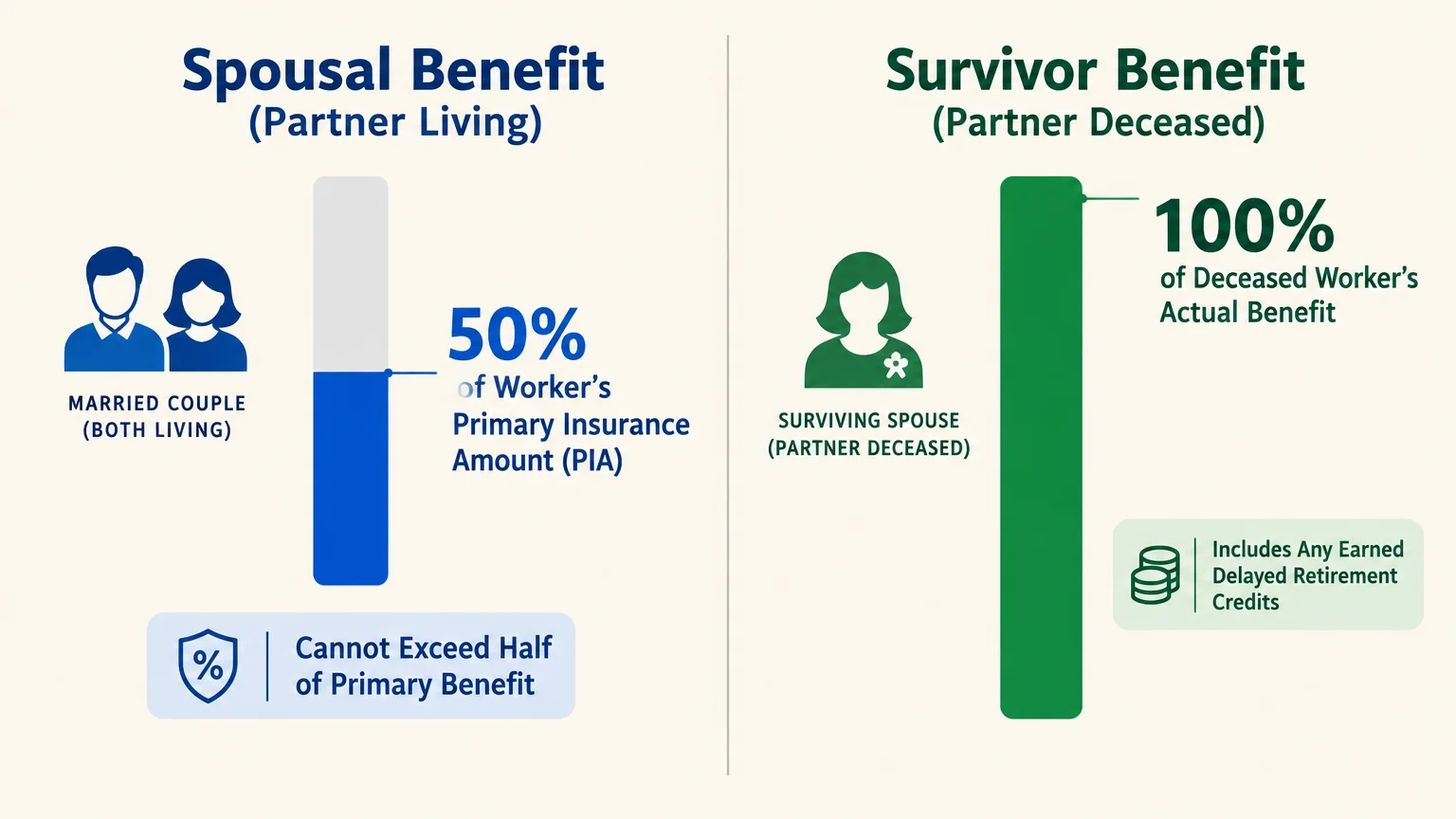
Many couples mistakenly conflate living spousal benefits with survivor benefits. While both rely on a partner’s work history, their operational rules and maximum payouts differ dramatically.
A living spousal benefit maxes out at exactly 50% of the primary earner’s Primary Insurance Amount. By contrast, a surviving widow or widower can inherit up to 100% of the deceased spouse’s actual monthly benefit.
Survivor benefits include any delayed retirement credits the primary earner accumulated before death. If the higher earner waited until age 70 to claim, the surviving spouse inherits that entire expanded 132% payout.
“Financial longevity is about understanding the levers that control your guaranteed income in retirement.” — Jean Chatzky, Financial Journalist
When one partner passes away, the smaller of the household’s two Social Security checks disappears entirely. The surviving spouse retains only the larger of the two payments.
This drop in total household income makes claiming strategy essential for married couples. The higher earner should frequently consider delaying their claim to age 70 to maximize the future survivor benefit for the remaining spouse.
Average survivor benefits for an aged widow or widower living alone jump to $2,005 per month in 2027. That steady monthly baseline protects surviving partners against financial hardship later in life.

Pitfalls to Watch For
Navigating spousal benefit rules can feel overwhelming, and simple misunderstandings can cost your household thousands of dollars over time. Watch for these common pitfalls as you prepare for the 2027 adjustment:
- Waiting past Full Retirement Age for spousal benefits: Spousal payouts do not earn delayed retirement credits after age 67. Delaying your spousal claim past Full Retirement Age forfeits monthly income without increasing your check.
- Filing early without realizing the permanent haircut: Claiming spousal benefits at age 62 locks in a permanent reduction to 32.5% of the primary earner’s base benefit. That smaller baseline remains reduced for life and dampens the dollar value of future COLAs.
- Ignoring the primary earner’s filing status: You cannot collect a traditional spousal benefit until your partner files for their own retirement benefits. If the primary earner delays until age 70, the secondary earner must wait as well unless eligible for divorced benefits.
- Neglecting tax bracket creep on Social Security: The 3.6% COLA boosts gross income, which can push your combined income above the $32,000 threshold. Failing to coordinate IRA withdrawals with benefit increases can trigger unexpected taxes.
- Forgetting to report wages while under Full Retirement Age: Exceeding the $25,560 earnings test limit triggers benefit withholdings. Failing to notify the SSA about outside earnings can lead to overpayment demands and delayed checks.

Getting Expert Help
While the basic math of Social Security appears straightforward, complex personal circumstances often require specialized financial analysis. Consulting a professional ensures your household maximizes its lifetime government benefits.
Consider seeking advice from a credentialed advisor, such as those registered with the Certified Financial Planner Board, in the following scenarios:
- Substantial age differences between partners: When spouses are separated by five or more years, optimal claiming schedules become intricate. An advisor can model whether the older spouse should delay claiming to protect the younger partner’s long-term survivor benefit.
- Non-covered government pension histories: Spouses who worked as educators, police officers, or municipal employees may face the Government Pension Offset (GPO). A specialist helps calculate how much of your spousal benefit will survive the two-thirds pension deduction.
- Complex retirement asset distributions: If your household holds significant traditional IRA or 401(k) balances, required minimum distributions can inadvertently trigger heavy taxes on your benefits. An expert can structure Roth conversions before benefits begin to preserve tax-free cash flow.
- Blended families and multiple marriages: Navigating benefits across prior marriages lasting over ten years requires careful analysis. An advisor can confirm whether claiming on an ex-spouse provides a higher yield than claiming on a current partner.
Frequently Asked Questions
Can I claim a spousal benefit if I never worked outside the home?
Yes. You do not need personal Social Security work credits to claim a spousal benefit. As long as your spouse has accumulated the necessary 40 work quarters and has filed for benefits, you are eligible once you reach age 62.
Does my former spouse know if I file for divorced spousal benefits?
No. The Social Security Administration does not notify your ex-spouse when you file a claim against their earnings history. Your claim is entirely private, processed independently, and does not alter their payment amount.
When will I see the 3.6% COLA reflected in my bank account?
Social Security payments for January 2027 are distributed on the second, third, or fourth Wednesday of January, based on your birth date. SSI beneficiaries will see their adjusted payments arrive on December 31, 2026.
Can both spouses collect spousal benefits from each other at the same time?
No. Deemed filing rules prevent couples from simultaneously collecting spousal benefits on each other’s records. Each partner receives their own earned worker benefit first, topped up only if the calculated spousal benefit is higher.
Taking Control of Your Household Benefits
The 2027 COLA delivers the largest raise in four years, offering welcome financial relief to married couples. However, capturing the full value of this 3.6% increase requires proactive planning and clear coordination.
Take time to log into your online account, verify your earnings record, and review your combined household income targets. Clear claiming strategies ensure that both partners enjoy maximum financial security throughout their retirement years.
This is educational content based on general retirement and financial principles. Individual results vary based on your situation. Always verify current benefit rules, tax laws, and eligibility requirements with official sources like SSA, Medicare.gov, or the IRS.
Last updated: November 2026. Retirement benefits, tax rules, and healthcare regulations change frequently—verify current details with official sources.









Leave a Reply