
Managing your finances shifts dramatically once your regular workplace paychecks stop. A steady monthly routine ensures your hard-earned savings support your lifestyle without unexpected interruptions.
Setting aside thirty minutes each month keeps your cash flow dependable. It also protects your nest egg from creeping subscription charges and identity theft.
This practical retiree monthly checklist covers the five vital numbers and accounts you should monitor. Establishing these simple habits will keep your long-term plan running smoothly.

Why Regular Monitoring Matters in Retirement
During your working years, employers managed tax withholdings, healthcare deductions, and retirement contributions automatically. Retirement places full operational control directly into your hands.
Transitioning from wealth accumulation to decumulation requires consistent oversight. Small accounting errors or billing mistakes compound quickly when you live on fixed income streams.
Developing disciplined retiree money habits prevents cash shortfalls. A brief monthly review provides peace of mind and keeps your budget aligned with your lifestyle goals.
“The goal isn’t more money. The goal is living life on your terms.” — Jean Chatzky, Financial Educator
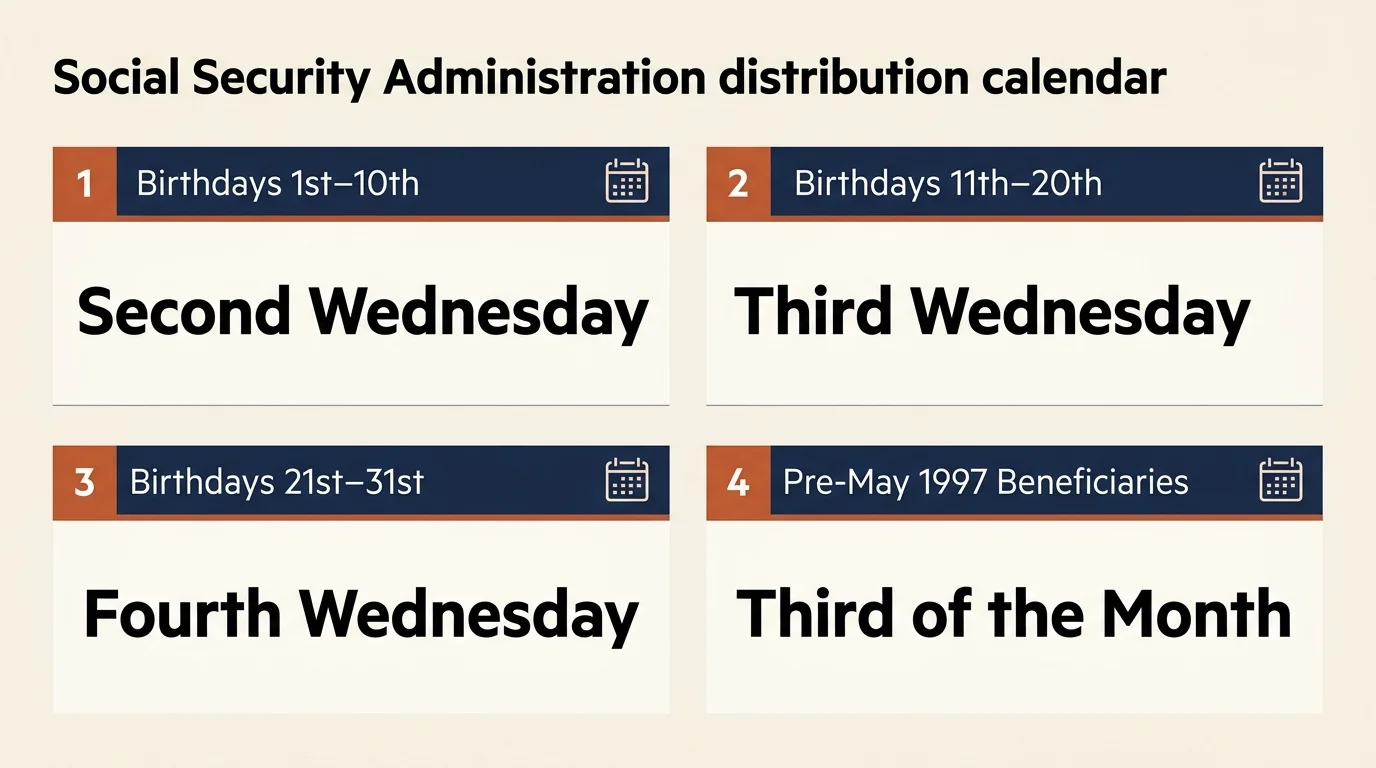
1. Social Security and Fixed Income Deposits
Verify your fixed income deposits during the first week of every month. Ensure that each expected payment arrived on its scheduled date for the exact dollar amount anticipated.
The Social Security Administration (SSA) follows a strict staggered distribution schedule for beneficiaries who filed after May 1997:
- Birthdays 1st–10th: Second Wednesday of the month.
- Birthdays 11th–20th: Third Wednesday of the month.
- Birthdays 21st–31st: Fourth Wednesday of the month.
- Beneficiaries before May 1997: Third day of every month.
Compare the net deposit against your benefit award letter. Automated deductions for federal tax withholdings or Medicare premiums frequently cause unexpected adjustments to your deposit.
If you elected voluntary tax withholding using IRS Form W-4V, confirm the agency withheld your chosen percentage. Review your pension statements and annuity deposits to catch administrative processing delays early.
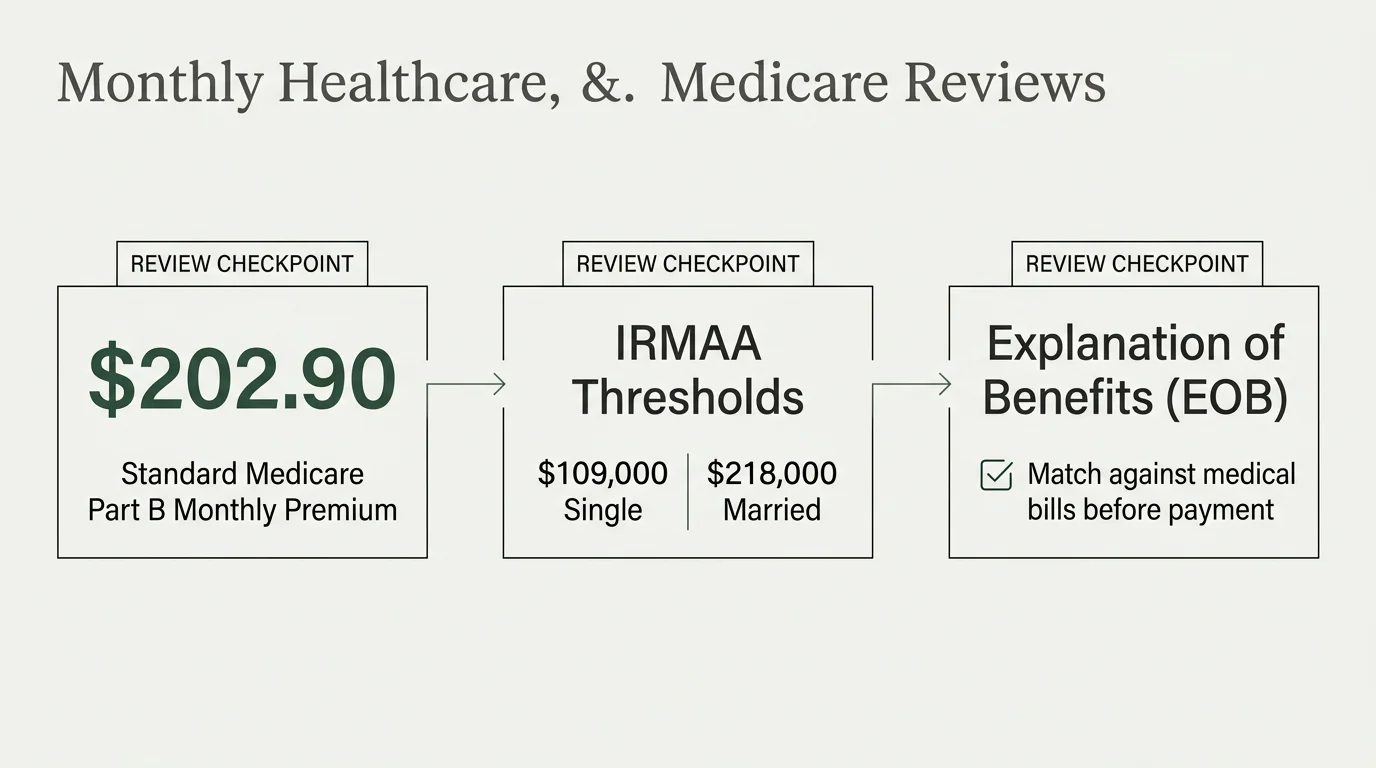
2. Health Insurance and Medicare Expense Deductions
Healthcare expenses represent one of the largest budget categories for retirees. Monitoring your monthly health statements prevents surprise out-of-pocket charges.
Review the standard Medicare Part B monthly premium deduction, which is $202.90 per beneficiary. Confirm that the deduction appearing on your statement matches your coverage tier.
Higher-income retirees must also track Income-Related Monthly Adjustment Amounts (IRMAA). If your modified adjusted gross income from two years prior exceeded $109,000 single or $218,000 married, monthly surcharges apply.
Review every Explanation of Benefits (EOB) statement sent by Medicare.gov or your private supplemental carrier. Never pay a medical provider bill until you match it directly against your processed EOB.
Look for billing errors, duplicate service charges, or denied prescription claims. Catching billing disputes early prevents unpaid medical accounts from escalating to collection agencies.

3. Portfolio Drawdowns and Required Minimum Distributions
Consistent retirement account monitoring protects your investments from unnecessary tax penalties. Track the pace of your systematic monthly withdrawals from taxable, traditional, and Roth accounts.
Ensure your total annual withdrawals align with your targeted distribution rate. Taking too much cash during market pullbacks accelerates portfolio depletion over time.
If you have reached age 73, monitor your progress toward satisfying your annual Required Minimum Distribution (RMD). Individuals born in 1960 or later must begin these distributions at age 75.
Failing to withdraw your full RMD by December 31 triggers a severe 25% excise tax penalty on the shortfall. The Internal Revenue Service (IRS) reduces this penalty to 10% if you correct the oversight within two years.
Checking your RMD progress monthly prevents a rushed, high-tax withdrawal in December. Setting up automated monthly or quarterly distributions keeps your taxable income predictable.

4. Liquid Cash Reserves and FDIC Coverage Limits
Maintain a liquid cash cushion in high-yield savings or money market accounts. Most financial planners recommend holding one to two years of living expenses in accessible funds.
Review your primary checking and savings balances to verify sufficient funds for upcoming bills. Maintaining adequate cash prevents forced asset sales during unfavorable market swings.
Verify that your total cash holdings at each financial institution remain within safety limits. The standard federal insurance limit is $250,000 per depositor, per insured institution, across ownership categories.
If your cash balance exceeds $250,000 at a single bank, reallocate the excess across different institutions. This guarantees complete protection under federal deposit insurance rules.
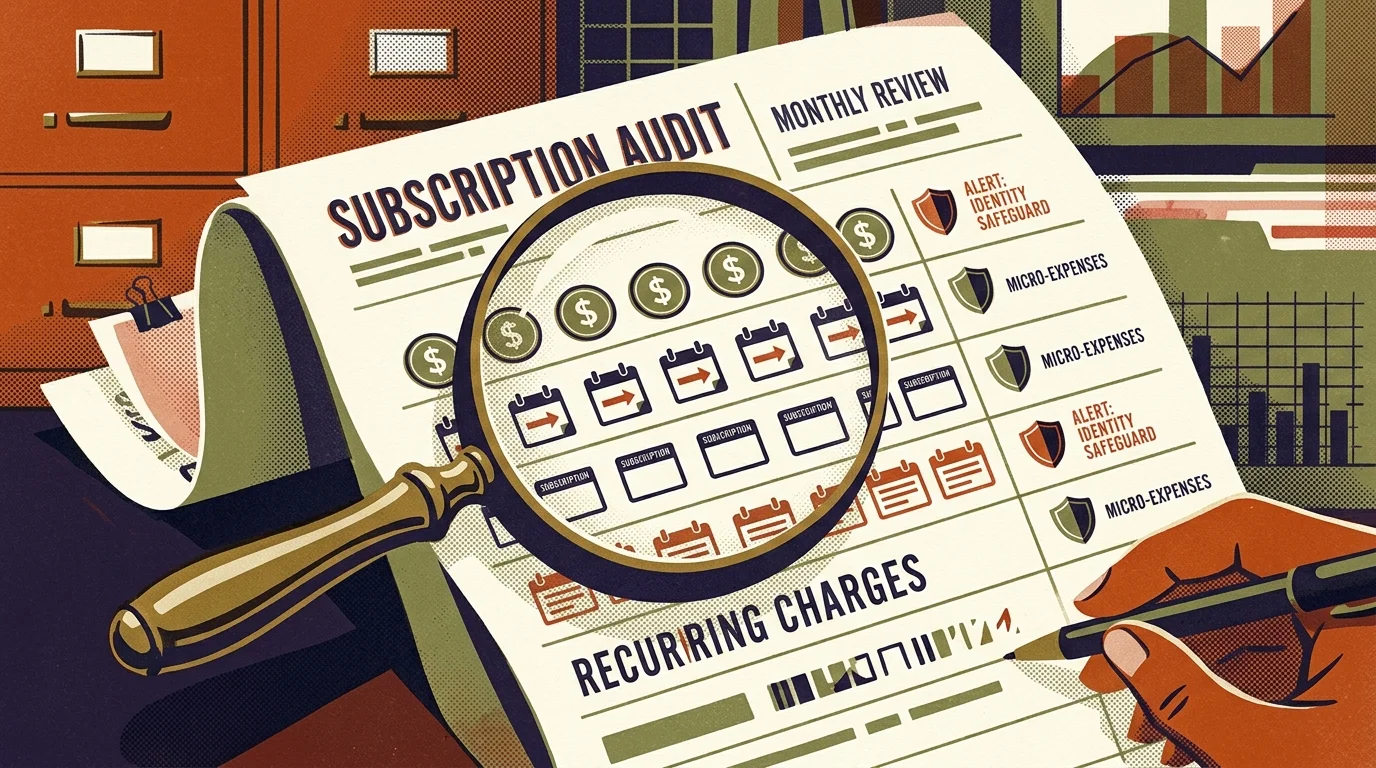
5. Credit Reports, Fraud Alerts, and Recurring Subscriptions
Retirees remain primary targets for sophisticated financial scams and identity theft schemes. Dedicate five minutes each month to auditing your credit activity and card statements.
Access free weekly online credit reports from Equifax, Experian, and TransUnion through AnnualCreditReport.com. Reviewing these reports helps you spot unauthorized credit inquiries or fraudulent accounts immediately.
The Consumer Financial Protection Bureau (CFPB) advises freezing your credit files with all three bureaus if you do not plan to apply for new loans.
Scrutinize your credit card and bank statements for unauthorized recurring subscription charges. Small auto-renewing services, duplicate streaming packages, and forgotten trial memberships drain hundreds of dollars annually.
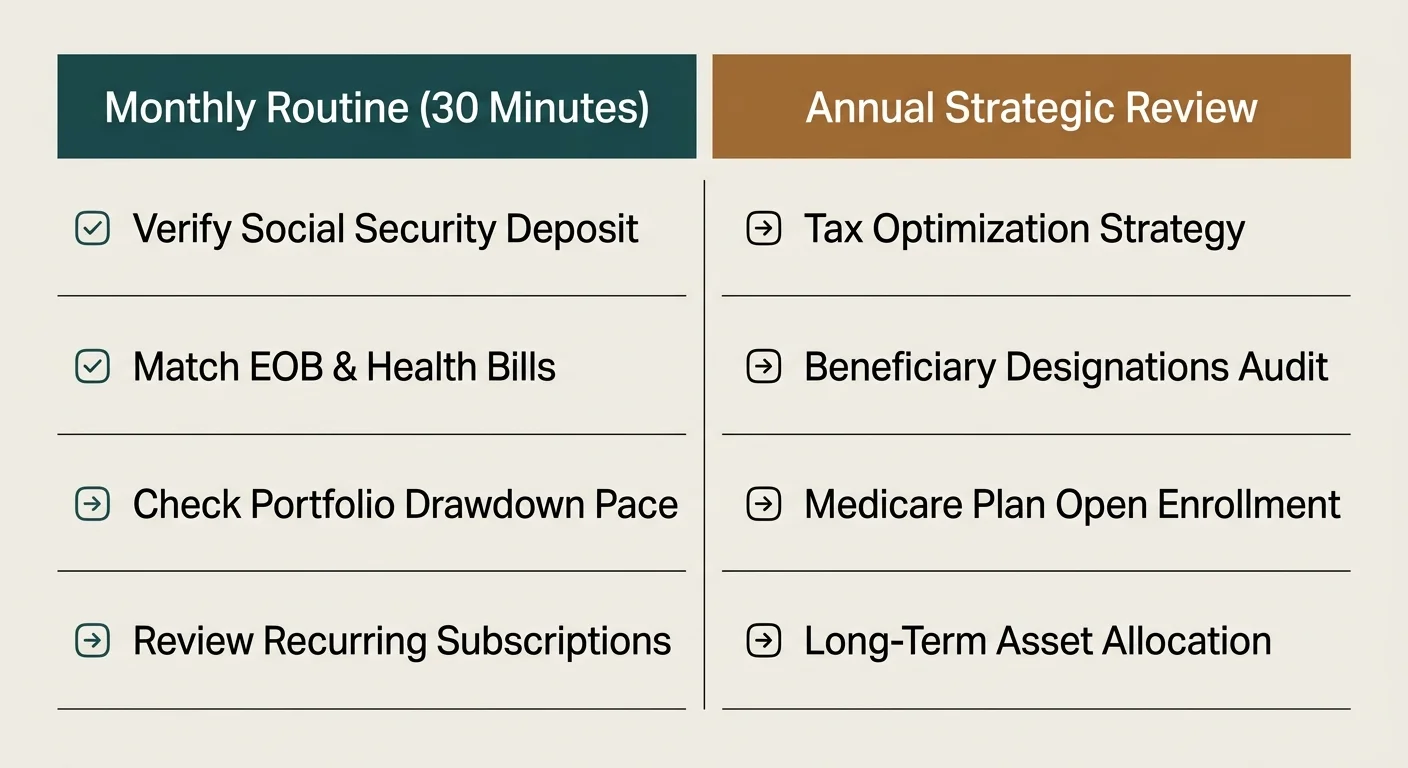
Monthly Retirement Tasks vs. Annual Reviews
Distinguishing between monthly maintenance tasks and annual strategic reviews saves time. Use this comparison table to structure your financial calendar efficiently.
| Task Category | Monthly Checklist | Annual Review |
|---|---|---|
| Income & Cash | Verify Social Security deposits and checking cash buffers. | Recalculate safe withdrawal rates and update spending plans. |
| Healthcare | Audit EOB statements and Medicare premium deductions. | Compare Medicare Advantage or Part D plans during Open Enrollment. |
| Investments | Track monthly drawdowns and RMD pace. | Rebalance portfolio asset allocation across stock and bond funds. |
| Taxes | Monitor quarterly estimated tax installments. | Analyze Roth conversions, capital gains, and tax bracket thresholds. |
| Security | Inspect credit reports and review bank charges. | Update account beneficiaries, powers of attorney, and estate wills. |

Pitfalls to Watch For
Even seasoned retirees make avoidable errors when managing monthly finances. Recognizing common traps protects your savings from administrative erosion.
- Ignoring Silent Fee Creeps: Small subscription price increases and rising bank maintenance fees drain cash balances unnoticed over time.
- Missing Quarterly Tax Deadlines: Forgetting estimated tax payments on Form 1040-ES results in underpayment penalties from the IRS.
- Reacting to Market Fluctuations: Checking portfolio account balances too frequently often triggers emotional, panic-driven investment decisions.
- Delaying RMD Calculations: Leaving entire distribution requirements until year-end limits tax-planning options like Qualified Charitable Distributions.

Getting Expert Help
While handling regular monthly retirement tasks is straightforward, complex situations require specialized professional advice. Seek qualified guidance during these key moments:
- Appealing Medicare IRMAA Surcharges: If a life-changing event significantly lowered your income, a professional helps submit Form SSA-44 for fee relief.
- Coordinating Multi-Account Tax Drawdowns: A Certified Financial Planner (CFP) structures withdrawals across taxable, IRA, and Roth accounts to minimize taxes.
- Managing Complex RMD Strategies: A tax advisor helps arrange Qualified Charitable Distributions (QCDs) directly from your IRA to lower adjusted gross income.
- Structuring Estate and Beneficiary Designations: An estate attorney ensures legal documents match your intended distribution goals across all accounts.
Frequently Asked Questions
How long does a monthly retirement financial check take?
A standard monthly review takes between 20 and 30 minutes once you organize your account logins and establish a checklist.
Why did my monthly Social Security deposit change unexpectedly?
Social Security deposits change when Medicare Part B premiums adjust, IRMAA surcharges apply, or tax withholding preferences change.
How often should I review my investment portfolio in retirement?
Check your withdrawal amounts monthly, but evaluate overall portfolio rebalancing and asset allocation only once or twice per year.
What is the penalty for missing a Required Minimum Distribution?
Missing an RMD triggers a 25% excise tax penalty on the shortfall, which reduces to 10% if corrected within two years.
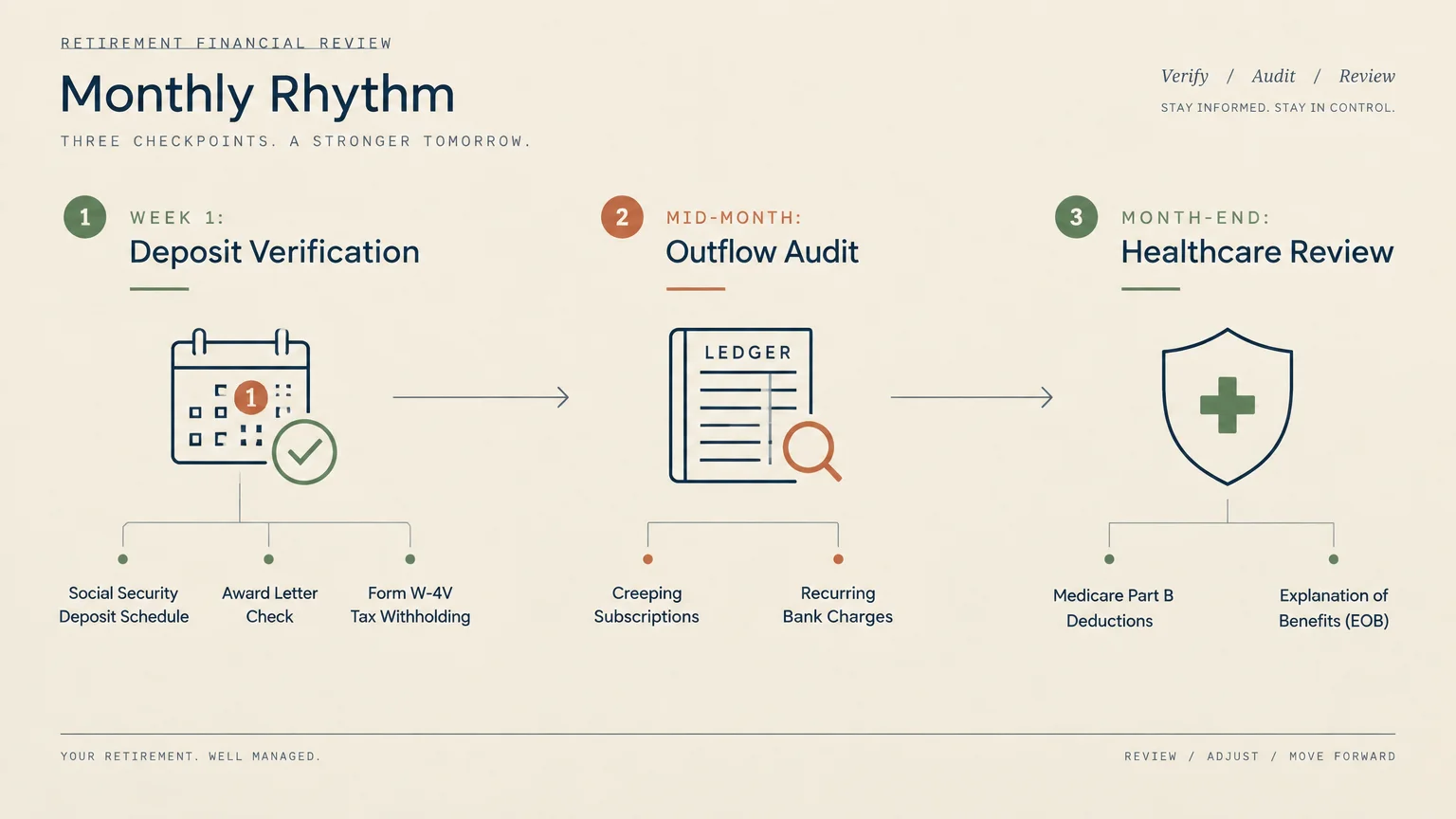
Building Your Monthly Routine
Schedule a recurring date on your calendar to complete this financial checklist for retirees. Performing these checks consistently ensures your money works effectively throughout your retirement years.
The information in this guide is meant for educational purposes. Your specific circumstances—including income, health needs, tax situation, and goals—may require different approaches. When in doubt, consult a licensed professional.
Last updated: March 2026. Retirement benefits, tax rules, and healthcare regulations change frequently—verify current details with official sources.








Leave a Reply