
You can lose thousands of dollars and surrender control over medical decisions by letting old paperwork gather dust. Federal tax shifts and evolving state codes mean estate documents written years ago may fail when your family needs them most.
An outdated designation or missing signature forces your loved ones into probate court delays. Updating your legal records protects your hard-earned assets and guarantees healthcare providers honor your exact medical choices.
Taking time now to update estate documents gives you total control over your future care and finances. Here are the nine essential legal documents for retirees that require a fresh review this year.

The Urgency of Reviewing Your Legal Portfolio
Recent research reveals a massive vulnerability across American households. National trackers show that only 24% to 26% of adults currently maintain an active will.
Even among those with documents, families rarely talk through the practical details. While 97% of Americans view estate discussions as critical, only 39% have held thorough conversations with their heirs.
In fact, 1 in 4 adults has never spoken to family members about inheritance expectations. This silence creates confusion during medical emergencies and asset division.
The stakes are historically unprecedented. Independent research firm Cerulli Associates reports that $124 trillion will move between generations through 2048, with Baby Boomers transferring the majority of that wealth.
Recent federal legislation permanently altered the tax landscape. Legislation signed on July 4, 2025 (Public Law 119-21) eliminated the planned 2026 sunset, setting the federal estate tax exemption at $15 million per individual.
A married couple can now shield up to $30 million from federal estate taxes. Estates exceeding that threshold face a top federal estate tax rate of 40%.
You can verify current transfer thresholds through the Internal Revenue Service. Tax rules change, making regular portfolio reviews an ongoing priority for every retiree.

1. Last Will and Testament
A will forms the bedrock of any traditional inheritance strategy. It spells out your primary personal representative, names guardians if needed, and directs assets that lack beneficiary forms.
A timely will update prevents state intestacy laws from dictating who receives your physical property. Without an updated document, local probate courts distribute assets based on rigid statutory formulas.
You should review your will whenever family dynamics shift. The arrival of grandchildren, a marriage, or the death of a named executor demands immediate adjustments.
Executor selection requires careful thought. Managing an estate involves paying outstanding debts, filing tax returns, and distributing funds under strict legal timelines.
Ensure your chosen personal representative remains physically, mentally, and geographically capable of executing these duties. Always name at least one alternate executor in case your primary choice cannot serve.
Having an attorney prepare a standard last will or basic document package averages between $300 and $1,200. This modest upfront investment spares your heirs substantial probate litigation expenses later.

2. Durable Financial Power of Attorney
A durable financial power of attorney authorizes a trusted individual to handle banking, tax filings, and property matters if you become incapacitated. Without it, your family must petition a court for conservatorship.
Court conservatorships consume months and cost thousands in legal fees. Appointing an agent beforehand ensures seamless payment of mortgages, insurance premiums, and living expenses.
The “durable” provision is vital because standard powers of attorney expire upon mental incapacity. A durable designation remains fully operational if you suffer a stroke or severe cognitive decline.
Financial institutions frequently scrutinize older power of attorney paperwork. Many national banks refuse to honor documents drafted more than five to ten years ago, fearing legal liability.
You can explore practical management guides from the Consumer Financial Protection Bureau. They publish step-by-step instructions for managing another person’s daily finances responsibly.
Contact your bank or brokerage to ask if they require their own internal power of attorney paperwork. Executing their institutional forms alongside your general document eliminates processing friction during emergencies.

3. Advance Healthcare Directive and Living Will
An advance healthcare directive combines a living will with a medical proxy appointment. It communicates your medical preferences when you cannot speak for yourself.
Your living will specifies interventions you accept or decline, such as mechanical ventilation, feeding tubes, and cardiopulmonary resuscitation. A healthcare directive names your medical power of attorney agent.
Federal healthcare programs actively encourage these preparations. Medicare Part B covers voluntary Advance Care Planning at $0 out-of-pocket cost during your yearly Wellness visit, provided your medical professional accepts assignment.
You can confirm participating providers directly through Medicare.gov before scheduling your appointment. This benefit lets you discuss end-of-life care decisions with your doctor without copayments or deductibles.
Revisit your medical preferences whenever your health status changes significantly. A diagnosis, surgical procedure, or shift in personal values should prompt a prompt document revision.
Provide verified copies of your signed directives to your primary care physician and your designated healthcare proxy. Keep electronic copies accessible on a secure portal for emergency hospital teams.
“Estate planning is not just about what happens when you die; it is about protecting yourself while you are alive.” — Suze Orman, Personal Finance Author & Educator
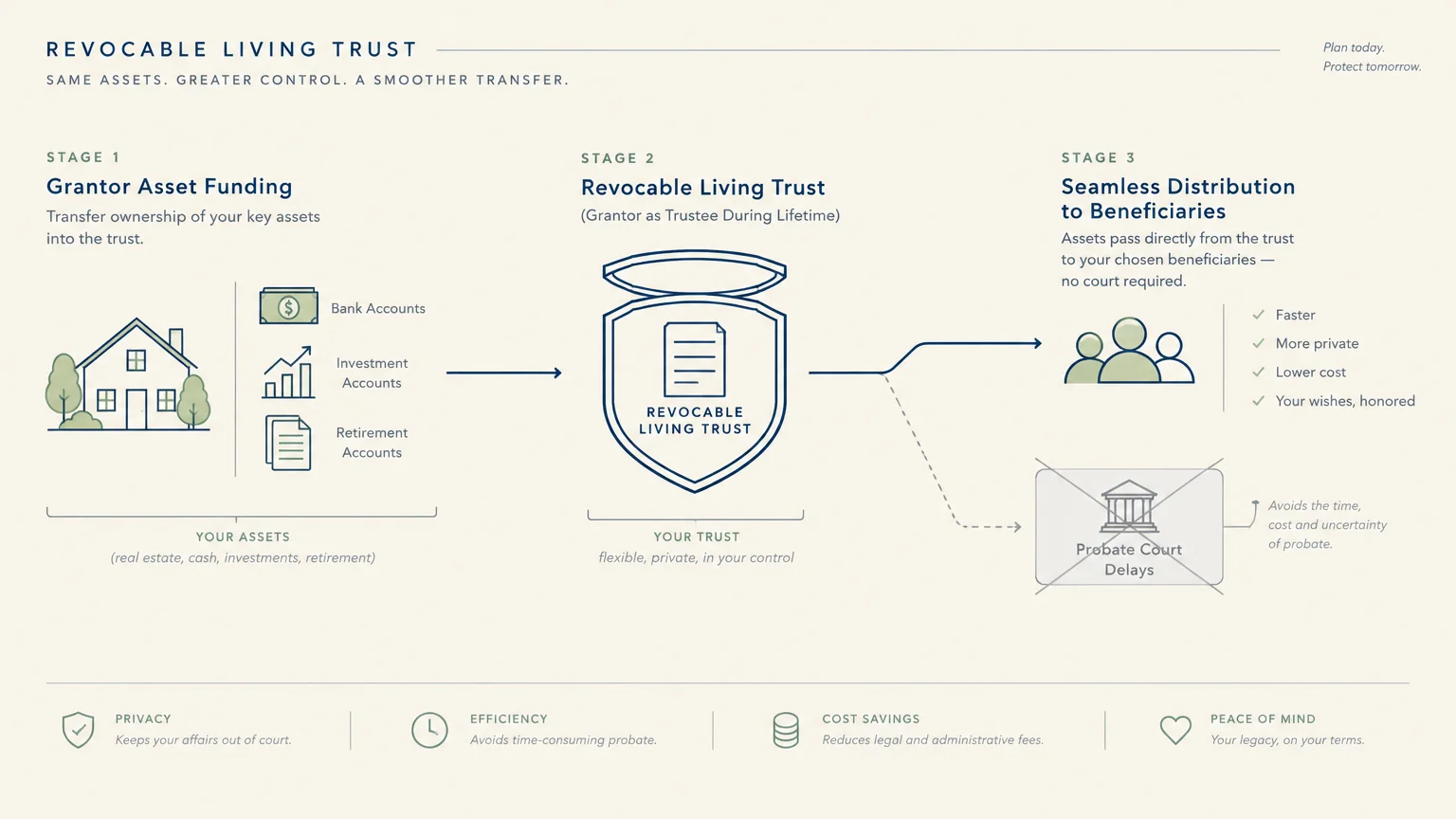
4. Revocable Living Trust
A revocable living trust lets you retain full control over assets during life while transferring them seamlessly outside probate after death. The successor trustee distributes trust property according to your private terms.
Public probate proceedings expose estate inventories to court records and public view. Trusts preserve family privacy, prevent court fees, and shield assets from protracted administrative delays.
Demand for trust planning has expanded rapidly. LegalShield reports that consumer inquiries about trusts jumped 7x over the past decade, now representing 20% of all estate inquiries.
A comprehensive estate package centered around a living trust typically costs between $2,000 and $5,000 or more. The total price reflects geographic location, family complexity, and asset volume.
A trust only controls assets officially transferred into its name. Failing to re-title real estate, brokerage accounts, and valuable personal property into the trust undermines its primary purpose.
If you created a trust prior to July 2025 to shield against a lower federal exemption, contact your attorney. The permanent $15 million baseline may allow you to streamline outdated trust provisions.

5. Non-Probate Beneficiary Designations
Beneficiary forms attached to retirement accounts, annuities, and life insurance policies dictate who receives your wealth. They control accounts like 401(k) plans, traditional IRAs, and Roth IRAs.
These contractual forms carry absolute legal authority. Under established federal precedent, beneficiary designations override contrary instructions written inside your last will and testament.
If your will names your current spouse but your IRA lists an ex-spouse, the financial institution must award the funds to your ex-spouse. The Supreme Court affirmed this outcome in Kennedy v. Plan Administrator for DuPont.
Updating your primary and contingent beneficiary designations costs exactly $0. You can review and update these designations online within minutes through your plan custodian’s portal.
Review every banking account for Transfer-on-Death (TOD) or Payable-on-Death (POD) options. Adding TOD or POD registrations converts standard savings and checking accounts into immediate non-probate transfer instruments.
Remember that the annual gift tax exclusion stands at $19,000 per recipient, or $38,000 for couples splitting gifts. Coordinate lifetime gifts alongside account transfers to distribute liquid assets efficiently.

6. Standalone HIPAA Privacy Authorizations
The Health Insurance Portability and Accountability Act (HIPAA) strictly protects your confidential health information from unauthorized disclosure. Doctors face stiff civil and criminal fines for sharing records improperly.
A standard healthcare proxy frequently delays medical updates until a physician certifies legal incapacity. This delay leaves loved ones uninformed during sudden accidents or temporary hospitalizations.
A standalone HIPAA authorization permits healthcare systems to discuss your condition, medications, and prognoses with designated agents immediately. It operates without requiring formal determinations of mental incapacity.
Name multiple trusted individuals on this release form. Listing your adult children, siblings, or close friends ensures at least one advocate can communicate with attending nurses.
Update this document whenever you change doctors, move to a new area, or establish care with regional hospital networks. Always verify that your hospital system keeps your signed form on file.

7. Digital Asset Inventory and Authorizations
Modern retirements involve complex electronic footprints across financial platforms, communication portals, and personal cloud archives. Ignoring digital assets leaves essential accounts frozen upon incapacity or death.
Your estate portfolio should address online banking logins, investment dashboards, tax records, photo libraries, and cryptocurrency keys. Without legal permission, federal computer fraud statutes restrict family access.
Forty-six states have enacted versions of the Revised Uniform Fiduciary Access to Digital Assets Act. This legislation allows designated agents to manage digital property only if you explicitly grant permission.
Incorporate digital asset language directly into your will, trust, and financial power of attorney documents. Expressly authorize your fiduciary to access hardware, bypass authentication barriers, and close online accounts.
Compile a secure digital inventory containing account names, usernames, and two-factor authentication instructions. Store master credentials inside an encrypted password manager, never in an unencrypted notebook or public will.

8. Transfer-on-Death Real Estate Deeds
For many retirees, primary residences represent their most valuable physical asset. Passing a home through normal probate can tie up property titles for months.
More than thirty states now authorize Transfer-on-Death (TOD) deeds or beneficiary deeds. These instruments permit homeowners to name a successor who inherits real estate automatically upon the owner’s death.
TOD deeds preserve complete ownership rights while you are alive. You retain the right to sell, refinance, or revoke the deed without asking the named beneficiary for approval.
In certain states, property owners use enhanced life estate deeds, colloquially known as Lady Bird deeds. These deeds offer probate avoidance while protecting Medicaid eligibility options.
Consult local county recording guidelines before executing real estate transfer paperwork. TOD deeds must satisfy precise statutory language and require recording with the county recorder prior to your death.

9. Letter of Intent and Personal Property Memorandum
A letter of intent acts as an informal, non-binding roadmap for your personal representative and family. It translates legal boilerplate into actionable everyday guidance.
Use this letter to detail burial preferences, memorial wishes, and pet care instructions. It provides immediate direction long before an attorney locates or files your formal will.
Many states allow you to attach a separate personal property memorandum to your will. This legal addendum lets you distribute specific physical heirlooms without hiring a lawyer to draft codicils.
List personal possessions alongside designated recipients, noting items like family jewelry, furniture, coin collections, or firearms. Sign and date every revision you make to keep the instructions legally valid.
Keep your letter of intent alongside your primary legal documents. Tell your executor where to find this guidance to prevent unnecessary disputes among surviving relatives.
“An ounce of prevention is worth a pound of cure.” — Benjamin Franklin, Statesman & Author
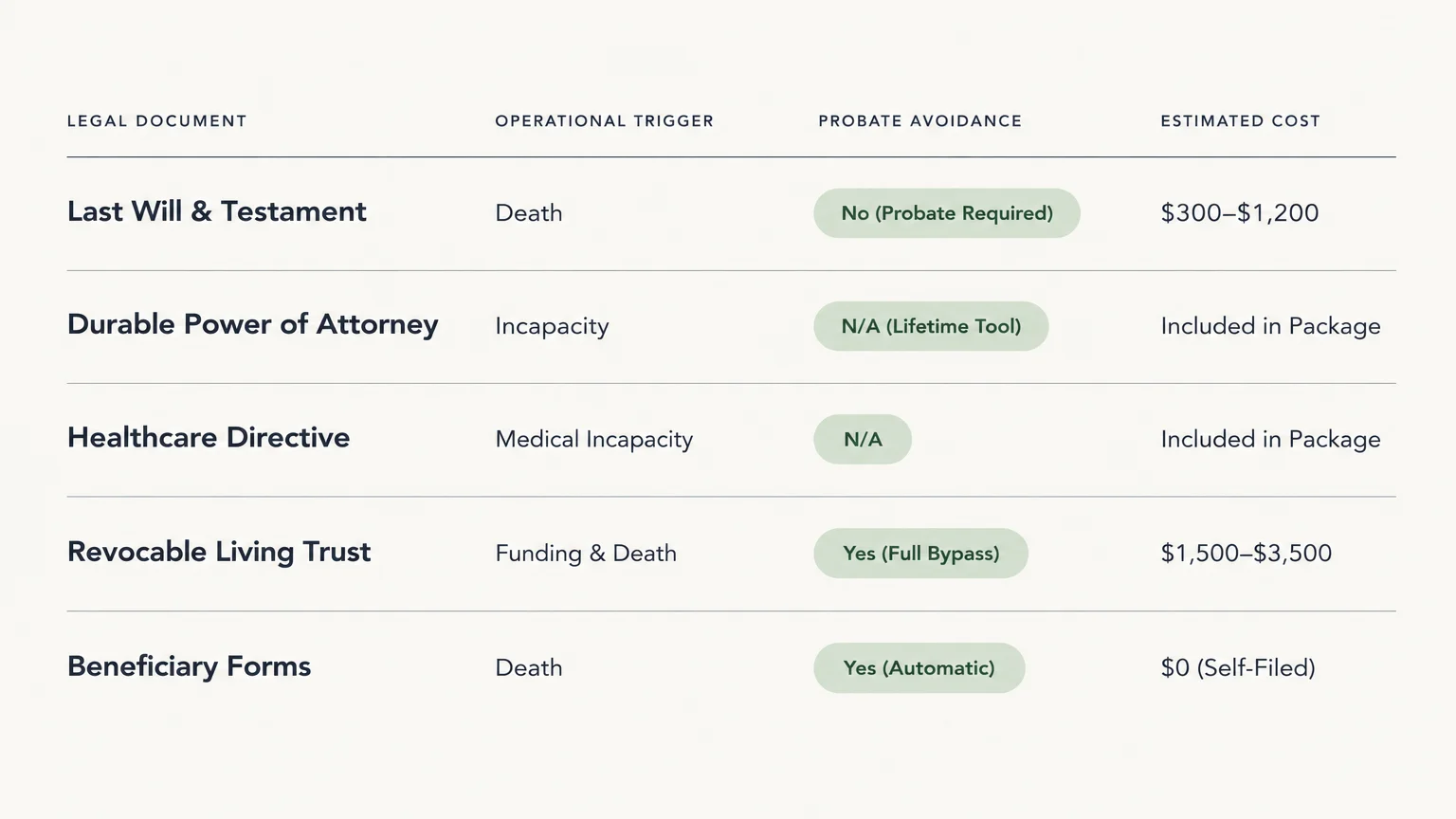
Document Comparison: Purpose, Triggers, and Costs
Evaluating your planning options requires understanding how each paper protects your assets. The following comparison highlights key functions, review schedules, and associated preparation costs.
| Legal Paper | Primary Function | Review Frequency / Triggers | Average Preparation Cost |
|---|---|---|---|
| Last Will & Testament | Directs non-beneficiary assets; names executor and guardians | Every 3–5 years; marriage, divorce, or birth of heirs | $300 to $1,200 (flat fee / package) |
| Financial Power of Attorney | Designates agent to manage bills, taxes, and bank accounts | Every 3 years; changes in agent availability | Included in basic estate packages |
| Advance Healthcare Directive | Directs life support wishes; names healthcare proxy | Every 2–3 years; major medical diagnosis | $0 via Medicare Wellness Visit or state form |
| Revocable Living Trust | Avoids probate; manages private asset distribution | Every 3–5 years; major asset changes or tax shifts | $2,000 to $5,000+ |
| Beneficiary Designations | Transfers retirement and life insurance outside probate | Annual review; divorce, marriage, or death of beneficiary | $0 (managed online via custodians) |
| HIPAA Authorization | Grants immediate medical information access to loved ones | Every 2–3 years; changing hospital systems | $0 (standard medical forms) to $100 |
| Digital Asset Directive | Authorizes access to online accounts and digital devices | Annual review; adoption of new hardware or accounts | Included in modern estate plans |
| Transfer-on-Death Deed | Passes real estate directly to heirs without probate | Whenever selling, refinancing, or buying property | $50 to $300 (plus county recording fees) |
| Letter of Intent | Provides practical family instructions and heirloom wishes | Annual review; acquisition or sale of family heirlooms | $0 (self-prepared personal document) |

Professional vs. Self-Guided Estate Planning
Technological tools empower retirees to complete basic forms online at low cost. However, complex personal situations demand tailored legal representation from an estate planning attorney.
Consider the following scenarios to evaluate whether you need professional legal counsel or self-directed forms:
- Blended Families: If you have children from previous relationships, rely on an experienced attorney. DIY documents frequently disinherit biological children unintentionally through standard survivorship clauses.
- Special Needs Beneficiaries: Passing money directly to disabled heirs can disqualify them from government programs. A professional can establish a third-party Special Needs Trust to preserve essential benefits.
- Substantial Real Estate Portfolios: Owning real estate across multiple states triggers multiple probate proceedings. An attorney centralizes cross-border properties under a single revocable trust framework.
- Straightforward, Modest Estates: Single accounts with direct beneficiaries and clear heirlooms work well with reputable online templates. Retirees can use standard statutory power of attorney and healthcare forms with minimal risk.
Explore retirement transition guides via AARP for educational planning resources. Their tools help retirees assess estate complexities before scheduling formal legal consultations.
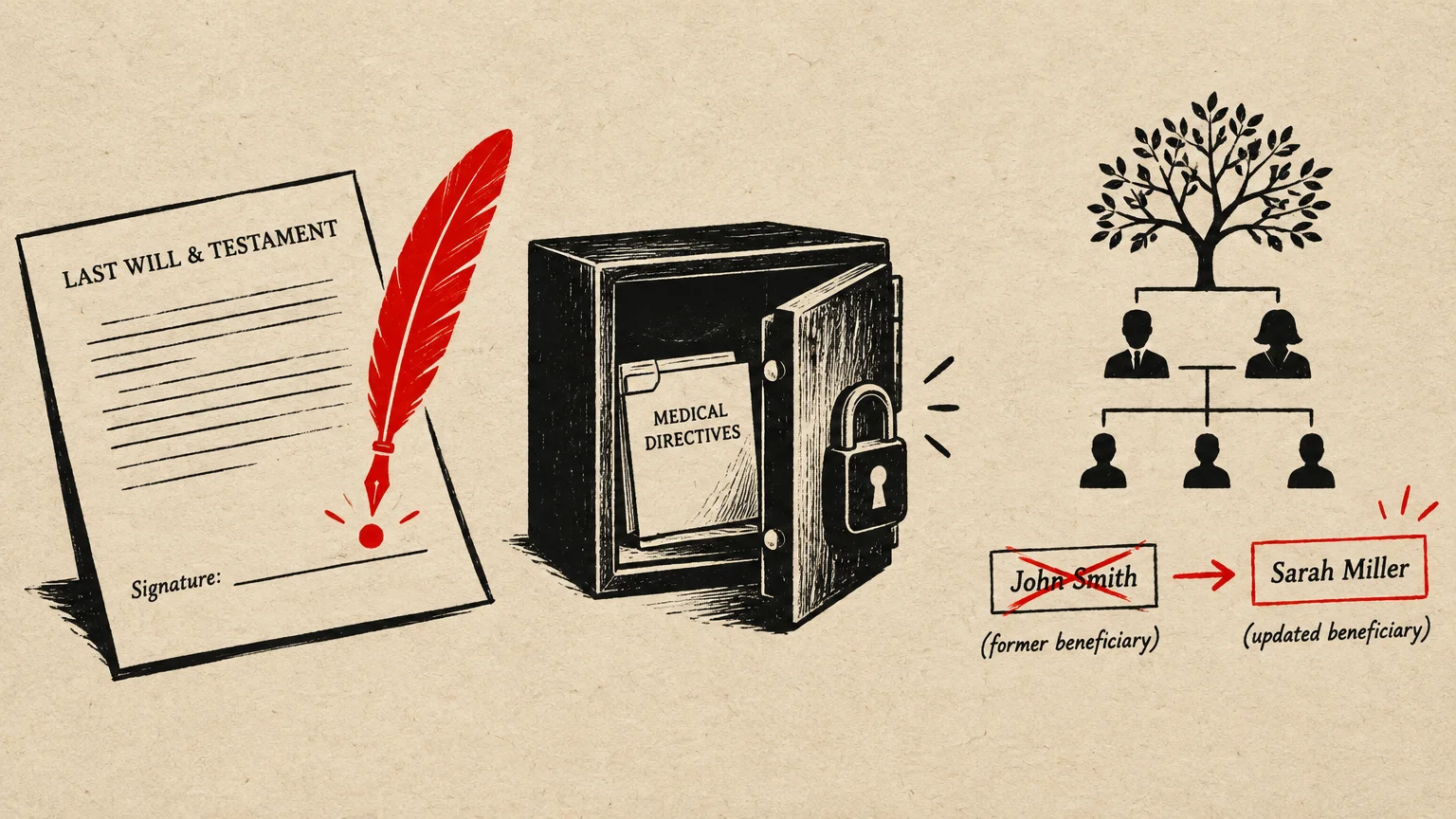
Common Mistakes to Avoid When Updating Legal Documents
Estate planning mistakes create avoidable tax bills, court disputes, and administrative delays. Avoiding predictable oversights keeps your wealth secure and accessible.
Ensure your updated documents avoid these four common pitfalls:
- Failing to Fund Your Living Trust: Creating a trust agreement without changing deed titles or account ownership leaves the trust empty. Unfunded assets must pass through formal probate court proceedings regardless of trust provisions.
- Relying on Outdated Beneficiary Forms: Neglecting to update retirement custodians after life milestones invalidates your testamentary goals. Remember that institution records supersede handwritten instructions in your will.
- Naming Co-Executors Who Conflict: Appointing two children to manage accounts jointly invites administrative paralysis. If they disagree on real estate sales or valuations, the estate grinds to a complete halt.
- Hiding Crucial Documents: Storing original paperwork inside an inaccessible private safe deposit box stalls emergency medical or financial actions. Keep originals in an accessible fireproof home safe and share copies with key fiduciaries.
Frequently Asked Questions
How often should I update my estate documents?
Review your documents every three to five years, or immediately following significant life changes. Events like marriage, divorce, births, major asset acquisitions, or relocations require immediate updates.
Does a will avoid probate court?
No, a will does not avoid probate. A will serves as instructions for the probate court to oversee asset distribution, settle debts, and validate your final intentions.
Can my power of attorney change my will?
No, an agent operating under a power of attorney cannot modify, draft, or revoke your will. Testamentary decisions remain exclusively yours and cannot be delegated to an agent.
What happens if I move to a different state?
Most states recognize wills drafted out of state if they complied with the original jurisdiction’s laws. However, local real estate rules, probate procedures, and statutory power of attorney forms differ considerably.
Next Steps for Securing Your Legacy
Take charge of your estate plan by pulling out your existing files this week. Verify your account beneficiaries online, confirm trusted proxies, and note changes in your financial life.
Scheduling a formal review guarantees your assets flow directly to chosen beneficiaries without court intervention. Protecting your estate now grants lasting peace of mind to you and those you love.
This article provides general retirement education and information only. Every retiree’s situation is unique—what works for others may not work for you. For personalized advice, consider consulting a qualified financial professional such as a CFP or CPA.
Last updated: October 2026. Retirement benefits, tax rules, and healthcare regulations change frequently—verify current details with official sources.









Leave a Reply