
Most retirement accounts force you to strike a painful bargain with the IRS. Traditional retirement vehicles defer taxes until withdrawal, while Roth accounts demand their cut upfront before your money grows.
A Health Savings Account bypasses this compromise entirely. The tax code grants this specific structure three separate layers of shelter, creating an unmatched shelter for long-term savers.
Learning how to leverage this tax free account can shield tens of thousands of dollars from taxation. You can systematically preserve your wealth while funding your future healthcare needs.
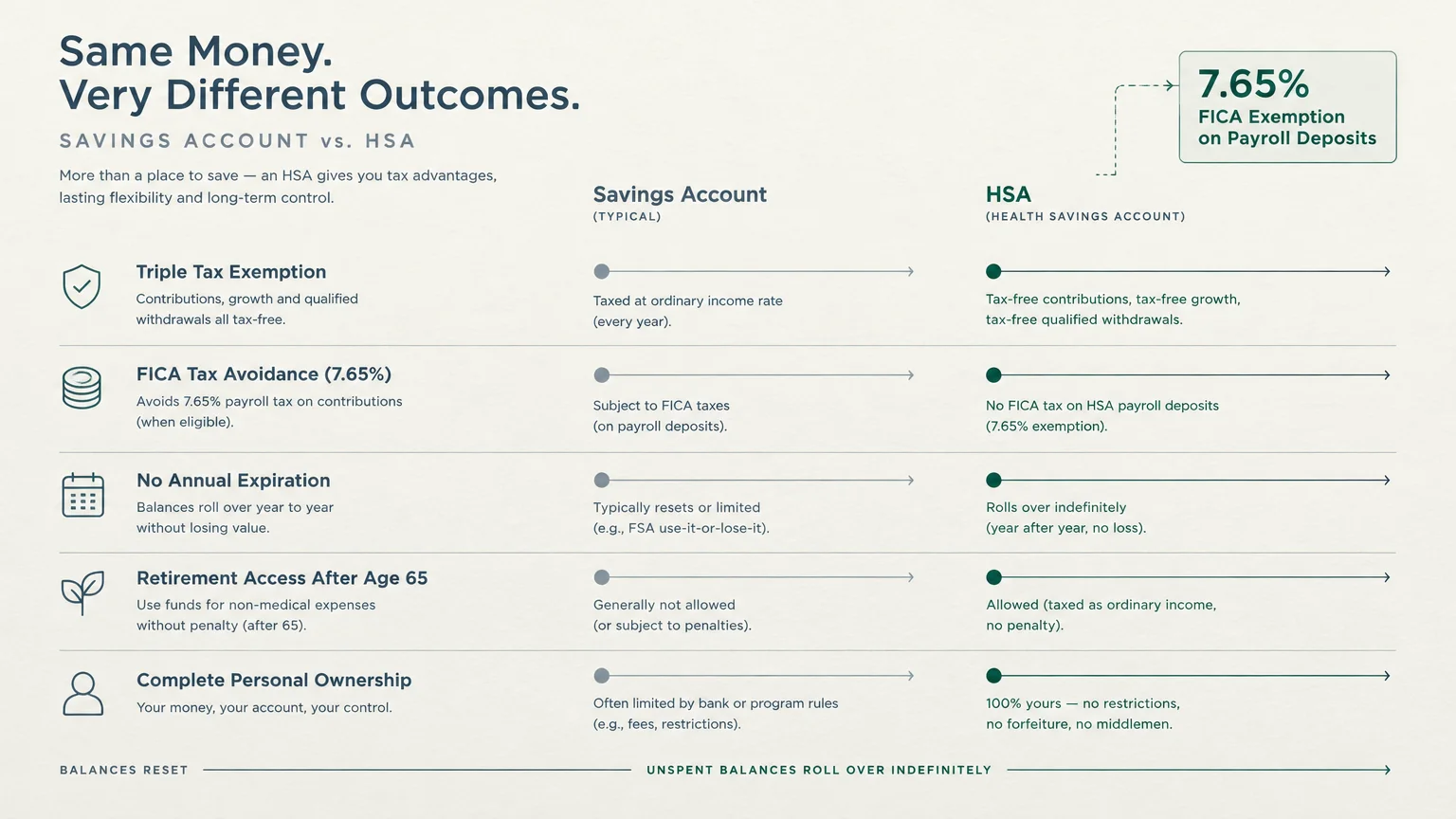
The Essentials: Why the HSA Stands Apart
Financial planners routinely call the Health Savings Account the most tax-efficient investment vehicle in the United States. Its legal framework permits benefits that no traditional retirement plan can replicate.
Most workers assume an HSA functions merely as a temporary holding account for medical bills. In reality, it acts as an aggressive wealth accumulator when paired with a disciplined retirement strategy.
- Triple Tax Exemption: You avoid taxes on contributions, investment gains, and qualified medical withdrawals.
- FICA Tax Avoidance: Contributions made through workplace payroll bypass the 7.65% Social Security and Medicare tax entirely.
- No Annual Expiration: Unlike Flexible Spending Accounts, all unspent HSA funds roll over from year to year indefinitely.
- Flexible Retirement Access: After age 65, you can withdraw funds for any purpose without penalty, paying ordinary income tax on non-medical distributions.
- Complete Control: You own the account permanently, keeping your accumulated balance even if you change employers or retire.
Understanding these primary features allows you to shift your perspective. You stop viewing the account as a checking vehicle and start treating it as an auxiliary retirement portfolio.
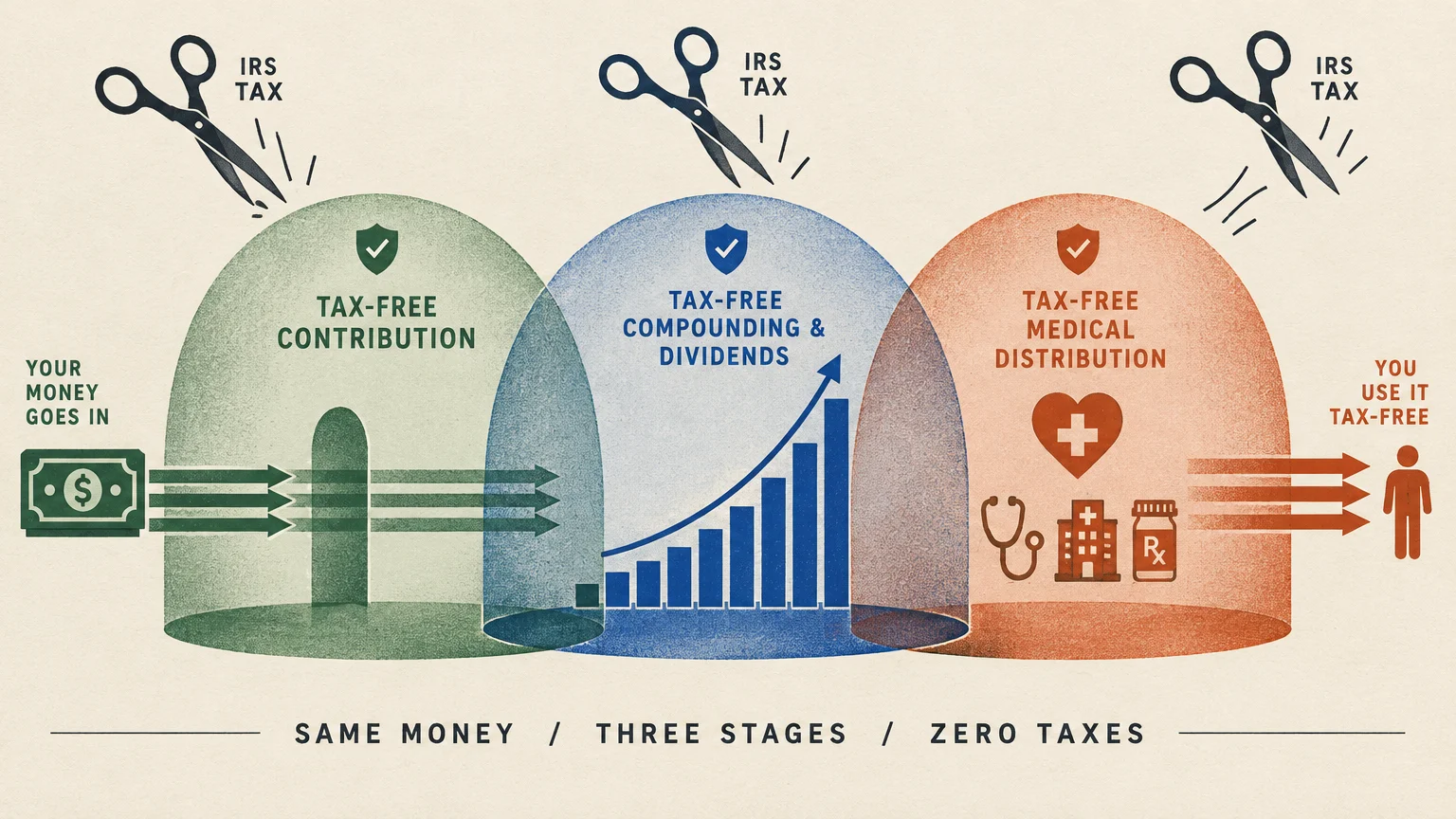
How the HSA Triple Tax Advantage Works
The core power of this account lies in the compounding effect of three distinct statutory tax breaks. When combined, these exemptions allow money to enter, multiply, and exit without surrendering a single dollar to the federal government.
The IRS rarely allows total exemption from taxation. Understanding how each tier functions helps you maximize the unique HSA triple tax advantage across your career and retirement.
The first tier protects your earnings when you make contributions. If you contribute funds through an employer payroll plan, your employer deposits the money before calculating federal income taxes.
This payroll setup also exempts your contributions from the 7.65% FICA payroll tax, which covers Social Security and Medicare. Very few financial mechanisms allow individuals to bypass FICA taxes legally.
If you fund your account directly from your personal checking account, you claim the deduction on your federal tax return. You can review the specific deduction guidelines on the Internal Revenue Service (IRS) website.
This above-the-line deduction lowers your adjusted gross income directly. You receive this tax reduction even if you elect to take the standard deduction rather than itemizing.
The second tier shields your account growth from all federal taxation. Once you build a balance, you can allocate those funds into stocks, mutual funds, and exchange-traded funds.
In a standard brokerage account, dividends and capital gains trigger immediate annual tax bills. Inside an HSA, your investments compound uninterrupted by capital gains taxes or dividend levies.
This tax-sheltered compounding accelerates balance growth over decades. Every dividend payment reinvests fully, generating additional earnings without generating tax paperwork for your annual return.
The third tier covers your withdrawals. When you withdraw funds to pay for qualified medical expenses, the distribution remains entirely tax-free at any age.
Qualified expenses cover an expansive range of health-related outlays. You can use these funds for doctor visits, hospital procedures, dental care, vision exams, prescription medications, and hearing devices.
Because healthcare represents one of the largest expenses in retirement, tax-free distributions provide immense cash-flow relief. You pay your bills using dollars that never underwent federal taxation at any point.
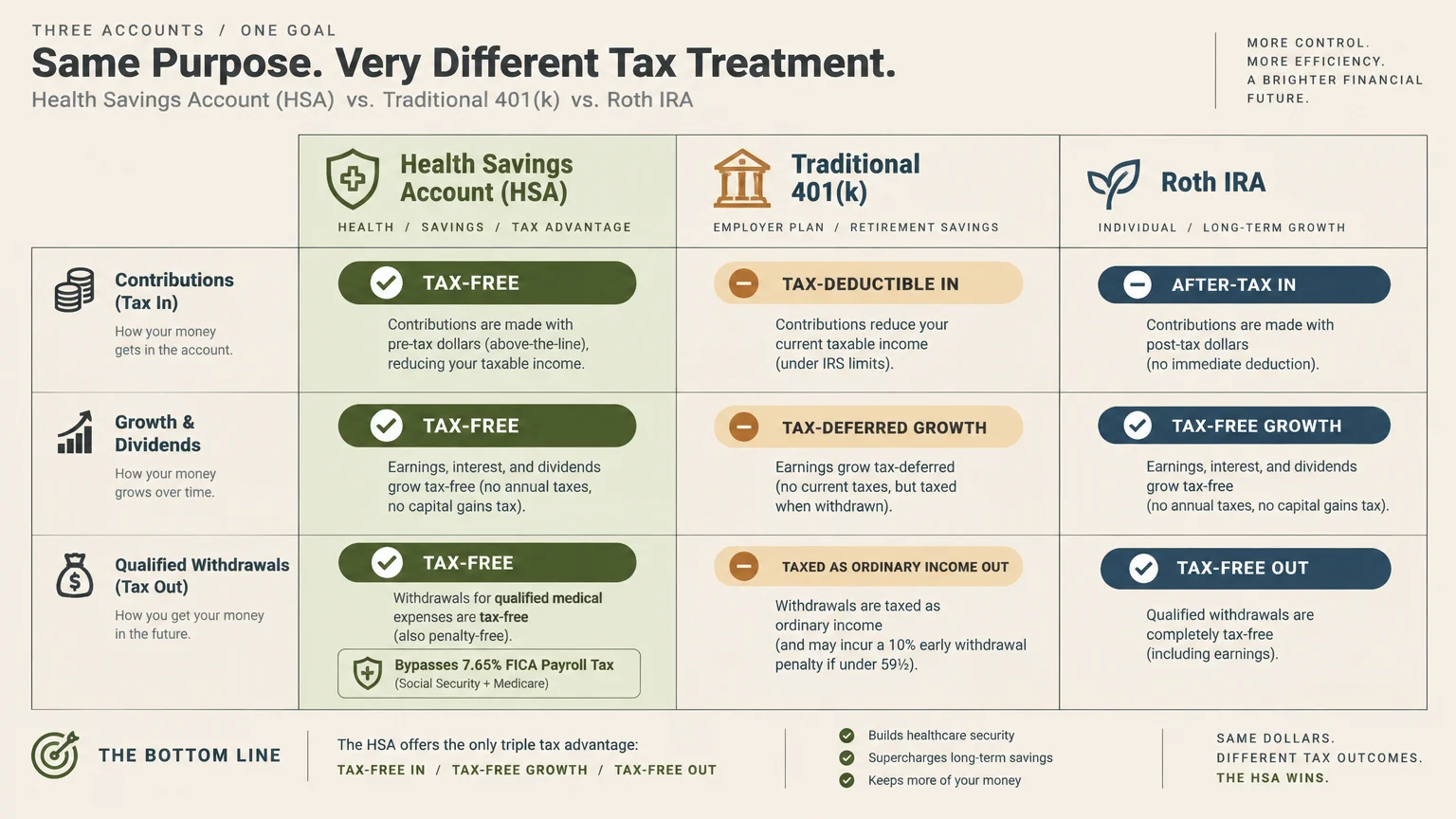
HSA vs. Traditional 401(k) vs. Roth IRA
Comparing account structures reveals why the HSA stands alone at the top of the tax hierarchy. Every other popular account forces you to pay taxes either on the way in or on the way out.
Traditional retirement plans grant upfront relief but create future tax obligations. Roth accounts provide future tax relief but require after-tax dollars today.
| Feature | Health Savings Account | Traditional 401(k) | Roth IRA |
|---|---|---|---|
| Upfront Income Tax Deduction | Yes (Above-the-line) | Yes (Pre-tax) | No (Funded with post-tax dollars) |
| FICA Tax Exemption (7.65%) | Yes (Through payroll deductions) | No | No |
| Tax-Free Investment Growth | Yes | No (Tax-deferred only) | Yes |
| Tax-Free Medical Distributions | Yes (At any age) | No (Taxed as ordinary income) | Only qualified basis/earnings rules apply |
| Non-Medical Distributions | Taxed as income after 65 (No penalty) | Taxed as income after 59½ (No penalty) | Tax-free earnings after 59½ and 5 years |
| Required Minimum Distributions | None during lifetime | Yes (Beginning age 73–75) | None during lifetime |
The comparative data highlights an unavoidable conclusion. An HSA captures the upfront tax advantages of a traditional 401(k) while preserving the back-end tax freedom of a Roth IRA.
Furthermore, payroll-based HSA funding outperforms both alternatives by dodging FICA taxes entirely. This distinct structural perk gives you an automatic 7.65% advantage on contributed capital.
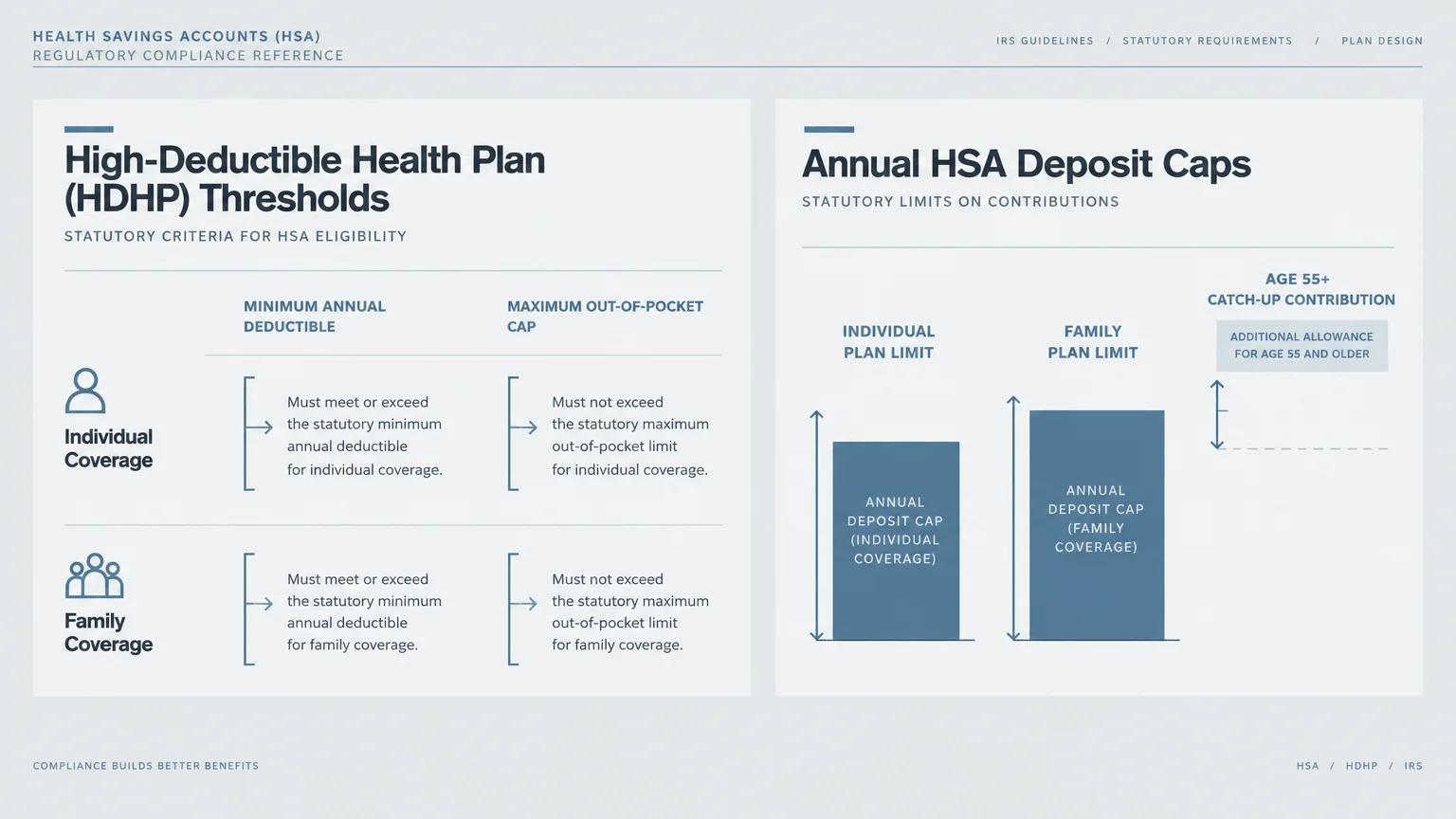
Contribution Limits and HDHP Rules for 2026 and 2027
To access these health savings account taxes benefits, you must enroll in an HSA-qualified High-Deductible Health Plan (HDHP). The IRS indexes both contribution caps and health plan thresholds annually for inflation.
For the 2026 tax year, the annual HSA contribution limit sits at $4,400 for self-only coverage. If you hold family coverage, your maximum annual contribution climbs to $8,750.
For the 2027 tax year, the limits expand further. The IRS sets the 2027 contribution cap at $4,500 for self-only coverage and $9,000 for family plans.
Individuals aged 55 and older who are not enrolled in Medicare can contribute an additional $1,000 annually. This catch-up contribution remains fixed by federal statute at $1,000 for both 2026 and 2027.
Married couples where both spouses are 55 or older must navigate a specific procedural rule. Both partners cannot deposit their $1,000 catch-up funds into a single shared account.
Each spouse must establish their own separate HSA to claim their respective catch-up allotment. Failing to create two accounts could result in taxable excess contributions.
Your health insurance plan must meet specific federal deductible criteria to qualify as an HDHP. For 2026, the plan requires a minimum deductible of $1,700 for individuals and $3,400 for families.
The 2026 maximum annual out-of-pocket spending limit is $8,500 for individual coverage and $17,000 for family plans. For comprehensive educational breakdowns on health plan mechanics, visit Investopedia.
For the 2027 plan year, the minimum annual deductible rises to $1,750 for self-only plans and $3,500 for family policies. The maximum out-of-pocket cap reaches $8,700 for individuals and $17,400 for families.
You can make prior-year HSA contributions until the annual federal tax filing deadline. For the 2026 tax year, you have until April 15, 2027, to complete your contributions.

Recent Policy Changes Expanding HSA Access
Federal lawmakers recently enacted meaningful structural updates that expand access to health savings accounts. These updates modernize eligibility standards and introduce new flexibilities for consumers.
Beginning January 1, 2026, federal legislation treats all bronze and catastrophic health insurance plans as HSA-compatible options. This applies whether you purchase coverage on or off the Affordable Care Act health insurance exchanges.
Previously, many low-cost bronze plans failed specific statutory design tests, disqualifying enrollees from establishing an HSA. This change allows millions of individuals to secure lower-premium catastrophic plans while accumulating tax-advantaged savings.
A second major reform affects Direct Primary Care (DPC) arrangements. Starting January 1, 2026, participating in a primary care membership does not disqualify you from opening or funding an account.
To maintain eligibility, monthly DPC membership fees must not exceed $150 for an individual or $300 for a family. You can now use your accumulated HSA assets tax-free to pay these direct membership fees.
Federal policy also resolved uncertainty surrounding remote clinical care. The safe harbor allowing high-deductible health plans to cover pre-deductible telehealth services became permanent for plan years starting on or after January 1, 2025.
This rule permits health plans to provide virtual doctor visits immediately with zero copayment. Patients can receive vital remote consultations without losing their ability to fund an HSA.

The Strategic Retirement Playbook: The Shoebox Method
Most individuals pay their current medical bills using their HSA debit card immediately. While convenient, this habit sacrifices the account’s greatest asset: long-term compound growth.
A sophisticated HSA retirement strategy relies on an alternative approach called the shoebox method. Under this method, you pay your immediate healthcare expenses using everyday cash flow or standard credit cards.
You leave your HSA funds untouched inside your account, directing the entire balance into low-cost diversified index funds. This capital compounds completely tax-free over 10, 20, or 30 years.
Crucially, the tax code places no time limit on when you must reimburse yourself for qualified expenses. An expense incurred today can be reimbursed twenty years from now, provided you established your HSA before incurring the bill.
You simply store your invoices, receipts, and Explanation of Benefits statements in a safe digital archive. When you enter retirement, you can withdraw those accumulated sums tax-free whenever you need liquidity.
“An HSA is the only account out there that gives you a triple tax break. It’s the ultimate retirement tool.” — Suze Orman, Personal Finance Author
Imagine accumulating $40,000 in tracked out-of-pocket medical expenses throughout your peak working years. That initial $40,000 left invested inside the account could grow into hundreds of thousands of dollars.
During retirement, you can pull that $40,000 out in a single tax-free distribution to purchase a vehicle or remodel your home. You satisfy IRS verification rules simply by showing your preserved medical receipts.
This strategy effectively transforms your past healthcare bills into a tax-free emergency fund for your golden years. You maintain complete control over the timing of your reimbursements.

Using Your Account After Age 65 and Navigating Medicare
Once you reach age 65, the operational rules governing your account change significantly in your favor. The account gains additional flexibility, making it even more resilient.
Prior to age 65, taking money out for non-medical reasons triggers ordinary income taxes plus a brutal 20% IRS penalty. At age 65, the IRS waives that 20% penalty permanently.
You can withdraw funds for any purpose—such as travel, housing, or general living expenses—without incurring penalties. Non-medical withdrawals are taxed strictly as ordinary income, mirroring a Traditional IRA.
If you use those same distributions for qualified medical care, they remain completely tax-free. Your account acts like a superior IRA with an exclusive zero-tax feature for healthcare.
Furthermore, HSAs require no minimum distributions during your lifetime. Traditional 401(k)s and IRAs force you to take taxable distributions in your 70s, but your HSA balance can compound indefinitely.
You can also deploy your accumulated HSA reserves to cover specific Medicare costs during retirement. You can research program details directly at Medicare.gov.
HSA distributions can pay premiums for Medicare Part B (medical insurance), Part D (prescription drugs), and Part C (Medicare Advantage). You can also use funds for copayments, coinsurance, and annual deductibles.
However, you cannot use tax-free HSA funds to pay premiums for Medigap policies. Medigap, also known as Medicare Supplement Insurance, remains an ineligible expense under federal tax regulations.
What Can Go Wrong: Costly HSA Traps to Avoid
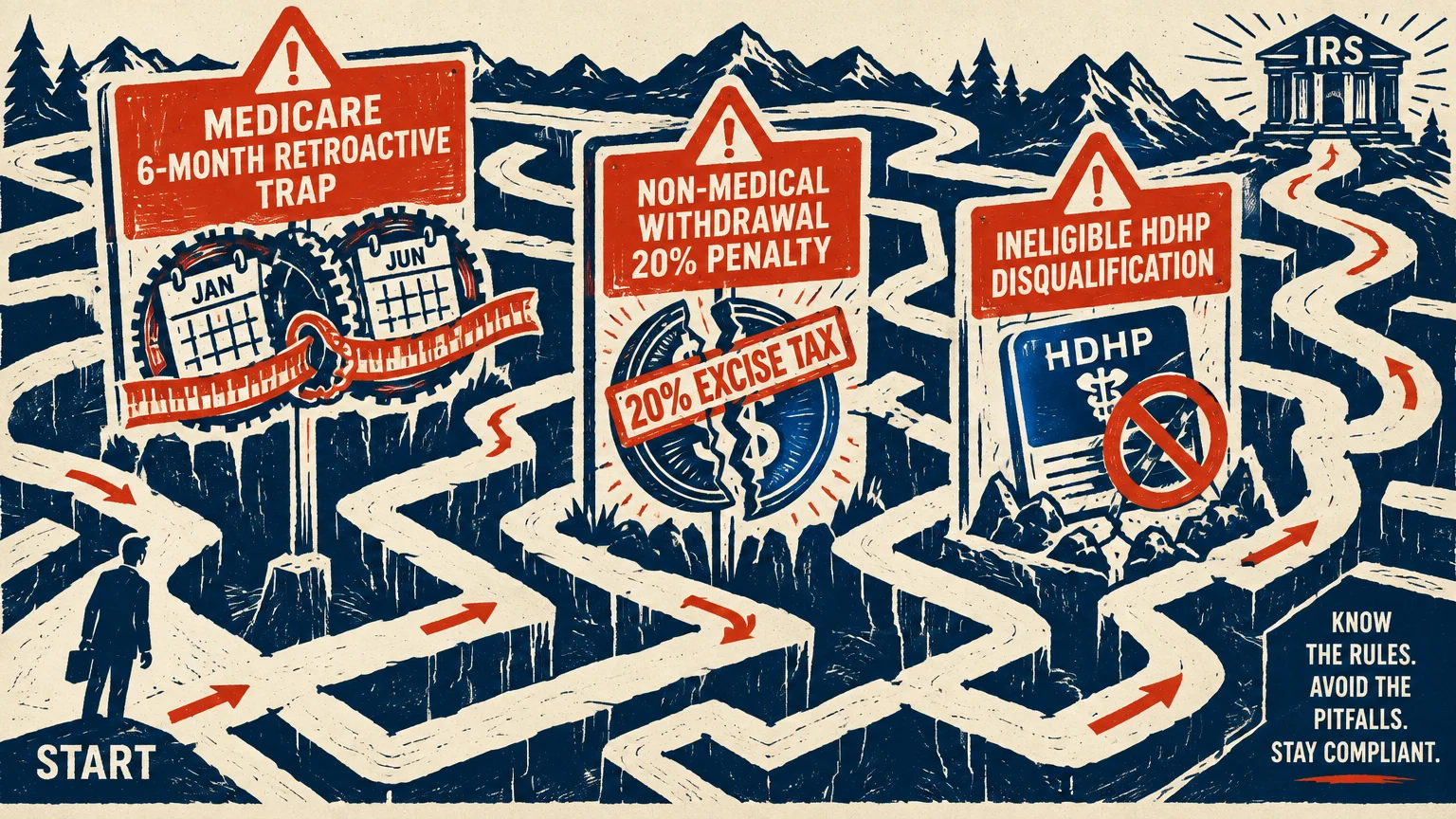
While an HSA provides unmatched tax efficiency, overlooking critical rules can lead to harsh penalties. Navigating these requirements demands strict attention to administrative deadlines and state laws.
The most dangerous hurdle for older workers involves enrolling in Medicare while actively contributing. Once you enroll in any part of Medicare, your HSA contribution eligibility ends immediately.
A severe trap catches workers who delay Medicare enrollment past age 65 while remaining employed. When you eventually apply for Medicare Part A or Social Security benefits, your Part A coverage backdates retroactively by six months.
Any HSA deposits made during that six-month lookback window count as improper excess contributions. The IRS imposes an annual 6% excise penalty on those excess funds until you remove them.
Workers planning to retire after age 65 should consult the Social Security Administration (SSA) well in advance. You must stop all payroll and direct HSA contributions six months prior to filing for Medicare or Social Security.
State tax laws create a second substantial trap. While the federal government grants triple tax advantages, California and New Jersey do not conform to federal HSA regulations.
Residents of California and New Jersey must pay state income tax on all HSA contributions. Furthermore, any interest, dividends, and realized capital gains generated inside the account face annual state taxation.
Another major mistake involves naming a non-spouse beneficiary on your account. When a spouse inherits an HSA, the account transfers seamlessly and maintains its tax-sheltered status.
If you designate an adult child or non-spouse heir, the account ceases to be an HSA upon your death. The entire fair market value becomes taxable income to your beneficiary in that calendar year.

When to Consult a Professional
Navigating health savings account rules becomes increasingly complex as you approach retirement. Enlisting professional assistance helps prevent costly tax liabilities and structural errors.
Consider consulting a qualified financial advisor or tax professional when facing these specific scenarios:
- Coordinating Medicare Enrollment: If you work past 65 and maintain high-deductible health coverage, an advisor can calculate your exact contribution cutoff dates to avoid retroactive excise taxes.
- Managing State Non-Conformity: If you reside in California or New Jersey, a certified public accountant can help track your cost basis and calculate annual state investment tax adjustments.
- Structuring Estate Planning Beneficiaries: A financial planner can help you align your beneficiary designations to prevent sudden, taxable distribution spikes for adult heirs.
- Optimizing Workplace Benefit Allocations: A financial professional can analyze whether your household benefits more from maximizing an HSA before funding optional employer retirement accounts.
A customized assessment ensures you capitalize on legal tax shelters without tripping over intricate federal restrictions. Expert guidance can protect your portfolio from unforced administrative errors.
Frequently Asked Questions About Health Savings Account Taxes
Can I contribute to an HSA if my spouse has non-HDHP coverage?
Yes, you can contribute to your own account provided you meet individual eligibility standards. Your spouse’s separate insurance policy will not disqualify you as long as you are not covered under their non-HDHP plan.
However, you cannot use your HSA funds to pay your spouse’s medical expenses if their personal health policy covers those costs. You can only reimburse legitimate out-of-pocket medical bills that their insurance does not cover.
What happens to my account balance if I leave my current employer?
You retain full ownership of your HSA balance regardless of changes in your employment status. The funds do not revert to your former employer, and you face no deadline to spend the money.
You can roll over your accumulated assets into an independent HSA custodian that offers lower administrative fees and superior investment options. You can continue spending the funds on qualified care even if you never enroll in an HDHP again.
Are long-term care insurance premiums eligible for HSA reimbursement?
Yes, the IRS permits you to pay qualified long-term care insurance premiums using tax-free distributions. However, the annual deduction amounts are capped according to your age at the end of the tax year.
The IRS indexes these allowable age-based premium thresholds annually for inflation. Check IRS publication guidelines to confirm the maximum qualified premium deduction allowed for your specific age bracket.
Can I use my HSA to pay for healthcare expenses incurred years ago?
Yes, you can reimburse past medical expenses at any point in the future. The only statutory restriction is that the healthcare expense must occur after you formally established your HSA.
You must maintain valid receipts and medical invoices proving that the services were medically necessary and never reimbursed through other insurance. There is no legal expiration date on your right to reimbursement.
Building Your Healthcare Safety Net
The Health Savings Account provides an exceptional tool to insulate your personal wealth from rising medical costs. Its unique triple tax advantage offers unmatched financial leverage during both your accumulation and retirement phases.
Examine your current health plan options during your next open enrollment window. Shifting toward an HSA-eligible plan can streamline your tax profile and launch an enduring healthcare reserve for your future.
The information in this guide is meant for educational purposes. Your specific circumstances—including income, health needs, tax situation, and goals—may require different approaches. When in doubt, consult a licensed professional.
Last updated: October 2026. Retirement benefits, tax rules, and healthcare regulations change frequently—verify current details with official sources.









Leave a Reply