
Most retirees assume their monthly Social Security check is completely off-limits to collectors, yet federal law allows specific reductions for government and court-ordered debts. If you owe certain agencies or support obligations, a portion of your deposit can disappear automatically.
Knowing which debts that reduce Social Security are legally enforceable helps you avoid sudden cash-flow shocks in retirement. Equally important, understanding where creditor power stops lets you challenge improper collection threats right away.
Below, you will learn how four specific obligations trigger social security garnishment, what dollar limits apply in late 2026, and which steps protect your monthly check.
How Social Security Protections Work—and Where They Stop
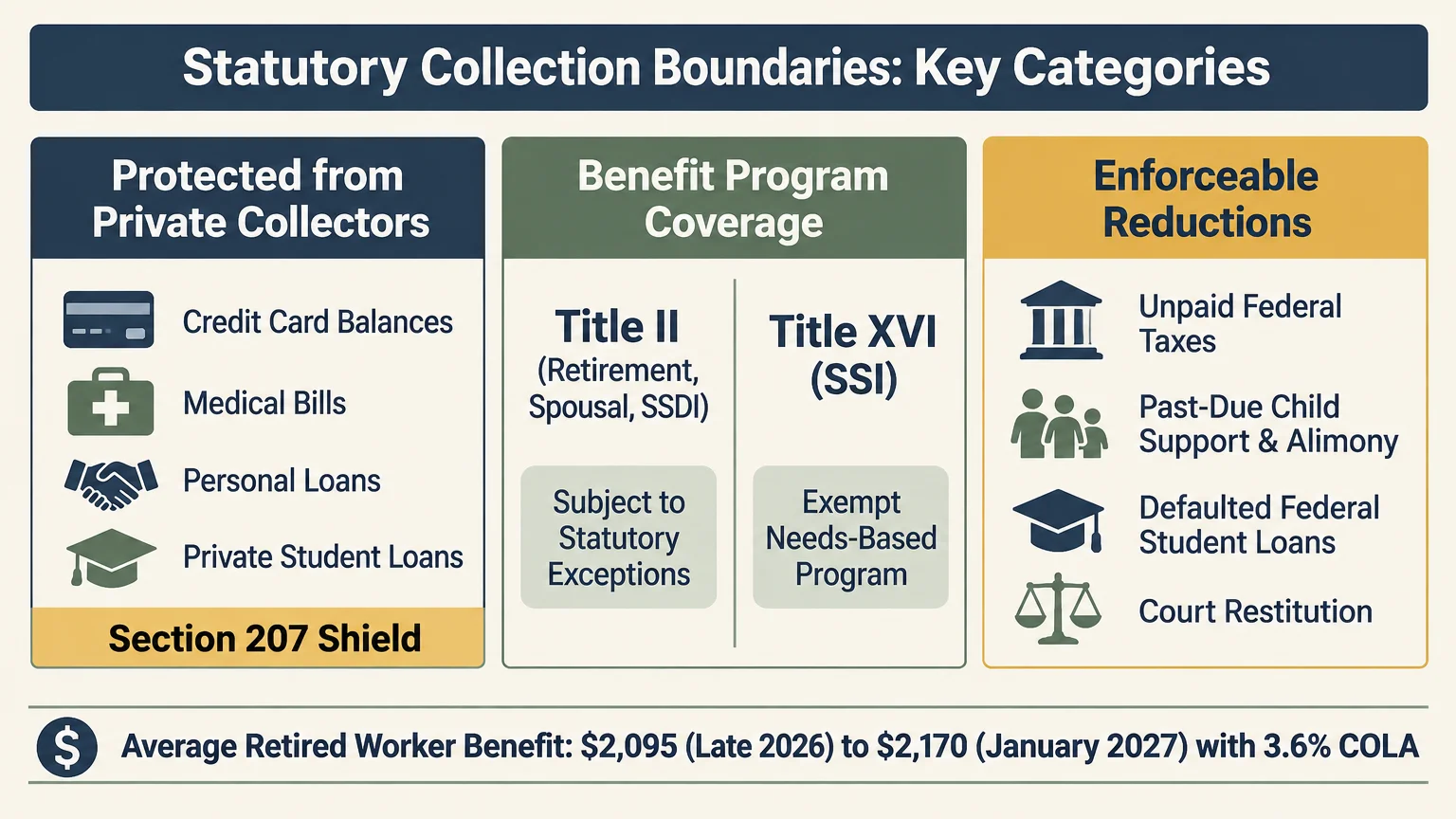
Federal law shields retirement income from ordinary commercial debt collection. Under Section 207 of the Social Security Act, private creditors cannot garnish, attach, or levy your Social Security benefits directly.
That broad shield blocks credit card issuers, medical debt collectors, personal loan lenders, and private student loan servicers from intercepting your monthly payment. Even if a private creditor wins a lawsuit against you, the Social Security Administration (SSA) will not send your check to them.
However, those protections depend heavily on which type of benefit you receive. Title II benefits—including retirement, spousal, survivor, and Social Security Disability Insurance (SSDI)—are vulnerable to select federal and court-ordered withholdings.
By contrast, Supplemental Security Income (SSI), known as Title XVI, carries far stronger protection because it is a needs-based program. Per the SSA and the Internal Revenue Service (IRS), SSI benefits are exempt from federal tax levies, Treasury non-tax debt offsets, student loan collections, and court-ordered restitution.
State and local tax agencies face similar limits on direct collection. While the federal Treasury Offset Program (TOP) can intercept federal income tax refunds for unpaid state income taxes, states cannot garnish your monthly Social Security check directly through SSA or TOP.
Protecting every dollar matters when living on a fixed income. According to the SSA’s 2027 COLA Fact Sheet released October 14, 2026, the average retired worker receives an estimated $2,095 per month in late 2026, rising 3.6% to $2,170 in January 2027 after a 2.8% increase in 2026.
Congress designed Social Security to cover basic living expenses in retirement, so private lenders cannot tap your check before it reaches you—only federal agencies, domestic support orders, and federal courts hold statutory exceptions.
Comparison of Debts That Can Reduce Your Social Security Check
Not every enforceable debt takes the same bite out of your monthly deposit. Some reductions leave a protected dollar floor in place, while others can claim more than half of your check.
| Debt Type | Maximum Withholding Limit | Protected Monthly Floor | Exempt Benefits | Primary Relief Path |
|---|---|---|---|---|
| Unpaid Federal Taxes (IRS) | Up to 15% automated (higher via manual levy) | None for automated levies | SSI, SSDI (automated), children’s survivor benefits, lump-sum death payments | Request Currently Not Collectible status, installment plan, or Offer in Compromise |
| Past-Due Child Support and Alimony | 50% to 65% of disposable benefits | None | SSI | Petition the issuing court or state child support agency for modification |
| Defaulted Federal Student Loans and Non-Tax Federal Debts | Lesser of 15% or amount over $750 | First $750 per month | SSI (plus ED student loan offset pause active as of November 2026) | Rehabilitation, consolidation, Income-Driven Repayment, or hardship review |
| Court-Ordered Victim Restitution | Up to 25% of monthly benefit | None | SSI | Seek payment schedule modification through the federal sentencing court |
| SSA Benefit Overpayments | 50% default rate (Title II notices dated April 25, 2025 or later); 10% for SSI | None by default | Reduced if hardship shown | File an appeal or waiver within 30 days, or request a lower withholding rate |

01 Unpaid Federal Taxes (IRS Levies)
Back taxes owed to the federal government represent one of the most persistent threats to retirement income. Under Section 1024 of the Taxpayer Relief Act of 1997, the Internal Revenue Service (IRS) uses the Federal Payment Levy Program (FPLP) to automatically take up to 15% of each monthly Social Security retirement or survivor check.
Unlike non-tax federal debt offsets, automated IRS levies have no protected minimum dollar floor. Even if your monthly benefit is modest, the 15% reduction continues every month until your tax balance, penalties, and interest are paid in full.
To put that in perspective, a 15% levy on an average $2,095 retirement check removes $314.25 every month. Over twelve months, that single withholding costs you $3,771 in lost retirement income.
Certain beneficiaries remain shielded from automated IRS computer levies. Per IRS guidance updated in April 2026, the agency has not systemically levied SSDI benefits through the automated FPLP since October 5, 2015, and SSI, children’s survivor benefits, and lump-sum death payments are also exempt from automated FPLP levies.
Still, the IRS retains sharper tools for unresolved tax accounts. Under Internal Revenue Code Sections 6331 and 6334(c), revenue officers can issue a manual paper Notice of Levy that is not capped at 15%, though SSA procedures note the agency will not run automated and manual levies simultaneously.
Before an automated levy begins, the IRS must send advance warning notices—such as Notice CP91—giving you 30 days to respond. Acting within that window gives you strong options to stop the withholding before it starts:
- Request Currently Not Collectible (CNC) status: If your monthly income barely covers basic living expenses, the IRS can temporarily pause collection activity after reviewing your financial statement.
- Set up an installment agreement: Negotiating a manageable monthly payment plan typically prevents or lifts an FPLP levy while keeping your budget predictable.
- Submit an Offer in Compromise: When you cannot pay your full tax bill before the collection statute expires, you may qualify to settle the debt for less than you owe.
02 Past-Due Child Support and Alimony
Domestic support obligations carry the steepest withholding limits of any debt in retirement. Under Section 459 of the Social Security Act, the SSA must garnish continuing Title II benefits when served with a valid court or state agency order for unpaid child support or alimony.
Many retirees are surprised to learn that arrears from decades ago do not vanish at age 65. Because child support judgments rarely expire quickly, unpaid balances—along with accumulated interest—can follow you straight into retirement.
Per the U.S. Department of Labor’s Fact Sheet #30, the Consumer Credit Protection Act (CCPA) sets high maximum garnishment percentages based on your current family situation and delinquency length:
- 50% cap: Applies if you are currently supporting another spouse or dependent child beyond the order.
- 60% cap: Applies if you are not supporting another spouse or dependent child.
- 55% or 65% cap: An extra 5% is added to either baseline limit if your support payments are more than 12 weeks in arrears.
Because these limits leave no protected dollar floor for Title II retirement or SSDI benefits, child support garnishment can immediately cut your monthly deposit in half or worse. Only needs-based SSI payments are shielded from domestic support withholding.
Crucially, the SSA acts solely as a compliance intermediary for these orders. Per SSA rules, you cannot appeal or reduce a court-ordered child support or alimony garnishment through Social Security itself.
To lower the withholding amount, you must petition the issuing family court or contact the state child support enforcement agency for a modified order. If your retirement income is lower than the wages used to calculate the original obligation, request a formal income review immediately.
03 Defaulted Federal Student Loans and Other Non-Tax Federal Debts
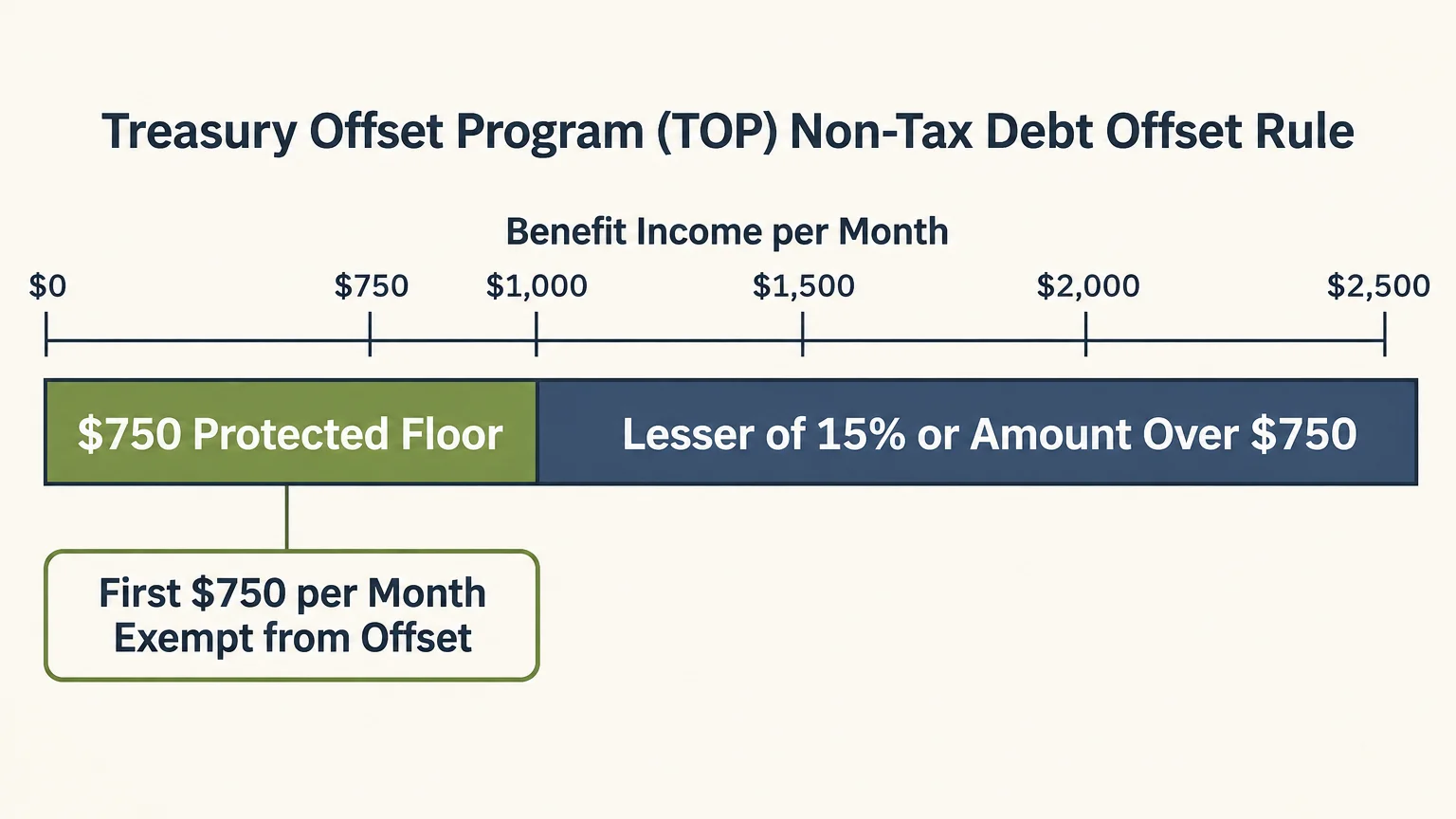
Unpaid non-tax debts owed to federal agencies are collected through the Treasury Offset Program (TOP), administered by the U.S. Treasury’s Bureau of the Fiscal Service. Under the Debt Collection Improvement Act of 1996, TOP can reduce Title II Social Security checks for delinquent federal student loans, Small Business Administration loans, FHA or VA housing debts, and federal benefit overpayments such as SNAP.
When a federal debt offset applies, the law caps the deduction at the lesser of 15% of your disposable monthly benefit or the amount exceeding $750 per month. That $750 monthly floor—unchanged since the late 1990s—means someone receiving $800 per month would lose at most $50, not $120.
Before calculating that 15% cap, federal regulations deduct legally required withholdings such as Medicare Part B premiums. With standard Medicare Part B premiums sitting at $202.90 per month in 2026 and rising to $209.40 in 2027, the offset applies only to the net benefit remaining afterward.
For non-tax debts owed to agencies other than the U.S. Department of Education (ED), normal collection rules are already active. Per SSA procedures, general TOP debt-collection activity resumed in March 2025 following the pandemic pause, requiring at least 60 days’ advance notice from the creditor agency before offsets begin.
Federal student loans follow a separate, rapidly shifting timeline that every older borrower should watch closely. Federal Direct and FFEL loans typically enter default after 270 days of missed payments, putting millions of households at risk.
According to Federal Student Aid data as of June 30, 2026, more than 9.3 million borrowers were in default on $234 billion in federal student loans. A January 2025 Consumer Financial Protection Bureau (CFPB) report also estimated that 452,000 borrowers aged 62 and older carried defaulted student loans and were likely receiving Social Security.
Before the 2020 pandemic collection freeze, student loan offsets struck roughly 192,300 Social Security recipients in 2019, reducing their checks by an average of $2,232 per year—or $186 per month. Recent federal policy shifts have temporarily paused those reductions again, though the pause may not last forever:
- Brief 2025 restart and reversal: After halting collections in March 2020, ED announced a restart of Social Security offsets on May 5, 2025—sending 30-day warnings to 195,000 borrowers—before pausing Social Security garnishments again on June 3, 2025.
- January 2026 delay: On January 16, 2026, ED announced a temporary delay of all involuntary collections on federally held student loans, including TOP Social Security offsets, tax refund intercepts, and wage garnishment.
- New 2026 repayment reforms: The delay gave ED time to implement statutory changes enacted July 4, 2025, including a simplified Income-Driven Repayment (IDR) plan launching July 1, 2026, alongside a second chance to rehabilitate a defaulted loan.
- Late 2026 outlook: As of November 2026, ED’s pause on TOP offsets remains active with no official restart date, though Treasury began onboarding private collection agencies in late 2026 to prepare for a possible resumption in 2027.
Use this temporary pause to resolve defaulted federal loans before offsets resume. Note also that older FFEL loans held by private guaranty agencies rather than ED are not covered by ED’s administrative wage-garnishment pause.
Rehabilitating a defaulted loan or enrolling in an IDR plan based on your retirement income can lower your monthly payment—sometimes to $0—and permanently remove your account from TOP eligibility.
04 Court-Ordered Victim Restitution and Benefit Overpayments
Two additional obligations can shrink your check sharply even when private creditors stay locked out. Both require quick attention to prevent severe monthly budget disruption.
First, under the Mandatory Victims Restitution Act and Section 459 of the Social Security Act, federal courts can order garnishment of Title II benefits to pay restitution to crime victims. Per SSA rules and the CCPA, monthly withholding for court-ordered victim restitution is capped at 25% of your monthly benefit.
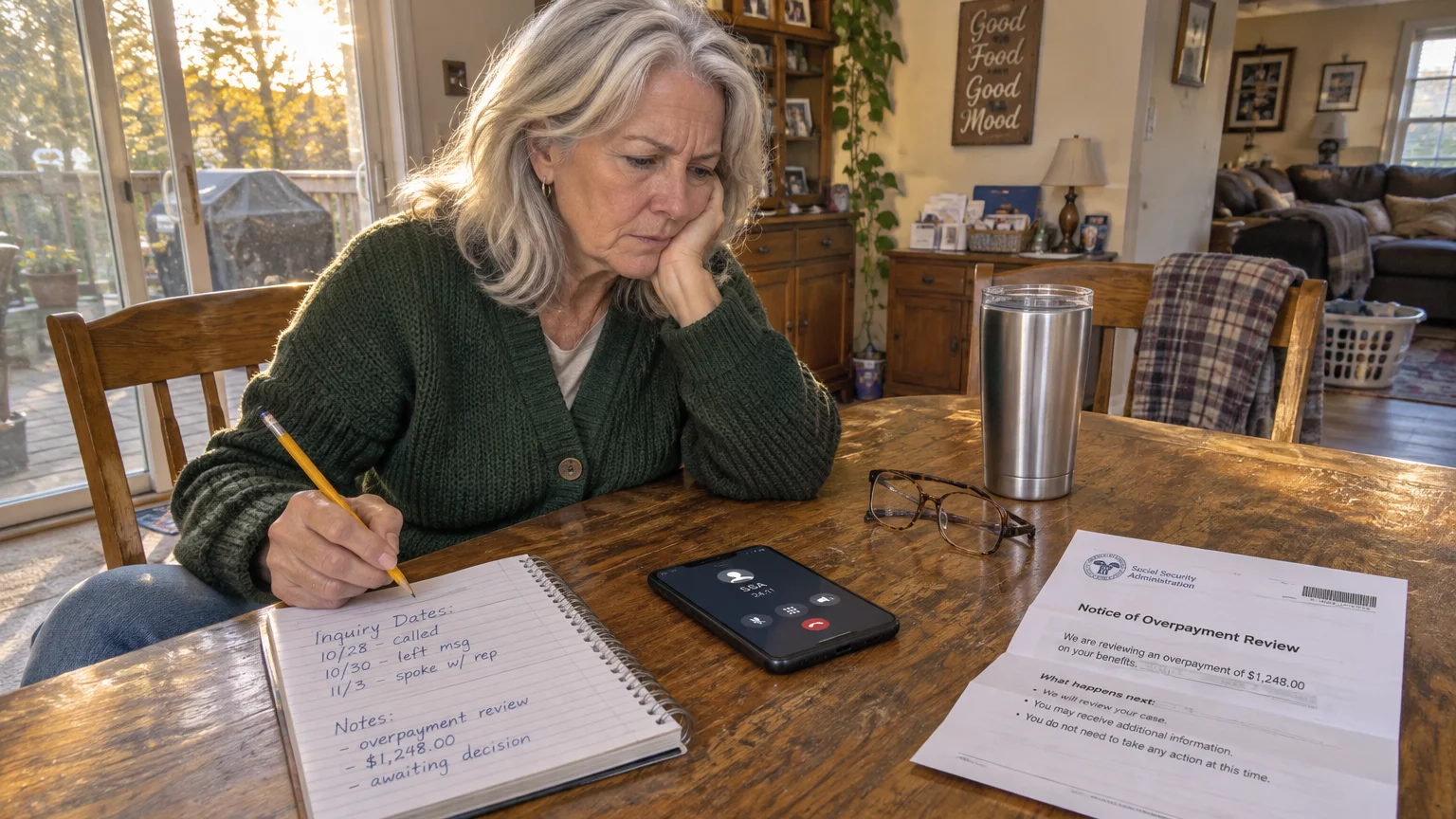
Second, the SSA itself can claw back money if it determines it previously overpaid you. Overpayments often happen when beneficiaries return to part-time work, experience changes in marital status, or encounter agency calculation delays.
Federal rules governing overpayment clawbacks changed dramatically between 2024 and 2026. After lowering the default withholding rate from 100% to 10% in March 2024 and briefly announcing a return to 100% in March 2025, the SSA issued an emergency policy change on April 25, 2025.
Under that rule—reaffirmed on August 28, 2025—the SSA now applies a default withholding rate of 50% of monthly Title II benefits for overpayment notices dated April 25, 2025 or later. Overpayment clawbacks for SSI remain capped at 10%.
Losing half of your monthly Social Security check can destabilize rent, groceries, and prescriptions overnight. Fortunately, the SSA waits at least 30 days after mailing an overpayment notice before starting deductions, giving you time to respond:
- File a timely appeal or waiver: Submitting a formal reconsideration request or waiver within 30 days pauses collection until the SSA makes a written decision.
- Prove you were not at fault: A waiver can erase the entire overpayment debt if you did not cause the error and cannot afford to repay it without sacrificing essential living expenses.
- Request a lower withholding rate: Even when you owe the balance, you can ask the SSA to reduce the 50% default clawback to a smaller monthly amount based on your actual budget.
How to Protect Social Security Benefits in Your Bank Account
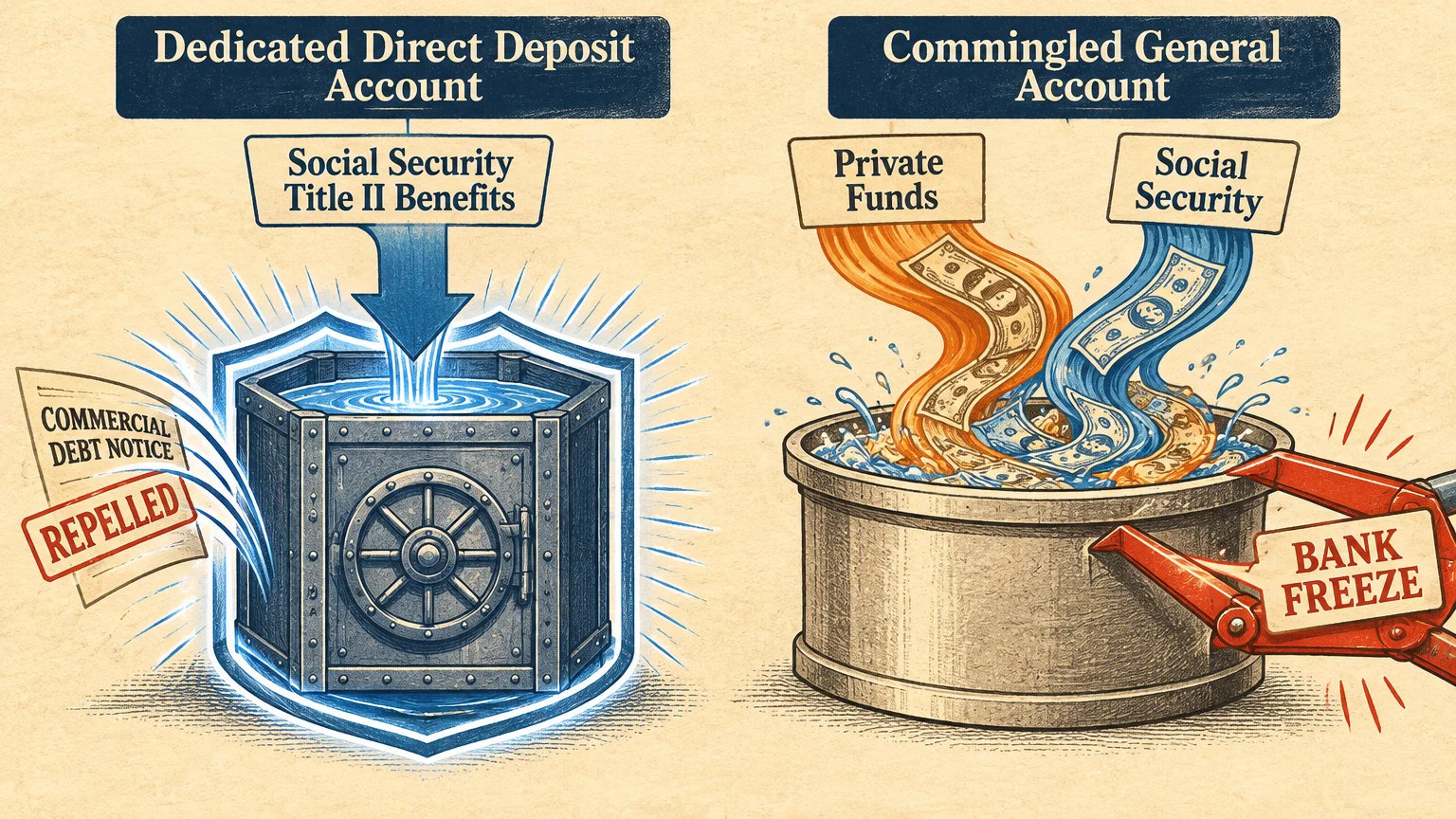
Stopping a garnishment at the SSA level is only half the battle. Once your check lands in a checking or savings account, private judgment creditors may still try to freeze your bank account through state court orders.
To prevent banks from locking up exempt federal money, federal regulations under 31 CFR Part 212—issued jointly by the U.S. Treasury, SSA, VA, RRB, and OPM—create an automatic two-month bank account protection rule.
When a bank or credit union receives a private creditor’s garnishment order, it must review your account within two business days. The institution must automatically protect the lesser of two amounts: all federal benefits directly deposited during the preceding two-month lookback period, or your current account balance.
Banks must notify you within three business days of the review and cannot charge garnishment fees against protected funds. They also cannot freeze that protected two-month cushion while the court order plays out.
However, two critical gaps can still catch retirees off guard. Any balance exceeding two months of direct deposits can be frozen until you go to court and prove the extra money also came from Social Security.
In addition, automatic bank freeze protection does not stop garnishment orders accompanied by a Notice of Right to Garnish Federal Benefits from a federal agency or a state child support enforcement office. To keep your cash safe, adopt practical banking habits that protect social security benefits from day one:
- Always use direct deposit: Paper checks deposited manually do not trigger the automatic two-month electronic lookback protection, forcing you to fight a bank freeze in court.
- Keep benefits in a dedicated account: Avoid depositing part-time wages, gifts, or pension payouts into the same checking account as Social Security so your funds stay cleanly traceable.
- Monitor balances above two months: If you face an unresolved lawsuit or private judgment, move excess savings beyond two months of deposits into exempt or properly structured accounts only after reviewing state exemption rules.
Avoiding Common Errors
Even well-prepared retirees lose money every year because of procedural missteps after a collection notice arrives. Avoiding these four common mistakes keeps you in control of your timeline:
- Ignoring 30-day or 60-day warning notices: Once an IRS CP91 levy notice, a TOP 60-day offset letter, or an SSA overpayment notice passes its response window, automatic withholding begins without further warning.
- Commingling benefit funds with non-exempt cash: Mixing wages or tax refunds into your Social Security checking account blurs the paper trail if you ever need to claim exemptions in court.
- Assuming SSI protections cover retirement benefits: While SSI is protected from IRS levies, student loan offsets, and victim restitution, standard Title II retirement and survivor checks are fully exposed to those deductions.
- Asking the SSA to fix a child support order: Calling Social Security wastes critical weeks when only the issuing family court or state enforcement agency holds legal authority to reduce domestic support withholding.
When DIY Isn’t Enough
Many routine payment plans and waivers can be handled directly with federal agencies, especially using free resources listed through USA.gov Benefits. Still, several high-stakes scenarios call for experienced legal or tax representation:
- You receive a manual IRS paper levy: Because manual levies bypass the 15% automated cap, an enrolled agent, CPA, or tax attorney should intervene immediately to negotiate Currently Not Collectible status or an installment agreement.
- Your check is cut 50% to 65% for support arrears: A family law attorney can file an urgent motion in the issuing court to recalculate arrears or adjust ongoing support based on your reduced retirement income.
- The SSA denies an overpayment waiver: When half your monthly check is at stake and the agency rejects your initial hardship request, a Social Security or legal aid attorney can represent you at an administrative hearing.
- A private creditor freezes your bank account: If a collector locks funds exceeding the two-month lookback cap, a consumer protection attorney can file your exemption claim before the court turns the money over.
Frequently Asked Questions
Can credit card companies or medical debt collectors garnish Social Security?
No. Under Section 207 of the Social Security Act, private creditors—including credit card companies, hospitals, debt buyers, and private student loan lenders—cannot garnish your Social Security check directly, and two months of direct deposits receive automatic bank protection.
Can states take unpaid state income taxes out of my Social Security check?
No. While the federal Treasury Offset Program can intercept federal income tax refunds to pay delinquent state income taxes, state and local revenue agencies cannot garnish your monthly Social Security check directly through the SSA or TOP.
Are federal student loan offsets happening right now in late 2026?
No. Following a January 16, 2026 announcement by the U.S. Department of Education, involuntary collections on federally held student loans—including Social Security offsets—remain paused as of November 2026, though Treasury is preparing for a potential resumption in 2027.
What happens if Social Security overpaid me and wants half my check?
For Title II overpayment notices dated April 25, 2025 or later, the SSA applies a 50% default withholding rate after waiting at least 30 days. Filing a timely appeal or waiver within 30 days pauses collection, and you can request a lower repayment rate for financial hardship.

Protecting Your Monthly Check Going Forward
Reviewing your mail promptly, keeping Social Security direct deposits separated from other income, and acting within 30-day notice windows remain your strongest defenses against unexpected withholding. If an old tax bill, federal loan, or overpayment notice surfaces, address it early while repayment options and waivers remain open.
The information in this guide is meant for educational purposes. Your specific circumstances—including income, health needs, tax situation, and goals—may require different approaches.
When in doubt, consult a licensed professional.
Last updated: November 2026. Retirement benefits, tax rules, and healthcare regulations change frequently—verify current details with official sources.