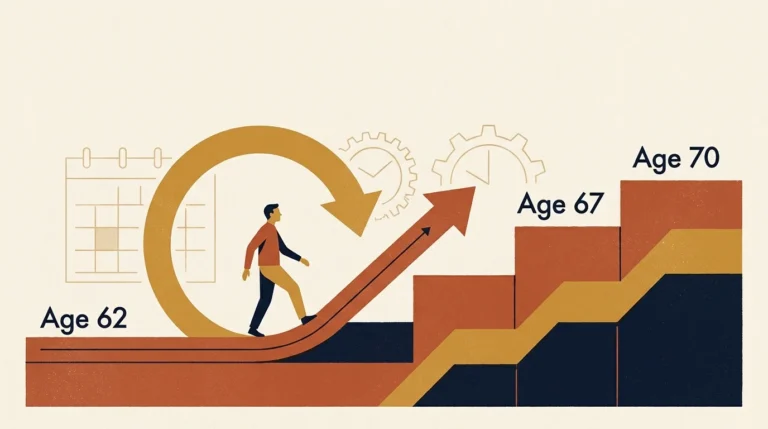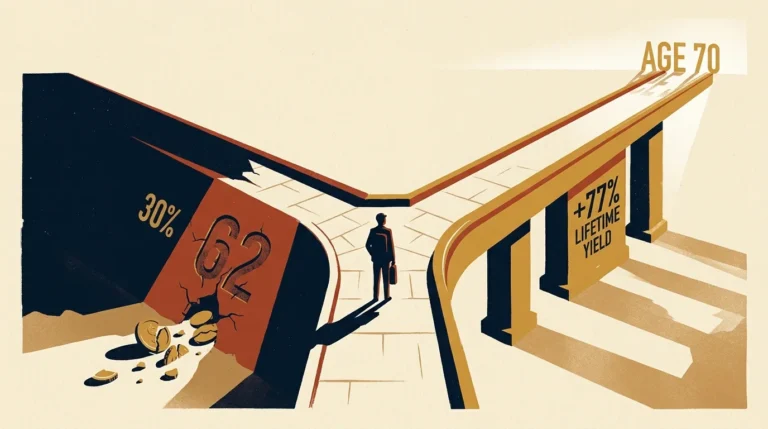

When both spouses plan for retirement, the higher earner claiming Social Security early creates a permanent chain reaction. That single filing decision cuts your monthly household check today and slashes the survivor benefit your spouse will rely on later.
Many social security couples assume each spouse should simply file as soon as they stop working. They focus on collecting two checks right away instead of protecting the household income that lasts as long as the longest-living spouse.
Understanding how spousal rules and survivor formulas interact helps you avoid costly claiming mistakes. With the right timing, you can bring in cash earlier while still locking in maximum lifetime protection.
The Essentials
- Two benefits turn into one: When the first spouse passes away, the smaller Social Security check stops and the surviving spouse keeps only the higher amount.
- Early filing triggers a permanent survivor cap: If the higher earner claims before Full Retirement Age, the widow(er)’s limit permanently restricts the survivor benefit even if the surviving spouse waits until full retirement.
- Delayed credits help survivors, not living spouses: Waiting past Full Retirement Age adds 8.0% per year up to age 70 for the higher earner and future survivor, but never raises the 50% living spousal benefit.
- The split strategy often wins: Having the lower earner claim earlier while the higher earner waits until age 70 delivers steady income now and stronger longevity protection later.
Why Higher-Earner Timing Shapes Your Entire Household
Most couples approach retirement benefits as two separate decisions, asking when each person wants their own check to start. That individual mindset misses how Social Security actually pays out over a marriage.
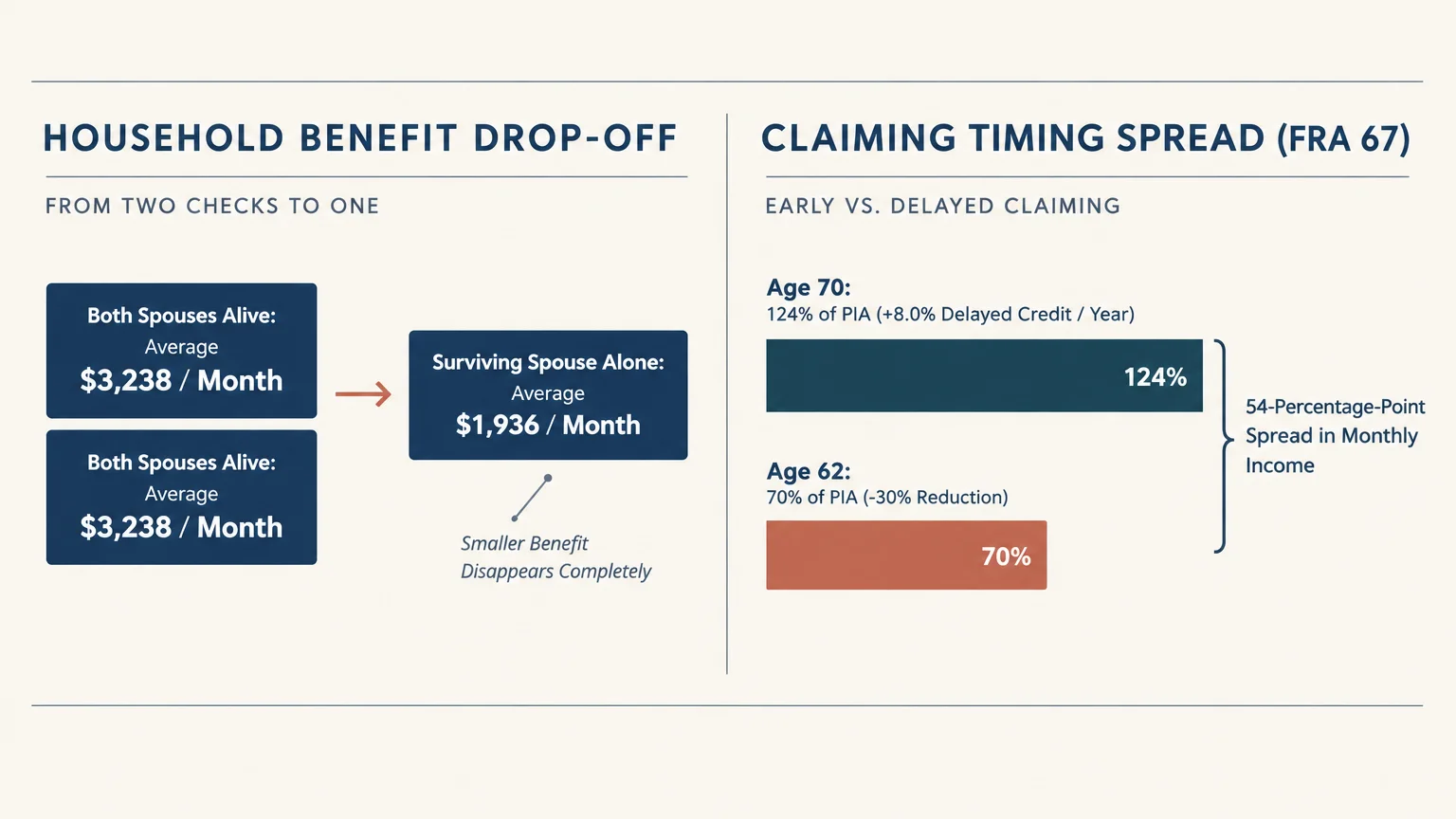
While both spouses are alive, two checks arrive each month. According to the Social Security Administration (SSA), an aged couple both receiving benefits averages $3,238 per month in 2026, rising to $3,355 in January 2027 after the 3.6% Cost-of-Living Adjustment (COLA).
Once one spouse dies, however, the smaller check disappears completely. The surviving spouse must run the household on a single check—an average of $1,936 per month for an aged widow(er) alone in 2026, or $2,005 in January 2027.
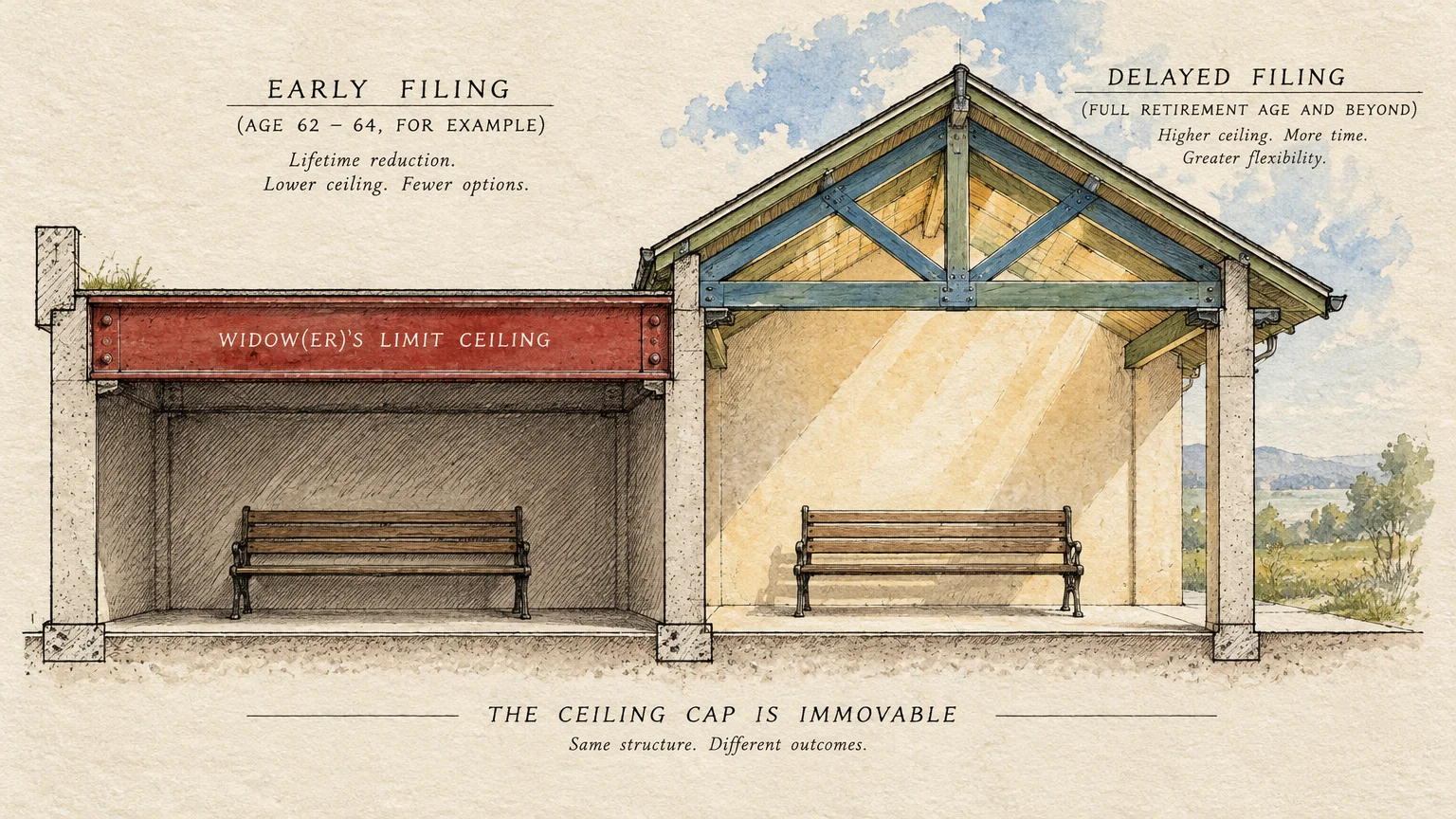
Because the surviving spouse keeps the larger record, the higher earner’s claiming age sets the ceiling for the couple’s joint longevity insurance. Claiming early shrinks that ceiling for decades.
Your Full Retirement Age (FRA) depends on the year you were born. Per the SSA, FRA is age 66 for workers born from 1943 through 1954, rises by two months per birth year through 1959, and reaches age 67 for anyone born in 1960 or later.
Workers born in 1959 have an FRA of 66 and 10 months, reaching that milestone in 2025 or 2026. Anyone born in 1960 turns 66 in 2026 and reaches FRA at 67 in 2027.
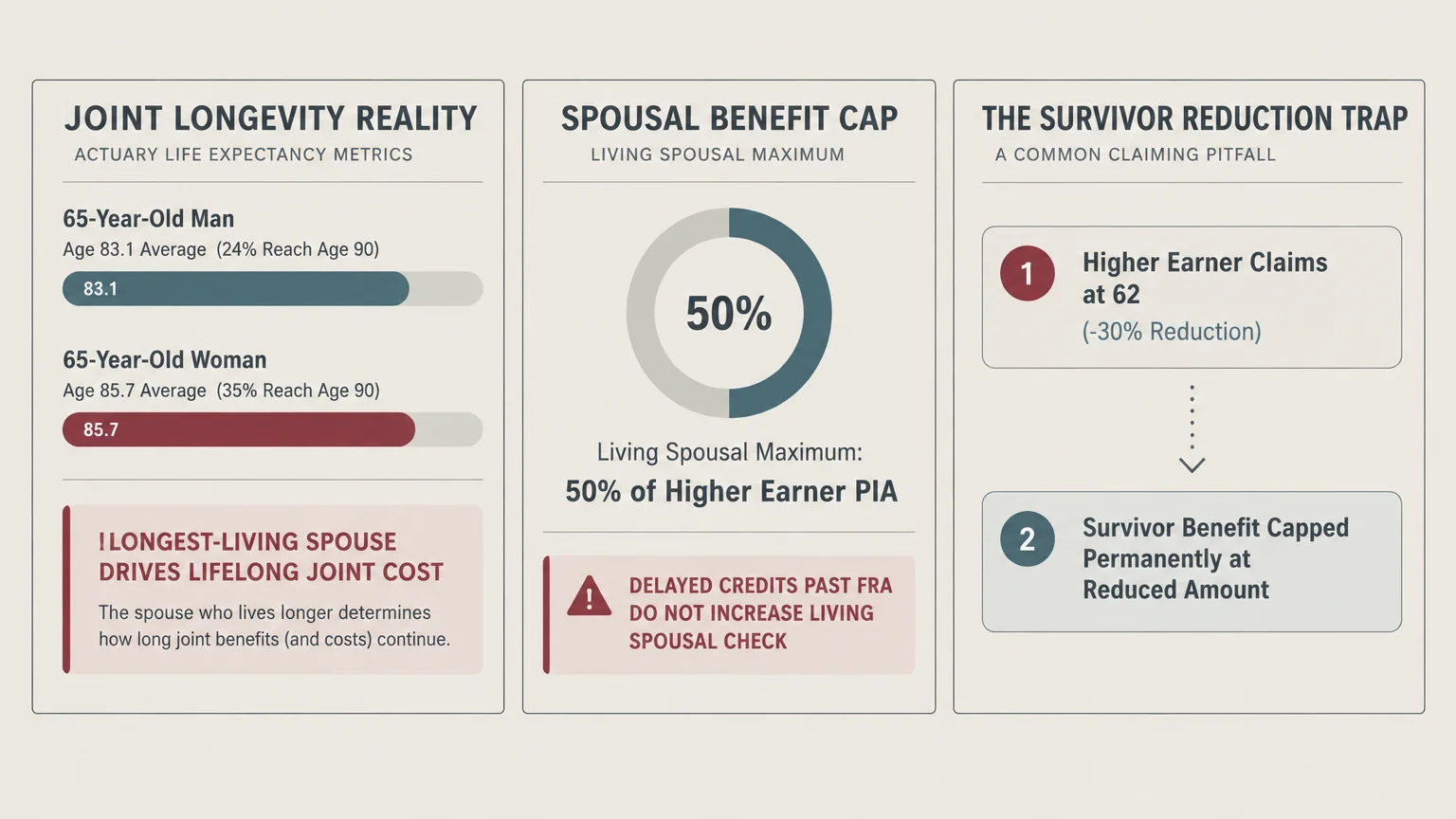
If your FRA is 67 and you claim at age 62, the SSA permanently reduces your own retirement benefit by 30%, leaving you with 70% of your Primary Insurance Amount (PIA). Waiting until age 70 earns delayed retirement credits of 8.0% per year past FRA.
That patience raises a worker’s benefit to 124% of PIA at age 70 when FRA is 67. Comparing age 62 against age 70 creates a 54-percentage-point spread in guaranteed monthly income.
Joint life expectancy makes that spread crucial for married households. Per the SSA Office of the Chief Actuary’s 2023 period life table used in the 2026 Trustees Report, a 65-year-old man lives an average of 18.1 more years to age 83.1.
A 65-year-old woman averages 20.7 additional years, reaching age 85.7. Individually, a 65-year-old man has a 24% chance of reaching age 90, while a 65-year-old woman has a 35% chance.
When you look at both lives together, the odds climb much higher. Society of Actuaries data shows a 65-year-old married couple has roughly a 45% to 50% or greater chance that at least one spouse reaches age 90.
The same data shows roughly a 20% chance that one spouse lives to age 95. Yet claiming patterns show many retirees still give up that late-life protection.
Per the SSA Annual Statistical Supplement, 2025, 62% of the 51.8 million retired workers receiving benefits in December 2024 took permanently reduced checks by claiming before FRA. That share included 59.1% of men and 64.9% of women.
An October 2026 tabulation of SSA Table 6.B5.1 shows gradual progress among newer retirees. Among 3.71 million workers starting benefits in 2024, the average claiming age reached 65.3, with 9.3% waiting until age 70 or later—up from 3.1% in 2014.
Even with that shift, 50.9% of new claimants in 2024 still filed before FRA, and 22.5% claimed right at age 62. When the higher earner is part of that early-claiming majority, both spouses pay the price.
How the Widow(er)’s Limit Permanently Caps Survivor Benefits
The hidden penalty behind early higher-earner claiming is an SSA rule called the widow(er)’s limit, also known as RIB-LIM. Most couples never hear about it until after one spouse dies.
Normally, a surviving spouse who waits until their own survivor FRA receives 100% of what the deceased spouse was receiving. That includes any 8.0% annual delayed retirement credits the higher earner built between FRA and age 70.
When the higher earner claims early, however, the formula flips against the survivor. Under SSA rules, the survivor benefit cannot exceed the greater of two numbers: the deceased worker’s reduced monthly check or a floor equal to 82.5% of the deceased worker’s PIA.
This cap binds the surviving spouse permanently. Even if your surviving spouse waits until their own FRA of 67 to apply for survivor benefits, they still cannot collect 100% of your full PIA.
Every month the higher earner claims before Full Retirement Age permanently narrows the income floor available to the surviving spouse—even if the survivor delays claiming their own benefit.
This rule affects millions of real households. An SSA Office of Retirement and Disability Policy study found that 33% of Social Security’s 8.1 million widow(er) beneficiaries receive smaller checks specifically because of the widow(er)’s limit.
Compare the difference on a worker whose FRA is 67. If the higher earner claims at age 62 for 70% of PIA, the widow(er)’s limit caps the surviving spouse at the 82.5% floor instead of 100% or 124%.
Between 82.5% and 124%, the surviving spouse forfeits 41.5 percentage points of PIA every single month for life. Furthermore, future annual COLAs—like the 2.8% adjustment in 2026 and 3.6% in 2027—compound on a much smaller base.
Survivor timing also matters on the surviving spouse’s side. Per the SSA, a widow or widower can claim survivor benefits as early as age 60, or age 50 if disabled.
Claiming survivor benefits at age 60 pays just 71.5% of the deceased spouse’s benefit. That share climbs above 75% at age 61, above 80% at age 63, and above 90% at age 65, reaching 100% at survivor FRA of 66 to 67.
If the higher earner already triggered the widow(er)’s limit by claiming at 62, and the survivor then claims early at 60 out of financial necessity, the compounding cuts leave the survivor with a fraction of the household’s former income.
The Spousal Benefit Trap and the Deemed Filing Rule
Why do so many couples walk straight into the widow(er)’s limit when they want to do the right thing? Often, the mistake starts with a well-intentioned attempt to maximize living spousal benefits.
Under SSA rules, a lower-earning spouse cannot collect spousal benefits on the higher earner’s record until the higher earner has filed for retirement or disability benefits. Couples sometimes panic when they learn this prerequisite.
The higher earner claims early at age 62 or 64 simply to unlock the spouse’s check. Unfortunately, that move misreads how spousal benefits work and sacrifices far larger survivor benefits down the road.
First, understand the 50% spousal cap. A living spouse’s maximum spousal benefit equals 50% of the higher earner’s PIA—the benefit calculated at the higher earner’s Full Retirement Age.
Delayed retirement credits do not increase a living spouse’s benefit above that 50% mark. Waiting from age 67 to age 70 raises the higher earner’s own check and the eventual survivor benefit to 124% of PIA, but the living spousal top-up stays tied to 50% of PIA.
Second, claiming spousal benefits early carries steep reductions of its own. Per the SSA, claiming a spousal benefit before FRA reduces it by 25/36 of 1% per month for the first 36 months and 5/12 of 1% for earlier months.
For a spouse with an FRA of 67, filing at age 62 cuts the spousal benefit by 35%. As the SSA illustrates, a $500 full spousal benefit drops permanently to $325 per month when claimed at age 62.
Third, modern rules eliminated the old loophole that let one spouse claim only a spousal check while delaying their own record. Under the Bipartisan Budget Act of 2015, anyone born on or after January 2, 1954 faces deemed filing at every age.
Deemed filing means that applying for either your personal retirement benefit or a spousal benefit automatically files for both. The SSA then pays a combined benefit equal to the higher of the two amounts, not both stacked together.
This rule touches a huge share of older women. Per the SSA Annual Statistical Supplement, 2025, 24.0% of the 30.3 million women aged 65 and older receiving benefits in December 2024 were dually entitled to both their own benefit and a wife’s or widow’s top-up.
Another 15.2%, or 4.6 million women, received wife’s or widow’s benefits alone. For any couple in those shoes, a higher earner filing early solely to unlock a 50% spousal check—especially one cut by 35% at age 62—trades away far more lifetime survivor security than the temporary spousal cash is worth.
Comparing Three Couple Claiming Strategies Side by Side
Seeing the trade-offs in one place makes the right spousal benefits strategy much clearer. The table below compares three common approaches assuming both spouses have an FRA of 67 and are subject to deemed filing.
| Claiming Strategy | Higher Earner Check (% of PIA) | Max Living Spousal Benefit | Max Survivor Benefit Ceiling | Best Household Fit |
|---|---|---|---|---|
| Both Claim Early at Age 62 | 70% of PIA | 32.5% of higher earner’s PIA (35% early cut on 50%) | 82.5% floor of higher earner’s PIA (RIB-LIM cap) | Severe cash shortage with no bridge savings and short life expectancy for both |
| Split Strategy: Lower Earner Claims Early (62–FRA), Higher Earner Delays to 70 | 124% of PIA | Spousal top-up starts only once higher earner files at 70 (reduced if lower earner claimed before FRA) | 124% of higher earner’s PIA (if survivor is at survivor FRA) | Most couples needing early cash flow while protecting the surviving spouse |
| Both Delay to Age 70 | 124% of PIA | 50% of higher earner’s PIA (if lower earner delays past FRA) | 124% of higher earner’s PIA | Couples with ample bridge savings, strong health, or similar high earnings |
Look closely at the middle row, often called the split strategy. Notice how it solves the cash-flow dilemma that pushes many higher earners into claiming too soon.
Instead of both spouses waiting or both claiming at 62, the lower earner starts their own retirement benefit early—say at age 62, 64, or FRA. Meanwhile, the higher earner holds off until age 70.
Yes, the lower earner takes a reduction on their own smaller benefit if they file before FRA. However, that lower check is the one that disappears when the first spouse dies.
Once the higher earner reaches age 70 and files, the lower earner can still receive any applicable spousal top-up if 50% of the higher earner’s PIA exceeds their own PIA. Remember, though, that any early-claiming reduction on the lower earner’s own record still reduces their combined living total.
Even with that trade-off, the higher earner’s 124% check becomes the couple’s anchor from age 70 onward. When either spouse passes away, the survivor steps into that full 124% benefit—a 41.5-percentage-point advantage over the 82.5% widow(er)’s limit floor.
Consider how large those dollars look for top earners. In 2026, the SSA maximum monthly benefit at Full Retirement Age is $4,152, rising to $4,188 in 2027.
For a worker with an FRA of 67 eligible for that $4,152 benchmark, claiming at age 62 cuts the check by 30%, whereas delaying to age 70 boosts it to 124% of PIA. Every future COLA then multiplies that larger base year after year.
What Can Go Wrong
Even couples who understand the basic math can stumble over technical rules when they file. Watch out for five common traps that catch retirees off guard.
- Triggering the Retirement Earnings Test: If the higher earner claims before FRA while still working, the SSA withholds benefits above annual limits. In 2026, if you are under FRA all year, the SSA withholds $1 for every $2 earned above $24,480 ($25,560 in 2027).
- Misreading the FRA-year earnings limit: In the calendar year you reach FRA, the limit is much higher—$65,160 in 2026 and $67,920 in 2027—with $1 withheld per $3 earned in months before your birthday month. Once you hit FRA, no earnings limit applies and withheld benefits are recalculated upward, yet claiming early while earning high wages often defeats the goal of getting cash now.
- Using outdated public-pension assumptions: Signed into law on January 5, 2025, the Social Security Fairness Act repealed both the Windfall Elimination Provision (WEP) and the Government Pension Offset (GPO) retroactively to January 2024. By July 7, 2025, the SSA had already processed over 3.1 million retroactive payments totaling $17 billion, so spouses with non-covered government pensions who previously faced a two-thirds offset should recalculate under full spousal and survivor rules.
- Claiming early out of trust fund panic: The 2026 OASDI Trustees Report projects that Old-Age and Survivors Insurance (OASI) reserves will deplete in the fourth quarter of 2032, leaving ongoing taxes to cover 78% of scheduled OASI benefits—or 2034 and 83% if combined with Disability Insurance. Locking in a 30% early cut at 62 out of fear leaves you with 70% of PIA right away, rather than collecting full benefits while Congress evaluates funding fixes.
- Overlooking the widow’s income drop: A surviving spouse loses the smaller check at the exact moment their household tax filing status shifts from married filing jointly to single. Failing to protect the 124% survivor ceiling squeezes cash flow when healthcare and home upkeep costs often climb.
You can verify your own benefit projections and earnings history directly at the Social Security Administration before choosing any filing date. Checking real records beats guessing with generic calculators.
A Step-by-Step Decision Checklist for Couples
Turning rules into a concrete plan takes only one focused afternoon together. Follow these steps before either spouse submits an application.
- Confirm both Full Retirement Ages: Check your exact birth years to see whether your FRA is 66 and 10 months, 67, or an earlier age. Remember that survivor FRA can differ slightly from personal retirement FRA depending on birth cohort.
- Compare both Primary Insurance Amounts side by side: Pull both statements from the SSA to see each spouse’s full benefit at FRA. If the higher earner is still working toward the 2026 maximum taxable earnings cap of $184,500—or $192,300 in 2027—additional high-earning years can also nudge their PIA upward.
- Map out a bridge-income plan to age 70: Identify how you will cover monthly bills if the higher earner delays. Combining the lower earner’s early Social Security check, part-time wages, or modest withdrawals from retirement accounts often bridges the gap smoothly.
- Test tax impacts before tapping accounts: Coordinating partial portfolio withdrawals with delayed Social Security can affect how much of your benefits become taxable later. You can review current federal income brackets and benefit taxation rules through the Internal Revenue Service.
- Stress-test your plan for a single survivor: Ask what monthly income remains if the higher earner dies first, and again if the lower earner dies first. Make sure the higher earner’s filing age leaves the surviving spouse with enough guaranteed income to cover housing, food, and healthcare.
- Review cash-flow tradeoffs with neutral worksheets: Use the retirement planning guides and budgeting tools at the Consumer Financial Protection Bureau to compare early-claiming cash against delayed survivor protection.
If the higher earner has already filed within the last year and you realize it was a mistake, you still have one reset button. Per Fidelity Investments citing SSA rules, beneficiaries who claim early can withdraw their application once within the first 12 months of receiving benefits, provided they repay every dollar already received.

When to Consult a Professional
Many couples can map out a solid Social Security timing plan on their own using official SSA statements. Still, certain household situations justify hiring a fee-only fiduciary or planner—and you can verify planner credentials through the Certified Financial Planner Board.
- A wide age gap between spouses: When the higher earner is five or ten years older than the lower earner, delaying the higher earner’s benefit to age 70 protects a younger spouse who could collect survivor benefits for 20 or 30 years.
- Unequal health or shortened life expectancy: If the higher earner faces serious health issues while the lower earner is healthy, delaying the higher earner’s claim can still be the best move purely to maximize the survivor benefit—unless the higher earner will not survive long enough without immediate cash.
- Public-sector pensions and prior marriages: Households newly eligible for full benefits under the Social Security Fairness Act repeal, or couples sorting through survivor eligibility from prior marriages, face intersecting rules that generic online tools often miss.
- High-earner wages paired with retirement withdrawals: Coordinating the Retirement Earnings Test, Roth conversions, and Medicare premium surcharges requires multi-year tax projections that a qualified planner or tax pro can model accurately.
Frequently Asked Questions
Can the lower earner claim spousal benefits while the higher earner delays until age 70?
No, not under current SSA rules. A spouse cannot receive spousal benefits on the higher earner’s record until the higher earner has actually filed for and begun receiving retirement or disability benefits.
However, the lower earner can claim their own personal retirement benefit early while waiting. Once the higher earner files at age 70, the SSA checks whether the lower earner qualifies for an additional spousal top-up based on 50% of the higher earner’s PIA.
Do delayed retirement credits increase my living spouse’s 50% spousal benefit?
No, delayed retirement credits never increase the living spousal benefit. The maximum spousal benefit while both spouses are alive is capped at 50% of the higher earner’s Primary Insurance Amount at Full Retirement Age.
Those 8.0% annual delayed credits between FRA and age 70 still carry huge value for couples, though. They boost the higher earner’s own check up to 124% of PIA for an FRA of 67 and pass directly into the surviving spouse’s benefit after the higher earner dies.
What if the higher earner already claimed early—can we undo that choice?
If the higher earner began receiving benefits less than 12 months ago, you can withdraw the application once under SSA rules. You must repay all benefits already paid on that record, including any spousal checks or Medicare premiums withheld.
If more than 12 months have passed, you cannot withdraw the application. Once the higher earner reaches Full Retirement Age, however, they can voluntarily suspend their own benefit to earn 8.0% annual delayed credits up to age 70—though spousal benefits on their record also pause during a suspension.
Should the higher earner claim early if they have health concerns?
For single retirees in poor health, claiming early often makes sense because there is no surviving spouse to protect. For married couples, the higher earner’s poor health can actually make delaying more valuable, not less.
Because the surviving spouse steps into the higher earner’s benefit for the rest of their own life, delaying to age 70 maximizes survivor income if the healthy spouse is expected to live into their late 80s or 90s. Only immediate cash hardship—or poor health for both spouses—usually justifies early higher-earner claiming.
Your Next Move
Before either spouse submits a claiming form, sit down together with both Social Security statements and test the split strategy on paper. Protecting the higher earner’s check until Full Retirement Age or age 70 is one of the simplest ways to safeguard the surviving spouse’s standard of living.
This is educational content based on general retirement and financial principles. Individual results vary based on your situation.
Always verify current benefit rules, tax laws, and eligibility requirements with official sources like SSA, Medicare.gov, or the IRS.
Last updated: November 2026. Retirement benefits, tax rules, and healthcare regulations change frequently—verify current details with official sources.