
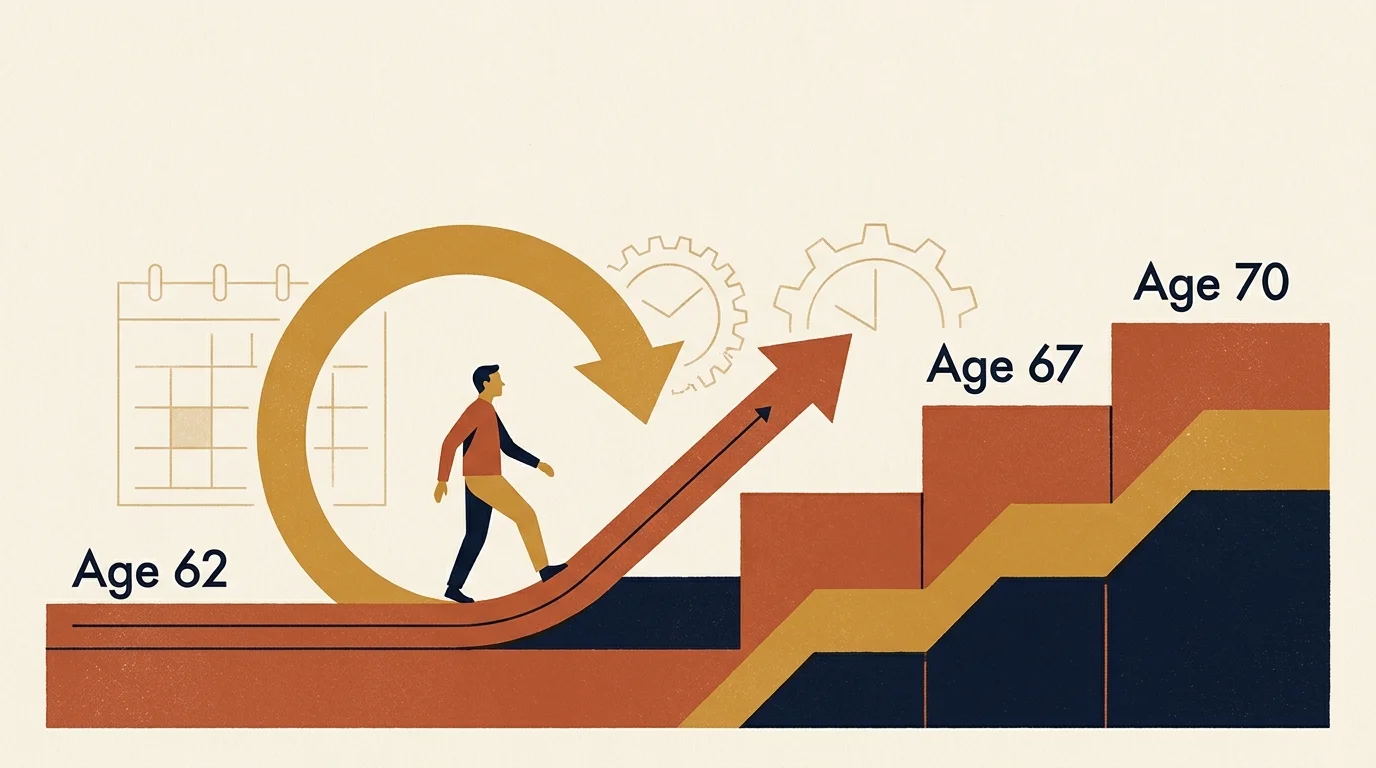
If you claimed Social Security early, you permanently reduced your monthly checks. Filing at age 62 locks in a lifetime benefit cut of up to 30 percent.
Many retirees immediately regret claiming early after finding new employment or discovering that living expenses exceed their expectations. Fortunately, federal regulations provide specific legal mechanisms to undo this choice.
Whether you filed six months ago or several years ago, actionable strategies exist to restore your monthly payments. You can rebuild your guaranteed lifetime retirement income using official program provisions.
The True Cost of Early Filing
Filing for benefits before your full retirement age creates a permanent reduction in your monthly income. The reduction percentage depends directly on how many months prior to your full retirement age you submit your claim.
In November 2026, the full retirement age officially reached 67 for everyone born in 1960 or later. For individuals born in 1959, full retirement age stands at 66 and 10 months.
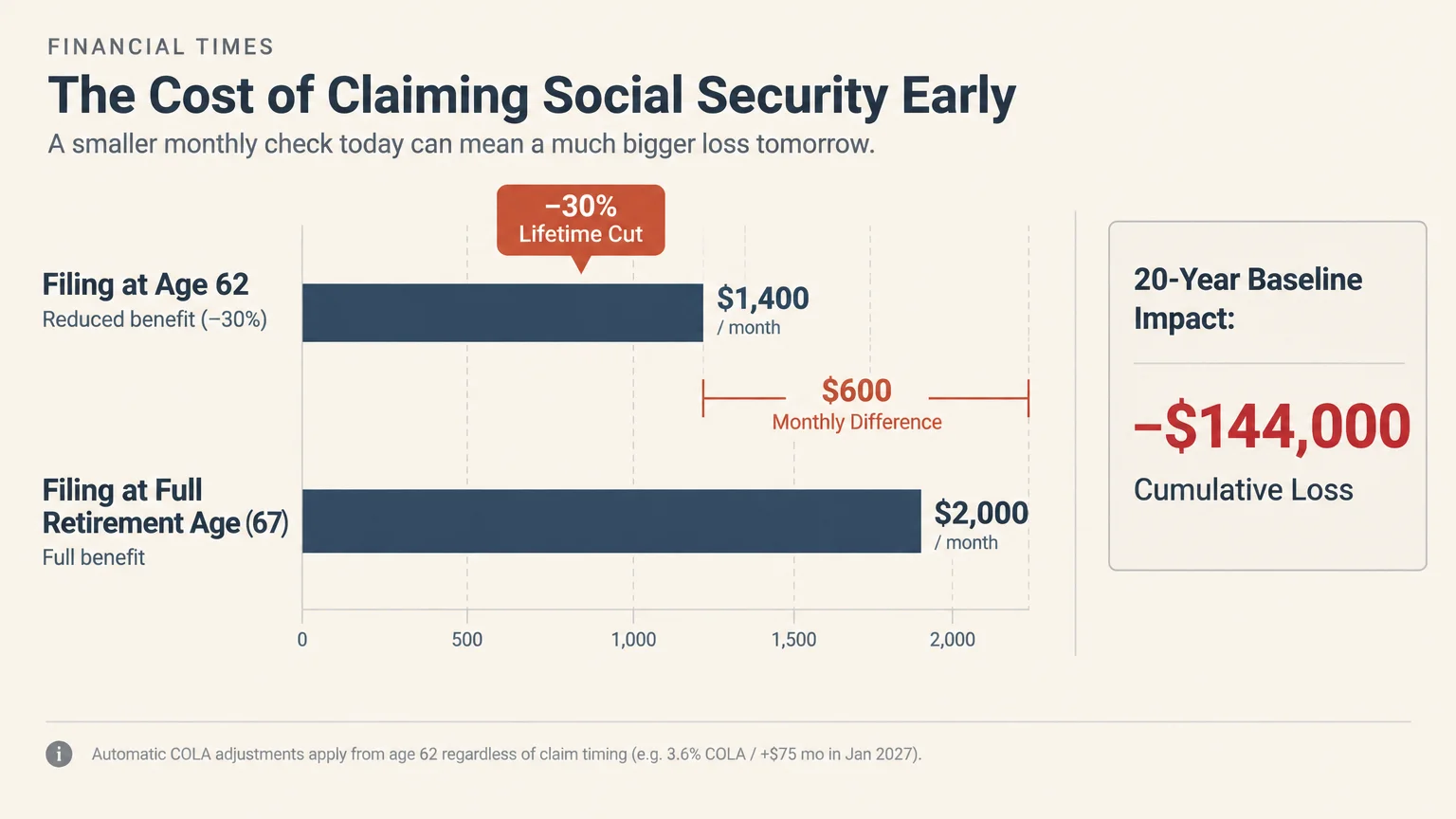
If your full retirement age is 67 and you claimed benefits at 62, the government slashes your monthly benefit by 30 percent. A primary benefit that would have reached $2,000 at age 67 shrinks to just $1,400 per month.
That $600 monthly difference compounds over time and removes thousands of dollars from your annual household budget. Over a twenty-year retirement, that single early filing choice costs you over $144,000 in baseline income.
Many workers mistakenly believe they must file early to capture annual Cost-of-Living Adjustments (COLA). In reality, federal benefit formulas automatically factor in all COLA increases beginning at age 62, even if you delay your claim.
For example, the 3.6 percent COLA taking effect in January 2027 increases average retirement checks by about $75 per month. You receive the full compounding benefit of that adjustment whether you collect benefits now or delay filing until age 70.
Early filers also discover that early retirement checks rarely keep pace with unexpected healthcare bills or rising living expenses. When regret sets in, you need to understand the official rules that grant you a financial reset.
Strategy 1: The Social Security Do-Over (Within 12 Months)
If you claimed benefits recently, federal law provides a genuine reset known colloquially as the social security do over. This provision allows you to wipe the slate clean and treat your initial claim as if it never occurred.
Under federal regulations (20 CFR 404.640 and SSA POMS GN 00206.005), you can officially withdraw social security application documents within a strict timeframe. You must submit your withdrawal request within 12 months of your first month of entitlement.
Your first month of entitlement is the first month for which you qualified for a payment, not the date your first deposit landed. If your entitlement began in February, you must file your withdrawal paperwork before the end of the following January.
The government enforces a strict one-time limit on this option. You can withdraw a retirement application only once in your lifetime, making this a singular opportunity.
To execute this reset, you must complete and file Form SSA-521 (Request for Withdrawal of Application). The current version in circulation is edition 07-2026 UF (OMB No. 0960-0015).
You can download this form directly, complete each required section, and deliver it to your local Social Security field office. Alternatively, you can upload the completed document through your personal portal at the Social Security Administration (SSA).
The application asks you to state your reason for withdrawing your claim. Simply stating that you wish to refile at a later date to receive a higher monthly benefit is an acceptable justification.

What You Must Repay Under Form SSA-521
The primary hurdle to executing an application withdrawal involves total financial repayment. If the agency approves your request, you must repay 100 percent of the gross benefits paid out on your earnings record.
The agency does not charge interest or financial penalties on this repayment. However, you must repay the gross total of every dollar distributed, rather than the net amount deposited into your checking account.
Your repayment obligation includes all monthly retirement checks you personally received during the entitlement window. It also encompasses any auxiliary benefits collected by family members on your record, including payments made to a spouse or dependent children.
If family members receive auxiliary benefits based on your earnings, they must provide written consent on Form SSA-521. If your spouse refuses to sign, the agency will reject your application withdrawal request.
You must also repay any funds withheld from your monthly checks for standard deductions. This includes voluntary federal income tax withholdings, administrative garnishments, and Medicare Part B premiums.
In 2026, the standard Medicare Part B premium equals $202.90 per month. If the government deducted Part B premiums from your monthly benefit, you must repay those premiums out of pocket as part of your settlement.
If you also choose to withdraw from Medicare Part A, you must reimburse the federal government for any hospital claims paid on your behalf. You can review coverage rules directly through Medicare.gov before making changes to health benefits.
Once the agency approves your Form SSA-521, it mails an official approval notice detailing your exact repayment balance. Federal regulation 20 CFR 404.641 gives you a 60-day window from the notice date to cancel your withdrawal if you change your mind.
Handling Taxes on Repaid Benefits
Repaying thousands of dollars in benefits creates immediate federal income tax complications. If you repay benefits within the same calendar year you received them, your year-end Form SSA-1099 will reflect net adjustments cleanly.
Complications emerge when you repay benefits received during a prior calendar tax year. Because you already reported that benefit income on your previous federal tax return, you must use specific tax provisions to recover overpaid taxes.
According to Internal Revenue Service (IRS) rules outlined in IRS Publication 915, you cannot simply file an amended return for the previous tax year. Instead, your tax treatment depends directly on whether your total repayment exceeds $3,000.
When your repayment exceeds $3,000, federal law permits you to use one of two distinct tax recovery calculations. You can choose the method that generates the greatest tax savings for your current tax year.
Your first option allows you to claim an itemized deduction on Schedule A for the full amount repaid. This deduction reduces your current year taxable income, but only helps if your itemized deductions exceed the standard deduction.
Your second option uses Internal Revenue Code Section 1341, commonly known as the “claim of right” doctrine. Under this provision, you calculate how much your prior year tax bill would have dropped without the Social Security income.
You then claim that exact dollar difference as a direct refundable credit on your current federal tax return. For most retirees, the Section 1341 tax credit yields far greater savings than an itemized deduction.
Strategy 2: Voluntary Suspension at Full Retirement Age
Many retirees realize they claimed social security early long after their initial 12-month withdrawal window has closed. If more than 12 months have passed since your entitlement date, you cannot submit Form SSA-521.
Fortunately, you can access a powerful social security second chance once you celebrate your full retirement age. You cannot pause your benefits while under full retirement age, but the rules change completely the month you reach that milestone.
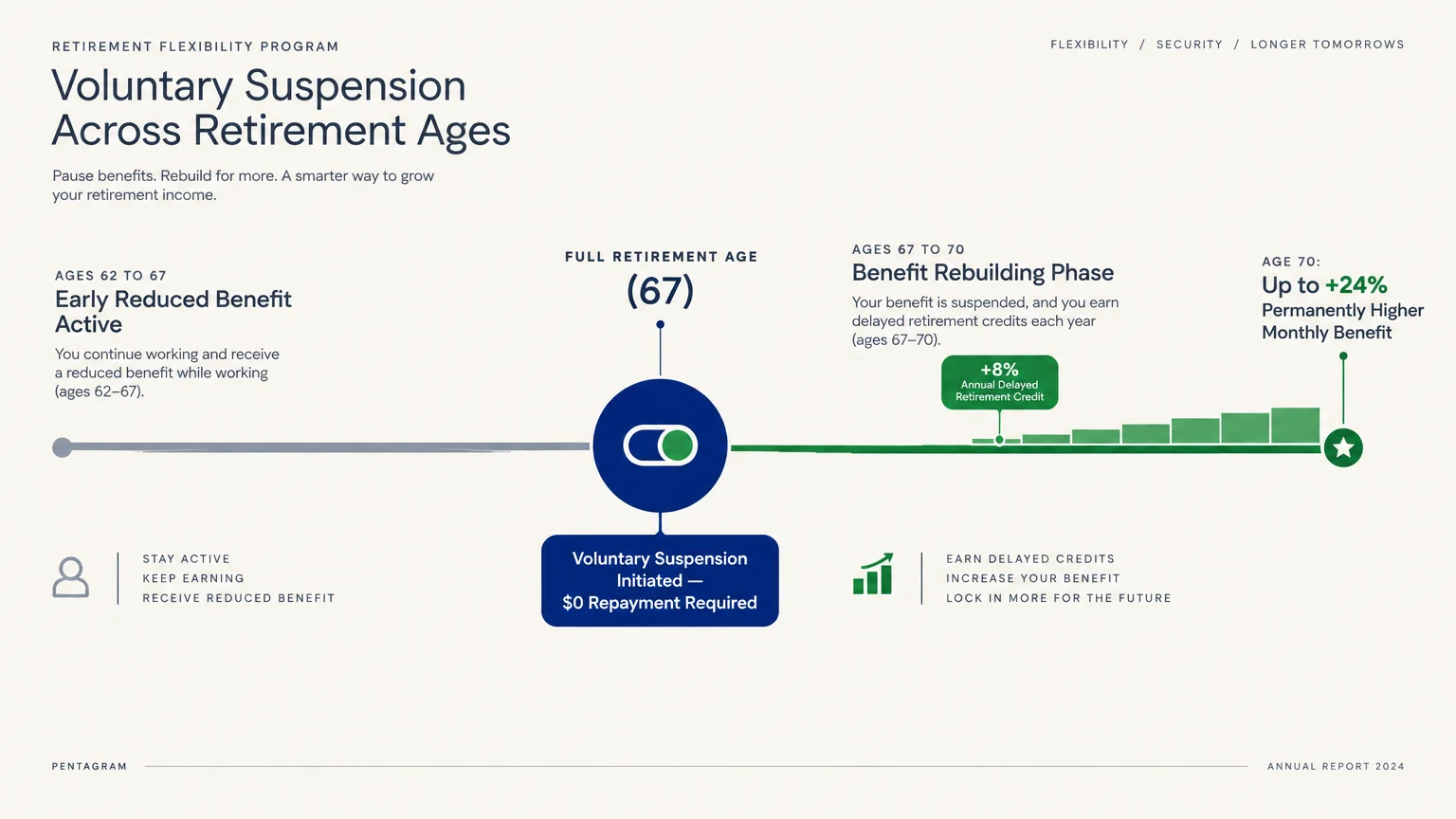
Upon reaching full retirement age, you hold the legal right to request a voluntary suspension of your monthly benefits. You do not need to repay a single penny of the benefits you already collected in previous years.
When you voluntarily suspend your benefits, payments stop immediately. During this suspension period, you earn Delayed Retirement Credits that increase your future monthly payment amount.
“Every month you delay claiming benefits between full retirement age and age 70 locks in a permanent eight percent annual increase in guaranteed income.” — Suze Orman, Personal Finance Author
Delayed Retirement Credits accrue at a rate of 2/3 of 1 percent for every month your payments remain suspended. This equals an annual benefit increase of 8 percent for every full year of suspension.
You can maintain this benefit suspension until you reach age 70. At age 70, the Social Security Administration automatically restarts your monthly benefit checks at the permanently elevated rate.
For example, assume your full retirement age is 67 and your reduced early benefit equals $1,400 per month. If you suspend your payments from age 67 until age 70, you earn 24 percent in total delayed credits.
At age 70, your monthly check climbs from $1,400 to $1,736, plus all cumulative COLA increases awarded during the interim. This strategy provides an effective path to boost monthly income without liquidating savings to fund repayments.
Keep in mind that suspending your benefit also suspends any auxiliary payments going to family members on your record. Only a divorced spouse receiving benefits on your record can continue receiving checks while your benefits remain suspended.
Strategy 3: The Earnings Test Alternative If You Return to Work
If you claimed benefits early and recently returned to the workforce before full retirement age, a third mechanism exists. The Retirement Earnings Test can functionally pause your benefits and restore your monthly payouts later.
Many working retirees view the Retirement Earnings Test as an unfair financial penalty. In reality, the earnings test acts as an automatic deferral system that restores your monthly benefit calculations over time.
If you remain under full retirement age for the entire year, the government establishes an annual earnings threshold. In 2026, you can earn up to $24,480 per year ($2,040 per month) without triggering benefit reductions.
For every $2 you earn above $24,480, the Social Security Administration withholds $1 from your retirement benefit checks. In 2027, this exempt earnings threshold increases to $25,560 per year ($2,130 per month).
A higher limit applies during the specific calendar year in which you attain full retirement age. In 2026, the earnings limit in the months prior to your birthday reaches $65,160 ($5,430 per month).
For every $3 you earn above $65,160 during that final stretch, the agency withholds $1 in benefits. In 2027, this threshold increases to $67,920 ($5,660 per month).
The money withheld under the earnings test is never lost or forfeited to the federal government. When you finally reach full retirement age, the agency automatically recalculates your primary insurance amount.
The agency removes the early claiming reduction penalty for every single month your benefits were withheld due to work. This administrative adjustment permanently increases your monthly check for the remainder of your life.
If high wages cause the agency to withhold 24 months of checks before full retirement age, your benefit adjusts upward accordingly. Educational resources at AARP emphasize that this adjustment occurs automatically without requiring new application forms.
Comparing Your Three Second-Chance Options
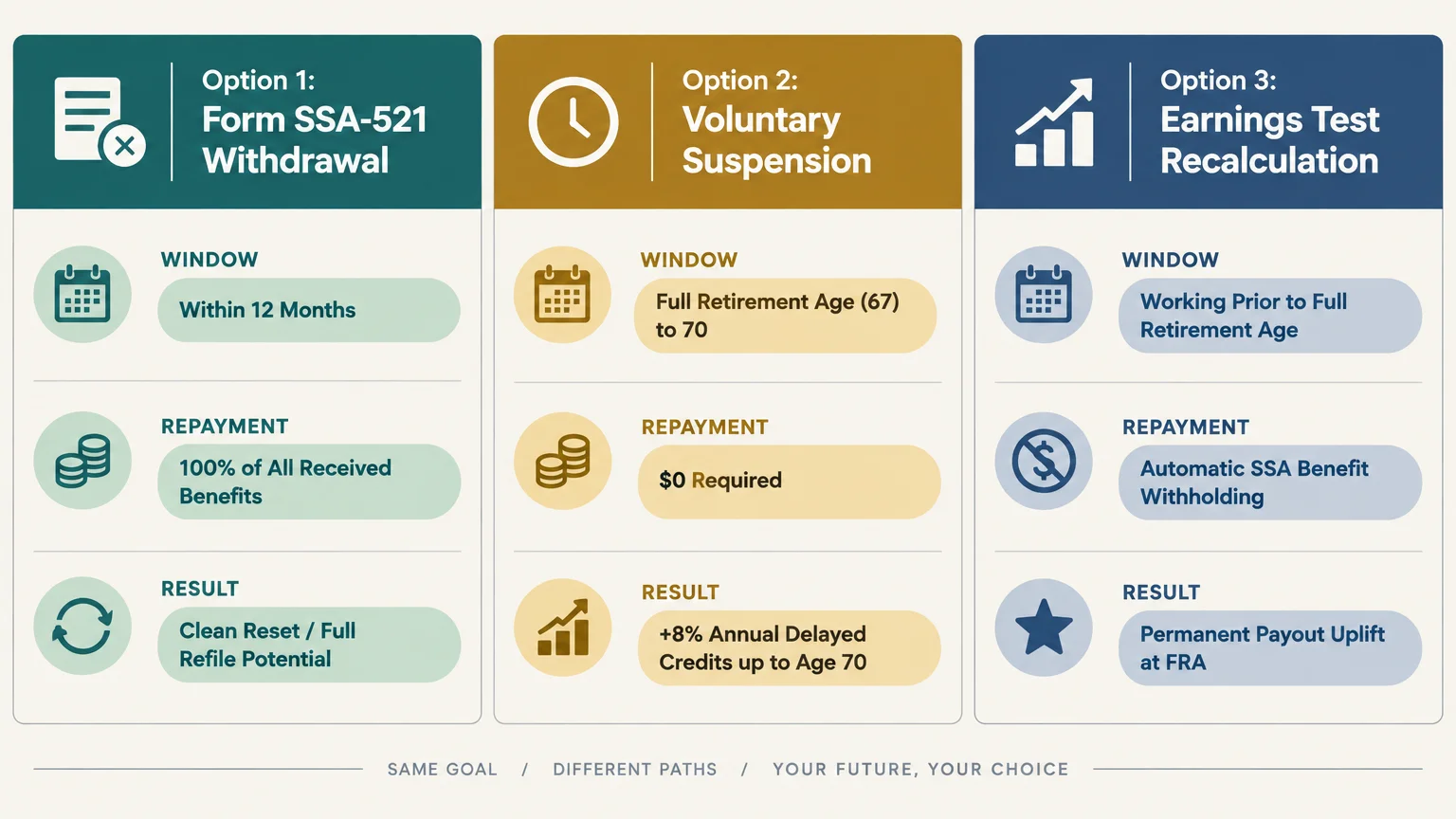
Each method for resetting an early claiming choice serves a distinct financial profile and timeline. Choosing the right path depends on your current age, available liquidity, and long-term income goals.
| Strategy | Eligibility Window | Repayment Required? | Long-Term Benefit Impact | Best Suited For |
|---|---|---|---|---|
| Application Withdrawal (Form SSA-521) | Within 12 months of first entitlement month | Yes (100% of gross benefits plus auxiliaries) | Erases early filing penalty entirely; resets baseline | Retirees with substantial cash reserves or new high-income jobs |
| Voluntary Suspension | Between Full Retirement Age and age 70 | No repayment required | Earns 8% annual Delayed Retirement Credits up to age 70 | Retirees past the 12-month window who can afford pausing income |
| Earnings Test Recalculation | Any age prior to Full Retirement Age | No (benefits withheld automatically from payroll) | Permanently removes early penalty for withheld months at FRA | Early claimers who re-entered the workforce with substantial earnings |
The application withdrawal offers the cleanest reset because it erases your prior filing history. It allows you to restart your benefit growth trajectory from scratch, maximizing your future age-70 payout.
Voluntary suspension requires patience because you must wait until reaching full retirement age. However, it requires zero capital outlay, making it accessible to individuals without large liquid cash reserves.
The earnings test operates in the background for active workers under full retirement age. It provides a structured mechanism to reverse early claiming penalties simply by earning wages at an active job.
Common Mistakes to Avoid
Executing a Social Security reset requires meticulous attention to federal regulations and deadlines. Small administrative oversights can derail your strategy and lock in permanent reductions.
- Missing the 12-Month Entitlement Deadline: The calendar begins ticking on your first month of legal entitlement, not the day your initial direct deposit clears. Missing this date by a single week permanently eliminates your right to withdraw your claim.
- Forgetting Auxiliary Benefits and Spousal Consent: Withdrawing your claim cancels benefits for any family member drawing on your record. Failing to secure their written consent on Form SSA-521 results in an immediate rejection.
- Triggering Unintended Medicare Lapses: If your monthly Social Security check pays your Part B premiums, withdrawing your claim disrupts payment processing. You must coordinate direct premium payments with Medicare to avoid losing coverage.
- Overlooking the Section 1341 Tax Recovery: Many retirees take standard itemized deductions when repaying prior-year benefits. Calculating your savings under the IRC Section 1341 claim of right credit often delivers thousands of dollars in extra tax savings.
- Leaving Benefits Suspended Past Age 70: Delayed Retirement Credits stop accumulating the month you turn 70. While benefits should restart automatically, verify with the agency to ensure your payments resume without administrative delay.
Carefully auditing these potential pitfalls protects your household budget during the transition process. Take time to verify all dates and calculations directly with agency staff before submitting paperwork.
“Your retirement strategy is not set in stone; when life changes, your financial plan must adapt to support your long-term security.” — Jean Chatzky, Financial Educator
Reviewing your household balance sheet prevents unexpected liquidity crunches when executing a do-over. Ensure you possess adequate cash reserves before writing a substantial repayment check to the government.

Professional vs. Self-Guided Decision Making
Determining whether to reverse your Social Security claiming decision involves complex tax calculations, longevity considerations, and family dynamics. While straightforward situations allow for self-guided execution, intricate balance sheets warrant professional guidance.
Consider four common retirement scenarios to determine if you need professional advisory assistance:
Scenario 1: You Hold Liquid Cash in a Bank Account
If you recently sold a home or hold ample cash reserves, repaying benefits under Form SSA-521 is mathematically straightforward. You can handle this process independently by submitting the form and cutting a single check to the agency.
Scenario 2: Repayment Requires Liquidating Tax-Deferred Accounts
If you must pull funds from an IRA or 401(k) to repay benefits, you trigger immediate taxable income. That distribution could push you into a higher tax bracket or trigger higher Medicare Part B surcharges (IRMAA). Consult a Certified Financial Planner or CPA before withdrawing retirement funds.
Scenario 3: Complex Spousal and Survivor Benefits Depend on Your Record
If your spouse expects to collect survivor benefits based on your earnings, resetting your benefit becomes a generational choice. Your monthly benefit at death determines the exact check your surviving spouse collects for life. Professional modeling helps quantify the lifetime household value of delaying your claim.
Scenario 4: Unexpected Health Declines Arise
If your health outlook changes significantly after filing, repaying benefits or suspending payments may prove counterproductive. If your life expectancy is limited, keeping smaller early benefits can generate more cumulative lifetime income than waiting for delayed credits. A comprehensive review ensures your strategy aligns with your personal medical reality.
Frequently Asked Questions About Resetting Social Security
Can I withdraw my Social Security application more than once?
No, federal law strictly limits retirement application withdrawals to one per lifetime. If you file Form SSA-521 and repay your benefits, you cannot use this specific withdrawal process a second time in the future.
What happens if my spouse received benefits on my earnings record?
If your spouse collected spousal benefits on your record, all of those payments must be repaid in full alongside your benefits. Furthermore, your spouse must sign Form SSA-521 to provide formal written consent for the withdrawal.
How does withdrawing my claim affect Medicare Part A and Part B?
You can choose to withdraw your retirement claim while keeping your Medicare coverage intact. However, because premiums will no longer be deducted from Social Security checks, you must pay your Part B premiums directly to Medicare.
Do I lose Cost-of-Living Adjustments (COLA) if I withdraw and refile later?
No, you never forfeit COLA increases by withdrawing or delaying your claim. The Social Security benefit formula automatically incorporates every annual COLA adjustment into your base benefit beginning at age 62.
Practical Next Steps
If you regret filing for benefits early, act quickly to evaluate your eligibility windows. Check your initial award notice to verify your exact month of entitlement and calculate your remaining time.
If you fall within the 12-month window, contact the Social Security Administration to request an official payoff calculation. If that window has closed, calculate your full retirement age date so you can prepare for voluntary suspension.
The information in this guide is meant for educational purposes. Your specific circumstances—including income, health needs, tax situation, and goals—may require different approaches. When in doubt, consult a licensed professional.
Last updated: November 2026. Retirement benefits, tax rules, and healthcare regulations change frequently—verify current details with official sources.