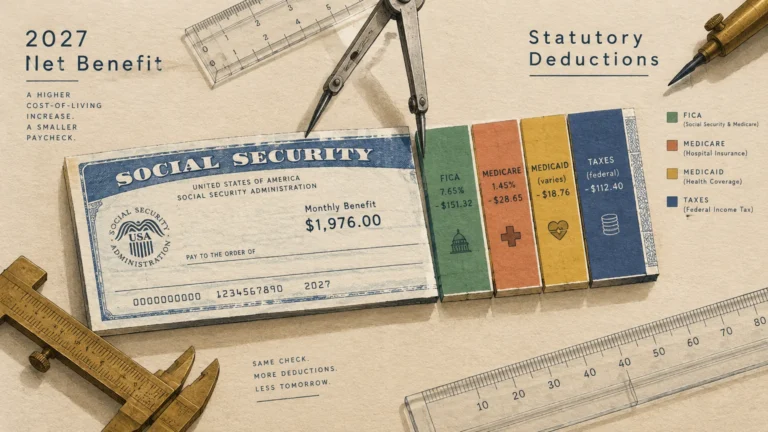

The Social Security Administration recently updated its official fee schedule, changing costs for eleven specific record and administrative requests. You will not pay a penny to claim your monthly retirement benefits, but third-party and archival services now carry revised price tags.
The agency adjusted these charges on October 1, 2026, lowering some processing costs while raising others. Knowing the exact breakdown helps you avoid unnecessary fees and protect your retirement budget.
Several essential earnings statements remain entirely free if you request them through the right channels. Here is everything you need to know about who pays, what changed, and how to keep your hard-earned money.

The Core Rule: Routine Benefits Remain Completely Free
Many headlines create unnecessary panic whenever government administrative schedules change. You should know upfront that your normal interactions with Social Security remain completely free of charge.
You never pay a fee to apply for retirement, spousal, disability, or survivor benefits. The agency also processes your Medicare enrollment and issues replacement Social Security cards at zero cost.
Under Section 1106(c) of the Social Security Act, administrative fees apply only to non-program information requests. These involve tasks that fall outside the normal administration of your monthly benefits.
Third parties request the vast majority of these paid services. Private disability insurers, mortgage lenders, background check companies, and pension administrators pay these charges regularly.
Individual retirees rarely need to pay these fees unless they require certified historical earnings records for private legal proceedings. Genealogists researching deceased ancestors also pay these fees to obtain historical application files.
Why Social Security Updates Administrative Fees Every Two Years
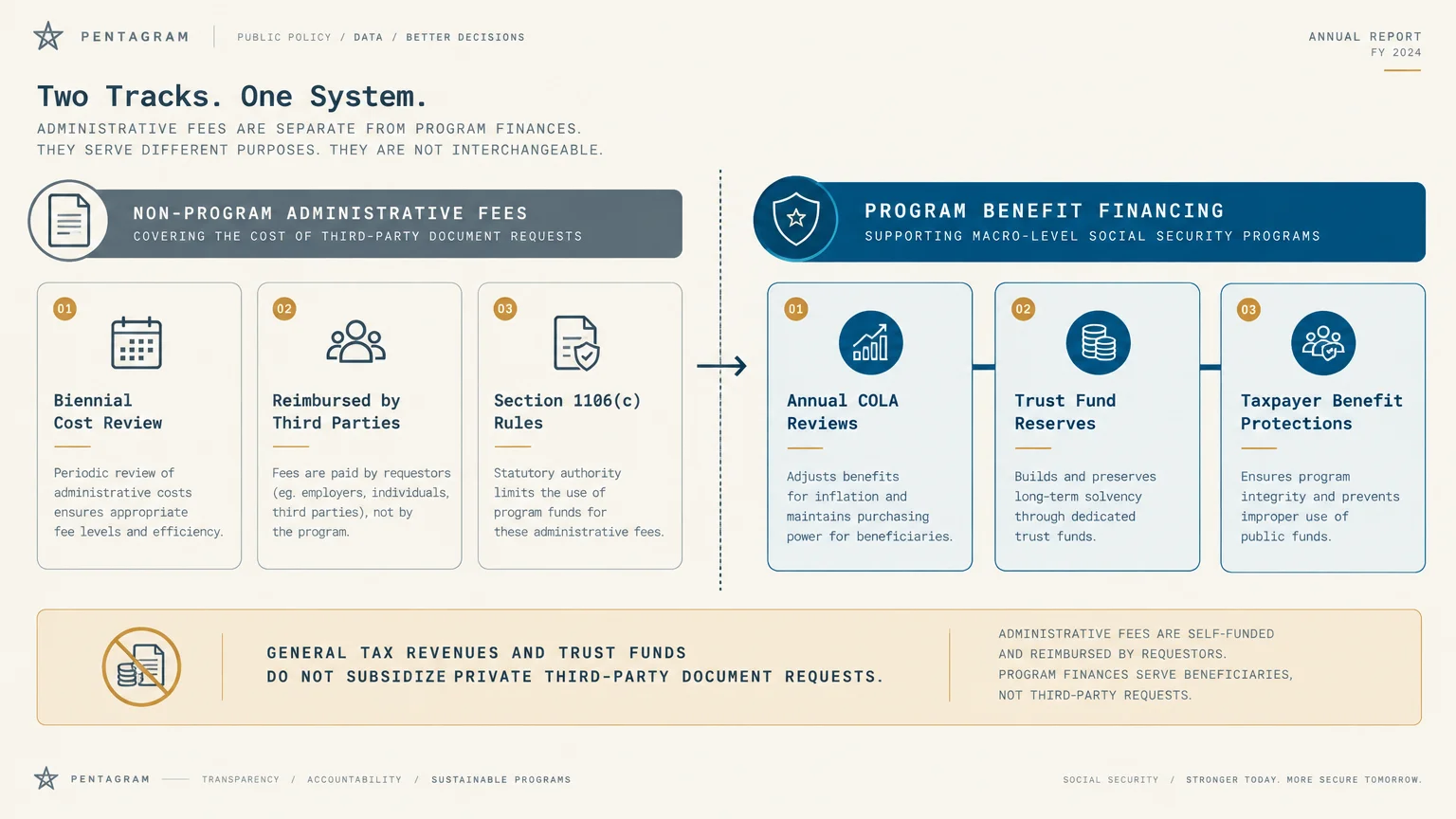
Federal law requires the Social Security Administration to review its non-program administrative fees every two years. This biennial review ensures the agency charges requesters the actual cost of providing specialized services.
The previous fee schedule took effect on August 23, 2024. The agency published its updated rates in the Federal Register on September 21, 2026, setting an effective date of October 1, 2026.
General tax revenues and Social Security trust funds cannot subsidize private information searches. When a private corporation or law firm requests detailed files, law dictates that they must reimburse taxpayers for the agency’s time.
Technological improvements led to price reductions for several digital services. As automated scanning and digital retrieval replace manual searches, processing expenses drop for electronic records.
Conversely, services requiring hands-on manual labor from agency personnel saw notable price increases. Locating physical paper folders in federal archives demands significant staff time, which pushed those fees upward.
The 11 Updated Social Security Fees in Detail
The updated schedule adjusts eleven specific administrative fees, with seven prices falling and four prices rising. Understanding each category ensures you never overpay when requesting documentation.
1. Copying a Paper Folder
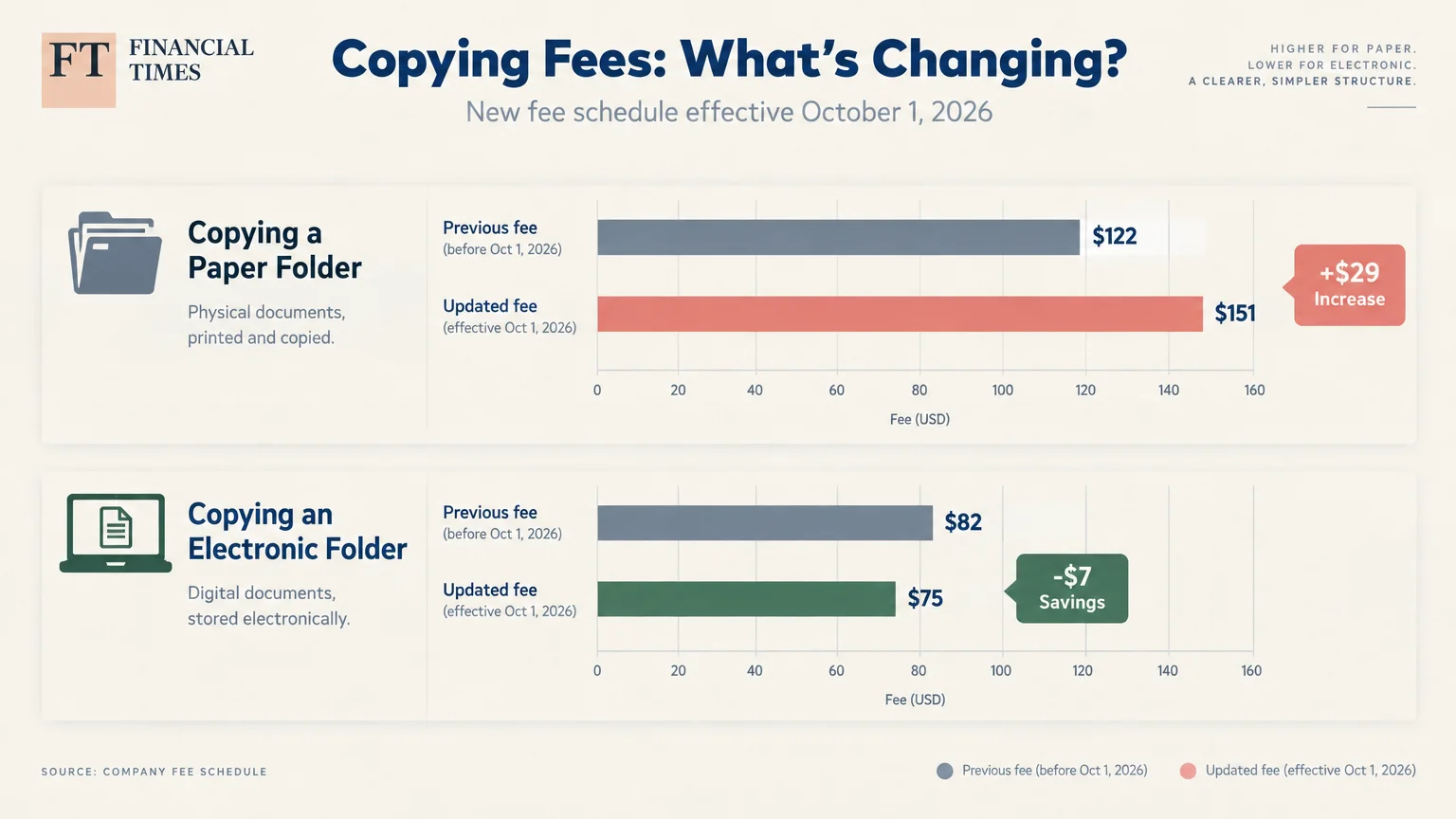
The fee to copy a paper folder increased from $122 to $151. This $29 hike represents the largest single dollar increase across the entire fee schedule.
Retrieving paper files requires staff to pull physical boxes from regional archive repositories. Technicians must manually photocopy pages, redact sensitive third-party details, and prepare files for secure shipping.
2. Copying an Electronic Folder
Copying an electronic folder now costs $75, down from the previous rate of $82. Modern document databases allow staff to compile digital records with minimal manual intervention.
This $7 savings reflects ongoing investments in federal digital record infrastructure. Requesters receive these encrypted files electronically, eliminating postage and paper supplies.
3. Third-Party Manual SSN Verification
The fee for manual Social Security number verification rose from $61 to $74. Private employers, background screening services, and financial institutions request this manual validation service.
When automated verification fails due to mismatched names or transposed digits, an agency specialist reviews the record manually. The $13 increase covers the growing personnel cost required for detailed identity checks.
4. Field Operations and Headquarters Certification
Official record certification handled by Field Operations or Headquarters dropped from $82 to $65. This service was previously labeled Regional Office Certification in older fee schedules.
Parties involved in state or federal litigation purchase this service to validate agency documents. The certification attaches a formal seal verifying that the submitted document represents an authentic government record.
5. Historical W-2 and W-3 Requests
Ordering historical copies of Form W-2 or Form W-3 now costs $54 per form, down from $62. You can request copies of your historical earnings tax forms going back multiple decades.
Keep in mind that the agency charges this $54 fee for each individual tax year requested. If you request five prior years of tax records, you will owe $270.
6. Form SSA-7050 Uncertified Detailed Earnings
Filing Form SSA-7050 for uncertified detailed earnings dropped from $61 to $49. The agency handles roughly 66,800 of these specific information requests every year.
This report provides an itemized list of your lifetime earnings, including employer names and addresses. Workers often order this detailed report to prove past employment for union pensions or civil service credits.
7. Record Extract Processed in a Field Office
Extracting a specific record inside a local field office now costs $46, up from $41. Field office staff pull targeted data points from agency software for private legal or administrative needs.
The modest $5 increase reflects general administrative overhead across field locations. Most retirees never need this extract because standard benefit summaries provide identical core information.
8. Central Processing Certification
Central Processing Certification dropped from $35 to $30. The Office of Central Operations in Baltimore handles these specialized document validations.
This fee applies when you need a central agency official to verify your detailed wage history. It commonly pairs with Form SSA-7050 when entering earnings evidence into legal proceedings.
9. Certified Detailed Yearly Earnings Totals
Ordering certified detailed yearly earnings totals now costs $79, down from $96. This combined service includes the $49 uncertified Form SSA-7050 base fee plus the $30 central certification fee.
Attorneys handling workers’ compensation, probate, or personal injury cases frequently purchase this complete package. It delivers a court-ready, certified summary detailing every past employer and wage amount.
10. Copy of Original Form SS-5 Application
Obtaining a copy of your original Form SS-5 dropped from $27 to $23. Form SS-5 is the original application you or your parents submitted when you first applied for a Social Security card.
Historians and genealogists frequently purchase these original applications to discover ancestral details. The form shows the applicant’s signature, birth city, and parents’ full names as reported decades ago.
11. Copy of the Numident Record
Ordering a Numident record extract now costs $22, down from the earlier $26 rate. The Numident represents the computer database extract summarizing your initial card application.
It provides the same vital family information as the paper SS-5 application without the applicant’s physical handwriting. Because it extracts directly from digital records, it remains the most affordable archival document available.
Fee Schedule Comparison: Previous Rates vs. Updated Rates
Comparing past and current rates highlights how digitization lowers administrative expenses. The following table outlines the updated fees effective for all requests received on or after October 1, 2026.
| Service / Document Description | 2024 Fee | 2026 Fee | Net Change | Primary Requester |
|---|---|---|---|---|
| Copying Paper Folder | $122 | $151 | +$29 | Attorneys, Insurers |
| Copying Electronic Folder | $82 | $75 | -$7 | Attorneys, Claimants |
| Third-Party Manual SSN Verification | $61 | $74 | +$13 | Employers, Lenders |
| Field Operations / Headquarters Certification | $82 | $65 | -$17 | Courts, Litigants |
| W-2 / W-3 Copy (Per Form Requested) | $62 | $54 | -$8 | Taxpayers, Executors |
| Form SSA-7050 Detailed Earnings (Uncertified) | $61 | $49 | -$12 | Pension Claimants |
| Record Extract (Field Office Processed) | $41 | $46 | +$5 | Private Litigants |
| Central Processing Certification | $35 | $30 | -$5 | Legal Representatives |
| Certified Detailed Earnings (Form SSA-7050 + Cert) | $96 | $79 | -$17 | Courts, Litigants |
| Copy of Original Form SS-5 Application | $27 | $23 | -$4 | Genealogists, Families |
| Copy of Numident Computer Extract | $26 | $22 | -$4 | Genealogists, Researchers |
Seven of the eleven fees decreased under the updated schedule. Only physical folder handling, manual identity verification, and local field office extracts grew more expensive.
How Retirees Can Access Lifetime Earnings Records for Free
You should never pay $49 or $79 simply to check your career earnings record. The agency provides complete earnings statements online at no cost to all American workers and retirees.
You can view your complete yearly earnings record by creating an account on the Social Security Administration website. Your online portal displays your reported earnings for every working year since your first job.
The free online statement also provides your personalized retirement benefit estimates at ages 62, 67, and 70. It shows your eligibility status for disability benefits and Medicare coverage as well.
If you prefer paper mail, you can download and mail Form SSA-7004, titled Request for Social Security Statement. The agency will mail your uncertified lifetime earnings summary to your home address for free.
The only difference between the free statement and Form SSA-7050 involves employer names. The free statement shows annual earnings totals, while the paid $49 form lists specific company names and addresses.
Unless a private pension board demands proof of work for a specific employer name, the free statement fulfills every retirement planning need. You can verify your work credits without spending a single dollar.
“Financial peace of mind comes from knowing where you stand and eliminating unnecessary costs before they compound.” — Jean Chatzky, Financial Educator
Advance Payment Rules and Submission Deadlines
The agency enforces strict payment guidelines for non-program record requests. Understanding these administrative mechanics prevents paperwork rejections and lost processing time.
The updated fee schedule applies strictly based on the date the agency receives your request, not the postmark date. If you mailed an application in late September 2026 that arrived in October, the agency applies the updated fee schedule.
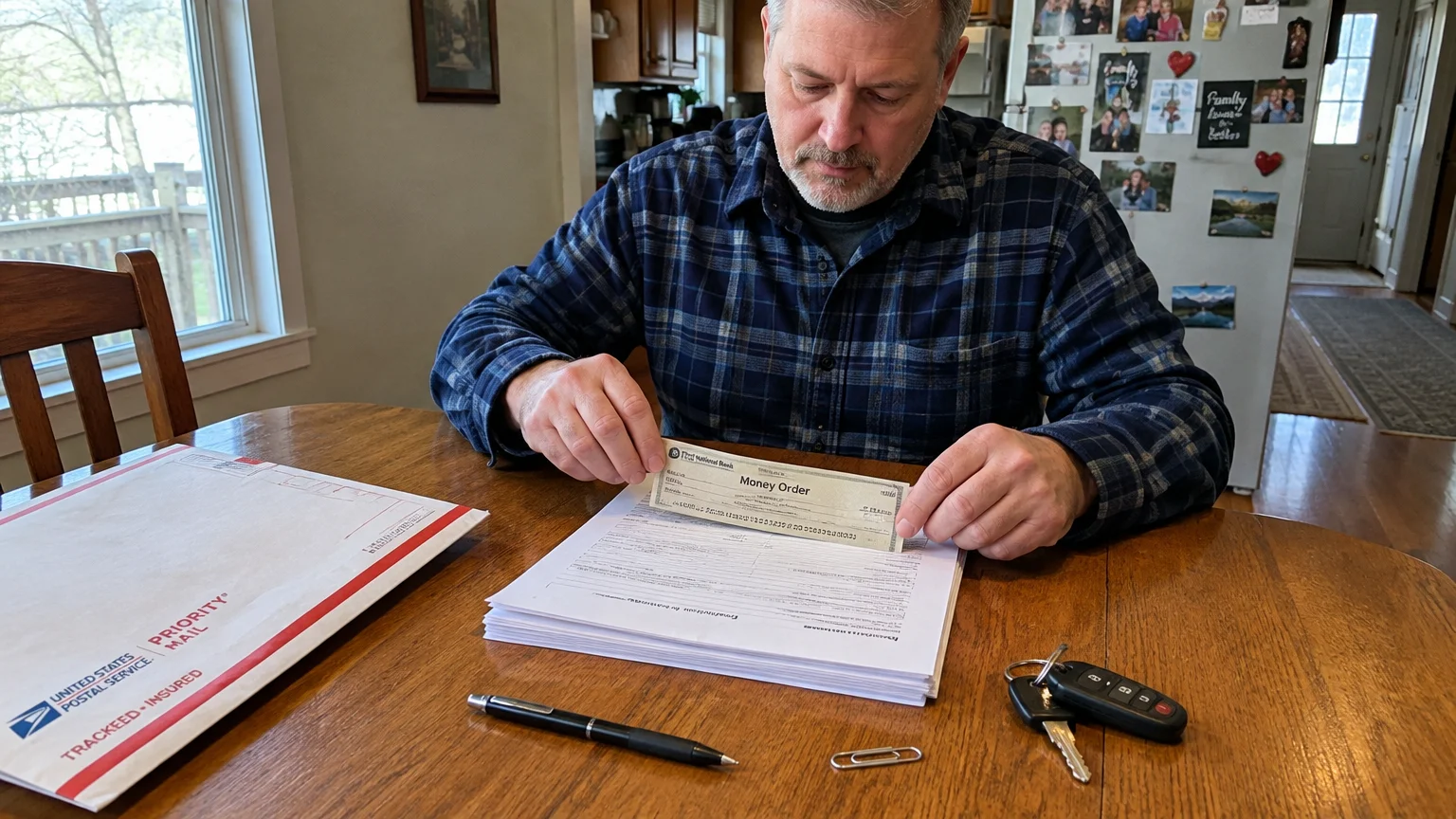
The Social Security Administration mandates advance payment before staff begin processing any record request. If your payment falls short by even one dollar, staff will return your entire packet unprocessed.
You must pay using an approved payment method, including personal checks, cashier’s checks, money orders, or credit cards. The agency strictly prohibits sending cash through the mail.
All administrative fees are nonrefundable once processing starts. Even if the search turns up no matching records or your private lawsuit settles early, the government retains your payment.
2027 Representative Payee Fee Adjustments
Alongside non-program record fees, retirees must track program-related representative payee fee changes. The agency periodically adjusts these compensation caps to reflect annual cost-of-living adjustments.
When an aging retiree or disabled beneficiary cannot manage their finances, the agency appoints a representative payee. Family members and personal friends who serve as payees can never charge a fee for their help.
However, qualified non-profit organizations and government agencies can register as authorized fee-for-service payees. These professional entities manage monthly checks, pay living expenses, and submit annual financial accountings.
Federal law caps the monthly fee an organizational payee can deduct from a beneficiary’s payment. An organization may collect the lesser of 10% of the monthly benefit or a statutory dollar ceiling.
Following the 3.6% cost-of-living adjustment announced for 2027, the standard monthly cap increases to $59 starting in January 2027. This rate rises from the $57 monthly ceiling enforced during 2026.
A higher fee ceiling applies when an authorized organization serves a disabled beneficiary with an active substance abuse condition. In those complex cases, the monthly fee cap rises to $110 in January 2027, up from $106 in 2026.
Protecting vulnerable retirees from excessive management fees remains a top priority for consumer watchdogs. You can review payee protections and elder financial safety rules through the Consumer Financial Protection Bureau.
2027 Claimant Representative and Attorney Assessment Limits
Retirees appealing a denied disability or retirement benefit claim often hire an accredited attorney or representative. Distinct federal rules govern how representatives receive payment from past-due benefits.
Standard fee agreements cap representative fees at 25% of past-due benefits or a statutory maximum amount. The maximum dollar limit under standard fee agreements remains $9,200.
When the agency approves an appeal, it pays the representative directly from the claimant’s back pay. To cover administrative costs, the government charges the representative an assessment fee known as a user fee.
Starting in December 2026 for the 2027 calendar year, the representative assessment cap rises to $128, up from $123. The agency deducts this $128 fee directly from the representative’s earnings.
You do not pay this $128 user fee out of your personal pocket as a claimant. The representative absorbs this cost from their approved fee share, preserving your awarded back payments.
“Consumers deserve transparent rules, fair fees, and clear access to the public records that shape their financial lives.” — Elizabeth Warren, U.S. Senator
Broader 2027 Social Security Financial Changes
Fee updates represent only one piece of the financial adjustments arriving for 2027. The annual 3.6% cost-of-living adjustment alters several core thresholds across the Social Security system.
The average monthly retirement benefit increases by approximately $75, rising from $2,095 to $2,170 in January 2027. This additional cash flow helps retirees manage rising living costs and grocery expenses.
Higher-income workers will also see changes in their payroll tax liabilities. The maximum taxable earnings wage base rises to $192,300 in 2027, up from $184,500 in 2026.
Earnings above $192,300 escape the 6.2% Social Security payroll tax deduction. Staying current on tax thresholds helps workers balance retirement contributions and estimate future take-home pay through the Internal Revenue Service.
Retirees enrolled in Medicare must also monitor how benefit increases interact with Part B premiums. Exploring benefit updates through advocacy groups like AARP ensures you anticipate net changes to your monthly deposit.
What Can Go Wrong: Costly Request Pitfalls to Avoid
Navigating government forms can lead to frustrating delays if you overlook procedural rules. Avoiding common record-ordering mistakes protects both your wallet and your personal timeline.
- Paying Private Scammers for Free Forms: Predatory websites charge $50 or more just to download blank Social Security forms. Every single official form is completely free to print on government portals.
- Ordering Certified Records Unnecessarily: Many retirees pay $79 for certified Form SSA-7050 reports when reviewing their work history. A free online statement provides identical earnings numbers without costing a cent.
- Mailing Inaccurate Payments Based on Postmarks: Sending an outdated fee amount because you mailed a packet before an update deadline causes rejections. The agency rejects applications that arrive without the exact updated amount.
- Purchasing Multiple Individual W-2 Copies: Paying $54 per year for ten separate W-2 forms costs $540. Ordering a single Form SSA-7050 for $49 provides your complete employer wage history for a fraction of the cost.
- Sending Cash Through the Mail: The agency discards or returns cash payments without processing the requested records. Always use a traceable personal check, money order, or approved credit card form.
Reviewing your document needs carefully prevents unnecessary spending. Always confirm whether an informal summary satisfies your third-party requirement before ordering certified government packages.

When to Consult a Professional
Most retirees manage their Social Security accounts independently without professional assistance. However, specific complex scenarios warrant outside legal or financial guidance.
Consider consulting a professional in the following situations:
- Missing Wages in Pension Vesting Disputes: If a past private pension board disputes your service credits, an employment attorney can pull certified SSA-7050 wage extracts to prove active quarters.
- Appealing Denied Disability Claims: Navigating formal administrative hearings requires an accredited disability advocate or attorney who understands representative fee caps and evidentiary rules.
- Resolving Fraudulent Earnings and Identity Theft: If unauthorized wages appear under your number, a Certified Public Accountant can coordinate corrections between the agency and the tax authorities.
- Establishing Organizational Payees for Aging Relatives: An elder law attorney can help you evaluate licensed fee-for-service payees versus family guardianship options for an incapacitated loved one.
A qualified expert provides tailored clarity during stressful legal and financial transitions. Their guidance ensures you satisfy evidentiary standards without overpaying administrative fees.
Frequently Asked Questions About Social Security Fees
Do I have to pay a fee to apply for Social Security retirement benefits?
No, applying for your Social Security retirement, spousal, or survivor benefits is completely free. The agency never charges beneficiaries an administrative fee to process benefit claims or enroll in Medicare.
How can I check my lifetime earnings record without paying a fee?
You can check your complete yearly earnings record for free by opening a personal account on the official Social Security website. You can also mail Form SSA-7004 to receive a free uncertified earnings statement by postal mail.
Can a family member charge a fee for serving as my representative payee?
No, family members and personal friends cannot collect fees for serving as representative payees. Only pre-authorized fee-for-service organizations that meet strict federal licensing standards can deduct monthly administrative fees.
Why did paper record fees increase while digital record fees decreased?
Paper record copying requires physical retrieval from federal storage archives, manual redaction, and shipping labor, which drove costs up to $151. Electronic record systems allow automated document generation, lowering processing expenses down to $75.
Taking Control of Your Retirement Records
Social Security’s updated administrative fee schedule reflects the real cost of handling specialized non-program record requests. Most retirees will never need to spend a dime on these administrative services during their retirement years.
Take time this week to log into your personal online Social Security account and review your career earnings history. Verifying your wage credits costs nothing today and guarantees that your future monthly benefit arrives accurately.
This article provides general retirement education and information only. Every retiree’s situation is unique—what works for others may not work for you. For personalized advice, consider consulting a qualified financial professional such as a CFP or CPA.
Last updated: November 2026. Retirement benefits, tax rules, and healthcare regulations change frequently—verify current details with official sources.