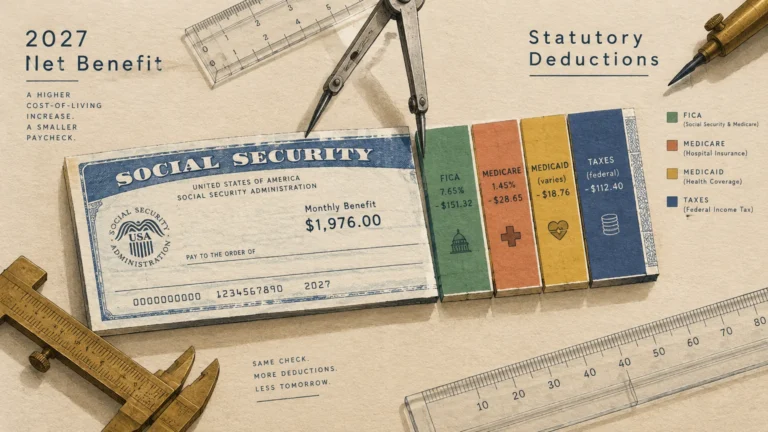

If you turn 65 in 2027, your estimated average monthly Social Security benefit will be roughly $1,665. This payout reflects the new 3.6% cost-of-living adjustment applied to current benefit baselines.
That amount sits well below the overall retiree average because claiming at 65 triggers an early filing reduction. Anyone born in 1962 faces a full retirement age of 67.
Deciding whether to claim at 65 requires balancing your immediate income needs against lifetime benefit reductions. Navigating this timing correctly ensures you protect your retirement cash flow.
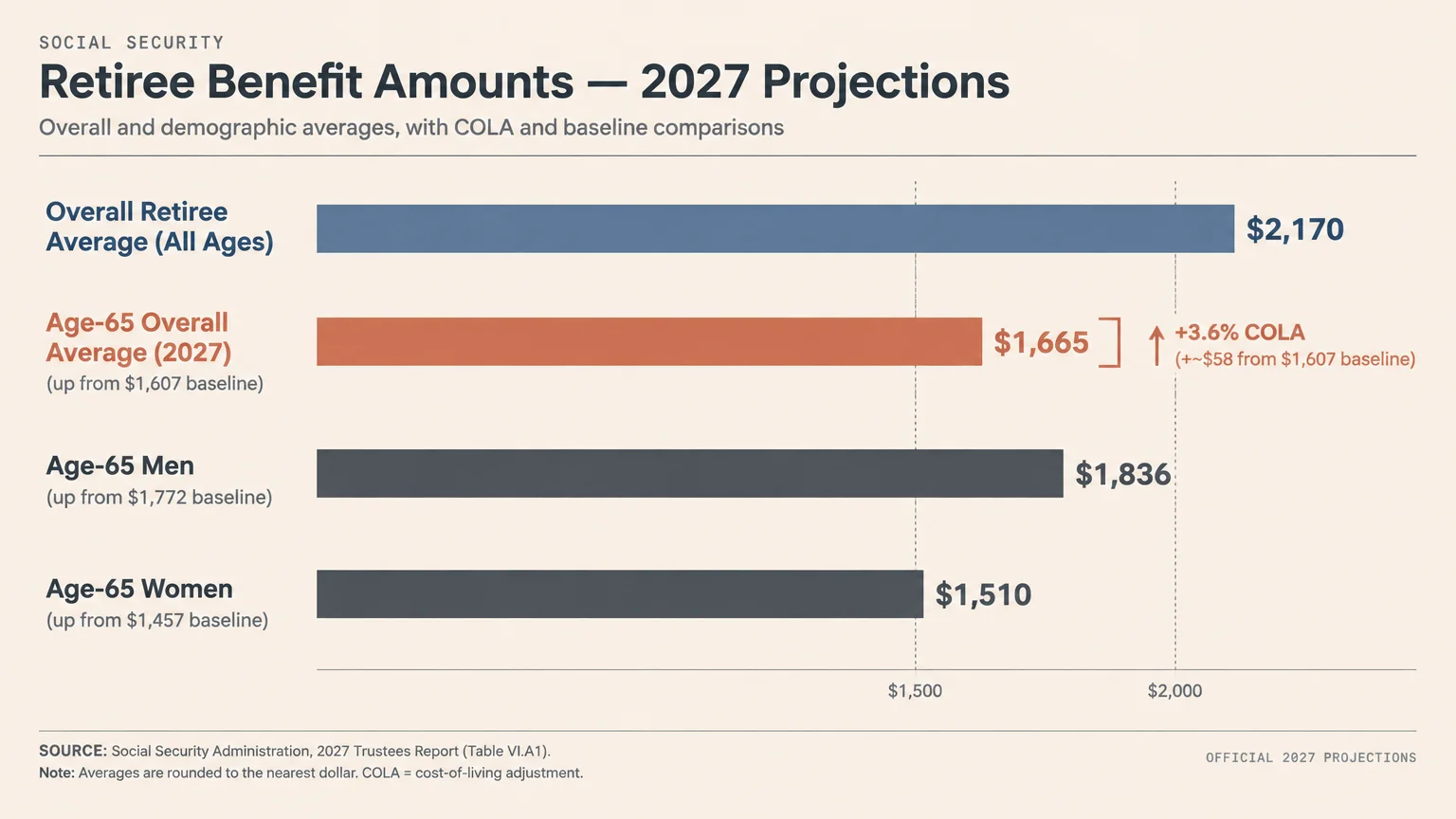
Projected Age-65 Social Security Benefits for 2027
Official data from the Social Security Administration establishes a baseline monthly payment of $1,607.27 for 65-year-old retirees. That baseline reflects benefits paid to beneficiaries who claimed prior to 2027.
Applying the 3.6% Cost-of-Living Adjustment (COLA) adds roughly $58 per month to that baseline figure. Consequently, the typical 65-year-old beneficiary will collect approximately $1,665 each month starting in January 2027.
Monthly benefits differ significantly across demographic groups because lifetime earnings determine your final primary insurance amount. Historical wage disparities continue to shape these payment differences.
Among 65-year-old men, the previous baseline of $1,772.00 increases to an estimated $1,836 per month in 2027. For 65-year-old women, the previous baseline of $1,457.40 rises to approximately $1,510 per month.
This $1,665 average sits well below the overall average for all retired workers. Across all age brackets, the average monthly retirement check climbs from $2,095 to $2,170 in 2027.
The wider retiree pool includes individuals who waited until their full retirement age or delayed until age 70. Those later filing ages lock in significantly larger monthly checks.
Understanding the 3.6% Cost-of-Living Adjustment
On October 14, 2026, the federal government finalized the 2027 COLA at 3.6%. This increase represents a noticeable jump from the 2.8% adjustment implemented in 2026.
The adjustment raises the overall average retirement check by $75 per month across the country. It helps retirees preserve their purchasing power against elevated costs for groceries, utility bills, and housing.
“Social Security is the only guaranteed income most Americans will have that rises automatically with inflation throughout their entire retirement.” — Jean Chatzky, Financial Journalist & CEO of HerMoney
Beneficiaries who maintain a personal online account can access their tailored payment notices ahead of time. You must register on the official portal by November 18, 2026, to view your notice electronically.
If you prefer standard mail, paper notices will arrive in mailboxes throughout December 2026. Your first updated check will arrive on your regular January payment schedule.
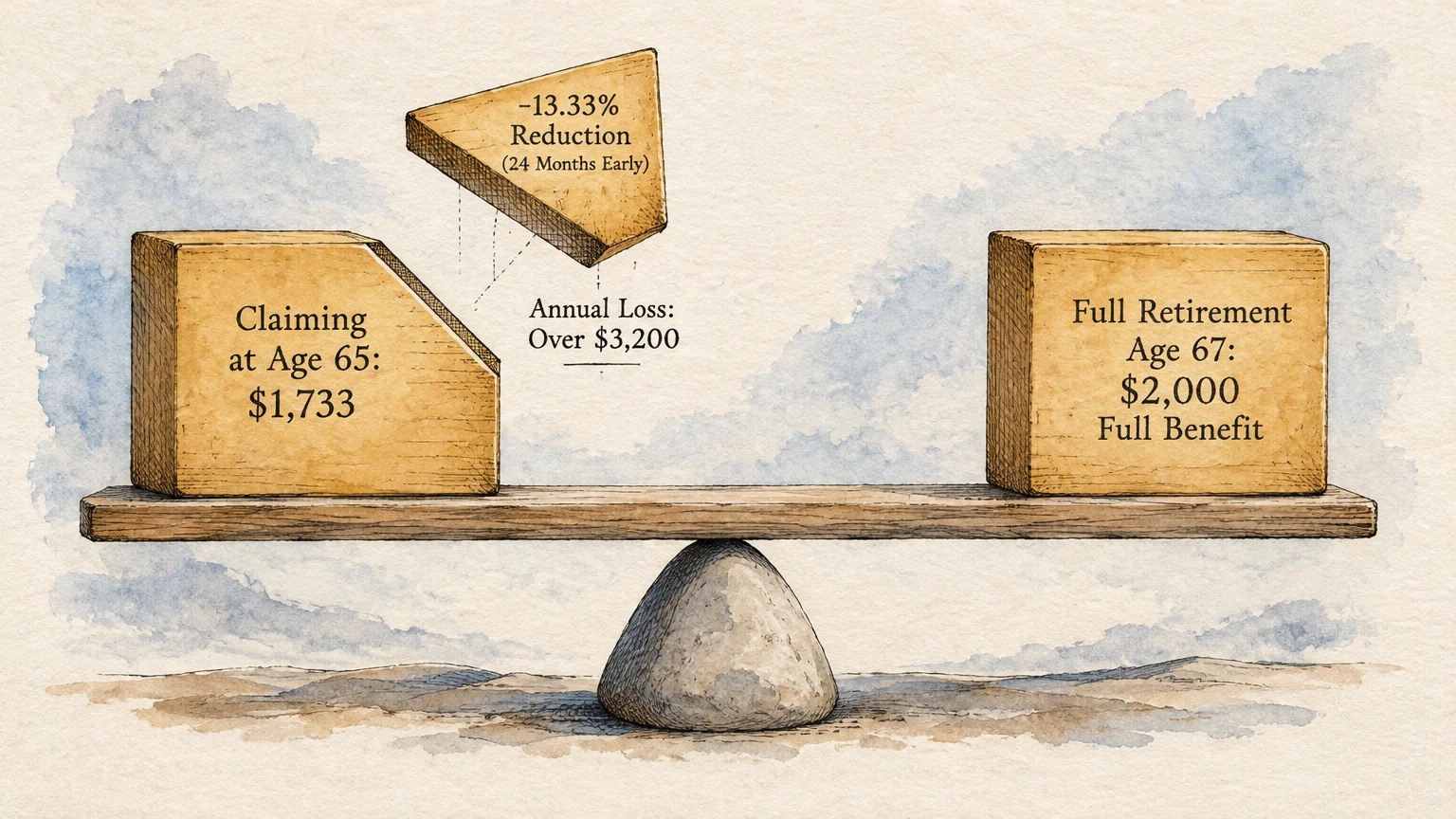
The 13.33% Early Filing Penalty at Age 65
Your birth year determines when you can access 100% of your earned retirement benefit. Anyone reaching age 65 in 2027 was born in 1962.
Federal law sets the Full Retirement Age (FRA) at 67 for all workers born in 1960 or later. Claiming at 65 means you are filing exactly 24 months early.
The government permanently penalizes early claims to account for the longer payout window you enjoy. For the first 36 months before full retirement age, the penalty equals five-ninths of 1% per month.
Multiplying that monthly reduction across 24 months creates a permanent 13.33% reduction in your payment. You surrender roughly one-eighth of your full entitlement for the rest of your life.
If your full earned benefit at age 67 is $2,000, claiming at 65 permanently reduces it to $1,733. That difference totals more than $3,200 in lost income each year.
This reduction is irrevocable once you claim; it does not reset when you reach age 67. The lower base rate also limits the dollar value of every future annual COLA you receive.
Comparing Benefit Amounts Across Different Claiming Ages
Your claiming age remains the single most powerful factor under your direct control. Filing as early as possible at 62 produces a severe 30% reduction from your baseline amount.
Conversely, delaying benefits past your full retirement age earns delayed retirement credits. Your monthly payment expands by two-thirds of 1% for each month you wait up to age 70.
The table below illustrates how claiming age alters benefit checks, based on a hypothetical $2,000 baseline at full retirement age.
| Claiming Age | Benefit Adjustment | Estimated Check ($2,000 Base) | Maximum Possible Benefit (2027) |
|---|---|---|---|
| Age 62 | 30.00% reduction | $1,400 | $2,831 |
| Age 65 | 13.33% reduction | $1,733 | $3,630 |
| Age 67 (FRA) | 0.00% reduction | $2,000 | $4,188 |
| Age 70 | 24.00% increase | $2,480 | $5,193 |
High earners who reach full retirement age in 2027 can collect up to $4,188 per month. That ceiling climbs to $5,193 per month for high earners who delay claiming until age 70.
To reach those maximum thresholds, you must earn at or above the taxable wage base for 35 working years. In 2027, that maximum taxable wage base rises to $192,300.
“If you can wait until 70 to claim Social Security, you receive a guaranteed 8% annual increase for every year past your full retirement age. That is an unbeatable return.” — Suze Orman, Personal Finance Author & Host
Before locking in an early claim, consult guidance from the Consumer Financial Protection Bureau on retirement planning tools. Comparing real numbers helps you see the cumulative impact over decades.
Working at 65: The 2027 Retirement Earnings Test
Many older adults transition into semi-retirement rather than leaving the workforce entirely. If you collect benefits at 65 while continuing to work, you must monitor the federal earnings limit.
Because you remain under full retirement age for all of 2027, you are subject to the annual retirement earnings test. For 2027, the early-claimer earnings threshold rises to $25,560 per year, or $2,130 per month.
If your earned wages exceed $25,560, the government withholds $1 in benefits for every $2 earned above the limit. Investment returns, pensions, and traditional retirement account withdrawals do not count toward this cap.
Earning credits toward coverage also requires higher wages in 2027. Qualifying for a single work credit requires $1,970 in covered earnings, up to the four-credit annual maximum.
Withheld payments are not lost forever; the administration recalculates your monthly benefit once you reach age 67. The agency adjusts your monthly payout upward to credit you for the checks withheld earlier.
Even so, dealing with withheld benefits can severely disrupt your immediate cash flow. Working full-time while collecting at 65 often results in completely suspended checks during the work year.
Medicare Part B Deductions from Your Monthly Check
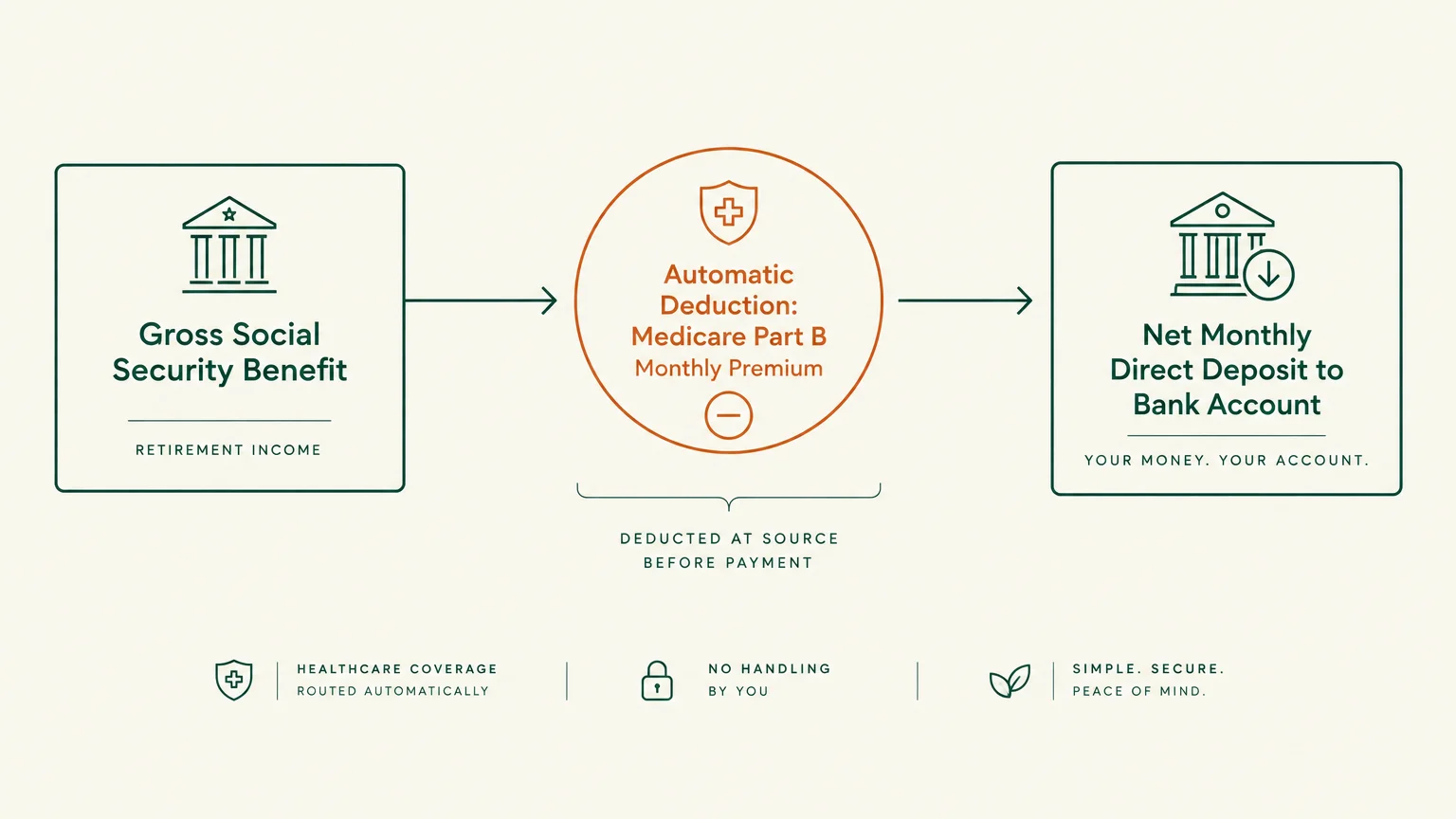
Reaching age 65 triggers standard eligibility for Medicare, regardless of when you take Social Security. If you claim both programs together, the government automatically deducts your healthcare premium from your check.
This automatic deduction means your actual bank deposit will be substantially lower than your gross award letter states. You must factor this mandatory deduction into your monthly household budget.
In 2026, the standard Medicare Part B monthly premium stood at $202.90, paired with an annual deductible of $283. Projections for 2027 indicate the standard monthly premium will rise to approximately $209.50.
The annual Part B medical deductible is also projected to increase to roughly $292 in 2027. Final figures will be confirmed by Medicare.gov before the calendar year begins.
Subtracting a $209.50 premium from an average $1,665 gross check leaves you with approximately $1,455.50 in take-home cash. That leaves many single retirees with very tight margins for other living expenses.
High-income retirees also face the Income-Related Monthly Adjustment Amount (IRMAA). These surcharges add extra charges to Part B and Part D premiums based on tax returns from two years prior.
Spousal and Survivor Impacts When Claiming at 65
Filing decisions made at age 65 rarely affect only one person. If you are married, your decision directly influences the financial security of your surviving partner.
A spousal benefit allows a lower-earning partner to receive up to 50% of the primary earner’s full retirement age amount. However, claiming that spousal benefit at 65 reduces the percentage below the standard 50% benchmark.
More importantly, survivor benefits depend heavily on when the primary earner filed. If you claim at 65, your surviving spouse inherits that permanently reduced benefit amount after your death.
Couples should look beyond their joint life expectancy when picking a claiming date. Delaying the higher earner’s benefit creates a larger, inflation-adjusted safety net for the surviving spouse.
Divorced individuals married for at least ten consecutive years can also collect benefits based on an ex-spouse’s earnings record. Your ex-spouse’s current marital status will not interfere with your earned claim.
Taxation Rules for Social Security Income
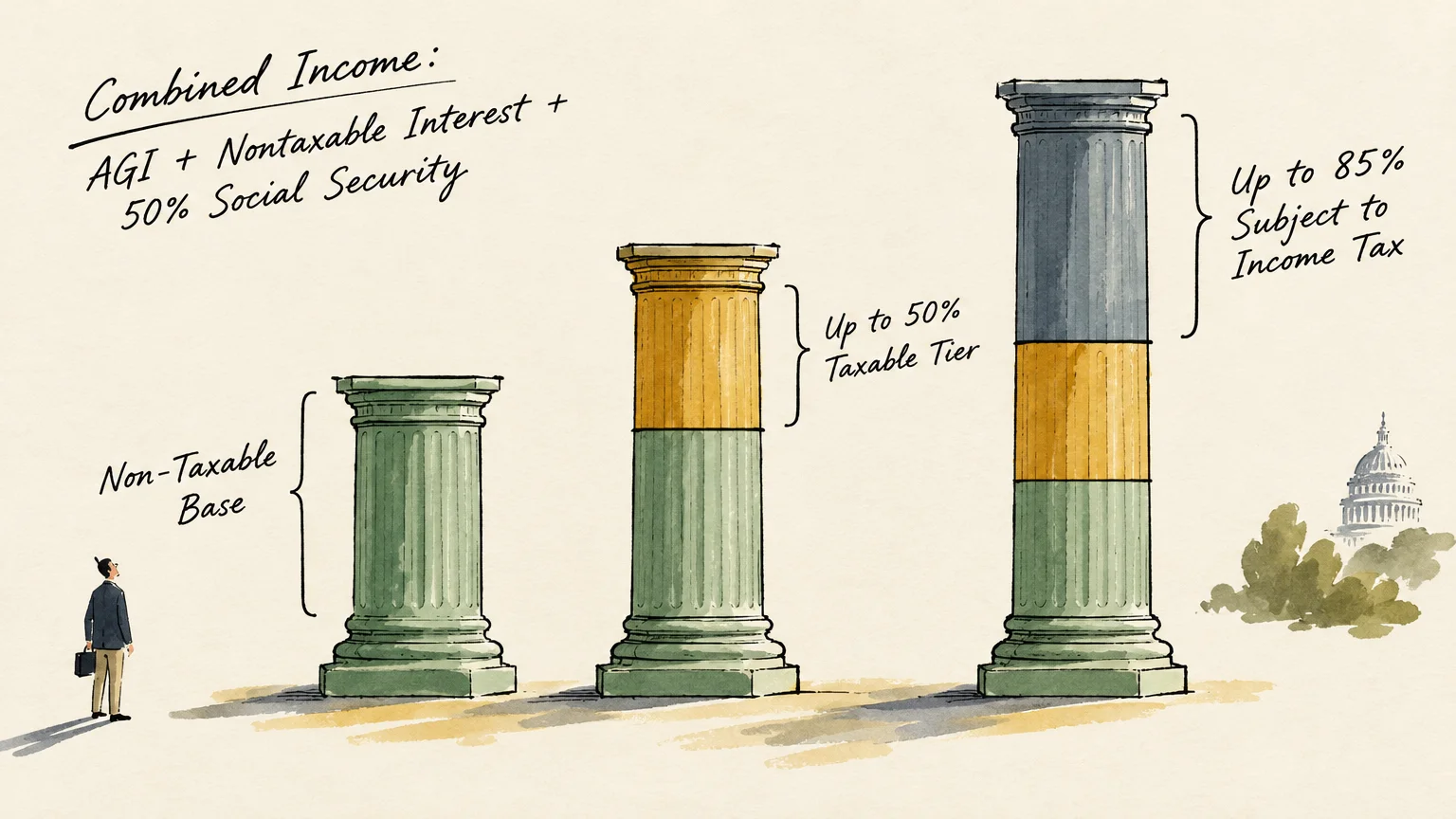
Many retirees are shocked to discover that federal income taxes apply to their retirement checks. The rules rely on a metric known as provisional income, calculated by the Internal Revenue Service.
Provisional income equals your modified adjusted gross income, plus any nontaxable interest, plus 50% of your annual Social Security benefits. If that combined sum crosses fixed thresholds, your benefits become taxable.
For single filers, provisional income between $25,000 and $34,000 makes up to 50% of your benefits taxable. If your income exceeds $34,000, up to 85% of your benefits become subject to ordinary income taxes.
For married couples filing jointly, the 50% taxable bracket starts at $32,000 and extends to $44,000. Exceeding $44,000 pushes up to 85% of your joint benefits into taxable territory.
Congress established these income thresholds in 1983 and never indexed them to general economic inflation. As regular cost-of-living adjustments raise your gross income, more of your check becomes exposed to taxes.
In addition to federal levies, several states still assess state income taxes on benefits. Review your state revenue statutes to confirm whether your benefits face local tax obligations.
Avoiding Common Errors
Filing for Social Security is an irreversible financial choice for most Americans. Sidestepping avoidable errors preserves thousands of dollars over the course of your retirement.
- Overlooking the Medicare deduction: Budgeting around your gross benefit creates sudden cash shortfalls once Part B premiums are subtracted automatically.
- Violating the earnings cap: Working full-time at age 65 without understanding the $25,560 earnings test can trigger frozen checks and delayed tax settlements.
- Rushing to file without inspecting records: Failing to verify your 35 highest-earning years on your personal account can leave reporting errors uncorrected.
- Ignoring survivor benefit dynamics: Higher earners who claim at 65 permanently restrict the lifetime income available to a surviving spouse.
- Failing to plan for benefit taxes: Withdrawing large sums from traditional tax-deferred accounts can trigger the 85% taxable threshold on your checks.
Taking several months to evaluate your household balance sheet helps prevent hasty claims. Ensure that every decision aligns with your broader investment portfolio and health profile.

When DIY Isn’t Enough
Calculating basic retirement benefits appears straightforward on the surface, but complex family and financial situations require specialized analysis. Several common scenarios justify working directly with a fee-only planner or tax professional.
First, blended families with minor children or adult disabled dependents face complex benefit allocation rules. Navigating maximum family benefit caps requires specialized knowledge of administrative rules.
Second, business owners transitioning equity or receiving deferred compensation must navigate active versus passive income tests. Misclassifying income can trigger severe earnings test withholdings during early claiming years.
Third, substantial balances in traditional retirement accounts can create an expensive tax trap. Required minimum distributions combined with Social Security can push you into much higher marginal tax brackets.
Finally, couples with significant age differences or disparate health outlooks need coordinated claiming plans. Maximizing total household lifetime payouts often requires one partner to claim early while the other delays.
Frequently Asked Questions About Claiming at 65
Can I undo my claiming decision if I change my mind?
You can withdraw your application within the first 12 months of approval using form SSA-521. However, you must repay every dollar received, including spouse benefits and withheld Medicare premiums.
Do I have to claim Social Security benefits when I turn 65 to get Medicare?
No, Medicare enrollment and Social Security filing are entirely separate legal choices. You can enroll in Medicare Part A and Part B at 65 while delaying Social Security until 70.
How does the Social Security Administration verify my annual earnings?
The agency cross-references reports from employers and IRS tax filings. If you expect to earn more than $25,560 in 2027, notify the agency directly to adjust payments proactively.
When should I submit my application if I want benefits to start at 65?
You should apply roughly three months before the month you want your benefits to begin. The agency requires several weeks to process your documents and establish your payment cycle.
Final Steps for Your 2027 Retirement Plan
Review your personal earnings statement online to verify your historical wage records. Check that your reported earnings accurately represent your actual career work history before submitting paperwork.
Examine your household budget to confirm whether an estimated net payment of $1,455 will meet your baseline obligations. If you can bridge the income gap with other assets, delaying past 65 provides a substantially higher return.
This article provides general retirement education and information only. Every retiree’s situation is unique—what works for others may not work for you. For personalized advice, consider consulting a qualified financial professional such as a CFP or CPA.
Last updated: November 2026. Retirement benefits, tax rules, and healthcare regulations change frequently—verify current details with official sources.