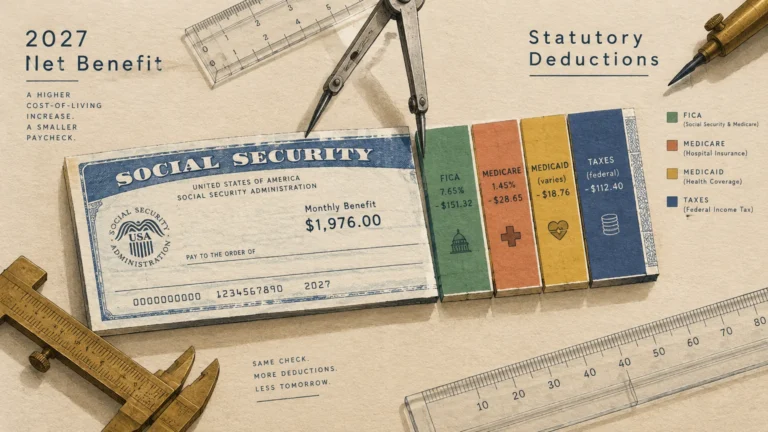

Waiting until age 70 guarantees your highest possible monthly Social Security check, but delaying isn’t the best financial move for every retiree. Forcing yourself to wait can drain your private savings, increase tax burdens, and shorten the years you enjoy your money.
While delayed retirement credits boost benefits by 8% annually past Full Retirement Age, only about 10% of Americans wait until 70. Health concerns, spousal needs, and market realities often make claiming earlier far more sensible.
Choosing the ideal filing age requires looking beyond monthly benefit formulas to examine your overall wealth, longevity, and lifestyle. Here is why the age 70 rule often falls short.
The Allure of Waiting: How Delayed Retirement Credits Work
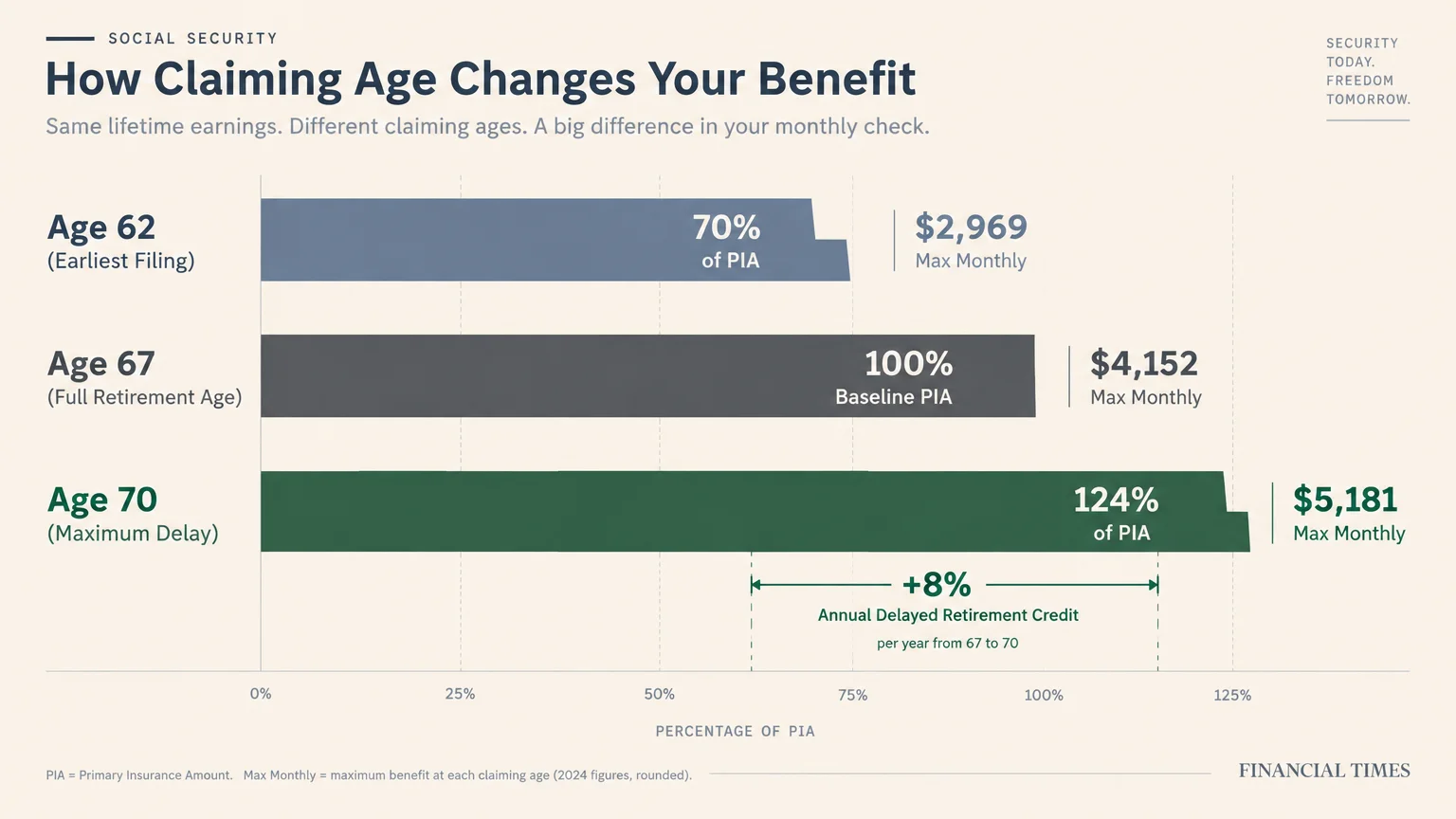
Social Security delayed retirement credits offer a tempting financial reward. For every year you postpone claiming past Full Retirement Age, your monthly benefit grows by 8% until age 70.
For individuals born in 1960 or later, Full Retirement Age is 67. Those born in 1959 reach their Full Retirement Age at 66 and 10 months during 2026.
Waiting from age 67 to age 70 produces a permanent 24% increase above your baseline benefit. That gives you 124% of your Primary Insurance Amount for the rest of your life.
In contrast, claiming at the earliest eligible age of 62 permanently reduces your monthly check by 30%. You receive only 70% of your full earned entitlement.
Those percentages create substantial monthly differences. In 2026, the maximum monthly benefit at age 70 reaches $5,181, rising to $5,358 in 2027.
The maximum benefit at Full Retirement Age is $4,152 in 2026 and rises to $4,188 in 2027. Early filers at age 62 face a maximum monthly check of $2,969 in 2026.
To qualify for those top-tier payouts, you must earn at or above the taxable wage base cap for at least 35 years. That taxable cap sits at $184,500 in 2026 and increases to $192,300 in 2027.
For typical retirees, the average monthly benefit is approximately $2,071 to $2,089 in 2026. A 3.6% cost-of-living adjustment pushes that average up by roughly $75 to $2,170 in 2027.
Because annual cost-of-living adjustments apply as percentages, waiting until 70 compounds larger dollar gains each year. That compounding leads many financial commentators to view delaying as an unbeatable guaranteed investment.
“Every month you wait between 62 and 70 pays you a guaranteed return, but you can only collect that return if you have the resources and health to reach it.” — Suze Orman, Personal Finance Author
The Break-Even Reality: Longevity and the Math of Mortality
Delayed retirement credits increase your monthly check, but they do not guarantee you will collect more total dollars over your lifetime. To beat early filing, you must live long enough to recover the money you skipped.
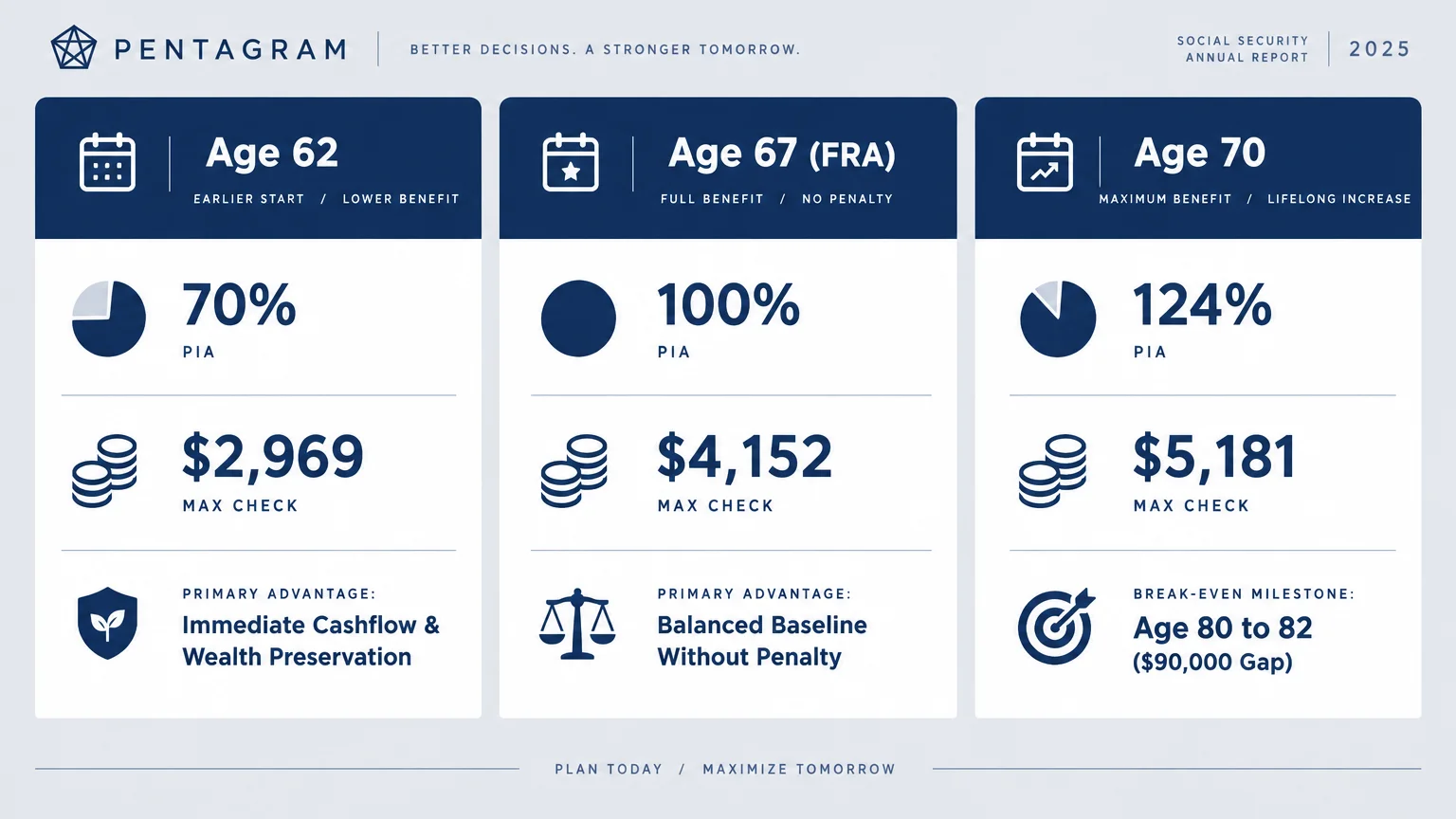
Actuaries refer to this milestone as your break-even age. For someone choosing between claiming at age 67 and waiting until age 70, the break-even age typically falls between 80 and 82.
Consider what happens if you delay claiming until age 70. Between ages 67 and 70, you forfeit three full years of benefit checks.
If your Full Retirement Age benefit is $2,500 per month, waiting three years means leaving $90,000 on the table. Your larger check at age 70 must make up that entire $90,000 gap before you pull ahead.
If you pass away at age 76, waiting until 70 proves to be a costly financial mistake. You will have collected checks for only six years, leaving behind substantial cumulative income.
Personal and family health histories matter far more than population-wide actuarial averages. If chronic health conditions or family histories suggest an average life span, delaying past Full Retirement Age rarely pays off.
Retirees also experience different phases of physical capability. Financial planners frequently divide retirement into “go-go,” “slow-go,” and “no-go” years.
Money collected at age 63 or 66 can fund active travel, home modifications, and hobbies while you possess peak physical health. Receiving higher checks at age 85 does little good if physical limitations keep you homebound.
Portfolio Depletion and Sequence of Returns Risk
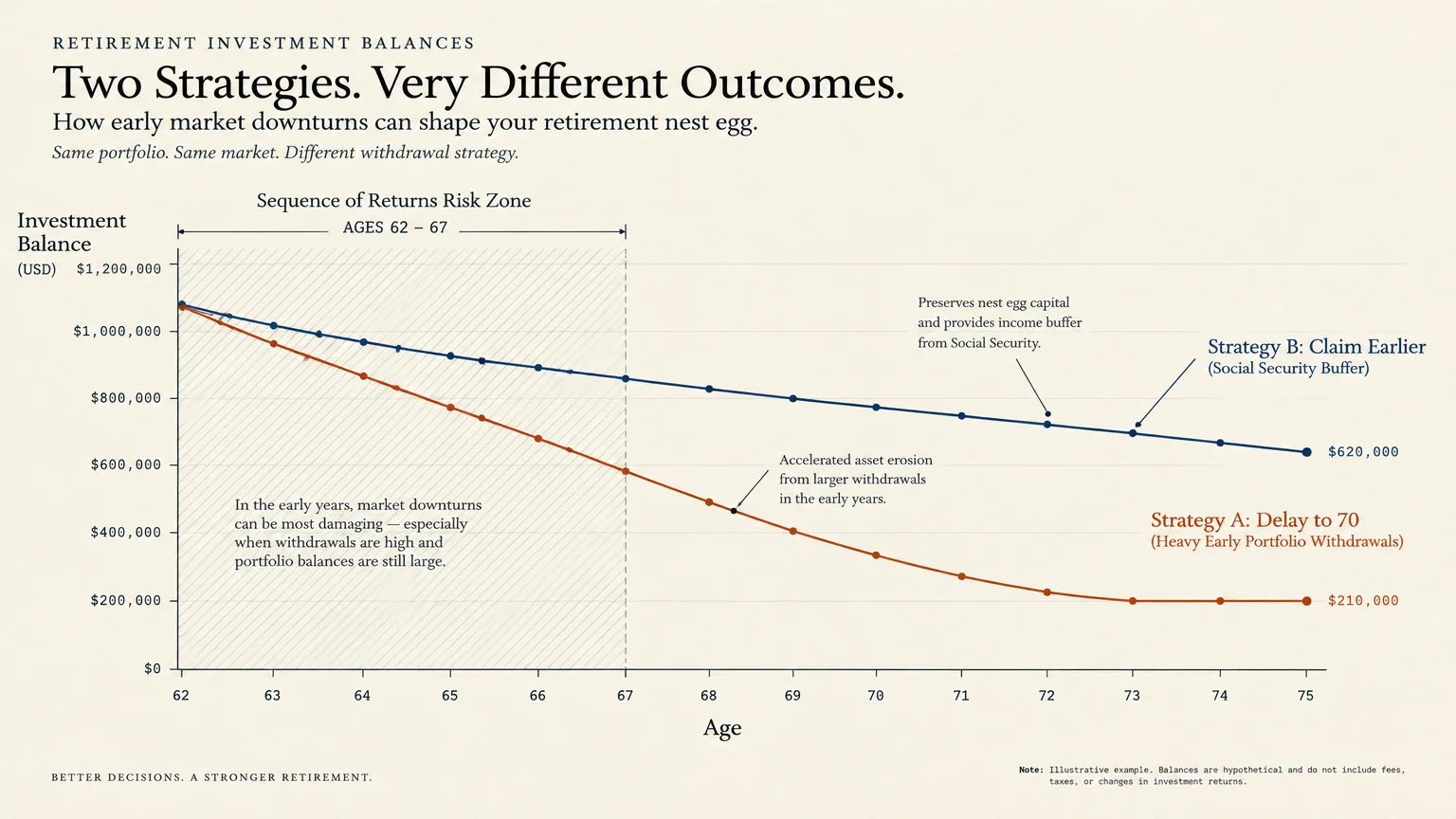
When you stop working in your early sixties and delay Social Security until 70, your living expenses do not disappear. You must fund daily life through a financial strategy known as a “Social Security bridge.”
Building this bridge requires withdrawing substantial sums from your private nest egg, such as 401(k) accounts and IRAs. You are essentially spending down your private portfolio to purchase a higher government annuity later.
This strategy exposes your life savings to devastating sequence of returns risk. If the stock market experiences a severe downturn during your early retirement years, your withdrawals lock in permanent investment losses.
Selling depreciated equities during a market correction cripples your portfolio’s ability to recover when the market rebounds. You risk depleting your liquid net worth just to secure a larger Social Security check years down the road.
Liquid assets provide financial flexibility that Social Security cannot match. You cannot tap your future Social Security benefits early to handle a major home repair, family emergency, or unexpected medical crisis.
Keeping money invested inside balanced portfolios allows your capital to generate long-term capital gains and dividends. Using baseline benefits from the Social Security Administration preserves more of your private wealth during uncertain economic cycles.
The Tax Torpedo: Why Larger Checks Can Create Tax Surprises
Many retirees believe delaying Social Security reduces their tax burdens, but the opposite often occurs. A massive monthly benefit check can trigger an expensive tax trap known as the “tax torpedo.”
Under federal law, your benefits become subject to income tax based on your combined or provisional income. Provisional income equals your adjusted gross income, plus nontaxable interest, plus 50% of your annual Social Security benefits.
The Internal Revenue Service taxes up to 50% of your benefits if provisional income exceeds $25,000 for single filers or $32,000 for married couples filing jointly.
If provisional income climbs above $34,000 for single individuals or $44,000 for married couples, up to 85% of your benefits become taxable. Congress established these thresholds decades ago and has never adjusted them for inflation.
When you wait until age 70, two distinct tax headaches emerge. First, taking larger IRA distributions in your 60s to bridge the spending gap pushes you into higher federal income tax brackets early.
Second, once your oversized Social Security checks begin at 70, they push you directly past the $34,000 or $44,000 thresholds. When Required Minimum Distributions kick in at ages 73 or 75, that combination can dramatically elevate your effective tax rate.
Recent legislation established an additional senior tax deduction of up to $6,000 for taxpayers 65 and older. While this deduction provides welcome relief, it does not fully shield wealthy filers from heavy benefit taxation.
“A great retirement is not measured by the size of your Social Security check, but by the alignment of your money with your life’s true priorities.” — Mitch Anthony, Retirement Author and Educator
Spousal Benefits and Deeming Rules: The Hidden Cost of Delaying
Deciding when to claim Social Security becomes far more intricate when you are married. An aggressive delay strategy by the higher earner can inadvertently penalize the lower-earning spouse.
Spousal benefits allow a husband or wife to collect up to 50% of the primary earner’s Full Retirement Age benefit. However, spousal benefits do not earn delayed retirement credits for waiting past Full Retirement Age.
Under current Social Security deeming rules, a spouse cannot file for a spousal benefit until the primary earner officially files for their own retirement benefit. If the primary earner waits until age 70, the spouse may be locked out of payments for years.
Consider a scenario where the higher earner delays benefits until age 70 to maximize their check. During those waiting years, the lower-earning spouse receives nothing from the spousal record.
That lost spousal income represents tens of thousands of dollars in cumulative household cash flow that the family can never recover. The primary earner’s extra 24% boost rarely compensates for multiple years of completely forfeited spousal income.
Survivor benefits follow a different set of rules that often justify delaying for the highest earner. When one spouse dies, the surviving partner inherits the larger of the two monthly checks.
If you are the primary earner and have a significantly younger spouse, waiting until 70 provides powerful survivor protection. But if your spouse is older or has health issues, delaying benefits can leave valuable spousal money on the table.

The Solvency Factor: The 2032 Trust Fund Horizon
Concerns over the financial stability of the Social Security program play a major role in claiming decisions. Many Americans prefer receiving smaller, guaranteed checks today rather than trusting political promises for the next decade.
According to the June 2026 Social Security Trustees Report, the Old-Age and Survivors Insurance (OASI) trust fund is projected to become depleted in the fourth quarter of 2032. That timeline leaves lawmakers with dwindling room to maneuver.
If the trust fund reserves deplete without congressional intervention, incoming payroll tax revenues will cover only 78% of scheduled benefits. That gap represents an automatic 22% benefit cut across the board.
When combined with the Disability Insurance trust fund, the hypothetical depletion date shifts to the third quarter of 2034, which would pay 83% of benefits. Even under that unified scenario, automatic benefit reductions remain substantial.
Congress will likely act to protect benefits, as lawmakers did during past solvency challenges. Potential solutions include raising the full retirement age, lifting payroll tax caps, or altering benefit formulas for high earners.
Even so, waiting until age 70 requires placing complete faith in legislative stability over the next decade. Claiming earlier allows you to bank real, spendable dollars immediately while program rules remain intact.
The Medicare Trap: Don’t Conflate Healthcare with Social Security
One of the most dangerous retirement misunderstandings involves confusing Social Security claiming ages with Medicare eligibility. Delaying your Social Security benefits does not mean you can delay your healthcare planning.
You remain eligible and expected to enroll in Medicare at age 65. You can explore coverage guidelines through Medicare.gov before your initial enrollment window opens.
If you delay Social Security until age 70, you must proactively sign up for Medicare Part A and Part B yourself. The government will not enroll you automatically if you are not receiving retirement checks.
Missing your initial enrollment window triggers permanent, cumulative late-enrollment penalties on your Part B and Part D premiums unless you maintain qualifying coverage through active employment. Those penalties last for the rest of your life.
Because you are not receiving Social Security, Medicare cannot deduct your monthly Part B premiums from your benefit check. You must pay those premiums out of pocket each quarter or set up automatic bank drafts.
Comparing Claiming Strategies: Age 62 vs. FRA vs. Age 70
Evaluating your Social Security options requires comparing the fundamental trade-offs across each milestone. Every filing age balances immediate cash flow against guaranteed lifetime longevity protection.
| Decision Factor | Claiming at Age 62 | Claiming at Full Retirement Age (67) | Claiming at Age 70 |
|---|---|---|---|
| Monthly Benefit Level | 70% of PIA (Permanent 30% reduction) | 100% of PIA (Base benefit earned) | 124% of PIA (Maximum 24% boost) |
| 2026 Maximum Monthly Benefit | $2,969 | $4,152 | $5,181 |
| Break-Even Lifespan Target | Immediate cash; breakeven irrelevant | Must live to roughly age 78 to beat age 62 | Must live to roughly ages 80-82 to beat FRA |
| Earnings Test Applies? | Yes ($24,480 cap in 2026; $25,560 in 2027) | No earnings limit applies starting at FRA | No earnings limit applies |
| Spousal Impact | Unlocks spousal benefits immediately | Unlocks full spousal payment options | Spouse forfeits benefits while waiting |
| Best Suited For | Health issues, urgent cash needs, retired | Balanced health, partial work, standard plans | Excellent longevity, younger spouse, strong nest egg |
Each option carries tangible advantages and clear trade-offs. Deciding on the best path depends entirely on your broader retirement infrastructure rather than isolated benefit charts.
Common Mistakes to Avoid
Navigating Social Security requires sidestepping several expensive traps that catch retirees unaware. Review these critical pitfalls before finalizing your filing strategy.
- Forfeiting spousal benefits through rigid delays: Waiting until 70 prevents your spouse from claiming spousal benefits on your work record, costing your household thousands in unrecoverable income.
- Draining equities during bear markets: Depleting private investments to bridge the gap to age 70 locks in market losses and ruins your portfolio’s compound growth potential.
- Failing to enroll in Medicare at 65: Assuming Medicare enrollment links to Social Security leads to missed deadlines and permanent Part B premium surcharges.
- Ignoring the retirement earnings test: If you claim before Full Retirement Age while working, the SSA withholds $1 for every $2 earned above $24,480 in 2026 ($25,560 in 2027).
- Overestimating longevity based on national averages: Base your filing timing on your personal vitality, current medical conditions, and actual family history rather than generalized actuarial tables.
Avoiding these common errors protects both your monthly cash flow and your long-term portfolio stability. Strategic coordination prevents preventable financial losses.

Professional vs. Self-Guided Decision Making
While Social Security rules apply universally, their financial impact varies dramatically from household to household. Some individuals can comfortably manage their filing strategy alone, while others require specialized advice.
Review these common scenarios to determine whether you should seek professional counsel or manage the claiming process yourself.
Scenario 1: Complex spousal and survivor benefit coordination. If you and your spouse have substantial age differences, disparate earnings histories, or previous marriages lasting over 10 years, professional guidance is invaluable. A fiduciary advisor can model claiming combinations that maximize total household survivor income.
Scenario 2: Single retiree with straightforward assets and average health. If you are unmarried, have clear personal savings, and possess a standard work history, you can easily self-guide your decision. Calculating your break-even age and evaluating your living expenses provides sufficient clarity.
Scenario 3: High-net-worth households facing the tax torpedo. If you hold substantial balances in traditional IRAs, 401(k) plans, and taxable brokerage accounts, professional planning is critical. Coordinated Roth conversions before age 70 can prevent massive tax spikes on Social Security income and future required distributions.
Scenario 4: Retirees forced to stop working early due to physical constraints. If health issues or corporate downsizing force you into early retirement, self-guiding with official resources works well. Claiming benefits early to prevent unmanageable debt is almost always the right move, regardless of theoretical delayed credits.
Retirees seeking fee-only advisory support can consult the Certified Financial Planner Board to find credentialed fiduciaries specializing in retirement income planning. Objective advice ensures your claiming age integrates seamlessly with your broader financial plan.
Frequently Asked Questions
Can I claim Social Security early and switch to my own higher benefit at 70?
No, you cannot claim early on your own record and then switch to a larger delayed benefit later. Once you claim your retirement benefit, that early filing reduction remains permanent for the rest of your life.
Does my spouse receive an 8% annual boost if I wait until age 70?
No, spousal benefits do not earn delayed retirement credits. Spousal benefits reach their maximum value of 50% of your Primary Insurance Amount once your spouse reaches their own Full Retirement Age.
What happens if I delay until age 70 and pass away shortly after?
If you die soon after claiming at 70, you forfeit the cumulative money you skipped during your sixties. However, if you leave behind a surviving spouse, they will inherit your higher monthly payment as their survivor benefit.
Can I undo my claiming decision if I change my mind?
Yes, Social Security permits a one-time withdrawal of your application within 12 months of your original claim. However, you must repay every dollar of benefits received, including any family benefits paid on your record.
Does working while claiming benefits permanently reduce my payments?
No, benefits withheld under the retirement earnings test before Full Retirement Age are not lost forever. Once you reach Full Retirement Age, the SSA recalculates your monthly check to credit back the withheld amounts over time.
Making the Right Choice for Your Retirement
Claiming Social Security at age 70 delivers unmatched monthly checks, but maximum monthly income does not always equal maximum lifetime wealth. Your health, market conditions, tax brackets, and spousal needs must dictate your timing.
Take time to audit your retirement savings, assess your current medical health, and run customized break-even scenarios before filing. Choosing a claiming age that provides security and financial freedom today is far more rewarding than chasing theoretical math on paper.
This is educational content based on general retirement and financial principles. Individual results vary based on your situation. Always verify current benefit rules, tax laws, and eligibility requirements with official sources like SSA, Medicare.gov, or the IRS.
Last updated: November 2026. Retirement benefits, tax rules, and healthcare regulations change frequently—verify current details with official sources.