

Open enrollment gives you an annual window to reset your healthcare finances and maximize your tax savings. Choosing the right health plan and funding strategy can dramatically cut your future out-of-pocket medical bills.
High-deductible health plans paired with health savings accounts offer unmatched tax advantages for workers nearing retirement. Yet thousands of older Americans leave valuable deductions and employer contributions on the table every year.
Making five deliberate HSA moves right now will protect your wealth and lower your lifetime healthcare expenses. Here is your roadmap for this open enrollment season.
Move 1: Recalibrate Your HSA Contribution for the New 2027 Limits
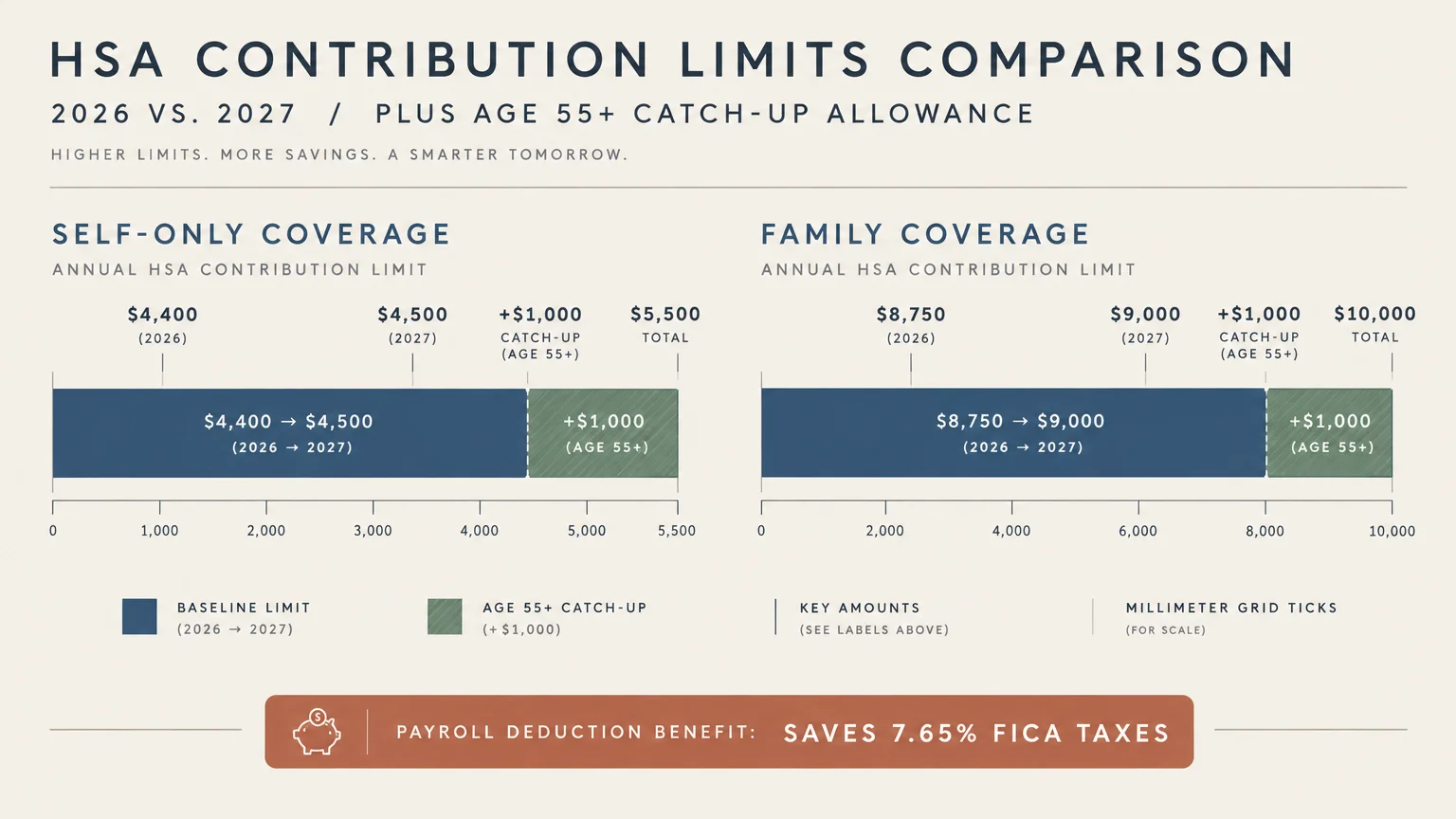
Inflation adjustments have pushed annual contribution caps higher for the upcoming plan year. You can contribute up to $4,500 for self-only coverage or $9,000 for family coverage in 2027.
These figures represent meaningful increases from the 2026 limits of $4,400 for individuals and $8,750 for families. Capturing these higher caps shields more of your current income from federal income taxes.
If you are age 55 or older, you qualify for an additional $1,000 catch-up contribution. This raises your effective 2027 limits to $5,500 for individual coverage and $10,000 for family coverage.
Married couples often miss a crucial requirement regarding this catch-up allowance. If both spouses are 55 or older and covered under a family plan, you cannot deposit both catch-up amounts into one account.
The primary account holder can contribute the family maximum plus one $1,000 catch-up. The second spouse must establish an independent HSA to deposit their separate $1,000 catch-up contribution.
Setting up payroll deductions through your employer provides an extra financial benefit beyond standard tax deductions. Contributions made via payroll reduce your taxable wages for Social Security and Medicare taxes under FICA rules.
Direct bank transfers into an HSA still qualify for an income tax deduction, but you forfeit the 7.65% FICA tax savings. Use your employer portal during enrollment to automate these pre-tax payroll deductions.
Do not forget your current-year funding options while planning for next year. You have until the federal tax filing deadline on April 15, 2027, to top off your 2026 contributions.
Move 2: Verify Your High-Deductible Health Plan Meets Updated Thresholds
You cannot legally fund a health savings account without qualifying coverage under an eligible high deductible health plan. The Internal Revenue Service sets strict annual definitions for minimum deductibles and maximum out-of-pocket expenses.
For 2027, qualifying plans must feature an annual deductible of at least $1,750 for self-only coverage or $3,500 for family plans. These thresholds represent an increase from the 2026 minimums of $1,700 and $3,400.
Plan out-of-pocket maximums are also adjusting upward for 2027. Your plan’s total out-of-pocket limit cannot exceed $8,700 for individual coverage or $17,400 for family coverage.
Review your open enrollment benefit summaries carefully before finalizing your plan selection. Some plans feature high deductibles but fail to qualify as HSAs due to low copay structures for office visits or prescription drugs.
Recent regulatory updates have expanded HSA eligibility for consumers purchasing health insurance outside workplace channels. Individuals enrolled in qualifying Bronze or Catastrophic plans on the Affordable Care Act exchange can now fund an HSA.
Another welcome reform affects individuals who utilize direct primary care arrangements for routine medical needs. Participating in a direct primary care membership no longer disqualifies you from contributing to an HSA.
To retain your eligibility, your aggregate monthly direct primary care fees cannot exceed $150 for individual arrangements or $300 for families. This update lets you combine personalized primary care with the long-term tax benefits of an HSA.

Move 3: Pair Your HSA with a Limited-Purpose FSA for Maximum Tax Protection
Many employees accidentally forfeit their HSA eligibility by enrolling in a standard healthcare flexible spending account. Federal regulations prohibit holding a general-purpose health FSA and an active HSA at the same time.
A general-purpose FSA pays for standard medical costs before you satisfy your deductible, which invalidates your HSA contribution rights. Fortunately, an alternative strategy exists that preserves your HSA eligibility while maximizing tax deductions.
You can pair your HSA with a Limited-Purpose FSA during open enrollment. A limited-purpose account restricts reimbursements exclusively to qualified vision and dental expenses.
For 2027, the salary reduction limit for healthcare FSAs increases to $3,500, up from $3,400 in 2026. The maximum allowable employer plan carryover also rises from $680 to $700.
Directing dental cleanings, fillings, eyeglasses, contact lenses, and orthodontic care through an LP-FSA preserves your cash. You shield thousands of dollars in vision and dental expenses using pre-tax dollars.
More importantly, this approach leaves your HSA balance completely untouched. Every dollar preserved inside your HSA remains available for long-term compound growth rather than being drained by routine annual bills.
Move 4: Transition from Healthcare Spender to Long-Term Healthcare Investor
Most participants treat their health savings accounts as temporary revolving accounts for immediate medical bills. They deposit money in January and spend the entire balance on routine prescriptions and doctor copays by December.
This spending habit misses the greatest wealth-building mechanism in the tax code. HSAs provide a rare triple-tax advantage that surpasses traditional 401(k) plans and Roth IRAs.
Your contributions enter the account tax-free, your balance compounds tax-free without annual capital gains taxes, and qualified withdrawals remain entirely tax-free. No other personal finance vehicle combines all three benefits in one place.
“Plan for healthcare costs early, because medical expenses represent one of the single largest financial obligations you will face in retirement.” — Jean Chatzky, Financial Educator and Author
To capitalize on this structure, shift your operational strategy toward long-term investing. Pay for minor current medical expenses out of pocket using regular cash flow whenever possible.
Leave your HSA deposits invested in diversified index funds or exchange-traded funds rather than holding them in default cash settlement accounts. Over a decade or two, compound growth can turn modest annual contributions into a substantial medical nest egg.
Implement the receipt-shoebox strategy to maintain complete flexibility over your accumulated wealth. The IRS imposes no strict deadline on when you must reimburse yourself for a qualified medical expense.
Save itemized digital receipts and explanation of benefits statements for all out-of-pocket medical costs incurred after establishing your account. You can reimburse yourself tax-free ten, fifteen, or twenty years later during retirement.
Move 5: Plan Your Medicare Transition to Avoid the Six-Month Retroactive Trap
Transitioning into retirement requires careful coordination between your health savings account and government benefits. Enrolling in any part of Medicare immediately ends your legal eligibility to contribute new funds to an HSA.
This rule applies whether you enroll in Medicare Part A, Part B, Medicare Advantage, or prescription drug Part D. You can keep and spend your accumulated funds, but new contributions must stop immediately.
Workers who plan to continue working past age 65 face a dangerous regulatory trap known as the six-month lookback rule. When you apply for Medicare Part A after reaching 65, the government automatically backdates your coverage.
The Centers for Medicare & Medicaid Services applies retroactive coverage for up to six full months prior to your application date. Coverage will not backdate prior to the month you turned age 65.
Failing to account for this retroactive window results in accidental illegal contributions. The IRS assesses a steep 6% excise penalty on every dollar contributed during those retroactive coverage months.
To avoid this penalty, stop all HSA contributions at least six months before you apply for Medicare or claim Social Security. Claiming Social Security automatically triggers mandatory enrollment in Medicare Part A.
Once you reach age 65, your HSA gains valuable new spending superpowers that support your retirement lifestyle. The standard 20% non-medical withdrawal penalty permanently disappears once you celebrate your 65th birthday.
Non-medical distributions after age 65 are simply taxed as ordinary income, mirroring the tax treatment of a traditional IRA. You can also use HSA assets completely tax-free to pay for Medicare Part B and Part D premiums.
You can even use HSA funds to pay tax-free premiums for qualified long-term care insurance policies up to IRS limits. Keep in mind that federal law strictly prohibits using HSA dollars to pay for Medigap supplemental premiums.
Comparing Healthcare Account Features for 2027
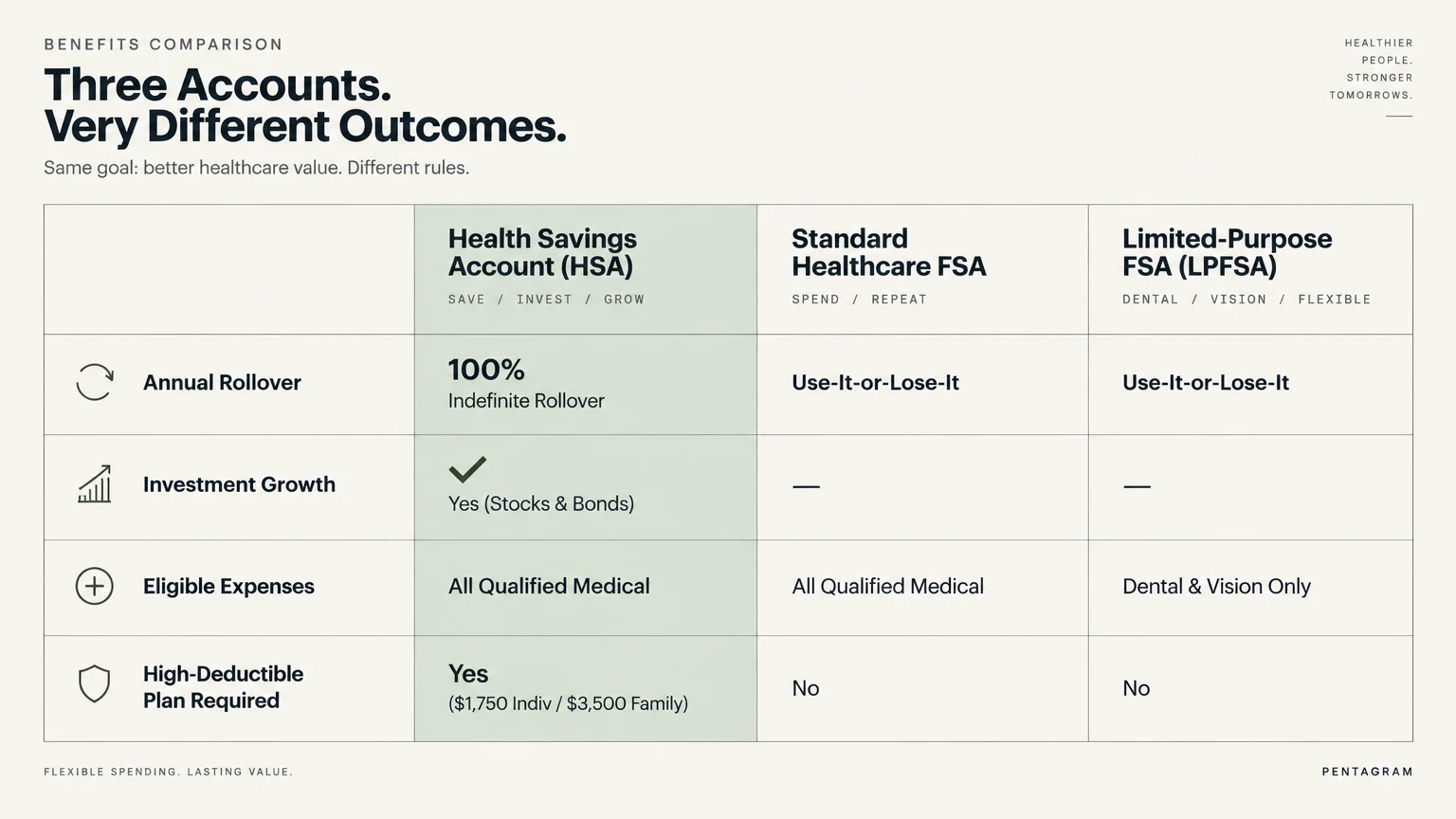
Choosing the correct combination of spending and savings vehicles requires understanding how these accounts interact. The table below outlines key differences between health accounts available during open enrollment.
| Account Feature | Health Savings Account (HSA) | Standard Healthcare FSA | Limited-Purpose FSA (LP-FSA) |
|---|---|---|---|
| 2027 Contribution Limit | $4,500 self / $9,000 family ($1,000 catch-up 55+) | $3,500 per employee | $3,500 per employee |
| Required Health Plan | High-Deductible Health Plan (HDHP) only | Any health plan (PPO, HMO, or HDHP) | High-Deductible Health Plan (HDHP) |
| Eligible Expenses | Comprehensive medical, dental, and vision | Comprehensive medical, dental, and vision | Dental and vision expenses only |
| Rollover Rules | 100% rollover year to year; funds never expire | Use-it-or-lose-it (up to $700 carryover for 2027) | Use-it-or-lose-it (up to $700 carryover for 2027) |
| Investment Capabilities | Yes; stocks, bonds, and mutual funds | No; cash holding only | No; cash holding only |
| Account Portability | Completely portable; stays with you forever | Tied to employer; lost upon job separation | Tied to employer; lost upon job separation |
Selecting an HSA gives you long-term ownership, whereas FSAs require precise annual spending projections. Pairing an HSA with an LP-FSA offers the optimal balance of immediate tax relief and permanent asset accumulation.
What Can Go Wrong: Critical HSA Pitfalls to Avoid
Health savings accounts carry significant financial advantages, but regulatory missteps can lead to unexpected tax consequences. Staying informed prevents costly mistakes during open enrollment and beyond.
- Over-contributing beyond annual limits: Depositing more than the IRS maximum triggers an ongoing 6% excise penalty. You must withdraw excess contributions and attributable earnings before your tax filing deadline to avoid this fee.
- Paying Medigap premiums with HSA funds: While you can pay Medicare Part B, Part D, and Medicare Advantage premiums tax-free, Medigap policies are excluded. Paying Medigap premiums generates ordinary income tax plus a potential 20% penalty.
- Failing to document past expenditures: Reimbursing yourself years after incurring a medical bill requires meticulous records. Maintain digital copies of itemized receipts, doctor bills, and insurance statements in case of an IRS audit.
- Combining spousal catch-up allowances into one account: Federal law does not allow a single HSA to hold $2,000 in catch-up contributions. Spouses must open separate accounts to claim both $1,000 allowances.
- Enrolling in an HSA alongside a general-purpose FSA: Even an unused standard FSA balance held by you or your spouse disqualifies your HSA contributions. Ensure any FSA coverage is strictly limited-purpose before funding an HSA.
Reviewing these potential traps helps you safeguard your hard-earned dollars. Always confirm how your employer packages benefit options to prevent accidental disqualification.

When to Consult a Professional
While basic HSA management is straightforward, certain life milestones introduce complex tax and healthcare interactions. In these situations, seeking professional guidance protects your retirement plan.
Consider speaking with a qualified financial planner or tax professional during the following transitions:
- Working past age 65 while covered by employer insurance: Coordinating high-deductible coverage with delayed Medicare enrollment requires exact timing to prevent retroactive tax penalties.
- Planning to claim Social Security while working: Because filing with the Social Security Administration automatically triggers Medicare Part A, an advisor can help you time your HSA contribution freeze.
- Structuring an estate plan around substantial HSA balances: Unlike traditional IRAs, HSAs passed to non-spouse beneficiaries lose their tax-exempt status immediately and become fully taxable in the year of death.
- Correcting excess contributions from a prior tax year: Calculating net income attributable to excess contributions requires specialized tax calculations to ensure complete compliance.
A professional helps align your healthcare funding choices with your broader investment portfolio and retirement tax strategy. This ensures every dollar works efficiently toward your long-term security.
Frequently Asked Questions About HSA Open Enrollment
Can I open and fund an HSA on my own if my employer doesn’t offer one?
Yes, you can establish an HSA through an independent financial custodian if you are enrolled in a qualifying high-deductible health plan. You will claim your tax deductions directly on IRS Form 8889 when filing your annual return.
What happens to my accumulated HSA balance if I leave my high-deductible plan next year?
You retain complete ownership of all accumulated funds in your HSA even if you switch to a traditional low-deductible health plan. While you cannot make new contributions, you can continue spending and investing existing funds tax-free.
Can I use my HSA funds to pay for my spouse’s medical expenses?
You can use your HSA funds tax-free to pay qualified medical expenses for your legal spouse and tax dependents. This rule applies even if your spouse is covered under a separate health plan or enrolled in Medicare.
Does HSA money expire at the end of the calendar year?
No, HSA funds never expire under any circumstances. Unlike standard flexible spending accounts, your entire HSA balance rolls over automatically from year to year and remains yours for life.
Taking Action on Your Healthcare Strategy
Open enrollment is your best opportunity to position your finances for reduced tax burdens and stronger long-term security. Evaluating deductibles, maximizing contributions, and utilizing limited-purpose accounts transforms healthcare expenses into an engine for wealth accumulation.
Take the time this week to review your employer’s plan documents, verify your health plan’s eligibility, and set your 2027 contribution targets. A proactive healthcare strategy today lays the foundation for a confident, well-funded retirement tomorrow.
This article provides general retirement education and information only. Every retiree’s situation is unique—what works for others may not work for you. For personalized advice, consider consulting a qualified financial professional such as a CFP or CPA.
Last updated: November 2026. Retirement benefits, tax rules, and healthcare regulations change frequently—verify current details with official sources.