

Single tax filers often face compressed tax brackets and smaller deductions than married couples. You can sharply lower your taxable income this year by claiming targeted single tax deductions and credits.
Missing these breaks means leaving thousands of dollars with the federal government unnecessarily. Recent legislative updates offer major tax-saving opportunities whether you itemize or take the standard deduction.
Exploring these eleven strategies will help you keep more of your hard-earned retirement dollars. Take charge of your return to preserve your wealth and simplify your tax filing.
Why Single Filers Face Unique Tax Pressures
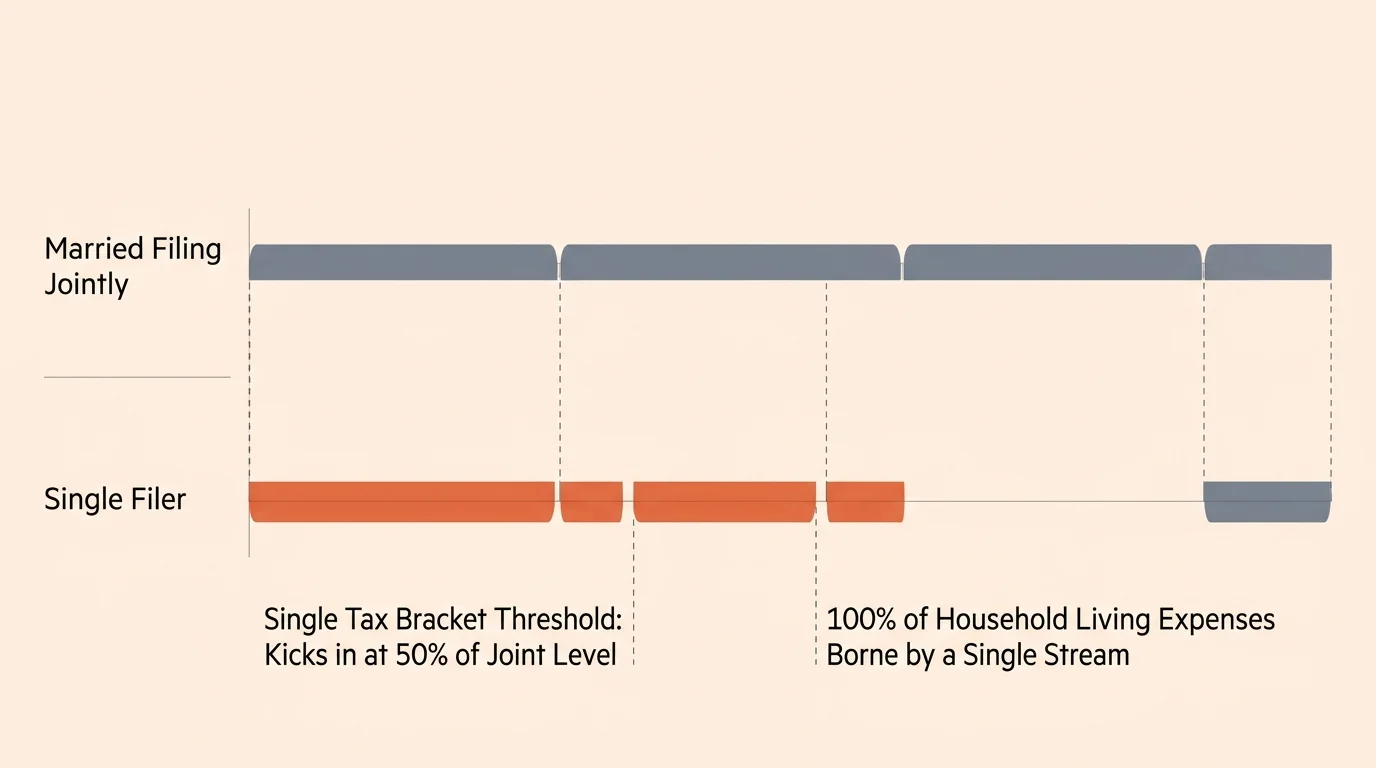
Filing single taxes often feels financially punishing. Tax brackets for single individuals kick in at half the income levels of married couples filing jointly.
Single retirees carry household living expenses on a single income stream. When property taxes, maintenance, and healthcare costs rise, you bear those bills alone.
Fortunately, the tax code provides targeted relief. Utilizing specific tax breaks for single filers allows you to shield substantial portions of your income from taxation.
You can optimize your tax position by understanding how above-the-line deductions interact with standard allowances. Strategic tax management leaves you with more predictable monthly cash flow.
01 The Triple-Stacked Standard Deduction for Seniors
Most taxpayers understand the base standard deduction single filers receive. For tax year 2026, the base standard deduction rises to $16,100.
Retirees age 65 or older receive an additional standard deduction of $2,050. If you are also legally blind, you receive another $2,050 deduction boost.
Recent federal tax legislation under the One Big Beautiful Bill Act adds a temporary enhanced senior deduction. Individuals age 65 and older can deduct an extra $6,000 on their 2026 returns.
This $6,000 enhancement begins phasing out at a 6% rate once your Modified Adjusted Gross Income exceeds $75,000. It disappears entirely for single incomes above $175,000.
When you combine these three provisions, qualifying single filers age 65 and older deduct up to $24,150. That means you pay zero federal income tax on your first $24,150 of income.
You claim this stacked deduction directly on your tax form without itemizing receipts. For older single Americans, this single provision provides thousands in real tax savings.
02 The $1,000 Non-Itemizer Charitable Cash Deduction
Under prior rules, you received no tax benefit from charitable donations unless you itemized your deductions. Because the standard deduction is so high, most single filers stopped deducting charitable gifts.
Tax rules for 2026 reinstate the above-the-line cash charitable deduction for non-itemizers. Single filers taking the standard deduction can now deduct up to $1,000 in qualifying cash gifts.
To qualify, you must give cash, checks, or electronic transfers directly to an eligible 501(c)(3) nonprofit organization. Gifts to donor-advised funds or private foundations do not qualify.
You must maintain written bank records or an official acknowledgment letter from the charity for every donation. Keep these records organized in case the Internal Revenue Service asks for verification.
This deduction directly lowers your Adjusted Gross Income. A lower baseline income can help protect other income-sensitive tax benefits and credits.
03 The 0% Long-Term Capital Gains Tax Bracket
Selling appreciated assets does not automatically generate a heavy tax bill. The federal tax code offers a 0% tax rate on long-term capital gains for qualifying income levels.
For tax year 2026, single filers qualify for the 0% long-term capital gains rate with taxable income up to $49,450. Any capital asset held longer than one year qualifies for this treatment.
Remember that taxable income is calculated after subtracting your deductions from your gross income. If you claim the full $24,150 senior standard deduction, your gross income can reach $73,600 before leaving the 0% bracket.
This rate structure provides an exceptional opportunity for tax-gain harvesting. You can sell appreciated stock up to the bracket limit, lock in gains tax-free, and reset your cost basis.
Monitor your total income sources carefully to prevent pushing dollars into the 15% capital gains bracket. Financial planning resources at Investopedia offer calculators to model these capital gain thresholds.
04 SECURE 2.0 “Super Catch-Up” Contributions for Ages 60 to 63
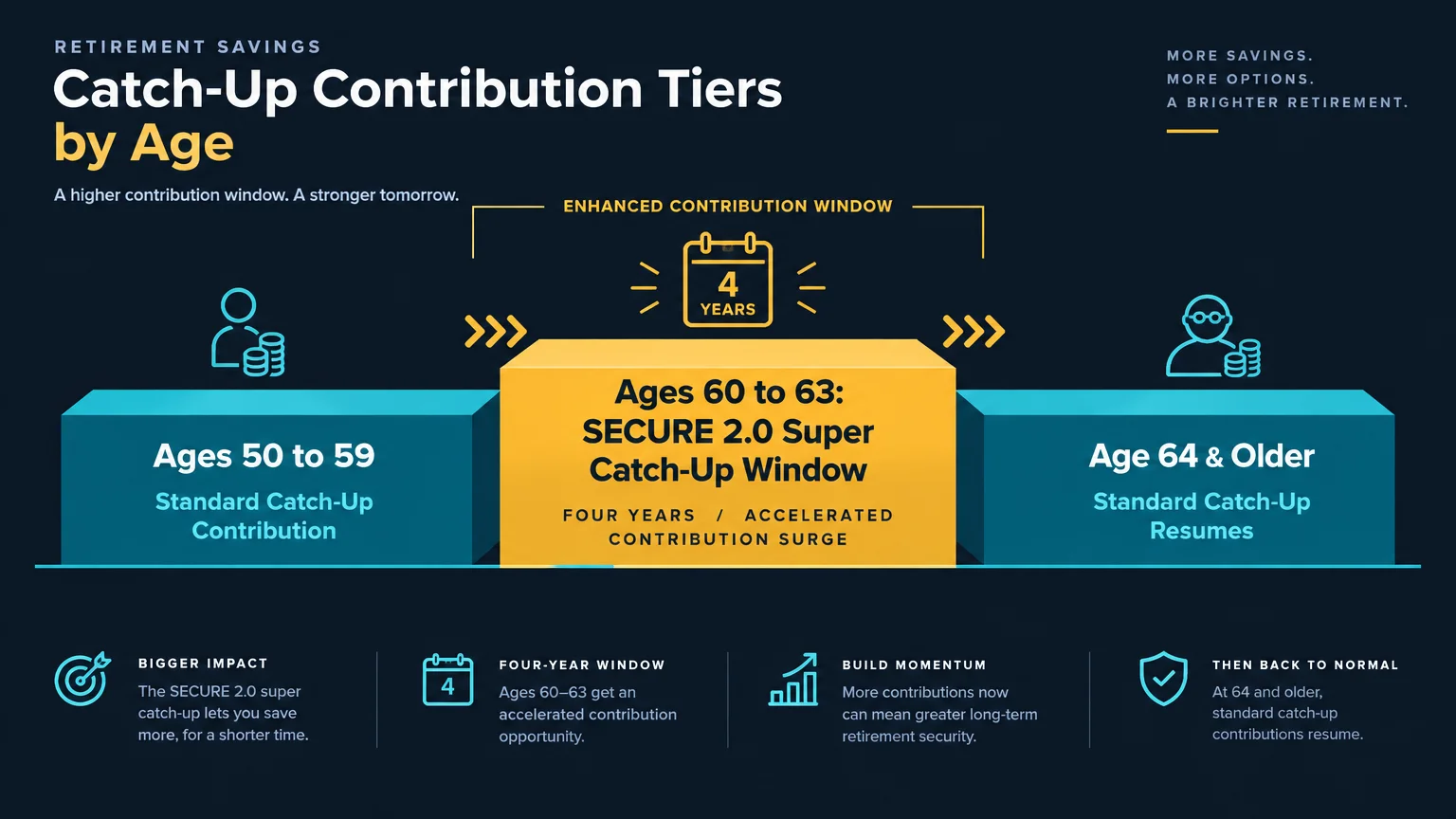
If you are still working in your early sixties, retirement account catch-up limits provide substantial relief. The base employee deferral limit for workplace retirement plans in 2026 is $24,500.
Workers age 50 and older normally qualify for an extra $8,000 catch-up contribution. However, SECURE 2.0 created an enhanced super catch-up tier for workers aged 60 through 63.
Single workers turning 60, 61, 62, or 63 during 2026 can contribute an additional $11,250 instead of $8,000. That brings your maximum annual workplace plan contribution to $35,750.
Every dollar you contribute to a traditional 401(k), 403(b), or 457 plan reduces your current-year taxable income. This strategy is especially valuable for single workers nearing their peak earning years.
Be aware of the mandatory Roth rule taking effect in 2026. If your prior-year FICA wages exceeded $150,000, your catch-up contributions must go into an after-tax Roth account.
05 Traditional IRA Contributions With Higher Age Limits
You can still contribute to an individual retirement account even if you lack access to an employer plan. For 2026, the IRA contribution limit is $7,500 for single individuals.
If you are age 50 or older, you can add an extra $1,100 catch-up contribution. This brings your total annual IRA contribution limit to $8,600.
If you do not participate in a workplace retirement plan, your contribution is fully tax-deductible regardless of your income. This creates a reliable avenue for reducing taxable income right up to the tax filing deadline.
If you have an employer plan, the deduction phases out for single filers with an income between $81,000 and $91,000. Even within that window, you can claim a partial deduction.
Eliminating age caps on traditional IRA contributions means you can keep contributing as long as you have earned income. Part-time consulting or post-retirement work qualifies as eligible compensation.
06 Qualified Charitable Distributions (QCDs)
Once you reach age 70½, Qualified Charitable Distributions become one of your most powerful tax-planning tools. A QCD allows you to transfer money directly from a traditional IRA to a qualified charity.
For 2026, single IRA owners can donate up to $111,000 per year using tax-free QCD transfers. The distributed funds bypass your taxable income entirely.
This strategy is superior to regular charitable giving because it prevents your income from inflating. You receive the full tax benefit even if you take the standard deduction on your return.
When you reach age 73, your QCD amounts count directly toward satisfying your Required Minimum Distributions. This keeps your Adjusted Gross Income lower and protects your budget from sudden tax spikes.
A lower Adjusted Gross Income also prevents surcharges on your Medicare Part B and Part D premiums. Official distribution rules are maintained and updated regularly by the Medicare administration.
“A great financial plan is not just about what you make; it is about what you keep after taxes.” — Suze Orman, Personal Finance Expert

07 Health Savings Account (HSA) Contributions at Age 55+
A Health Savings Account offers unmatched tax benefits if you maintain a qualifying high-deductible health plan. Contributions are tax-deductible, growth is tax-free, and withdrawals for qualified medical expenses are completely tax-exempt.
For tax year 2026, the single HSA contribution limit is $4,400. If you are age 55 or older, you can contribute an additional $1,000 catch-up amount, totaling $5,400.
To qualify, your single health insurance policy must have a minimum annual deductible of $1,700. The out-of-pocket maximum cannot exceed $8,500 for single coverage.
Unlike flexible spending accounts, HSA funds roll over indefinitely from year to year. You can invest these funds aggressively to build a dedicated healthcare reserve for your future retirement years.
Remember that you must stop contributing to an HSA once you enroll in Medicare Part A or Part B. Plan your final contributions carefully around your planned Medicare start date.
08 Long-Term Care Insurance Deductions and Relief
Long-term care costs represent one of the greatest financial threats facing single retirees. Because single filers have no spouse to assist with care, insurance coverage is critical.
The tax code allows you to deduct eligible long-term care insurance premiums as deductible medical expenses. You can deduct unreimbursed medical expenses that exceed 7.5% of your Adjusted Gross Income if you itemize.
The IRS caps deductible premium amounts based on your attained age at the end of the tax year. For 2026, eligible age-based limits permit substantial deductions:
- Age 50 or younger: Up to $480 in deductible premiums
- Ages 51 through 60: Up to $1,800 in deductible premiums
- Ages 61 through 70: Up to $4,810 in deductible premiums
- Age 71 and older: Up to $6,020 in deductible premiums
SECURE 2.0 introduced another option for funding your policy without tax penalties. You can withdraw up to $2,600 penalty-free from eligible retirement accounts in 2026 to pay certified long-term care premiums.
This penalty-free distribution provision offers immediate liquidity for protecting yourself against catastrophic custodial care expenses. Review policy details carefully with a qualified insurance specialist before making changes.
09 The Retirement Savings Contributions Credit (Saver’s Credit)
Moderate-income single individuals who save for retirement can claim a double tax benefit. You receive a deduction for your contributions while claiming a direct tax credit on the same dollars.
The Saver’s Credit offers a nonrefundable credit worth 10%, 20%, or 50% of your eligible contributions. The credit applies to the first $2,000 you contribute to an IRA or workplace plan.
For tax year 2026, single filers can claim the credit with an Adjusted Gross Income up to $40,250. The maximum tax credit you can receive as an individual is $1,000.
Credits are far more valuable than deductions because they subtract dollar-for-dollar from your final tax bill. If you owe $800 in taxes and claim an $800 credit, your tax liability drops to zero.
Note that 2026 marks the final year for this specific tax credit mechanism. Starting in 2027, federal legislation transforms this credit into a direct government matching deposit called the Saver’s Match.
10 The $3,000 Net Capital Loss Offset
Market volatility can be unsettling, but investment losses offer a valuable silver lining at tax time. If you sell taxable assets at a loss, you can harvest those losses to shelter gains.
Your realized losses first offset any capital gains dollar-for-dollar across short-term and long-term categories. If your net capital losses exceed your capital gains, you can deduct up to $3,000 against ordinary income.
This $3,000 deduction directly offsets income from pensions, wages, interest, or taxable Social Security benefits. Even better, you can claim this deduction without itemizing your return.
Any unused capital losses do not vanish. You carry remaining net losses forward indefinitely into future tax years to offset future income and investment gains.
Review your non-retirement brokerage accounts each autumn to identify potential tax-loss harvesting candidates. Careful tax-loss selling turns market dips into reliable tax write-offs.

11 New Deductions for Vehicle Interest and Expanded SALT Caps
Recent legislation brought significant changes to state tax deductions and everyday loan interest write-offs. Single filers living in states with high income or property taxes gain immediate breathing room.
The State and Local Tax (SALT) deduction cap jumped from $10,000 up to $40,400 for 2026. This change makes itemizing deductions far more beneficial for single homeowners in high-tax states.
This higher SALT cap begins phasing down only when your single Adjusted Gross Income exceeds $505,000. Most middle-income and affluent retirees will be completely unaffected by that phaseout threshold.
New federal rules also allow both itemizers and standard deduction filers to deduct qualified passenger vehicle loan interest. You can deduct up to $10,000 in auto loan interest paid during the year.
If you work part-time or perform service work in retirement, check for specialized income deductions. Qualifying single filers can deduct up to $12,500 of qualified overtime pay and up to $25,000 of qualified tips.
Comparing Single Filer Deductions and Credits
Evaluating which tax breaks fit your circumstances requires comparing their financial limits and qualification rules. Use this reference table to identify the strategies that best match your financial profile.
| Tax Provision | 2026 Single Limit | Requires Itemizing? | Key Eligibility Rule |
|---|---|---|---|
| Base Standard Deduction | $16,100 | No | All unmarried single filers |
| Senior Add-On Deduction | $2,050 | No | Age 65 or older |
| Enhanced Senior Deduction | $6,000 | No | Age 65+; phases out over $75,000 MAGI |
| Non-Itemizer Charitable Gift | $1,000 | No | Direct cash donations to 501(c)(3) charities |
| 0% Capital Gains Rate | $49,450 taxable income | No | Long-term capital assets held over 1 year |
| Workplace Super Catch-Up | $11,250 ($35,750 total) | No | Workers aged 60 through 63 |
| Traditional IRA Catch-Up | $1,100 ($8,600 total) | No | Age 50+ with eligible earned income |
| Qualified Charitable Distribution | $111,000 | No | Age 70½+; transfers directly from IRA |
| Health Savings Account Catch-Up | $1,000 ($5,400 total) | No | Age 55+ with qualifying HDHP coverage |
| Long-Term Care Premium Cap | Up to $6,020 | Yes (exceeding 7.5% AGI) | Age-based; qualifies certified policies |
| Net Capital Loss Deduction | $3,000 | No | Offsets ordinary income after gains |
| Expanded SALT Deduction | $40,400 | Yes | Phases down above $505,000 MAGI |
Pitfalls to Watch For
Claiming tax deductions without reviewing phaseouts can lead to expensive IRS filing errors. The new $6,000 senior deduction begins phasing out when your modified income crosses $75,000.
Taking large traditional IRA distributions to fund lifestyle purchases can push your income past this boundary. Each dollar above $75,000 reduces your senior deduction by 6 cents until it disappears.
Higher income also triggers Medicare premium surcharges under the Income-Related Monthly Adjustment Amount (IRMAA). Crossing IRMAA thresholds raises your Part B and Part D monthly payments significantly.
Another common mistake involves contributing to a Health Savings Account after starting Medicare. Even enrolling in premium-free Medicare Part A completely disqualifies you from making further HSA deposits.
Do not forget to keep detailed documentation for non-itemized charitable donations. The IRS rejects unsupported deductions, so maintain bank statements and receipts for every dollar claimed.
Watch your workplace plan catch-up contributions if you earned more than $150,000 in wages during 2025. Depositing those catch-up funds into a pre-tax account violates 2026 Roth mandates.

Getting Expert Help
Navigating the interaction between standard allowances, itemized write-offs, and retirement distributions can quickly become complicated. Consulting a qualified tax professional or financial planner makes sense in several common situations.
Seek professional assistance if you recently transitioned from married filing jointly to single status due to divorce or widowhood. The sudden shift in tax brackets requires an overhaul of your withholding and distribution strategies.
Contact a certified planner if you are approaching age 73 and need an RMD strategy. A tax specialist can sequence your withdrawals and QCDs to protect you from bracket creep and IRMAA spikes.
Get professional advice if you own high-value real estate or live in a state with high income taxes. An expert can calculate whether your total deductions exceed the $16,100 standard deduction under the new $40,400 SALT limit.
Work with an advisor if you hold mixed assets across traditional, Roth, and taxable brokerage accounts. A professional can help you harvest capital gains at 0% without inadvertently disqualifying other senior deductions.
Frequently Asked Questions
Can I claim the new $6,000 senior deduction if I take the standard deduction?
Yes. The $6,000 enhanced senior deduction is available whether you take the standard deduction or itemize your return. However, it begins phasing out if your Modified Adjusted Gross Income exceeds $75,000.
How does the reinstated charitable deduction work for single non-itemizers?
Single filers who claim the standard deduction can deduct up to $1,000 in qualifying cash donations to public charities. You claim this deduction directly on your return without needing to file Schedule A.
Can I still contribute to an HSA if I am 65 and working?
Yes, but only if you have not enrolled in any part of Medicare. Once your Medicare Part A or Part B coverage begins, you can no longer make contributions to an HSA.
How much can a single filer deduct in state and local taxes for 2026?
For tax year 2026, the federal SALT deduction cap increases to $40,400 for single itemizers. This cap phases down only for individuals whose Adjusted Gross Income exceeds $505,000.
Final Steps for Your Single Tax Return
Filing single taxes does not require paying higher rates than necessary. Review your records now to ensure you capture every deduction and credit for which you qualify.
Take time to calculate your standard deduction options and evaluate your retirement account contributions. Proactive tax management provides the financial stability you deserve throughout your retirement years.
This is educational content based on general retirement and financial principles. Individual results vary based on your situation. Always verify current benefit rules, tax laws, and eligibility requirements with official sources like SSA, Medicare.gov, or the IRS.
Last updated: November 2026. Retirement benefits, tax rules, and healthcare regulations change frequently—verify current details with official sources.