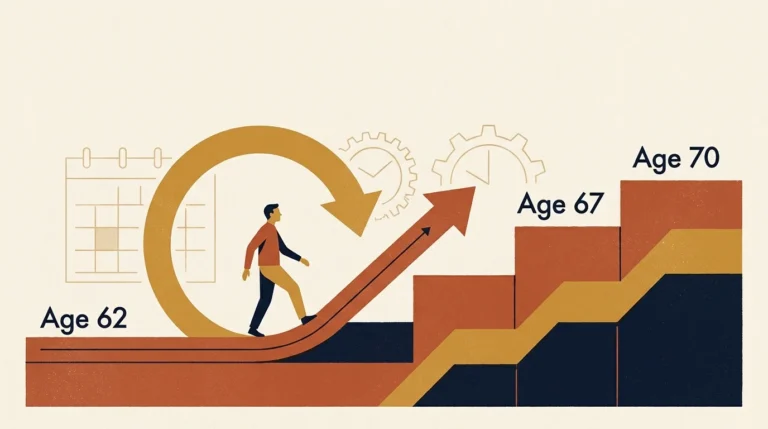
Claiming Social Security at the wrong time can permanently drain tens of thousands of dollars from your golden years. A landmark economic study reveals that the median American household forfeits over $182,000 in lifetime spending simply by claiming benefits too early.
Navigating your claiming age requires balancing immediate cash needs with long-term financial security. While monthly checks become available at age 62, rushing to file locks in a steep, lifelong reduction in your monthly income.
Understanding the exact trade-offs of Social Security timing helps protect your wealth and preserve essential spousal protections. Choosing the optimal date puts you in control of your retirement security.
The $182,000 Reality: What the Research Uncovered
Most retirees understand that claiming early reduces their monthly payment. However, few realize the staggering cumulative loss that occurs across an entire retirement.
A landmark study published by the National Bureau of Economic Research (NBER) quantified this exact financial damage. Economists David Altig, Laurence Kotlikoff, and Victor Yifan Ye analyzed national claiming behavior and lifetime spending power.
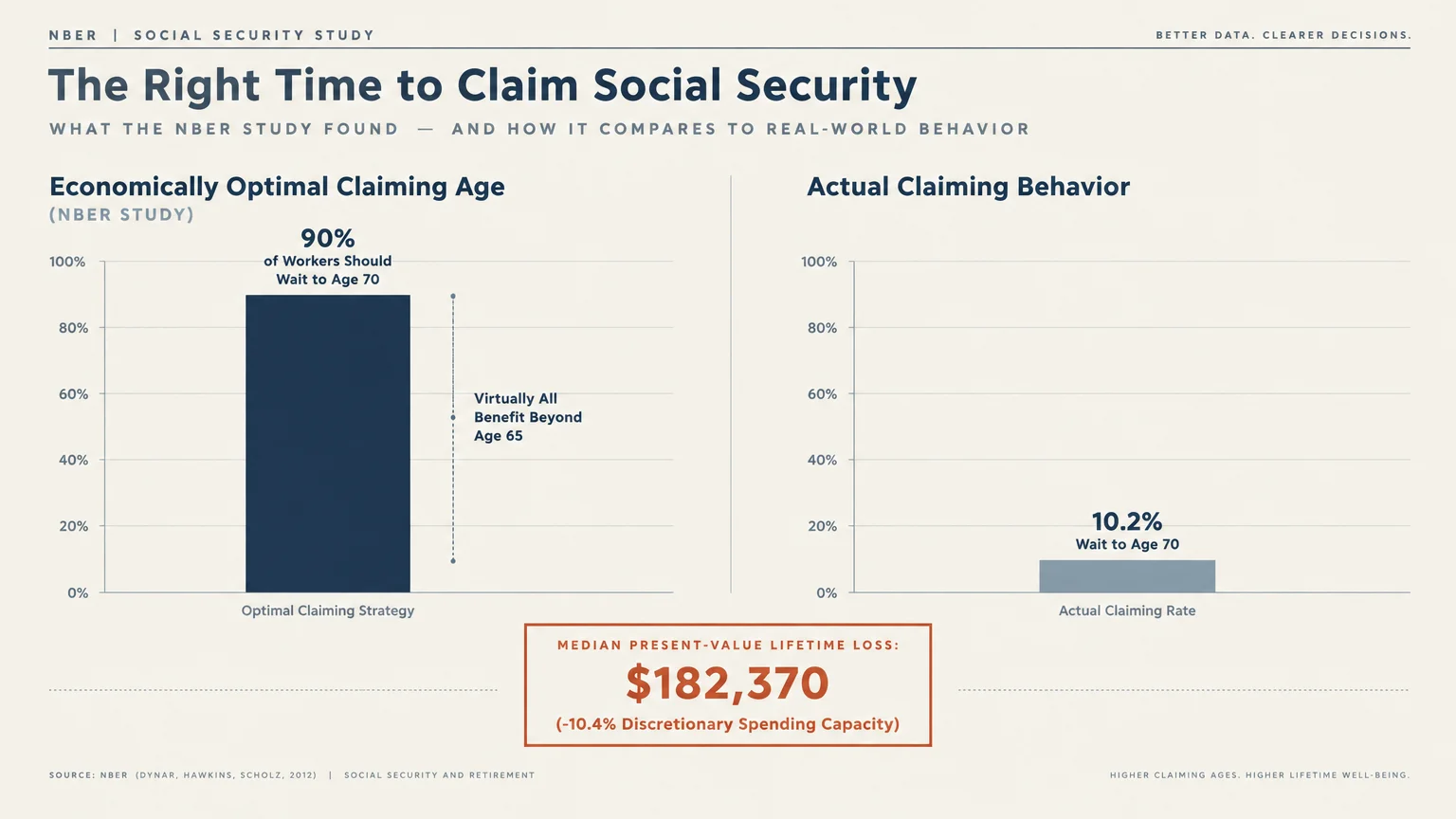
Their research discovered that an overwhelming majority of American workers file for benefits prematurely. The findings showed that virtually all workers aged 45 to 62 should wait beyond age 65 to collect.
Furthermore, more than 90% of workers would maximize their household resources by waiting until age 70. Despite this advantage, only 10.2% of Americans actually wait until age 70 to file.
This widespread social security claiming mistake carries a painful price tag. The researchers found that failing to optimize the filing age costs workers a median of $182,370 in present-value lifetime discretionary spending.
For a typical household, that missing sum represents a devastating 10.4% cut in lifetime spending capacity. That missing income could fund decades of healthcare expenses, travel, or everyday living costs.
How Claiming Age Dictates Your Monthly Check
The Social Security Administration determines your base retirement benefit through your Primary Insurance Amount (PIA). This figure reflects your highest 35 years of inflation-adjusted earnings.
Your PIA serves as the baseline payout you receive upon reaching your Full Retirement Age (FRA). For anyone born in 1960 or later, your FRA is exactly 67.
If you were born in 1959, your FRA is 66 years and 10 months. Filing before your FRA permanently reduces your benefit check every single month.
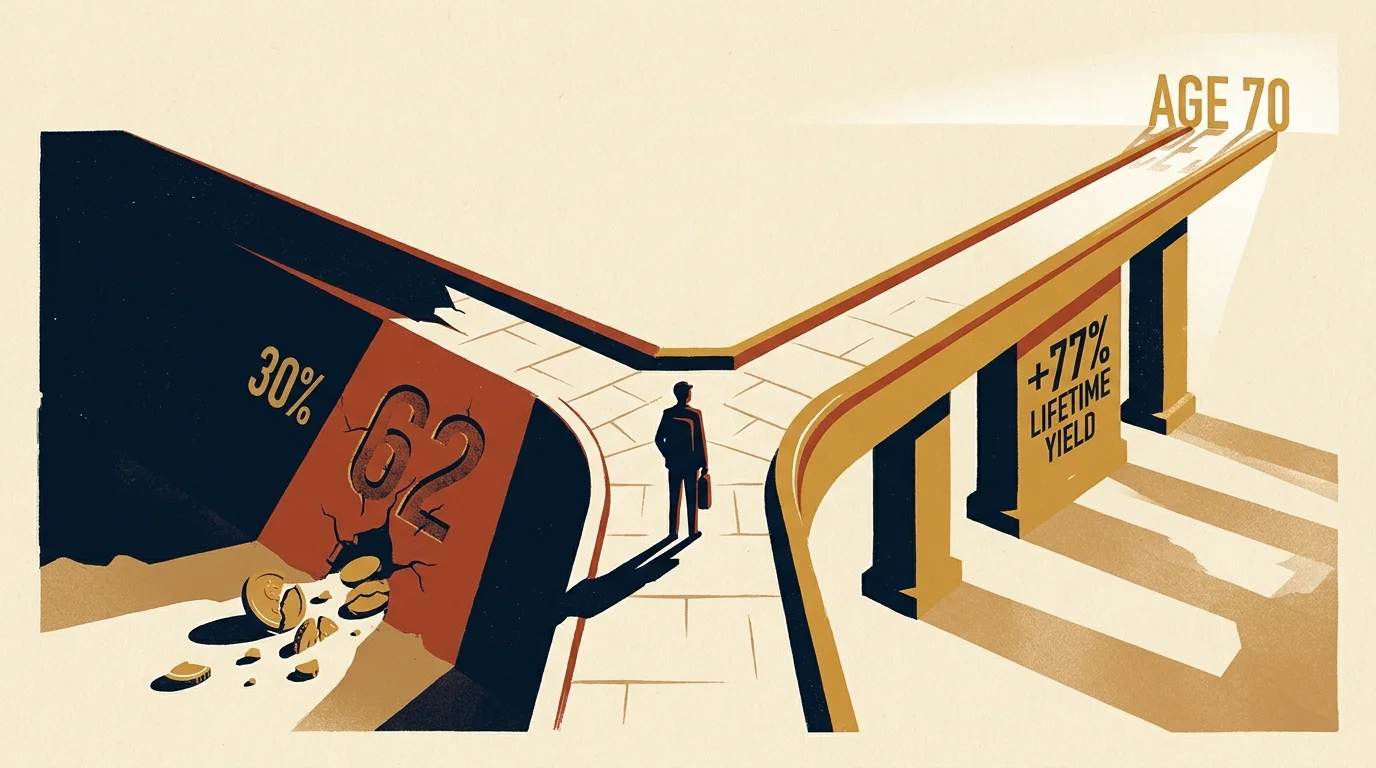
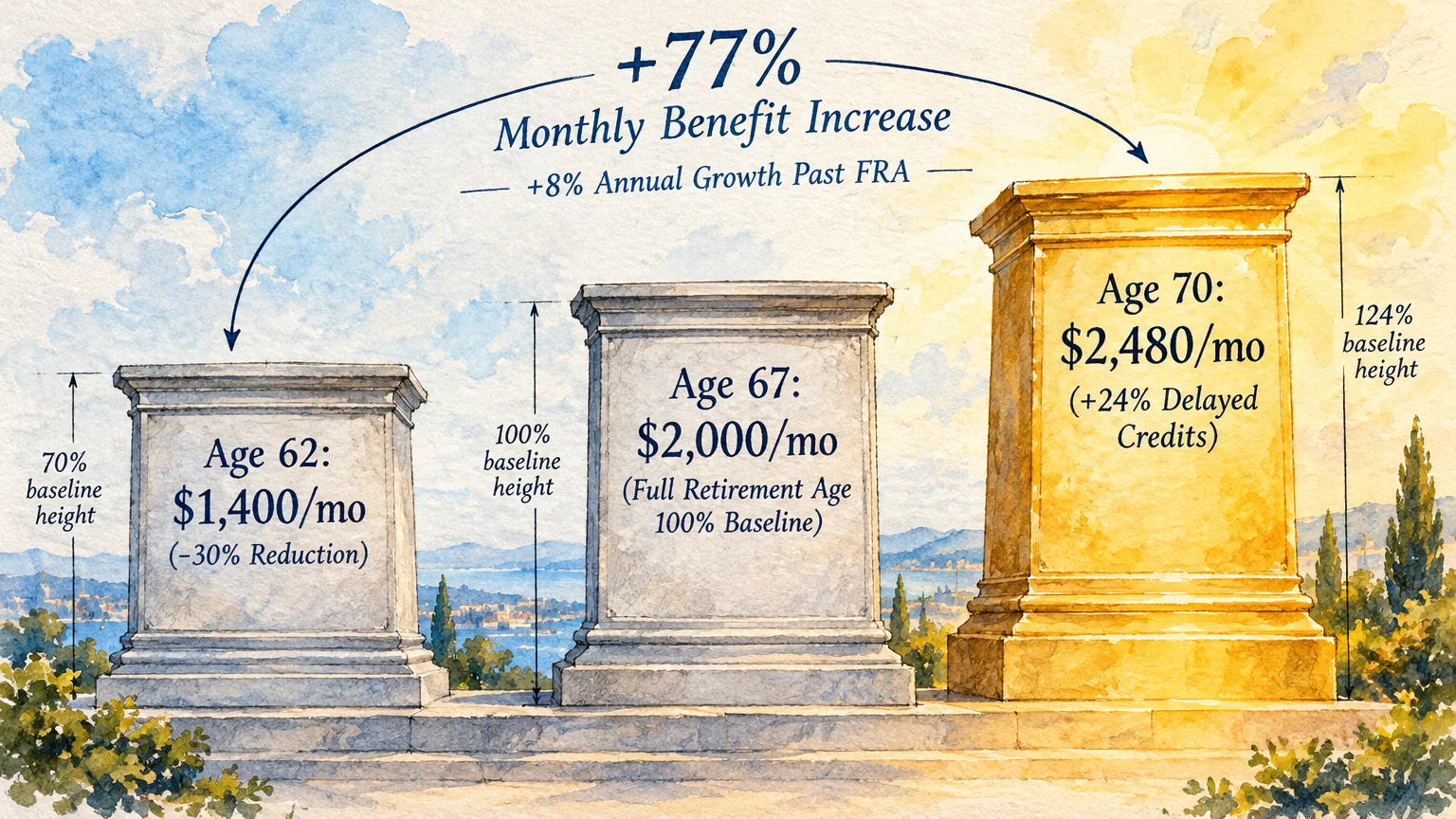
You can claim retirement benefits as early as age 62, but doing so triggers a severe 30% reduction. If your full benefit is $2,000 at age 67, claiming at 62 slashes that payment down to $1,400.
Spouses face an even steeper reduction when filing early. A spousal benefit claimed at age 62 is cut by 35% compared to waiting for full retirement age.
The Compounding Power of Delayed Retirement Credits
Patience pays handsome dividends under current Social Security rules. For every month you delay claiming past your FRA, your benefit earns delayed retirement credits.
These credits accumulate at a rate of two-thirds of 1% per month. This mechanism generates an 8% annual increase for every year you delay filing up to age 70.
If your FRA is 67, waiting until age 70 permanently boosts your monthly benefit by 24%. You lock in 124% of your full baseline benefit for the rest of your life.
When you compare age 62 to age 70, the difference becomes dramatic. Waiting until age 70 yields a monthly check roughly 77% higher than the payout you receive at 62.
“Social Security is your best longevity insurance, and waiting until age 70 guarantees an eight percent annual return you cannot get anywhere else.” — Suze Orman, Personal Finance Expert
Very few commercial financial products provide a guaranteed, inflation-protected annual return of 8%. Postponing your claim provides an unmatched financial hedge against outliving your savings.
Comparing Payout Scenarios: Age 62 vs. FRA vs. Age 70
Looking at maximum potential payouts illustrates how much money remains on the table. To capture the maximum benefit, a worker must earn at or above the taxable maximum wage base for at least 35 years.
The Social Security taxable wage base sits at $184,500 in 2026; it increases to $192,300 in 2027. High earners who reach these thresholds see massive payment divergence based on when they file.
| Claiming Age | Benefit Percentage of FRA | 2026 Maximum Monthly Benefit | 2027 Maximum Monthly Benefit |
|---|---|---|---|
| Age 62 (Earliest Claim) | 70% | $2,969 | $3,094 |
| Age 67 (Full Retirement Age) | 100% | $4,152 | $4,188 |
| Age 70 (Maximum Delay) | 124% | $5,181 | $5,358 |
In 2026, waiting from age 62 to age 70 increases the maximum monthly payment by $2,212 each month. In 2027, that monthly gap expands to $2,264.
Even for typical earners, the variance remains substantial. The average monthly benefit for retired workers started 2026 at $2,071 and hovered near $2,089 by late 2026.
The announced 3.6% Cost-of-Living Adjustment (COLA) for 2027 adds roughly $75 per month to the average check. Delaying your claim magnifies every future COLA you receive throughout retirement.
How Lost COLAs Magnify Lost Social Security Benefits
Cost-of-Living Adjustments are applied as a percentage of your current benefit check. Consequently, a higher monthly baseline produces significantly higher annual dollar increases.
If you receive $1,500 monthly, a 3.6% COLA adds $54 per month to your budget. If you delayed benefits and receive $2,500 monthly, that same 3.6% increase yields $90 more per month.
Over a 20-year retirement, this compounding difference creates an enormous income gap. What begins as a small dollar disparity widens every time consumer prices rise.
This compounding effect represents a primary reason why lost social security benefits reach the $182,000 threshold. Early claimers lock themselves into permanently smaller percentage expansions.

Working While Claiming Early: The Retirement Earnings Test Trap
Many retirees attempt to claim benefits at 62 while continuing to work part-time or full-time jobs. Unfortunately, doing so triggers the Social Security Retirement Earnings Test.
If you claim benefits before reaching your FRA and earn above specific annual thresholds, the government temporarily withholds your payments. For 2026, the annual earnings limit sits at $24,480 ($2,040 per month).
In 2027, that threshold increases to $25,560 ($2,130 per month). If you are under your FRA for the entire year, the agency withholds $1 in benefits for every $2 earned above the limit.
A different threshold applies during the calendar year you reach your Full Retirement Age. In 2026, that higher limit is $65,160 ($5,430 per month) for the months leading up to your birthday.
In 2027, the limit in the year of your FRA rises to $67,920 ($5,660 per month). During that final stretch, the agency withholds $1 for every $3 earned above the limit.
Once you reach your FRA, the earnings penalty disappears completely. There is no earnings cap once you achieve full retirement age.
The agency eventually recalculates your monthly benefit at your FRA to credit withheld payments back into your check. However, triggering withholding disrupts your short-term cash flow without providing early claiming advantages.
Protecting Your Spouse: The Survivor Benefit Penalty
Social security timing is rarely an individual decision for married couples. Your claiming choice directly impacts the financial survival of your partner if you pass away first.
When one spouse dies, the surviving spouse inherits the larger of the two monthly benefits. The smaller benefit disappears entirely from the household budget.
If you are the higher-earning spouse and claim early at 62, you lock in a permanently smaller baseline. You simultaneously cap the maximum survivor benefit your surviving spouse can receive.
Conversely, delaying your benefit until age 70 maximizes the financial lifeline left behind. Your spouse will step into your enhanced 124% benefit check for the rest of their life.
According to research from AARP, women disproportionately outlive their husbands and rely heavily on survivor benefits. Maximizing the higher earner’s benefit serves as vital longevity insurance for your partner.
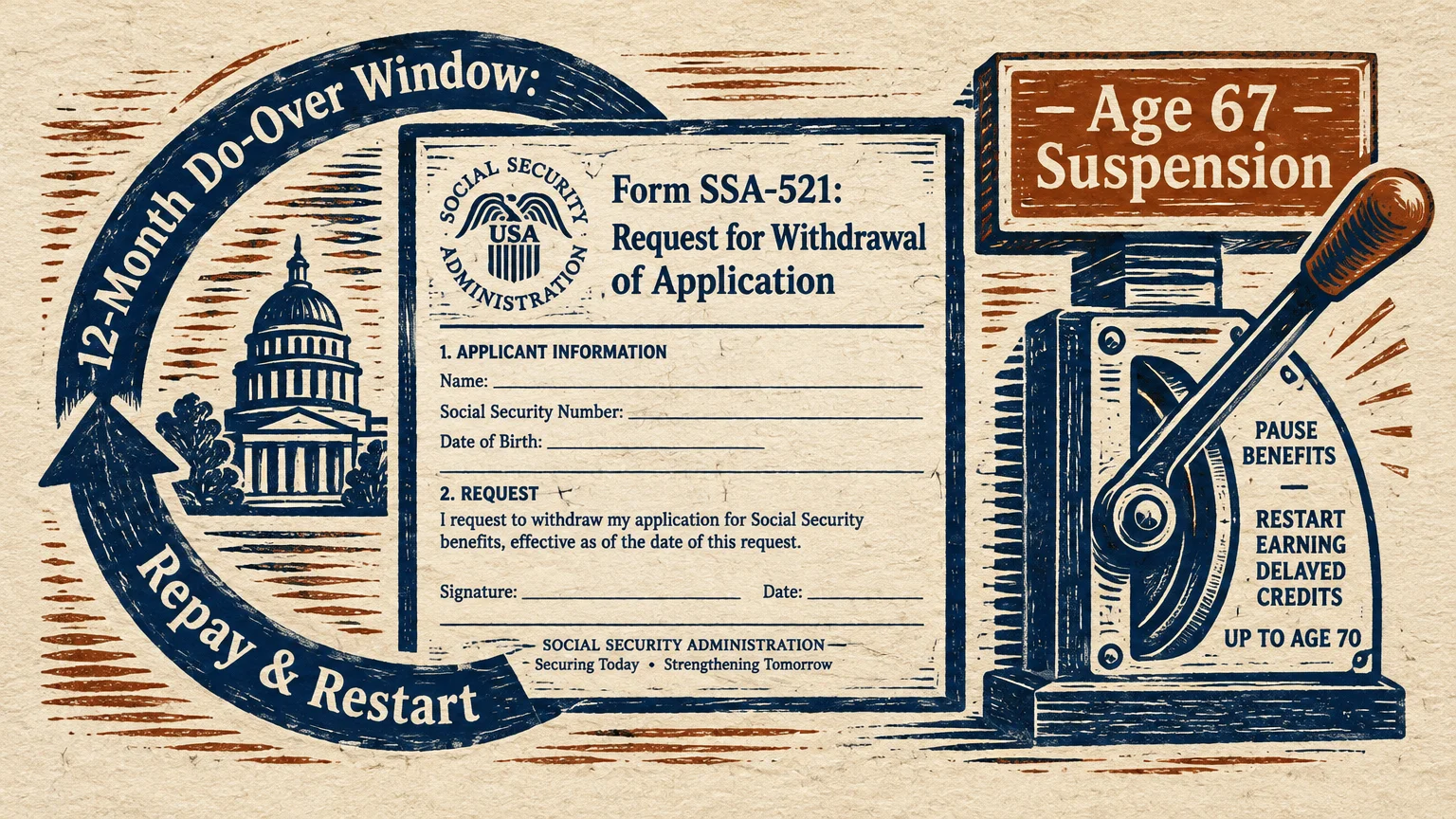
How to Fix an Early Claiming Mistake
If you already claimed your benefits early and regret the decision, you have options. The Social Security Administration provides two formal mechanisms to reset or restore your benefits.
- The 12-Month Withdrawal of Application: You can cancel your claim within 12 months of entitlement using SSA Form 521. You must repay every dollar received, including spousal benefits and withheld taxes.
- Voluntary Benefit Suspension at Full Retirement Age: If you missed the 12-month window, you can suspend your payments once you reach FRA. Your payments halt, earning 8% annual delayed credits until age 70.
The withdrawal option serves as a complete reset, allowing your benefit to grow as if you never filed. However, coming up with the cash to repay past benefits can present a hurdle.
The voluntary suspension route requires no cash repayment whatsoever. You simply contact the agency at FRA and instruct them to pause your checks until age 70.
Pitfalls to Watch For
Deciding when to claim social security requires navigating several hidden financial traps. Avoid these missteps when finalizing your claiming strategy:
- Ignoring your family health history: Claiming early makes mathematical sense if you suffer from serious health conditions that severely limit your life expectancy.
- Failing to coordinate spousal benefits: Having both spouses claim at age 62 often creates the worst possible financial outcome for lifetime household wealth.
- Neglecting Medicare enrollment at age 65: Even if you delay Social Security until 70, you must enroll in Medicare at 65 to avoid permanent late-enrollment penalties.
- Depleting growth assets recklessly: Spending down equities in taxable accounts during severe market downturns can occasionally cause more portfolio damage than claiming benefits slightly earlier.
- Fearing program insolvency: Cashing in early out of fear that Social Security will collapse locks in guaranteed reductions to avoid an uncertain legislative risk.
Each of these traps can erode your retirement standard of living. Evaluating your options objectively ensures your choices reflect math rather than emotion.

Getting Expert Help
While general guidelines point toward delaying benefits, unique personal situations require tailored professional planning. Consulting an experienced advisor clarifies trade-offs when circumstances complicate your filing roadmap.
Look for guidance from a fiduciary professional certified by the Certified Financial Planner Board. Seek professional advice across these four complex scenarios:
- Substantial Earnings Discrepancies: When one spouse earned significantly more than the other, coordinated claiming strategies can generate tens of thousands in extra spousal and survivor income.
- Working Past Age 62 With Volatile Income: An advisor can help you model the Retirement Earnings Test to prevent unexpected payment withholding and tax spikes.
- Tax Bracket Optimization: If you hold significant balances in traditional 401(k) accounts, delaying Social Security while executing strategic Roth conversions can slash lifetime taxes.
- Managing Chronic Health Concerns: If health limitations affect your working capacity, a planner helps evaluate break-even ages alongside disability or bridge withdrawal strategies.
A qualified professional models your cash flows across various mortality projections. This analysis removes guesswork and reveals the exact breakeven age for your household.
Frequently Asked Questions
Does delaying Social Security to age 70 always make sense?
No, delaying is not ideal for everyone. If you have serious health complications or an urgent need for income to survive, claiming earlier is completely reasonable.
What is the typical break-even age for delaying benefits?
The break-even age between claiming at 62 versus waiting for full retirement age generally falls between ages 78 and 82. If you live past your early 80s, delaying generates superior cumulative income.
Can I claim spousal benefits early and switch to my own record later?
Under current deemed filing rules, filing for spousal benefits automatically triggers an application for your own retirement benefit. You receive the higher amount, eliminating the ability to switch later.
How does the 2027 COLA change benefit payments?
The 3.6% COLA for 2027 increases the average worker benefit by roughly $75 per month starting in January 2027. Maximum benefits rise accordingly across all claiming ages.
Taking Control of Your Retirement Income
Your Social Security claiming age represents one of the largest single financial decisions of your lifetime. Choosing patience transforms your benefit into an unmatched, inflation-protected stream of guaranteed income.
Take the time to evaluate your health, career plans, and spousal protections before filing paperwork. The information in this guide is meant for educational purposes. Your specific circumstances—including income, health needs, tax situation, and goals—may require different approaches. When in doubt, consult a licensed professional.
Last updated: November 2026. Retirement benefits, tax rules, and healthcare regulations change frequently—verify current details with official sources.