
Deciding when and how to claim Social Security shapes your retirement paycheck for decades. Even a single claiming mistake can permanently shrink your monthly income and ripple into your tax bill.
Many retirees stumble into these Social Security errors because benefit rules overlap with work income, Medicare premiums, and spousal timelines in ways that rarely feel intuitive.
Spotting the eight most frequent Social Security mistakes before you file gives you clear steps to protect your household income and maximize Social Security over your lifetime.
01 Claiming Early Without Weighing the Lifetime Cost
Most retirees file before reaching Full Retirement Age (FRA), often locking in smaller checks for life. According to Social Security Administration (SSA) data, 62.1% of retired workers received a reduced monthly benefit as of December 2024 because they claimed early.
Your FRA depends on your birth year. It is age 66 for anyone born from 1943 through 1954 and rises gradually to age 67 for people born in 1960 or later.
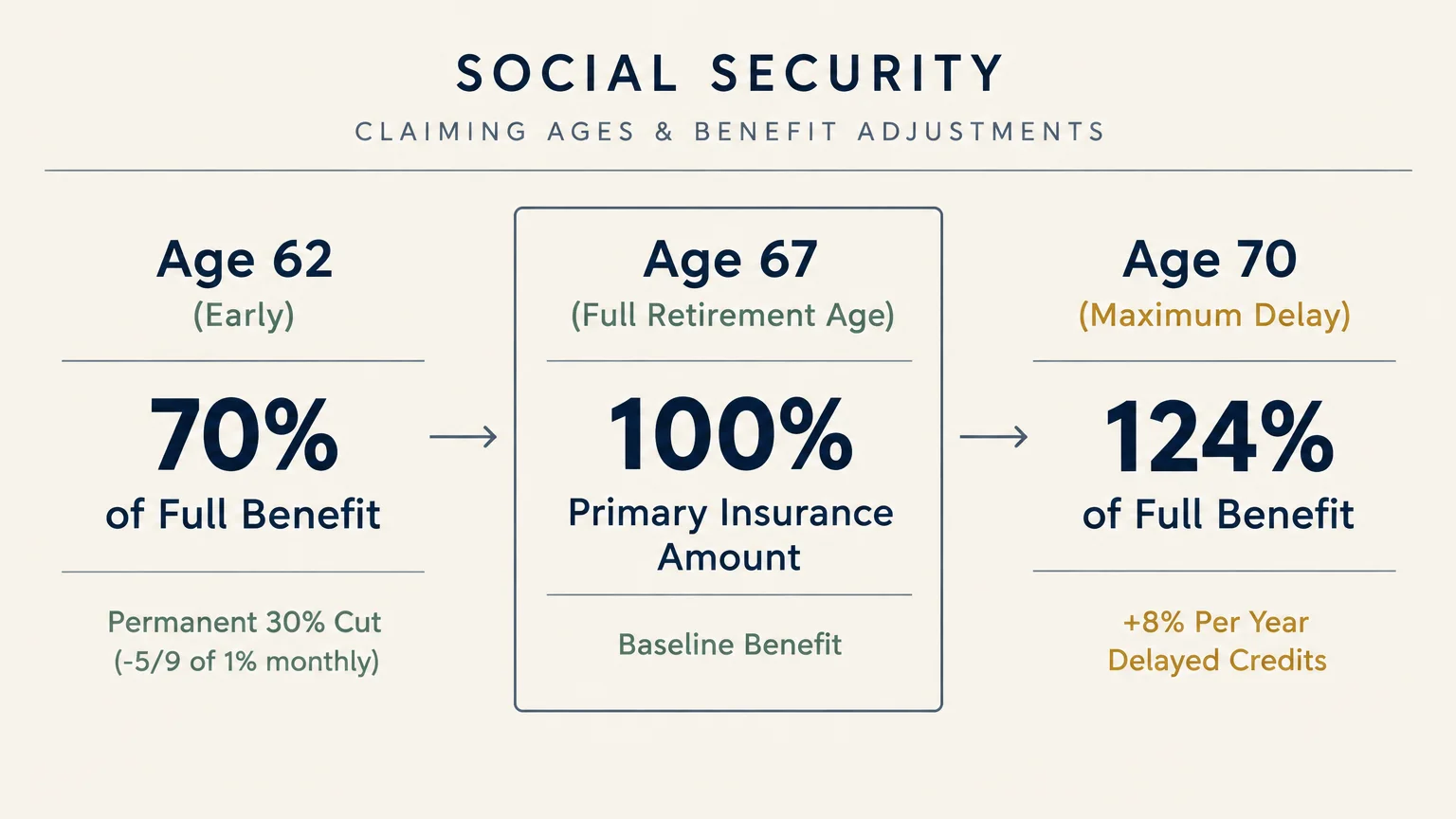
Claiming before FRA triggers a permanent reduction of 5/9 of 1% per month for the first 36 months. Each additional early month beyond 36 months reduces your benefit by 5/12 of 1%.
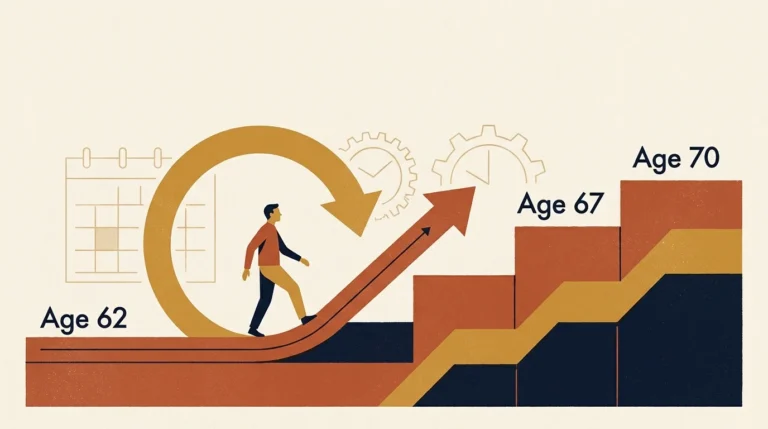
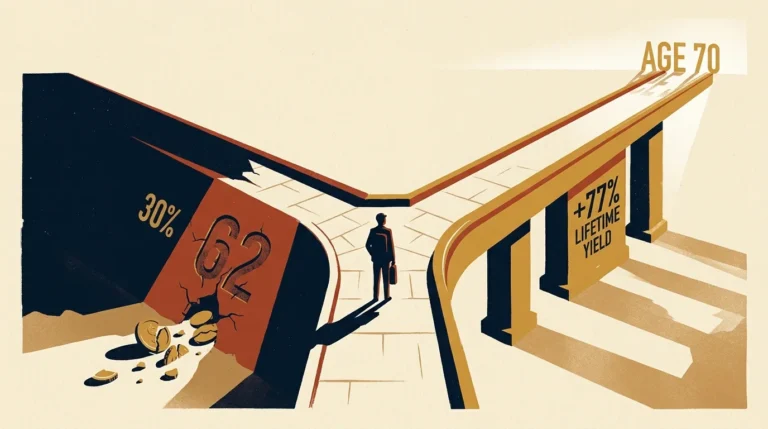
For a worker with an FRA of 67, filing at age 62 cuts your monthly payment by a permanent 30%. That leaves you with 70% of your full Primary Insurance Amount.
Waiting past FRA works in your favor instead. Delayed retirement credits add 8% per year—or 2/3 of 1% per month—up to age 70, lifting an FRA-67 worker to 124% of their full benefit.
Those larger starting checks also compound every time annual Cost-of-Living Adjustments (COLAs) arrive. Benefits rose 2.8% in 2026 and will increase 3.6% in 2027 across 76 million Americans.
Consider the scale of what is at stake using official Social Security Administration figures:
- Average retired-worker benefit: $2,089 per month ($25,065 per year) in September 2026, projected to climb by roughly $75 per month to about $2,170 in January 2027.
- Maximum benefit at FRA: $4,152 per month in 2026 and $4,188 per month in 2027 for high earners.
- Maximum benefit at age 70: Up to $5,181 per month in 2026 for workers who earned the taxable maximum starting at age 22.
Claiming at 62 still makes sense if you face serious health issues, lack other savings, or need immediate cash flow. Just run the break-even math first so you choose early benefits intentionally rather than out of habit.
| Claiming Age (FRA 67) | Percentage of Full Benefit | Monthly Adjustment Rule | Best Fit Scenario |
|---|---|---|---|
| Age 62 (Early) | 70% (permanent 30% cut) | Minus 5/9 of 1% (first 36 months) and 5/12 of 1% (next 24 months) | Shortened life expectancy or urgent income need without other assets |
| Age 67 (Full Retirement Age) | 100% of Primary Insurance Amount | No early reduction and no delayed credits | Retiring around FRA with balanced savings and average longevity expectations |
| Age 70 (Maximum Delay) | 124% (no credits earned after 70) | Plus 8% per year (2/3 of 1% per month) past FRA | Strong health, other income to bridge the gap, or protecting a lower-earning spouse |
02 Working While Claiming Before Full Retirement Age
Filing for benefits while you still earn a solid paycheck frequently triggers a surprise withholding penalty. Under the Retirement Earnings Test, the SSA reduces payments if you claim before FRA and earn above annual limits.
If you remain under FRA for the entire calendar year, the SSA withholds $1 in benefits for every $2 you earn above $24,480 ($2,040 per month) in 2026. In 2027, that annual threshold rises to $25,560 ($2,130 per month).
A gentler threshold applies during the calendar year you reach FRA. In 2026, the SSA withholds $1 for every $3 earned above $65,160 ($5,430 per month), counting only wages earned in months prior to your FRA month.
That pre-FRA-month cap increases to $67,920 ($5,660 per month) in 2027. Beginning in the exact month you reach FRA, the earnings limit disappears completely regardless of how much you make.
Retirees often misunderstand what counts toward this limit. Only earned wages or net self-employment income apply; pensions, annuities, investment returns, and IRA or 401(k) withdrawals do not count.
Withheld benefits are not lost forever because the SSA recalculates your monthly amount upward once you hit FRA. Still, claiming early only to have checks withheld defeats your short-term cash flow goal and creates unnecessary administrative headaches.
03 Overlooking Gaps or Errors in Your 35-Year Earnings Record
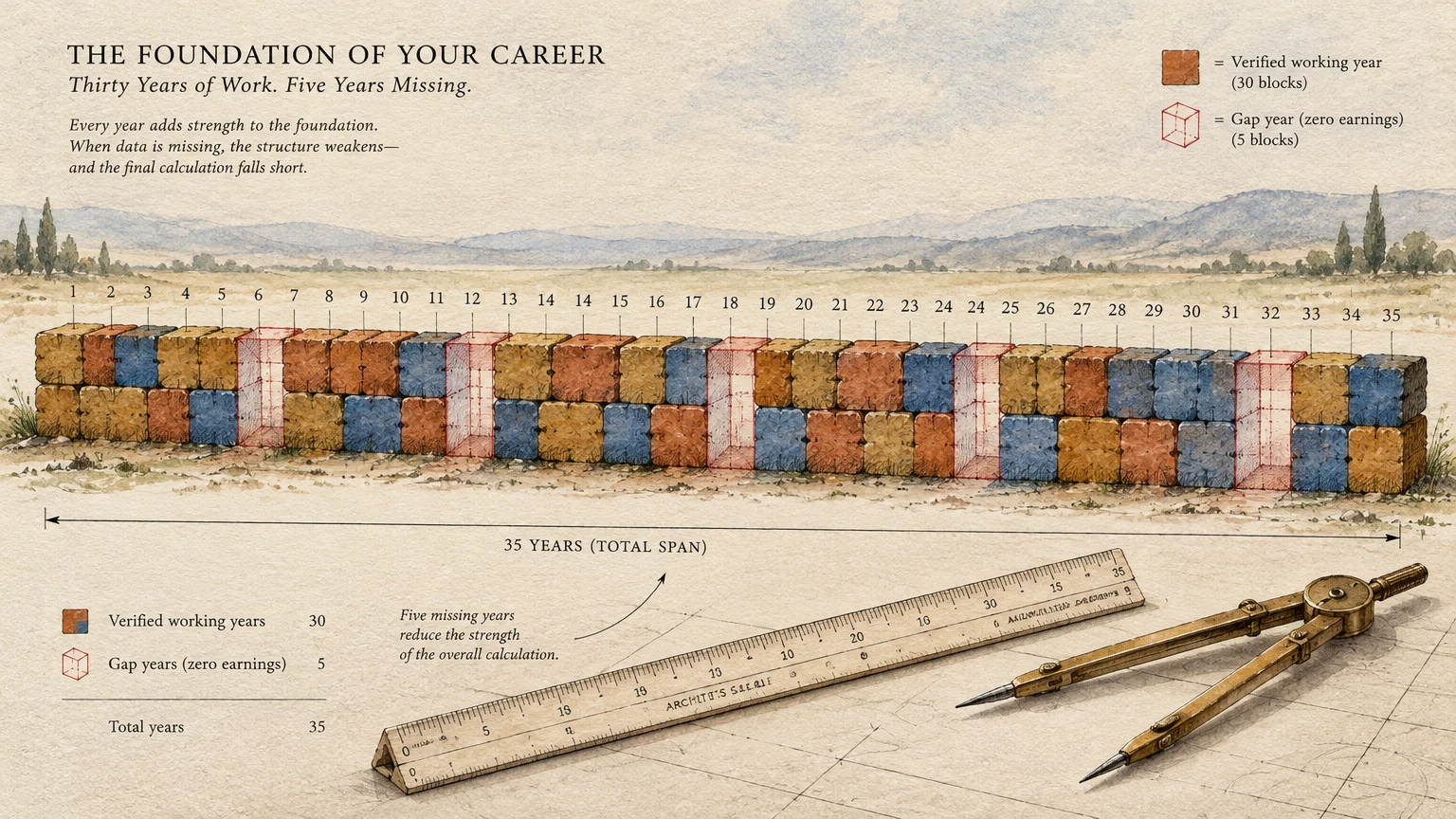
Your monthly check relies on your 35 highest-earning, inflation-adjusted years of covered wages. If you worked fewer than 35 years, the SSA averages zeros into the missing slots, dragging down your calculation.
You also need 40 work credits—earning up to four credits per year—to qualify for retirement benefits. One credit requires $1,890 in earnings during 2026 and $1,970 during 2027.
Higher earners also need to watch the annual taxable wage base. Social Security taxes and benefit formulas cap covered earnings at $184,500 in 2026 and $192,300 in 2027.
Clerical mistakes happen, especially if you changed names, switched employers frequently, or held multiple jobs in a single year. Letting an underreported year sit unchallenged permanently lowers your lifetime benefit.
Review your online Social Security statement every year before filing. Comparing each year’s posted wages against your W-2 forms or tax returns lets you spot missing income early while records remain easy to prove.
Working one or two extra years near the end of your career can also boost your check. When current pay replaces a zero or a low-earning year from your twenties, your 35-year average rises automatically.
04 Misjudging Benefit Taxes and the Temporary Senior Deduction
Many new retirees assume Social Security checks arrive completely tax-free, only to face an unexpected bill in April. Federal income taxes on benefits depend on your provisional income—a formula that catches middle-income households off guard.
Provisional income equals your adjusted gross income (excluding Social Security), plus any tax-exempt interest, plus 50% of your Social Security benefits. Unlike tax brackets, these dollar thresholds have never been indexed for inflation.
Here is how the Internal Revenue Service (IRS) taxes benefits based on filing status:
- Single filers: Provisional income between $25,000 and $34,000 makes up to 50% of your benefits taxable; over $34,000 makes up to 85% taxable.
- Married filing jointly: Provisional income between $32,000 and $44,000 makes up to 50% of your benefits taxable; over $44,000 makes up to 85% taxable.
Recent tax legislation added another layer of confusion. The 2025 One Big Beautiful Bill Act (P.L. 119-21) did not repeal federal taxes on Social Security benefits, despite widespread rumors suggesting otherwise.
Instead, for tax years 2025 through 2028, the law created a temporary enhanced deduction on IRS Schedule 1-A for taxpayers age 65 and older. You can claim up to $6,000 per eligible person—or $12,000 for joint filers both age 65 or older—whether you itemize or take the standard deduction.
That deduction phases out by 6% of modified adjusted gross income (MAGI) above $75,000 for single filers or $150,000 for joint filers. It disappears entirely at $175,000 single or $250,000 joint.
Because large IRA withdrawals, capital gains, or Roth conversions can both trigger the 85% benefit tax tier and shrink your $6,000 senior deduction, timing your withdrawals matters. Mapping out your tax brackets before claiming helps you keep more of every dollar.
05 Getting Caught Off Guard by Medicare Part B and IRMAA
Your gross Social Security award rarely equals the cash deposited into your bank account. Most enrollees have their Medicare Part B premium deducted directly from their monthly Social Security payment.
According to the Centers for Medicare & Medicaid Services (CMS), the standard Part B monthly premium is $202.90 in 2026. As of early November 2026, AARP noted that CMS had not yet released the final 2027 standard Part B rate.
Higher-income retirees face steeper deductions through Income-Related Monthly Adjustment Amounts (IRMAA) on both Medicare Part B and Part D. In 2026, IRMAA surcharges apply when your MAGI exceeds $109,000 for single filers or $218,000 for joint filers.
Part D surcharges alone add between $14.50 and $91 per month in 2026 depending on your income tier. The real trap lies in the two-year lookback rule.
Your 2026 IRMAA bracket relies on your 2024 tax return, while your 2027 surcharges come from your 2025 return. Selling a business, taking a big retirement payout, or completing a large Roth conversion two years before claiming can inflate your Medicare premiums right as you start benefits.
You do not always have to accept a surcharge based on peak working years. If your income dropped due to a qualifying life-changing event—such as retirement, divorce, or the death of a spouse—you can appeal via Form SSA-44 using Medicare.gov and SSA guidelines.
06 Misreading Spousal, Divorced Spouse, and Deemed Filing Rules
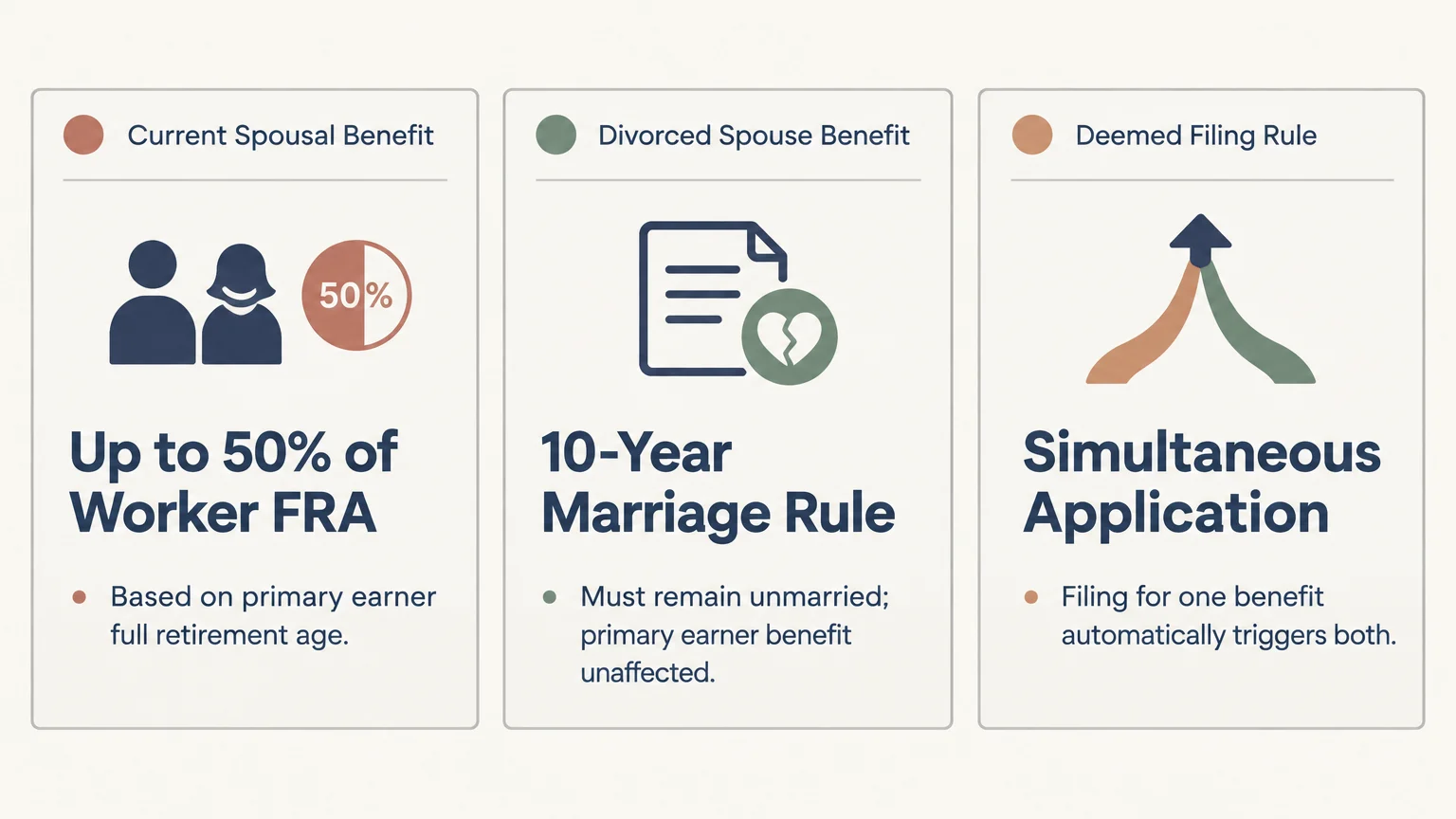
Married and divorced retirees frequently leave thousands on the table by assuming outdated claiming strategies still exist. Under the Bipartisan Budget Act of 2015, deemed filing rules changed how couples coordinate benefits.
Anyone born January 2, 1954 or later who applies for either retirement or spousal benefits is automatically deemed to have filed for both if eligible. You receive whichever combined amount is higher rather than picking one now and saving the other for later.
Another frequent error involves delaying a spousal claim past FRA. The maximum spousal benefit equals 50% of the higher earner’s Primary Insurance Amount at the claimant’s FRA, and spousal benefits do not earn delayed retirement credits past FRA.
Waiting until age 70 to claim a pure spousal benefit only forfeits years of payments without raising your monthly rate. Meanwhile, the lower earner cannot collect a spousal benefit until the higher earner actually files for retirement benefits—unless the couple is divorced.
Divorced spouses often overlook valuable rights on an ex-spouse’s earnings record. If you are unmarried, age 62 or older, and your marriage lasted at least 10 years, you may qualify for divorced spouse benefits.
Once divorced for at least two continuous years, you can apply even if your ex-spouse has not yet claimed, provided your ex-spouse is at least 62 and eligible. Claiming on an ex-spouse’s record never reduces their benefit or affects their current spouse.
07 Missing the Special Flexibility Built Into Survivor Benefits
While deemed filing locks up switching strategies for living spouses, survivor benefits follow a completely different rulebook. Widows, widowers, and eligible surviving divorced spouses (married at least 10 years) retain the power to claim one benefit first and switch later.
You can claim survivor benefits as early as age 60, or age 50 if you have a qualifying disability. Payouts range from 71.5% to 100% of the deceased worker’s benefit, including any delayed retirement credits the deceased spouse earned.
One of the most costly claiming mistakes occurs when a survivor files for both their own retirement check and their survivor check at the same time. Doing so forfeits the opportunity to let one benefit grow untouched.
Depending on your earnings history, two smart strategies stand out:
- Take the survivor benefit early, then switch to your own at 70: If your own retirement benefit at age 70 will exceed the full survivor benefit, you can collect survivor payments starting at age 60 while letting your own record earn 8% annual credits until 70.
- Take your own reduced benefit at 62, then switch to the survivor benefit at FRA: If the survivor check is larger, you can start your own reduced retirement benefit early and switch to 100% of the survivor benefit once you reach FRA.
Remarrying before age 60 (or age 50 if disabled) generally cuts off eligibility for survivor benefits on a prior spouse’s record. Remarrying at age 60 or later preserves your survivor benefit rights.

08 Letting Solvency Fears or Outdated Pension Rules Drive a Rushed Claim
Headlines about Social Security trust fund depletion push many pre-retirees into panic-claiming at age 62. Taking a permanent 30% cut out of fear that checks will vanish is a severe financial miscalculation.
According to the 2026 OASDI Trustees Report, Old-Age and Survivors Insurance (OASI) Trust Fund reserves are projected to run dry in the fourth quarter of 2032. On a combined OASDI basis, trust fund depletion is projected for the third quarter of 2034.
Depletion does not mean zero benefits because payroll taxes continue flowing into the system every payday. Even if Congress takes no action, ongoing tax revenue would still cover 78% of scheduled OASI benefits in 2032—or 83% on a combined basis in 2034.
A potential 22% across-the-board reduction is serious, yet claiming early at 62 locks in a 30% cut immediately—and any future legislative adjustment would reduce that smaller check even further.
A second outdated assumption hits millions of teachers, firefighters, police officers, and public servants. For decades, the Windfall Elimination Provision (WEP) and Government Pension Offset (GPO) slashed benefits for workers with pensions from jobs that did not withhold Social Security taxes.
On January 5, 2025, the Social Security Fairness Act (P.L. 118-273) repealed both WEP and GPO retroactively for benefits payable after December 2023. That change affected more than 3.2 million retirees with non-covered public pensions.
By July 7, 2025, the SSA had already issued over 3.1 million adjusted or retroactive payments totaling roughly $17 billion. The Congressional Budget Office estimated average monthly increases by December 2025 of $360 for former WEP workers, $700 for GPO spouses, and $1,190 for GPO widow(er)s.
If you previously skipped filing for spousal or survivor benefits because GPO wiped out your payment, check your eligibility immediately. Acting on pre-2025 pension rules means leaving substantial monthly income unclaimed.
Pitfalls to Watch For
Even after you spot one of these retiree social security tips too late, trying to fix a bad claim carries strict deadlines and hidden traps. Knowing the reversal rules protects you from making a costly second error.
If you regret filing within your first year, you can withdraw your application once per lifetime using Form SSA-521. You must submit that request within 12 months of your first month of entitlement.
Here is the catch: withdrawing requires repaying every dollar you and any family members received on your record. You must also pay back withheld income taxes and deducted Medicare premiums out of pocket before the SSA resets your clock.
Once 12 months pass—or if you cannot repay prior checks—you lose the withdrawal option. At that point, you must wait until you reach FRA to regain flexibility.
Between FRA and age 70, you can voluntarily suspend your benefit without repaying past checks. Suspending payments earns 8% annual delayed retirement credits up to age 70.
However, voluntary suspension also pauses auxiliary benefits paid to your spouse or dependents on your record (divorced spouses are exempt from this halt).
Finally, never delay filing past age 70. Delayed retirement credits stop accruing the month you turn 70, so waiting longer simply forfeits checks you can never recover.

Getting Expert Help
Online calculators handle straightforward single-earner timelines well, yet complex household rules reward personalized modeling. Consider consulting a fee-only financial planner or tax professional in these four situations:
- Couples with wide age or earnings gaps: Modeling how delayed credits on the higher earner’s record protect a younger or lower-earning spouse through survivor benefits requires coordinated cash-flow projections.
- Large pre-retirement income spikes: If you plan Roth conversions, property sales, or lump-sum distributions, a tax planner can help you avoid the 2025–2028 senior deduction phaseout and two-year IRMAA Medicare surcharges.
- Widowhood or long-term divorce: Navigating non-deemed survivor switches or gathering marriage and divorce decrees for a 10-year ex-spouse claim leaves little room for filing errors.
- Public-sector pension transitions: Retirees newly freed from WEP and GPO reductions can review retroactive adjustments, new spousal options, and updated tax withholding strategies.
Frequently Asked Questions
Can I undo my Social Security claim if I realize I filed too early?
Yes, you have two ways to adjust an early claim depending on your timing. Within 12 months of first entitlement, you can file Form SSA-521 once per lifetime, provided you repay all benefits, withheld taxes, and Medicare premiums paid on your record.
After 12 months, you must wait until Full Retirement Age to voluntarily suspend benefits. Suspending between FRA and age 70 earns 8% annual delayed credits without requiring you to repay earlier checks.
Does Social Security count 401(k) or IRA withdrawals toward the retirement earnings limit?
No, the Retirement Earnings Test only counts earned wages from a job or net self-employment income. Pensions, annuities, investment income, and withdrawals from a 401(k) or IRA do not reduce your Social Security checks before FRA.
Remember that while retirement account withdrawals do not trigger the earnings test, they still raise your adjusted gross income. That extra taxable income can push more of your Social Security benefits into the 50% or 85% federal tax brackets.
Did the new senior tax deduction eliminate federal taxes on Social Security benefits?
No, the 2025 One Big Beautiful Bill Act kept the existing provisional income rules intact, meaning up to 85% of benefits can still be taxed. Instead, it created an extra deduction of up to $6,000 per person age 65 or older for 2025 through 2028.
That temporary deduction reduces overall taxable income for eligible seniors with MAGI below the $75,000 single or $150,000 joint phaseout thresholds. Once MAGI hits $175,000 single or $250,000 joint, the extra deduction disappears.
Will Social Security run out of money before I finish retirement?
No, Social Security cannot completely run out of money as long as workers pay payroll taxes. According to the 2026 Trustees Report, trust fund reserves are projected to deplete in late 2032 for OASI or mid-2034 on a combined basis.
Even without congressional action before then, ongoing payroll taxes would still fund roughly 78% to 83% of scheduled benefits. Claiming early out of fear locks in a permanent 30% cut immediately rather than waiting to see how lawmakers address the shortfall.
Next Steps for a Stronger Claiming Plan
Before you choose a filing date, log into your personal account at SSA.gov to verify your 35-year earnings history and compare estimates at age 62, FRA, and age 70. Pair those numbers with your household tax outlook, Medicare IRMAA thresholds, and spousal or survivor options so your decision serves your whole retirement.
The information in this guide is meant for educational purposes. Your specific circumstances—including income, health needs, tax situation, and goals—may require different approaches. When in doubt, consult a licensed professional.
Last updated: November 2026. Retirement benefits, tax rules, and healthcare regulations change frequently—verify current details with official sources.