
Many retirees move to a state with low or zero income tax, only to watch their budgets erode through property bills, sales levies, and utility surcharges. Your total retirement tax burden depends on far more than what appears on an annual income tax return.
State and local governments collect billions through hidden taxes for retirees—including wireless fees, fuel excise taxes, vehicle assessments, and estate cliffs. Knowing which states stack these costs helps you protect your savings before you sign a lease or buy a home.
Below, you will find the five states where layered fees hit retirees hardest in 2026, plus practical steps to audit your true cost of living.
At a Glance: Where Hidden Retirement Taxes Hit Hardest
Headline tax rates rarely show what you will actually pay once you stop working. States that exempt wages or pensions often make up the revenue through everyday consumption charges and steep local assessments.
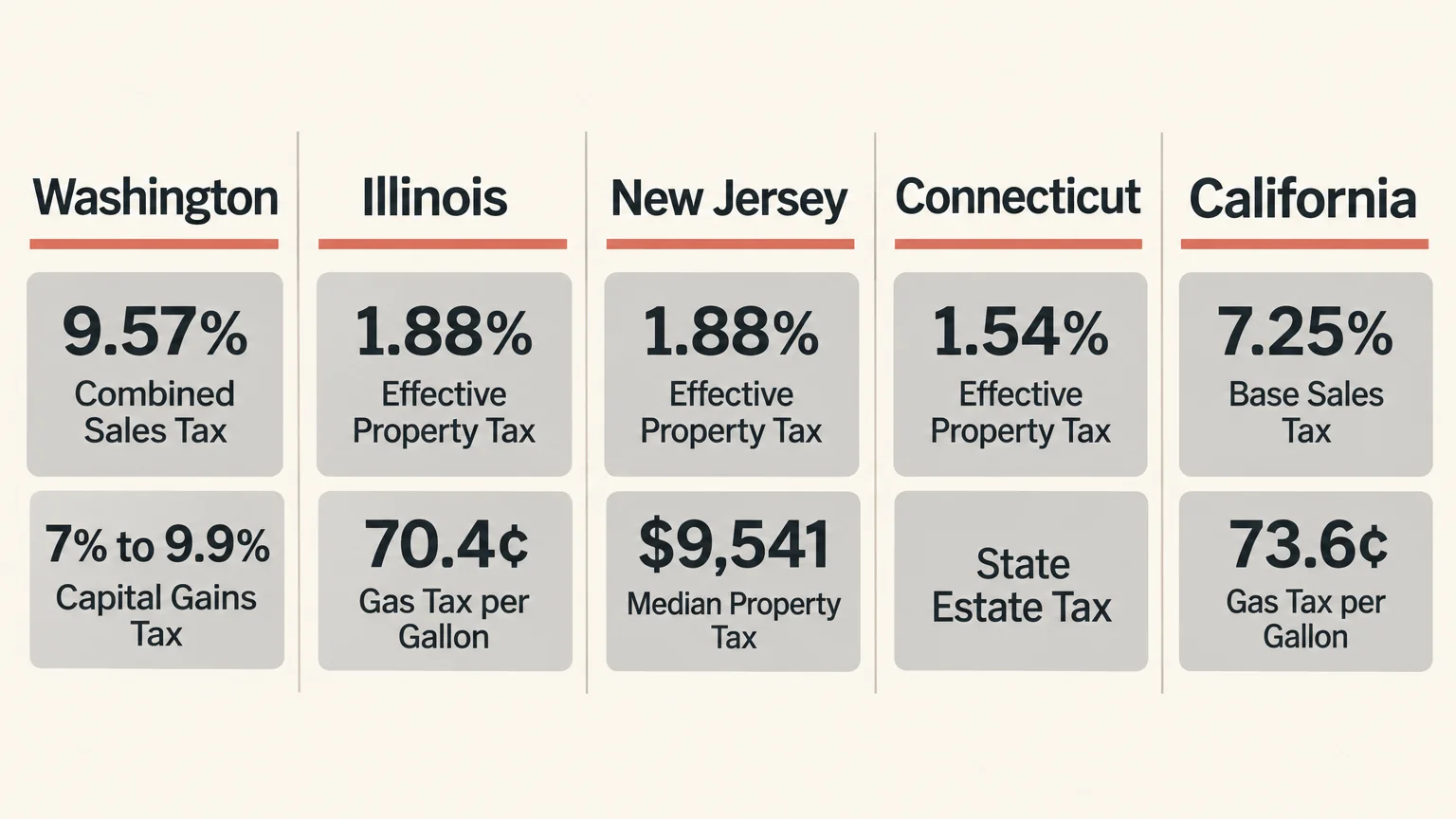
- Washington: No wage income tax in 2026, yet retirees face a 9.57% combined sales tax, a 7% to 9.9% capital gains tax, top wireless fees, and a steep estate tax.
- Illinois: Exempts retirement distributions, but ties for the highest effective property tax rate at 1.88% while charging over 30% in wireless taxes and 70.4 cents per gallon on gas.
- New Jersey: Ties for the nation’s highest effective property tax rate (1.88%), posts the highest median property tax bill ($9,541), and levies up to a 16% inheritance tax.
- Connecticut: Combines a 1.54% effective property tax rate with Social Security taxation above certain income thresholds, sales tax stacked on gasoline, and a state estate tax.
- California: Charges the highest statewide base sales tax (7.25%) and gas tax (73.6 cents per gallon) while taxing pensions and IRA withdrawals up to 13.3%.
What Counts as a “Hidden” Tax or Fee in Retirement?
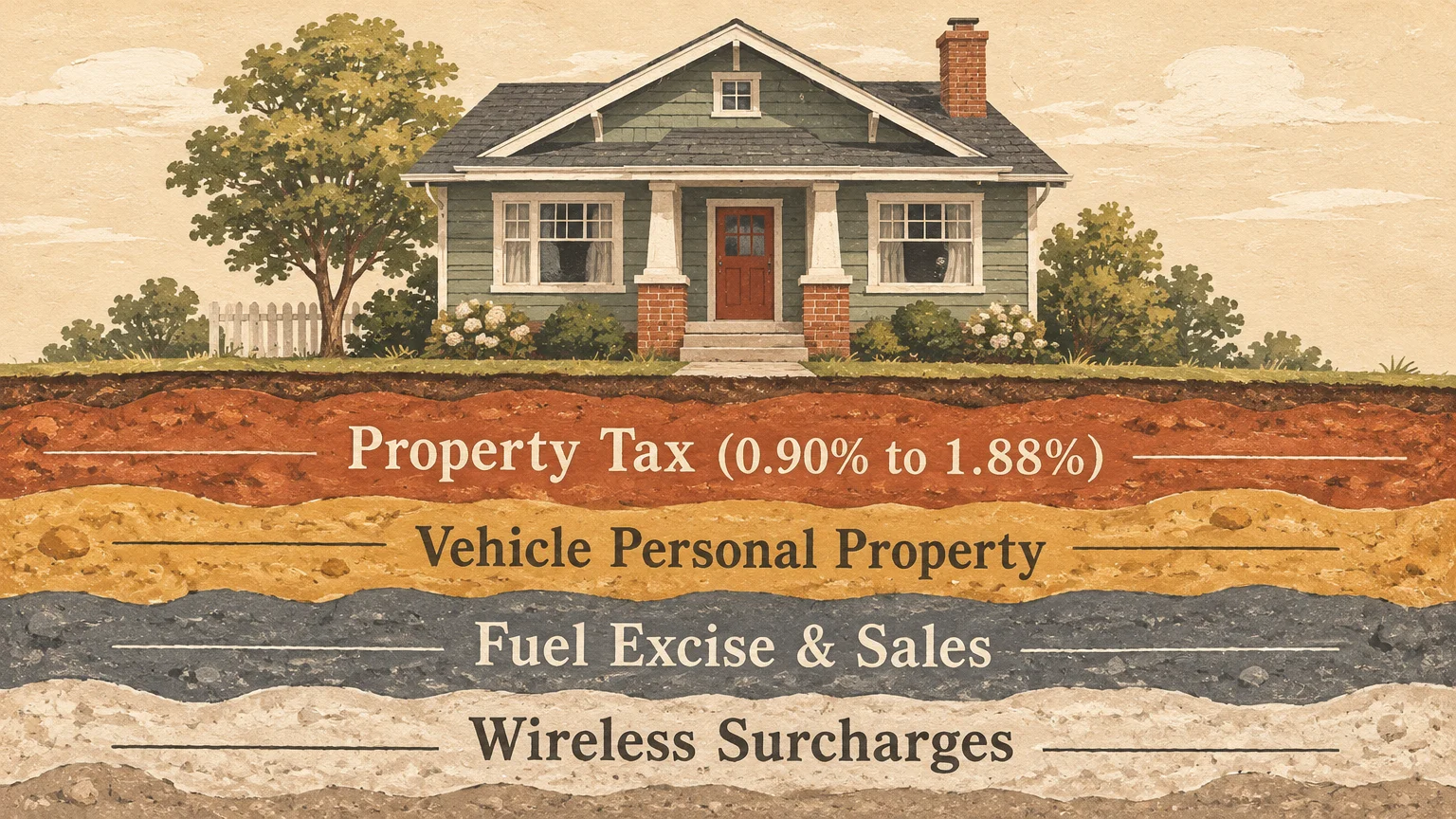
When you evaluate the worst states for retirees taxes often hide outside your Form 1040 or state income return. Instead, they show up automatically on utility statements, grocery receipts, vehicle renewals, and county property notices.
Because these charges rarely adjust for age or fixed incomes, they quietly consume a larger share of your cash flow each year. Understanding each category helps you spot the leaks in your retirement budget.
Property and Vehicle Assessments
Property taxes seniors pay each year often represent their single largest ongoing state and local expense. According to Tax Foundation 2026 data based on 2024 Census figures, the unweighted national average effective property tax rate sits at 0.90%.
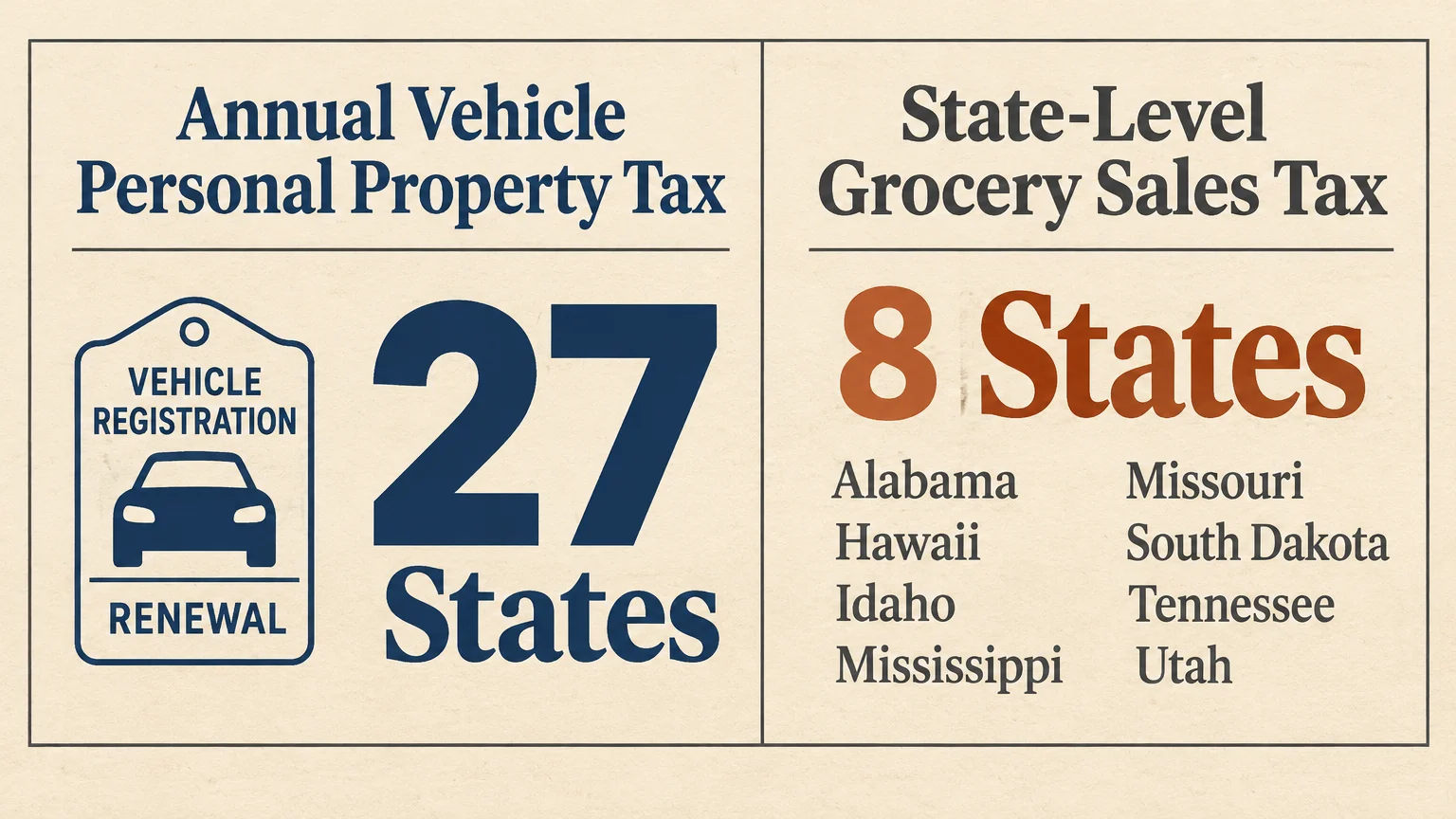
In high-tax states, however, effective rates reach 1.50% to 1.88%, translating to $4,500 to $5,640 annually on a $300,000 home—and far more in higher-priced markets. On top of real estate, WalletHub data notes that 27 states charge recurring personal property taxes on vehicles every year.
Sales, Grocery, and Fuel Stacking
Retail sales taxes generate 24% of combined state and local tax collections nationwide, per Tax Foundation figures. In states with combined rates nearing 9% to 10%, every home repair, appliance replacement, and restaurant meal costs noticeably more.
A March 2026 AARP update shows only eight states still impose a state-level sales tax on groceries—Alabama, Hawaii, Idaho, Mississippi, Missouri, South Dakota, Tennessee, and Utah—though local grocery taxes can still apply elsewhere. Several states also apply general sales taxes directly on top of gasoline excise taxes.
Wireless, Utility, and Excise Surcharges
Cell phone bills carry some of the fastest-growing state fees retirees rarely factor into relocation math. Tax Foundation data from September 2026 reports that taxes and government surcharges averaged a record 28.8% of a monthly wireless bill, up from 16.2% two decades ago.
A typical household with four phones on a $100 monthly plan paid roughly $345 in wireless taxes and fees in 2026, up from $330 in 2025. Tobacco excise taxes add another heavy layer, ranging from $4.35 to $5.35 per pack in top-taxing states.
State Estate and Inheritance Taxes
For 2026, the federal estate and lifetime gift tax exemption stands at $15 million per individual, or $30 million per married couple, with a 40% top rate. That high federal ceiling leads many retirees to assume their estates are completely protected.
Yet Tax Foundation and Ridley Law data from October 2026 show 12 states plus Washington, D.C., still levy their own estate taxes, and five states impose inheritance taxes. Maryland collects both, while states like Oregon trigger estate taxes starting at just $1 million.
Why Federal Tax Breaks Don’t Always Offset State Fees
Under the One Big Beautiful Bill Act signed in July 2025, taxpayers age 65 and older receive a temporary $6,000 bonus federal deduction per person from 2025 through 2028. That deduction phases out starting at $75,000 MAGI for singles and $150,000 for joint filers.
The law also raised the federal state and local tax (SALT) deduction cap to $40,400 in 2026 before reverting to $10,000 in 2030. However, if you take the standard deduction—or pay heavy sales, gas, wireless, or estate taxes—the SALT cap gives you zero relief.
5 States Where Retirees Pay the Highest Hidden Taxes and Fees
No single tax makes a state expensive for everyone. The true financial squeeze happens when property assessments, consumption levies, retirement income rules, and wealth transfer taxes stack on top of one another.
The table below compares five standout states from 2026 tax data where layered levies create an outsized retirement tax burden.
| State | Effective Property Tax Rate | Avg. Combined Sales Tax | Social Security & IRA Rules | Estate / Inheritance Tax | Top Hidden Fee Drivers |
|---|---|---|---|---|---|
| Washington | Below top 7 (varies locally) | 9.57% (#3) | No wage income tax in 2026; 7%–9.9% capital gains tax | Estate tax (top rate 20% post-July 2026) | #2 wireless taxes; 0.58% WA Cares payroll tax; 9.9% high-earner tax starts 2028 |
| Illinois | 1.88% (Tied #1) | 8.96% (#8) | Exempts Social Security and retirement distributions | Estate tax starting at $4,000,000 | #1 wireless tax (>30%); #2 gas tax (70.4 cpg + sales tax) |
| New Jersey | 1.88% (Tied #1) | Moderate statewide rate | Exempts Social Security; partial retirement exclusions | Inheritance tax up to 16% on non-lineal heirs | #1 median property tax bill ($9,541); ranked last for retirement by CareScout |
| Connecticut | 1.54% (#3) | 6.35% state rate | Taxes Social Security above $75k/$100k AGI | Estate tax matching $15,000,000 threshold | #2 median property bill ($6,575); 6.35% sales tax on gas; #5 cigarette tax ($4.35) |
| California | Capped locally, high home values | 8.99% (7.25% state base #1) | Exempts Social Security; taxes IRA/401(k)/pensions 1%–13.3% | None | #1 gas tax (73.6 cpg + sales tax); recurring vehicle personal property tax |
1. Washington: The “No Income Tax” Trap
Washington draws retirees with its promise of zero state wage income tax in 2026. Yet that headline perk masks one of the heaviest combinations of consumption, investment, and wealth-transfer taxes in the country.
According to Tax Foundation figures, Washington ranks 47th overall on its 2027 State Tax Competitiveness Index. Residents pay a 9.57% average combined sales tax—third highest in the nation—plus the second-highest wireless phone tax burden.
Investors selling non-exempt brokerage assets face a 7% state capital gains tax on gains between $278,000 and $1 million, rising to 9.9% above $1 million. Anyone still working part-time pays a 0.58% WA Cares payroll tax capped at a $36,500 lifetime long-term care benefit.
Washington also levies a state estate tax, though Ridley Law notes its top rate dropped from 35% to 20% for deaths on or after July 1, 2026. Even steeper changes lie ahead, as a newly enacted 9.9% income tax on high earners takes effect in 2028.
2. Illinois: Tax-Free Pensions, Crushing Property and Utility Bills
On paper, Illinois looks generous because it exempts Social Security benefits and distributions from 401(k) plans, IRAs, and pensions. Once you own a home or pay monthly bills there, those income tax savings vanish quickly.
Illinois ties with New Jersey for the highest effective real-estate property tax rate in America at 1.88%—more than double the 0.90% national average. On a $300,000 home, that equals roughly $5,640 per year before local reassessments.
Everyday expenses take another deep bite out of fixed incomes. Tax Foundation 2026 rankings show Illinois levies the highest wireless taxes in the U.S. at over 30%, an 8.96% combined sales tax, and the second-highest gas tax at 70.4 cents per gallon.
Federation of Tax Administrators data confirms Illinois also charges general sales tax on top of its gasoline excise tax. Although Illinois dropped its state grocery tax on January 1, 2026, local grocery taxes can still apply, and estates above $4 million face a state estate tax.
3. New Jersey: Record Property Bills and a Steep Inheritance Tax
New Jersey consistently ranks among the costliest places to own a home in retirement, and CareScout’s 2026 rankings placed it last overall for retirees. While New Jersey skips recurring vehicle property taxes, its real estate levies overwhelm most budgets.
New Jersey ties Illinois for the #1 effective property tax rate at 1.88%, according to Tax Foundation data. World Population Review figures show New Jersey also carries the nation’s highest median annual property tax bill at $9,541.
Those carrying significant property bills often see little relief unless they itemize deductions under the temporary $40,400 federal SALT cap. Even then, retirees living on modest pensions or Social Security rarely generate enough itemized deductions to benefit.
Estate planning carries an extra trap if you plan to leave assets to siblings, nieces, nephews, or unmarried partners. Tax Foundation October 2026 data shows New Jersey ties Kentucky for the highest top inheritance tax rate at 16% on non-lineal heirs.
4. Connecticut: High Property Levies, Gas Stacking, and Social Security Taxes
Connecticut hits retirees from multiple directions at once, combining high housing levies with targeted income and consumption taxes. It ranks #3 nationally for effective property tax rates at 1.54% and #2 for median annual property bills at $6,575.
Unlike the 42 states that fully exempt Social Security in 2026, Quartz reports Connecticut still taxes benefits once adjusted gross income reaches $75,000 for single filers or $100,000 for joint filers. Crossing those lines by even a small RMD can raise your state bill.
Drivers and smokers pay heavy hidden surcharges at the register. Connecticut applies its 6.35% state sales tax on top of gasoline excise taxes, and Tax Foundation figures put its cigarette tax fifth highest in the country at $4.35 per pack.
Wealthier families face an added layer because Connecticut maintains a state estate tax matching the $15 million federal exemption. For middle-income retirees, however, the relentless mix of property bills and stacked daily fees creates the biggest strain.
5. California: Top Sales and Fuel Levies Plus Full Retirement Income Taxation
California exempts Social Security benefits, yet virtually every other retirement dollar faces heavy taxation. According to Kiplinger data from July 2026, California taxes pension, 401(k), and IRA distributions across nine brackets from 1% to 13.3% with no special retirement exemptions.
That top-heavy income structure pairs with the nation’s highest consumption taxes on daily necessities. Tax Foundation data shows California imposes the highest statewide base sales tax rate at 7.25%, reaching an 8.99% average combined rate after local add-ons.
Getting around costs far more in California than anywhere else in the U.S. As of August 2026, California charges the highest state gasoline tax at 73.6 cents per gallon, plus general sales tax layered on top at the pump.
Car owners also pay recurring personal property taxes through annual vehicle registration fees, per WalletHub data. Even without a state estate or inheritance tax, California’s combined income, sales, fuel, and vehicle fees shrink retirement purchasing power fast.
Other High-Burden States Retirees Often Overlook
Focusing only on those five states can still leave blind spots if you are considering other popular destinations. Several smaller or less-publicized states top national burden rankings once you measure taxes against personal income.
WalletHub’s 2026 state tax burden analysis highlights three additional states where hidden or concentrated levies deserve close scrutiny:
- Hawaii: Posts the highest overall state and local tax burden and the highest sales and excise burden as a share of personal income. Despite a nation-low 0.29% effective property tax rate, Hawaii charges a 4% general excise tax plus county add-ons on nearly everything, including groceries.
- Vermont: Carries the highest overall property tax burden as a percentage of personal income in 2026, alongside a 1.51% effective property rate. Vermont is also one of only eight states that still taxes Social Security benefits.
- Oregon: Imposes the highest individual income tax burden in the nation as a share of personal income, and Fidelity November 2026 data shows a single filer taking a $100,000 IRA withdrawal pays a 6.90% effective rate. Oregon also triggers a state estate tax at just $1 million, the lowest threshold in the U.S.
Even well-known no-income-tax havens like Tennessee and New Hampshire carry quiet trade-offs. Tennessee charges a 9.61% combined sales tax—second highest in the nation—and taxes groceries, while New Hampshire imposes a 1.50% effective property tax rate and recurring vehicle taxes.

How to Calculate Your True State Retirement Tax Burden
Looking at state rankings gives you a starting point, yet your personal spending mix determines your actual bill. A renter who drives an electric car faces a completely different tax profile than a homeowner taking large IRA withdrawals.
Before relocating or finalizing your retirement budget, run through this five-step personal tax audit:
- Check federal and state Social Security thresholds: Roughly 39% of Americans age 65 and older rely on Social Security for at least half their income, and up to 85% of benefits are federally taxable above $25,000 (single) or $32,000 (married) in combined income. Verify your target state’s rules through the Social Security Administration (SSA) and state revenue sites, especially if you live in one of the eight states taxing benefits.
- Price your IRA and pension withdrawals: Fidelity data notes that 37 states and Washington, D.C., tax IRA distributions at varying effective rates. Estimate your required minimum distributions and check whether your state offers senior pension exclusions or full bracket taxation like California and Oregon.
- Calculate actual county property and vehicle bills: Never rely on statewide averages when comparing property taxes seniors pay. Look up exact county millage rates, senior homestead exemptions, and annual vehicle personal property fees on the specific home and cars you plan to keep.
- Add 12 months of consumption and utility taxes: Multiply your non-housing annual budget by the local combined sales tax rate, then factor in wireless surcharges, fuel taxes, and whether local governments tax groceries.
- Review state estate and inheritance thresholds: Even if your net worth sits far below the $15 million federal estate threshold, check whether your state taxes estates starting at $1 million to $4 million or penalizes non-lineal heirs.
Treat every “tax-free” state claim as an incomplete equation: when a state skips taxing your pension or paycheck, county assessors and utility bills almost always collect the difference somewhere else.
Avoiding Common Errors When Comparing Retirement States
Small assumptions during relocation planning can lock you into thousands of dollars in unexpected annual costs. Avoiding these four common mistakes keeps your retirement projections realistic.
Error 1: Chasing Zero Income Tax Without Checking Sales and Property Rates
States with zero wage income tax—such as Washington, Tennessee, Texas, and New Hampshire—frequently rank near the top for sales or property levies. If you spend most of your income rather than saving it, high sales and property taxes can exceed what you would have paid in income tax elsewhere.
Error 2: Assuming Your Federal SALT Cap Covers All State Taxes
The temporary $40,400 federal SALT deduction cap in 2026 helps higher-income itemizers offset steep state income and real estate taxes. However, retirees who take the standard deduction—especially with the extra $6,000 senior deduction—gain no federal deduction from high state property bills, and consumption or wireless fees never qualify for SALT.
Error 3: Ignoring Local Grocery and Fuel Add-Ons
Even after states like Illinois and Arkansas ended their statewide grocery taxes in January 2026, local cities and counties can still tax food and everyday goods. Likewise, states that layer general sales tax onto fuel excise taxes raise your driving costs every time gas prices climb.
Error 4: Overlooking State Estate “Cliffs” and Non-Lineal Heirs
Some states structure estate taxes harshly if you cross a threshold by even a few dollars. New York, for instance, imposes a notorious cliff that taxes the entire estate once it exceeds 105% of the state exemption, while New Jersey and Kentucky tax non-lineal heirs up to 16%.
When DIY Isn’t Enough
Online tax calculators work well for rough estimates, yet complex retirement rules reward tailored professional advice. Consider consulting a qualified CPA, estate attorney, or fee-only planner in these four scenarios:
- Your net worth approaches a state estate threshold: If your home equity and retirement accounts approach $1 million in Oregon or $4 million in Illinois, an estate attorney can structure trusts or gifting strategies to avoid state estate cliffs.
- You plan to realize large capital gains or Roth conversions: Timing asset sales in states with special capital gains levies like Washington, or high ordinary brackets like California, requires multi-year modeling using official Internal Revenue Service (IRS) and state rules.
- You are splitting time between two states: Establishing legal domicile takes more than changing a mailing address; high-tax states closely audit part-year residents for days spent, voter registration, and primary home ties.
- You leave assets to unmarried partners, siblings, or friends: Inheritances passing outside spouses or children trigger up to 16% taxes in New Jersey and Kentucky or 10% in Maryland without careful beneficiary planning.
Frequently Asked Questions
Which states are the worst for retirees on taxes overall?
WalletHub’s 2026 analysis ranks Hawaii, Vermont, and Oregon highest for overall, property, and income tax burdens respectively, while CareScout ranks New Jersey last overall for retirement. Washington, Illinois, Connecticut, and California also stand out when property, sales, wireless, and retirement income levies stack together.
Do any states still tax Social Security benefits in 2026?
Yes, though 42 states now fully exempt Social Security benefits in 2026 following recent phase-outs. Only eight states still tax some benefits: Colorado, Connecticut, Minnesota, Montana, New Mexico, Rhode Island, Utah, and Vermont, typically with income-based exemptions.
Does the higher 2026 SALT deduction cap protect retirees from high property taxes?
It helps only if you itemize deductions on your federal return instead of taking the standard deduction. Under the 2026 rules, the $40,400 SALT cap phases down above $505,000 MAGI and reverts to $10,000 in 2030, and it never covers sales, gas, or wireless taxes if you deduct income tax.
How can seniors lower their property tax bills without moving?
Start by contacting your local tax assessor to claim every senior homestead exemption, age-based assessment freeze, or circuit-breaker credit available in your county. You can also review your property assessment card for errors and formally appeal overvaluations before local deadlines.

Your Next Step Before Making a Move
Before falling in love with a state’s climate or its advertised tax breaks, build a simple one-year test budget using real county property rates, local sales taxes, and utility bills. A weekend spent verifying those hidden numbers can protect thousands of dollars every year throughout your retirement.
The information in this guide is meant for educational purposes. Your specific circumstances—including income, health needs, tax situation, and goals—may require different approaches.
When in doubt, consult a licensed professional.
Last updated: November 2026. Retirement benefits, tax rules, and healthcare regulations change frequently—verify current details with official sources.